PASTRY

fullsizeoutput_1131

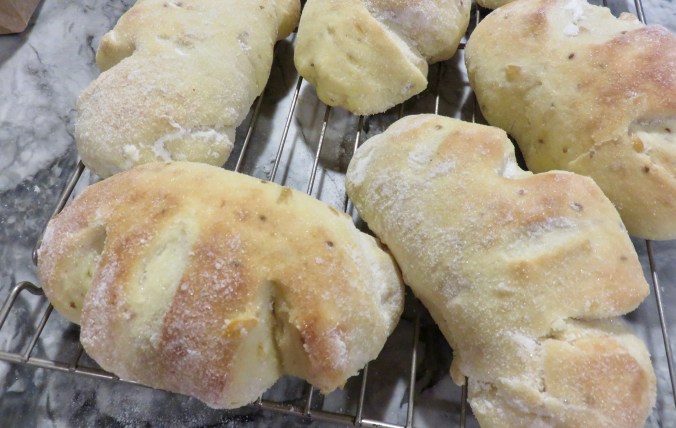
I made gibassier last evening. Fourteen brioche-rich rolls with both butter and olive oil and scented with orange flower water, anise seed, and candied orange peel that I made last winter. The previous night I made the preferment, and I completed the dough in the late morning, then two rises, and they baked in time for us to have gibassier for dinner.

After several experimental slashes, I figured out how to replicate the cutting and slashing we are used to from Pearl Bakery. (But then I created my own method.) The pastry looks different from each maker, though there are not many makers on this side of the world.

I had to do this bake because Pearl Bakery, one of our Portland destinations, has abruptly closed. Ten years ago I looked online for the Pearl’s distinctive pale sweet rolls, but I couldn’t find a reliable recipe. The day before yesterday I found a half dozen. The pastry traces to southern France. M.F.K. Fisher was given gibassier after Midnight Mass, but I do not have her recipe or the one pretending to be her recipe. I used the one from The New York Times that is measured entirely in grams—even the water and other liquid ingredients. That one might actually be PB’s recipe scaled back for a home oven.

Ten minutes of measuring and mixing Tuesday evening, and seven hours of mixing, rising, cutting, resting, forming, rising, and baking. (None of this was difficult, mostly waiting, but it did require attention over nearly 24 hours start-to-finish.) Then, hot from the oven, one last step: brush one at a time with melted unsalted butter and shake in a bag with fine sugar. Cool on a rack for as long as you can stand to wait.

They are light and not too sweet even with their dusting of sugar. Several recipes included a recommendation that they may be frozen and then thawed and warmed for 3-4 minutes at 375°. I froze eight of them once they fully cooled.

FALLING

iu-1.jpeg

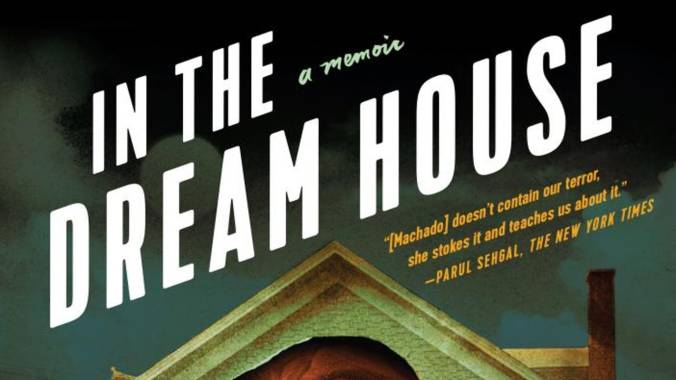
I just finished In the Dream House by Carmen Maria Machado. I usually read a book in a few days, but this memoir took longer. Where was the wisdom I was seeking? I was afraid for a long time that it would not come. I was doing NaNo during those weeks too, so I was writing my own angry story and struggled to know how to rate Machado’s until the last entries raised it up for me. “Dream House as Memory.”

Machado is brilliant and her writing is important. There is an element of revenge here but also of documentation. I believe her. She did not have to work so hard to prove her experiences to me. 

“It’s not radical to point out that people on the fringe have to be better than people in the mainstream, that they have twice as much to prove. In trying to get people to see your humanity, you reveal just that: your humanity.”

She did not need to prove that abuse is also possible between women lovers, I understand that. I have seen abuse. The seduction and gaslighting she so deliberately documents through her own experience and popular culture with an episode of Star Trek and Alice’s adventures. Readers must be forgiven for thinking again and agin: Why is she still there? Why does she come back? Again? Though Machado fails to fully explore the why, the answer is common enough. We believe the abuse is what we deserve. 

The last entries saved this book for me. I was impatient throughout the second hundred pages, but she writes so well—I make this judgement as a writer. She is brilliant. I nearly did not finish because I disagree that queer abuse is different. From inside all abusive relationships are the same. It is only details that differ. It is strong relationships, constructive and kind relationships that [should] matter, and this is merely a sketch here. I wish she had the perspective and distance to tell me more of that story. 

Perhaps in time she will.

SENSE OF DIRECTION

IMG_5167

Tracking shows my package shipped via UPS from Wisconsin and has since traveled to Georgia, Illinois, and Massachusetts. In that order. I live in Oregon. A former student who delivered for UPS once tried to explain to me why such routes are efficient.

I remain unconvinced.

Continue reading

TREE SKIRTS

fullsizeoutput_112e

Over the years three boys in my Junior English classes argued in their research papers that nuclear power was the cheap, non-polluting, and safe alternative to fossil fuels. They were blissfully unaware that radiation is deadly. They did not want to hear about it. When one boy asked an engineer via email whether there were any health dangers associated with nuclear power, he was oblivious to the sarcasm dripping from the nuclear expert’s response: None. I pointed out that a nuclear engineer was certainly an expert but not on health. No matter. He found an industry website that gave him the quote he needed to prove his thesis.

1 million years

That’s how long Germany has to keep the radioactive waste from all of its nuclear power plants buried for it to be safe. The country recently closed all of its nuclear power plants and is looking for a way — and a place — to make the million-year commitment.

Nuclear fuel is only cheap if you do not count the waste left behind. It is absolutely polluting in itself as well in the vast amount of water heated while cooling the reactors, and safe? Seriously? Why did I have to keep bringing this up. Radiation is dangerous. At least acknowledge that and work from there. But these young writers were determined to ignore any information that countered their thesis.

We want to believe what we want to believe sometimes. Climate change is not happening. The hearings are unfair. I do not have to testify. I am safe to drive. I do not have to tell you. My situation is different. 

Yes, it is. They are fair. You do and you should. No, you’re not. Yes, you do. It’s the same for everyone else.

It is inconvenient to face facts.

There is no magic in pretending. What we believe is not the same as what we know. Faith in what we want does not have the permanence of truth in the real world.

Year after year, the majority of my students chose to write their persuasive essays about something they already believed and many of them left cavernous gaps in their argument because they could not be objective in their research. And year after year a few students chose to write about something they did not already believe and generally wrote better papers as a result. Once in a great while students changed their minds, and that was most impressive of all.


Yesterday I addressed holiday cards. They say “Happy New Year!” so there really is no hurry sending them out. It’s just one of those things on our list like ordering candles (done) and finding a tree (also done) and wrapping gifts (whoops). My approach to the holidays is to spread the labor throughout the year so that I can better enjoy the season. This must be a habit left over from having two toddlers and six dogs (with weekly grooming I did myself), and later a job that overwhelmed my time. I even held a holiday Open House for years when the kids were small. (Baking done each night after I got home from school for a month in advance.) Get it done early so that I am “not rushing about at the last minute,” as my mother used to warn me.

By the time the big Black Friday sales begin, my shopping is already done because I started a year ago. I am free to enjoy the season. Yes?

Does that really work for me anymore?

I’m not certain. The truth is that I enjoy making and buying presents. The truth is that I am one of those people who overdo the holidays. The truth is that my mother never entertained so I had no model for how to do that. The truth is my husband had a genuinely impoverished childhood and this was a dreaded season for him before we met, but now he loves it all. So that mission is accomplished.

Is that the goal? I check my list and mark off the tasks and something always remains undone.

There is a tree in our living room and NaNo is done and I still have to seal and stamp cards and one bed is crowded with gifts waiting to be wrapped. I am still knitting. This year I have several projects I hope to complete sooner rather than later. I thought I might actually sew patchwork tree skirts for family members. That project has been on my list literally for years. It generally haunts me till New Years. I plan each year to start on them earlier . . . and then I don’t.

I have already decided that to cross out tree skirts. It is good to let go of some obligations. It is best to face truth that everything cannot and need not be done. I am not sewing tree skirts.

There’s always something.

ON NOT CONNECTING DOTS

fullsizeoutput_1129

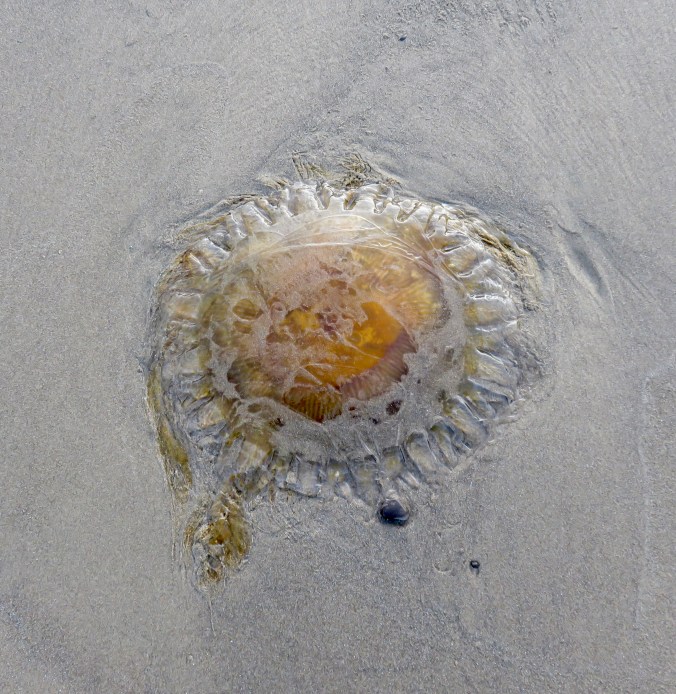
It was the orange jellies I was warned against as a child. The clear ones tended to be a couple of inches across when I was young. The orange ones were six or eight inches. This one is closer to eighteen inches. No, Daddy, I didn’t touch it.

We had such a wonderful Thanksgiving that I am embarrassed to think of it. I told Tammy on the beach this morning that I didn’t feel I deserved such a lovely day. She said, “It’s best not to connect the dots.”

Our drive over was uneventful—good news given forecasts of snow and ice. We walked in Forest Park with our younger son’s family, checked into a hotel, had dinner with our older son’s and his wife’s family, and then went back to the Kennedy School for a long soak in their pool. It was very cold and the soaking pool is outdoors. Bamboo and fats and palms rustled overhead, but the water was perfectly warm. We slept well, had breakfast and drove home again. Snow on the verges but no ice on the pass.

We also had an opportunity to drive in the city. Always an adventure. We were honked at twice, each time while waiting for a pedestrian in a crosswalk. People gave us exasperated looks for driving too slow—barely over the speed limit. (I have come up with a new safety rule about speed: drive at the posted limit plus 20% and other drivers will not throw up their hands.)

Today I received a link to a fascinating history of automobiles in the U.S. Apparently our “love affair with the automobile” began where Groucho Marx declared it so in a documentary financed by the car industry. Early on there were perfectly functioning electric cars and people walking, on horseback, or driving were not in such a rush. Most hated the new cars that only the wealthy could afford. All Americans would pay for the roads these drivers demanded.

In his 1896 essay making the case for electric vehicles, Salom decried the fumes associated with the internal combustion engine: “Imagine thousands of such vehicles on the streets, each offering up its column of smell . . . and consider whether such a system has general utility or adaptability.”

Instead of thousands of such vehicles, we now have more than a billion. Had the desire of working Americans for safety been prioritized and their enthusiasm for public space been respected, transport might have designed on the basis of public good rather than private enrichment. If that had happened, the planet would look very different today.

Instead, a relatively small number of entrepreneurs successfully campaigned to reorganize the country—and subsequently the world—so that their particular business model might succeed.—“The Car Culture That’s Helping Destroy the Planet Was By No Means Inevitable: On the Relentless Campaign to Force Americans to Accept the Automobile” bJeff Sparrow

Today is the last day of NaNo and I have over 53 thousand words. I think they are mostly in the right order, though I might have to flip chapters 19 and 23, which are both flashbacks and probably need to be in chronological order. I have marked the five chapters I need to develop further. Overall, it is way too short, but I think once I develop another plot thread (plot!) and those five short chapters, I might get to a more desirable length. I aim for 70-80k words.

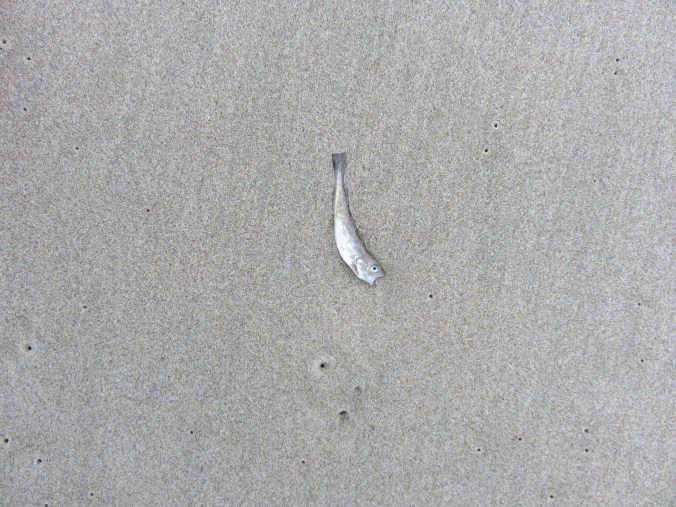
fullsizeoutput_112bThis morning we went out for our beach walk on last night’s high tide line where we expected to find trash. We did and brought it home, and I found three pieces of glass, some shells and frozen jellyfish. When I was a girl, jellyfish were rare. I might see one orange jelly six or eight inches across in a half mile walk. These days we see dozens or hundreds, both blue and orange and ranging from an inch up to two feet across.

It was sunny and cold this morning, and we were glad to be out and home.


WITH OR WITHOUT

IMG_5134

We wish everyone a happy Thanksgiving. Alone or with friends or family. With or without turkey. With or without.

There is always something missing. In childhood that was whatever the parents were allowed to do that we, at seven and four, believed we were missing. As adults there is the glossy image in magazines and television of what holidays look like. They never looked that way for us. Disagreements and tension, jealousy and resentment. There are the missed opportunities and missed events. Mostly we miss people.

We hope to see most of our family today, but not one of our siblings. Most live far away. One has already died. One does not speak to me. I imagine some people assume that last is my fault. Sometimes I have too. But mostly I am over the rejected overtures and that particular guilt. I am thankful for that. I am thankful.

“When psychologists study siblings, they usually study children, emphasizing sibling rivalry and the fact that brothers and sisters refine their social maneuvering skills on one another. The adult sibling relationship has only sporadically been the subject of attention. Yet we’re tethered to our brothers and sisters as adults far longer than we are as children; our sibling relationships, in fact, are the longest-lasting family ties we have. . . .

“In one Swedish study, satisfaction with sibling contact in one’s 80s was closely correlated with health and positive mood — more so than was satisfaction with friendships or relationships with adult children. And loneliness was eased for older people in a supportive relationship with their siblings, no matter whether they gave or got support.

“That’s why it’s so sad when things between siblings fall apart. This often happens when aging parents need care or die — old feelings of rivalry, jealousy and grief erupt all over again, masked as petty fights ostensibly over who takes Mom to the doctor or who calls the nursing home about Dad.

“Many families get through parents’ illnesses just fine, establishing networks where the workload is divided pretty much equally. Paul and I did fine, too, throughout our mother’s progressive frailty and forgetfulness, and we also had no problem splitting the chores that arose in the aftermath of her death. But about 40% of the time, according to one study, there is a single primary caregiver who feels like she (and it’s almost always a she) is not getting any help from her brothers and sisters, which can lead to serious conflict.

“And because of the particular intensity of sibling relationships, such conflict cuts to the bone. People grieve for the frayed ties to their siblings as though they’ve lost a piece of themselves.”—“Here’s to Grown-Up Siblings and the Ties that Bind” by Robin Marantz Henig on NPR. [Well worth a read.]

That has been the other loss I grieve on top of parents, profession, and pets.

I am thankful for my husband, our children and grandchildren and their other families, for the memories of forty years of teaching, for art and the ocean, for still being able to walk miles, for my step-grandmother who left me this house, for books and so many decent citizens and those committed to justice and kindness. Thankful for the hard work of others who care about more than themselves.

And I am grateful that the water in the bird bath is not frozen this morning, and that in a couple of hours we may be safely on our way to see people we love.

Thankful.

PROGRESS

fullsizeoutput_1126

On Tuesday, I “won” the National Novel Writing Month (NaNo) challenge by completing fifty thousand words. It needs at least twenty or thirty thousand more words, but I have identified the arc of the story, my two main characters in their parallel experiences, a structure that imposes both tension and order, and some sort of closure. Words, words, words. I am not done but have the beginning of a novel, and I have cheated, which is totally allowed.

Once a week I play Scrabble with a friend and we cheat. We do not keep score, we use  the dictionary and a page with two-letter-words to check spelling and aid our choices, and our goal is interesting words and enjoyable play. We have never actually traded tiles, but we frequently lament picking a third and fourth A from the bag of letters. The letter I seems to gather too often as well. We offer to move our new word to another part of the board in order to make play easier for the other. We both celebrate a new word neither of us has used before. We laugh when each of us manages to put down the same word: OATH or QUIET. We play until we have used all the tiles, and then we play a second game. We have been doing this most weeks for a couple of years.

My husband and I began playing Scrabble in 2015 when I retired from full time teaching. But I usually won because I like winning competitive activities and I am a strategist. It was not so much fun for Gary. Running had to be abandoned because of my arthritic feet. Instead, we began taking our daily walks together. Yesterday, we walked for over two hours. We do not go so far from the house, even in two hours. We walk up and down the beach, and gather a lot of plastic, until my back aches from bending over fifty or a hundred times to fish a bit of blue plastic or cup lid from between stones. On certain parts of the beach we follow a very close zig-zagging course, searching every inch for sea glass. Yesterday I found a nub of thick brown glass. Gary found an impressive lump of clear and pale green larger than a quarter.

He tells me I am grieving because I have left teaching. He was delighted that I retired. (Gary takes exception to the “delighted” because “from the situation you were in—yes. From the work that you loved—no,” he says.) It was the right decision, the situation was too stressful, and it was good that I retired. But he still says I am grieving.

I have gained ten pounds, and my days are a muddle. I hope, once an entire school year has passed that I will be in a better state. We miss our children and grandchildren though they are not so far away. We miss the dog. We miss the cat. We are clearing out the house. Only one bedroom is piled with gifts waiting to be wrapped, and my work space is pure chaos. I have three quilts wanting binding. Three knitted items being blocked. Boxes of materials and piles of scraps that want sorting.

My life wants sorting. I recently read Gail Collins’ new nonfiction, No Stopping Us Now, which chronicles the accomplishments (and struggles) of older women in the United States. Despite medical opinion over the decades that women are unfit, insane, or simply dangerous in age, older women have managed to change the world. My personal favorite example is the author of Silent Spring, Rachel Carson. Carson did what many women I have known and worked with have done. She sacrificed her ambitions, abandoned her educational goals after completing a Masters and went to work as a marine biologist for U.S. Fish and Wildlife Service in order to support her family. When a friend begged her to find out why all the songbirds were dying after a community DDT spray, she looked for someone in that field to write about the danger of pesticides. She was in her 50s when she accepted that no one in the field would risk the backlash from industry, she devoted the remainder of her life to documenting the dangers of the poisons spread on crops and neighborhoods.

“Although Silent Spring was met with fierce opposition by chemical companies, it 1024px-Rachel-Carsonspurred a reversal in national pesticide policy, which led to a nationwide ban on DDT and other pesticides. It also inspired a grassroots environmental movement that led to the creation of the U.S. Environmental Protection Agency. Carson was posthumously awarded the Presidential Medal of Freedom by President Jimmy Carter.”—Wikipedia

Rachel Carson was 56 when she died of cancer.

November is the beginning of the dark days of the winter season. It is a false glittering and interior time. I tend to look inward, to make plans, set goals in this season. I have no illusion of contributing to the world as Carson did, but I am not done contributing. I will complete the projects currently cluttering my work space, clear it out and begin cluttering it again. I am teaching a workshop for Willamette Writers in April, and perhaps I will complete a novel over the coming months.
SEEING BASALT?

IMG_5172

Seeing things?

My blog is loaded with mistakes. Misspelled and missing words, usually. I figure most of them out and correct them eventually. Some slide right by for months or forever. Sometimes I might blame auto-correct, but more often it’s just my lousy typing.

I was reading a personal essay in a literary magazine. The piece has a title that includes a couple of food items, including a particular mushroom. I realize that the essay isn’t actually about mushrooms, but using them as a metaphor, but I don’t believe that is enough of an excuse to use a photo of chanterelles clear across the top of the page. I know my chanterelles. I’ve picked them and enjoyed eating them. They are not at all the species referenced in the essay title or the essay itself. I was completely distracted, scanning the essay for a reason that illustration was there. No. Apparently someone wanted an attractive photo of mushrooms. Any mushrooms.

If the designer had gone to Wikipedia, he or she would have found an image—not in the public domain but a source is available and likely would have allowed use. Or a photo of the other metaphorical food. That one would have been available at the local market for purchase and photographing. Wikipedia has a terrific photo that is free to use with credit. Not so very tricky.

Instead, a few hundred people are going to think Auricularia auricula-judae look like chanterelles. Different color, shape, texture and flavor.

I suppose this only bothers me. Like the writer who used the word “voodoo” in a novel that was supposed to take place close to a hundred years before that word was coined. Adult crows with pink legs. A cottonmouth snake a thousand miles outside its range. Horses and big cats and other animals behaving in impossible ways. I find such errors all the time. Sometimes I think: I could make that mistake (well, witness how often I do here). But other times I begin to doubt the narrative. I wish the author had completed just a bit more research. Sometimes the mistake just feels like carelessness. Indifference to truth. The “creative” in writing does not mean every- or anything is possible. Even a fantasy novel creates an internal consistency, rules by which the magic operates.

I’ve closed the page on that mushroom-not mushroom essay. It’s possible that the designer (I refuse to blame the author) used the wrong species of mushroom deliberately to make some sort of point or to drag me in. I should go back and reread to see if it was a plot designed to intrigue people like me. (Fusspots and picky-readers.)

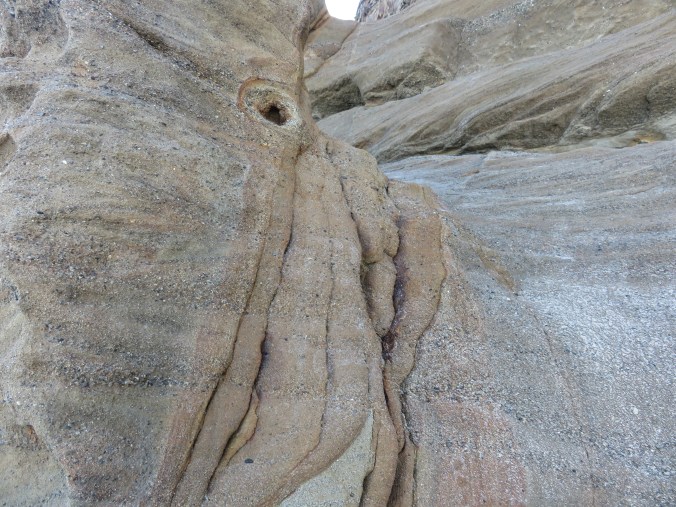
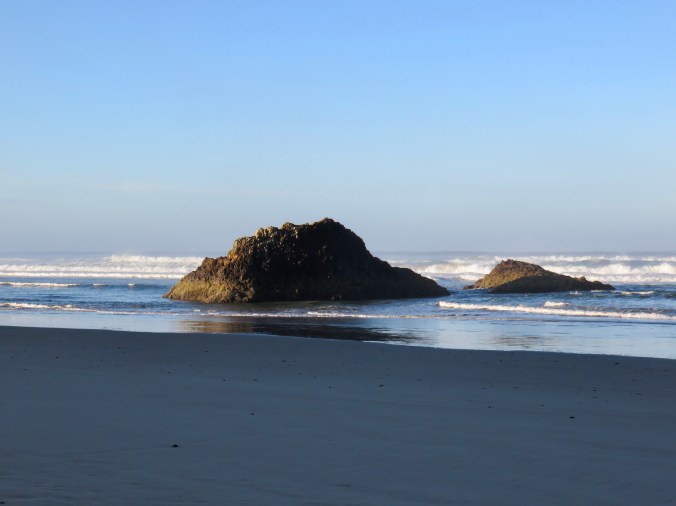
But no. I am set off and distracted and writing my own blog post about how basalt lines my shore. When the tide is high a retreating wave tubes the stones over one another, clattering in a deep-throated tumble that very gradually rounds and smoothes their edges. (Yeah, that’s sandstone up at the top of this post. Different color, texture, shape, flavor. I could have posted a photo of basalt, but why?)

CHANGING WEATHER

fullsizeoutput_1122

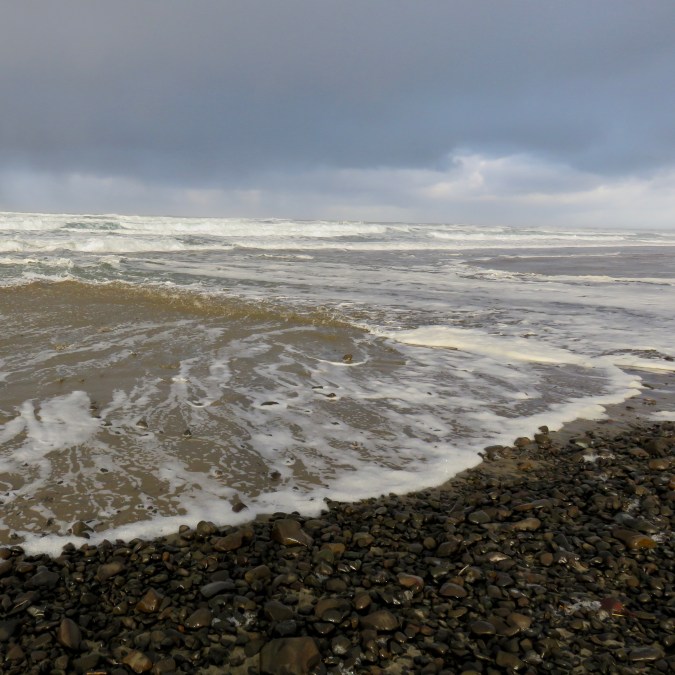
Dark clouds, rain, waves coming from odd directions, not just onshore but across. This is the point we turned for home on our walk yesterday.

Lots of new roofs going on lately. We put a new roof on our little duplex rental and it seems to be holding up under the weather. The roofers are busy. It took our contractor six months to get a roofer to do the job. Gary is still picking up trimmings and roofing nails. The contractor working on the house north of us put a wrap over half the roof because it was dripping inside the house and then had to come out and put on a larger wrap. In the end, he roofed it himself, though in my experience general contractors don’t like roofing themselves.

In the mean time, the barometer has been dropping, we are experiencing 10′ tides, and neither Gary nor I has found a piece of sea glass for a few days [found green later in the day]. That last is unusual with high tides washing into the rocks. But there is no telling. Lots of bits of pumice have been kicked loose

People staying in the rental since the roof was repaired have been out in the ocean. A reminder: it’s November. Barefoot, swimwear, and playing in the surf during outgoing tides. Sometimes it was all I could manage not to go out and tell them to get their kids out of the water. In forty years, we have known too many drownings.

We expect to see snow in the coast range today. We expect to get in a walk because high tide is late in the morning. Yesterday we went out after dawn and after the tide had been coming in for a while and had to walk home on the road because the waves were washing up into the rocks by the time we got to our turn around. We got a little bit wet too.

A huge drift log, a couple feet across and thirty feet long, rolled and floated up and down in the tide. That log lived in the hedge next door for at least a decade [Gary says at least 2 decades], but yesterday afternoon it was lying in the sand directly in front of our house. We hope that 10-foot tides today and tomorrow will move it on.


I have finished my last holiday gift and picked up larger needles to make a hat for my grandson. The #6 needles felt so fat after knitting with #1s that I unraveled the hat and started over with #5s. I have a little dress to make too, and it’s supposed to be done the day after tomorrow. I am not optimistic.

NaNo is also a struggle just now. I have over 45k words, but the last few thousand are coming slow. How hard could it be to write those last five thousand words? At this point in previous years I had 70k, well over what I need for NaNo. And here I am struggling to get to the minimum.

fullsizeoutput_1124The good news is that I may have figured out how to develop the generational historical v. contemporary conflict I  had in mind at the start. Yeah, four days to go in NaNo and I might finally know what I’m doing? I have devised a plot twist (yes, plot! actual plot!) and have about a third of that written. I know about how it ends. I think I am writing Elizabeth Berg when I keep hoping to write something far more edgy, more like Emily Fridlund’s History of Wolves.

Well, there you are. Scratch this cynic and the optimist bleeds.