SIN OF OMISSION

fullsizeoutput_1117

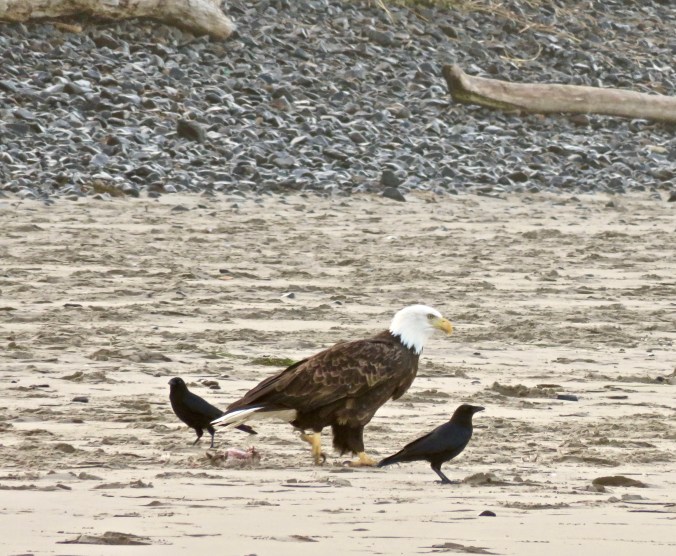
Many times crows forage beside eagles. The crows cannot pierce the skin of most dead creatures, but the eagle can. (In the wild, ravens hunt in tandem with wolves. The raven spot game, the wolves open the body.) I have seen crows drive raptors from a wounded gull and from their own nests. The smaller birds win their point.

“A man has been arrested after antisemitic abuse was directed towards Jewish children on the London Underground. … Wearing a cap and hoody, the man is seen in the video threatening a man off-camera after he tries to intervene before a woman in a hijab – Asma Shuweikh – confronts him.”—The Guardian

The Muslim woman is a mother of two and wishes more people would intervene in such situations.

“Wilshire Bus,” a short story by Hisaye Yamamoto, concerns a woman taking the bus to visit her husband in a VA hospital post-WW2. Japanese-American herself, Esther says nothing while a drunk harasses an elderly Chinese-American couple on the bus. She bursts into tears when she reaches her husband’s hospital bedside. He believes this is because she misses him, but readers understand that she is suffering from guilt that she failed to defend the couple on the bus. When I first read the story in graduate school, the obvious ironies of the situation and her feelings of guilt reminded me immediately of my own experiences.

I would have been twenty-one or twenty-two, an undergraduate student at the University of Washington and taking the bus home alone. My husband and I had bought a house on the other side of the zoo. I was sitting toward the back and a drunken man began harassing an adolescent child. People nearby looked nervous but avoided eye contact. I thought we all hesitated to say anything because the man was big and we were afraid. A young black man stood up from his seat and told the drunk that he needed to stop what he was doing. It’s been over forty years and I do not remember everything, just that the young man was slender and the drunk outweighed by fifty pounds at least. I remember that the drunk got off the bus at the next stop. I remember we were grateful to the young man. I remember thinking the drunk was twice my size and wishing I had done something myself and trying to think what I should have done.

The next time was also on a bus, and I was also alone, but instead of the route that ran east-west on 45th, I was heading downtown. I can no longer remember the bus numbers, but this one took Eastlake Avenue NE, traveling south from the U District. Again, I was seated near the back and again a man began harassing someone smaller, a racist harangue. I got up from my seat almost immediately and walked to the front to tell the bus driver. By the time I got to the driver, there were three of us. And this is very clear: The bus driver did something I would never have thought could happen. He pulled his bus over the the side of the road, on University Bridge. He stood and walked to the back of the bus and told the drunk, “You’re going to have to get off my bus, or I am calling the police.” And the man got off and passengers clapped and cheered.

Sometimes doing the right thing is frightening. It might even be dangerous. I did not directly confront a drunken man who outweighed me by close to a hundred pounds, but I found a safe way to intervene. In Yamamoto’s story, many people were offended by racist language, and every one remained silent until after the drunk had left the bus. Esther suffers from her sin of omission. She fails to act as she knows she should have.

So did I.

Fortunately, I learned my lesson and I like to think so did Esther. I think the courage to act in such situations sometimes requires rehearsal. We need to think it through in our heads and balance what we know is right with known risks.

Mob rule is not right and speaking up can be dangerous—we mostly all learned that in school. Silence in the face of abuse can be more dangerous. The assumption when we are silent in response to abuse is that we agree with what is being said and done. And that perpetuates the evil.

How many times do we need to learn that lesson?

PRINCESS

fullsizeoutput_110e

I have tried to stay away from making political comments here. (Readers “unfollow” every time I do.) But Prince Andrew.

This is not about the disastrous interview on the BBC where the royal admitted to being “too honorable” but with no memory of abusing a child. I did not watch the interview. I cannot avoid the excerpts.

This is more basic. (My grandfather was born in England and his son, my father, was an historian. I had more than my share of British history as a child.) I will set aside just for now the immorality of British behavior in the world. My immediate anger is reserved for the assumption that anyone is born royal. The concept of royalty is at its base both immoral and unAmerican. Nobility and aristocracy are notions that rely on a simple, magical concept: God chose these people to be better than the rest of us.

Is it possible for an American to believe this?

While my country is obsessed with the individual, powerful people in my country are nevertheless earnest in their support of inherited rights.

I tried watching Merlin yesterday on Netflix because the series is leaving that streaming platform next month. So cute. Arthur is a spoiled brat, Merlin is initially magical without effort (I assume this changes as the series progresses), and all the young women look alike. The music is spritely and everything is charming and funny. Young adult fare. I paused the show when Merlin is put into stocks and fruit is thrown at his head. This was treated as comic relief. (I could hear my father sigh, his patient explanation of what happened when a person’s head was locked into stocks. No one would have wasted edible food and stones would have been throw. People sometimes died in the stocks.)

Every Disney princess film plays to this assumption of privilege by birth. Fathers are significant in most of these films, the choice of female villains is misogynistic, and the assumed beauty and inevitable ascendancy of the heroine are damaging to the character of impressionable children. How to reconcile American “rugged individualism” with the concept of royalty?

It cannot be done. It should not be attempted.

I have been thinking a great deal about the presumptions of power. About how we view the rich and powerful. About the Puritan faith that worldly success reflects God’s favor. That seems entirely counter to the ideals upon which our nation was later founded. (And which we have repeatedly failed to make manifest. What we believe is right vs. how we behave.)

Andrew apparently thinks he did well in the interview. He thinks his explanations and noblesse oblige were enough to excuse the photo with his fingers on the bare midriff of his accuser, his tour of the palace enough to excuse his lack of empathy, his precise memory of pizza and his four days spent in the mansion of convicted child molester excused because sex “is a positive act” for men.

But no. This is about power and the presumptions of power.

I have tried to recall if my father every called me, as so many fathers have, “princess”? Perhaps. I recall him calling me, in rare and precious incidents, “daughter-of-mine.” It felt likely an honorary title, that I had earned that designation. As a nation we are founded on the principle that each person earns their way. Yet here we are rewarding torture as if it were comic relief. Making birthright preeminent rather than accomplishment. Admiring bullies and power over decency and righteousness.

We should do better. We should feel determined to do better.

The sky is pink in the east this morning.

DECLINING BOBS

IMG_5147

In the satellite photo, there is an ancient white Volvo parked in the driveway and a waterbed tipped up on its edge where both have been for at least a decade. A surveyor was here the past few days, locating property lines and updating contours for the new owner of our neighbor’s house. The sale closed a week ago but the previous owners have been slow to vacate. The locks have been changed. The buyer is land developer and we fear he will try to create a triplex out of the building and flip it. That is one rumor.

The good news is that we are not built on that property, as our previous neighbor believed. She based this on a survey completed by another neighbor. That neighbor had been half responsible for inaccurate work in two counties. (Thirty years ago I was doing research for an architect, and the county engineer told me that surveyor and another one had been told to retire, that their work was so bad they would no longer accept it. Nevertheless, that neighbor was the one who surveyed that house when it was built in the 80s though that survey was not, of course, recorded with the county. At that time the area was so badly out of kilter that local firms refused as there were no reliable markers to work from.)

Times have changed.

The waterbed is gone, but the Volvo is still there. Last week, the former owners took out a few things on a flatbed truck, always in the middle of the night. (Make of that what you will. Marijuana is legal in Oregon.) Moving didn’t really take off until the day after closing when an enormous U-Haul blocked the entire road. There was a great deal of shouting and banging.

It was my grandfather who surveyed property lines for our house in the 40s (the older one was built by his aunts in 1911), and his third wife Genevieve who had walls built at the north and south in the early 60s. The wall on the south side is entirely on our property. Turns out the neighbor’s dog is buried mostly on our front yard, and so are all their downspout drains that have given us so much trouble. Ruby’s fort is well within our property.

There are still three Bobs left. One is a tenant, one owns the rental across the street, and a third lives a block away. The new owner is not a Bob. We hope the new owner will not create a triplex of short-term rentals. We hope that will not happen. We like having real neighbors.


NaNo is going fine with over 33k words. There were briefly over 34k, but then I began butchering.

One of my favorite websites is selling little bags to use for sandwiches in the toaster—reusable “up to 50 times” and “completely food safe.” The trouble is that they are made of fiberglass and PTFE (DuPont’s Teflon). Teflon has been labeled carcinogenic by some (many), but there is considerable disagreement about that. (My husband points out that overheated Teflon releases fumes that can kill pet birds in the house. Trust him to know that.) Fiberglass can release tiny particles which are not healthy, but there is such a thing as “food grade fiberglass.” So maybe okay? . . . Even if it’s chemically harmless to use in a toaster (really?), such bags make nasty trash.

fyi When I want a heated sandwich, wrap it in parchment paper in the oven or a toaster oven. I reuse my parchment paper over and over, too, and it’s a lot cheaper than bags that might kill the parrot. If we had one.

NaNo ISSUES

fullsizeoutput_10b6

Am I the only one who finds the new NaNoWriMo site clunky, uncooperative, and downright annoying? Communication in forums is impossible (I find nothing when I click that link) and with buddies seems challenging (a message from a buddy waited to be read for a week because I didn’t notice it was there). In fact, if this had been the site I used the first time back in 2016, I might not have continued using it, and I have completed and “won” the NaNo November challenge three times and also written in other months. It has been a great comfort to me in years past.

But now . . .

My stats show up erratically. Sometimes NaNo knows this is my fourth November, but sometimes it announces this is my third or first. That’s no big deal. It’s when I try to access people or useful information that I find . . . nothing. Every time I try to access any of the links beyond the actual Help Desk, I get an error message. “Known Issues,” for example, is just one of the links that returns “Login Error.” It’s all downhill from there.

Most of the links I have tried to access return that message. (The exception is that NaNo merchandise links work perfectly, of course.) I don’t even remember how I eventually was able to send a note about these issues to the higher ups over a week ago. They probably clicked on it and their login failed.

I thought my troubles might be because I was using Safari as my browser, but I had the same issues with Chrome.

Some questions were not all that hard to figure out on my own, like how NaNo determines my writing speed, etc. But overall, the updated version of NaNo seems far less intuitive, and communication, and error messages, and trying to access anything. Fortunately, I have my link stored in my computer or I’m not sure I could get to my data at all. Perhaps I should logout and try logging in again? Somehow that sounds like a recipe for disaster, and I won’t try that until I am willing to abandon the whole site.

Gary says, “Any sensible person would have given up by now, but you’re too stubborn.”

I am over halfway through the “challenge” (passed 26k words this morning) but I do not like what I’m writing at all. So this morning my mood would be a bit testy even if the website functioned as I wish it would.

Maybe I will knit the rest of today when I am not walking in the rain. (In case you are thinking that a rainy days sets off my mood—nope. We are always grateful for weather.)

“I sometimes fear that all of humankind may sooner or later come to my conclusion: that reading fiction is a waste of time.”—Isaac Bashevitz Singer

I think fiction is a vital aspect of humanity and Singer was probably having a bad day. Maybe he tried using a website to track his writing progress?

coming soon: declining Bobs


CHEESE

My husband and I both grew up with Velveeta, which is not really cheese at all. I remember my father loving blues and sharp cheddars, but my brother and I were fed toasted cheese sandwiches made with horrible pre-sliced white bread, Velveeta, and margarine. That “cheese product” melts like glue. I am embarrassed to admit how much we each loved these sandwiches when we were little.

We grew out of that. Our sons, as far as we know, never tasted Velveeta.

Tillamook cheese was a major step up in adulthood, and we bought the large five-pound blocks of Tillamook cheese, usually “medium” sharp. The special black wax white cheddar is not too bad. But no, we do not buy Tillamook cheese anymore. We use Dubliner as our basic cheese, but there are three or four others in my cheese drawer at the moment.

Last year we considered ordering an entire wheel of Stilton or even of organic Rogue River Blue as a gift to ourselves, but backed off at the last moment. The cost is equivalent to a large grocery cart from Whole Foods.

This morning I have been reading recipes for koiugn amann pastries and tortelli [darn that auto-correct fixing what ain’t broke] with a sweet/salty filling and soups with lentils and sweet potatoes and caramelized onions. One of the recipes called for an Italian hard cheese I had never heard of, Grana Padano, and that is how I found myself looking at wheels of blue cheese.

Do we want to spend over a hundred dollars for five pounds of cheese?

We might.

There are worse things than buying expensive foods. What passes for a “good meal out” often disappoints. There are plenty of foods from our childhood we hope never to taste again: Hi-C, KoolAide, French’s mustard, Wonderbread, Hostess “bi-products” (Gary’s name for Twinkies and the rest of the line), canned (dyed black) olives, canned stew, canned chili, canned baked beans (all the canned main dishes that saved time), sweet salad dressing (yes, Catalina dressing, I am talking about you), tinned ground pepper, fake maple syrup and fake vanilla (yes, the flavors are different, Mom), instant potatoes, and Jello.

My grandmother baked everything from scratch. My own mother learned to bake her weekly four loaves and everything else, but was eager to adopt all the modern conveniences in the 50s and 60s. I am a throwback. Real olives and real vanilla and real maple syrup were revelatory. While I was still eating meat I learned to roast a beautiful chicken stuffed with sliced lemon and onion, beef bourguignon with red wine, chili verde with pork shoulder.

I like playing with flavors and I love to both bake and cook. A friend sat at our table and asked me with suspicion what was in the dish I set before him. I told him and he was a bit put off, but then he asked for seconds so I guess the combination was not a failure, though I can’t recall now what I put on his plate.

My combinations are not always successful, but experimentation is how I found mango slices on spinach and cheese tortellini and grated parmesan over the top, cumin in most soups, and good french tarragon-dijon mustard on toasted cheese sandwiches made with two kinds of cheese.

Food is good.


iu

Though I wrote this blog post instead of focusing on the novel, I have over 23,000 words this morning.

PROGRESS

We each found a piece of sea glass this morning on our walk. “Our work is done,” Gary said. It is a common line between the two of us, a joke, but also reflects our sense that gathering abandoned graham cracker packets and finding pretty things is our excuse for walking.

Recently, while we were gone, the people staying in the house next door lifted two sitting-logs over their fire and then deserted it. It was still smoldering two mornings later and Gary lifted the one end that was still hot and managed to toss it into the sea. People sometimes try to use sand to put out their beach fires, which rarely works and a smoldering fire stinks. I think people simply have an unrealistic idea of how fires burn. A tourist once built a tower of beachwood well over his head. Locals tried to talk him out of it, but he set it alight on a Sunday morning and then was gone home a couple of hours later. He seemed to think it would all go up in a blaze of (his personal) glory and be done. Gary helped put that one out too.

The tourists now staying in the house north of us put out their beach fire—ten barely-burned pieces of firewood!—so Gary didn’t have to this morning.

When we left the other day we had fog rolling in from the sea and it was thicker, unusually thick, the next day when we got home. Though we have back-up baseboard heaters in some rooms, we don’t leave the heat on when we are gone. The house was cold and the power had been out since early morning. Our neighbor said it was supposed to be back on by 1:30, but that didn’t happen. We were grateful for our wood heat as there is no natural gas and power does go out now and again.

The sun came out and a roll of clouds rested out on the horizon, one of my favorite things. It rained on us on our way home from our walk today. Now the world has gone pale gray, ocean and sky, a color I enjoy but not what most people declare as “good weather!” Nevermind.

fullsizeoutput_8f8I am doing well with NaNo, 22k words and over 80 pages as of this morning (about 4k are not new).
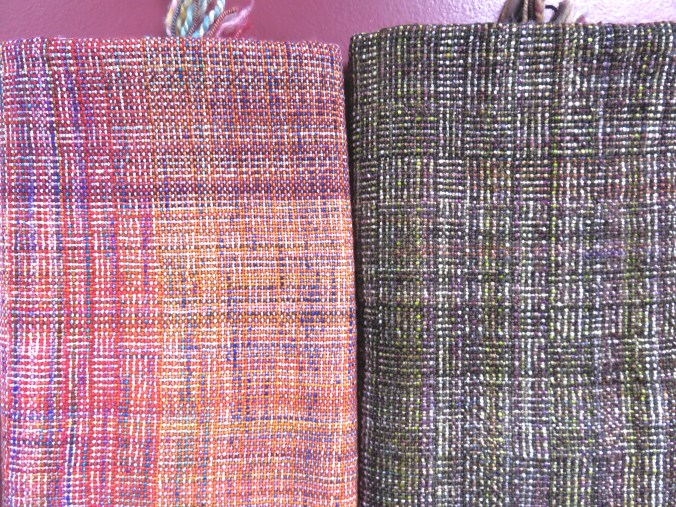
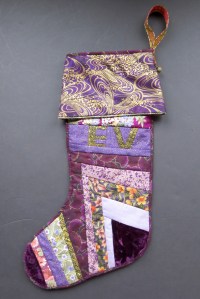
Yesterday I learned my visual art has been accepted for a local gallery show in December 2020. I will be putting on warps all spring. Purple, blue, pink. Green. I expect to have a dozen shawls, three large quilts for sale, and maybe a couple of pieced Christmas stockings.

I have been asked to lead a workshop for Willamette Writers in April. The coming year . . . fullsizeoutput_bed

In the mean time, My most problematic story is still waiting on a response since July 2018, and is short-listed at two other journals. I am resigned  to rejection all around.

THANK GOODNESS

IMG_3405.jpeg

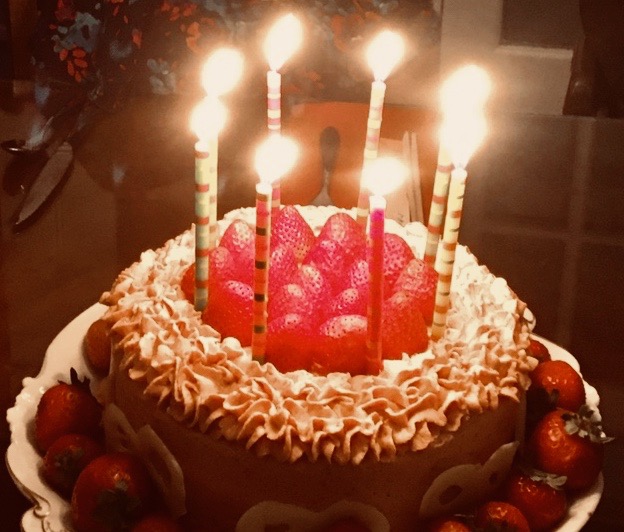
Three layers of vanilla sponge with strawberry jam and a lot of strawberry buttercream flavored with jam and powdered organic freeze-dried strawberries!

She liked the cake, though she was not expecting pink frosting—and to think how hard I worked to make it both pink and tasting of strawberries! (I cropped her from the photo to preserve her privacy, but my granddaughters, both of them as well as my grandson, are delightful!) She likes the white chocolate 8s best, I think. It was a flying visit, and we were pleased to see family.

This morning I have 17k words for NaNo, though I wrote barely 200 words on the birthday.


SUNSET PIG

fullsizeoutput_10fd

…you might kiss one.

A group of at least a dozen people stayed next door this past weekend. (Gary says they were likely Swedish because of the white caps and running about barefoot on the sand and even in the water in November.) They took over the depression where Gary had his fire last week and burned two thick root knots that he’d left, plus some purchased firewood. They did not burn the log they sat on in the evening, which is a blessing. Tourists tend to lay huge drift logs over their beach fires and then walk off when they discover that the log needs hours to burn. Thankfully these people had a nice-sized and perfectly legal fire and then put it out before going to bed. (Gary hoped they might leave the remains of their cedar kindling, but they didn’t. Did it go all the way back to Sweden?)

The wood chairs still need painting, but a plastic chair Gary rescued from the rocks where it had drifted on high surf last month can stay out all winter. You would have thought I could manage to paint those chairs over the summer, but it didn’t happen and they stay under cover till I get them done.

There are a lot of other things I did not get done in the past months. I meant to make my oldest granddaughter a cardigan and two dresses. What was I thinking? I have not sewn a garment in decades. But like most women of my generation, I learned how to sew in school. I made a pullover cotton shift in seventh grade and a wool skirt the next year. My mother hated to sew but she taught me too. The last garment I can remember sewing was pure cotton onesies four our youngest son born in 1982. American companies were not making cotton clothing for babies because of flammability issues. We neither of us smoked then or now, so I found a pattern and learned to machine-sew cotton double-knit jersey. Dark green with rainbow trim. Bright red. I don;’t suppose I even thought to take a picture, though I can picture them in my mind’s eye even now. But now I can find organic cotton for babies and children, which is even better.

iu.jpeg

I am over 12k (of 50k) on my NaNo challenge this morning, and I seem to be writing something unexpected. I meant to rewrite a very old manuscript, but instead I am writing something new. It’s true I am using the same principle character and I imported a few pages that I had already reworked over the years, but even without those pages, I am ahead of schedule.

The best part? I am not sure where this story is going. And maybe even better (so the best-best): it’s funny. I have not written funny in such a long time. I have been giving the chapters titles a la Forster such as “In which Alice tries to solver her personal problems with a hammer.” So that is happening. And barely into the fifth day of November.

A strawberry-frosted cake is tricky in November. She wanted fresh strawberries and I avoid them out of season. No avoiding them for my granddaughter. A light vanilla cake, though I am partial to and only experienced with pound cake. I made a run at three cake recipes and strawberry cream cheese frosting. That last was not a win, though it tasted good enough and was a pretty color. I ordered freeze-dried strawberries, organic freeze-dried strawberries. Powdered in the food processor, they are a rich color that thinned down to a pretty pink. (I mean to try Swiss buttercream as soon as I get my hands on the right sort of instant-read thermometer.)

There is a cake in the fridge. Two pounds of out-of-season organic berries. I had dreams last night about making cake.

Gary and I both had a sore throat and sinus issues, but we seem to be better now. Our sore throats completely gone, no fever ever. I had to put off baking the final birthday cake till yesterday when I knew I was healthy again. Took my time. Photos later.


DOLLHOUSE

fullsizeoutput_1105

When I was a little girl, I was already fascinated by Japan—the architecture particularly, but also the clothing and food and toys. The fables. Because I lived in a suburb of Seattle, it was easy to visit the House of Rice or Trident Imports and lust after kimono and sandalwood chests.

I did not play with dolls much as a girl, but I had a pretty toy geisha on a stand that held place of honor in my bedroom. My farvorite model horse was made of paper and lacquer, gray with a traditional fancy saddle. I didn’t like that his mane stood straight up, but I could not coax it to lie over. I have that Japanese horse to this day. It must be nearly sixty years old.

There are few other things I still have from my grade school obsession. I read a book about how to build a Japanese doll house and I sewed bedding, made the storage box of balsa wood—those things are gone, but the scale vases from an import store are carefully stashed.

My father worked for the Bureau of Commercial Fisheries. I ate sushi for the first time in the early 60s. This was during a Japanese/American fisheries conference. I didn’t like sushi then, but I did later. I have gathered books on Japanese building, on the impact of Japanese woodblock prints on the Impressionists.

This is National Novel Writing Month, and I am writing first thing each day in pursuit of at least 70k (NaNo’s goal is only 50k).  This morning of Day 4, I have written past ten thousand words. My intention was to take a very old manuscript of 80k that I began in 1996 and update it. That isn’t quite what I am doing, as it turns out. I have outlined 25 chapters and I am writing beginning to end, a chapter a day. When I was writing that earlier novel that inspires this one, I wandered all over the place, beginning the middle to end and back, from the points of view of eight characters. So far I have hardly looked at that old manuscript to write this one. Instead, I am sticking with the here and now. There is a ghost cat, maybe. There might be a diary, which was the center point of the earlier novel. Maybe not. I haven’t gotten to that chapter. I write my 1667 words and then some more, and then a bit more, and when the chapter is done and I have my words, I stop.

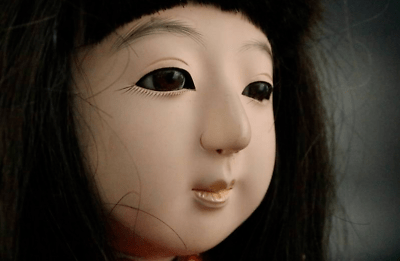
s-l400.pngWhen I meet my daily goal, I am allowed to do something else like look at Japanese dolls that I cannot afford on Ebay or watch a Korean historical romance (Rookie Historian Goo Hae Ryung) and admiring the costumes, one more episode till the end.
For many years, my life was cluttered like a Victorian drawing room—my time so tightly compressed, I barely had space to breathe, much less turn around. I worked eight hours, then came home and worked most of the evening. I neglected the house. I probably neglected my family and friends, though I did not notice at the time. The weekends were almost never time off—the shocking thing when I retired to teaching just a pair of college classes was discovering I did not need to work on Saturday and Sunday. I am still getting used to that now I am not teaching at all and all my time is wide open. Grace is emptiness.

Life can have space like a Japanese home. Floors empty to the walls, I cross freely from one side to another. There is the freedom to chose to sit on the floor and regain composure.

This clearing of space, this abandonment of possessions—well, the fabric for quilting, the yarn for weaving and knitting still arrive—this new-won spareness and simplicity.

But I am not talking literally. I am not living a cluttered life, but a gradually simplified, cleared away life.

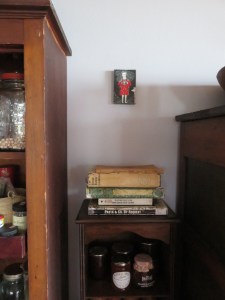
IMG_5098My obligations are easier to count, easier to recognize and balance. My clothing is spaced in my closet. I keep removing what I do not wear. I give away what I do not use. The little girl with the red dress and white ghost dog greets me each morning in my kitchen—hanging just there above the jelly cabinet and between the Forest Ridge bookcase I use as my pantry and the pie safe with my grandmother’s porcelain custard cups.

I have a cake to bake, birthday gifts to wrap today. My coffee is cold. I need more sleep.

I am speaking literally.