BRAIN POWER

IMG_2389

The brain is a greedy organ*. I heard once that Einstein used the same energy when he was thinking hard that a marathon runner would be using about mile 25.

I am thinking a lot these days. I am revising curriculum on the fly because my tiny writing class needs to become a more muscular group, and I am grading their essays and trying to give them specific writing advice—actually all sorts of advice.

At the same time I am writing a story. It is not ready to be submitted, but it has undergone enormous revision. When I butcher four or five thousand words out of this long story, write a thousand new words, and then butcher out another thousand to make room for them; when I rethink how the story should end and what, perhaps it means; and when I allow myself to become distracted enough that I risk killing that darling at the beginning of my novel (a very different project), which I am trying to find representation for . . . I need to take a nap.

My exhaustion is not physical, but it is real. I have been thinking. And all my thoughts are about what to put on the page.

This year I set an unusual writing goal for myself. I would like to plan on publications, but acceptance for publication is primarily the choice of editors. I have no control about what is published, other that to submit work for consideration. All I can do is send work out. So a more reasonable goal is to set a number of submissions. A friend of mine, in her effort to gain tenure as a college writing professor, set a goal of having 100 submissions out at all times for a year. That sounds admirable but insane to me. One hundred? I have been paying attention for a long time and have read many, many—in fact, an astounding number of—journals, and I have found 104 to put on my list. There are close to 4,000 I might consider, but even of those on my list, there are perhaps a couple dozen that really interest me. In the past, I have tried to keep at least 8 submissions out at a time. Sometimes I go for double digits.

The entire process of submitting work is work, and mass submissions also require that I have a lot of work “ready for publication” (see above). And there is that word “submit.”

At some point toward the end of 2017, I read about a writer whose goal was to have 100 rejections. That is pretty smart, I thought. Sneaky too, since in order to have 100 rejections, I would need at least 100 submissions over the course of the year. In 2017, I had 78 submissions—close—so I thought about this and decided it was totally doable.

Counting rejections also has the advantage of giving my some tiny advance in my record-keeping each time an editor sends me a note that says, “I liked the quality of the prose, but overall the narrative didn’t quite win me over and I’m going to pass on this story for [our magazine]. I wish you best of luck finding the right market for it and hope that you’ll continue to keep us in mind in the future.”

Well, that story really does needs more work. I sent it out too early, and I should have asked a friend reread it. I should have read it aloud to my husband. But . . .

But good news, halfway through May, I already have 45 rejections! Whoopee me! I am going to meet my rejection goal!

The bad news? My brain is completely worn out. Wiped out. Soggy noodle. Maybe I should go take a nap? Or two. Or a good night’s sleep?

Tomorrow I will read that story aloud and do the needful.

*Although the human brain makes up only 2 percent of body weight, it consumes more than 25 percent of our baseline energy budget.

SaveSave

‘Can We Talk About Race?’

002_1477347.jpg

I remember when I first understood that “Negro” had gone the way of “colored.” In the late 60s, I walked home from school and explained this to my mother: “Don’t say that word, ‘Negro’. Say ‘black’,” and because we were that kind of family, Mom and I discussed respect for a long time. Years later the language changed again, and I screwed up my courage to ask one of my best friends if she preferred to be called “black” or “African American”? We discussed respect too. Even then, I understood that she was making a personal choice, not a definitive one.

My mother disliked the word “drapes.” So I called the fabric hanging across her windows “curtains.” It’s no skin off my nose.

When talking about ourselves, this is more critical. People have the right to label themselves, to choose their own identity. I am not a “broad” or a “chick” or a girl. I am not “65 years young” or a “young lady” or “as old as I feel.” I have lived sixty-five years, and I have been paying attention. Some language offends one person and is shrugged off by another, even when that other seems to share many similar qualities, even when the words themselves seem too similar to make any difference.  I detest certain words used to demean or define me. Not everyone minds. I am also old, and I feel it would be silly to deny that. I didn’t like a doctor calling me “elderly” at 63, but “old” or “older” don’t bother me a whit. I was a young woman in the 70s, and I was white. I am a white woman.

I can claim a great grandmother Rosa who crossed the Mexican border to marry in Texas, and I suspect my great grandmother on the other side was unrelated to the six tall red-headed brothers in her family—she was under five feet, dark-skinned, and black-eyed—but it makes no difference what investigating my genes proves. It means nothing. I was raised white and that is who I am.

Writing workshops frequently get around to the question of who is entitled to tell what story. One short answer is “anything you want.” There are longer, tougher answers.

As a woman, can I speculate about my grandfather immigrating to this country over a hundred years ago? Am I allowed to write across boundaries of time and space, gender and race? A better answer would be that writers may tell any story they have the skill and courage to tell, but that is pretty shallow. The reality is different. We need to talk about what belongs on the page. We need to talk about tact but also truth.

Language draws us in, but it also drives us apart. We do not have equal access to words we are born with, choose, and claim through observation and suffering. I was given “white” by birth, and I did nothing to earn or to claim it. It is a word I cannot put aside. I am also the oldest living member of my family, and I have no word for that. I am retired, but not retiring. I am warned against quiet writing, but also shouted at for raising my voice.

In a bio prepared for a recent public reading, I called myself a “native Oregonian” because I was born, spent my early childhood, and have lived nearly all my life in Oregon. A concerned reader invited “the organizers to interrogate the use of ‘native’ in one of the bios provided, and reflect on how it may contribute to the ongoing erasure of Indigenous people that underlies mainstream US American society.” My Alaska Native friend and I interrogated that usage. It would be useful to have a broader discussion about language and the words I use and should use, and to consider who is in the best position to help me make those choices.

I can choose words for myself, and I must respect that right for others. How about “Oregon-born”?

Indian Country asked prominent people their preferences for self-identification, and they chose a variety of terms to self-identify: indigenous, Native, Indian, American Indian, original people, First American, Native American. First Nations is a term of preference in Canada, but all those interviewed were clear that their first preference is to be known by their tribes and their personal names. When in doubt, when it is necessary to know, ask people how they prefer to be identified.

Getting the words right is only the beginning of the challenges when discussing race in America. Science assures us that race and ethnicity are social constructions invented by a dominating whiteness. We are so closely related that if we were plants, we might merely be different colors of snapdragons. Pink flowers off this stem, yellow off another. Nevertheless, “race” is not going away because we recognize that it is a false division or even because it makes white people uncomfortable. Race is muddled up in our Constitution and laws. It shows up on identification records just as caste does in India. It does damage. America has an insidious history of racial injustice and systemic persecution. We need to talk about race, and perhaps more important we need to listen more carefully and report faithfully what we hear. We need to judge less and observe more.

Forget our past? When people are still reenacting the Civil War? When 23&Me is dragging up genetic structures and telling people they’ve been celebrating the wrong holidays? When Faulkner claimed: “The past is never dead. It’s not even past.” It’s right here with us. Pretending it’s over denies the lingering impact of our personal, family, and communal histories.

Maybe what we can hope for is to overcome the past. We can talk about it. We can plan for a better future.

Guilt, embarrassment, and resentment cloud our talk. It might seem easier, safer even, not to refer to race at all. Some argue there are enough human struggles and conflicts without entering a potential mine field, and not all people of color welcome white authors telling stories based on guesswork rather than firsthand experience. White authors may respectfully shy from writing characters of color or about situations involving racial, ethnic, religious, and other differences. That creates another layer of fabrication, because an all-white fictional world defies reality, and impoverishes our writing.

We cannot write about ethnicity or race without risk of getting something wrong. This is a legitimate concern, but the same challenge exists when I write about my grandfather, dead these fifty years or about the experiences of my mother who is also not here to tel her own story. Pretending different realities do not exist is one way we hide our trespasses and become complicit in disrespect of others’ feelings and lives. When we limit our writing to “our own” we limit our story in a way that can be fatal to truth. Can we speak from personal preference and experience without demanding absolute authority? Can we tell our truth without infringing upon the truth of others? And can we enrich our stories by including other’s stories?

Would I prefer my story be told incorrectly or would I prefer it not told at all?

Am I only allowed two choices?

An Oregon author writing a novel that included tribal members went to a tribal member and asked for help in getting things right. Bette Lynch Husted found a third choice for All Coyote’s Children: Write as carefully as you can, do the research, and then ask for help.

The people I see every day are dark and pale, red-haired and dreadlocked; they visit relatives in China and Germany, Mexico and Florida; they are older and younger than I am; and some speak languages I do not know at all. When I describe the people in my life, I must include all their colors, because all colors are part of my reality. These people are my people. I want to know their stories. I want to share them.

Talking about race might lead to writing reasonably and accurately and to language that expresses those same values. I can listen to those who possess different identities and different lives. Writers, just like readers, want to know other stories alongside our own.

If we trust one another, if we approach with respect and genuine interest, then maybe, yes, maybe we can talk, even about race.

NOTE: An earlier version of this essay appeared in RAIN.

COLD COFFEE

IMG_3313

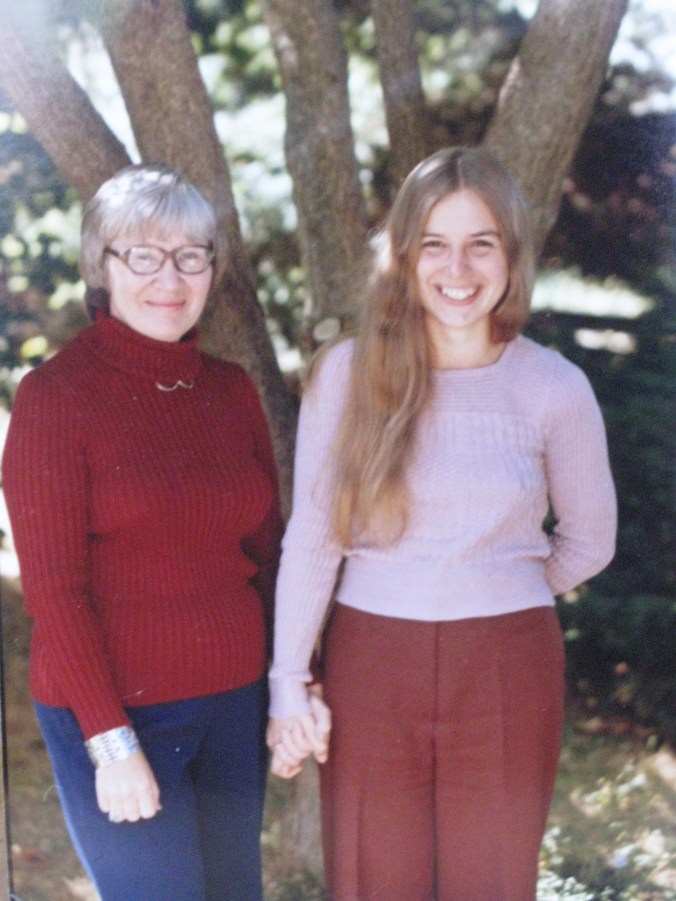
Probably in 1970. I was 17 and Mom would be about 43. I’d forgotten my hair was that long.

My mother would wander about the house looking for her coffee cup. Maybe she left it on the counter or the coffee table, beside the telephone or on the mantel in the living room. It might be on the picnic table in the back yard from when she went out to check on something.  It was usually cold. The cup was always half-full. Sometimes it was in her hand while she searched.

It keeps me awake, but helps my husband to sleep. He is what might today be diagnosed as ADHD. If he wakes in the middle of the night, drinking a little caffeinated coffee allows him to go right back to sleep. That is actually not uncommon. The caffeine allows some people to focus enough that they stop thinking about a thousand things and instead think about one thing: sleep . . . and they do.

Coffee has the more usual effect on me, so I drink two cups of coffee when I first wake and then I stop, unless I want to be staring at the moonlight half the night.

I began drinking coffee in my thirties as a way of drugging myself into alertness when I driving home from night classes. My children were still preschoolers but I had decided I would return to teaching as a Social Studies teacher. When my husband arrived home from work, I would head out for a 45-minute drive to an evening class. The struggle was remaining alert on the drive home. Coffee did it for me.

A few years later, I was hired as an English teacher, but I didn’t give up night classes. I began driving to Portland State for graduate work in their English Department. I also continued drinking coffee.

I like my coffee strong, black, and unsugared. I like iced coffee with whole milk, and the only way I take sugar in my coffee is in ice cream.

You might think that after nearly fifty years, my husband and I would know all there is to know about one another, but we had a discussion about coffee before six this morning and Gary was surprised to discover I do not sugar my iced coffee.

We had been talking about beer.

I’m not sure what my mother loved about coffee. She was not particular about flavor—she thought that instant and fresh-brewed tasted the same. She always had a cup, but didn’t actually drink it much. Maybe she liked the heat of it in her hand. I recall her reheating coffee in a saucepan on the stove. The microwave was a great timesaver. On the other hand, she never drank everything in her cup.

Happy Mother’s Day, Mom.

A BLESSING FROM BOOKS

IMG_2772

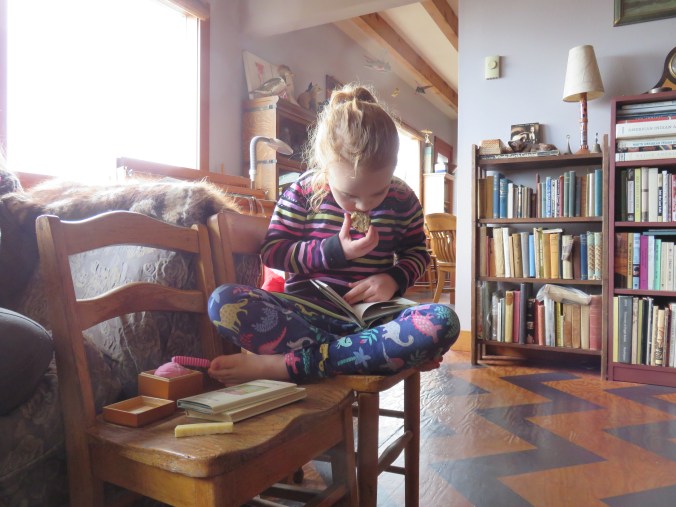
My granddaughter Ruby with her chosen books, cross-legged on a little chair, and making that one cookie last as long as possible.

I buy books. My husband buys books. We have, on occasion, vowed to stop, but we do not stop. We buy more books. Purchasing books is no cheaper than smoking or drug use, but this habit will not kill either of us.

We buy books.

We buy books from second-hand vendors and the local stores and Powell’s Book Store in Portland. We buy from independent small presses. We read about them online.

We buy books that make us suck our breath. Books for the past and future. We buy books that tell us our own story. We buy books that tell us a story we have never heard before. We buy books because we are not in district for the local lending library and the school library has a tiny collection. We buy books because we like to own books, and because the books we want will never be in our local libraries. We buy books because that is how authors make a living. We buy books to reread. We buy books because I write them. We buy books to covet and collect and loan to friends. We buy books for photographs and poetry. We buy books we cannot read because they are in Icelandic or Greek.

We look to books for laugher and tears. We look for education. Inspiration. Peace and hope and joy. Possibility. Truth.

A bird in the house is supposed to foretell death. Books are different. We buy books because research shows that just having books in a house with children will cause them to do better in school. A blessing.

We buy books to find lives we will never live.

We buy books to find ideas we do not have time to explore without help.

We buy books to find the other side.

We buy old books and out of print books and books that contain references we cannot find in the edition we already own. We order books we hear about and books we read about and books we wish we’d written ourselves.

We have books written originally in English and books in translation. We have books we still have not read. We have books bought in duplicate because we forgot we already had a copy. We have multiple translations of the same text, in order to place them side by side and judge for ourselves.

We have books we struggle to read because they are complex. We struggle reading books we do not have the training to understand. We read books that are over our heads and require additional sources to follow.

We never highlight with yellow markers or underline or dog ear—an abuse of pages. We use bookmarks and post-it note, tabs to help us back to the lines we want. We treasure and treat these books with the respect they deserve. All our dreams and goals and desires fit along their lines.

It is not true that you cannot have too many books. We have too many books. I feel a little guilty for having four pairs of black boots, but I do not feel guilty for owning the entire Patrick O’Brian series, even though I have already read them each twice.

We have filled many bookcases, sorted through and organized them by genre, subject, and author. (We do not sort books by the color of their bindings—an abominable habit we would never inflict on friends.) We give books away—we buy new copies to give. We loan them to friends who are gentle with them. When the bookcases become too tight to allow another purchase, we sort and we make the hard choice to allow some to reenter the world outside our door. Then we buy more.

We buy them so that they are ours and belong in our home.

For as long as I have had days, there have been books in my house.

We buy books.

NOTE: It was 85 years ago today that the Nazis burned books. Buy a book and let it burnish your brain instead.


SaveSave

SaveSave

READING MEN

d5wxnck0quim9bosyfdo.jpg

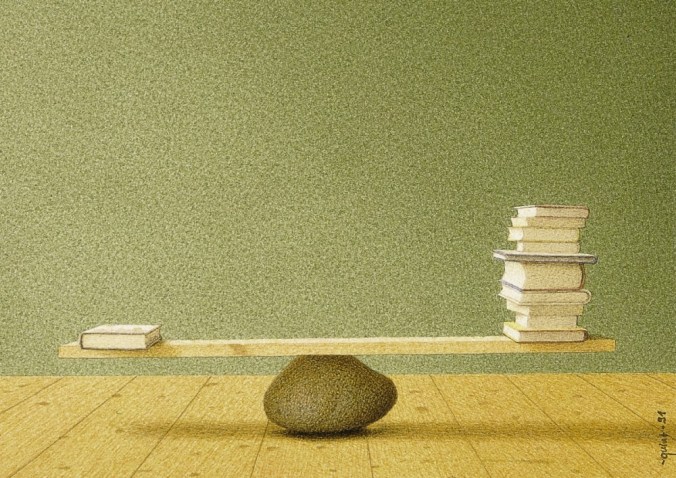
Book Scales by Quint Buchholz (1991)

So now it’s Junot Díaz accused of abusive behaviors toward women.* I wish I could say I was surprised.

Karina Maria Cabrera wrestled with how to respond to the news, with how to reconcile her own ugly experience with Diaz and her indoctrinated impulse to make excuses for him, and to resent the accuser who called him out. In “The Reckoning: What Junot Díaz Teaches Us About Internalized Misogyny” she writes:

“I had to reevaluate my anger towards Clemmons and examine why I wanted—for even a brief second—to justify Díaz’s actions. I told my mom about wanting to write about my reaction; she metaphorically clutched her pearls and said ‘No. Don’t do that! If you do, you better say he was very respectful towards you. Don’t add flames to the fire.’

“That’s when it clicked: The root of the issue is in the way women are wired to think. It is a systematic modus operandi that has been passed down to us from generation to generation. . . .

“As a child, I did not always feel protected, because we were taught to ‘save face.’ But I want my daughter to feel protected, and I want her daughter to feel empowered, and I want her daughter to feel invincible. If that means going against the grain and saving ourselves instead of saving face, then that’s exactly what we should do.”

Today, we can tell our stories and the stories can be believed. We are willing to hear voices and read beyond the chosen perspectives I was offered as a child.

As a student, the only novels ever assigned to me were written by men. Anne Frank was still part of the public school canon, but all the fiction was by white men such as Hemingway, Goldman, Twain. This barely changed in graduate school. A college class on African Arts (literature, music, visual art) gave me Things Fall Apart, but my MFA program gave me the excellent short stories of Ron Carlson and Stuart Dybek. I had to find women such as Jane Austen, the Brontës, Dorothy Sayers, Alice Munro, Maxine Hong Kingston, and Toni Morrison on my own. A student gave me Middlemarch. There is an enormous list of authors, men and women of many races, ethnicities, nationalities, and sexual orientations I can recommend. My shelves (and I have thousands of books) represent a huge range of perspectives, but I hope there is nothing bigoted or deliberately cruel pressing up against my favorites.

At the top of this post there should be an image of great authors representing a range of voices instead of merely the ones I was taught. I tried to find such a collage of authors. I searched a thousand images and mostly found composites of author images are white and male. (For composers too.) I nearly chose Virginia Wolf in the midst of 29 white men. Where is George Elliot? Where is Jane Austen? Linda Hogan? Le Guin? Erdrich? Shields? Silko? Or in alphabetical order—Atwood, Byatt, Chopin, Cisneros, Drabble . . .

We need more. More voices. Unheard voices.

Some much-praised authors wear thin. As a woman I find that my existence barely registers in the brilliant novels of Cormac McCarthy. I read the Border Trilogy and that was enough. Some authors are so hostile toward women, I have avoided their work altogether. Juno Díaz was one of those. I did try. My impression was not so unreasonable. I felt my existence demeaned. I set it down. Don’t I already get that every day of my life, everywhere I look?

Sometimes it is possible to see it coming.

Recent news of Alexie’s abuse of women, confirmation by no less than Joy Harjo that complaints have been ongoing for years, and especially his semi-apology should not surprise anyone either sheers. It is clear in his memoir that his perception of suffering is entirely selfish. At no point in this memoir does he reveal any depth of appreciation for the suffering or pain of anyone but himself. Despite his skill as a writer, I do not understood the apparent widespread “love” of this memoir. His short stories are often brilliant and that is why I have slogged through his earlier unfortunate novels.

“Believe me, believe me, believe me.” Ever since I read Sherman Alexie’s memoir, You Don’t Have to Say You Love Me, the song has been running through my head. You could find it on YouTube, but if Dusty Springfield’s voice doesn’t come right up out of your memory, best to leave it alone. You may find yourself walking in time to the tune for the next few days. Maybe that isn’t so bad. It’s a great old song.

Alexie’s memoir is likely to stick around in my head for a while too. I don’t have much in common with Alexie since he is an “urban Indian” and a man and fifteen years younger than I am. He was raised poor and on a reservation and, while I was raised on a dirt road with open ditches and poverty all around me. My parents chose that house because the schools were good. My father was also an alcoholic. Maybe. But he worked and brought home his paycheck. We always had milk in the house, even if it was powdered. He died. I loved him very much. We have that in common. But I am a woman and a mother and faithful to my marriage. I often blame myself for my parenting mistakes. We might have that in common. Sherman blames his mother.

The memoir offers short vignettes, longer scenes, words cut into lines and stanzas that sometimes are poems and sometimes have other business. It began strong, but ultimately this book does not reveal the wisdom of hindsight or the generosity of objectivity or compassion. This is thrashing. This is struggle. This is aggressive self defense.

I loved Sherman’s first collection of short stories. My friend Kathie Werner lent me her ARC and we invited him to talk to my high school students and to read in Cannon Beach based on that book. We are a largely rural and poor community. Alexie and his bride stopped off for these events on the Oregon coast before completing their journey home after their honeymoon in Hawaii.

Disclosure: I should mention that I have read his books, that my friend teaches The Absolutely True Diary of a Part-Time Indian, which has considerable connection to Alexie’s real life, that when I was teaching literature I taught his short stories, and this author made my husband cry. I bear a grudge concerning that last. It is unfair, probably, but I have not forgiven Sherman Alexie any more than he has forgiven his mother. But then, Alexie is not in my family. I was not raised in poverty, but my husband was. I am not always a kind person, but my husband nearly always is. So I am a skeptic when it comes to Sherman Alexie. I am a fan, but I do not trust him.

The strength in this memoir is the writing itself, which is sometimes brilliant and occasionally even humble and honest. Too often he is defensive. Mostly he is churning with guilt and anger and not managing any forward movement. He is eager to label himself bipolar. He expresses tremendous guilt and resentment for his estrangement from his mother, for not speaking to her for days and weeks and even years at a time. But he blames her for it. Like many children of bad fathers, he blames his mother for his sad childhood. As a woman and a mother myself and not his, I find that bizarre. I take it too personally, you might think. I am a feminist and a class warrior. I am also weary of people who hold their mothers responsible for all the sorrow in their childhood.

Big message here: Everybody’s mother dies. None of us is perfect.

Alexie’s mother stopped drinking when he was a little child and struggled to support her children and her husband. She also moved onto the living room couch, a move she explains as a step up from memories of being crowded in bed with siblings. At least sleeping on the couch, on a succession of couches, she did not have to share. Alexie accepts and even defends this explanation. I wonder that he never considers the likelihood that she no longer wanted to sleep with her drunken husband, that she did not want to take a chance on another pregnancy? That while she may have still cared for Sherman Senior, she was not willing to sleep with him stinking of “alcohol and vomit and piss and shit”?

Sherman Alexie is an aggressive and angry man. He cannot stand outside himself in order to see his experiences fairly. He has suffered in his life, he has suffered terribly, and perhaps that is why he is quick to anger and quick to exact revenge for any real or imagined slight. My impulse is to call his attacks in this book “counting coup” but counting coup is honorable, a show of courage and skill. These attacks are self-justifying, snarky, and often unfair. Sometimes they are not even skillfully written.

I was still young when I first met him, and Alexie was much younger with several books of poetry and only that first collection of fiction when he told my students he wrote prose for the money. If he didn’t need to sell his work he would stick to poetry. That might be the major difference between us.

Like his mother, I am a quilter. My father died in 1986 and my mother died in 2007, a week after graduation from my MFA program. After my mother died I grieved. Everything went dull and even my writing withered for a time. My husband and I had cared for her in her last five years. When she apologized to me: “I was mean to you” I responded with absolute sincerity that she never was. But she was. She did hurt me. She bullied me and criticized and was an imperfect mother. She was also kind and helpful and supportive in most ways. It took some time after her death for me to appreciate that this is the best anyone might hope for.

According to this memoir, Lilian Alexie could be kind and supportive but also verbally combative and abusive. When Alexie’s good friend died his father played hoops with him for hours. When, days later, he was still crying in his room, his mother opened his door and told him to snap out of it. He took his father’s action as proof of love and his mother’s as proof of cruelty. But which one got him out of bed?

Once or twice a year, Lilian would take it into her head to vacuum in the middle of the night. According to Alexie, this was completely inconsiderate and unbearable since woke everyone in the house. One night, because he was the strong kid willing to stand up to his mother, Alexie got out of bed, grabbed the vacuum and threw it out the door. Alexis here, as in nearly every scene, is the hero of his story. When I read this vignette, I sided with his mother. Who else ever bothered to vacuum? Who else was working, supporting the family, cooking and cleaning? She is the one who stayed. Alexis ran away and has never really returned. He might at least credit her for her willingness to remain with her family, even if chooses to question her motives.

Immediately after her husband died, Joan Didion wrote her memoir: The Year of Magical Thinking. After a lifetime of journalism and research, Didion did what she had always done. She reported with objectivity and poetry about her experience. The result is truthful and beautiful and a powerful exploration of loss and death.

Alexie has not done so well. He is too angry and guilty, eager to assign blame and to score points on every person who ever hurt his feelings. He is angry at the man who abused him as a child (me too). He wants everyone in the audience to admire and cheer him, not just most. He is also angry at the SW Native American woman who called him out for his claim to be the voice of all Indians. It was a claim he made in my classroom when he was still in his twenties and later speaking on a panel of people about shared issues of people of color. If Sherman Alexie is to be believed, his suffering is the worst, his people have suffered the most, no one else knows the sorrow he has seem. No one but he has the courage to say it. Only he can tell truth. These feelings are not entirely unjustified, but they get in the way. He has been angry for all this time.

I was put off that he quoted liberally from another Native American author without once naming his source, or even revealing that his rant was not in his own words but the borrowed words of another. The man has an amazing memory, but even I recognized long passages from Vine Deloria.

He claims his mother was the last Spokane fluent in the language, but that he never learned a single word of that language. I mentioned that to my husband, who found both claims unlikely. For a while in the 1970s, my husband was one of a handful of fluent speakers of Puget Coast Salish. During a reading he said a name to Sherman Alexie, the name of a Spokane Indian, and my husband pronounced it perfectly. Sherman walked close and demanded, “What did you say?” but my husband would not repeat it. “I have some naked pictures of your mother,” Alexie said. “I would like to see them,” my husband said. His mother had recently died. Two men wounding each other.

I have been paying attention since. Sherman Alexie and I have several mutual friends and acquaintances. Perhaps he is a wonderful father and devoted (if unfaithful) husband, but he was a neglectful son and he is not a man to tangle with unless you are prepared to bleed. None of us is perfect and most of us have a list of actions we are not proud of, but Alexie might do better to comes to terms with his own failures and his particular cruelty while criticizing his mother for similar behavior.

Like most memoirists, Alexie concedes that his version of events may not parallel versions told by others. Mary Karr warns at the beginning of Liar’s Club that her memories are not the same as her sister’s and mother’s. Mary McCarthy offers a similar disclaimer in Memories of a Catholic Girlhood. In his case, Alexie seems to allow for considerable stretchers. His is a memoir of personal convenience, occasionally confessional, but more often on the attack.

Alexie wrote this book and saw it published in the two years following his mother’s death at 78. He also had brain surgery. All of this is too quick. Unlike Didion, he does not have a lifetime habit allowing him to stand apart from his experience in order to tell his story objectively. He does not even try. These are powerful words, considerable rambling, some poetry, and some prose broken into lines and stanzas in a pretense of poetry. There is self-justification and enough fury and blame to waste what little insight this brilliant author might otherwise have shared.

Alexie declares himself an “urban Indian” in a way that is defensive and tough. He had a hard life and survived to move away. He has kept himself strong by keeping apart. There is a lot more guilt here. He needs to forgive his mother. More than that, he needs to forgive himself before he can recognize that he owes her more than forgiveness. She let him out.

He claims he is deliberately repetitive. He claims a lot of things here.

If readers take Alexie at his word, they might find a touching if erratic story of a heartbroken son struggling to come to terms with the death of his “complicated” mother. This book was promoted as a memoir about Alexie’s mother, about grief and family and loss and forgiveness. I found it mostly about getting even.

On the last page: “I don’t know how or when / My grieving will end, but I’m always / Relearning how to be human again.” I speak from experience: The grieving does not end, and the year or so after that loss there is almost no sense to it at all.

My advice to readers: Do not read this or his awful novels. Read The Absolutely True Diary of a Part-Time Indian which is a circuit of stories. Read the short stories and the poetry. Let Alexie come back in twenty years and write about his mother. At the least he may find some kindness. Maybe the truth isn’t funny, and Alexie wants that sharp wit like a stick to poke us. Maybe tenderness makes us vulnerable. It requires a difference sort of courage than a streetlight.

Believe him?

Like too many powerful men, he used his position and power to abuse women. This is how it goes. Men are abused, most often by other men, and then they take out their pain on women, and too often, we women accept it. It’s what we have been socialized to do.

I saw an on-air interview of Alexie with with Tavis Smiley where they talked about his memoir. They were soft-spoken and charming, but I found it impossible to believe either of them. Then Smiley himself was yanked from the air in response to accusations of abuse.

Who do I believe? Sometimes I trust my impressions. I trust my gut. I refuse to blame myself. And I prefer, when I get right down to it, reading authors who seem not to hate me.

*Junot Diaz Accused of Misconduct, and Responds, “I Take Responsibility for My Past”. “On Saturday, the Sydney Writers’ Festival said that Diaz had withdrawn from his remaining scheduled appearances at the event. The organizers emphasized their committment to providing a ‘supportive and safe environment for our authors and audiences alike.’ They noted the line in Diaz’s recent New Yorker essay—’Eventually the past finds you’—and stated, ‘As for so many in positions of power, the moment to reckon with the consequences of past behavior has arrived.’ “—Publishers Lunch

SaveSave

SaveSave

SaveSave

SaveSave

‘The Things I’ve Lost’ from Brevity

lost.jpgBrevity 22 

The Things I’ve Lost

by Brian Arundel

Fleece hat and gloves: in the backseat of a Boston cab in 2002, before driving back to Maine. Round, purple sunglasses: in an Atlanta pool hall over drinks with Ashby, whose wife was determined to save their marriage by having a baby. A measurable dose of self-skepticism: at about 14, when I realized I was very good at both playing violin and baseball, while not necessarily everyone else was. A school-wide presidential election in sixth grade, after I was drafted to run by Mrs. Sticoiu, the most frightening teacher in the school, while I was out of town. A copy of The Little Prince, in Mrs. Sticoiu’s class the previous year. A floppy disk that contained my paper on ideological subversion in Wendell Berry, the first essay I’d written after returning to graduate school following a four-year respite. A black scarf from Pigalle: somewhere in Maine before moving west.

The chance to kiss Leslie Wertmann, and, later, that redhead in seventh grade with a smile that could buckle steel—Kim, Christine, or Kathleen maybe—and the blonde at the freshman dance because I couldn’t recognize flirtations, even when told that I looked like Bruce Springsteen. My virginity: in 1980, a couple weeks short of 16, in a ritual so brief, awkward and forgettable that I have, in fact, forgotten it. My heart, or so I thought, in 1985, when Susie dumped me; my naivete, three months later, when I learned that she’d slept with at least three other guys I knew while we’d been dating.

Belief that my mother was somehow more than human: in 1972, the first time I saw her fall down after getting drunk. Belief that my father was more than human: a few months beforehand, after learning that he’d had an affair and was being thrown out of the house. The belief that my sister was stable: 1976, when she began pointing at random objects and saying their names, a few months before getting arrested, the first of many times, for disturbing the peace by refusing to leave a Western Union office until they gave her a job. A ten-dollar bill on a DC subway in 1985, on my way home to my friend Tommy’s, where I was staying after leaving my father’s house—after he’d moved back in, once my mother remarried and moved south.

The chance, in 1986, to meet Raymond Carver: the only person invited to sit in on an interview, I instead drank all night with friends and overslept. A quarter-inch off the tip of my left thumb, in 1987, while slicing Muenster cheese on an electric Hobart slicer. My shit, figuratively, that same summer when Bob Weir sang “Looks Like Rain” just as my acid trip was peaking at a two-night Dead stand in Roanoke, Va. The Buick a friend had given me as a tax write-off in 1996, which I let someone take for a test drive without holding collateral.

The thought that officials were somehow more evolved than those who elect them: in 1972, listening to my father explain the Watergate burglary. Faith in politics—particularly a two-party system relegated to fundraising contests perpetuated by shallow sound bites, mudslinging and outright lies for the Mindless American Voter so that each party can pursue a majority with which to repress the other, with complete disregard for actually trying to improve the lives of citizens: gradually over time, culminating in 2000. Fundamental hope that Americans really would overcome their vacuity, fear and greed to evolve beyond sheep determined to re-elect George W. Bush: 2004.

The ability to drink until late at night and go to work the next day without feeling like I need to be zipped inside a body bag: sometime in my early thirties. General insecurity and inadequacy: during the past seven years, as I’ve tried to allow myself to be loved without guilt or judgment. Self-pity and -importance, at least most days, while striving to look beyond the borders of my own desires in a steady ascent that some might refer to as maturation. The desire to remain in this country: since 2004. A black beret: in a Minneapolis bar, just a few days before relocating to Georgia in 1993. A taste for soy sausage patties: inexplicably, sometime in the past six months, leading up to a Saturday brunch three weeks ago.


Brian Arundel received an MFA in creative writing from Louisiana State University, and his fiction and nonfiction have appeared in numerous journals, including Mid-American Review, Under the Sun, The Strange Fruit and Bryant Literary Review. He works as an editor in Seattle, where he lives with his wife, Manuela.

from Brevity


The obvious thing is to make a list of things you have yourself lost. It was my first impulse, but at risk of being sentimental, I want to feel better, not sadder.

Do something else: consider what have you found.

Brainstorm a list of things you found: Your way out of the woods when you were seven years old; a rock with pinkish crystals; a lost kitten who eventually went home; a missing sock; single earrings, a gold chain, how to forgive yourself for losing your temper . . . make your own list of what may not even have been noticed as lost before it was found.


And perhaps most important—go read Brevity!

POETRY + 10

sojourner-truth---abolitionist-and-feminist.jpg

Sojourner Truth

A friend has posted news of a Texas charter middle school that asked students to brainstorm a “balanced” list of the pros and cons of slavery. This is what is meant by “false equivalency”. All I can think of on the pro side? I am not on that side. On the con side, slave owners sacrificed their souls. On the con side is a lengthy list. There is no balance possible, it is a demented assignment.

April is National Poetry Month, and my students and I have been stealing 20-minutes out of our class to write bad poem drafts. They are only bad because they are so young. (The poems, not the poets.) Twenty minutes might get something started, but after we complete several such drafts we will revise just one. Maybe that one will break our hearts.

This is also Confederate History Month in five U.S. states. (There used to be six.) I refuse to go look up which ones still celebrate the most deadly conflict in the history of my country, and I do not want to guess. I can only assume that the legislators of these states have so little to be proud of now that they must perpetuate a fictional glory in the past.

Why is this a problem? Let me count the ways.

  1. The Constitution was ratified over a four year period. Delaware was first in 1787. Southern states ratified in 1788, except for North Carolina in 1789, the year before Rhode Island, which was last in 1790.
  2. Southerners were notable authors of our Constitution, and states’ ratification means each state agreed to the terms outlined therein.
  3. The Constitution of the United States makes no provision for state succession.
  4. The most notable feature of the Confederacy was its support of slavery. (Seriously, if you didn’t learn that in school, consider that the textbook that taught you about the Civil War was produced by white apologists in Texas, not people with actual history foremost in the sights. When I was a girl, the books still insisted on calling it “The War Between the States.” My father would roll his eyes, take a deep breath, and correct what they were teaching me in school. I am sorry he was not there to do that for you.)
  5. The Confederacy was in open rebellion against our nation—treason anyone?
  6. Men from my husband’s family, like so many, fought on opposing sides.
  7. The south lost.
  8. Why not Civil War Month?
  9. I am so heartily sick of hearing about how monuments to southern generals need to remain standing in order that we not forget our past.
  10. Remind me, what past are we trying to remember?

My husband and I each have relatives who fought with the South in that war. We imagine they were honorable men and believed in their cause. We also accept that they were wrong, terribly wrong in that choice. However badly the North behaved after the war, they did win it. And slavery, well, there is no supporting a government determined to preserve a bald, unwarrantable usurpation of human rights, and long after most of the Western world was busy outlawing the practice.

It is a paradox for us, of course, but not really a challenging one. We can both feel interest and connection to our past, and yet recognize the abomination of the system they struggled to uphold. We feel no guilt for slavery. We were not born then. No one we have ever met was alive then. our personal identities are reliant on our own actions, not the actions of relatives who are mere photograph and documents. There is no need to belabor one of the uglier passages of our nations’ and families’ history.

It’s called letting things go.

Go write a poem. Consider the words, the verbs and intentions; couch ideas in concrete images. We are a proud country, but what should we be most proud of? Surely not open family discord, bomb blasts, and butchery. Choose something that saved lives, choose what preserved natural landscape. Hold out a hand and pull someone out of despair.

SaveSave

PLOVERS, WHITE CLAY, AND SAND

IMG_2850

We drove down the coast, past the place where, last summer, we watched the equinox spread waves of chasing light across the ground. It was a privilege for us to get away, we who rarely vacation and have generally been extravagant only about music and books and art. We drove south to have a night in a hotel, a bed and breakfast.

This is the Sylvia Beach Hotel. A rickety, somewhat cattywampus structure overlooking the Pacific Ocean. There is a cat, too. Our room was the Jane Austen, the third and fourth windows east of the ocean front and facing north on the top floor. I could watch the sky and sea from the bed. We had a beautiful view. Most of the rooms do. It is not expensive to stay in the off-season and a Sunday, and the breakfast is good.

IMG_2840

IMG_2841

The Sylvia Beach Hotel was built over a hundred years ago and eventually named for the founder of Shakespeare & Co. in 1987 with author-themed rooms. A fire escape on the east side is gone, but all the rooms have baths and sprinklers. In most other ways it remains what it always was: a Victorian boarding house.

The decks on the ocean side are recently rebuilt and much of the shingle siding has been repaired and replaced. When the work is done, it will be painted dark blue-green again.

We decided to have the dinner, served in five courses with several choices of entrée. The food was wonderful, but too much food for us. The company was marvelous and entertaining, the best part of the evening.

IMG_2845

At first the semipalmated plovers (I think) were nearly invisible until they moved. There were a half dozen or so just a few feet away as we made our way south on the sand. They scooted along the windblown beach, but eventually lifted and joined a larger group.

The flock of dozens of birds would rush cover together and then fly straight up all at once, turning instantly north, west, east, north again, and land. On the ground they rushed about, spacing themselves several feet apart and peck at the sand, turn, move back closer together again, and then all back up to begin again their collective dance in the air.

I watched the plovers do this once, twice, again and again, the landing, the expansion of their range, as if released from a leash connecting them to the flock, a moment of business, then back toward their center, and flight!

When we walked at home, we saw plovers again, not the same birds, perhaps not the same species. Pretty sure they are plovers.

IMG_2851

White clay and a trickling of sand. The pattern of trickled sand below is a mere inch tall.

IMG_2860


NOSTALGIA

IMG_2836.JPG

[CLICK TITLE TO READ MORE] I made my youngest grandchild a birthday cake for her party today. She is two years old. I also made a 2-year-old quilt, something I also did for each of her cousins. Pink is her favorite color. For now.

IMG_2631

EV’s quilt, completely pieced but before it was quilted.

The quilt is cotton with a cotton filling and a pieced backing that is partially pink with metallic gold dots. The cake is yellow, some of it tinted pink from the addition of black Oregon huckleberries. I made lemon curd and raspberry jam for the fillings, and a huge batch of blackberry buttercream for the frosting. It is the most incredible pink. I knew this trick with blackberry juice in buttercream from a previous series of cake made to please my oldest grandchild, who turned six last fall. Fresh organic raspberries. Organic everything, because we do not like to take chances with toxins.

Two cake batches, blackberry syrup to flavor and color the double batch of buttercream, and lemon curd. I completely thrashed the kitchen. Powdered sugar everywhere. Crumbs. Gary was cleaning my mess for me as I began typing this.

Gary is good to do this cleaning, but he reminds me that I was in the kitchen all day. He had a hard day himself. We had to make a correction to our taxes, he cleaned the walkway and trimmed shrubs on the north side of the house, and his brother called to complain and then hung up on him. This brother is afraid of all sorts of things that might not worry me in the slightest. That’s because he is mentally ill and unable to step away from himself long enough to think about others. Others are always dangerous to his mind.

Years ago I heard the poet Naomi Shihab Nye say that even as a child she felt this strange homesickness for a place she’d never been. She realized that what she missed was the place where poetry resides. At least, that is what I remember her saying.

Another poet, the marvelous Tracy Smith, recently discussed the terrible hunger she sees for literature: “I have this belief that we are so vulnerable when we open ourselves up to literature. We’re reminded of these real parts of ourselves.” Perhaps it is that willingness to be vulnerable, that we pursue. It is some vestige of glory in our souls—not paychecks or adoring crowds or battlefields, but something more like what e’re inclined to term humanity.

Some see vulnerability as weakness, when it is actually strength. To be open and accepting requires that we have the strength to remain standing under the weight of chance, of betrayal and error. Not everyone can manage that.

The alternative is continual anger and fear. No one is wise while continually angry and fearful.

Ursula K. Le Guin writes: “All old people are nostalgic for certain things they knew that are gone, but I live in the past very little. So why am I feeling like an exile?” No time to lose—yes, that’s it exactly.

I willingly call myself old and I am grateful to Le Guin for reinforcing my sense that aging is inevitable, but has its perks. I will die, but I have lived long enough to know what might be missed if I fail to pay attention.

The past is not my usual space to dwell, though I fret over lost friends and family. I fret over misunderstandings concerning recent history and that my students do not know the parts of speech or how to construct a formal outline. I am nostalgic for my own excellent education. More often, I look ahead to what I might still accomplish. Most often I am here and now, figuring out my life one step forward at a time.

I have thought about my place in time often over the years. Just now, reading Le Guin’s last book, I am thinking a good deal about what I might do with whatever time I have left. I might have as many years as Ursula. She was younger than I am now when I first met her, and her lifespan suggests I might still be living and writing sensibly into my 80s. I hope during this time to find the poetry in myself.

More of us might seek that strength that risks communion, that loves and forgives, that locates the heart of our hearts. I think, at least, that I might have time to do that, to continue looking forward. To open myself. To hear. And to give voice without fear.

And pink cakes.

SaveSave

THE LAST CHANCE

IMG_0523

[CLICK TITLE TO READ MORE] Just now, sitting up in bed, I have already updated my progress on Ursula K. Le Guin’s last book No Time to Spare. Le Guin ruminates about, among other things such as her cat and overpopulation, the meaning of spare time. Here I have to stop for a moment.

Through my email inbox, The Literary Hub offers links to various articles and I read one or two of those. The New Yorkers sends me the frequent Borowitz Report. I read the headline and kicker, but I do not click through.

The New Yorker wants me to subscribe. This is my “last chance.”

I read a good deal every day. I read stories from three newspapers (I subscribe online to two of them) and some days I read stories on NPR or The Atlantic. I read Brevity—both the blog and the magazine. I read short fiction on four SF/fantasy websites. I receive daily posts from three poetry websites, and occasional ones from a poet and an educator, plus a handful of others. Sometimes I even read whatever book I am carrying around. In the school library I look over a magazines.

I do not read The New Yorker cover to cover, though I have a friend who has been doing that since we were both in high school, going on 50 years ago. I have an attitude about The New Yorker. I am not their target demographic.

Even when Jamaica Kincaid was writing Talk of the Town, I found the magazine elitist and representative of a view from, as Walter Lee Younger declared, “a bunch of hustling people all squeezed together being Eastern.” Richer than me, too. It is one of the magazines I find in the library. I enjoyed Zadie Smith’s essay about (finally) discovering Joni Mitchell. I sometimes read the fiction, which used to be common in magazines and is still featured there. I routinely urged students to check it out for full length literary analysis essays, another increasing rarity in mainstream magazines. I do not subscribe.

These days, I subscribe to Poets & Writers, which I fail to read, and occasional other literary journals, which I also fail to read. This failure to subscribe has not always been my practice. There were years when I subscribed to many journals and read each one cover to cover, particularly making note of fiction. One year, when The Best American Short Stories (BASS) came out, I had already read all but two of the award-winning stories.

Then my thesis adviser, as I was completing my MFA, asked: “Why bother to submit to journals? No one reads them.”

And I realized that I didn’t read them anymore either. It was the most depressing thing anyone had said to me since my mother began dying. I felt that my literary goals had been shot dead on the spot. Certainly this was not the intention of my mentor, but it bit deep, even so.

The New Yorker wants me to subscribe, and I am a reader. But no. I will read in the library and I will read periodicals online and save the paper.

I will not be subscribing. It is not my last chance. I receive such emails at least once a week. The New Yorker will offer many others.

In the mean time, I am not done myself. This is not my last chance. I will go for a walk this morning once it is light enough to see. I was asked to bake a birthday cake for our youngest grandchild’s 2nd birthday party. EV just turned two. She likes pink and she like berries so there will be wild huckleberries in the cake, blackberries tinting the buttercream pink, and raspberries on top. I will be busy today making lemon curd, a layer cake, and buttercream. There is a lot to get done and I have only an outline of my day. I have not yet begun.

At 65, I accept that some things are pretty much over for me. No plans to run another 10k. I will not be teaching full time again. Not ever. But I am still doing most things I love. I am writing every day. This is not my last chance.

What I do now is not my last chance, but I have no time to spare.


SaveSave