CRASH

grayscale photo of explosion on the beach

Photo by Pixabay on Pexels.com

My computer screen went all magenta last Friday and is being (hopefully) repaired. Maybe by the weekend—they said maybe earlier, but I think it may have died at a mere six months and two days, an infant laptop still under warranty. It has been flakey since I first opened it, and one son shrugs and laughs, they other tells me that the last good Macs were from a few years ago when an owner could change the battery without driving all the way to Portland because everything is now glued in place. Fortunately, I had backed-up my computer just hours before. (I am working here on a borrowed computer.)

By good fortune, I was reading Dreyer’s English, which is the most entertaining writing style guide I have every read. (There are plenty of funny ones—none so funny as this.) I needed a laugh.

This morning I read a Goodreads review of a book about Chernobyl:

“Chernobyl was not a single event but was instead a point on a continuum; the radioactive contamination of Polesia lasted more than three decades. Chernobyl territory was already saturated with radioactive isotopes from atomic bomb tests before architects drew up plans for the nuclear power plant. And, after Chernobyl as before Chernobyl, the drumbeat of nuclear accidents continued at two dozen other Ukrainian nuclear power installations and missile sites. Sixty-six nuclear accidents occurred in Ukraine alone in the year after Chernobyl blew. More nuclear mishaps transpired after the Soviet Union collapsed, including the fires in the Red Forest in 2017.

“Calling Chernobyl an “accident” is a broom that sweeps away the larger story. Conceiving of the events that contaminated the Pripyat Marshes as discrete occurrences blur the fact that they are connected. Instead of an accident, Chernobyl might be better conceived of as an acceleration on a time line of destruction or as an exclamation point in a chain of toxic exposures that restructured the landscape, bodies, and politics.”

Students have frequently horrified me with their eagerness to embrace nuclear power as perfectly “clean” and the best solution to our energy needs. They did not have duck–and–cover drills (yes, now I not only know how to use an en dash but how to make them), and they never watched the based–on–reality Silkwood (1983) or spookily–prescient The China Syndrome (1979). Those real life accidents at Five Mile Island (1979) Chernobyl (1986) and even Fukushima (2011) are just too long ago in the minds of teenagers.

When I was a teenager myself, my father was confident that we would solve the problems of storing nuclear waste with fusion plants—that was fifty years ago. I have never felt so confident that technology and science would solve the problems at the pace they created them. So tell me: How are those fusion plants coming along? And do you have any idea how long nuclear waste remains toxic? Go look it up.

Some days it seems everything is eager to explode.

On an entirely different note, I walked through a department store while waiting for my computer appointment. In the children’s department there were two adorable items, and only two, with huge monograms: a sleeping bag and coverlet. I wish I’d had my camera. It was astonishing to find LOGAN on my right, to make a half-turn, and find RUBY. The first names of our two oldest grandchildren.

MUDDLED MAY

fullsizeoutput_f3b

The ODF&G lists ten species of shrew found in Oregon, but no photos. It might be Trowbridge’s shrew (Sorex trowbridgii), first described in 1857, though it does not resemble the dead shrew in the Wikipedia entry.

Yesterday we spotted a shrew and I followed it about for a couple of minutes, trying to capture photos of its tiny face. This was a small critter, just over an inch across, and it poked its head into the grass repeatedly, upending itself into little depressions and then moving on, apparently looking for shelter. Shrews often use holes dug by others such as moles. (So do salamanders.)

Shrews have a bad reputation, and though I find them sweet, I am careful not to antagonize them. The last one I saw close up was a round ball carried to my feet by our gray cat Zora. It looked like a fat black cherry in her mouth, and she did not intend it as a gift. She fairly spit it out onto the grass. It unrolled itself and rustled across the moss and between blades of grass struggling to be a lawn. Zora glanced down when it made a six-inch dash, but then lost interest. That shrew got away.

Those who predict say the summer will be dry this summer. An early burn ban. Trees and entire unwatered gardens drooping. Just now a gull landed on the roof, that tide came in high last night. I heard the drizzle as I dozed, reluctant to get out of bed. I slept past five, a good night for me, but our walk will be postponed. It is a luxury to choose the time of day for our walk.

May is a muddled month. Typically, the weather runs from cool and wet to heat. This fools us each time into believing summer has arrived. June will change all that. Reliable summer arrives in July. I know this. Weeks past the solstice, it will be dry.

Time for sharing need.

The shadows of bats

flicker across open windows. 

BOOK ORDERS

IMG_4120

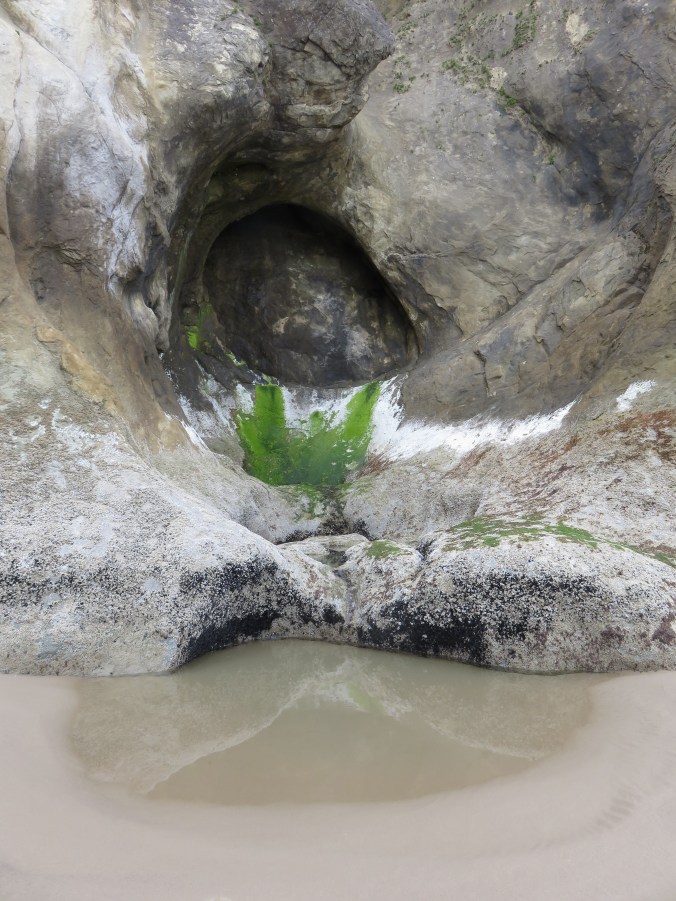
I think of this as the Big Altar. Sometimes in summer that back wall shows lime green.

I received notice this morning that I saved $5.66 on the order of a book I have absolutely no memory of ordering six months ago. And another one, a book costing over twenty-five dollars, hard cover, by an author whose name I do not recognize, is coming in September. I think I must have read a short story by this person on-line. Maybe?

What I was actually thinking about this morning was the sound of the dawn chorus—the chattering and peeking and calling of a variety of songbirds that I particularly enjoy in late spring with my bedroom window open. Too quiet this morning. I hear the eurasian doves flirting. I hear the ocean, always the ocean. I hear my husband clearing his throat downstairs.

And I was reviewing memories of other lives I have lived. Pushing teaching off to the side, I was once a goldsmith, a sighthound field trial judge, an illustrator, a teenager. These were exhausting and interesting occupations—still fascinating to me after all this time.

My husband came upstairs and told me that I was not hearing the birds because they did not come on duty for another twenty minutes. I wanted to believe he was serious.

A crow.

I opened the novel the day before yesterday and worked for a couple of hours. I found a typo. I found a half-page repeated twice because I had rewritten it and then failed to delete the first version. I liked the first version better so I deleted the revision. I think I have still failed to scatter the ashes of the dead. If I open the manuscript today in order to scatter the dead, I think I will only find a typo.

I will begin the right front of my youngest granddaughter’s pink cardigan instead.

IMG_4122

This is the Little Altar.

To Theodore

To Theodore

George Marion McClellan, 1860

Such are the little memories of you;
They come and go, return and lie apart
From all main things of life; yet more than they,
With noiseless feet, they come and grip the heart.
Gay laughter leading quick and stormy tears,
Then smiles again and pulse of flying feet,
In breathless chase of fleeting gossamers,
Are memories so dear, so bitter-sweet.

No more are echoes of your flying feet.
Hard by, where Pike’s Peak rears its head in state,
The erstwhile rushing feet, with halting steps,
For health’s return in Denver watch and wait.
But love and memories of noiseless tread,
Where angels hovered once, all shining fair,
To tuck you in your little trundle bed,
Kneel nightly now in agony of prayer.

This poem is in the public domain. Published in Poem-a-Day on April 21, 2019, by the Academy of American Poets.

The Widow’s Lament in Springtime

William Carlos Williams, 18831963

Sorrow is my own yard
where the new grass
flames as it has flamed
often before but not
with the cold fire
that closes round me this year.
Thirtyfive years
I lived with my husband.
The plumtree is white today
with masses of flowers.
Masses of flowers
load the cherry branches
and color some bushes
yellow and some red
but the grief in my heart
is stronger than they
for though they were my joy
formerly, today I notice them
and turn away forgetting.
Today my son told me
that in the meadows,
at the edge of the heavy woods
in the distance, he saw
trees of white flowers.
I feel that I would like
to go there
and fall into those flowers
and sink into the marsh near them.


[in the public domain]

STICKER PRICE

I did not have my camera with me so I cannot post a photo of the orange-juice orange Mustang we saw this morning at Costco. The sticker price is a tad over $44k, but I could save $4k buying it from Costco. I laugh about this because the color is one of my husband’s favorite (bright) car colors, and because somehow we managed to raise a son who likes muscle cars. Yes, it’s true. He bikes or busses or walks to work and doesn’t own a car, but if he had one it would be a Mustang GT. Or something like it.

April I have committed this year to CampNaNo again, a daily writing tracker. National Novel Writing Month (NaNoWriMo) in November involves a commitment to 50k words in 30 days. I’ve done it three times. The “Camp” in April works differently and allows writers to determine how many pages or words or hours or minutes of time they want to commit to.

I dithered and pledged something easy. I pledged to write 10,000 words. I expect to exceed that, and so far have 2900 words. But here’s the thing: What do I really want to work on? So far I have taken fragments of story ideas and worked on those. Do I work on one of the novels? fantasy and SF? flash nonfiction? poetry for National Poetry Month?

Good questions.

So far, as I said, flash fiction:

“And Another Thing” realist fiction about a drunk in his bar confronting another drunk, and it’s funny. It’s been a long time since I wrote funny.

“Final Words from the Master” is a first contact fantasy about the end of a seriously unfortunate landing on what might be Earth by kinder and more intuitive people than ourselves.

“The Way They Disappeared” about a young girl who causes an attacking hand to, well, disappear.

“Rapunzel” is realist fiction about a girl scooping ice cream in a tourist-town, and it makes her ears cold—actually no idea where this will go. Also funny.

What I think I most want to work on is a novel that no one wants. My goal was to show the hard work of recovery from overwhelming grief, but that grief-inducing scene remains the highlight and I kept pushing it earlier and earlier into the novel in order to focus more on what happens afterward. Every time I tried to reveal that event late in the narrative, I got chewed, even when I left foreshadowing hints big as pink elephants. And with that scene near the beginning, the rest of the story apparently feels like a letdown. There must be a way to fix this, but I do not seem to be a good enough writer to figure out how. Still. I might try again.

Maybe create a short story to try out a different structure? What if the grieving mother imagines other ways her life might have gone? What if grief is her best option? That’s cheery.

Or I could work on another manuscript entirely. I have a novel that won publication and prizes for the first chapter. Maybe that one?

Or flash.

Stay tuned for daily updates and maybe a shared story along the way.

post-AWP


IMG_3994

So we went, I saw, and we came home again. Fourteen thousand people. I saw Marvin Bell entering the building as we drove past. I am mostly the invisible woman, too old to matter, but there were amazing people all around.

My choices of what to bring home were determined by money ($15) and covers. I am a genuinely shallow person who chooses books for their covers. Then I read the first page. Believer is stunning. Witness (a journal I have long admired) gave me a free issue because I rolled 9 three times in a row. Ruth Gundle (bless her!) handed me Judith Barrington’s newest. I could not resist buying Karen Joy Fowler’s new collection of short stories (charged it!) and then three volumes of poetry (Dan Kaplan’s cover was not great imo, but a peak inside revealed his write is). I could have spent a couple of days trolling literary journals. I had less than an hour.

I went to only one presentation (seriously, just one) and it was a perfect choice, even though I am not teaching anymore:

S157. The Most Versatile Essay: Flash Nonfiction in Any/Every Classroom. (Brian Benson, Allison K. Williams, Sayantani Dasgupta, Anna Vodicka, Celeste Chan) Even the most reluctant-to-write students take to flash essays. Drawn to their economy, they’re won over by the urgency and potency of the form. From the academy to the incarcerated, beginners to advanced, flash nonfiction is a boon to writers of all stripes, and a vital part of teaching in the technological age. Panelists will discuss the versatility of the form, successful teaching strategies, prompts, exercises, and go-to resources from a range of educational settings and pedagogical perspectives.

Panelists represented programs from all over the U.S. and the world. Hugo House in Seattle, The Attic in Portland, as well as academic and commercial backgrounds. Pages of notes! I received a wealth of excellent advice from five people who write nonfiction, are active members of writing communities, and shared years of specific, hands-on experience working with young adults and adults. Though I have taught for 40 years, I learned from each member of this panel and left feeling energized and excited by approaches that were entirely knew to me.

I hugged Allison, shook Dinty Moore’s hand, bought Karen Joy Fowler’s new book, two poetry books from Burnside Books, plus another book written by the person working that booth—gorgeous all! I rushed through the Book Fair. Presses I have submitted to, presses holding work, some who have sent me kind rejections, and others who sent me form rejections. It was pretty overwhelming.

And then I sat and talked to Molly Gloss and Bette Husted and when Karen Joy Fowler showed up, we all talked.

I had arranged to meet Gary outside at 2:30, and as I went down the stairs I could see him through the window. There he was on the sidewalk talking to Ruth Gundle while she waited for Judith Barrington to pick her up. Brilliance everywhere I looked.

Five hours of literary illuminaries.


Gary felt I should mention the $4.25 for a Pepsi. He’d waited in line for 10 minutes and felt disheartened by the price. He left his change as a tip, and it wasn’t cold, though the young man who handed it to him was touched to receive a tip.

I had told him I would not be buying lunch. That much I know about conventions. He is still ranting about that Pepsi, “my AWP experience.” He was a grocer for much of his adult life and knew what was paid for that Pepsi.

Bette or Molly told me I’d missed Nisi Shawl. I missed Debra Magpie Earling. There were many people I would have enjoyed shaking hands with. I took no photos, though I had my camera with me. I knit a couple of rows on a baby blanket. I limped.

AWP

fullsizeoutput_edf

There are beautiful and interesting places all over the world. This is mine.

So yes, I am going. I am going to the national conference today, just for a few hours. Originally, because it is in Portland and has not been here in ages and because I know many people who will be attending and serving on panels (though specifics were hard to come by unless an individual posted them) and because, you know, I realize I should go, I was going for three days. Then I thought we would dive in twice, over the Coast Range and through the woods, but no.

The truth is that conferences overwhelm me. I am always glad once there, but . . .

It was two of our grandchildren who drove over the river and through the woods to grandmother’s house. They arrived in time to keep me home for all but one day. (And I will not post photos I did not take, but it was a really wonderful visit. We played Uno and made jewelry out of shells found on the beach, and I made waffles.)

The Burnside Bridge is down for repairs and Gary had planned to drive that way. We disagreed about how far the Oregon Convention Center is from Powell’s City of Books (no one should miss that). Gary thought it was miles, I thought it was closer. Google Maps suggests a 26-minute walk, 1.2 miles. I will wear my walking shoes just to get around the convention center. I used to take students to Powell’s on unofficial field trips.

So today. I hope to finally meet Allison Williams in person, and to visit with Bette Husted and Molly Gloss, and why didn’t I email Felicity? Jeannette will be busy and I have not heard from others. This is the disadvantage of leaving Facebook last month.


UNDERGROUND RAILROAD

I was reading The Underground Railroad by Colson Whitehead. In a blurb on the back cover, Oprah Whinfrey urges people to buy a second copy for a friend “because you are definitely going to want to talk about it.” Someone asked me to be that friend.

This fantasy fiction details real atrocities committed against African Americans over the past two hundred years in the fictional life of a woman named Cora, born a slave. There is no fiction in these burnings, beatings, and other bald unwarrantable usurpations Whitehead describes, though they are unlikely to have all been experienced by one person, and did not occur as described since some events are expanded in scale or compressed in time, and some happened in the following century. (Those alterations and inventions do not make the suffering any more disturbing, but considerably less so. I kept wondering why it was necessary to exaggerate an already abominable history? My friend tells me she can set history aside, but I never can. She’s right about that.)

And then there is the literal manifestation of railroad tracks and engines underground. Sometimes they went the wrong way. I liked that a lot. Such is real life. Sometimes.

Cora jumps on the underground railroad without knowing its destination, just desperate to escape. There was no telling. From Georgia, her first ride takes her to South Carolina.

Late in the novel, Cora begins working on a side branch of the underground railroad—no engines here, only a hand-driven cart through a narrow tunnel headed north from Indiana. There’s more. But step aside for a moment.


There was a real woman in Indiana working for the Underground Railroad during the first half of the nineteenth century. She was born a free person in the slave state of Delaware in 1823. She traveled all over, and she would eventually marry and raise two children. Her husband died four years after their marriage, and like many woman in my family, she supported herself and her family. Her home in the last years of her life in Washington DC has been designated a National Historic Landmark. She is easy to research.

“Mary Ann Shadd Cary (October 9, 1823 – June 5, 1893) was an American-Canadian anti-slavery activist, journalist, publisher, teacher, and lawyer. She was the first Black woman publisher in North America and the first woman publisher in Canada.

“Shadd Cary was an abolitionist who became the first female African-American newspaper editor in North America when she edited The Provincial Freeman in 1853.

“During the Civil War, at the behest of the abolitionist Martin Delany, she served as a recruiting officer to enlist black volunteers for the Union Army in the state of Indiana. After the Civil War, she taught in black schools in Wilmington, before moving to Washington, D.C., where she taught in public schools and attended Howard University School of Law. She graduated as a lawyer at the age of 60 in 1883, becoming only the second black woman in the United States to earn a law degree. She wrote for the newspapers National Era and The People’s Advocate and in 1880, organized the Colored Women’s Progressive Franchise.

“Shadd Cary joined the National Woman Suffrage Association, working alongside Susan B. Anthony and Elizabeth Cady Stanton for women’s suffrage, testifying before the Judiciary Committee of the House of Representatives, and becoming the first African-American woman to vote in a national election.”—Wikipedia

Undergroundrailroadsmall2.jpg

A nineteenth century map of the Underground Railroad.


I felt held at a slight distance from Cora. This impression was underscored as I read accounts of real women living in slavery in Mother Is a Verb by Sarah Knott. This well-documented nonfiction about mothering, speaks from the author’s personal experience as a new mother and from first-person accounts of real women from hundreds of years past. Two pages about slave labor in the fields created a greater intimacy than I found in The Underground Railroad. I felt at once that I was reading truth, and I never quite felt that in the novel. (Perhaps arguing with his mucking about with history.)

Nevertheless . . . Whitehead is a wonderful writer, and I waited to fall under his spell; he certainly casts one.

“Before the book the only thing to read was what came written on a bag of rice. The name of the firm that manufactured their chains, imprinted in the metal like the promise of pain” (235).

Their chains do not belong to them.

2017_30_47_001detail.jpg

The Emily Howland photo album containing the previously unknown portrait of Harriet Tubman, (above: detail, ca. 1868) was unveiled at the Smithsonian’s National Museum of African American History and Culture. (NMAAHC, Library of Congress)

TO BE SURE

nancy-drew.jpg

The Los Angles Review of Books blog has a grammatical error.

“Unlike Nancy, who’s mother died when she was three, I had a mom, and my mom had read Nancy Drew when she was my age.”

The contraction “who’s” stands for “who is.” The writer wanted the possessive form of “who” (whose) and failed to find it. No one caught the mistake before the article went to print, or in this case was posted online.

I am not a grammatical wizard (anyone who reads my blog will have caught typos), merely a well read person who is a naturally bad speller, ignorant of rules, and not afraid to admit it, and one willing to look up what I do not know. Usually, I know when I am unsure, but sometimes I am mistaken even about that.

One thing I do know, when I find writing in a journal as eminent as the BLARB, I expect someone will proofread the copy. I hope someone might.

That would assume that there was someone on staff to do the work of editing. Years ago, every publisher had fact-checkers and line editors. We are none of us perfect, and most writers are blind to their own errors, which is why working with a really good editor is such a treat. That doesn’t happen often, and most writers today are left entirely to their own devices as far as editing goes.

Today, there are merely readers who are supposed to weed out the genuinely bad writing and narrow the list of submissions to a readable number. The actual editors come in late to winnow the list to the pieces that might see print. Among writers this is the process, largely invisible, of submission. I send a piece of writing to a journal, a reader (usually an undergraduate volunteer at literary journals produced on college campuses) gives it a yes or no, and it passes on to the next reader. Some journals use multiple readers and incorporate multiple rounds of reading, and many include the Editor in Chief in the final round that decides what will be printed. On the masthead will be listed names of the Editor in Chief as well as Editors for fiction and poetry and nonfiction. The layout artist and covers designer might show up. There are often Assistant Editors, and at the bottom of the pages, sometimes, a list of the Readers.

The only time I have seen a Proofreader listed in the masthead of a literary journal was nearly twenty years ago when I found a typo in Tin House. She did not thank me for pointing it out.

No one wants to hear about their mistakes once they have gone to print.

A California executive secretary applied for a job with the Oregon high school where I worked. The Head Secretary whose job she was applying for was so incensed by the applicant’s notations about typos that she threw the letter out. Imagine if someone who actually understood perfect grammar and spelling had been hired! I, for one, would have stood in line at her desk asking for an edit.

“The Case of the Perfect Girl Detective’ is well worth the read. The error is trivial, no worse than you might find here in every post. I was not confused as to the author’s meaning. I might have found the error reassuring, in fact.