LOLITA

Screen-Shot-2019-08-14-at-10.30.35-AM.png

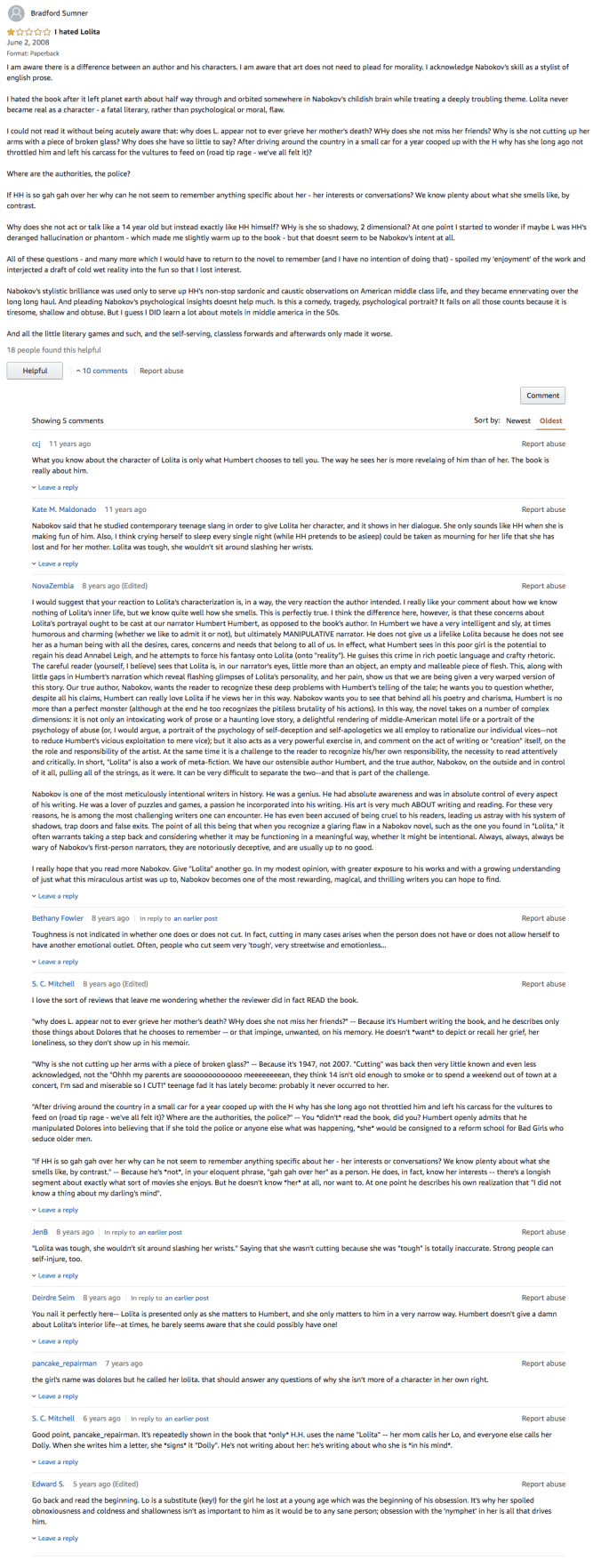
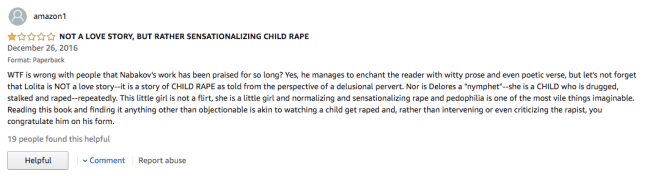
Literary Hub has an article up: “The 50 Best One-Star Reviews of Lolita.” The first time I tried to read Lolita, I did not get past in the first pages. I went to Amazon and read all 147 reviews, which gives you an idea of how long ago that was. I found they fell into three general camps: people who objected to the immorality of the story, people who loved the writing, and pedophiles. Reviews were not reviewed as they are now. Men wrote how much the novel reassured them that they were not alone in their sexual relationships with children. “Man-Child Love” advocates and rapists rationalized their behavior through literature. You can see it in responses to the one-star reviews.*

That name Hummer Humbert gave Delores, a 12-year-old raped child, has found it’s way into general usage as the name, Lolita, for sexually aggressive young women is perhaps ironic. It is also a horrible abuse of power.

Some argue that Nabokov wanted to see just how detestable he could make a character and still find readers, but ultimately, there are many things we can do but should not do. There is such a thing as judgement.

Here are a few of the reviews and comments on Amazon:

Screen-Shot-2019-08-14-at-10.49.37-AM.png

*Have a look at Edward S. just above. As a reader are you supposed to support HH’s obsession, or see past it as monstrous? I would like to think Nabakov was toying with his readers in much the same way that HH does with a child. It would be something if readers picked up on that, if they recognized how convincing evil can be. Well, friends, there are plenty of readers who fail to see beyond HH’s tale to feel shock that they have even temporarily sided with him.

Pedophiles inevitably find confirmation. They do not find HH monstrous, they find a kindred spirit. They can easily explain HH’s behavior. They are, after all, on his side.

STEP 6: Accident

fullsizeoutput_1019

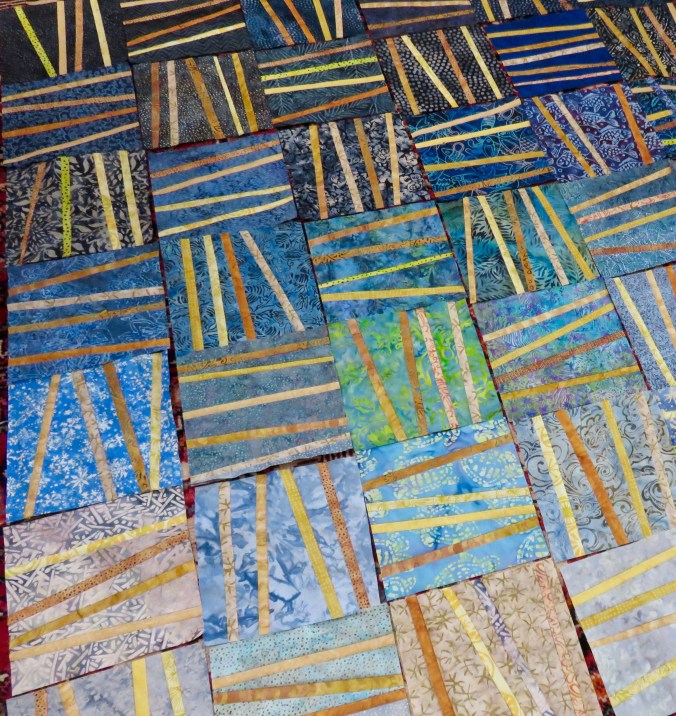
Above are a few of the forty-nine pieced square blocks laid out on the floor. The photo distorts them; they are each 8.5″ and carefully squared. So far I’ve used over sixty batik fabrics and cut over five hundred pieces of fabric. And this is only the center panel They will make a center panel 56″ x 56″ once they are stitched together, of an eighty-inch square quilt.

The second blue quilt was meant to be simple. I set specific, easy guidelines in order to piece it quickly and with a minimum of fuss. It’s that staring process, the decision-making at every cut and sewn seam. This color or that one, this way or that, rearrange and rethink the border? It was meant to be almost thoughtless but then the inevitable accidents. Most blocks were planned to be too large and I shave a quarter inch or as little as a sixteenth off the edges. A block might also too small or too dark or pushy or bland. I add another stripe or one going the wrong way, choose a different color or move the whole block to the other side of the quilt. Accident forces me to make decisions I might otherwise avoid, but accident has always served me as an artist. The writer Ron Carlson argues for something similar in writing fiction. Don’t allow serendipity to be cleaned out of writing. Let it flow. It is random chance that often hands us our finest work.

Decades ago, as a Metal Arts major, I was careless firing a base coat of enamel on square of copper sheet. The glass enamel color was called “Pigeon” a pale, perfectly transparent blue-gray. Fired over scrubbed copper it took on a lavender glow. Stenciled on copper, leaving some of the metal bare and then overfired to nearly 1700°F, the copper turned gunmetal-black, the enamel went palest blue-violet. The accidental firescale could be scrubbed off, leaving a line of black firescale on the edges of the enamel. I used that. Later, after deliberately overfiring sample tiles, I began using larger areas of firescale, enameling over the top and producing a unique metallic gleam. It was accident at first, and then a signature effect. It started by mistake.

Mistakes take time. Few are really useful. They are frustrating and not easily corrected. I have picked out stitches plenty of times making this quilt. Changed my mind in an instant. I could follow a quilt pattern or use a kit. There are plenty around that prescribe specific patterns and fabrics. I would not be constantly making choices, and choice is the hard work. But without choice, where’s the fun? I’m only barely interested in covering a bed. I am making art.

Mistakes push me, force me to reconsider, to change direction, to accept what happens sometimes and other times to fix it.

Mistake was at the first and will be at the last, so long as we don’t give up.

“The most important thing a writer can do after writing a sentence is to stay in the room. The great temptation is to leave the room to celebrate the completion of the sentence or to go out in the den where the television lies like a dormant monster and rest up for a few days for the next sentence or to go wander the seductive possibilities of the kitchen. But. It’s this simple. The writer is the person who stays in the room. The writer wants to read what she is in the process of creating with such passion and devotion that she will not leave the room. The writer understands that to stand up from the desk is to fail, and to leave the room is so radical and thorough a failure as to not be reversible. Who is not in the room writing? Everybody. Is it difficult to stay in the room, especially if you are not sure of what you’re doing, where you’re going? Yes. It’s impossible. Who can do it? The writer.”—Ron Carlson, from Ron Carlson Writes a Story

9 YEARS AGO

NINE YEARS AGO ON MY OLD BLOG I POSTED:

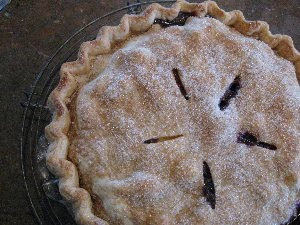
Today’s blueberry-peach pie. My family is of the opinion that a pie is done once it’s bubbled out of the crust. Yesterday I made pesto and apricot-gooseberry jam. Tomorrow… carrot-ginger jam.

8/8/2010: I woke this morning and realized that I didn’t have to run today [I was mostly running every other day until 2012], the weather is perfect, and I’ve spent my entire summer reading to prepare for the new school year and making jam. The jam is tasty, but I like making it more than eating it. The dog is not pregnant. The bathtub for the bathroom remodel is still in the garage. I haven’t written a story. I didn’t attend the Bellevue Arts Fair. I didn’t attend my 40-year high school reunion (that’s another thing, I’m getting old). We didn’t go to Lisbon. We didn’t go anywhere on vacation. I have two weeks before school starts up again.

I’m already tired just thinking about it, but I also look forward to getting back to work, to feeling useful and occupied. It feels good to be working a job I love.

A series of studies Dan Pink describes at RSA finds that once basic needs are met and people aren’t worried about money, money ceases to be a motivator for higher performance. It actually works in reverse—offer them more money and their job performance goes down. Yeah, weird. The study began at MIT but has been replicated all over the world such as rural India. Same thing. Extra monetary incentive for high performance doesn’t work when the work requires thinking. Assembly line tasks—more money, more work. Ask people to problem-solve, be creative, or think… and the whole scenario begins working in a way that seems counter to reason.

So pay people enough that money is not an issue anymore, and then if you want them to think harder and achieve really great things, you need a better motivator.

Instead of money, what motivates thinking people who aren’t worried about how to pay the babysitter or their overpriced medical care are three things: autonomy, mastery, and purpose.

  • Autonomy: Give us a challenge and just get out of our way—let us make our own choices about what to do. We want to be self-directed.
  • Mastery: It’s fun to do things well. That’s why we often work so hard at our leisure activities even though they do not “pay” us anything.
  • Purpose: Humans want to feel useful. We want to make a difference in the world.

What’s the lesson to be learned from this? Some of our traditional beliefs about leadership and motivation are turned on their head. Top down direction and money rewards work for the most simplistic tasks, but fail to address the need for creative and intelligent work in a modern society. To be fair, they aren’t working well for traditional cultures either, which include autonomy, mastery, and purpose in every job from cooking a meal to weeding a field. It’s the industrial system that has caused us to lose sight of the value of work because the end-game tasks are so divorced from the control and skill of the individual worker.

I have two weeks where I can wake up in the morning and decide what to do, practice doing it well, and look toward being useful. I guess that’s how I’ve spent my summer vacation.


Today I did not make a pie, but I took a walk. I made salal scones and eggplant Parmesan. Both turned out well, and we also attended the Tillamook County Fair this morning. I am fully retired, have still not been to Lisbon, and have heard no word about my 50th high school reunion that is coming up next year. I have made two kinds of pesto and six kinds of jam this summer. Nothing with carrots.

But yes, I still want independence, mastery, and meaning.

WINNING OMELAS

IMG_4577

In good company: brilliant Bette Husted, me, and magnificent Molly Gloss. [Cheesy, perhaps, but such excellent cheese.]

“Those who build walls are their own prisoners. I’m going to go fulfill my proper function in the social organism. I’m going to go unbuild walls.”

— Ursula K. Le Guin, From The Dispossessed

The review of a book about mental illness in the Brevity blog this morning reminds me about American obsession with competition and our “country concerned with triumph.”

I have been thinking a great deal about gaming and about competition, the basis for survival according to most these days. Winning is everything. I saw it in education, the work of my yearbooks staff that created groundbreaking design and content, but only received notice when I shared a “win.” Those certificates for cover design and deadlines never meant as much to me as the students who found work based directly on skills learned in class. We were not in competition, we only wanted a good book at the end of the year. By “good” we meant a distinctive, complete and compelling record of the year that we’d managed to pay for. No one had to lose in order for us to “win.”

That’s not how we look at things, is it? For there to be a winner there must be losers, the more losers, the bigger the win. It is the most essential understanding and assumption of how the world works.

People making a great deal of money believe they are winning and thus are superior to those of us who are not. We have accepted dollars as the mediator for morality. That and being white seem to be the only focus for our current nation’s executive branch.

I am thinking about this especially because of “The One Who Walk Away from Omelas” by Ursula K. Le Guin. (First published in 1973, it won the Hugo for short fiction in 1974 and is collected in The Wind’s Twelve Quarters in 1975.) We spent the weekend participating in the final act of a yearlong tribute to Le Guin. Many people referenced her most famous story, the perfect joy of a utopian society “a shimmering city of unbelievable happiness and delight” held aloft by a single suffering child locked in a cellar. “The terms are strict and absolute; there may not even be a kind word spoken to the child.”

In the biographical film presented Saturday, students offered three solutions, one beyond what Le Guin herself seems to suggest. One would tolerate the injustice for the child for the sake of paradise, another would fight to free the suffering child, and the third would walk away. In Le Guin’s thought experiment no one chooses to free the child in Omelas, they accept the inevitability of the child’s suffering, and a few walk away as unwilling to participate in such a society. The story demands we consider the moral option, that we choose. “The place [those who leave] go towards is a place even less imaginable to most of us than the city of happiness. I cannot describe it at all. It is possible it does not exist. But they seem to know where they are going, the ones who walk away from Omelas.”

I have taught the story many times. My students, like the students in the documentary, like every adult I know, see the three options. Most will claim that they will walk away. That is presented the most moral choice.

“The only winning move is not to play.”

War Games

My own view of Le Guin’s story is somewhat different. The story begins with Le Guin offering the reader utopia, perfect joy and celebration, conceding trains and drooz “as well as exciting the pleasure of sex beyond all belief; and it is not habit-forming. For more modest tastes I think there ought to be beer. What else, what else belongs in the joyous city? The sense of victory, surely, the celebration of courage. But as we did without clergy, let us do without soldiers. The joy built upon successful slaughter is not the right kind of joy; it will not do; it is fearful and it is trivial.”

Perfection.

And yet she questions the reader mid-story: “Do you believe? Do you accept the festival, the city, the joy? No? Then let me describe one more thing.” And it is here she introduces payment for perfection.

The child suffering is necessary for the perfections of this city.

And then she asks: “Now do you believe them? Are they not more credible?”

She knows that we demand payment, that we assume there must be pain as some sort of balance to pleasure, that sorrow inevitably balances joy, that evil must balance good.

Once we are given the balance of pain for pleasure, we believe absolutely. Le Guin know this. Within the context of her thought experiment even Le Guin herself insists that someone must pay for our happiness, that there must be losers if we are to win.

No.

Despite my own superstitious belief in a balance, I have not found that this is true. Driving away from Fishtrap, I thought a great deal about the story of Job. For decades I detested that story of God proving to the evil angel that his “good servant Job” would be faithful despite hardship. Why did God need to prove anything?

It has only been later in life that I understood that the story of Job does not exist to prove anything to anyone within the story. It exists to demonstrate to me, the reader, that terrible error of assuming balance. Though God returns all of Job’s lost fortune seven-fold, restoring the previous life, it is not the point of the story. There is no win, no lose in life that represents moral justice. We cannot expect overt success to represent spiritual triumph.

There is no battle raging between good and evil with the winner proved righteous. Thousands of years ago, scripture impressed that truth upon us. Winning is not virtue. It is belief, not truth, not a factual representation of the world I live in. In fact, terrible things happen to good people, and evil people become president of the United States.

Those who live deplorable lives are not made to inevitably suffer in their lives. People who are good do not necessarily achieve a good life. People who are kind and generous and deserving of long life and happiness often do not achieve fraction of what goodness should balance the sorrow in their lives.

I have been supremely fortunate in my life, I know this despite some ordinary grief and disappointment, occasional despair and sorrow. My life, I might want to say, is “blessed.” But I am not in competition. No one lost to give me joy and my “win” is not deserved. As a thought experiment, “Omelas” is an extraordinary gift, but its message is more complicated than how I choose to respond to injustice.

No. And again, no. I know there is no perfection, but I do not believe my joy must be taken at the expense of anyone’s sorrow. I do not accept that a child must suffer in the basement.

IMG_4576

Molly was right: Gary photographed our feet first.
FINDING TIME

Photo by Steve Larson

People ask me all the time, even now as I climb the stiff ascent to seventy: Where do you find the time? 

This morning, my husband and I were up and dressed and out the door by five to listen to the dawn chorus from the deck of the lodge. We are in Wallowa Lake for Fishtrap, a writers’ gathering. (The photo above is borrowed. The grass is greener and there is a tent for outdoor events. At right you can see the leaning tree. Yes, it is still there, Ann.)

8519949156_34edb2f18a_o.jpgSo far I have seen people I recognize, but no one I actually know. Yesterday we sat in the beautiful great room of Wallowa Lake Lodge (opened in 1923). We walked across the street for dinner. We walked through Canada goose poo to admire the river pouring into the lake. I watched clouds pass over head, the nearer moving east, those higher up shifting more slowly south. We have seen an unfamiliar species of ground squirrel and several deer since we arrived yesterday, and I had a pleasant talk with a local woman who was also knitting while her husband and daughter participate. Time passes slowly. I varnished the dining and kitchen floors before we left the house. Being here while “paint dries” is only an excuse. We plan to read and relax and hope to visit with friends.


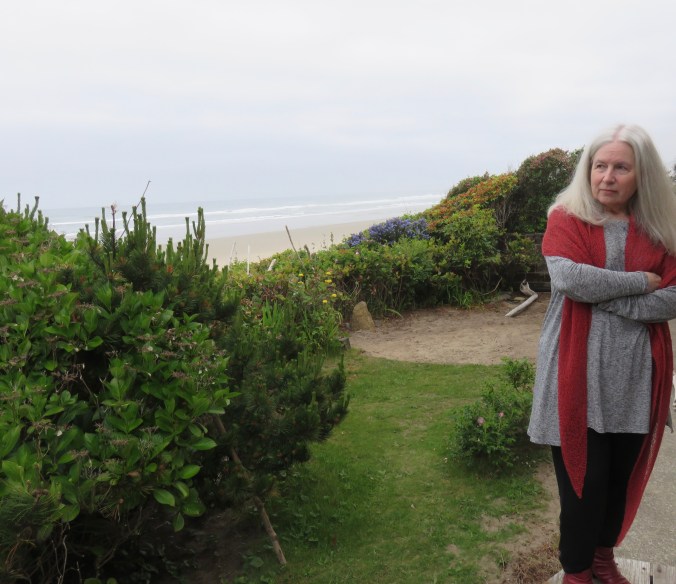
Even in my twenties I was writing and publishing articles in magazines. In those early post-college years I judged field trials all over the west and learned to cook and had Afghan Hounds. 

In my early thirties, when I had two preschoolers at home, I canned peaches and read books and made quilts and worked part time. In my forties I went back to my work teaching, began taking writing classes, wrote stories and read and knit sweaters, and began running. 

In my fifties I began writing novels and attended workshops and read and made only jam in the summer. I spent a lot of time writing curriculum and grading papers and baking and cooking and making quilts and knitting and weaving and reading a few dozen books each year and writing thousands of words. Marilyn Chin once told me I was the most driven person she knows—this from a writer with six books in print. Molly Gloss sighs that she doesn’t understand why I have not had more success. But these women are sympathetic friends. There is accomplishment and accomplishment. 

Recently I went off Facebook. I do not text. I do not post on Instagram. I have a Pinterest account and it was useful to wean me off magazines, but I spend only minutes there each week. I subscribe to two major newspapers and read through them both plus at least one other international newspaper. I rarely watch the news. Did I mention that my cell phone is not smart? No time spent there. 

I get up early and tend to go to bed early, but like Daylight Saving Time, that only shifts my day around from most people. Early to bed and early to rise does not magically give me more hours in a day. It saves nothing. 

Now in my late sixties I no longer run and have retired from work, and my time is still filled with things to do—both pleasant and onerous tasks I have ignored for decades and now choose. We have always had and enjoyed watching television, but this month we are ending our broadcast and cable subscription. We read the news and go for walks each morning. Even so, I might well wonder how I found the time in my earlier years to get so much done. 

Perhaps it was not so hard. My husband took on his share of housework and childcare. Some things did not get done, usually cleaning and upkeep we neglected in favor of more urgent demands from children or our interests. I learned to be efficient about many things, especially the necessary tasks I do not enjoy, but also the interesting things I do. 

My habits are productive but not notable. I do not have books in print. I do not see family as much as I would like. Vacations were nonexistent for years, and even now are rare. We do not often feel the need to get away. (We live in paradise, after all.) I make many things without selling anything on Etsy. Perhaps, now that I am retired and accomplishing less, people will no longer ask me where I find the time. 

It is there, has been there all along. When I had children running about, I did tasks I could carry about with me, put down when I needed to chase a child, scrubbed the kitchen floor at least once a week, bathed and groomed dogs during the Sunday mornings my husband was always home. There were things I did not do—dressing up and going out to dinner, for example, because it did not matter and I spent my money elsewhere. I have always volunteered but we do not attend charity events. Even now, I think sometimes I should spend a few minutes a day meditating. If it genuinely mattered to me, I think I would find the time. 

What we should find time for is only what matters to us enough that we make the time happen. No magic, no great skill. If we would rather have time for a walk than read Facebook, we can choose to do that. If we would rather read or write a letter or have tea with a friend after work, that is a choice anyone might make. 

I choose how to spend my time, and if I do not, time spends itself.

“A YEAR AGO” or more

IMG_4465

So far this month. I have made little progress on Camp NaNo, but I withdrew six poetry submissions yesterday. A story has been out for a year, six months short-listed—I think they are only teasing me. Yesterday the last of the base trim went down in the dining room and kitchen; it’s only been thirty-some years to get it completed. This morning I have a few hundred square feet of floor to varnish plus that newly installed base. Rain is nearly always welcome, post-fireworks especially, but the damp will slow drying, so that is not so good.

I am worried about a former student and driving and writing and the world too. Not in that order.

Sleep did not find me last night, and I am already tired before a very hectic morning. The next busy-busy days, and I figured out, finally, what to do about a quilt I have wanted to construct. Good? I gave up reading Romola, which is too smart for my mood just now. And I was wrong about a connection to the painter Artemesia Gentileschi. Does anyone enjoy being wrong? I should be up walking the beach, but finally I feel sleepy when it is too late in the morning already for sleep.

Finally, the national newspapers seem to care about abuses against women, or at least when it makes a good story. One local Florida reporter would not let the Epstein story go. Julie K. Brown of The Miami Herald just kept digging and pushing. It took a while to regain traction—more than a decade for the boys to pay attention to this legal travesty—but her name has already disappeared from reporting on the rapes and other abuses committed by a very rich man despite her efforts to drag them into the [lime]light. New York’s Southern District, Geoffrey Berman, noted, “The defendant, a registered sex offender, is not reformed, he is not chastened, he is not repentant.” Well, when you are famous they let you do anything. (Who said that?) Money does not talk, it fairly shrieks until it has its way.

Why is that allowed in the land of the free and the home of the brave?

Oh, right, money.

Communal

fullsizeoutput_fdd

Tide pool photo taken from south of the Cape. A sliver of the arch is visible.

Last evening we were upstairs when we saw a couple sitting at our beach fire. (It was dying but we were keeping an eye on it, and suddenly it was back in flames.) We joined them on the sand and shared a lovely time. They were astounded by the fireworks—in Colorado, it would never be allowed. Several times they expressed amazement at how uncrowded the beach was, while we were alarmed because there was such a mass of beach fires and people. This morning, it is clear most took away their things, leaving the beach bare again. There will be firework litter, but there is always firework litter.

It was pleasant having people to talk to yesterday. Sometimes I think we are too isolated. We often go days without a lengthy face-to-face conversation with anyone but one another. (And I will always miss teaching.)

Jessica and Craig told us how they met, how they came to live in Denver. Craig talked about a poet-friend, so I went looking later and found his friend’s poetry. Here is one from Young Ravens Literary Review. I post it here without permission.

by Matthew Burns

The Sharp Air


The river I don’t know

rumples over its rocks

and carries anything

that falls in—silt and brush,

a tumbleweed blown

from ten miles away.


The river, clear and silent.

When I crouch at its trembling lip

or pitch the rare flat stone across its skin,

I am looking for something

to carry me, not away but up.


Like the chickadee’s call to its mate

that goes bay-bee and bay-bee 

until she calls back with same

and they go on beside the river

so the water carries this, too, away;

so that it unwinds and eddies,

like the silt of missing,

into the air; the sharp air,

carrying everything it can hold.

Matthew Burns teaches writing and literature in upstate New York and is currently a poetry editor at Heron Tree. His poem “Rhubarb” won a James Hearst Poetry Prize from North American Review; other poems have received Pushcart and Best of the Net nominations and have appeared or are forthcoming in Posit, ellipsis…, The Raleigh Review, Camas, Spoon River Poetry Review, anderbo, Quiddity, Heron Tree, LimeHawk, and others.

It was an astonishing point of connection in retrospect. I had a poem in North American Review a few years ago. Look up “Rhubarb.” Brilliant. Though I pull the stalks and never cut them.

CLOSING

fullsizeoutput_f6a

I discovered yesterday that Tin House is closing after this month’s issue. I already knew about Glimmer Train, Shimmer, and the end of Apex except as a publisher of books. These were all excellent publications. The New York Times is only writing about Tin House, because the founding editors are in New York?

Sometimes I really do wish there were a newspaper on this coast I could subscribe to.

Penguin has reissued No-No Boy by John Okada. It’s an important novel that I read for a graduate class on Asian-American literature taught by a San Francisco University professor in a class at Portland State. Despite the fact that the novel was already reissued (the copy I read with an introduction by Lawson Inada), Penguin has chosen to completely ignore previous copyright and to claim the novel is in the public domain.

Sometimes I wish New York(City)ers were not such “a bunch of hustling people all squeezed up together being ‘Eastern!’ “—Lorraine Hansberry’s character Walter Lee Younger in A Raisin in the Sun.

A New York editor reportedly complained about a West Coast novel because it “has all these trees.” City people.

Reading the editor’s description of their literary journal, I found two women’s names in the list of authors they were proud to have published. Both names were misspelled. Ursula K. Le Guin. (She always included the K. and Le Guin is two words, not one.) The first woman to publish science fiction under her own name was Clare, without the I, Clare Winger Harris, not Claire.

And don’t get me started on the lay/lie issue in print publications—everybody has trouble getting that right, it seems, but some of us take the trouble to doublecheck this obvious trip.

Yes, peevish today, on a minor note, and despite the fact that my own line-editing is never perfect.

I am rereading Wild Life by Molly Gloss.


Middlemarch by George Eliot

fullsizeoutput_f58

“But the effect of her being on those around her was incalculably diffusive: for the growing good of the world is partly dependent on unhistoric acts; and that things are not so ill with you and me as they might have been is half owing to the number who lived faithfully a hidden life, and rest in unvisited tombs.”