Uncategorized
BELIEVE ME
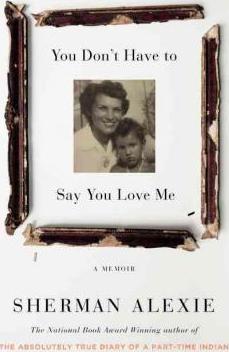 I first wrote a review of Sherman Alexie’s memoir, You Don’t Have to Say You Love Me, in August of 2017 on Goodreads. I continue to be mystified by the glowing reviews of this memoir. It seemed to me that Alexie was busy blaming women for what men had done or for what he, himself has failed to do. I have read many books that attack a woman (a character, a mother) in inexplicable way, as if the suffering of women listed purely to advance the needs and character of men in their live. Zoe Boisierre wrote on the Brevity blog about the recent outing of Junot Díaz as a serial abuser. Given recent revelations about Díaz, Alexie, and other authors, I feel vindicated in my distrust.
Recent news of Alexie’s abuse of women (early 2018), confirmation by no less than Joy Harjo that complaints have been ongoing for years, and especially his semi-apology should not surprise anyone. It is clear in his memoir that his perception of suffering is entirely selfish. He reveal no depth of appreciation for the suffering or pain of anyone but himself. Despite his skill as a writer, I never understood the apparent widespread “love” of this book.
“Believe me, believe me, believe me.” Ever since I read a review of Sherman Alexie’s memoir, You Don’t Have to Say You Love Me, the song has been running through my head. You could find it on YouTube, but if Dusty Springfield’s voice doesn’t come right up out of your memory, best to leave it alone. You may find yourself walking in time to the tune for the next few days. Maybe that isn’t so bad. It’s a great old song, but I would be happy to get it out of my head.
There are short vignettes, longer scenes, words cut into lines and stanzas that sometimes are poems and sometimes have other business. Ultimately this book does not reveal wisdom of hindsight or generosity of objectivity or even modest compassion for the woman who sacrificed so much to keep him alive. This is thrashing. This is struggle. This is self defense.
Alexis calls himself an “urban Indian” who left home to attend an elite private high school and never really came home again. As I read, I searched for commonalities. He was raised poor and on a reservation and, while I was raised on a dirt road with open ditches and poverty all around me, my parents chose that house because the schools were good. My father was also an alcoholic. Maybe. But he worked and brought home his paycheck. We always had milk in the house, even if it was powdered. He died. I loved him very much. We have that much in common.
My friend Kathie lent me her ARC and we invited him to talk to my high school students and to read in Cannon Beach based on that book. (We are a largely rural and poor community, those of us who actually live on the north coast of Oregon. He would not have been available a few months later. His speaking fees were astronomical.) Alexie and his bride stopped off for these events on the Oregon coast before completing their journey home after their honeymoon in Hawaii.
Before telling more I should mention that I have read most of his books. I loved Sherman’s first collection of short stories and the ones that followed. I did not love his novels. My friend taught The Absolutely True Diary of a Part-Time Indian, which has considerable connection to Alexie’s real life, when I was teaching literature I taught his short stories, and this author made my husband cry on that long-ago visit. I bear a grudge concerning that last. I have not forgiven Sherman Alexie any more than he has forgiven his mother. I was not raised in poverty but my husband was. I am not always a kind person, but my husband nearly always is. So I am a skeptic when it comes to Sherman Alexie. I am a fan, but I know enough not to trust him.
The strength in this memoir is the writing itself, which is sometimes brilliant and occasionally even humble when he admits flaws. Too often he is defensive. Mostly he is churning with guilt and anger and not managing any forward movement. He is eager to label himself bipolar. He expresses tremendous guilt and resentment for his estrangement from his mother, for not speaking to her for days and weeks and even years at a time. But he blames her for it. Like many children of bad fathers, he blames his mother. As a woman and a mother myself, I find that bizarre. I take it too personally, you might think. I am a feminist and a class warrior. I am also weary of people who hold their mothers responsible for all the sorrow in their childhood.
Big message here: No ones’s mother is perfect.
She did the best she could.
Alexie’s mother stopped drinking when he was a little child and struggled to support her children and her husband. She also moved onto the living room couch, a move she explains as a step up from memories of being crowded in bed with siblings. At least sleeping on the couch, on a succession of couches, she did not have to share. Alexie accepts and even defends this explanation. I wonder that he never considers the likelihood that she no longer wanted to sleep with her drunken husband, that she did not want to take a chance on another pregnancy? That while she may have still cared for Sherman Senior, she was not willing to sleep with him stinking of “alcohol and vomit and piss and shit”.
Sherman Alexie is an aggressive and angry man. He has suffered in his life, he has suffered terribly, and perhaps that is why he is quick to anger and quick to exact revenge for any real or imagined slight. My impulse is to call his attacks in this book “counting coup” but counting coup is honorable, a show of courage and skill. These attacks are self-justifying, snarky, and often unfair. Sometimes they are not even skillfully written.
I was still young when I first met him, and Alexie was much younger with several books of poetry and only that first collection of fiction when he told my students he wrote prose for the money. If he didn’t need to sell his work he would stick to poetry. That might be the major difference between us.
Like his mother, I am a quilter. My father died in 1986 and my mother died in 2007, a week after graduation from my MFA program. After my mother died I grieved. Everything went dull and even my writing withered for a time. My husband and I had cared for her in her last five years. When she apologized to me: “I was mean to you” I responded with absolute sincerity that she never was. But she was. She did hurt me. She bullied me and criticized and was an imperfect mother. She was also kind and helpful and supportive in most ways. It took some time after her death for me to appreciate that this is the best anyone might hope for.
According to this memoir, Lilian Alexie could be kind and supportive but also verbally combative and abusive. When Alexie’s good friend died his father played hoops with him for hours. When, days later, he was still crying in his room, his mother opened his door and told him to snap out of it. He took his father’s action as proof of love and his mother’s as proof of cruelty. But which one got him out of bed?
Once or twice a year, Lilian would take it into her head to vacuum in the middle of the night. According to Alexie, this was completely inconsiderate, unbearable, and woke everyone in the house. One night, because he was the strong kid willing to stand up to his mother, Alexie got out of bed, grabbed the vacuum and threw it out the door. When I read this vignette, I sided with his mother. Who else ever bothered to vacuum? She is the one who stayed. Alexis ran away and has never really returned. He might at least credit her for her willingness to remain with her family, even if chooses to question her motives.
Immediately after her husband died, Joan Didion wrote her memoir: The Year of Magical Thinking. After a lifetime of journalism and research, Didion did what she had always done. She reported with objectivity and poetry about her experience. The result is truthful and beautiful and a powerful exploration of loss and death.
Alexie has not done so well. He is too angry and guilty, eager to assign blame and to score points on every person who ever hurt his feelings. He is angry at the man who abused him as a child (me too). He wants everyone in the audience to admire and cheer him, not just most. He is also angry at the Indian woman who called him on his claim for being the voice of all Indians. It was a claim he made in my classroom when he was still in his twenties and later speaking on a panel of people about shared issues of people of color. If Sherman Alexie is to be believed, his suffering is the worst, his people have suffered the most, no one else knows the sorrow he has seem. No one but he has the courage to say it. Only he can tell truth. These feelings are not entirely unjustified, but they get in the way. He has been angry for all this time. One of my students was angry that he misquoted Kurt Cobain while claiming Cobain as his. I was put off when he quoted liberally from another Indian author without once naming his source, or even revealing that his rant was not in his own words but the borrowed words of another.
He claims his mother was the last Spokane fluent in the language, but that he never learned a single word of that language. I mentioned that to my husband, who found both claims unlikely. My husband’s parents are both dead too. We are each the oldest in our families. Alexie has cousins, I have none. We have troubled relationships with our siblings. For a while in the 1970s, my husband was one of a handful of fluent speakers of Puget Coast Salish. During a reading he said a name to Sherman Alexie, the name of a Spokane Indian, and my husband pronounced it perfectly. Sherman walked close and demanded, “What did you say?” but my husband would not repeat it. “I have some naked pictures of your mother,” Alexie said. “I would like to see them,” my husband said. His mother had recently died. Two men wounding each other.
I have been paying attention since. Sherman Alexie and I have several mutual friends and acquaintances. Perhaps he is a wonderful father and husband, but he was a neglectful son and he is not a man to tangle with unless you are prepared to bleed. None of us is perfect and most of us have a list of actions we are not proud of, but Alexie might do better to comes to terms with his own failures and his particular cruelty while criticizing his mother for similar behavior.
Like most memoirists, Alexie concedes that his version of events may not parallel versions told by others. Mary Karr warns at the beginning of Liar’s Club that her memories are not the same as her sister’s and mother’s. Mary McCarthy offers a similar disclaimer in Memories of a Catholic Girlhood. In his case, Alexie seems to allow for considerable stretchers. His is a memoir of personal convenience, occasionally confessional, but more often on the attack.
Alexie wrote this book and saw it published in the two years following his mother’s death at 78. He also had brain surgery. All of this is too quick. Unlike Didion, he does not have a lifetime habit allowing him to stand apart from his experience in order to tell his story objectively. He does not even try. These are powerful words and considerable rambling, some poetry and some prose broken into lines and stanzas in a pretense of poetry. There is self-justification and enough fury and blame to waste what little insight this brilliant author might otherwise have shared.
Alexie declares himself an “urban Indian” in a way that is defensive and tough. He had a hard life and survived to move away. He has kept himself strong by keeping apart. There is a lot more guilt here. He needs to forgive his mother. More than that, he needs to forgive himself before he can recognize that he owes her more than forgiveness. She let him out.
He claims he is deliberately repetitive. He claims a lot of things here.
If readers take Alexie at his word, they might find a touching if erratic story of a heartbroken son struggling to come to terms with the death of his “complicated” mother. This book was promoted as a memoir about Alexie’s mother, about grief and family and loss and forgiveness. I found it mostly about getting even.
On the last page: “I don’t know how or when / My grieving will end, but I’m always / Relearning how to be human again.” I speak from experience: The grieving does not end, and the year or so after that loss there is almost no sense to it at all.
My advice to readers: Do not read this or his awful novels. Read The Absolutely True Diary of a Part-Time Indian which is a circuit of stories. Read the short stories and the poetry. Let Alexie come back in twenty years and write about his mother. At the least he may find some kindness. Maybe the truth isn’t funny, and Alexie wants that sharp wit like a stick to poke us. Maybe tenderness makes us vulnerable. It requires a difference sort of courage than a streetlight.
[Just saw an on-air interview with Smiley. Who is this person? Salish is not a single language but many. The scene at Haight Ashbury was over by the 70s. Who is this man abruptly stating the obvious, which is clear but pretty much unstated in the book, that Sherman and Lilian had/have a great deal in common? His manner is so tender and humble. When has he ever been tender and humble? I do not even recognize his voice.]
NATURAL VARIATION

Despite discussion the other day about his resemblance to other family members, my grandson looks like no one more than himself. This is true for all life—zebras too.
A friend posted on Facebook that if she could have any question answered, she would ask God why humans were so made to be so different, varying in height and weight and color and language—we are so variable, unlike zebras or elephants or monkeys, which are about the same, she wrote.
A mutual friend suggested that the answers were in the Bible. [Maybe, if you accept that the story of the Tower of Babel is about God separating people to make us unable to talk to one another, and completely miss that it is primarily an allegorical story about the danger of hubris—our self-importance and arrogance.]
They are both missing the obvious.
Animals, too, are each unique, variable in height and weight and color and language. Ask anyone who has spent time observing another species.
When we study animals closely, we find that they exhibit all the variation found among humans. Humans may not notice the variation because we are not attuned to it, not because all zebras or elephants or monkeys are identical. They vary in size and color and voice and personality. Zebra stripes vary and are as distinct as fingerprints, but on a grand scale. They also vary in size, build, and character—some are faster or slower, with higher or lower voices, inclined to complain or bear up, kick their neighbor or not.
Elephants are individually recognizable from a distance by the zoologists who study them, and find size, shape, ears, mannerisms, and movements distinctive.
And monkeys? or apes? Check out Jane Goodall’s research. She named and studied the animals over many years. Each was as individual to her as my own children are to me. They all look alike to us because we fail to observe. We are not interested in the many distinctive physical characteristics and behaviors that make each one an individual. As a result, we simply do not see them.
All penguins of a species look identical to me, but not to another penguin. Twenty thousand baby penguins wait on land in a rookery, waiting for Mom to come back with food. Their mother is able to distinguish her own baby’s cry and find it among that surging cacophony. Diane Ackerman could not understand how they could hear anything in the racket of screaming infant penguins, much less identify a distinct voice. Then she spent time feeding baby penguins, and realized, with a sort of shock, that she could hear “her” baby’s voice distinctively amidst the calling of dozens of other babies.
We learn to notice individuality only when it matters.
As a tiny local example, the song of song sparrows in Arch Cape barely resembles the song of the same species in Seaside or Portland. Song sparrows mostly all look alike to me, but even I can hear their variation. To another song sparrow, they must look as distinctive and unique as my husband and I do to me.
We make friends with twins and learn to distinguish between them. We notice what we care to notice, what we attend to, and to what matters to us. We see that all trees are not Christmas trees or apple trees. We notice one day, as I did in Kindergarten, that “red hair” is not red, but orangish.
All species change through time, adapting through tiny and notable genetic variation to different climate and food sources. There is ample evidence of this in recent history—moths in Britain evolving to camouflage against coal soot-stained trees and brand new species, not to mention deliberately created breeds of cattle and horses and dogs that are human-selected for desirable traits.
On a more human scale, consider Golden retrievers. Do they all look alike? Would a dog-owner fail to recognize his own well-loved dog in a crowd of retrievers?
We notice what matters.
When I was young and had no interest in motherhood, I once insisted that all babies looked alike. Maybe one was a little darker or had more hair. Some have brown eyes already? Whatever. I saw no individuality when I was fifteen. They all looked alike to me.
I am a mother and grandmother of babies.
Ask me now.
BIRTHDAY CAKE

I like to bake. I like baking cakes even more than eating them. I like eating pie better, but baking a pie is never as satisfying as cake. I don’t know why that is.
Let month, I was asked to make a cake for my youngest grandchild, an honor. Today we are celebrating our only grandson’s birthday, and orange is his favorite color. So far.
Orange was my dad’s favorite color too. There are Campbells in my family coming down from my dad. When I was little, I tried to pinch my dad for not wearing green on St. Patrick’s Day, and he pointed to a smudge of orange from painting boats for the Bureau of Commercial Fisheries, and he said that counted for him as a Scot.
Whatever. My grandson is a busy little person, so his preferences are bound to be original. He likes the color orange just now even it is statistically more often a least favorite color as well as the color most likely to be hated.
But I ask you: Would you mind getting a four-layer gingercake with orange buttercream for your birthday, even if it was orange? Even if you’d moved on from orange to red?
The cake is dark as chocolate, but instead is flavored with gingerbread spices and a full cup of organic blackstrap molasses. I cooked down the juice of four oranges to color and flavor the buttercream. The orange candy slices came from Bruce’s in Cannon Beach just this morning. You can’t see it, but the sides of the cake have a sprinkling of naturally colored orange sugar sprinkles. I’ve saved the tall, striped candles for almost a year.
Happy birthday, Logan!
METAPHOR FOR GIRLS

Pododesmus macrochisma: METAPHOR FOR GIRLS
Each morning I walk the sand, searching
for what my grandmother misnamed
the “ugly clams” caught in foam left behind
by a retreating wave or stranded high on shore
from last night’s tide. Smaller than my thumb
or filling my palm, they might come to rest
among seaweeds torn from their beds,
half buried by wind-driven grains. Often
when I find a shell, there is another nearby.
Is it too fanciful to think they gather to die?
Perhaps because the first makes me alert
to the next. Every one I have seen lies
face down, resembling nothing much of note.
Some thinner than drawing paper, sometimes
thick, calloused like my toes. They lived wild
in depths to three hundred feet, here adrift
and dead, their softer life dissolved in the sea.
Only rarely are the unequal halves complete,
shaped back shell still attached to the round.
Sometimes only shards remain, wholeness
crushed by the careless heel of an earlier walker
passing by, oblivious to the gift underfoot.
One reason to search at dawn. Turn one
over, see what hides—that nacre, sometimes
scarred, dark glimmering, pearly sheen—alive
amber and green, holding captive light.

originally published last year in Portland Review
THRASHED
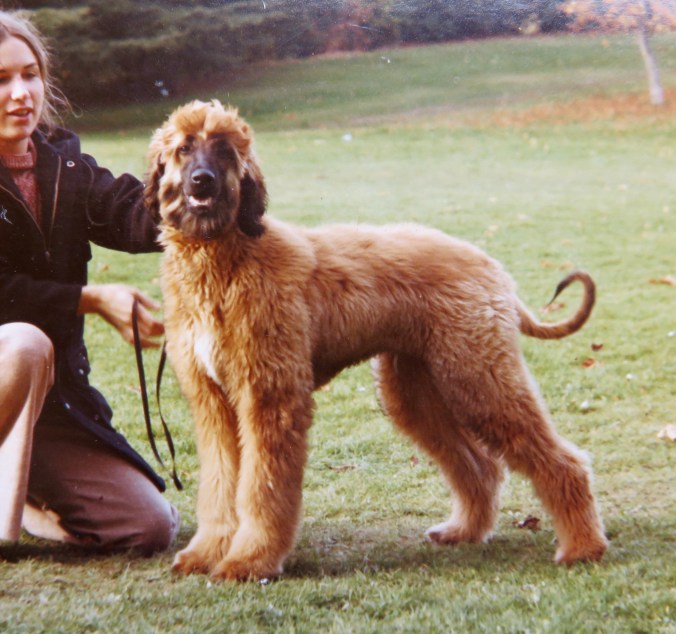
This is Gary’s dog, Manny, as a puppy in 1976. He was the first Afghan Hound we bred, shown in puppy coat. We kept him all his life. He was a smart boy.
I thrashed the kitchen the other day and Gary had to clean it. It’s what he does most days. It had been hard that day. His brother called to complain and then hung up on him. This brother doesn’t like Oregon’s Governor Brown and believes Hitler went to Brazil, and worries that Gary is “leftwing.” Gary told him we like Governor Brown (the brother is a resident of Washington) and Hitler is dead. Yeah, and we’re leftwing. My husband’s brother was diagnosed schizophrenic when he was fifteen.
He is at the age where the general mental health of some schizophrenics improves. This has not happened for him. He is not worse than he was as a teenager, but he is not better. He still tends to rant about things a good deal, has no interest in anyone’s opinion unless they are agreeing with him, and he hangs up on people if they disagree, or might have taps on their lines, or for other reasons too convoluted and absurd to go into. He has never been on meds, has never been institutionalized, is sometimes banned from call-in radio shows, but otherwise does not cause trouble. He argues with people but has not spent time in jail that I know of.
On the other hand, another relative has been arrested and convicted of abusing his spouse, began court-ordered therapy in his late forties, and with good behavior had that conviction wiped from his record. He is not schizophrenic but has anxiety and phobias and perhaps borderline personality disorder, which is not nice, but he can be charming and he is very smart. He has been institutionalized only briefly, and has been on meds and in therapy for many years. He is also not better. He is, some might judge, worse.
He is depressed and rarely leaves his home and is lonely and claims he has driven away all his friends. He is angry and blames people for failing to behave better. All this is likely true, though I have not spoken to him in a long time.
I was reminded of this just the other day when I called to make a reservation at a charming coastal hotel. There was some confusion about who I was. And the story came out about repeated reservation cancelations. The person I talked to was charmed, but anxious herself about those cancellations. I promised I would not cancel.
So. A cake, some sadness about our family members, and a clean kitchen.

BEING SOLD
Just now I have only two ads on the side of my Facebook feed. One is for organic cotton sheets and the other offers to sell me the “best reviewed” mattress. I am seeing these two ads because yesterday I was shopping for organic sheets and a new mattress. You see the connection, right? Facebook knows where I have been and so do the newspapers I read. Twist ads always appear in the middle of my Times stories. If I look too long at a lamp on the Crate and Barrel website, the company sends me an email warning me how few they have left in stock.
I have the general understanding that cookies are involved. It is as if I were shopping at a mall and someone continuously walked behind me, noting on a little pad of paper what I look at and for how long, and then sent me junk mail based on those notes.
Except that the internet does it with computers and they do it far more efficiently.
Mark Zuckerberg is testifying before Congress this week. Many of those asking him questions seem not to understand how social media works. Despite, an excellent article in the Post, which illustrates how little those questioning him understand social media, I wonder how much most users understand.
The platform exists to make a profit and it does this by selling our shopping habits, also our political and social concerns. It also made money by selling space to propagandists Cambridge Analytica, bent on electing Donald Trump as president.
“It was my mistake, and I’m sorry,” [Mark Zuckerberg] said.
He sounded as if he had broken a vase, not a democracy.
But the entire purpose of Facebook is to make money by treating its users as the product that it sells to advertisers. Anything that impedes that is going to be extraordinarily unwelcome — and thoroughly resisted — despite Zuckerberg’s insistence to the contrary.
In case you were in any doubt, Facebook makes a great deal of money selling space and users. Is there a difference between selling space in order to convince you to buy “the best reviewed bed in the world” and trying to sell you lies about our political candidates.
Yes, dears, there is a difference. We were sold, and in this case we were sold to people lying to us about our country. And while Zuckerberg is in some trouble just now and has vowed to fix this “problem” (Facebook stock is back up), I assure you that he will continue to sell to whomever is willing to pay.
I knew signing up that Facebook was for sale, and that I was for sale by using it. I weighed benefits (no cost up front) against cost (someone collecting my information) and chose to participate anyway. When I see the lunatic memes, I call them out or let them pass depending on my mood and whimsey. I am not the web police. I am the daughter of parents who believed in getting facts straight. I make my living by teaching others, among other things, to distinguish between opinion, fact, fiction, and outright lies. (They do not always learn.) When the claim is important, I check it out.
Most of what I read on the internet is marvelous and accurate reporting. Some of what is posted on the internet is trash. Even news markets vary. When coal miners were trapped underground in Chili, Fox News had the only reporters who remained until they were rescued alive after their record-length 69 day entombment. But Fox & Friends, the channel’s afternoon “news show” is about as trustworthy as three of your alcoholic neighbors working on their second or third sixpack. They might say anything. A reporter on a morning news show offers a “maybe” conspiracy theory, and by afternoon the Friends are reporting it as fact.
Know your sources, and doubt the outrageous story. If whether it makes you furious or frightened: Check and verify. Avoid the “op-ed” and “opinion” pieces if you want straight news, but be aware that being aware requires trusting the right people.
The truth is out there. It is rarely as entertaining as you might wish. It is always more complicated. Distrust the easy answers. No one is out to get you . . . They just want you to buy their brand of mattress. They want your vote. “Follow the money,” the saying goes.
Your attention is for sale. Beware.
VERIFY
Check straight news services such as Rueters and the AP, check Pew surveys, check NPR, The New York Times, Washington Post, and The Hill. Check the left and the right. Look for government statistics. Verify. Wikipedia does a decent job.

I might not place each news source exactly as shown below, but it’s a pretty good chart, I must admit.

WISE WORDS
“Resolve to be tender with the young,
compassionate with the aged,
sympathetic with the striving.
and tolerant with the weak and wrong.
Sometime in your life, you will have been all of these.”
—Gautama Buddah
IT’S COMPLICATED
I have been reading and writing since I was at least five years old. A science teacher complained some years ago that English was offered to students every year in school. “You would think kids would know how to read and write by now.” I could see his point. Two years of high school science is clearly not enough, given everything from technology to understanding the difference in treating a bacterial infection versus a virus. You would think we could find a way to teach writing and reading throughout the curriculum so that all subject areas received adequate attention. I could get behind that.
Sadly, only a few teachers of science or social studies or mathematics bother to reinforce, let alone teach reading and writing skills. The careful scanning for bias in a text, interpreting multiple perspectives, and writing well-documented analysis. The complaining science teacher was not among those. That would be my complaint.
Some teachers do teach reading and writing skills relevant to their disciplines. A local Social Studies teacher insists student read primary source material such as “Letter from a Birmingham Jail,” and a Biology teacher assigns The Sixth Extinction. Yesterday, I handed my coffee-stained copy of Saving Tarboo Creek to an English teacher, suggesting that while the biology of habitat and spawning salmon was a primary draw, the memoir was worth reading for the analogies alone.
There is no single discipline we studied in high school that explains how to buy the right car or plan a vacation or choose a future career. No high school class teaches us how to be responsible citizens and happily married. Our lives are not neatly divided into school subject areas. The skills and information specific to a discipline should best be taught within that discipline, but our education must expand beyond school.
When I ask students in an English class to use basic arithmetic to compute a letter grade or their reading speed, they sometimes look at me as if I have lost my mind. Why are we doing math in English? They demand an explanation, perhaps an apology. I am asking them to mix stuff up. As if our lives were not a confusing mixture already.
Our lives are a messy tangle of obligations as members of families, communities, nations, religious affiliations and social groups; work in our homes, our neighborhoods, as citizens, and on the job; choices about procreation and leisure, career and family planning, government and law; and steps taken to ensure the mental and physical health of ourselves, our loved ones, and the more general population.
What we know how to do and our perspectives on justice and fairness and the future are determined by our family backgrounds and experiences and also by the tools and information provided by our formal education. If we lived in a hunter-gatherer community, those food-collecting skills would have been taught by people we had known and trusted since birth, people who had themselves been taught and practiced those skills all their lives. We are long past the time when every adult in a community knew everything there was to know.
Geometry and Botany and multiple translations of The Odyssey (and the original Greek) are disciplines that might each consume a lifetime. Most of us need a little of each. Our lives are far more complicated today. We travel. Our lives are touched by people, experiences, events, and demands beyond the capacity of any one person to grasp entirely. We know a little about a lot of things. We might know a lot and a few things. We require complicated skills of computation and reasons, reading and writing to manage even that much.
Rudyard Kipling wrote “If history were taught as stories, they would never be forgotten.” He had something there, and not only about history.
My students often want a simple narrative, a right and a wrong. The world does not work that way, or anyway, it rarely does. The truth is not possessed by one side alone. That would be science, and even science evolves.
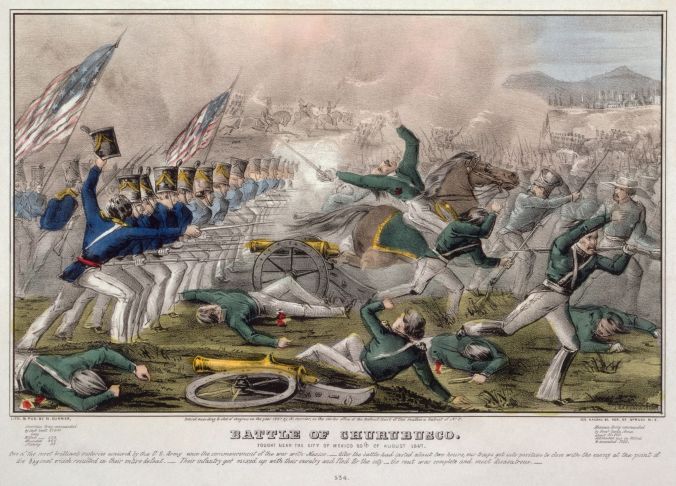
We need stories to go with all our studies. We need stories about ecology and mathematicians and social movement. If we are truly to understand the Mexican-American War, we need the stories from Polk and Taylor and Perry; of the San Patricios, enlisted men and others who moved to the other side; of Americans, Mexicans, and native peoples who fought and died and the ones left behind; and the stories of those who came after. There is more than one true narrative.
We need all the stories if we are to make sense of our lives, too. Our lives are not high school classes, neatly divided into discrete disciplines. Our lives are complicated. Our lives change all the time. Our lives matter as story.

