LET THEM EAT CAKE

33688037_10217044950302347_6133954008747868160_n

One of my favorite websites sent out a link to their recipe for confetti cake. It is made with artificial coloring (in the confetti), colorless artificial vanilla (for that true “box cake” flavor), egg white, oil, and cake flour (bleached). My husband and I must be the only people left in the world who have no nostalgia for cake made from boxed cake mixes. Truly, if you want those flavors, it’s easier and much cheaper to go to a (bad) bakery and order your birthday cake.

I worked in a wonderful bakery that made the Danish dough from scratch but used an “apricot” glaze packaged in gallon metal tins and took orders for “bakeoff” pies that  were premade and frozen off site and merely baked in the bakery oven. The ingredients? I could not even begin to say, but by my twenties I knew enough not to eat one.

Continue reading

and MORE

fullsizeoutput_1183

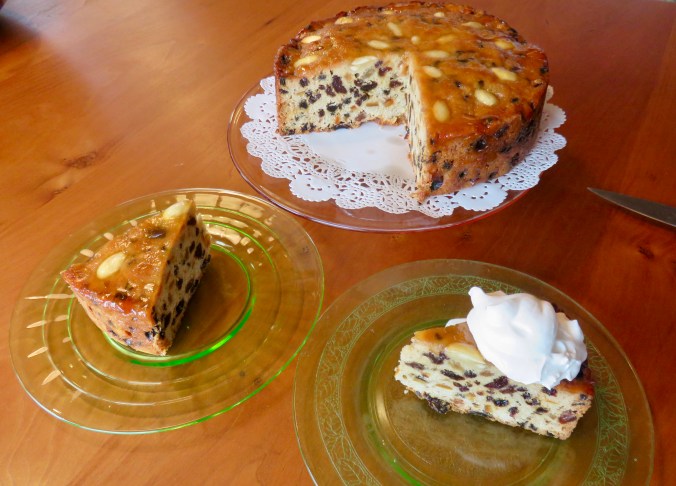
Gary loves fruitcake, even the awful gumdrop sort which I would not even use as a doorstop. I like the real thing. I made a traditional wedding cake for our wedding in 1974, a dark, aged cake from a nineteenth century recipe. This is what our family regarded as a wedding cake: fruitcake with white sugar frosting. That one was made with candied fruit from the Seattle Public Market, raisin and half orange peel punched from giant glass jars. It was a rich and aged cake, darkened with cocoa and brushed weekly with rum, but this is his favorite of all time. The Dundee cake is also made with “real” dried fruit, and a lovely golden color. Good luck aging it more than a few hours. I always use all organic ingredients.

Dundee cake

Continue reading

HUNGER

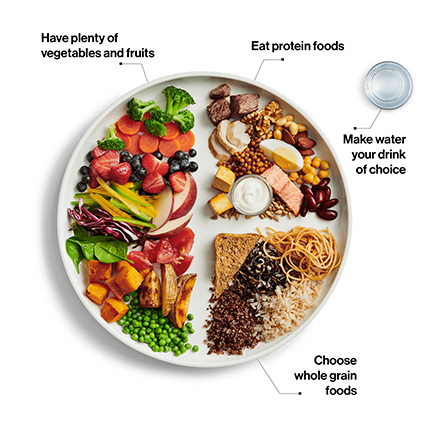
I have read Berkeley Wellness Letter for years. In their latest report they applaud the new Canadian dietary recommendations.

Canada food guide-1.jpg

“Canada has done away with the dairy category altogether (instead including dairy as just one of many sources of “healthy protein foods”) in favor of reminding people that water is the best beverage overall. Its previous guide advised two to four servings of milk (or milk alternatives) a day, depen­­­­ding on one’s age.”

The USDA continues to emphasize meat and dairy in diet because “unlike Health Canada, whose sole mission is to improve the health of Canadians, the mission of the USDA is not only to safeguard the health of Americans but also to promote agriculture production (including meat and dairy foods)—which is a conflict of interest.”

Intense lobbying has created the plates Americans are encouraged to eat. Advertising supports the industry paying for it. Advertising and industry-biased research has fed us a pack of lies.

We have lost faith in dieting as a way to control or lose weight because the soda industry has devoted millions to convincing us, often through bogus research, that changing what we eat (and how much) will not work. Hello. What we eat matters. What we eat, how much, and when does impact our body weight. Exercise is critical for a healthy body, but what we feed ourselves matters most of all.

I share this in full knowledge that I eat badly, that I should lose weight, and that baking rugelach and cake is one reason I have gained weight over the past year. We have been vegetarian/pescatarian for decades, and there is little chance of our abandoning dairy any time soon (cheese!) but we hope for small stage changes toward more vegetables.

The colorful illustration above does not represent how my husband and I eat. It is entirely different from how my family ate when I was a child. In those days our plates were half brown (meat), a quarter each green or yellow or orange (peas, corn, carrots) and a quarter white (potatoes). In my childhood a salad meant chopped iceberg lettuce and Catalina dressing (sweet). Dessert was something large, sugary, and baked, cut into four pieces. Sweet drinks vied with whole milk (or powdered milk in lean times). It was a diet driven by culture and industrial interests, not health. Our meals were all too valid and sweet.

“Eat food, not too much, mostly vegetables.”

The very concept of meals has disappeared in our country. We eat all day, though recent research strongly suggests that we are meant to feel a bit hungry each day. Breakfast is intended to break a fast of at least 12 hours. We are meant to feel and to be empty. People all over the world literally starve, but Americans are deeply afraid to feel hungry and so we snack and nibble and “graze” all the hours we are awake. We encourage our children to develop lifelong habits that will impact their health and shorten their lives.

The way we eat is not healthy. I should have seen this coming when the sleep surveys I have been completing online began asking me not only about hours of sleep, sound, lighting, and how quickly I got out of bed in the morning, but also how many nights I went to bed a bit hungry. Never, I responded. But then I wondered and sure enough the research began to come out.

Eat within a 10-12 hour window, between 7am and 7pm, for example. Or between 7am and 5pm. Fill our plates with vegetables. A little grain, a little protein. (Protein is actually easy to come by. Almost everything we consume contains protein.) One large meal, ideally earlier in the day. One very light meal, ideally the last of the day. (Or first like the French, back when we envied how they were all so slender.) Give your gut a rest overnight. Feel genuinely hungry for a few hours. No, you are not “starving” when you feel a bit hungry. Each day I hope to experience just a little “hunger” because my body needs a rest from eating.

Berkeley Wellness Letter also warns that by midcentury “the world will have nearly 10 billion people. One looming challenge will be how to feed them healthfully and without wreaking even more havoc on the environment. Our current eating habits, especially in wealthy Western countries, are responsible for creating an excess of greenhouse gas emissions that contribute to climate change, largely due to our penchant for red meat and other animal foods. What’s more, the typical Western diet plays a major role in obesity and other chronic health problems; meanwhile, millions of people elsewhere are undernourished.”

I need a break from feeling full.

I need a different fullness: Full of hope. Full of passion. Full of intent and wonder and admiration and love. I am hungry for conversation and compassion and kindness. I am hungry for productivity and purpose.


on another note: Today is Zora Neale Hurston’s birthday.

not a YEAR END REVIEW


fullsizeoutput_116b

I just reread my year-end reports from 2018. (I have some work to do.) One of those posts was about what I had read. One of them had to do with paying for college. My mother was famous as a worrier, which was not great but did result in a daughter who was careful about money.

My husband and I have managed full retirement quite well financially. We are maintaining a small reserve in the bank, taking a day now and again to travel nearby and stay the night, and thinking ahead to what we need for the future. We need a new roof and some other major repairs. Our wood-burning stove needs replacing—it’s necessary in a location where the power routinely goes out in the winter, usually for a day at a time, but sometimes for a week. All of this means we have decided to budget more tightly in 2020 in anticipation of these expenses. We got through college without debt and entirely under our own steam because we had cheap habits and careful spending. Some of that is still true. We still do not smoke or use drugs. We drink good coffee and cheap wine. We have not eaten most meat for decades, not because we disliked meat, but because it felt morally wrong the way animals are raised, and increasingly dangerous to our health and the health of the planet. We eat organic food but plan to be completely vegetarian for the rest of this new year, abstaining from our habit of seafood once or twice a week. We’ll see how that goes. But cheese. We both think we will always have cheese.

This past couple of days we had our children and their children here for a visit. The the tea party for the kids was a bust, but we walked the beach and I knit with Ruby. There was a scavenger search around the house with written clues (thank you, Emily), The Family Stone (thank you, Kerris), and eleven for dinner last night. There was a lot of food. My baking and cooking plan included a detailed timeline for chili verde, sautéing mushrooms and onions, roasting various vegetables, poaching salmon, putting together frittatas, frying latkes, Waldorf salad, pumpkin custards, cranberry bread and also orange-cranberry sauce, wild rice, and rugelach. I made vegetable stock. I cooked like a crazy person. Saturday morning, I baked two loaves of bread—which was not even on the list!

We managed. Everyone is gone now because of work tomorrow, and I would be feeling pretty great about now but did not sleep last night.

You do your best, and the best is never perfect, not even close. But you hope that the people you love most in the entire world understand you are imperfect but trying hard.

fullsizeoutput_1161

LATKES

IMG_5302

The last sweet potato latke, with cranberry sauce on a Rainbow Gate plate.

We have family coming for dinner next week, and I am test-driving family recipes and trying out a couple of new things. I hope to serve Waldorf salad (without nuts or brown sugar), cold poached salmon with sauces no one is allergic to, the mushroom-and-wild-rice casserole (without flour or butter or cream), Brussel’s sprouts, and “the chocolate thing” I used always to make for my college classes (without dairy or refined sugars or nuts). And latkes for Sunday breakfast.

Continue reading

PASTRY

fullsizeoutput_1131

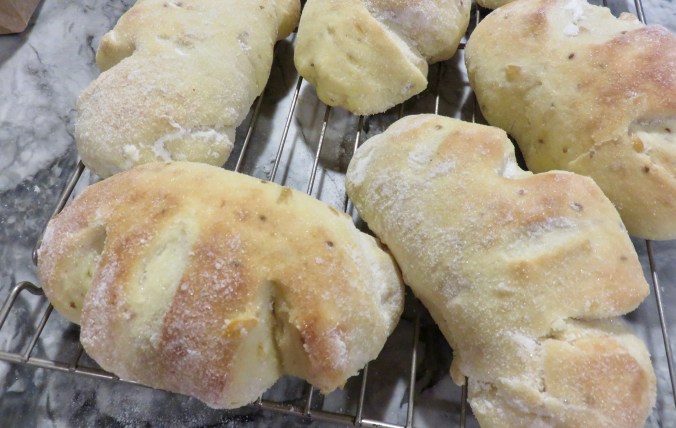
I made gibassier last evening. Fourteen brioche-rich rolls with both butter and olive oil and scented with orange flower water, anise seed, and candied orange peel that I made last winter. The previous night I made the preferment, and I completed the dough in the late morning, then two rises, and they baked in time for us to have gibassier for dinner.

After several experimental slashes, I figured out how to replicate the cutting and slashing we are used to from Pearl Bakery. (But then I created my own method.) The pastry looks different from each maker, though there are not many makers on this side of the world.

I had to do this bake because Pearl Bakery, one of our Portland destinations, has abruptly closed. Ten years ago I looked online for the Pearl’s distinctive pale sweet rolls, but I couldn’t find a reliable recipe. The day before yesterday I found a half dozen. The pastry traces to southern France. M.F.K. Fisher was given gibassier after Midnight Mass, but I do not have her recipe or the one pretending to be her recipe. I used the one from The New York Times that is measured entirely in grams—even the water and other liquid ingredients. That one might actually be PB’s recipe scaled back for a home oven.

Ten minutes of measuring and mixing Tuesday evening, and seven hours of mixing, rising, cutting, resting, forming, rising, and baking. (None of this was difficult, mostly waiting, but it did require attention over nearly 24 hours start-to-finish.) Then, hot from the oven, one last step: brush one at a time with melted unsalted butter and shake in a bag with fine sugar. Cool on a rack for as long as you can stand to wait.

They are light and not too sweet even with their dusting of sugar. Several recipes included a recommendation that they may be frozen and then thawed and warmed for 3-4 minutes at 375°. I froze eight of them once they fully cooled.

CHEESE

My husband and I both grew up with Velveeta, which is not really cheese at all. I remember my father loving blues and sharp cheddars, but my brother and I were fed toasted cheese sandwiches made with horrible pre-sliced white bread, Velveeta, and margarine. That “cheese product” melts like glue. I am embarrassed to admit how much we each loved these sandwiches when we were little.

We grew out of that. Our sons, as far as we know, never tasted Velveeta.

Tillamook cheese was a major step up in adulthood, and we bought the large five-pound blocks of Tillamook cheese, usually “medium” sharp. The special black wax white cheddar is not too bad. But no, we do not buy Tillamook cheese anymore. We use Dubliner as our basic cheese, but there are three or four others in my cheese drawer at the moment.

Last year we considered ordering an entire wheel of Stilton or even of organic Rogue River Blue as a gift to ourselves, but backed off at the last moment. The cost is equivalent to a large grocery cart from Whole Foods.

This morning I have been reading recipes for koiugn amann pastries and tortelli [darn that auto-correct fixing what ain’t broke] with a sweet/salty filling and soups with lentils and sweet potatoes and caramelized onions. One of the recipes called for an Italian hard cheese I had never heard of, Grana Padano, and that is how I found myself looking at wheels of blue cheese.

Do we want to spend over a hundred dollars for five pounds of cheese?

We might.

There are worse things than buying expensive foods. What passes for a “good meal out” often disappoints. There are plenty of foods from our childhood we hope never to taste again: Hi-C, KoolAide, French’s mustard, Wonderbread, Hostess “bi-products” (Gary’s name for Twinkies and the rest of the line), canned (dyed black) olives, canned stew, canned chili, canned baked beans (all the canned main dishes that saved time), sweet salad dressing (yes, Catalina dressing, I am talking about you), tinned ground pepper, fake maple syrup and fake vanilla (yes, the flavors are different, Mom), instant potatoes, and Jello.

My grandmother baked everything from scratch. My own mother learned to bake her weekly four loaves and everything else, but was eager to adopt all the modern conveniences in the 50s and 60s. I am a throwback. Real olives and real vanilla and real maple syrup were revelatory. While I was still eating meat I learned to roast a beautiful chicken stuffed with sliced lemon and onion, beef bourguignon with red wine, chili verde with pork shoulder.

I like playing with flavors and I love to both bake and cook. A friend sat at our table and asked me with suspicion what was in the dish I set before him. I told him and he was a bit put off, but then he asked for seconds so I guess the combination was not a failure, though I can’t recall now what I put on his plate.

My combinations are not always successful, but experimentation is how I found mango slices on spinach and cheese tortellini and grated parmesan over the top, cumin in most soups, and good french tarragon-dijon mustard on toasted cheese sandwiches made with two kinds of cheese.

Food is good.


iu

Though I wrote this blog post instead of focusing on the novel, I have over 23,000 words this morning.

THANK GOODNESS

IMG_3405.jpeg

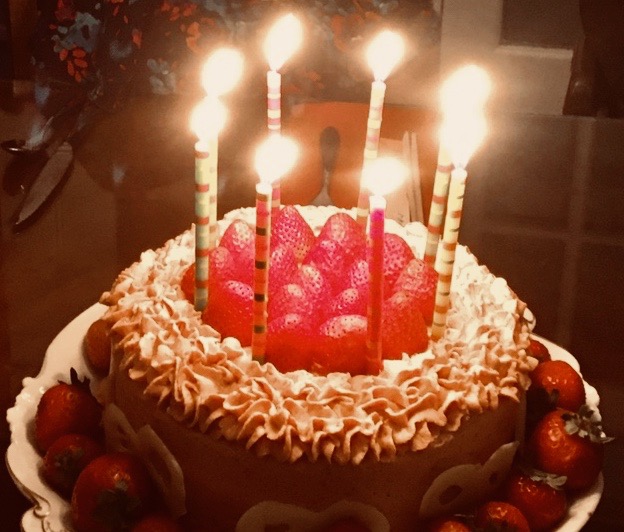
Three layers of vanilla sponge with strawberry jam and a lot of strawberry buttercream flavored with jam and powdered organic freeze-dried strawberries!

She liked the cake, though she was not expecting pink frosting—and to think how hard I worked to make it both pink and tasting of strawberries! (I cropped her from the photo to preserve her privacy, but my granddaughters, both of them as well as my grandson, are delightful!) She likes the white chocolate 8s best, I think. It was a flying visit, and we were pleased to see family.

This morning I have 17k words for NaNo, though I wrote barely 200 words on the birthday.


SUNSET PIG

fullsizeoutput_10fd

…you might kiss one.

A group of at least a dozen people stayed next door this past weekend. (Gary says they were likely Swedish because of the white caps and running about barefoot on the sand and even in the water in November.) They took over the depression where Gary had his fire last week and burned two thick root knots that he’d left, plus some purchased firewood. They did not burn the log they sat on in the evening, which is a blessing. Tourists tend to lay huge drift logs over their beach fires and then walk off when they discover that the log needs hours to burn. Thankfully these people had a nice-sized and perfectly legal fire and then put it out before going to bed. (Gary hoped they might leave the remains of their cedar kindling, but they didn’t. Did it go all the way back to Sweden?)

The wood chairs still need painting, but a plastic chair Gary rescued from the rocks where it had drifted on high surf last month can stay out all winter. You would have thought I could manage to paint those chairs over the summer, but it didn’t happen and they stay under cover till I get them done.

There are a lot of other things I did not get done in the past months. I meant to make my oldest granddaughter a cardigan and two dresses. What was I thinking? I have not sewn a garment in decades. But like most women of my generation, I learned how to sew in school. I made a pullover cotton shift in seventh grade and a wool skirt the next year. My mother hated to sew but she taught me too. The last garment I can remember sewing was pure cotton onesies four our youngest son born in 1982. American companies were not making cotton clothing for babies because of flammability issues. We neither of us smoked then or now, so I found a pattern and learned to machine-sew cotton double-knit jersey. Dark green with rainbow trim. Bright red. I don;’t suppose I even thought to take a picture, though I can picture them in my mind’s eye even now. But now I can find organic cotton for babies and children, which is even better.

iu.jpeg

I am over 12k (of 50k) on my NaNo challenge this morning, and I seem to be writing something unexpected. I meant to rewrite a very old manuscript, but instead I am writing something new. It’s true I am using the same principle character and I imported a few pages that I had already reworked over the years, but even without those pages, I am ahead of schedule.

The best part? I am not sure where this story is going. And maybe even better (so the best-best): it’s funny. I have not written funny in such a long time. I have been giving the chapters titles a la Forster such as “In which Alice tries to solver her personal problems with a hammer.” So that is happening. And barely into the fifth day of November.

A strawberry-frosted cake is tricky in November. She wanted fresh strawberries and I avoid them out of season. No avoiding them for my granddaughter. A light vanilla cake, though I am partial to and only experienced with pound cake. I made a run at three cake recipes and strawberry cream cheese frosting. That last was not a win, though it tasted good enough and was a pretty color. I ordered freeze-dried strawberries, organic freeze-dried strawberries. Powdered in the food processor, they are a rich color that thinned down to a pretty pink. (I mean to try Swiss buttercream as soon as I get my hands on the right sort of instant-read thermometer.)

There is a cake in the fridge. Two pounds of out-of-season organic berries. I had dreams last night about making cake.

Gary and I both had a sore throat and sinus issues, but we seem to be better now. Our sore throats completely gone, no fever ever. I had to put off baking the final birthday cake till yesterday when I knew I was healthy again. Took my time. Photos later.


JAM INSTRUCTIONS

fullsizeoutput_107b

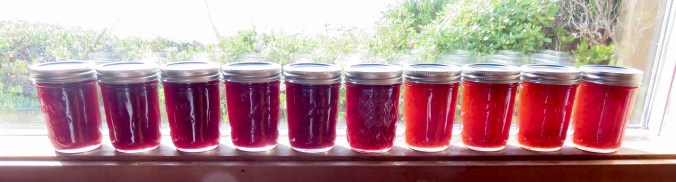
Here’s what I made the other day: ten (and a half) cups of two different pepper jams.

Basically, for any jam using pectin, you prepare fruit, add powdered pectin, bring to a full rolling boil that will not stir down for at least a couple minutes, add premeasured sugar and return to a full rolling boil for another minute, ladle into sterilized jars, ensure the rims of the jars are absolutely clear and clean, top with one-use metal dome lids, tighten on reusable metal rims, invert jars until cool enough to handle, turn right side up. By the time they are mostly cool, the dome should sink indicating the seal is good, often making a tink sound when they do, but not always.

NOTE: Nearly all current canning instructions require a boiling water bath to ensure the jars are completely sterile. My canning experience predates this recommendation. When I canned tomatoes and stone fruit and sauces in quart jars back in the day (the 80s), I used a boiling water bath. I have never done this with jams or marmalades or chutneys. I keep everything boiling hot when I fill and seal my jams. I have never had a problem.

PREPARE: Have everything ready before you begin.
fullsizeoutput_107c

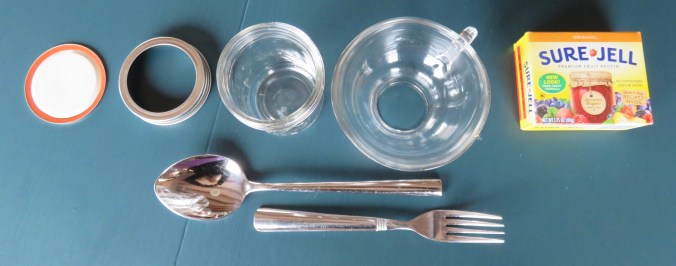
Dome lid, screw-on rim, half pint (1 cup) glass canning jar, glass canning funnel, commercial pectin, with large spoon for skimming and the fork I use to fish the boiled lids out of water.

Wearing gloves, prepare fire-roasted hot red peppers, by rubbing off the charred skins, splitting open and removing seeds and any tough membranes. I did this in the sink, one pepper at a time over a fine sieve placed in a colander, and under running cold water.

Measure out sugar in a bowl and place by the stove.

Put clean glass canning jars in the dishwasher without soap on a hot wash or sanitizer wash. Plan to begin making the jam at about the time the cycle will finish (my dishwasher tells me how many minutes it has to go). Keep the dishwasher door closed except to remove one jar at a time so that they are hot when you fill them.

Place the dome lids in a saucepan with water and boil. You will also need an ordinary fork or tongs to pluck each one out of the water as you need it. The screw-on metal rims do not need to be sterilized.

Set out a ladle, large spoon, small bowl for skimming foam, large canning funnel. Mine is glass.

Put peppers in food processor with blade and process till semi-smooth. Add vinegar and briefly whirl. Add pectin and whirl till combined.

1 pound of fire-roasted hot red peppers

1 cup cider vinegar 

packet of pectin*

(The packaged recipe says to measure the prepared fruit, but I almost never do that.) Place in a 6-8 quart kettle and bring to a boil, stirring constantly. Boil and add

4 cups of sugar

Return to a boil, still stirring, and here is why you need a really big canning kettle because it foams up high. I use long-handled bamboo spoon to stir and a 6 quart Le Creuset dutch oven. Mine is dark green on the outside and very pretty. I turn off the heat (usually while it’s in its last minute of boiling because the cast iron holds the heat for so long) and quickly use a large spoon to skim off foam into a bowl. There’s nothing wrong with the foam, it just shouldn’t go in jars since it’s mostly air. I use a cloth to hold the jars while I tighten on the rims since they are literally boiling hot. I tighten the rims by hand—that’s tight enough. After a day, I can remove the rims. The lids do not need them once they have sealed and cooled completely.

This yields about 5 cups of jam. Except I didn’t do it quite like this either time.

BATCH ONE: Since I cannot follow a recipe exactly. Ever. I made two batches. The first used the last 12 ounces of strawberry shrub I made earlier in the summer and feared I would not finish while it was still good. Since shrub is basically fruit and sugar and cider vinegar, I swapped out the shrub for the vinegar and 1 cup of sugar. So . . . one and a half cups of shrub instead of the cup of vinegar and three cups of sugar instead of four. The jam is a pretty and intense red. Shown at right in photos. The black flecks are tiny bits of charred skin from the fire-roasting. I think they are pretty so I am not too obsessive about fishing them out, but you might think they look nasty. I do fish out any seeds I missed.

BATCH TWO: The other batch has wild black huckleberries. I bought three half-pounds from the vender at Portland’s Farmers’ Market, as I try to do each year. (I used to pick them myself, but lately all my wild berry patches seem overrun by tourists.) James Beard’s Huckleberry Cake (one of two recipes I do mostly follow, and you can find it online by searching the name) calls for a cup of huckleberries. When I packed most of the berries into 1-cup parcels for the freezer, I discovered I had hoarded a cup, still in the back of the freezer since last summer and well past its best-used-by date. I thawed and added that 1 cup of Oregon black huckleberries to the peppers without making any other adjustments to the recipe. It turned the jam dark red-burgundy. Shown at left in photos.

Both batches went well, though I had not quite a fifth jar from the first batch. I added this to the last bit from the second batch of five full jars, reboiled (yes, you can do this), and then got the tenth jar. All ten sealed and were set by the next day. Sometimes jams need a day, and sometimes do not “set” (turn thick) at all. That’s happened to me with marmalade a couple of times.

My cast iron kettle takes a long time to cool, and all the time it’s doing that, the last bits of jam—too little to fill a jar—simmer and steam—going thick and possibly scorching. I added water to the kettle—just a splash—and stirred it in so that I could scrape down the bottom and sides and salvage the last of the cooked jam. I got another half cup that cooked right down into jam of proper consistency. I put a spoonful on a scoop of vanilla ice cream last night. Mixed jam shown in middle of top photo, fifth from right.

I mean to make green poblano pepper jam, but my husband wants chili verde, so I will need to combine a half pound of peppers with something else. I have Italian prunes . . .

*I am not entirely comfortable using prepared pectin to thicken my jam. I use all organic fruit and organic sugar, so MCP or Sure-Jell is not an entirely happy addition. There are alternatives. I could boil the fruit down to make it thick, but I wonder what that does to flavor and nutrition. Boiling down apples is the obvious and readily-available alternative and the traditional technique. Apples naturally have their own pectin so they don’t need any added. They make jelly without anything added but sugar and lemon juice (most apples are way too sweet these days, lacking acid). I have also used other fruit to thicken my jam. The local salal berries have enough natural pectin that I combine them with blackberries to make a dark purple jam without added commercial pectin, but we didn’t have any blackberries this year. Another wild berry, aronia berries (chokeberries), native of the other coast, also have a great deal of pectin and I have used them with great success alone and combined with other fruit.

Properly made and sealed jams and preserves with keep a very long time. My last meat meal was the last quart jar of canned mincemeat (made with venison) that I’d lost at the back of a shelf. It was at least two or three years old. I could not resist making a last mincemeat pie. The animal was long dead and I see no virtue in wasting food. (And I did relish mincemeat once upon a time. I am not vegetarian because I “never liked meat” but because I didn’t want to eat animals I would not want to kill.)

I always make jam and not jelly, because I cannot bring myself to discard the solids, and I actually like eating jam more than jellies. The transparency of the latter is pretty but jellies lack the mouth-feel that I enjoy.

The amount of sugar in any preserve can be halved (which I’ve done) or even eliminated (which I never have), but the jam must then be refrigerated until eaten within a relatively short time. Strawberries, it seems to me, could be boiled down without any addition and eaten as “preserves” but from the refrigerator.

Alternatives to cane sugar include honey, which foams like mad. Use slightly less since honey has more sugar cup-for-cup than granulated sugar. (I know, weird.) Minimal amount of maple syrup works, too, but again, refrigerate. Date sugar or coconut sugar would probably work too. A boiling water bath might seal and sterilize jars with less sugar, but I have always understood the acid-and-sugar balance is critical to safe canning.

Even so, while I mostly follow the instruction in the pectin packets, I fiddle, and often add something like fresh ginger or combine fruits and berries, always careful to add lemon or lime juice that seem called for, especially in very sweet fruits. The acid is critical.
fullsizeoutput_107d

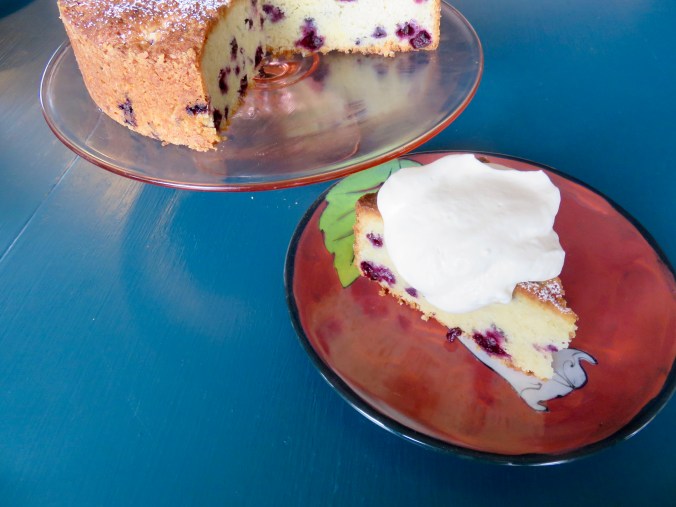
James Beard’s Huckleberry cake. Beard wants the cake served warm with whipped cream, not hot or cold, and I can testify that it is best that way. Sometimes I make it in two 6″ pans and layer it. The cake is still excellent even days old, if it lasts, which it usually won’t. I have frozen berries for five more cakes over the next months. A close second to lemon Angel Pie.