BAKING

IMG_6740

My black plum upside-down cake. I made this yesterday morning and we ate the last of it this morning for our breakfast. The plate is from Rainbow Gate, a Santa Fe studio.

Bread is on the first rise downstairs and I meant to come upstairs and work on the new quilt. That was what I meant to do. I bake most days, and I do that because I enjoy baking.

I took up cooking and baking while I was a teenager partially in contrast to my mother. I saw it as an opportunity for creativity. My mother saw it as drudgery. My mother was skilled but unimaginative in the kitchen. Resistant. She was of the generation that produced syndicated columnist Erma Bombeck (1927-1996) who wrote a series of satirical books about Midcentury Modern Life with titles such as The Grass Is Always Greener Over the Septic Tank and If Life Is a Bowl of Cherries, What Am I Doing in the Pits? Continue reading

BEAUTY TOO

fullsizeoutput_139e

This single-flowing pink rugosa rose has an intoxicating fragrance and set huge apple-red hips. I let the hips set each year hoping to make jelly, but the chipmunk gets them every time.

Two months ago I wrote here about beauty and about the storks nesting in England for the first time in a hundred years. It seems a long time ago.

fullsizeoutput_139b

This lacecap hydrangea grows under, around, through, and over the windswept pine in our front yard.

Yesterday, for the first time in over four months, I ate a meal I had not myself cooked. It was a risk and we will not likely do it again any time soon. Most of our favorite places to buy food are closed (Ove NW and Pearl Bakery) or they have demonstrated a certain level of complacence or carelessness. And I am a decent cook and baker myself. Yes, I can bake a cherry pie starting with a hallock of sour cherries if I could get to the Farmers Market to buy them. I was baking sourdough before the pandemic. Usually by this time in the summer I have frozen pesto and huckleberries and the makings of pies. Instead my freezer looks barren. Continue reading

HALFWAY

fullsizeoutput_12a1

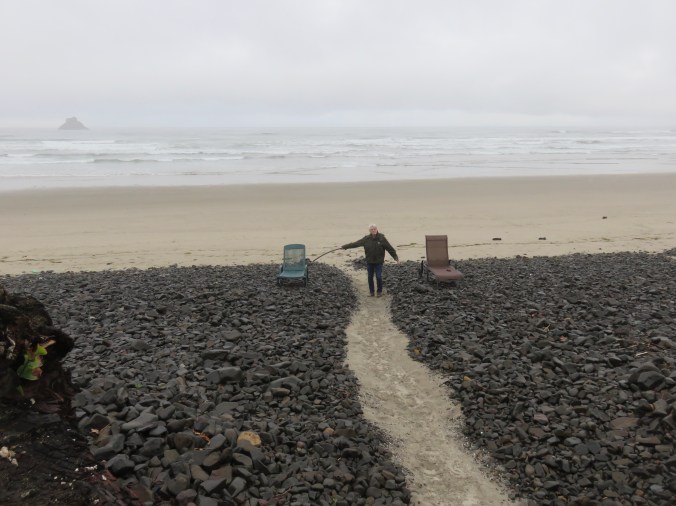
Gary standing in the path he built (and has had to rebuild several times) through the rocks. We hope we will be able to turn the loungers around and safely enjoy a 4th of July fire on the sand. (We half hope someone takes these lounge chairs—one of which we found.) That’s a bit of beach trash in Gary’s hand, a length of plastic pipe he carries to poke at the sand.

Today is halfway through 2020 and it’s a good place to pause and take stock. For many human beings this has already been a tragic year on so many levels, so I feel I need to access my situation.

We are both retired so we’re doing fine as far as finances go. That is, unlike so many who are without income such as one son and both daughters-in-law, we still have Social Security. Everyone in our immediate family is healthy but several have continued working in essential services. We have been isolating since 10 March with one exception: our younger son and his two children visited for a weekend sixteen days ago. We are still healthy because they are still healthy, masking and taking other precautions. Other than that, we have the habit of weekly grocery shopping with the occasional extra trip out to pick up mail or deliver mail to the nearest mailbox.

At the beginning of 2020, I set a couple of goals that are still valid. We gave up seafood from our diet. In six months, no seafood, again with one exception: there is fish sauce in my pantry and I made an umami-rich sauce that I’ve used in bowls with fresh veggies and pasta or rice.

The other goal was to purchase no more than eight items of clothing the entire year. I have bought three garments from Eileen Fisher on steep discount (more than 60% off). EF is a highly responsible company and I am glad to support them. Do the two hair clips from eBay count as clothing? Does the replacement headband for the one I’d worn since the 90s but lost on the beach count as clothing? Either three or six purchases, either I am doing fine or this is not looking promising for the second half of the year.

In the past four months I have cooked angelhair pasta at least a couple dozen times (a simple one-pan meal cooked with vegetable stock and with greens, onions, and/or cheese), baked a couple dozen loaves of bread, made gibassier and waffles and spring onion pancakes. I have made curries and vegetable stews and spiced grains. I discovered that a rich soup can be made with leeks and water and salt and pepper—simple as that. Yum. We have eaten pounds of broccoli and uncounted bags of various greens.

Last month I killed my sourdough starter, but I have grown a new one. It tastes fine once it’s baked, but the smell is rather alcoholic than sour. That’s because the “All-Purpose Unbleached Flour” from Costco has barley mixed with the hard red wheat—I didn’t even notice until a local friend and I were comparing notes on our sourdoughs and she said her sourdough had gone rather alcoholic too. A step shy of beer, but . . .

One of my best discoveries is organic miso available at one of the stores we shop once a month. I now have both white and red miso in the fridge! Also, salad greens sauté well with pasta.

My root canal is still sore. I gained back the four pounds I lost. I am not running. sigh

Three packages that we ordered in May have not arrived and we assume now all three are lost. Gary’s CD of Estonian music and my handmade doll from Russia both vanished somewhere in the Baltic. They left their country of origin and never arrived anywhere at all. And the painting—Oh, that painting I love so much—UPS lost track of it at their hub outside Chicago and has issued a refund to the shipper. The refund has been forwarded to me, and I will do the responsible thing and set it aside toward our property taxes.

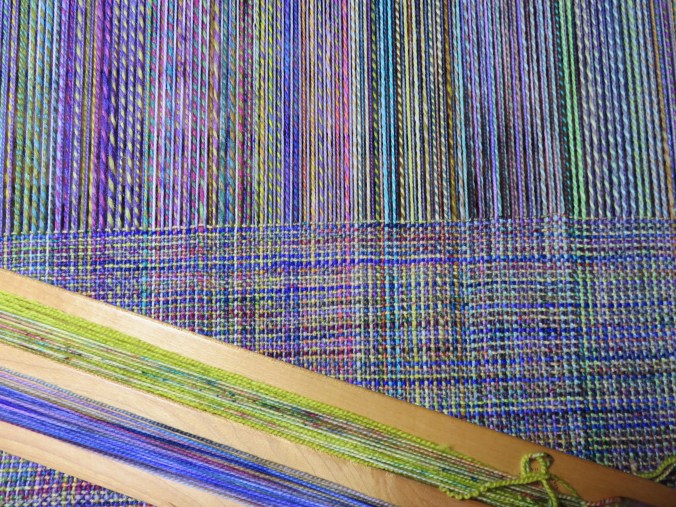
This year, I have ordered eleven skeins of yarn. I use fourteen for each warp and that much again in weft. This means that the four seven warps I have put on the loom since January have yielded nineteen and a half shawls so far. I am generally still weaving past 7pm. After six months work and subtracting expenses, selling them all might yield a couple weeks or even a month of minimum wage pay, but who’s counting?

I pieced the top and back of a quilt that is waiting its turn to be quilted.

Butterfly Fontanelle has gone through revision three times and I am halfway through reading it aloud again. Tiny changes this time, little corrections but since I am still finding things to repair, change, and move, I will need another edit when I finish this one. I am always in too much of a hurry to send out work. Did it this time too, but I have sent it to a slow responder that does not allow simultaneous submissions, which will ensure I do not send it out again until winter.

This morning I caramelized my last two onions to top macaroni and cheese made with the last of the Stilton, mozzarella, Parm, and with a scattering of dried cranberries because our taste has shifted to sweet and savory and salty all at once. I had only two cups of milk until our next shopping trip so cooked twelve ounces of pasta. It’s in the oven.

At our next shopping trip everyone in the state is required to be masked. Yeah, July 1st! (And about time.) But neither the local sheriff and nor the parks department plan to do a thing about what happens on our beach on the 4th. The one time we tried calling the fire department about a beach fire that was over twenty feet high (absolutely not exaggerating—it flew up another ten feet), the volunteer fire department dismissed our concern. The local millionaires are allowed. “With the rich and mighty, always a little patience,” according to Jimmy Stewart’s character in Philadelphia Story.

I read the news every day—NYT, WaPost, NPR, Guardian—even on the days I swear I will take a break. I study covid-19 statistics. Gary reads different news’ sources. Between the two of us we cover the world. Apparently we are much better informed than the President of the United States. That’s because we read. I have read 34 books so far this year, including nonfiction, memoir, poetry, and novels. Streaming (no cable) we are currently particularly fond of watching Midnight Diner (again) and we finished Somebody Feed Phil on Netflix, even though Phil eats so much meat! Detectorists remains Gary’s all time favorite. On recommendation of a friend, we tried again to watch it and decided we liked Shitz Creek after all. We look forward to Monty Don and Gardeners World on Friday nights. We paid to stream two current release movies and they each had their good points, but we’ve found better distraction and information and drama via our subscriptions.

The hall where I meant to paint is not finished, but Gary and I are scouring the house for set of essays written by a former student. Gary is not optimistic, but our search will be thorough. I was fond of those essays and kept them and still trust they must be here someplace . . . I hope. In the mean time, searching has forced us both to sort and clean. It wasn’t how we planned to spend the week, but it needs to happen.

There has been a lot of cleaning house going on throughout our nation. Statues of treasonous and racist men are coming down. Men who did nothing for our country other than attack it. Comment on national websites point out that even Benedict Arnold fought for our nation in several important battles, long before turning against our country, and no one celebrates him in a public statue or named a military base after him. Laws are changing. White people are taking long, difficult, honest looks at their own privilege and insisting to themselves and the world that we can do better. As hard as these days are for so many and for so many reasons, this is reason to think we might actually accomplish some good in our nation.

My husband and I still get along fine with one another. We are sad sometimes. We nap too much. We worry about our children and the world. Too much. Half of a year and too much has happened to claim anything except hope. There is hope.

We have rewatched the first seven and a half minutes of the pilot of The Mentalist a dozen times in recent months. “Seriously, it’s not as bad as it looks.” And every time, we laugh.

How could I forget making chutney and two kinds of jam?


BREAKING EGGS

fullsizeoutput_1182

Do you know where your food has been, who touched it, who breathed or sneezed on it, how it was prepared?

Annia Ciezadio insists in The Washington PostThe safety problem for restaurants isn’t the dining room. It’s the kitchen.” Restaurant employees work in close quarters and are too rushed to take proper safety precautions, most do not have health care coverage and cannot afford to remain home when they are sick. They work anyway.

And managers do not stop them. They want cheap labor.

Undocumented labor is in a particularly tough position when it comes to staying home while sick. In many restaurants they are the invisible workers doing the hardest and dirtiest tasks such as using high pressure sprayers to clean dishes (and blowing mist into the air all over the kitchen). In my county 84% of those diagnosed with coronavirus are Hispanic. As in many places in our country, the main outbreaks have been in animal processing plants, locally that is seafood. The work is hard and even dangerous, and proper precautions to ensure both food and worker safety are perhaps lacking?

[Years ago ICE came through my county, and all my Hispanic students, whether documented or not, stayed home from school. The vice principal, contrary to law, had called the federal agency to report them. The principal had a fit because the job of public schools is, by law, to educate the public not to question citizenship. It was a question that as a teacher I did not ask. In the mean time on that long ago day, every restaurant in the county temporarily closed. I used to tell my students, themselves often called upon to work hours well beyond the legal limit for their age, that the only way many businesses stayed open was because of their labor and the labor of undocumented individuals. We do not want to pay.]

Sensible precautions seem too difficult even for some home cooks and bakers. I was reading an article online about the best way to separate eggs—removing the yolk from the egg white. In the comment section people complained the preferred method of removing egg yolks by sifting through fingers was annoying because they would then have to wash their hands right after.

I thought: you mean you do not wash your hands every time you touch eggs?

I wash my hands before I begin cooking and any time I handle something raw, especially eggs and even the carton they come in since I was taught to be cautious of Salmonella. “The U.S. Food and Drug Administration (FDA) estimates that 79,000 cases of foodborne illness and 30 deaths each year are caused by eating eggs contaminated with Salmonella.”

We cannot even rely on health care to take proper health care. Decades ago when half my family was diagnosed with giardia, a parasite carried by mountain beavers, the local clinic did not report the infection to County Health. But I had looked up regulations and so I reported it. The county had not had a report, the nurse said, in a couple of years yet the pharmacy that filled my prescription said they filled that prescription several times a week.

When my husband managed a grocery store (and was still eating meat) he stopped buying meat from his own store because he’d witnessed how his butcher handled product. When he later worked in a deli he only ate sandwiches he had prepared himself because one of his co-workers picked his nose while making sandwiches. That popular deli was regularly cited for health violations, the produce guy failed to clean his cases for months at a time (Gary wound’s buys produce there either), and there were rats that came out at night. One Whole Foods in Portland stank so bad near the meat department that I spoke to the manager about the smell. Gary speculated that the “diaper” under their meat cases was not being properly changed out. It was bad the next time too, and we stopped shopping there. Before the pandemic we had a wonderful Thai meal, but Gary won’t return to the restaurant because tables and dishes were not clean. We have seen servers handle both food and money without washing hands, despite what we fear lingers on bills. Of course these days most businesses will not accept paper money for fear of passing illness.

A dollar bill probably isn’t the greatest danger we face while eating out.

Too many do not even understand the most basic truths about illness. A friend said she never got a flu shot because she never vomited. She did not know that influenza is a respiratory illness.

So-called “stomach flu” is not influenza, but what is more accurately labeled gastroenteritis, inflammation of the digestive system—food poisoning—usually caused by food contaminated with a virus or bacteria—pickers who do not have access to proper restrooms, packers who do not properly wash their hands, preparers who sneeze without a mask, food that is unwashed or improperly stored or handled. Our food is often unclean and many Americans do not know how to manage food properly, or do know and fail to do it consistently.


ARCHITECTURE + CHOCOLATE

Robie_House.jpg

My dad used to tell a story about his first job at a California aircraft company. The new head offices had a problem. The roof leaked on the President’s desk and the famous architect who designed the structure refused to address the problem. “It’s a work of art,” he is supposed to have said. The CEO tore the entire building down.

I was reminded of this while reading an article in The Washington Post about how office layouts might change to ensure distancing and a healthier work environment.

image3

A student took a photo of me into Hagia Sophia so I could say I’d been there.

Gustav Pundt was among my favorite professors at the University of Washington. Hermann Johannes Gustav Pundt (28 August 1928 – 15 September 2000) was a leading architectural historian and Professor in the University of Washington Department of Architecture. I took his architecture history series in 1971, I think, and he introduced me to such wonders as Hagia Sophia (in Istanbul, Turkey), which is among the beautiful buildings in the world. His photographs of the interior, taken at a time when it was forbidden to take such photos, completely captured my imagination. Light flooded from a circle of windows at the base of the main dome. Magic. I have wanted to visit ever since. I really did love the guy for that.

As a student himself, Pundt participated in the restoration of Frank Lloyd Wright’s Robie House (1909, above) in Chicago, a beautiful building in the Arts and Crafts style, showing the influence of his Mentor, Louis Sullivan (the “father of skyscrapers”, but also a designer who appreciated detail). True, the Robie House was designed to have no blinds or curtains on any room, the leaded patterns dividing the glass was intended to ensure privacy. How did that work for the occupants? You decide. 

RobieHouseWindows_ChicagoIL

Windows in the Robie House. Most of the window is clear with only small bits of colored glass.

I was not a fan of the architect. The Johnson Wax Headquarters (1936) was a nightmare to my way of thinking: too many specialized brick forms (over a hundred molds which looked less innovative than inefficient to my 19-year-old eye), the glass tower continuously leaked (this was later corrected by the Johnson Wax company’s innovations, not Wright’s), Wright’s special three-legged chairs fell over, and it included the dehumanizing “open office” plan he’d used in an earlier office building.

The Larkin Administration Building (1906) is touted as the “first modern office” with entire floors left wide open for secretarial pools. If you have seen The Apartment with Shirley McLaine and Jack Lemmon, the open space where Lemmon is working at the beginning of the film is Wright’s fault. This “regimented approach, where workers sat in lines of desks with managers in offices surrounding them”—what fun. Today it’s blamed for the spread of colds and other viruses in offices. How to prevent the spread of covid19 in such wide open spaces?

The saddest part of this might be that I know all this because Pundt told his students all about Wright, warts and all. He loved the guy whose architecture placed function below innovation. So I did not agree about Wright. I want to have my cake and eat it. Give me a beautiful building that is also a pleasure to live and work in.

Johnsonwax02

Wright proved that his beautiful reverse “lily pad” columns could support weight. He did not prove that people enjoyed working in what he envisioned would resemble a “factory floor.”

Don’t even get me started on Falling Water, with the dysfunctional stairs to the water and unremitting damp (again, a detail thanks to his admirer—it was an unliveable house). Beautiful site and stonework, but, like so many of Wright’s designs, it fails its primary purpose. It’s a showcase, not a functional building. The Solomon R. Guggenheim Museum is showy too and notable for forcing visitors to look at art from a slanted floor. Yeah, I’m sure it looked spacey and futuristic in 1959. Now, to me, it’s just an ugly airport parking garage or an out-of-scale child’s toy.


Speaking of frustration and scale: We are waiting for two and a quarter pounds of chocolate to arrive.

I bought three bars of Theo baking chocolate back in December. Organic, gluten- and dairy-free, Fair Trade, and made in Seattle. Practically local. I meant to make vegan chocolate pots de creme when our sons and their families came for Twelfth Night. I ran out of cooking motivation before I got to the pots, however, and the chocolate remained in my baking cabinet until last week. I used two huge chocolate bars and pecans to make brownies last week. They came out so thick it was hard to get my mouth around them, and dark, very dark. I love dark chocolate. We each had a square the other evening and again yesterday because I put some in the freezer before we could gorge.

There is also a single 4-ounce bar left in the drawer, so I went to the Theo website to order more baking chocolate. It’s sold out. I checked Amazon, but they only have the same high cocoa content in 3-ounce bars. Back to Theo. Sadly, this Seattle company sells their candy cheaper on Amazon than directly from their own website. I ordered a dozen bars last weekend. Yes, I am weak.

Amazon Prime shipped FedEx. You probably see where this is going. Oakland. Seattle to Oakland, so far. Had it shipped USPS, I’d have my chocolate by now. It would have gone Seattle to the regional center in Washington, to Portland, and here. Three days. Instead, it shipped right past Oregon to California. If it were in Oregon by now (630 miles back north), that would not be so bad, but you know FedEx doesn’t work that way.

This is my current entertainment: watching FedEx ship my chocolate around western states. It left Oakland yesterday afternoon. Idaho next? Eastern Oregon? I was actually looking forward to finding it had gone to Wyoming, but this morning it is in Portland. There is still time for the order to wander through a few small towns or head back to Washington state. FedEx can prove that the meandering delivery routes are actually functional. Unlike some of Wright’s designs that were unusable, my chocolate will arrive at my house after it takes a tour, and is functional. I will make more brownies.

I am easily entertained.

CARNIVAL

IMG_5639

My third day working on the “Carnival” warp with just ten inches woven. (I discovered that the acid green I’d hoped to use was from a very old first dyelot of the color and the yarn itself thicker than the others. I finished off a very old blue skein like that in the recent blue warp.) Twenty or more inches today, I hope, and I will bake bread. We had salad last night for dinner! Such a relief after no fresh greens for a week. Salads for the next couple of weeks, and I have leeks to make leek soup, potatoes to go into the soup or for oven fries, cheese!, green beans I will roast tomorrow. Potato chips are a treat.  Continue reading

BREAD

fullsizeoutput_11bf

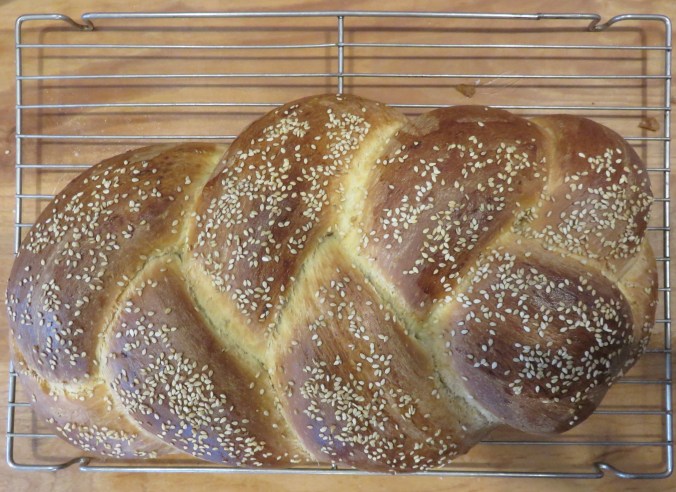
When I retired I intended to revive a college habit of baking a braided loaf on Fridays. I used to make it entirely by hand and I once broke a wooden spoon beating the sponge. This loaf is only three strands and I always braided four, but it’s a tasty loaf.

We have all our mail through this past Thursday. I baked bread the next day. We’re still getting our early walks, but there are unfamiliar people and dogs on the beach today. Yesterday the gale force wind was desperately chilling in the morning. Today is mild. So. Walking, baking, writing, and staying safe.

Continue reading

BLUETONGUE

fullsizeoutput_11c0

Gary has stuck a half dozen sticks in the front hedge for birds to perch upon, which they do. This robin had, when I went to get my camera, perched on the tip of a different stick.

Almost 40 years ago, a friend was working on the bluetongue virus at Colorado State. Though this work was done in a lab with masks and gloves and all the protocol of any university lab researching a disease, albeit one only infecting sheep at the time, there was an issue. Routine screening revealed that she and the head of the study became the first human beings to test positive for the disease. She seemed oddly pleased, or at least excited by the news. Continue reading

LIFE EXPECTANCY

fullsizeoutput_1185

completed last night: The “Shelley” warp with “Storm” (mostly blues) “Water” (mostly greens), and “Wave” (mostly peacock) shawls. Each woven with dozens of Canadian hand-painted merino wool and handspun dyed-in-the-wool yarns, and about 25″ wide by 65″ to 75″ long plus fringes. This is the first warp of the year and two of them will be in the sale this coming December.

People often look at life expectancy statistics and assume that people died at the age of 46 in 1900 because medical care was poor and that people seldom lived past age 46. In fact, anyone reaching the age of 46 in 1900 was probably as likely to reach age 75 or 80 or even 95 as someone is today. Life expectancy is an average, and children more often died of diseases and then-untreatable infections and pneumonia. Families died from eating tainted food or because their water system was poisoning them. People also died at work more often, but that has changed in the last hundred years.

Continue reading

DOs & DON’Ts

fullsizeoutput_1172

What I do and what I don’t do. Most of my behavior is habit and thoughtlessness. I do what I was taught, what I enjoy, and what I assume is “natural” and not what I have considered long and hard and found to be wrong—unkind or harmful. Some activities are basic: food, drink, and shelter. Today: consider FOOD.

In 1990 I gave up eating most animal flesh. It had taken me a few years to convert or replace recipes focused on chicken and pork, lamb and beef, but I worked at it and early in that year I became a pescatarian. I generally called myself “vegetarian” because people rarely understood the more accurate term, and if I explained I only ate seafood they tended to go through a list, But you eat chicken? Right? Continue reading