CHOOSING FAMILY

fullsizeoutput_e4a

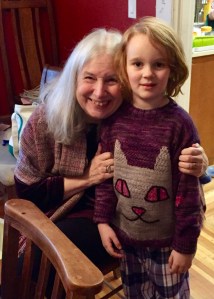
with my first-born grandchild.

“Marriage still ain’t equal, y’all. It ain’t equal. I tell women that whole ‘you can have it all’ — mmm, nope. Not at the same time. That’s a lie. It’s not always enough to lean in, because that s— doesn’t work.”
— Michelle Obama

Some would consider me a second-wave feminist. This is because I was born in 1952 and have always insisted men and women are the same species, generally need the same things in life (food, air, purpose), and that women should have the same opportunities, rights, and respect accorded to men.

Crazy me.

The day my high school announced that girls were allowed to wear pants to school, I was already wearing jeans. I expected to attend college on my own steam. I expected to work. I expected to make my own choices. I chose to be a “Ms” as soon as that option came to my attention. Neither my husband nor I changed our names when we married nearly 45 years ago. I have opinions. I speak up.

But back to that line above about having it all, all at once. I never believed that.

Raising children is an enormous job. In the past, families, extended families were available to help with child rearing, and that was how parents managed is the days when everything everything about getting by was harder. Laundry took days and reddened hands, cooking required lighting a fire first, and getting to work was either right outside, a long walk, or saddling a horse. Letters written on paper. That’s where we were a hundred years ago. We had to clean the chimney’s of lamps once a week. Everyone worked harder to do things we now complain about when we have to stuff dirty clothing into a machine, pull a frozen meal out of the fridge, drive, compute. But people pitched in and most Americans had lower expectations.

I don’t remember horse-drawn vehicles, but my childhood included party telephone lines and black-and-white television and typing. Dinner on the table ever late afternoon. Mothers at home. Things are easier now, most daily chores anyway. Raising children is still an enormous responsibility. A person needs help.

My husband and I discussed who would stay home with our children. I wanted them in my twenties because physically that seemed the best time. I was working and so was Gary, but he had insurance, and that was why we decided I would stay home with the children. It’s almost an impossible option for most parents today. Even then, it was hard and money was very tight. We scrambled to pay bills and did not expend much on entertainment, but we managed. Children in my twenties, back to work in my thirties, graduate school in my early forties. That was my plan.

I thought, in my twenties, that once my children were grown I would return to school and earn a Masters of Fine Arts in the visual arts, probably in enameling, thus continuing my undergraduate trajectory.

Things turned out differently. I earned an MFA in writing fiction in 2007.  I mostly retired in my sixties though at one time I hoped to teach into my seventies. In 2015, I could no longer manage the long hours as a full time English teacher. I was tired and had been sick for weeks the previous winter. I was unwilling to spend less time working full time, and part-time was not an option. Now I teach two classes a year. I set goals for writing and other creative work.

Beginning as a girl, I have always set goals for myself. I wanted to raise children (usually), live in a beautiful countryside, raise horses, keep a garden, love. Most of those early goals came about differently than I expected when I was a teenager. I raised Afghan Hounds until I had children, our garden is mostly wild, and the countryside is right out in front of me every day. And I love. I never expected to have everything I wanted at once, but I have always kept my eyes on the heart of my life goals.

Marriage is not equal from the outside.

(Not yet, but someday. I am not among those cynics who excuse inaction by complaining that this or that will never happen. Wonderful things happen all the time.)

Women are still paid less than men by every sort of measure (as are many other marginalized peoples). I am sorry that white men find discussion of their advantage offensive. They do not necessarily have anything easy, but all other things being equal, they have things easier. The rest of us work at a disadvantage. We are accorded less respect outside our homes, and too often inside our homes. As one example, I saw this working with occasional contractors who simply could not talk to women as people. Their work was primarily with other men, and they assumed that their advantage is “natural” and fair, that their opinions should always have precedence, unquestioned by women. They were irritated by a woman saying most anything, particularly if they were expected to take directions from a woman. I always feel sorry for their wives, assuming they are still married, and so often they are not. It is pathetic that the only way some men manage is by pretending they are superior to others, including to women they promised to love and cherish.

Yes, I know there are bad women in the world, selfish people of every stripe. But I speak from my own experience. Here I want to speak of marriage as a bonding of equals.

My own marriage is built that way. It is solid. My husband and I care for one another, take care of one another. We hear one another.

I am most fortunate about that. A friend posted a meme listing the qualities of a good and lasting marriage. Love was strangely missing from the list, but a lot of other things were there—respect, kindness, sharing, compromise. It is the determination of two people to make things work, because being alone os not the way people are supposed to live. It is not in our DNA to be solitary in life. Most of our existence today is solitary and alone, but human beings need connection with other people. Maybe these relationships are with spouses, or siblings or cousins or offspring or friends or some combination of people we treasure as family.

Michelle Obama is correct that women are not playing on a level field, that we cannot have everything all at once, but neither can men. We need to prioritize. We need to plan a life we can be proud of. We need to make the best of what comes. We need to treasure relationships.

We need family, all those people we are given by chance or by choice.
 

RELATIVE

IMG_3580

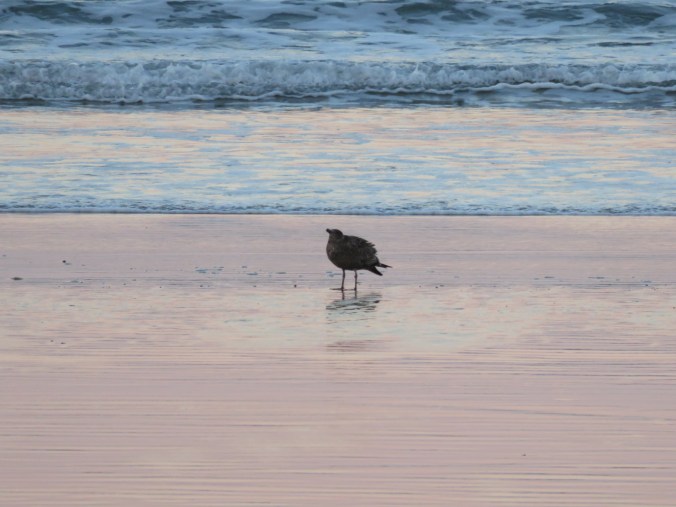
This young seagull was peeping for its parent, but that adult flew away.

When my husband was young, sometimes he would sit on the back steps in a parched Arizona payday waiting for his dad to get home with groceries. Another family of four children was left alone for the weekend that turned into a week or maybe two. The woman who told me about her childhood was not sure, only that even the mustard was scraped out of the jar by the time Child Services showed up.

My own childhood was not so deprived. I went without dental care and my mother mixed powdered milk and when I first tasted a real butter pat, it was like candy to me. In kindergarten, I had two skirts and three short-sleeved Orlon sweaters. For Easter, I had a new cotton dress. It is odd the things you remember. But we were never hungry, and my father’s mother and aunt had enough money put by that it was safe to assume we could borrow money if things got desperate, which they did on occasion.

This is to say, I was not raised poor. Raised poor is hunger and no one to turn to who is better off. “Poor” is so bad that we make up euphemisms like “economically challenged” or my students say a person is “not very rich.” No, poor is not having enough money to pay bills even though you live cheap. Poor is embarrassed because even when everyone in the household is working hard to earn money, money is still “tight” and bills are sometimes late. Poor is being blamed in our country.

And that isn’t fair. Innumerable studies show the sort of income necessary to pay for housing in different parts of the country. Recent studies are equally clear that poor children almost never receive the quality of education wealthier parents give their children. Their health care isn’t as good. What they suffer damage in childhood that their ability to improve their lives, quite permanently.

The truth is that wages have not kept up with inflation—they have been falling behind for decades. Telling someone that if they want to earn money, they should get a better job is like telling a person waiting in a wheelchair to run to the head of the line, like telling the five year old to reach something down from the top shelf, like asking someone who is starving in a third world country: “Well, for heaven’s sake, go to the store and buy some food!”

Sometimes we simply fail to pay attention.

Poverty is lousy circumstance, not a character defect.

I am reading Adrienne Rich’s essays in her new collection, Essential Essays: Culture, Politics, and the Art of Poetry, edited by Sandra M. Gilbert. Rich was a force of nature, a woman who found compassion for others when she granted it to herself. She reminds me that compassion is necessary, that affluence is not a free pass to righteousness, that everyone faces difficulties in life and it’s a good thing to remember that sorrow and trouble come to each of us.

Here is the first poem I ever read of hers:

Prospective Immigrants Please Note

Prospective Immigrants Please Note
Either you will
go through this door
or you will not go through.

If you go through
there is always the risk
of remembering your name.

Things look at you doubly
and you must look back
and let them happen.

If you do not go through
it is possible
to live worthily

to maintain your attitudes
to hold your position
to die bravely

but much will blind you,
much will evade you,
at what cost who knows?

The door itself makes no promises.
It is only a door.

Thoughts from Adrienne Rich

I believe that poetry is asking us to consider the quality of life. And it is reflecting on what makes it possible for us to continue as human. Under the barrage of brute violence, numbing indifference, trivialization, shallowness, that we endure.

Even when I was very young, I was reading poetry, looking for what it could tell me about how to live. For me, poetry has never, ever been just an escape from the world, an escape from history.

I think in this poem, what I am talking about is the choice that we can make, to move deeper into things, or simply to live worthily, maintain your attitudes, hold your position, even die bravely, but not to see what might have been seen. Not to grasp what might have been grasped. And that is a choice, for us all, whether in poetry or in life.

Our country has many truths, but certainly one of them has to be that this was never a democracy. That this was a hope of democracy, an enormous, an enormous hope for true democracy, and that it failed many people from the outset and it’s failing more people now.

I think that more and more people feel uncared for, feel that their lives are not only unvalued, but meaningless. Feel that though they may care for their lives, no one else will. Feel that the only way that they can protect their survival and their interests is by the gun. I’m afraid that many people feel an enormous desperation which plays into the propaganda of hate.

I think that poetry speaks beyond that, to something different. And that’s why it can bring those parts of us together, that are both in dread, and which have the surviving sense of a possible happiness, and a possible collectivity, a possible community, a loss of isolation.

These reflections are excerpted from an interview Bill Moyers did with Adrienne Rich in 1995 as part of The Language of Life series. Rich died in 2012 at the age of 82. You can read the transcript of her entire interview with Bill in our archive and read more of her poems at Poetry Foundation website.

FOOD for the HOLIDAYS

IMG_3574When Gary and I were in college at the University of Washington, Starbucks was a brand new store at the old Public Market, Pike Place. We did not drink coffee, but I shopped in Starbucks for spices and chocolate at the original store, and then later at University Village, at their second store. Spice and herbs were put up in little sealed plastic packets kept in gallon jars. Those jars filled a wall of shelves. The chocolate was broken into fist-sized chunks from ten kilo blocks imported from Europe. All the coffee was roasted locally.

Italian delis in the Market stored candied citron, lemon, and orange peel in enormous glass jars. These fruits were nothing like the gumdrop candied fruit found then and now in chain grocery stores. The lemons were the peel of half a lemon, with a bittersweet bite of lemon. I used these candied fruits and others when I baked our wedding cake in 1974 from a traditional 100-year-old fruitcake wedding cake recipe (white cakes were called “Bride’s Cake” back in the day). I found all the ingredients I needed at the Market.

By the time we’d moved to Oregon (a return home for me), we began drinking coffee, starting with instant. However, once we tried Starbucks, we could not drink anything else. For a time, we received coffee each Friday that had been roasted the day before in Seattle. Then the new CEO took over the company, and everything changed. Coffee was roasted not in NW Seattle but some other part of the country and we never enjoyed fresh-roasted beans in quite the same way again. For a time our coffee orders were the envy of our neighbors.

We also used to order from an Oakland, California deli-style food store when our boys were young. I ordered, actually, it was on me. In the late fall I went through their lengthy catalogue, searching for unusual food items like pappadams and pomegranate molasses. It was a holiday tradition, at least in my mind, to place a big order of unfamiliar foods,  spices and sauces and lovely pasta. The large box would arrive and I would unpack all those wonderful and strange foods. Food for Christmas.

The import food store I ordered from in the 80s was established in 1897, but these days all they deliver is sandwiches. I don’t remember when it became impossible to order foods from Ratto’s (the 90s, or later?) but somewhere along the way, we lost that habit.

Everything is available on Amazon now. And that is not the same somehow.

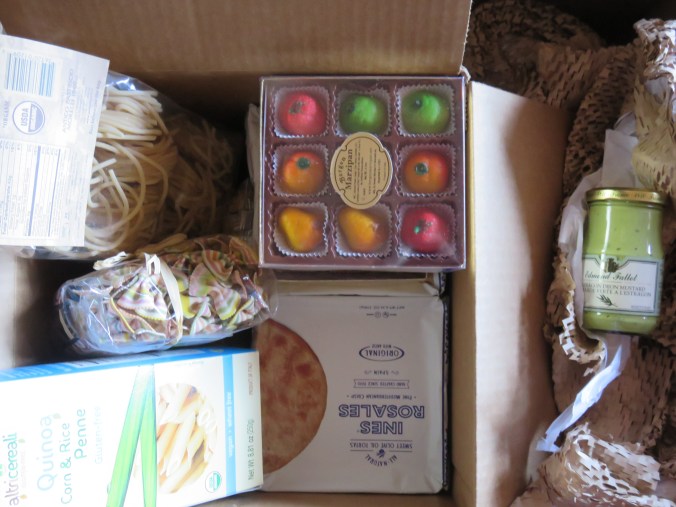
This year I found a small company selling the brand of imported tarragon mustard we like best and a lot of other good things. Yesterday, a big box arrived.

Some of the items from that box will be gifts—the tiny marzipan fruits are something I would have loved as a child—but two bottles of the mustard went straight onto my pantry shelf. Pasta went into my cracker and bread drawer, because even though I like making pasta from scratch, the striped bow ties were just too sweet not to order. Orange flower and rose water put up in glass bottles. The sweet olive oil Ines Rosales Tortas are crispy wafers that make a luscious breakfast with goat cheese and fresh raspberries—my favorite since I discovered the combination in Ashland when I was there for a Shakespeare workshop.

It might have been Thoreau or Emerson who said the only proper gifts were food and flowers—items that were useful and consumable, implying no obligation other than being edible and beautiful. We do not need things, but these packages of food are marvelous and entertaining. We will eat them and they will be gone.

[A nice detail is that everything was packed in paper, ruffle-cut waste kraft paper—you can see it off to the right in the photo above.]


LETTING THINGS GO

IMG_3578

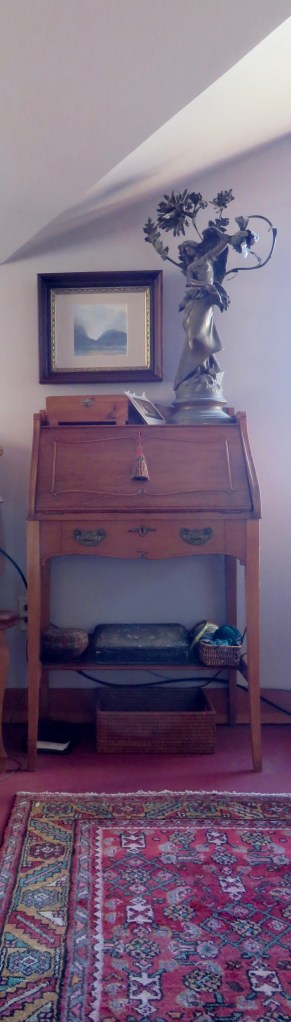
My grandmother’s desk.

My step grandmother gave a mandolin to Gary many years ago. He had the instrument cleaned and repaired but then nearly sold it after she died because somehow an essential family connection had slipped by him unnoticed. When I explained it had belonged to Genevieve’s father, he took it out again and held it. “Then it stays.” He also has a guitar made the year I was born. I like to think that is one reason he treasures it, but it’s the tone. I know it’s the pure, lovely tone that earns it a place in our home.

A friend chided me on Facebook: “NEVER get rid of musical instruments.”

The note was in response to my post of Gary with his Guy Fawkes bonfire and my words: “Gary is on the phone lamenting every single splendid guitar he ever let get away (not to mention the awful ones he laughs over), in his entire life. It is a painful litany and one I have listened to too many times.” The bonfire was of attic refuse from ten and twenty years. I told him about never getting rid of instruments. Gary says, “I get that.” Books, too, I was told should never be allowed to go.

There is a part of me that completely agrees. Books and music and art are essential and precious. Ridding oneself of such things suggests we do not want them, and that is almost never the case. We want it all.

We never want to “get rid of” musical instruments or books.

Sometimes we choose to let go.

Over recent years, I have given away or sold hundreds, perhaps even a thousand books. I just counted twenty-eight bookcases in our home, some as wide as six feet, others just two. Some are six feet high, some just three. There are thousands of books in our house. None are kept in the attic anymore, and only a few dozen are stacked on the floor behind the couch upstairs. I am not allowed to discuss Gary’s instruments in details, but he has “several.” I have books I walked down to the bookshop in Aurora Village to buy when I was twelve, and books I finished reading last month. We have no free local library, so most of the books I read were purchased used, often from Powell’s Book Store in Portland. I no longer keep books if I do not love them.

My husband and I, as I have explained in earlier posts, are engaged in Swedish Death Cleansing, a pragmatic approach to discarding and giving possessions we do not need.

I sort through my clothing. I love clothes, always have, and I know I have too many hanging in my closet, not to mention the tub of genuinely vintage things I have held onto since high school and college. I give things away to charity. I cannot keep it all.

Recently, I went through my jewelry box. I pulled out family pieces for my daughters-in-law. I set aside pieces for my granddaughters. And I gave a box of jewelry to my son to sell on Ebay. We offered many things to family first. People, in case you have not noticed, no one wants the family furniture or china or sterling either. You jewelry is costume or old fashioned or both and no one wants it. If he or anyone liked something, I said to keep it. The money will pay for a new roof next year, or at least a tiny corner of a roof.

Sometimes possessions accomplish more negative than merely taking up space. I gave away my enameling kiln, sold boxes of yarn for a fraction of what they cost me. I was not using them, and their existence in our home felt like a reproach, a lack of industry. And honestly, industrious is pretty much my middle name. I let things go to relieve guilt for not having made more of them.

And sometimes we have had no choice but to sell.

Decades ago, Gary sold his amp because his dad was out of work and could not afford to pay bills. In college we sold our entire collection of Maxfield Parrish prints. We did not mean to “get rid” of them, we needed money to buy bread and pay tuition.

Sometimes by choice, but always the result of some sort of need.

These days, stacks of books everywhere in our house meant I could not find the one I wanted amidst the dozens or hundreds I would never open again. I still have thousands of books on shelves.

Guitars and books have left us because we were not using or reading them. Sometimes Gary traded up for a better guitar. He could not afford to keep every one he ever owned, and we would not have had space to store them. And there is no one to love them when we are gone. If we are not enjoying them, they simply take up space.

Not everyone is experiencing this, I understand that. We could have left our attic stuffed, and I could expand my clothing to fill every closet in the house. But we have sorted attics for others who passed and did not want to leave that task for our family. Our family does not have room for even the stuff we love best, much less the stuff we are indifferent to.

There is an entire social network, an industry of sorts, devoted to reminding us again and again that we are not our possessions, that this gathering of objects is an inadequate substitute for gathering of the self, for questioning and self-awareness. Humility.

My husband and I took stock after dealing with the deaths and possessions of relatives. Our lives were cluttered and if the clutter was not useful to us nor interesting to our family and friends, I still believe it is for the best to let it go to someone who cares.

We do not rid ourselves, we let go.

THE PLANS

IMG_3533

My first panettone. 

Last night I started the dough for panettone. This morning I mixed the dough and set it to rise, and that’s when the trouble started.

An hour before they went into the oven, Gary had plans. “Bring your breakfast and I will hold things up. You don’t even have to touch it. Just say yes or no,” he said.

My husband was determined this past summer to empty our attic, the spaces north and south behind the knee wall. He was entirely successful. The spaces are empty, the roof only barely leaking, and most of the contents given away. Most.

What is left? A stack of “old” good stuff for our son to sell on Ebay and a dozen or so cardboard bankers boxes with “school stuff” I will never use again. There was also a fair-sized cardboard box with rolls of plans and prints of plans and my original plans drawn on translucent paper. There had been another box of these, or perhaps two boxes. I thought I’d rescued all the architectural plans I needed or wanted to keep, but then he unrolled plans for a house I’d forgotten I designed. I remembered it only vaguely from those years I was designing additions to coastal dwellings and entire houses.

There were many more than I recalled: homes and home additions in Gearhart, Little Beach, Tolovana Park, Cannon Beach, Arch Cape, and Falcon Cove. This began in 1983 when I was a new mother with preschool children when our tenant asked if I could make an architectural model. I said, Of course, though I had never done anything of the sort before. My model was the wrong scale and clumsy, but it satisfied the homeowner who was leery of a roofline redesigned to meet a local covenant. She was pleased enough to ask me to design the interior, with the architect’s blessing. He was glad to be shut of this difficult client.

That first project led to work for several homeowners, architects, contractors, and myself too over the next ten or twelve years. I designed and supervised the building of my brother’s home and my mother’s. Neither paid me, and I missed work to complete them, but sacrifice is expected of daughters. I tiled the entry, kitchen backsplash, and the tub surround, floor and wall of Mom’s house. I had to quit my job to get it all done, but she was hysterical most of that time. The contractor went far, far over budget. (It would be years before I understood how little that contractor cared about honest billing.)

The houses I am most fond of were the Buckley House in Tolovana Park and my mother’s house on Jefferson Street in the Presidential Streets of Cannon Beach. I have not passed any of these houses other than my mother’s, which is painful since the new owners remodeled all the charm out of it. I loved that house, and I cannot bear to look at how they ruined it. Mom always promised to leave it to me, but she sold it instead because she liked having cash. It is a sad memory. Perhaps that was what my mother meant when she told me the day she died that she had been cruel to me?

I stopped drawing plans once I was a full time teacher, which paid less, but gave me a steady income and work I enjoyed a great deal. I always thought I would design one more home, from scratch and just for Gary and me, but alas.

In any event, I had forgotten how many projects I completed. The one I live in is good and well, though I find that I changed it from my drawings as we built. The plans tell an interesting story and there a great deal more, what we refer to in the family as “The Big Mess.” That is no fun at all, still a mess in our minds.

The attic is no longer any sort of mess. The atrium, where Gary staged his sorting of attic stuff, is also no longer any sort of mess either with just the two neat stacks destined to leave us permanently. In the house, there are still four original Thonet bentwood chairs labeled 1907, purchased in 1968, when I was in high school. They want recaning and free to a new home. Anyone?

Today, I have begun National Novel Writing Month with 1404 words (so far), somewhat under my goal. And I am supposed to complete knitting the first sleeve for Ruby’s birthday sweater. And really, I would like to curl up with hot chocolate and a slice of panettone.

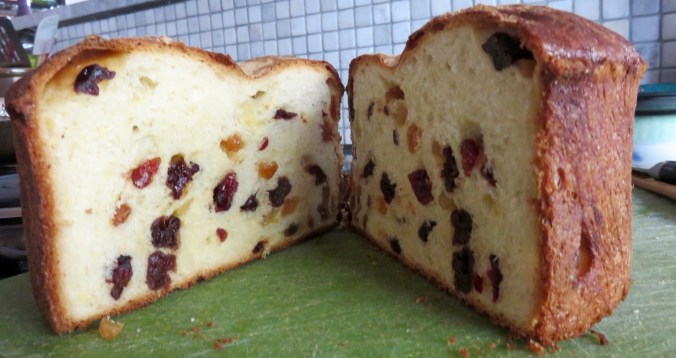
I made two loaves in pans I had, not proper panettone paper pans, and substituted regular for instant yeast and other things. It was still wonderful!

PREPARATION

IMG_2587

The rain is finally here, and the tide sweeps up over sand that has been dry for months. The last time we drove over the coast range, vine maples were turning scarlet and purple.

It is only October for one more day and I have been receiving weekday recommendations for holiday preparations from Apartment Therapy. I do not live in an apartment, and the therapy offered is useful to me mostly for the photographs. (I am one of those people who almost never reads magazines, not even the captions. I only admire the photographs. Now, between Pinterest and the library, I don’t buy magazines. It is a financial savings like quitting smoking, except I never smoked.)

The weekday emails have advised me to make a gift-giving list, purchase just one holiday gift, organize my holiday card strategy. Mostly I have found myself one step ahead in planning and preparation. Nevertheless, I enjoy the reminders. My favorite so far is “Do an act of kindness on Day 4. I sent a card to someone who was recently unkind to me. This was intended both as kindness and as a way of reconnecting with a person I care about.

eqyzrphyqtzfbwzzftrqlfqqwqfrjhqpsywsdypftppt~.gif

DAY 8:

Book an appointment or service you need for the holidays.

Think about that thing you always put off or forget until late in the season, when all the good appointment times are taken or—gasp!—your favorite provider is all booked up through New Year’s Day. Today, call them up or fire up the app and make the appointment.

Nothing came immediately to mind.

If nothing immediately comes to mind, here are some services that might jog your memory. If you read something and your gut screams out, “oh RIGHT,” that might be the task for you today.

  • haircuts or color
  • eyebrow grooming
  • manicures and pedicures
  • spray tan
  • facial and spa services

The list goes on quite a bit further, including pet care, house cleaning, travel, and professional photographs. But I got stuck on the first five that concern personal grooming.

I have not had my hair cut since the mid-60s. The last time I put color on my hair was a few years ago when I was playing with purple. Mostly I was fortunate in my eyebrows, which used to be quite dark and well-shaped. They are now going gray, and I cannot be bothered. I have never had a manicure or pedicure and every time I consider the process, I remember that I really do not enjoy strangers touching my body in an intimate way, and I think about nail fungus (which I dod not have and do not want). Spray tan reminds me of the person in the White House, so that’s out. Facial and spa? My skin might thank me, but it seems a waste of money.

The man whose admiration I care about, the only man I feel any need to impress, is easily impressed. Frankly, he is the only man I am interested in. Lucky, yes.

[Next month, though I have not even used mascara or lip gloss in a while, this may change. Hanging around with teenagers tends to make me feel dowdy. A little color?]

Thinking over all of this had me reviewing what my holiday preparation actually look like. I buy gifts all year long, I plan gift wrapping, which is the most onerous task of the holidays. We mail only a few gifts. I design cards (though so few people send them anymore that some of the fun is lost). I bake and decorate the house with lights and ornaments and nutcrackers.

Teaching is not part of my holiday preparation, but my part-time job teaching college writing begins next month. Three weeks sandwiched between Thanksgiving and Christmas, and right on top of Hanukkah. (It will be a busy time because I have 33 students on my role and I am scheduled to use a math teacher’s room. At least the desks are flat, though when I went in for a peak I could not find 33 chairs.)

Years ago, we hosted a holiday party on a mid-December Sunday. It was an Open House in the afternoon, usually 2 to 4 so that it was clearly not lunch. We furiously cleaned before the party. I came home after work each day and worked my way down the refreshments list, baking and freezing.

We did not serve alcohol, and that might be the secret to having a pleasant time. I made mushroom pastries and curried filo triangles, fancy cakes with nuts and fruit, a Java cake, cookies, and a dip made with homemade chili relleno and a pound or more of grated cheddar that always disappeared moments after I put it on the serving table. It was not lunch, but people could get a meal out of it.

We invited family, the neighbors and everyone we worked with. Sometimes we had over forty people in the house at once. People stood around and talked and we played the Muppets’ Christmas album or The Anonymous Four. Though I am uncomfortable in social situations, it was not a long party, and a lovely time. Post party clean-up took only a little over and hour. By dinner time the house looked neat and festive and we generally had enough leftovers that I did not have to cook for a couple of days.

[Our first Saluki, during her first Christmas party, peed in the middle of our bed in front of Ted Tallman, who asked, “Does she do that often?” No, never before or since. She disapproved of the crowd.]

One year, my brother and mother (who lived nearby) gave their excuses, did not attend, and we stopped after that. It seemed a lot of trouble with so much preparation and almost no one reciprocated.

It’s been a long time, but I think about those parties still. I miss the preparations! I miss the people!

Maybe it is time to reestablish that tradition. Either that or find a hotel and fly away.

Those parties demanded a lot of planning and cleaning and baking, but I love to bake, and the result was smiling with friends and a week before Christmas, our home was beautiful.

This morning we heard rain and tomorrow is the start of National Novel Writing Month. I will be writing each day, and for the month, if there are any post, they will likely be brief.

WEATHER GAGE*

s-l1600-1.jpg

I have begun rereading Patrick O’Brian’s Jack Aubrey/Stephen Maturin novel series for the third time, this time aloud. I found the jargon and exposition early in Master and Commander hard going aloud, but we have moved on from there to familiarity with some details and absolute acceptance of the rest. My husband laughs at every bit of wit so we are having a fine time and sailing right through. (I began reading three days ago and we are already past three quarters through.) I try to stifle my impulse to explain what will eventually become clear in a next few pages or a few books. O’Brian builds tension and action wonderfully.

(I have spent too many hours in despair and crying of late. Lucky to be alive. Yes. But these are not proud times for my country.)

Perhaps O’Brian is one reason I thought about the wind so specifically during our walk this morning. Yesterday, we walked for two and a half hours, and then about another half hour later on. This morning we meant to have a short walk, but stayed out the better part of an hour, despite the stiff wind. It rained on us yesterday, but we really did not mind. Today over the ocean were blue skies, the moon still showing more than a half even as the time neared nine o’clock. Wind out of the south, gusting and sometimes holding at a light gale.

Dry sand blows over the top of wet sand, sometimes gathering they way snow will, though snow is very rare on our coast. I recall our Sequoyah, an Afghan Hound of considerable strength and sweetness, who did not like the sand piling on his toes when I walked him on a windy beach. He would pick up each forefoot in turn and shake the sand out of it, then dancing on the shore like a dressage horse. (I do miss the dogs painfully.)

We have over the years been possessed of two wind gauges—one belonged to my step-grandmother who left me the house. It was carried away during a great storm while we were in Arizona (with Sequoyah at dog shows, as it happens). The next gauge was also carried away during a storm. We were accustomed to steady winds of 45mph or more, gusts of 65 or even 70mph during an ordinary storm. A really bad wind coming from the west would bow the glass in our ocean-facing windows. It was a disconcerting sight, and the reason I was always grateful to have some sort of curtain or blind to lower against such blows.

We have had no wind gauge at all for years now, and though we can check with Cannon Beach for windspeed, because they are a larger community, we almost never do. We can feel it.

The last really impressive storm was 2 December 2007, the day a window facing the ocean blew out and I fixed in back in and wired it in place as best I could because Gary was still drugged from hernia surgery two days before. We were without power Sunday to Friday. It was dark and wet and boring that time of year with so few hours of daylight and inadequate lanterns.

The local public radio station reminded us every hour on the hour about a tree falling on their roof and never provided a speck of news about our end of the county. (I have never quite forgiven the necessity of driving to Cannon Beach in order to buy a Portland paper in order to find out what was going on.) We were warm enough with our wood stove which I cooked on. I’d made a large casserole of eggplant parmesan and we put thawing strawberries in oatmeal for lovely breakfasts, and experimented with various methods of grinding coffee beans—smashing with hammers and rolling with rolling pins—to fill the french press. It was a challenging week, but not a bad one. Rather fun, to tell the truth, though I was grateful to have hot water again by Friday night.

It was also the year my mother died, the year I graduated from my MFA program,the year our younger son married, and the beginning of the first of my still non-writing periods. I was mourning. I lost all humor from my writing, and my stories often were humorous until then.

And here, the day has worn on while I return to this posting, adding to my story and watching the weather change outside my window. The sky was clear aqua during most of our windy walk, then rain again (it rained last night off and on), and now the pale blue sky is flying overhead again.

O’Brian reminds me how one disappointment or embarrassment can dredge up a range of others long thought put to bed. There was a tide earlier this spring that cast up hundreds of crabs on shore—huge Dungeness crabs, and all male. A knowledgeable friend explained that they were likely scraped up from very deep water where they had lain for some time.

There is work to be done.

I have knitting to attend to and a partial knitting project to unravel and begin again, cards to send my grandchildren, and I am rethinking my plans for National Novel Writing Month. Last year I had intended to work on a series of short stories. I think that might be a good choice for this year. A baker’s dozen, aiming for 60k words, perhaps. So long as I write 50k of new words meant for a single book, I think that will answer.

I have already met my “writing goal” for the year of 100 rejections. Mostly because of 65 agent queries, it easily met that target a couple of weeks ago. I will not order new lamps, but move around the ones I have. I have been trying to send back the darned desk and hope to have it gone within a fortnight (finally!). I rearranged the living room sofa downstairs, shifted the one upstairs, and I will continue desk using a set-up that is imperfect but has done duty.

That is, I am rearranging the deck chairs on the Titanic (if you know the saying?) and will muddle along. That is often the way when terrible forces are at work destroying the world. The ocean is white with foam from heavy surf, though not so loud at the other morning when it seemed to be deliberately cracking on.

In a day or two, at most, we will begin the next book in this series. When we have read the twenty volumes on my shelves, I will go hunting for number 21.

*Yes, that is the preferred spelling.

WHAT IS IT?

IMG_3503

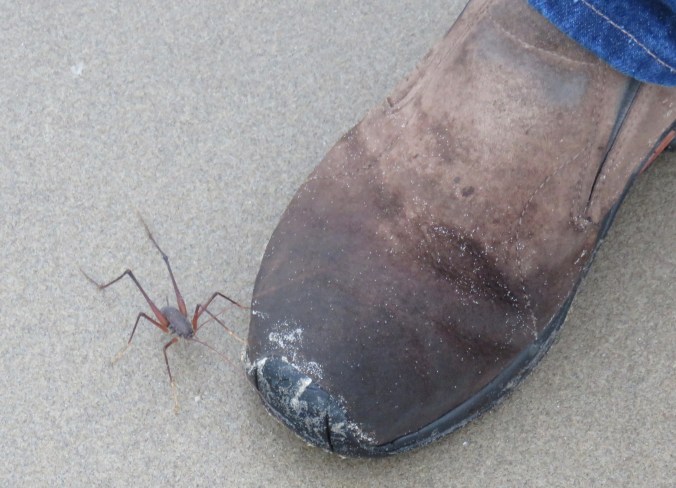
Giant cricket? Super grasshopper? It was on the beach this morning! When I asked Gary to put his size 12 foot in the frame for scale, it sidled right over and checked his shoe out. When Gary stepped away, it hopped after him. Yikes!

What?

At least we recognized the thing below as a spider.

IMG_3505

unSATISFIED CUSTOMER

95a8e252eca89dbaa7458a3c2b379aa0.jpg

The order.

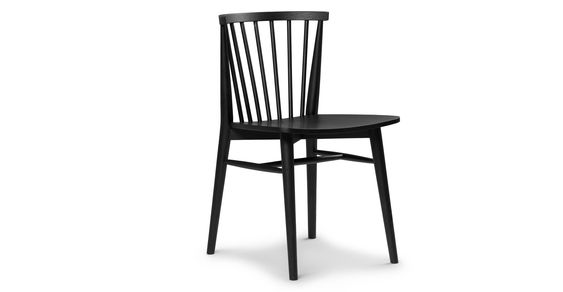
“Years and years and years ago” when Mom was still alive, I did what my mother had done and decided on solid black, spindleback wood chairs for her old dining table she’d given me. I wanted four chairs, and bought cheap, unfinished chairs and stained and lacquered them matt black. They are currently serving duty in my son’s dining room.

Our garage sale library chairs have been good, but they are too heavy to slide easily in and out at table. It was time, I decided, to get what I really wanted.

Anthropologie (see above) had chairs that looked right. Black. Spindles. Oak. I had a discount coupon. The coupon did not work, but I ordered the chairs anyway. I had not sat in them so I worried they might not be as comfortable as they looked.

They were beautiful and comfortable, apparently sturdy. We received only three, each with serious flaw—a cracked leg, a botched paint job, seat not fitting to the back legs. After a dozen emails and many phones calls, each with conflicting information and advice, the chairs are all returned, the lost one given up, the money refunded, and I have the option of ordering chairs “at any time in the future” with a 20% discount from Anthropologie. Probably not.

Then a desk I had saved for and ordered months ago arrived Tuesday and is stripy walnut like milk chocolate-colored teak. I wanted dark bittersweet black walnut swirls. Honestly, even the salesman recognized it was not what I wanted, and I think both of us hoped I would love it anyway. I don’t. I am a generation past and a generation too late for the Danish-teak-now-called-Midcentury-Modern aesthetic. I mostly did not like the style the first time around and have not warmed to its resurgence.

The desk will go back as well, and that is going to be an expensive return.

The disorder.

These are the concerns of affluence, I think, fussing over chairs and custom desks, as if they mattered. Money. I have tried to figure this out. I do love all this stuff, but lately we have been selling and giving things away, emptying closets and attic, and even my jewelry box. Most of my life I have accepted what came—furniture, people, jobs. Maybe that is a flaw in my character? A failure of common sense? Bad and good luck?

We have been shoveling out what came unbidden into our lives in order to trade up for things deliberately selected. Affluence again to have that choice. Entitlement.

What matters is that my husband and I go for our long beach walk each day, even when it’s raining. We sit at the table and share breakfast.

Spiders can hear human conversation, I am told. They know when we spot them working their way across the ceiling. They hear our alarm. They huddle down and accept our coming for them, or run for a crack in the ceiling.

Maybe I need to run away too?

We listen to and read the news and would rather worry about furniture.

Run away! Run away! Doctor Who shouts.

Yes, maybe that.

There is terrible news every day and no place to escape to. But we would like to escape from cruelty and willed ignorance and obsession over money, even our own.

Who needs a vacation?

I can count the days we have slept away from home during the past twenty years on my ten fingers. In 2003, Gary and I began calling a few hours in a daytrip to Portland our “vacation.” Since then we have had two nights in Orcas and one in Canada, two trips to Seattle and two nights at Nye Beach, a few nights with family in Portland (does that count if I have to cook?). Fifteen years and, okay, maybe we had a dozen nights away from home. More than ten nights in fifteen years. We talk about travel to Iceland and Ireland and Portugal. (I have always wanted to see Hagia Sophia and Crete.) Mostly we stay home and stare too much at our computers. Have we been investing in furniture in place of vacation?

We should try it the other way around. Or something.

Next week we will go for two nights without technology. When we come home, there will still be just two ancient chairs at the dining table, and that will be plenty for us. Perhaps the desk will have gone back to Portland by then, and I will continue to sit up in bed when I write.

In the mean time, vacations too are the concern of affluence. Give me time to think about that.

I’ll keep you posted.


PASSING

IMG_3471

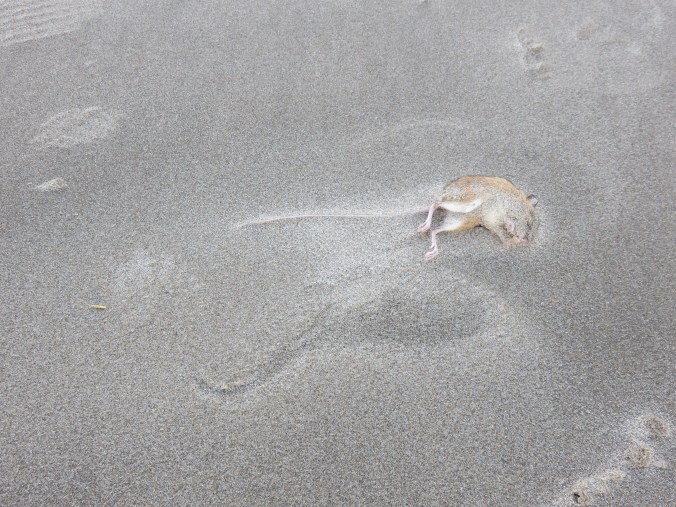
I passed this mouse on the beach—mouse?— half-covered by blown sand.

There is a novel by Nella Larson called Passing, which includes racial passing by a character. There are other sorts of passing. Passing by, passing judgement, passing the mashed potatoes. A running dog passing another is called a go-by and it’s a good thing. Passing over, we die.

Years pass too, time passes. But not really. We are only here from instant to instant, only really here. Life is not a train headed in a particular direction and we are not riding a carrousel in circles. We are here, looking ahead at what we hope or fear might be coming, basing our predictions on what we remember has already happened.

Today is my birthday. I am 66. We have already established that I am not any number of “years young.” But back in May, I decided to track my daily activities. Looking forward, I thought I should plan more decisively for writing and reading and walking and eating, taking the medication for my thinning bone, and drinking enough water, limiting alcohol—all the things my mother would tell me to do if she were alive, even while she failed to follow her own good advice.

A new post on the Brevity blog urges us to consider how easily we are distracted, not just by the distractions of phone calls and tweets, but by the time required to process and recover from them. Set priorities, set goals.

Most of the project goals I established in January and June are coming along. I lost fifteen pounds and I am walking an hour a day. I have seen my writing published eight times this year, which is fortune as much as effort. The only control I have over publication is submitting my work. Mostly I submit—terrible term—to journals that publish a tiny fraction of the work they receive. They might print a dozen stories in a year and reject ten thousand. Just yesterday I earned my 100th rejection for my writing, and it was, in fact, a writing goal for the year, one I could control by submitting my work many times. Score one for me! I passed my 52-book reading goal for the year too. I have a story that might become a novel next month during NaNoWriMo (National Novel Writing Month). In that story nearly all visible life on earth other than plants and insects dies. One woman is left alone wondering how she deserved to survive and was it punishment for something she doesn’t know she did? Too much time passes for her.

The Washington Post warns about an massive drop in insect life and the birds and reptiles that eat them on pristine tropical islands. Is it the result of climate change which impacts insects much more dramatically than I supposed? Or is this the result of the use of pesticides and defoliants? Some Devil’s Triangle of threats? Researchers can’t explain it, but they’re worried. So maybe I have my prophetic story backwards?

Or perhaps what I was told about Australian people is true, that they see humanity as forever facing the past, walking backwards into whatever unknown comes next.

I am merely passing by.