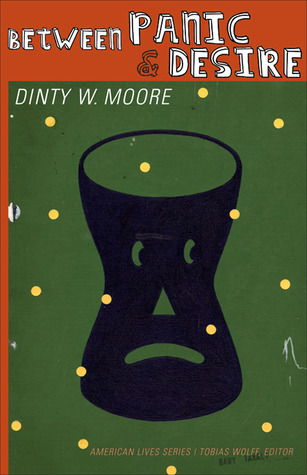
DESIRE & PANIC

2260552.jpg

The author had my attention from the hilarious introduction to his memoir, Between Panic and Desire. I recognize the world he describes. Unlike his parents, my father never left; it was my grandparents who all divorced, some remarrying, some not. But while he was not yet 6 years old during the Bay of Pigs, I was already 8. I remember. My parents were fierce supporters of JFK, and Boeing Field was just down the road. However, living on the West coast, in the suburbs of Seattle, my life was never at risk during those tense days. The bombs could not reach so far. The eventual fallout, WW3, escalating tensions? I recognized those risks even as a child.

Fifty years ago, shortly before midnight on 16 April 1961, a group of some 1,500 Cuban exiles trained and financed by the CIA launched an ill-fated invasion of Cuba from the sea in the Bay of Pigs.—BBC

Dinty W. Moore recalls the period of our shared youth and I recall all the events he does—the international crises and threats, Squeaky Fromme, the assassinations, the same presidents, the same falling Towers. All the events that haunt his childhood memories. He yearns for his absent father, and goes looking everywhere for a replacement.

Moore was about 12 when Fromme joined the Manson “family”; I was not quite 15. I had to look that up because I never found her the least bit interesting. I remember Martin Luther King Jr.’s death as vividly as JFK’s. The balcony. The black horse, my mother explained, was “spirited because our president was spirited.” I never considered any of the presidents to be father figures, and I got over southern accents with LBJ. Happily, I met the person I would marry (whom I also mistakenly assumed on first sight was otherwise connected) at the age of 16, so I was spared Dinty Moore’s years of lonely drug abuse. My husband was not a user. However, Dinty Moore and I did not experience the 60s in the same way. My memory has a great deal more music and fewer cars. Many of my friends died. Peace marches. Feminism. Later, the AIDs epidemic. Identification as a visual artist. A long period of yearning for a country life. Moore had other concerns. I still do not consider that our failure to develop a strategic response to terrorism might have been a serious oversight. I wanted then to address the cause: ongoing imperialism. The corroding root.

When Dinty W. Moore lost his father, I was worrying about the world population explosion. By junior high school, my best friend was African American. Perhaps this is because I lived on the other side of the continent. I still do. I met the Dinty Moore in 2002, while attending a novel writing workshop with Bret Lott in Milledgeville, Georgia. He and Bret sat on a wide porch smoking cigars in the dark. (Perhaps only Brett smoked—I could be wrong about that.) Dinty will not remember me. I was the one typing on my laptop about twenty feet away, the Mac logo glowing.

While I was in Georgia that week, my mother drove the few blocks to her local Post Office and found she could not get out of the car. She drove home, crawled into her house, and called for help. My husband called me in Georgia on a landline and had to leave a message. I borrowed a phone to call him back. I wanted to fly home immediately, but this was the start of Memorial Day weekend and there were no flights available. The workshop organizers made no effort to help. Still, I got home on Monday, in time to sit in the waiting room while Mom had back surgery. Her surgeon promised immediate improvement. There was none.

This did not go well, I realize now, because she’d already been taking Fosamax for years and that bone-building medication actually interferes with the healing of bone. There was research suggesting that even then, but no one considered it for my mother. She was eventually placed on a deadly combination of opioids and benzodiazepines, failed to drink enough water, and was mostly housebound or hospitalized for the remaining five years of her life. Many, many trips to the ER. Broken bones. Slow healing. Pain. There is probably a way to make this a funny story, but I do not have the gift Moore does.

I have quit teaching, but the third essay in this collection, “Double Vision”, has a masterful structure, and I immediately and inevitably considered how I would use it as a model for student essays. There is no self-pity but considerable humor concerning his diplopia. He nails the short form. Well, what would I expect?

The award-winning memoir is elegant in structure and voice. These are very funny stories, a masterful and unique memoir of absent fathers, drug abuse, and eventual insight. Now I shall have to find a copy of The Accidental Buddhist.

GREEN SPACE

fullsizeoutput_ebd

Sometimes the tide reveals the remains of a long-lost forest. This log in the foreground is waterlogged, usually buried under sand and rock, and probably hundreds of years old.

My husband and I made two simultaneous and life-changing decisions in 1979. We would move to my family’s property in my home state of Oregon, and we would begin a family. We had been living just a few blocks from the Woodland Park Zoo in Seattle and often spent time in the wild Lower Woodland area east of the zoo. Gary had worked in the zoo ands recently returned to college for a masters degree in education. He planned to teach elementary school. But the illness of his father threw his family into chaos and too much of the emotional burden seemed to fall on him. His sisters called most evenings, his youngest brother is mentally ill and his older brother, in California, did not make the trip north for the funeral when their father died.

Our new home in Oregon offered the ocean, the broad beach, and a forest behind our backs. Both Gary and I had grown up playing in wild places. It felt right that our children would have that same opportunity. Recent research suggests our choices were fortunate for the future mental health of our sons.

Urban residence is associated with a higher risk of some psychiatric disorders, but the underlying drivers remain unknown. There is increasing evidence that the level of exposure to natural environments impacts mental health, but few large-scale epidemiological studies have assessed the general existence and importance of such associations. Here, we investigate the prospective association between green space and mental health in the Danish population. Green space presence was assessed at the individual level using high-resolution satellite data to calculate the normalized difference vegetation index within a 210 × 210 m square around each person’s place of residence (∼1 million people) from birth to the age of 10. We show that high levels of green space presence during childhood are associated with lower risk of a wide spectrum of psychiatric disorders later in life. Risk for subsequent mental illness for those who lived with the lowest level of green space during childhood was up to 55% higher across various disorders compared with those who lived with the highest level of green space. The association remained even after adjusting for urbanization, socioeconomic factors, parental history of mental illness, and parental age. Stronger association of cumulative green space presence during childhood compared with single-year green space presence suggests that presence throughout childhood is important. Our results show that green space during childhood is associated with better mental health, supporting efforts to better integrate natural environments into urban planning and childhood life.—from the recently U.S.-published Danish study: “Residential Green Space in Childhood Is Associated with Lower Risk of Psychiatric Disorders from Adolescence into Adulthood” by Kristine EngemannCarsten Bøcker PedersenLars ArgeConstantinos TsirogiannisPreben Bo Mortensen, and Jens-Christian Svenning, published in PNAS

Both Gary and I thrived in a generation that allowed children to run free. We ran and walked and biked sometimes for miles. We followed trails in woods or scanned the desert, climbed trees or rocky cliffs, swam in local ponds and sloughs, and experimented with all sorts of dangerous stunts.

It is a wonder we are alive. Perhaps.

Or maybe these early childhood opportunities are the reason we are alive. No one should fall for the fallacy that various threats to childhood are something new. There were bullies in my childhood. I nearly drowned in tiny Echo Lake. Gary and his friends stretched a rope across a road in the absurd attempt to catch a truck. I climbed so high into a tree in the cow pasture that the top flopped over, leaving me upside down and close to a hundred feet in the air.

Yet, here we are.

A man up the street used to strip his children and beast them with a strap. The hunting dogs kept in a pen in the back yard of the house across the street were widely viewed as dangerous. The adult son of the owner of those dogs was in prison. The pastor living in a brand new house behind our back yard famously piled up old furniture in the empty lot, poured lighter fluid over it, set it alight, and drove away with his family. This was 60 years ago. I know children have always been at risk both from experience with my peers throughout school and from reading.

My experience also suggests that hovering over children encourages their misbehavior and fears. I built a fort in our yard when the boys were little, a distraction from the beach, which was not a safe place to play when they were very small. The threat of a sneaker wave was very real and I did not allow them out on the sand without being there myself. On the other hand, I found that my sons would hang off their new fort in the most dangerous manner while I watched. I realized they assumed I would protect them from harm. This was true even when they walked along the railing eight feet from the ground and while I was not close enough to catch them. They seemed to have some magical faith in rescue.

If I went into the house and watched from behind the blinds where they could not see me, they stopped hanging upside down and balancing on railings. It took me a while to figure this out. Maybe it isn’t always true.

Whenever our children were doing something they shouldn’t, the best response was distraction. Gary was especially good at this. Are they throwing the little plastic animals? Gary will have them lining up all the plastic pigs. They want our attention, but pointing that out is not useful. Young children want our attention, not to hear about the psychology of their needs.

As a grandmother now, I mostly keep my observations to myself unless I am asked. (I am not usually asked.) I wish my grandchildren had a wild wood in their front yard, but their parents take them often to play in parks. I wish my sons had studied behavior modification and educational theory that urges only positive reinforcement and redirecting attention rather than relying on threats. But they do pretty well without my help.

I suppose most people do.


CARE-GIVER

fullsizeoutput_eb3

It was Billie’s 90th birthday party and we drove over 200 miles each way to attend. I have known her since 1969, but Gary has known her longer and she remembers him with great fondness. Back when I met her, Billie’s hair was a curly mass of mostly-gray tied into pigtails. She was the picture of the Hippie mama, beautiful in that particular Billie-manner, and uniformly kind and wise, and full of fun.

Gary sat down next to her yesterday and she said, “Gary, you’re not a kid any more.”

Long ago she told me a story about a chair that has stayed with me. This would have been in the early 70s that I heard the story. She wanted a beautiful wooden rocking chair she saw in an antique store. She could not afford it, she said, on her teacher’s salary. So she calculated what smoking cigarettes cost her each month and gave up smoking. She put the chair on layaway and paid it off from her nonsmoking funds. Her children, who are mostly younger than me, had never heard that story but were delighted. “It sounds just like her!”

These days Billie is frail and her hearing is poor, aided somewhat in one ear (her left) by a hearing aid. While I sat on the ottoman next to her, trying to be loud without actually shouting, she leaned to me. “Is that a baby over there?”

“Yes,” I said. Across the room a beautiful women held a sleeping child. It was her granddaughter holding Billie’s great grandson, 17 month old Enzo.

“I would like to have that baby. If I kept him for a couple of years, do you think they’d notice?” She looked at me with a twinkle in her eye. She was teasing me. Yeah, that’s Billie.

She still lives in the same house where I first got to know her. On her shelves are some of my favorite novels. She has Smiley’s Moo (the black book on the second shelf down behind her toward the right) and Carol Shield’s Unless (my favorite of Shields’s novels on a cart a few feet away) and The Absolutely True Diary of a Part-Time Indian. She has some of the same poetry and Norton anthologies I love. There are books and photos and works of art all over, a wedding certificate from over 150 years ago. It is a well-lived home. She is greatly loved.

During the week, she has some sort of professional care. On weekends, some member of her family stays over. Her children and grandchildren take turns. This way she can stay in her home and manage quite well.

IMG_2922


My “Gaga,” my mom’s mother, managed to stay in her home until shortly before her death. My grandmother’s second husband, Papa, brought her coffee each morning before leaving for work. Later, as her health failed, he carried her up and down the stairs until he could no longer manage even her slight weight. Then he cared for her in the living room, carrying her only as far as the bathroom. They were in their seventies by then.

We had cared for my mom for years before it occurred to me to ask my mother if she or her sister had ever provided respite for her step-father.

No, she never had. She seemed surprised at the question.


Yesterday we left Edmonds, Washington after staying only a short time at the party. We generally avoid driving in the dark but we arrived home in the recent dark, tired, too tired to eat. Gary had a beer and brought me tea with brandy in it. I don’t usually drink whiskey but it warmed me and made me thoughtful all at once. That rocking chair was still right there in Billie’s living room where it belonged.

fullsizeoutput_eb8

My friends Toni and Billie on Billie’s birthday.

My husband’s Billie Playlist (with links to the videos—he says you have to watch the videos): 

You might cry along with that first one, but you’ll end in a great mood.

CREATURE OF HABIT

IMG_2180

A baker’s dozen of koi at the Japanese Garden in Portland, Oregon.

“Good dog.” These days we pet any dog that comes near us on the beach. They all like to be told they are good dogs. Even the slightly dangerous ones, the ones that growl or charge, if they gave us a chance, would get a good rub on the occiput and be told they are good dogs.

Our aged goldfish died when we fed it tainted fishfood from China. You might not recall that scandal. That was years ago now. Our last cat and the dog are gone now and we have not had the heart to risk another, though for many years we had five or six sharing our home.

I went to a commercial website the other day, just to get my koi fix. Now their ads show up each day in my Facebook feed. I looked at goldfish too. I imagined refilling the enormous Chinese pot where we having kept goldfish in the past. Koi need running water so they have never been in the program. Still, I miss having fish. I miss having pets—no dog no cat in our house, cluttering up our furniture. No dog to swipe the slice of cheese off the table. No need to be careful of doors open or closed, food left out, getting home in time to walk the dog.

Why would we miss that?

Yet, we do.

EDITING & BREAD

IMG_3900

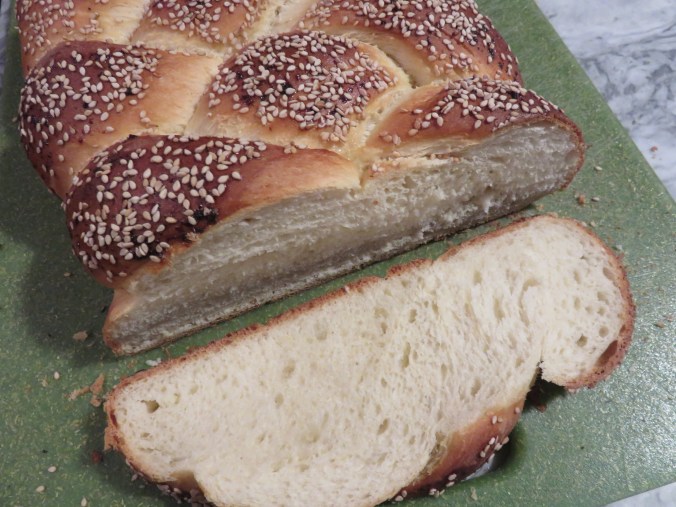
This first challah is light and tender, soft, finer grained than this photo shows. I used some bread flour (“strong flour”) and no whole wheat, but I think I miss the wheat flavor.

I suppose this means I should complete my editing before posting.

On 8 February 2019, I found I had 100 followers. That makes my day. Seriously. This is true especially because I wrote about common-sense self care as part of countering depression. Every time I have tried to post anywhere about depression, I’ve been attacked. People who were friends and generally seemed to like me, went off on my comments have apologized for using language in response to my post. “You don’t know anything about depression . . .”

The thing is, I do know about depression. I am not as self-assured as some people seem to assume. I know depression. I won’t describe details here, but I have been depressed and I have a strong thread of serious depression and anxiety disorders in my family. Maybe I cover it better than most? Maybe I was told I should smile about a thousand times when I was six and I acted on that suggestion.

In any event, I am not writing a memoir, but a blog. I am not telling the story of my childhood here today. I write about myself too often as it is.

Most often I write as often in direct response to something in the news as to anything happening in my life. Friday I played Scrabble with a friend and in the afternoon I had challah rising. I used to make a huge braided loaf each week, but it’s been decades since I did that. Most of my life has passed with only occasional loaves cooling on the counter.

Baking bread each week was one of the things I swore to do now that I am mostly retired. And challah—in a dead tie with brioche for best bread in the world. (For now we can set aside cinnamon buns and panettoni, which are sweet breads rather than bread loaves.)

So the bread was in its first rise. I’d have taken a nap if it hadn’t needed to be punched down and shaped in about 10 minutes. I recall three rises (or proofing a sponge and then proofing twice, which is the same thing) before shaping, but fingers crossed. That first attempt on Friday would have only two rises, one in the bowl and the second as a braided loaf. Most of the kneading was done with a dough hook by my electric mixer.

I first learned to make bread from my mother who had a recipe for four loaves, lost now. [There was a typo here. I noticed it and fixed it five minutes after I posted. sigh] Though she never enjoyed cooking or baking, her loaves were marvelous. In college, I made whole wheat bread in a very large crockery bowl, stirring by hand with a wooden spoon (I broke a spoon one time) until I turned it out onto a board to knead. I quite liked kneading; it reminded me of wedging clay and as a Ceramic Arts major I had a lot of experience wedging clay.

My first job in Oregon was in the old Cannon Beach Bakery, which baked the “Haystack Loaf” in a brick oven, one of the last remaining fired brick ovens in the state and gone now. Harrison’s Bakery in Seaside, with its marvelous “Beach Bread” is gone too.

My old recipe for challah is also long gone. There were 7 cups of flour and 6-8 eggs and butter and honey and cardamom, as best I can recall. It made an enormous loaf, almost too big for my tiny apartment oven. I wish I had my old recipe, the one I used in college 45 years ago. I thought it came from the Tassajara Bread Book, the source of my ordinary whole wheat recipe, but I’ve looked and there is no recipe for challah. Challah is not supposed to have lemon peel, but I recall I put it in anyway and I will today too. None of the recipes I found online were quite right in other ways—not enough eggs, sugar instead of or in addition to honey, and oil rather than butter—so I used my best guess, and when I make bread again today, I will make any necessary adjustments. I used oil the first time.

“Like thousands of cooks of my generation, I have in my kitchen an ancient volume of The Tassajara Bread Book, its cover gritty with flour, its spine cracked from use, its pages stained with molasses, and dog-eared with decades of perusal. It is the book that taught me how to make bread and its simple wisdom has been present in every loaf I have baked. I will recommend it with enthusiasm to a new generation of cooks.” —Steve Raichlen, author of The Barbeque Bible

That’s the book. Sometimes, back in college, I made a loaf in two layers, a three-strand on top of a six, but I generally made a 4-strand braid, and that is what I did on Friday. It had a rest and second rise while I was writing this. When I took a break from writing, I preheated the oven, mixed an egg yolk and honey wash, brushed it, scattered sesame seeds, and baked for however long it took. Recipes I found recommended temperatures from 325° to 425° and times from 20 minutes to the better part of an hour. I aimed for someplace in the middle, and 25 minutes in a 350° oven seems to have done the trick. Maybe I was writing in between baking bread and not the other way around?

IMG_3895

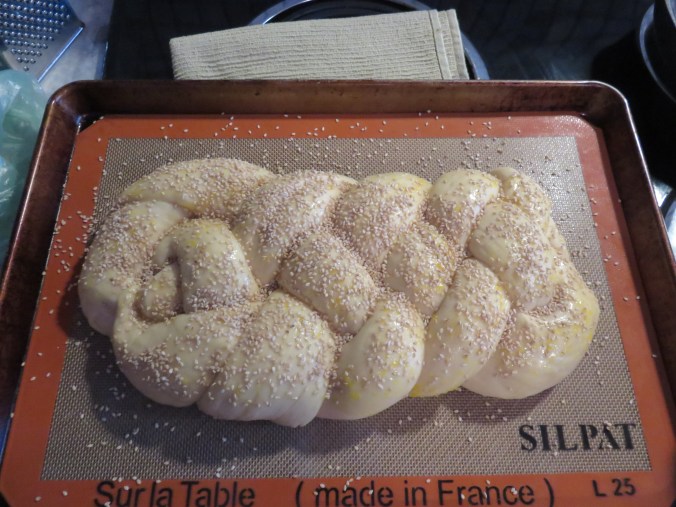
The first rise was in a bowl, the loaf shaped and allowed to rise again. Here is my 4-strand braided loaf ready for baking.

I have a couple of dozen blog posts drafts saved that I will never finish. I begin posts and never go back to them. But after I’ve posted, I do always go back. I correct typos, add a link or another photo. Sometimes I correct information or even add an entirely new paragraph. With so many people reading (I hope), it’s about time I corrected typos before posting, don’t you think?

There is a second baking scheduled today after our walk, and I want to celebrate. Over a hundred people have chosen to receive my posts. That is worth celebrating. It also reminds me of that bad habit I need to change. I write fast and post, and almost immediately people receive my blog post as an email. I am grateful when they “like” my post because that gives me a sense of the success of what I have written.

Finding those “likes” on my posts is something like my husband asking for a third and fourth slice of bread, fresh out of the oven. Except I get to see him smile.

the SHOULDs

fullsizeoutput_ea9

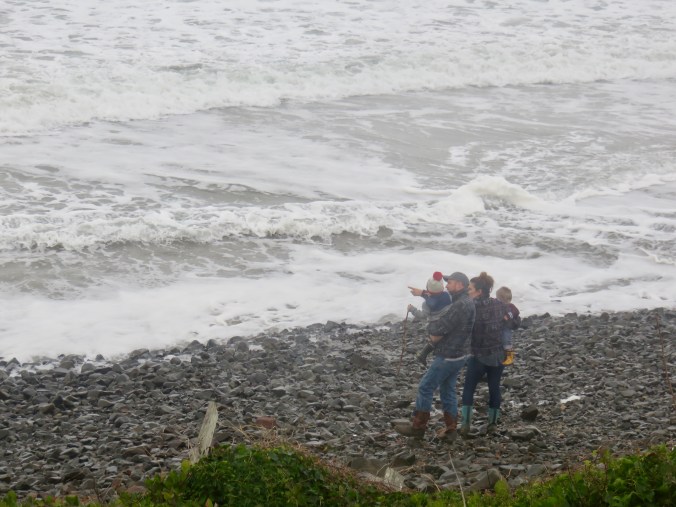
These vacationers should not stand on the beach during an incoming tide in mid-winter. Note the recent foam in the rocks to their right. I watched this family until they picked up their children and went back inside. (Yes, they briefly put them down on the rocks.)

I have worried about my weight since I was 13 years old and weighed 117 pounds. All my girlfriends felt, as I did, that we should lose weight. I was thin. I did not understand that. I still receive the message that I should lose weight. More often I am told I should not worry about my weight.

I should smile more.

I should not make a fuss.

I should get more rest.

I should see my doctor about that.

I should trust the process to play out.

I should say less, not everything I know.

I should not let things bother me.

I should not allow unkind people to get under my skin.

Unkind people bother me. This is especially true when I am afraid the unkind person is me.

I should wear colors.

I should dye my hair.

I should put on some lipstick.

I should not take things too seriously.

I should not care about people I do not even know.

I should use the trash I find on the beach to make art.

I should read this book, or another book, or watch a video, or attend this event.

I should stay safe.

I should. I should. I should.

It was my mother who was forever after me to put on lipstick. The “you-shoulds” began early in my life and they never seem to stop. My husband and I pick up trash on the beach most mornings. Most people ignore us. None offer to help. Instead they describe seeing “art” made from beach trash. “You should see what this guy made with beach litter!” They think I should do that.

There are times when I feel completely at a loss for what I should do. Should I revise this manuscript again? Should I do more research about that one? Should I abandon the goal of publication and save myself enormous disappointment? Should I?  Should I finish the warp on my loom and warp a new one? Will I ever reread most of my books? Should I let most of those books go?

Should I sell my family home and move someplace safer? Where is that safety?

These days I find I appreciate the marvelous diversity of lives. The couple who work and perhaps raise a family, perhaps pay off a mortgage, take a vacation to Hawaii just once, and slip silently into death without making leaving behind much more than a few fond memories. Should they have done something differently? The couple who spent their lives striving toward wealth and then discover late on that it doesn’t make their lives meaningful, or perhaps they fail to achieve that understanding. Have they wasted talent? The couple who sacrifice and demand sacrifice from others in pursuit of artistic, cultural, social, or personal goals. Was their sacrifice worthwhile? Was the sacrifice of others worthwhile? Which couple would I rather have for parents?

For more than two weeks I was ill. I am only just now feeling healthy. I coughed a bit last night and woke, but no meds, no coughing today so far, no body aches, no fever is a week. I missed my beach walks, I stayed in the house most days. I could not read for more than a few minutes at a time. I could write only in tiny fits and starts. I ate most of two bags of honey-dijon chips—not the individual serving size. I deliberately forced myself to eat three full meals a day but managed to lose two pounds during the week. I responded promptly to student emails, but I have not been able to score their essays—the necessary sustained energy is still beyond me.

My sense of obligation never entirely leaves me. I know plenty of people, even many teachers, who are able to turn off their concern long enough to get healthy. I wish I could. I should be able to do that. But like a lot of other “shoulds” I can not turn them off.

I should score my students’ papers by Wednesday.

I should eat healthy and not worry.

I should get off my computer.

I am 66, walk most every day, and today I weigh 145 pounds.

I should lose weight.

BLAME THE CHILI VERDE

IMG_0001

This is not chili verde, but half-eaten pot of Sunday Soup, made differently each week from vegetable stock and veggies + some combination of legumes, rice, or potatoes. recipes below

Early on, in the ’90s, when I said I didn’t eat meat, people would offer me chicken, and I would have to point out, Isn’t chicken meat? What about duck? they would ask. Turkey? Rabbit? I started calling myself a “vegetarian” because trying to explain what I ate led to a lot of confusion. And a lot of questions. And then more questions. Why? But why? And eventual irritation on both sides.

Let’s Cook It Right and cookbooks. I read a great many books on nutrition when I was in college. Some of my friends were vegan for religious reasons, and we all cooked. I came to terms with butter (I’d been raised on margarine) and sugars and avoided pseudo-foods. I cooked a many bad meals and followed any number of recipes, and Gary gamely ate most everything I set before him. He claims today that he became a vegetarian because I stopped feeding him meat.

We eat wild seafood sometimes and dairy and eggs. We are not vegan. I am not ready to give up dairy and honey and eggs. I have been told I am “Full of s–t” for claiming I am vegetarian. Most vegetarians agree. Today, I can call myself a pescatarian and people know what I mean, but in 1990 that was expecting too much. The term was not then in common use. None of these terms were familiar 30 years ago. Properly speaking, we are ovo-lacto-pescatarians. Even today, using that term in most company, non-vegetarian company, stirs up trouble.

Instead, I labeled myself vegetarian, and mostly for moral reasons. I had always loved eating meat, but after close exposure to feed lots and the flavor difference between grass fed and feed lot beef; way too many horror stories about slaughterhouses and animal diseases from a friend working in the vet school in Fort Collins, Colorado; recognition of the damage done all over the world to habitat, global warming, indigenous populations, and so forth by raising mammals for Americans to eat; ; more stories about how we raise farm animals in this country, the genuinely horrific conditions in which pigs and chickens are often raised; and a family that is painfully sentimental about animals and horrified by cruelty to animals; I decided it was wrong to eat what I would not kill. Why cry over the injured animal in a film and then eat a hamburger? I could not do both. I loved eating lamb, roast beef and stew, and pork shoulder in my chili verde, but I stopped by choice because I believed it was wrong for me to do.

These days, I still eat fish and shellfish on occasion because I would be willing to kill them in order to put them on my table. This is not to say that I did not cry when I caught a bullhead as a child, my dad clubbed it, and then threw it back in the water. I did not cry for the trout on another occasion. But also, I was not the one that killed either fish. And I eat eggs and dairy. I can be particular about sourcing both, but dairy, in particular, disturbs me. I need to give up cheese. I know this. Butter too. The dairy industry . . .

In the 70s, didn’t I give up on table grapes for years because of the farmworkers’ strike? Haven’t I given up other foods for health and moral reasons?

Processed meats is unhealthy. I loved bacon, but gave it up even thought I love that salty goodness. Ham was the easier pork product to abandon. I do not understand why people want pot bellied pigs as pets and get weepy reading Charlotte’s Web but will eat pork. Isn’t there an inconsistency there? If describing beef as “dead animal flesh” is offensive, it is also accurate.

There is the reality that meat from a supermarket is not what my grandmother would have been eating from off the farm, and a long ways from what my ancestors a hundred, much less a few thousand years ago were eating. The meat we eat is genetically different from what our ancestors ate, and it is born, fed, and raised differently. The flesh found in a supermarket packet is chemically, nutritionally quite different.

It is this sort of thinking that made me determined, more than 30 years ago, to stop.

It was the chili verde that held me up the longest. I needed several years to figure out how to feed my family and myself food that was delicious and also contained nothing with a face. My chili verde had to be as wonderful even without meat. I use no recipe, but an approximation exists in my personal cookbook:

chili verde

1970s • makes two or more quarts • serves 6-12

I used to make this according to the recipe from the Denver Ladies Society which called for pork shoulder browned first in oil and then the rest of the ingredients (no onions or beans!). I learned how after visiting Colorado for the first time in the mid 70s. I tried beef and finally accepted that it was best made with pork shoulder (bone in and then removed from the pot and the meat picked off and returned to the other ingredients. This chili was so good, it had the final hold on me as an eater of meat. The recipe here is almost nothing like the original in terms of ingredients, though I promise it’s as delicious as the original version from years ago.

1 large onion, chopped

1 T. garlic, crushed

2-3 lbs. roasted or fresh cut up tomatoes or 2 large cans tomatoes 

1/4 t. cinnamon

1 T. ground cumin

1 T. ground chili or more to taste (ground chipotle is best)

1 t. salt, or more (the recipe called for 1 T., but  I use smoked salt)

1 lb. fire roasted, seeded, and chopped poblano or 2 large cans diced green chilies

3 c. cooked black beans

chopped red or green bell pepper

Sauté onions in 1 T. of oil till transparent. Add garlic for a minute longer. 

Add remaining ingredients and simmer altogether for at least 45-60 minutes. May simmer for hours and additional ingredients such as zucchini or bell pepper may be added later; it is better the next day.

*optional: usually I begin by cooking 1 c. of dried black beans in water or stock to cover or add 2 or 3 drained cans of black beans and a grain such as corn or rice. You may substitute fresh tomatoes, add chopped cilantro, chopped zucchini, green onions, fresh chili peppers, etc. For a heartier meal (and a complete protein) add a pound of frozen or fresh corn kernels right at the end, or 1/2 c. raw rice and simmer 45 minutes or longer before the end of cooking. NOTE: beans do not cook well in an acidic liquid, so if you want to cook the beans with the rest of the ingredients (which I do from time to time), add the tomatoes and chilis only after the beans are tender. 

Serve hot with cilantro on top, nonfat sour cream or a stick of cheese stuck into the middle, and hot rice or chips on the side. Or serve with or over the rice or spooned over crushed tortilla chips for tortilla soup with cheddar cheese grated on top.

green chili dip: add equal parts grated cheddar cheese to completed chili and heat gently. I made this once for a party and three quarts were gone in the time it took me to greet more people at the door. This also makes a wonderful, if rich, meal.

The Sunday Soup, such as shown at top, is easier and more variable. Begin with onions and garlic, add stock and rice or lentils or potatoes and other root vegetables. I add fresh herbs such as thyme or dried such as a curry powder mix or chili, simmer 20 minutes (or start brown or wild rice sooner to cook). Then add whatever other vegetables I have—zucchini, fennel, fresh beans or tomatoes, mushrooms, etc. Cook just till tender, then serve with something fresh on top: cilantro, parsley, basil, a grating of cheese.

All vegetable trimmings go into a freezer container, which becomes stock for the soup the next week. I made this every Sunday for years when I was working 60-70 hours a week, because it fed us for three or more days and other than chopping the vegetables, it was easy to make while I scored papers.

GULLS & OYSTERCATCHERS

Version 2

We socialized a lot this holiday season. So far, a party, visitors, driving to Portland to see our sons and their families, and their extended families. The weekend after next, we will have a full house here for Twelfth Night. Gary wants Dundee cake, and we will have salmon and mushrooms and grains and salads. Our grandson Logan will get his waffles for breakfast, and weather permitting, we will walk the beaches.

Our travels have been lucky so far. No snow or ice. Just now the sky is a tender aqua over the ocean. It hailed a moment ago, but all that has cleared off the windows. There is almost enough sand for a walk.

I am supposed to be completing a final draft of a novel, but I have not gotten to it yet. I think maybe I will have to beg off. I think I want to do that. A kind reader in London surely has other things to do, and I would like to do something smaller. I wrote a story for Ruby some time ago, “Louise DeFleur Makes Magic Shoes.” There is a sequel about the alligator (or crocodile?) that lives under her bed and the beginning of a third story about the trolls in the basement. I want to work on those three stories and put them in a little book for my grandchildren. A Twelfth Night present. Illustrated, maybe. Maybe.

Or maybe I will nap and watch movies on television, or maybe I will lie back on the sofa and finally read The Tie that Binds by Kent Haruf. It’s been on my to-read list for a long time and I read the first 14 pages, which are really good. I have an early Le Guin story collection I have never read start-to-finish, and Gary gave me The Best American Short Stories of 2018 edited by Roxane Gay. And I have been reading aloud from Patrick O’Brian whenever I could get Gary to sit still. Reading is definitely on the program.

The silk and mohair scarf has four of five bands done, and I don’t like having yarn for a new project till it’s done. I really want to order yarn for a pullover. The sale ends today.

Perhaps I am doing too much—my mother’s voice is still in my head warning me to not overdo.

So for a little while, at least until the sun goes down, I will watch the ocean sending waves onshore, while really going out.


WRAPPING UP

fullsizeoutput_e57

The year is not over, but with Hanukkah already past, five days to the beginning of winter, and just over two weeks till 2019, “the season” is closing in. The day before yesterday I wrapped gifts for twenty people. Yes, I am amazed too. We sent out fewer holiday cards, but we did get them out.

It was been an interesting year, and by “interesting” I mean in the sense of the Chinese curse: May you live in interesting times. I mean both marvelous and traumatic for me personally. A man who pursued me on the beach, screaming obscenities, pretty much ruined summer, and then the Kavanaugh hearings brought up old stuff I could have lived without reliving. The determination of people to deny a bad word about the dead, the continuing horror that is the current national administration . . . I did not sew a dress. I did not bellydance for an hour a day. I recklessly ordered a custom desk, but when it arrived it was nothing like what I asked for and it took a month to get the brute out of my office space.

I might not be blamed for feeling a little down.

Instead, we feel cheered to have paid off our mortgage this year. We are not yet accustomed to having disposable income. There is a large open space in the middle of my office space that I quite like. I read several dozen books and gave away books, and there will be more about that later. Reading aloud to my husband is something we have enjoyed in the past. Just now we are beginning the fourth book of Patrick O’Brian’s 20-volume series. It’s my third time through and it’s better each time.

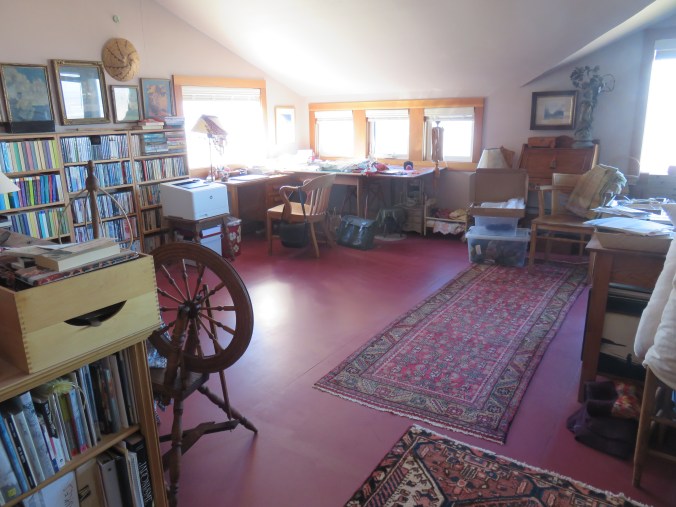
We replaced our skylights, repaired some plumbing, and I painted the entire upstairs myself, including floors. We have been seriously divesting lovely things we do not need, have no room for, and our family doesn’t want either. The attic contains only a cardboard box and plastic tubs to catch the leaks, and no rodents. It’s never permanent, of course, but Gary got the job done. (Next year, the roof itself needs replacing, obviously, and the deck now has holes large enough for both my feet to step through.)

We went on vacation, several times, and not merely 6-hour daytrips to Portland that we have counted as “vacation” in the past 16 years. We went to Canada for two nights, Seattle, Forest Grove, Nye Beach, and Decatur Island. Nine days away. Imagine!

I sold a story and an essay—yes, actual money changed hands. I did not find an agent for my newest novel, but that is the result of my determination to indulge in an unpalatable structure. I am working on something else now. Plus, during NaNoWriMo, I wrote a lot of new material, and in the new year, I will work on that too.

On the visual arts front: I knit hats and sweaters; wove blankets, scarves, and shawls; and pieced one completed quilt. This was not all I had planned and a baby blanket is still waiting for me to complete a warp on the loom so that I can put on a blue-gray warp. Still.

Gary and I picked up half a ton of trash off the beach, and gathered an assortment of seaglass, shells, and pebbles that I have only half-sorted.

I taught Writing 121 and 122 last school year, and I have begun teaching that series again this month with a large class of willing and capable students (hooray!). This Thursday, a half dozen former students will be speaking to my college class about their college experiences. I will have made at least three batches of “the chocolate thing” from a Canadian recipe. (That making will happen after I get home late from school on Wednesday.) It is cream, good chocolate, egg yolks, and a tablespoon of orange liquor for nuance.

51mVnm2RrDL._SCLZZZZZZZ__SY500_SX500_Confirmation of my order of The Speed of Darkness by Muriel Rukeyser revealed the cover image, which I immediately recognized. I thought: I have that book already, downstairs in Ian’s old bedroom on one of the poetry bookcases. I have not yet looked to be certain it’s there. If this book was inherited from my aunt or mother, and I have possessed it all this time without reading it, well, that would be both bad news and good, wouldn’t it?

My husband is most pleased that I am regularly using my grandmother’s desk. It is tiny, a ladylike drop-front desk of satinwood, and unsuited to spreading out. I must confine my mess to a narrow surface and that might be a part of the appeal. I generally sit on the sofa with my laptop, or in bed as I am now, typing this post, but I open that drop-front desk each morning and sit at it for a time, and then in the evening, I plug my laptop in on a chest to my left and close my grandmother’s desk. Gary finds all of this precious.

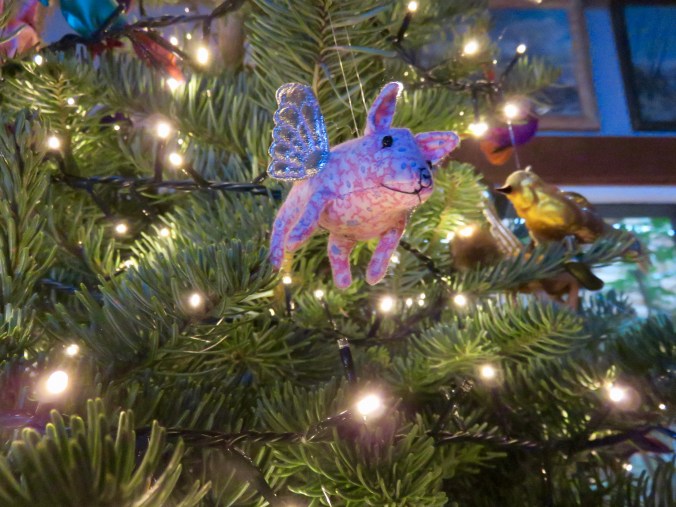
IMG_0015aThe tree downstairs has a thousand LED lights and is decorated with glass birds and tiny stuffed, winged animals made by Margaret Swanson-Vance of SewWing Studios. Some are more than 30 years old. This flying tiger has painted embellishment by her husband, who has passed (marked T  W  MS ’94 ‘Nar Bachcha’). The silver-winged pig at top is brand new. Upstairs is a little white paper tree in the front window. It has only a few lights and white ornaments, some of which are also from Margaret. A unicorn is on its way.
I have learned to bake panettone this fall. The sourdough start has not died but provided waffle batter, sweetrolls, and crumpets throughout the year. I did not make jam or jelly, but there are packets of fire-roasted peppers in the freezer, and we picked up tamale-ground organic masa from Three Sisters Nixtamal. For our Christmas there will be tamales! I plan to bake panettone, rugelach, and pecan cookies for the holidays, too, though it’s tight between the beginning of Winter Break (this Friday) and Christmas Day (next Tuesday).

We’ll manage in joy.


NO ONE WANTS YOUR STUFF

IMG_3480

Halfway through our summer homework: Everything in the far corner under the windows is moved. We are not done, but nearly. The last bedroom where we stored stuff is worse-but-better.

Mom told us: “Just sell it or give it to the kids [her grandchildren] and they can sell it.” She had promised that I would inherit her home, the house I designed and supervised in building, ordered the cabinets, installed the tile backsplash and the tile floor and walls in the bathroom and the entryway floor. I lost several months of paying work doing that, and the house was my favorite of all the ones I designed.

But when Mom finally accepted that she could not live there alone, she decided to sell the house. She preferred cash in the bank and did not “want to fuss” over renting. It sold quickly to a realtor who wanted it cleared out by closing. We had to wait till my brother took what he wanted before we could empty the house and the stuffed attic. In the end, Gary and I and our sons and one of our future daughters-in-law, emptied the house in two days and we have been loaded down ever since. [Gary says I am wrong about this, that he went back and forth for two weeks or more. He’s probably right.]

Mom wanted me to put all her things into storage and I refused to do it. The expense and the unlikelihood that I would find time to visit a storage unit made that impractical. I knew I would never go through a storage unit. So instead we moved it into our home, until Mom told us to just sell it all. After she died, we looked for charities.

There was little that was genuinely marketable, because the market crashed for a lot of items. Mom and I both collected: dolls, china, glass, prints and photos, books. Fewer people collect these day, and with Ebay, you can find whatever you want anywhere in the country. My mom and I used to hunt antique shops all over western Washington, searching for specific things we often could not find, and buying wonderful objects we did not need simply because they were rare. We had great fun doing that, and the items I have kept are the ones where I recall that search, our discussions about price and value and so forth. Reminders of time spent with Mom.

[In the mean time, antiques stores and malls are failing. Now, people can find anything, anything! they are looking for online. I recently bought two discontinued dinner plates on Ebay. They came from Finland.]

We stored boxes Mom brought to Oregon from Seattle, boxes of my school materials from grade school all the way through decades of teaching, boxes of Mom’s collectibles and recent purchases she’d never bothered to open. Cardboard boxes cluttered our rooms and stuffed the attic that already had my own accumulated clutter. I resisted going through Mom’s boxes, but at least I was not paying for a storage unit, I reasoned.

Looking back now, maybe that was a mistake. If I’d put everything in storage, I think we might have just walked away from it all—and maybe that would have been better. Finding places for my mother’s possessions was a nightmare that went on for over a decade. What left us before this past summer went to our sons or charity. My brother was angry not to have received money from sale of the pile, but we didn’t sell much of anything from Mom, just gave stuff away. We would have welcomed any attempt on his part to take things he wanted or to deal with the mess. Certainly, I would have preferred to do what he did: cherry-pick what I wanted and leave the rest of the mess to someone else.

Instead it is a chore that we find both onerous and painful. We are closing in now. The six boxes of books Gary wants to take to the GoodWill truck are my books, not Mom’s. The last sorted banker’s boxes were all my stuff that needed to be dumped. The north attic is finally empty, and only the one room still contains clutter—the Thonet chairs I bought while I was in high school, bedding and linens destined for charity, six more cardboard boxes of books. It has been emotionally and physically challenging to discard the accumulations of several lives. This has been our primary occupation in retirement: getting rid of stuff.

This is a common experience, I have learned. No one wants our stuff.