GROWING UP

IMG_3417

Yesterday, though it is October and cooling, the sun was bright overhead and we got in our two beach walks. A huge broken V of birds flew south so fast we were not able to identify the species. Not Canada geese, who fly slower and in a tidier skein and honk. Gary suggested cormorants.

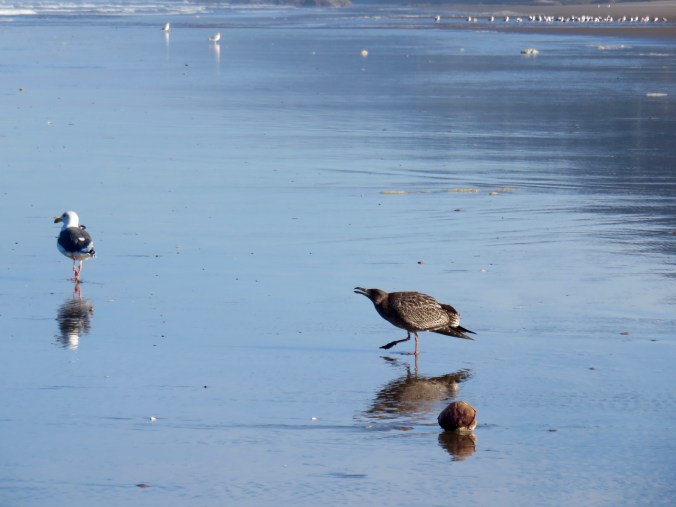
The juvenile gulls have mostly begun foraging for themselves, but we still see the occasional young bird begging its mother for food. The young gulls are fully fledged and as big as their parent, but still in dull gray child’s clothing. They duck their heads into their bodies, circle their parent and peep: “Feed me! Feed me!”

IMG_3424

The pelicans, too, seem to have fully grown children still in baby plumage, though these larger birds have more dignity, stately in size.

Hild by Nicola Griffith of Seattle is a novel about Saint Hilda, an ancient woman, who begins in this telling as a three year old. Her life is at risk, and she has been warned: Quiet mouth, bright mind. She is to listen and connect all she observes and throughout her precarious early life, she attends those around her with power: to the words of powerful people, to the scent of boggy land and new-turned earth and blossoms. She hears how the winds rattles leaves and the rustle and tuck of creatures in the wild.

Hild flies with eagles. This is not so much magic—this is medieval history, not fantasy—as wisdom. Hild connect dots in the air that no one else pays the slightest attention to. She misses things, but her seeing is not represented as a magical gift, but as the result of her openness to everything around her. She is smart and strong and very tall at a time when these qualities were often confused with the right to power. Hild seeks the pattern, sees it build and twist and turn, looks for ways to use it to advantage, both her own for the sake of weaker folk.

Times have not changed so much. We still confuse size with virtue. And even now there are people seeking a pattern to how the world changes.

There was a royal wedding, my husband tells me, and people were complaining about the cost. In Crazy Rich Asians there is an insanely expensive wedding too, but at least in the latter fictional case, the parents were supposed to have done something to earn the price. I always cry at weddings, and I even cried during that fictional one. I cried at my own wedding, which cost only a couple of hundred dollars including my dress and the gold I bought to make our rings.

I was young when I married, but Gary and I paid for the ceremony. We were already past begging our parents to feed us.

These days I think it would have been nice to have a friend who threw me a bridal shower, a father-in-law who paid for a pre-wedding banquet, a mother who insisted on all the trimmings and paying for them. But these are things I did without quite happily at the time. And they would be distant memories now, less valuable that the dress still wearable though folded away. There is no genuine regret. It was a lovely weeding in my parents’ back yard under the pagoda tree.

Seasons pass and time gathers itself in lumps of memory. How I laughed from excitement during the ceremony. How my new husband wrapped me in his arms. How our grins made our teeth click ever so gently at that first married kiss.
IMG_3418

The parent has already provided a crab meal—stripped clean here—and walks away. However it strives to appear small and dependent, it’s time for this gull to grow up.

EMBRACING THE CRONE

Ursula K. Le Guin once talked about embracing that word, “crone” as an honorific. For most, it is pejorative, inherently agist and sexist, but Ursula argued for a different take. The crone has experience and perspective, intelligence and awareness. The crone is old because she has lived long and prospered. She has earned respect, even though she rarely gets it.

“In her essay, ‘The Space Crone,’ Ursula Le Guin wrote that old women would make the best space explorers. Free from the daily tasks of rearing helpless children, free to see and comprehend without vanity, loving life because we know we may have to leave it soon, we would embark on our journey to the stars not for ego or planting flags but only for information to transmit back to our grandchildren for their future explorations. We know by then that we are part of the flow of life.”

I heard her talk about crones in the 1990s when she was about what my age is now. She wrote this essay twenty years earlier in 1976, when she was in her late 40s and I was in my 20s. It’s the first essay in Dancing at the Edge of the World, which includes her speech “Hunger” that I teach each year. Half that volume is made up of collected book reviews about writers such as C.S. Lewis, Doris Lessing, and Molly Gloss.

Kate Atkinson objects to book reviews written by authors, and particularly to a reviewer declaring her a “matron” in The New Yorker. I understand she considers the term disrespectful. I get it. She’s right. It wants to connect to “society” as in society matron, some woman with grown children who works on charitable committees without ever dirtying her hands. Matron, according to common use and the dictionary is a married woman, especially a dignified and sober middle-aged one. Like “bitch” maybe it’s time we took back the label of matron, the way Dick Gregory took back “Nigger” when he used it to title his memoir, so his mama would know that when she heard that loaded word, it was someone talking about her son’s book. Except that never quite worked and the n-word is still a bad’un.

Like racism and sexism, agism is something we’d like to pretend does not exist. In our youth-obsessed, age- and death-denying society, everyone past high school feels pressure to be young. How many times have people declared: It’s only natural to want to be young? Maybe. But in most past cultures, even the feeble old were regarded as having earned respect. They are the holders of what we now call institutional knowledge.

A woman I worked with on the local arts council assured me decades ago that “the great thing about being 70 years old is that no one expects you to look young anymore.” She made me laugh. We both laughed. I admired her home, her view, the wooden blackbird hovering over her dining table. I admired her ability to be who she was. I was 30-something at the time, no longer “young” but still uncomfortable with “middle aged.” I clung to Gloria Steinem’s incredible birthday riff about turning forty. “This is what forty looks like. We’ve been lying for so long, who would know?” Except, she was always beautiful, still is, and she’s 84 now. Gloria Steinem is old. She is even that worse thing, elderly.

I will be 66 next week, and I am old. (In medical terms, I am also elderly, but I resist that term. It belongs to my next decade and the one or ones after, should I be so lucky.) I am old, not middle-aged, not young. And I am not “66 years young” which is a pathetic claim to my mind. I am not living backwards. I am not trying to look 35 or 45. I am what I am. I am tired of guilt about youth. I am weary of being told I should yearn for youth, that I should strive for it, that I must always be forever young. I am not young.

from On Golden Pond:

Ethel: “Hey, I just met the nicest couple…. In the woods.”

Norman: “Couple of people?”

Ethel: “No, a couple of antelope. Of course a couple of people. Their name is Migliori, I believe…. They’re a nice middle-aged couple, just like us.”

Norman: “If they’re just like us, they’re not middle-aged. Middle-aged means middle, Ethel. Middle of life. People don’t live to be 150!”

Ethel: “Well, we’re at the far edge of middle age,” she says: “That’s all.”

Norman: “We’re not, you know. We’re not middle-aged. You’re old, and I’m ancient.”

Ethel: “Oh, pooh! You’re in your seventies, and I’m in my sixties.”

Norman: “Just barely on both counts”

[In fact, Hepburn was 74 when she said those lines. Henry Fonda was 76. Both were genuinely old, but not ancient. Hepburn was 94 when she died in 2003, but this was Fonda’s last theatrical film—he also made a TV movie that year. He passed early the next year, in 1982.]

There is nothing I want back from youth but the ability to run distance. I could still do that when I was 58. I would like that back. Yes, I truly would. But it won’t happen. I can walk for 2 hours and run short distances, but I will never run 6 or 16 miles again.* I mourn for the loss of that running freedom, but I honor what living, reading, and thinking have given me at my age.

I have experienced much, read many books, and thought deeply. I have never stopped reading and thinking and observing the world. There is still learning in my life. I am subject to change. That last should be another posting.

In the mean time, I have lived long and prospered. I have earned my age. Give me the credit I am due.

______________________________

*UPDATE: In October of 2022, the week before my 70th birthday, I ran a 10k in 71 minutes, 9 seconds. That’s 6.2 miles and I was 8th of two-hundred-something in the 65-69 age group. Whoo-hoo for me!

further UPDATE: I completed the same run the next year, a little slower but came in 2nd in my age group of over 200 runners because at a week before my 71st birthday, I was 70-74. Yeah, elderly now.


FLYING ON

IMG_3370

When I prepared my application to the MFA (Masters of Fine Arts in fiction) at Pacific University, I needed a short story, a very brief literary analysis essay, and a personal statement. This was 2004. My mother had been dying for over two years, and my brother had declared me “the most disfunctional person” he knew.

I had recently unshouldered the yearbook and left the high school cross country team, but I was teaching high school English full time, and visiting my mother at least three times a day since her collapse in 2002. My husband, too, carried this burden, stopping on his way to work to get Mom up and make her coffee, at lunch, and again on his way home. I have my annotated calendars from those years. They do not list these and other daily tasks or fun events as they would have during my working-my-way-through-college years. They note my mother’s hospital visits.

There was a four day period that included my high school Open House and three visits to the ER. I never missed school. I trudged on.

It’s true that I felt disfunctional. I was overworked, but I did not have the leisure to alter my obligations. I loved my mother and she was too stubborn to change. I was only halfway through the most stressful and painful and emotionally destructive period of my life, but I was doing the job. All the jobs of teacher, wife, mother, and daughter.

In the midst of this chaos, halfway through what would be the five years of Mom’s dying, I began to carve out a new life for myself. Our older son had completed his first college degree and our younger son, despite taking time out for commercial and regional theater and a leading role in a film, was completing his degree. I was, I see now, adjusting to my life chaos, struggling to regain space for myself as an individual.

My application to an MFA program, then, was essentially a survival strategy. I have absolutely no memory of what I wrote in my personal statement. I wrote my literary analysis about how Edward P. Jones details events without reflection in The Known World. And then, because I had never written a story longer than ten pages, I set out to write a story of close to twenty.

“The Promised Hour” was based on a pair of a true events, one of personal experience in college when I believed a child was being molested and I confronted the man after the Seattle Police said they could do nothing. The other, more recent event, concerned a local doctor, a man I knew whose daughters had gone to my sons’ grade school before moving out of the area. After his wife left him, the doctor deliberately bankrupted his practice and then seized and murdered his children and killed himself.

These deaths were reported in the newspaper and had a devastating impact on my community, on the people who knew the girls, teachers who had cared for them in the classroom, neighbors and school friends. I kept trying to understand how that mother could ever recover.

That was the story I told, the story of a woman carving out existence after devastating loss. I told it badly, I was later told, but well enough that someone thought I might have potential as a writer of fiction.

The story itself went through endless revisions. I mostly stopped keeping track after the first forty or so rewrites. I moved events into and out of chronological order, added and deleted scenes and details. Removed characters and created them. The story has since been submitted to literary journals a few dozen times. Sometimes it is summarily dismissed. A few journals kept it for months past their normal review time. Some wrote back with admiration and perhaps even sincere regret, but always rejection.

Then, in 2016, I turned it into a novel, which allowed me room to explore this woman’s life after death, the years of clawing her way back to life. Only fourteen drafts of the novel, and I am done rewriting. That novel has done no better than the story in submission. Mostly, it does not get past the query letter.

Everybody’s Mother Dies, a literary novel of about 78k words, follows a woman’s odyssey through grief. 

Thena Justice was building a new life near Seattle after the death of her mother and breakup of a terrible marriage when her former husband murders the neighbor-babysitter and their daughter before committing suicide. Lost in grief, Thena first hides in a friend’s converted garage, then in a tiny cottage on the Pacific coast, thrashing her way through apathy, anger, and routine. Instead of returning to Puget Sound, she moves to the city where she was born, takes the bus to a retail job each day, and keeps her head down until a child crying in the night wakens whatever it is that gives existence meaning. 

One agent wrote:

But no, I’m sorry.  . . . I read this query letter, it’s thoughtful and well-written. I don’t, however, have the mental energy to read a novel of this description, the world has become such a violent and angry place, I find myself unwilling to read fiction which deepens that impression. I’m sure there are others who will disagree with me and toward that end, best of luck.”

Though I rewrote the query, too, others do not disagree with her. Even the reader who read the entire work and liked it ultimately said no,

“I would love to take your manuscript on and work with you in placing it, but I’m afraid my current workload simply wouldn’t do it justice. This project requires care and attention – because it is no doubt a beautifully quiet yet impactful story – that I don’t feel I can give. I say this with a heavy heart.” 

Whatever care and attention it requires is beyond me. Though the bulk of my story is about recovery, not the devastating loss that demands it, I cannot help but respect these views. The world has become too angry and violent. And I have written my story badly.

Two agents and seven* small presses have sample pages, and then I will regretfully put this work aside permanently.

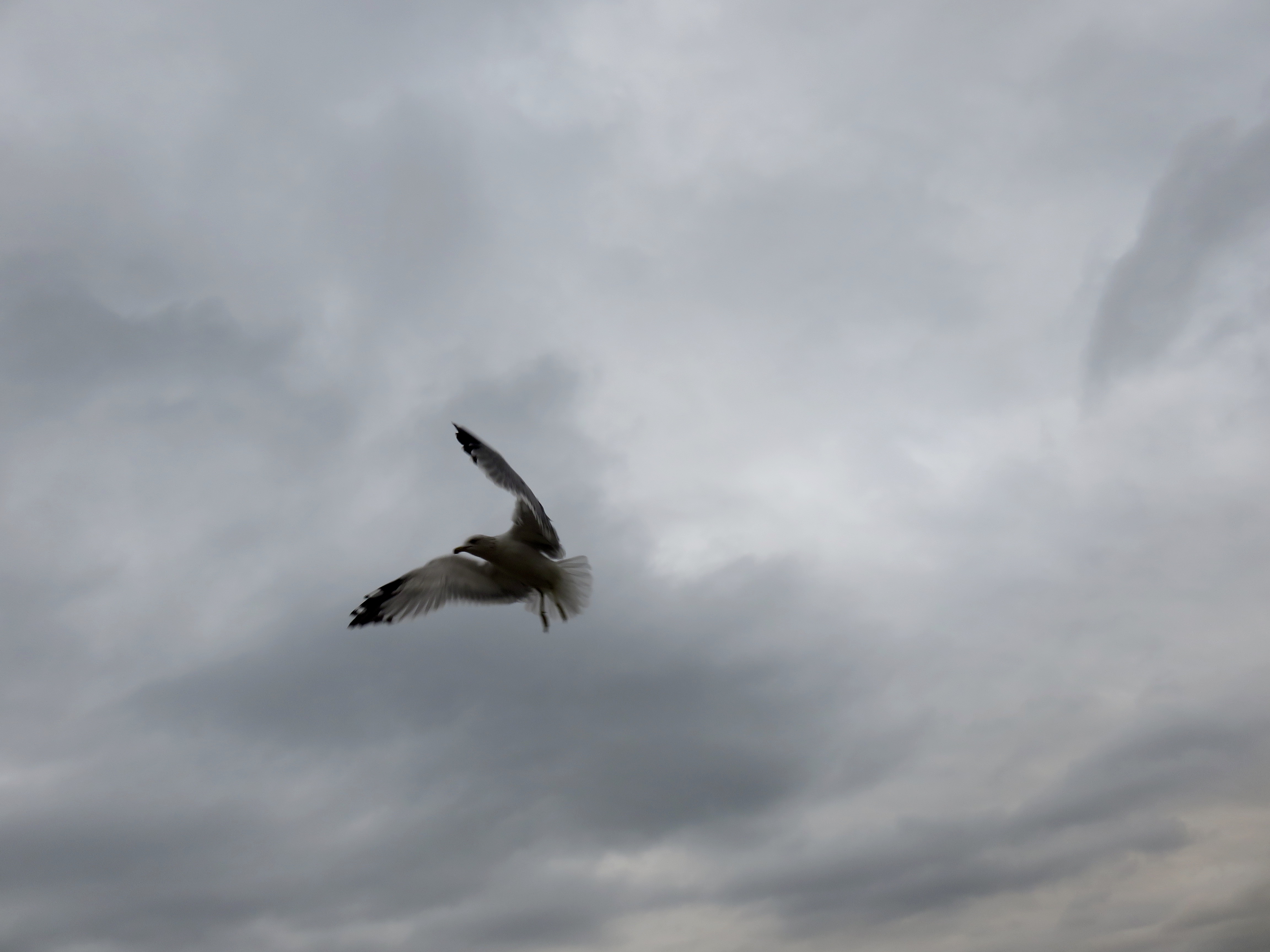
Sometimes the only way to survive is just to fly on.

IMG_3390

*I had to go look this up. Not four, seven.


MEETING & GREETING

IMG_3367

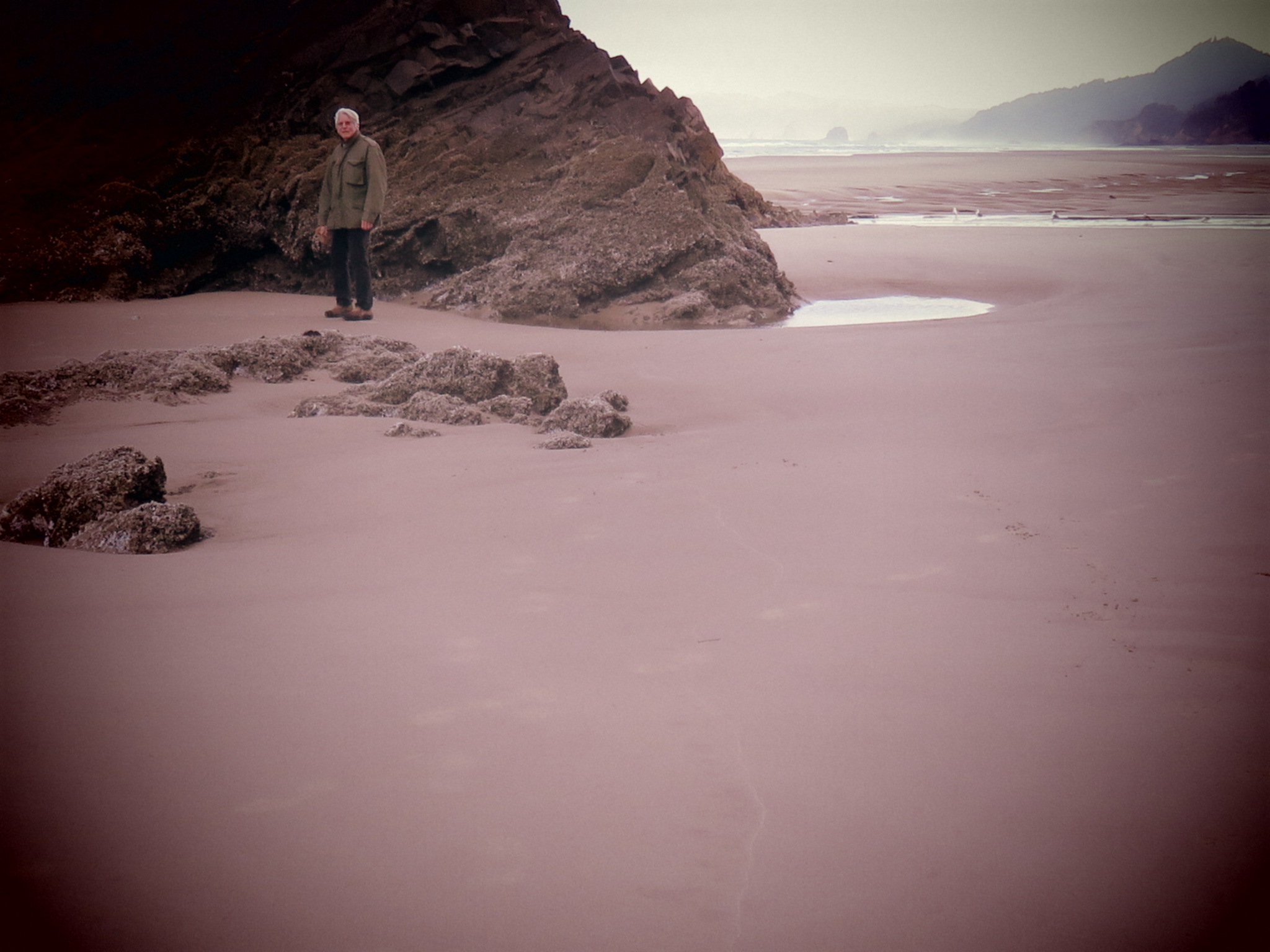
The man I love. Gary does not read my blog, so he will have no idea I posted this photograph. He is beautiful to my eyes. He won’t think so, but it’s true.

Love consists in this, that two solitudes protect and touch and greet each other. —Rainer Maria Rilke

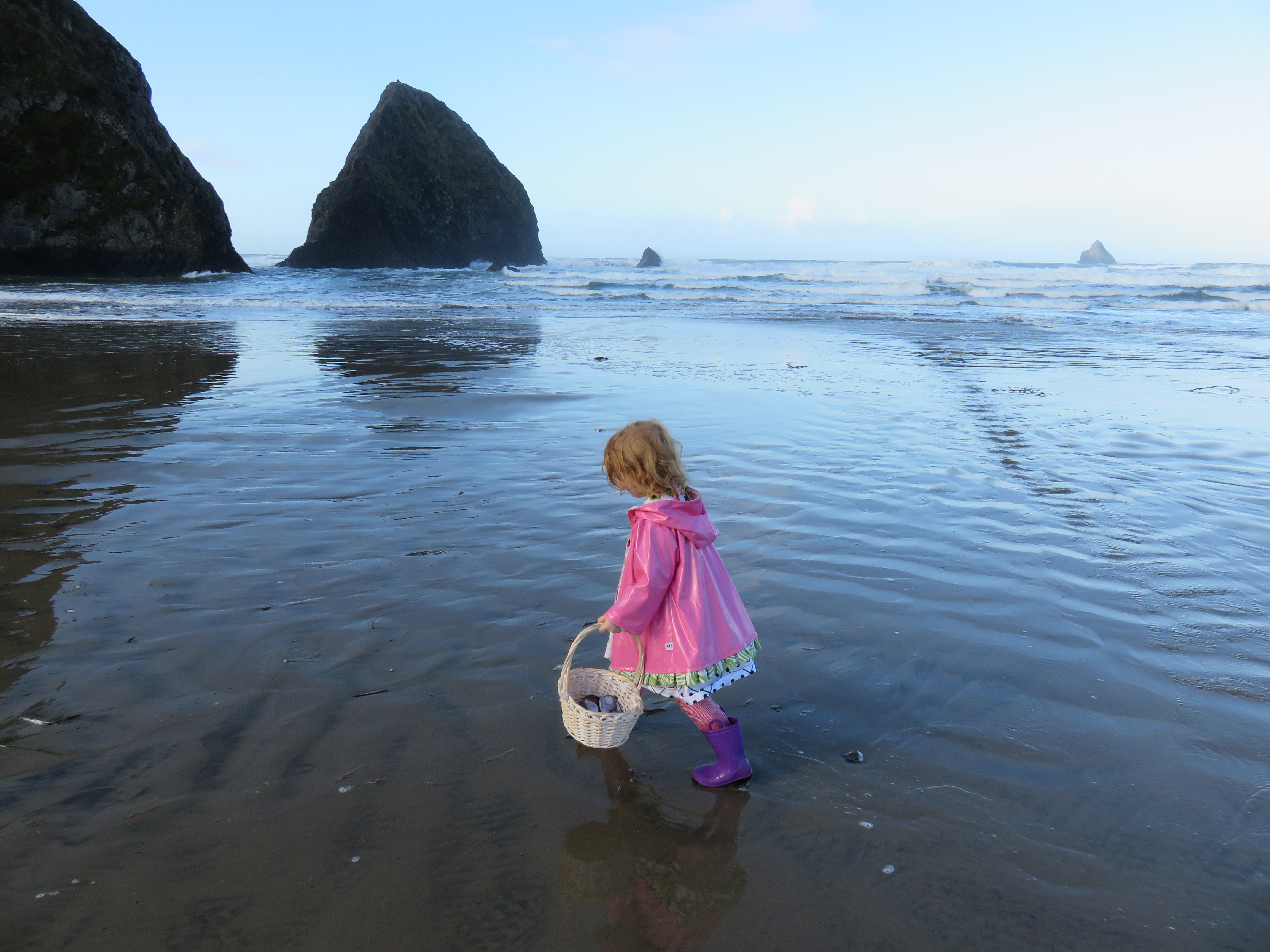
When my husband and I take our morning walk, we wander apart as much as we walk side by side. “I am going up to check that,” Gary will say, gesturing at something pink higher upshore. Yesterday morning it was a used diaper in a pink plastic bag. If it’s still there tomorrow, he’ll pick it up.

That is not what we talked about for quite a while that morning. We talked about candor and honesty in our relationship. We reviewed our history. We acknowledged our shared trust. I have since been thinking about love and family.

My mother and I were always very close. She had mental health problems and sometimes that made for painful or awkward moments, but her mental health while I was a girl only hovered on the edge of my awareness. The therapy. Medication. Hospitalization. Her furious insistence on trivial matters was just the way it was. (She had to be the first one to open a magazine that came in the mail. Tape, glue, and scissors were hidden.) She was my mother.

I told my mother most everything. Yes, I was one of those girls. I never revealed the worst, but mostly I told. I told her about boys I liked at school. We talked and talked and talked. We had family discussions about people I knew from school. We argued about gun control and hunting and race relations. My parents used their new reel-to-reel tape recorder to record family conversations about boys I knew and other issues. Conversation and debate were valued in my home.

Yes, I understand now that some of this is odd.  (Weird?) It only occasionally seemed uncomfortable at the time, and I was not in a position to judge. This was my family. (Some things are actually bizarre—strange enough that I do not see how I could use these events in fiction, and I have cannibalized most of my life for my fiction.)

When I began dating my future husband in 1969, I did not discuss him with my parents. This was not a conscious choice, it was merely the result of my absolute conviction that Gary was better than I deserved or was ever likely to meet again, and my determination that our relationship would last. I was not going to muck it up. Gary went further in that he believed we were destined. So we worked at our relationship. We made some smart choices.

For one, we played no games. We were and remain entirely honest with one another. Do I tell him every thought that crosses my mind? No. But mostly he knows and I trust him with that knowing. He knows me and I know him equally well.

It was my mother who pointed out early on, “You never talk about Gary. I think you must not care much about him.” She smiled but was wary.

I did not rise to what I now recognize was bait. I was merely surprised at the time. I think I smiled and shrugged. Did I tell her she was wrong? Not that I recall. But since then, I have thought a lot about that comment from my mother. She was threatened, of course. Did she think he was a bad influence? Did she judge him too old for me? Was it really that she did not care for him or about his family? He was never going to make enough money to support me in the manner she hoped I would become accustomed? Probably bits of all those things.

I never discussed Gary with my parents. I never complained about him to them either. I had complaints, of course I did. I have had my grievances and so has he. We have quarreled. We talked about them. We were loud. We were apologetic. I considered leaving the relationship. I yelled and ranted and we hurt one another’s feelings. We apologized. We tried to do better. Sometimes we were successful. Mostly we said little or nothing to anyone else. This was between us.

Even now, when I recognize that someone is more forthcoming with a friend than a “partner”, I figure it’s a bad sign. I might joke about Gary’s “failings” but there is no running to others about them. I did not complain to my mother about Gary. I did not complain to my girlfriends about Gary. I never once complained to his parents about Gary. They would have been hurt, I think. They would not have been able to help. If I had a problem, I complained to Gary. We discussed our issues between us.

We shared the good stuff with others. We did not intend to portray a false impression of our relationship. Sure, we argued, we bickered, we hurt each other. But only we could address that between us. Our honesty was honestly shared.

Outside of Gary, I am inclined to lie about annoyances. It is unfortunate, perhaps even dishonest and unhelpful and mostly the result of how I was raised as a girl. Do you like turquoise clothing? No, but I will say yes. Is that okay with you? No, but sometimes I will not admit that. Did I hurt your feelings? Only to Gary will I immediately admit: Yes. Yes, you did.

I love him and respect him and we have both worked hard to build a relationship of trust and openness.

If that used diaper is still there tomorrow, Gary will take along an extra plastic bag to use to pick it up. Yes, he is a bit of a germ-phobe. He wakes up too early in the morning. He wants to be asleep by 8pm. He still listens sometimes to old rock-and-roll that I could never hear again and be satisfied.

These are not things I expect others to help me change. These are not even things I expect him to change. He has a list, I know, of my troubling habits. These are not character flaws. These are merely the ordinary wackiness any of us must learn to live with if we hope to have a family.


VIOLATION


IMG_3354

The rape scene is explicit. I taught The Bluest Eye for 25 years. It is an extraordinary novel told from multiple perspectives. A little girl is ruined, driven insane and lost. The language is stunning, beautiful, masterful. I introduced the novel with an early event where a narrator describes being sick and feeling her mother’s anger. This anger is not toward her daughter, but toward the sickness, which the narrator eventually understands: “Love, thick and dark as Alaga syrup . . . welled up in that house”

The first pages tell the story. I always warned my students about the graphic description of the rapes so that they could skip those pages if they wished. Sometimes they asked to read another book, which I offered. I reread the novel every year with my students, but truthfully, I did not reread those pages myself every year. They are brilliant. Brutal paradox  is set up immediately in the book when Claudia McTeer describes how her vomit sticks to itself “so neat and nasty at the same time.” Ultimately about love, the eloquent revelation of pain never lets up. It is sharp and bloodying. Toni Morrison claims there is no understanding the why of her Pecola’s father violating his 11 year old child, of a community destroying her. We must be content with how.

Morrison accomplishes more than that, in my opinion. I always told students they might understand why Cholly Breedlove rapes his little girl, but that Morrison does not require us to forgive him. We are not asked to forgive him. We understand, but even so his actions are not forgivable.

______________________

The rape scene before me was explicit. I stood up and walked out of the room. My thoughts fluttered. Why? Generally, I am a determined viewer. I do not watch porn, but I do not enjoy scenes of sex in books or movies. Nudity does not bother me a bit, but violence with sex makes me cringe. Rape drives me out of the theater, off the page.

For most of my adult life, I struggled to understand why I reacted so badly to rape scenes in films and avoided them in books. I was never raped. I was never violated. It made no sense that I had such a visceral reaction to violation in fiction.

I wondered if I had suffered some trauma I had repressed? I raked through my memories for truth. Nothing. All through this, I was aware of an ugly experience from the age of 7 or 8. I knew it had happened, but my understanding of that event minimalized my experience. It was not so bad, I would think for many years after. After all, much worse things happened to others. Much, much worse things happened all the time.

“It isn’t necessary to minimize one group’s pain and suffering in order to legitimize another’s,” a former student posted on my Facebook page.

I think enormous stigma and shame is what all survivors share. Insistence that some suffer more than others—while certainly true in a general way—serves to separate us and undermine our shared felt reaction.

There is a reason that even today only a tiny fraction of rape victims of either sex report the crime. Recently, I have posted elsewhere that I was molested on the playground by a group of boys who held me still. I never told anyone at the time and did not even admit it as an act of molestation to myself or characterize the experience as a sexual assault for almost 50 years.

As a young teenager, men exposed themselves to me and I did not tell.

The one time I tried as a college freshman to report an event, I was treated very poorly. And I knew this was my fault. I had no words to describe it as anything else by mine. I had been told in an infinite number of ways from the sex education I received at home and at school to the general attitude of my culture, that if I was victimized, if something “nasty” happened to me, I had done something to “ask for it.” My fault.

Are we not still in that terrible place?

Being loud, insistent, bombastic even, seems to convince some people. When it comes from a man. Tears. Denial. The silence or the soft (female) voice is refuted. Why not talk about it immediately? Why talk about it at all. What did you do?

Society weaves a thick blanket of blame and certainty over who I was then. That absolute judgement that what happened to me, if it happened at all, did not matter. That, I knew.

And now I unweave this memory. I examine it. I consider the glee in the faces of those boys. Those boys who never had paid me the slightest attention in the past, a wonder to me, approaching me with grins on their faces. I was small, small for my age, and youngest in the class.

I could not tell you the boys’ names or the date it happened. I could describe the light, their faces, the buzz cut of the boy who violated me. I know where I was standing on the playground. I remember the weeds I ran through after running from the blacktop playground. I was surprised to have escaped. My arms had been pinned, boys all around me. Perhaps my passivity, my well-trained smile, left them unprepared for my explosion. I escaped, but they had already gained what they wanted. Hadn’t they? They were done with me. They let me go.

It felt like escape at the time. I had not escaped. They were through.

The story of that day never left me. I simply ignored the warning.

If, as a victim, I could not admit even to myself the trauma of those boys surrounding me on the playground, holding on to my body, and one boy thrusting his hand into panties, my abrupt realization of what he was doing, and my scream and abrupt break. Running away. My tears. I told not a single soul. I did not, in 1960, even have words to describe what those boys and that boy had done. I pushed the memory away. I told myself it was a minor event.

So many people have suffered so much worse.

PARING DOWN and going out

IMG_0046

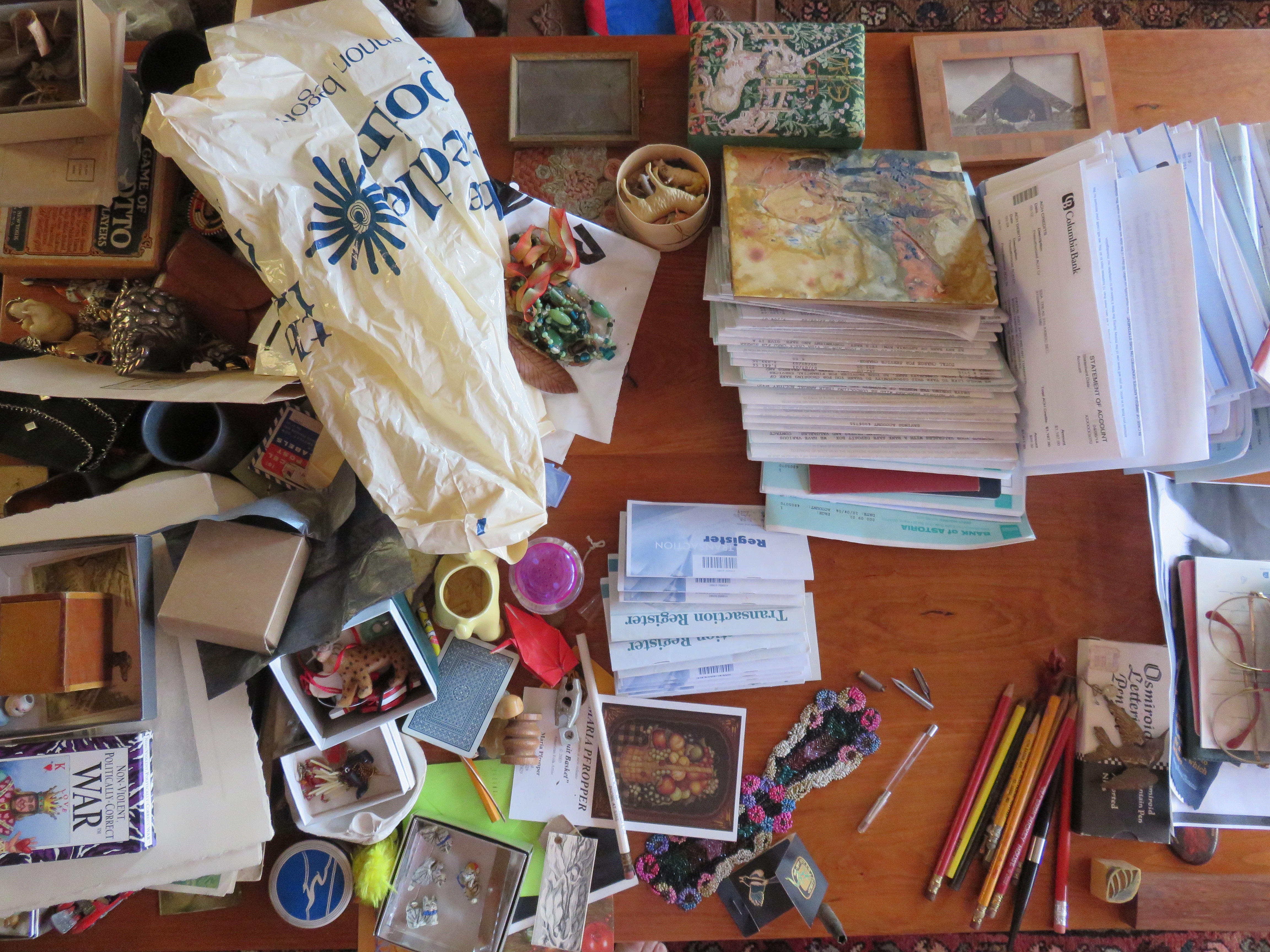
In our continuing effort to tidy the house, I am following an online series of articles on how to edit and tidy my home. Fifteen days of advice on how to eliminate clutter, and basically sort “stuff” into giveaway, toss, and keep-but-put-away.

The process began by suggesting that I have a “monster pile” someplace in my home. It was true. I had a pile that was a couple of feet high and three by six feet. By the time I’d cleared other areas of my house my monster had grown to four times that size. Even made tidy into straight lines and contained by boxes, it filled the center of my workspace. My online article told me to remove three items from the pile and find a place for them or scoot them out of the house. The next day it gave me a different area to tackle, but then reminded me to take three things out of the pile. That’s mostly how it’s been ever since.

A junk drawer is not necessary only in my kitchen, I was told, there should be one in each room. That made me laugh. I had already sorted out my sewing “junk drawer” but kept the little plastic bin of miscellaneous stuff that needed to be somewhere but did not belong in the baskets with thread, the drawer with scissors, or any other particular place. I have an orderly junk drawer in my kitchen and one in the bathroom vanity. The dressing table in my bedroom contains scarves and miscellaneous “junk” too. All this has been sorted recently, but each day I try to turn the home-tidying advice into practice.

Yesterday, I was told to edit my freezer, fridge, and pantry with specific attention to outdated items or foods I had tried but did not like. While I was upstairs reading these instructions on my computer, my husband was downstairs actually emptying one shelf at a time in—you guessed it—the freezer, fridge, and pantry. He sorted. That afternoon I went through his piles as a second reviewer. Trash, giveaway, and keep. He cleaned the shelves too. The resulting order went well beyond what had been suggested, and even though I didn’t do most of the work, I felt accomplished!

I have been advised to spend a limited time sorting one specific area each day. I did the entire linen closet. I was advised to remove three items from the “monster pile” and sometimes I eliminated an entire cardboard box from the room.

I spent some extra time with my monster pile after dinner, choosing not three items but a mini-pile or box to sort, several days in a row, while the television played something in English where I did not have to read subtitles. My monster is mostly gone, though it seems to be rebuilding.

However, the attic is completely empty. I still have space on my book shelves. (I ruthlessly sorted books again this summer, but there are still eleven bookcases upstairs and more than that downstairs.) We took a small painting to be framed in a wooden frame that came out of the attic. On Friday we hope to take a tiny print up to be placed in another frame from the attic. I gently oiled, sanded, and waxed the beautiful walnut veneer.

Over the past summer, I painted the entire upstairs, ceiling included.

There is still work to be done. Next summer we need to move all the furniture out of the living and dining rooms and varnish the floors. The kitchen, too. The entry and hall floors have a different finish on them and I plan to paint over it. I suspect I missed the weather window for floor paint, so that will likely wait till next year. I sorted through everything in the lower half of my grandmother’s secretary, but there is still the top half.

The Christmas ornaments are at home in a downstairs closet. I have completed most of my Christmas shopping. There is paper and tissue and green velvet ribbon waiting for me to wrap.

I have put a warp on my loom for a pair of scarves and begun knitting a third. These are straight forward, simple projects I can do without thinking much. But I also have less than five weeks to knit my granddaughter a sweater with a cat on it for her birthday.

My laptop is getting a little creaky, but I have been putting off buying a new one. This morning it abruptly turned itself off, screen went black. Later it was fine. Not a very good sign, though. My older son told me before I replaced my last one (after nine years) that laptops have a half-life of about 18 months. The one I am using now is going on six years and unlikely to last much longer, I fear. I want a lighter laptop. I enjoy the screen on my 15″ MacBookPro, but it weighs four and a half pounds. How about two pounds? I am thinking a tiny screen and two pounds, but I have a couple of bills to pay first. In the mean time, I am backing things up.

I made a ginger plumcake the day before yesterday, which we had for breakfast and then broccoli for lunch.

It is also Wednesday and I am sitting in the high school library for Open Library. Three sophomores were working on Chemistry lab write-ups, but they’ve left. Last week I helped a freshman with his Geometry. I’m not sure he finally had the correct answer to the last problem. He’d done it wrong the first time and I did my best to steer him in the right direction. Next week I am promised a few frantic juniors working on the infamous Reading for Writers. I would rather have customers than not.

I have committed to NaNoWriMo this year, and begun notes on an SF novel. That cat sweater has to be done. Maybe that is something I should start tomorrow?

IMG_3365

HELP, I’VE FALLEN BUT I GOT BACK UP

IMG_3294

I fell hard yesterday. I was doing something stupid, trotting backwards as I tried to photograph my husband and a seastack and he kept walking right out of my frame. (If he knows he’s being photographed, he mugs or frowns. Photos of Gary smiling are pretty rare.)

So I was backing up to keep Gary in my photograph, and I tripped over a rock poking out of the sand that I had failed to notice and landed hard on my back. The smooth wet sand was hard as concrete. I did not land on the rock.

Still on the sand, I held still to discover how badly hurt I was. Would I be able to stand up? Had I broken my pelvis? I hurt. Gary had been watching me and wondered what I was doing. He says he thought, “Why is she trotting backwards? She’s going to hit that rock.” Then I did and he trotted over to me.

When he arrived, he said: “What are you you trying to do?” I snapped back at him, and he considered that a good sign. I hurt.

When I was pregnant with our first child I tripped and landed in a seated position. I damaged my tailbone. The doctor said it might have been cracked, but they couldn’t Xray because of the baby, and “there’s nothing we could do for you anyway.” Time would heal me, not any treatment they could offer beyond over-the-counter pain meds such as Tylenal. That was almost forty years ago, but I remembered that pain and considered that I might have cracked something in my pelvic area, but there wasn’t much to be done about it.

Aside from, maybe, my little toe and the little finger on my right hand, I have never actually broken a bone. Usually, I am a good faller. I could probably recall every time in my life I have ever fallen. Never from a tree, but once on my bike as a child. I jumped from a second story window, but that was a stupid choice, not a fall. I’ve been thrown from horses without a mark. One fall while pregnant, once I tripped over the oversize shoes my podiatrist insisted I wear, before I was used to them. About fifteen years ago, I fell while running hills when I missed my footing at the edge of pavement on the highway. I got right back up and kept running. This time was not like that.

After a half minute assessing my condition, flat on the sand, I rolled carefully to the side and got up. Yes, hurt. Not broken, not flashing or searing pain, nothing stabbing or worse on standing. We continued our walk, stopped when we got to a stream we could not cross without getting wet, and turned for home. I took two aspirin, sat carefully, discovered what movement hurt more or less, and went back to work on a quilt. A few hours later I took another dose of aspirin, and that’s all I have done. A former student, now nearly a nurse, warned me not to use aspirin, so I stopped.

Gary told our older son on the phone about my fall, which I had not planned to reveal to anyone. Like their dad, sons worry.

When I got out of bed this morning, I felt odd in my head—not pain, but fluffy, disconnection. I lay back down for a time, considering the possibility of concussion. When I got up again, I felt the same wooly-headedness, and I was careful.

So maybe a cracked bone, certainly some bruising though nothing shows, and maybe a concussion—I hit the back of my head hard. I will take it easy for a few days. I will not think too hard since research suggests that an active mind after a concussion slows recovery. I think about my students who were in car crashes, suffered concussions and came back too soon. I think about the coach who put his own son back into a game after he suffered a concussion. I think about my age and that I am too old to risk the loss of brain function. I think worrying probably isn’t good for me.

My husband brings me coffee in bed each morning. My favorite grandparent, my step-grandfather Lavin Hansen, whom I called “Papa,” brought coffee to my grandmother in bed each morning.

The mind travels even when the body is in pain.

FOUNTAIN PEN

IMG_3205

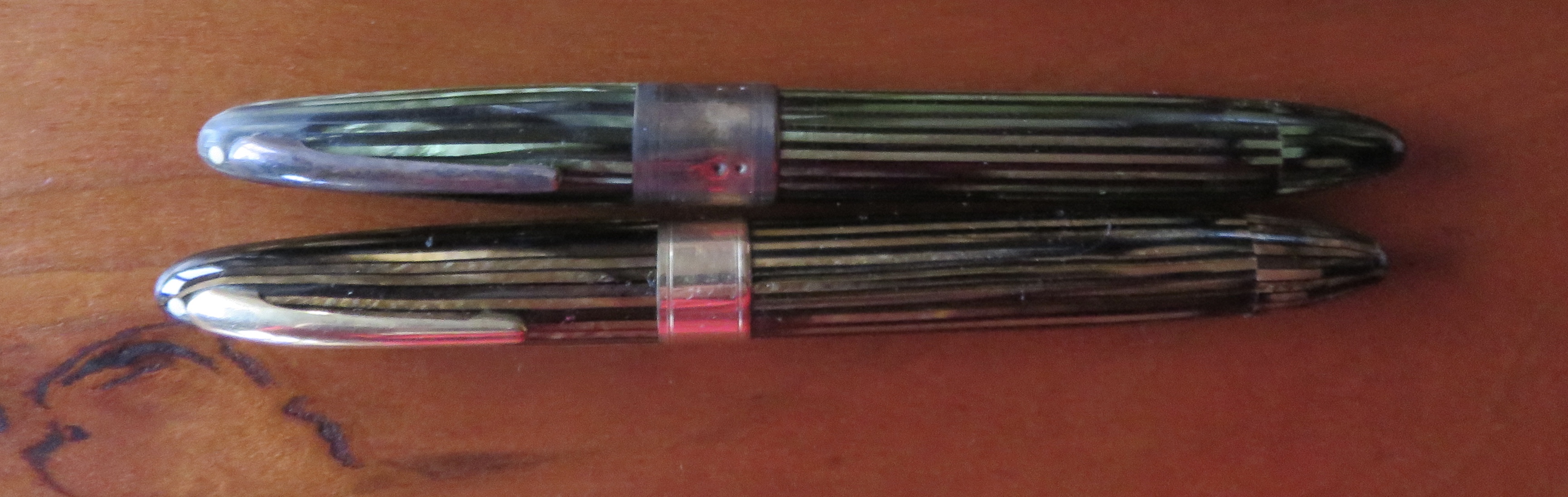
top: My dad’s fountain pen, probably from the 40s, maybe older or younger. The lower one was a surprise. I have no memory of seeing it before a couple of days ago. I have searched for exactly such a pen on Ebay.

I began using fancy pens when I was in college as an Art major. Mostly I wrote with a 0000 stylus fountain pen—a Kon-i-noor Rapidograph. The tip of such pens is a tiny tube, thinner than a crow quill, and notorious for clogging. The 4×0 tip makes a line 0.18mm wide. I used a 3×0 later, but eventually, the pens would always clog, freeze, and I would need a new one every 2-3 years. I learned to write carefully because the pen must be pretty much perpendicular to the paper to flow at all. While I have never been successful at calligraphy, my handwriting, which had been even worse than my typing is now, improved. I worked at it.

I also illustrated catalogues and magazines, designed logos and other advertising, and drew portraits of famous dogs. A German kennel came across an illustration of mine and was using it for his logo. By the time I found the image on his website, I was no longer making a living as a designer. He offered to pay me, but I told him he was welcome to it.

0105214-1.jpg

Eventually, I shifted over to Rotring Rapidographs, which were easier to find and cheaper. Around the time my children began walking, I gave up on Rapidographs entirely.

In the ’90s, my husband gave me an expensive fountain pen, a Pelikan 600, with green striations, and I have been using it daily every since. My dad’s fountain pen, the green striated one above at top is from another maker and was always loaded with blue-black ink. My pen generally has green or purple ink. Just now it is loaded with a Japanese green ink that is not quite olive enough. I am tempted to fool with the color by adding some orange to the bottle. I’ve mixed ink colors before.

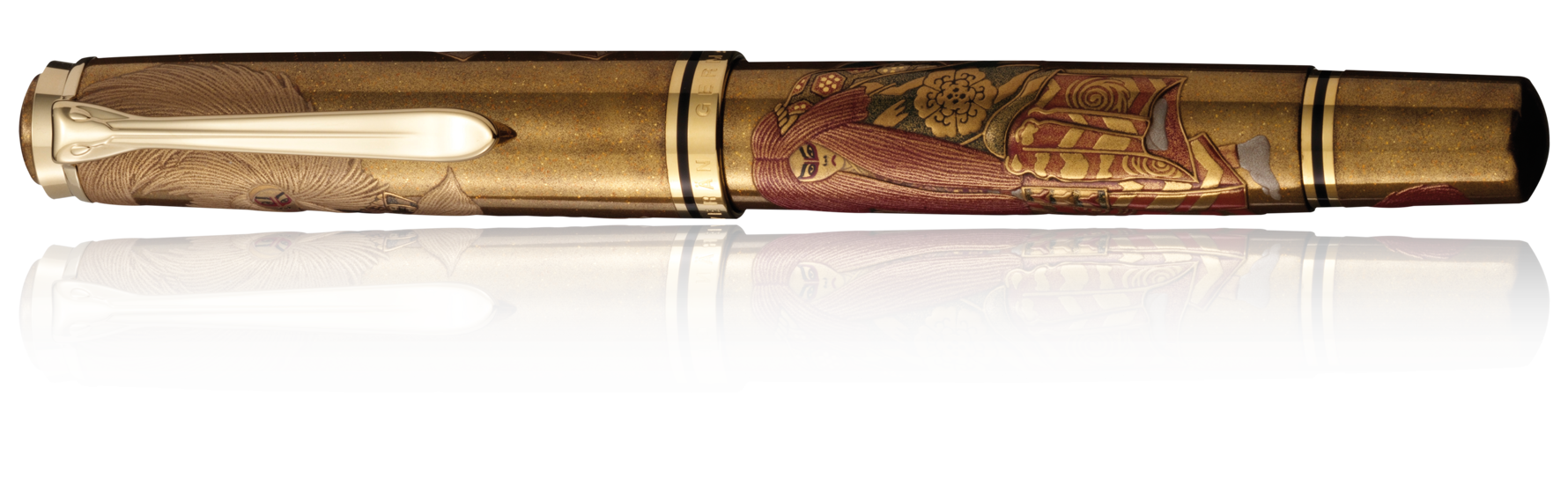
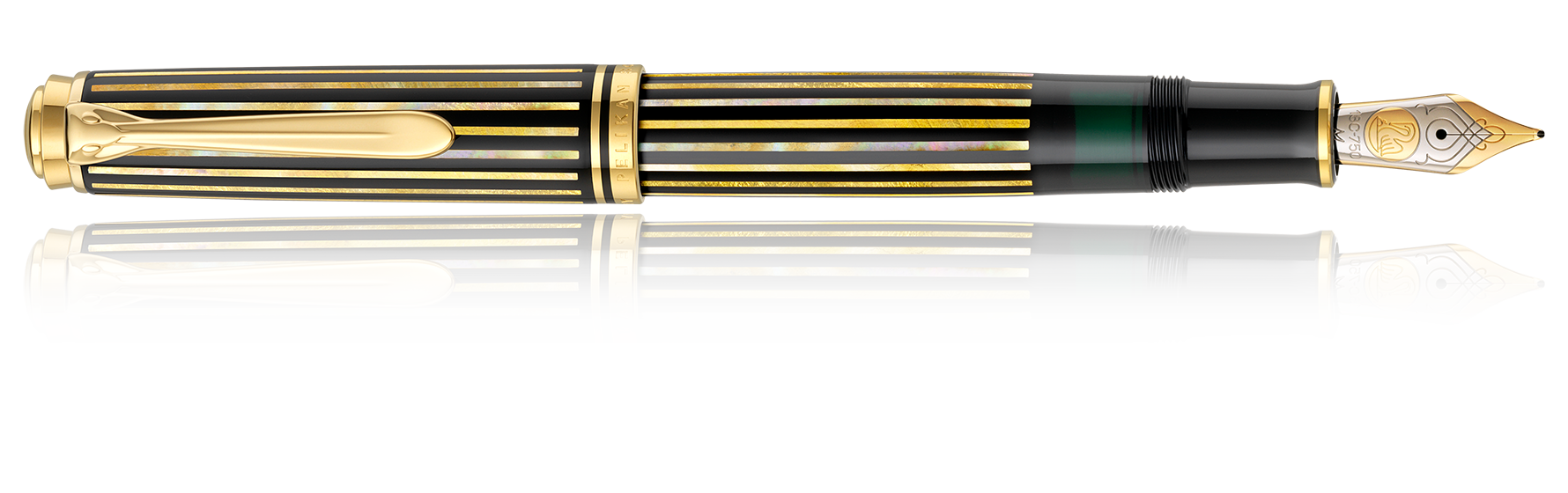
My Pelikan fountain pen has served me well for over 20 years, During that time an occasional student was inspired to try a fountain pen after admiring mine. They wanted to try it, but my dad always insisted that no one should ever, ever use an other person’s fountain pen. I have tried the Pilot Metropolitan, which is a very cheap pen (about $20) and allowed me not to cry when it was ruined at school. My Pelikan remains the one I carry everywhere. If I ever win the lottery, I would be tempted to buy one of the crazy-expensive Maki-e or Souveraen pens from Pelikan. They don’t even list prices online. So, yes, the lottery. 

maki-e-renjishi-large.png

souveraen-m800-raden-royal-gold-large.png

This is just to say that I love fountain pens both as artful in themselves and in use whether to make art or a shopping list. 

When they have been used, as my dad’s pen was used, they become almost like family.

In unpacking my grandmother’s desk, I found a stash of fountain pens in a drawer. Two tiny ones with ink reservoirs held in place by the nib, two Esterbrooks (black and gray marble from the 40s or 50s), and two Shaeffer’s pens. I put most of them in that desk drawer myself perhaps 30 years ago before my dad died. Since it came to me, my dad’s Shaeffer’s pen has floated about the house, in places where I could pick it up and hold it. The original owners of the other pens include a fancy gold-bound one with the initials of my grandmother’s second husband’s brother, and small serviceable pen my step-grandmother Genevieve used as a nurse. There is no certainty about the others. I have been able to clean two Esterbrook pens, and I am using the marbled one with purple ink.

The mechanical pencils in that drawer? . . . well, that’s for another day. I use a Y&C Grip500 0.5mm mechanical pencil. After losing several, I found they were discontinued. I bought a box of six old stock 10-15 years ago, and I have managed to hold on to four of them. (Whoops! found another one, which means only one has been lost.)

Tools are precious things.

The two pens in the photo up top are going to a repair person in Arizona tomorrow. I am not optimistic about what he can do for my dad’s pen. My dad used his pen for nearly 50 years. It took him all through the war to France and Germany, and the nib is quite bent to suit him. Late in life Daddy “customized” the pressure closure because it was no longer holding, and I doubt that can be corrected. But there is a chance both pens will return to me in a few weeks, and at least one will be serviceable.

I have felt loyalty to my Pelikan for over 20 years, but I respect the two small Esterbrooks for still working, after a lot of flushing, despite benign neglect for decades. The gray marble one has seen hard use. Both its “jewels”, the black plastic button on each end, are damaged, but the gold nib still flows nicely. I might load vermillion ink in the black one.

Perhaps, if I am particularly brave, I will try cleaning my old stylus pens. It would be good to use one again. Doing that would also convey an obligation in my mind to return to drawing. I have the idea of illustrating the owl story.

I do not know what happened to the original illustration. Here is the fuzzy version I found on a German website. Ch. Mecca’s Falstaff and Wita Rosie van de Oranje Manege


DÖSTÄDNING

IMG_3203

I found the escutcheon plate missing from the top drawer. They key is in another lock.

My step-grandmother’s secretary desk has pride of place in our home opposite the front door. Yesterday, I began emptying this beautiful secretary, purchased in 1962 for $125. Baubles, birthday cards, baskets, and relics of childhood. Things my mother and grandmother kept, programs from Ian’s early performances, and things I had forgotten completely even existed. A pair of ancient fountain pens I will try to get working again.

IMG_3202

What came out of the working part of the desk. Three drawers and a cubby are empty.

I keep finding baskets and little boxes with buttons, necklaces, earrings I will never wear, campaign buttons and tiny objects without any use whatsoever. The music box will return to the desk, my grandmother’s slim leather briefcase with her maiden initials. The rest is going out the door to find a new home, leaving without regret.

Gary points out we are merely getting rid of things we do not both love and need. The “love and need” items still constitute quite a stash. It is only our half-joking effort at Swedish death cleansing, döstädning. A garage sale, giving things away, donations, etc. are an effort to make a little space in our home and in our lives.

The idea is to lighten our load, which has been burdened by being the last Priddy in my dad’s family, as well as the last in my mother’s family. Gary, with five siblings, brings less to this accumulation of stuff.

A few years ago a family member yelled at us for “not sharing” the family’s collectables. Truly, we would have been very grateful had this person taken more since they had first access to my mother’s house when it was emptied.

The family items I treasure were given to me long ago, a tiny pin, my great grandmother’s engagement gift, two lengths of wool jersey fabric that I have no more been able to cut and sew into a garment than my grandmother was. I am keeping it even so.

IMG_3204

Maybe I will tackle the upper display in the secretary . . . later.

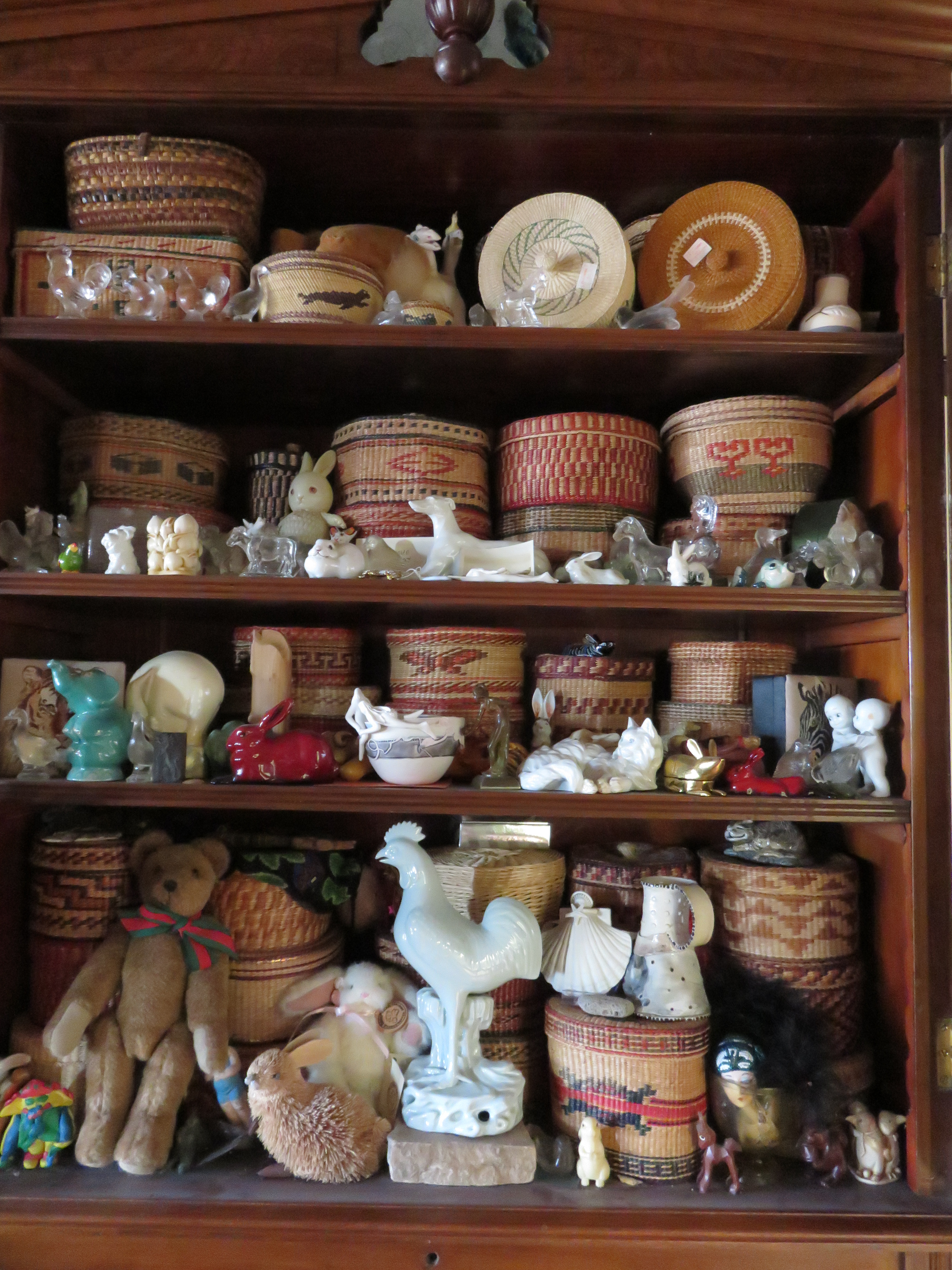
And there are the objects on display in the upper glassed section of the secretary. Most of these are not “family” but objects I made or collected.

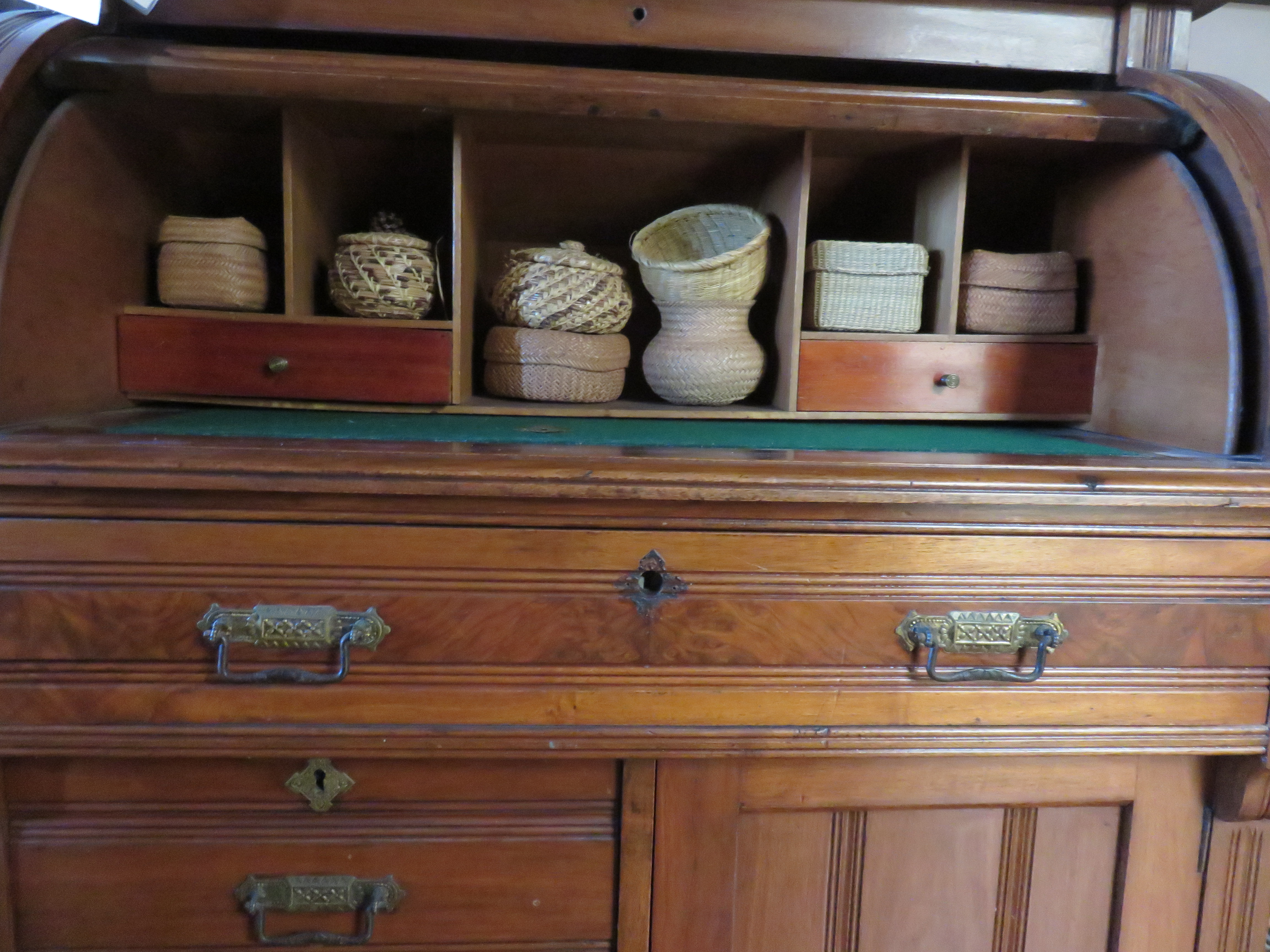
The green elephant on the second shelf came from my grandmother’s kitchen window. She would remove her wedding rings and place them on the trunk when she did the dishes. There is a little white Persian cat on the same shelf that Mom found in an antique show held at Northgate. I was with her when she first saw the kitty, but it was only later in the day she went back to buy it. She gave it to me before she died in 2007. There is a Kay Finch ceramic goldfish and a porcelain greyhound. The celadon rooster is meant to decorate the table at holidays. Aside from small ornaments, all the little woven grass baskets I bought while I was in college and working at the University Book Store are waiting for review. Also the NW basket made and given to Gary in thanks for his work at Tulalip. We will keep all the baskets, but I am afraid many of them have things inside.

To be clear, we are not preparing for death anytime soon. We are accepting of our mortality, but having cleared the homes of too many relatives ourselves, we do not want to leave an unnecessarily burdensome task for our family.

44th ANNIVERSARY

IMG_3726
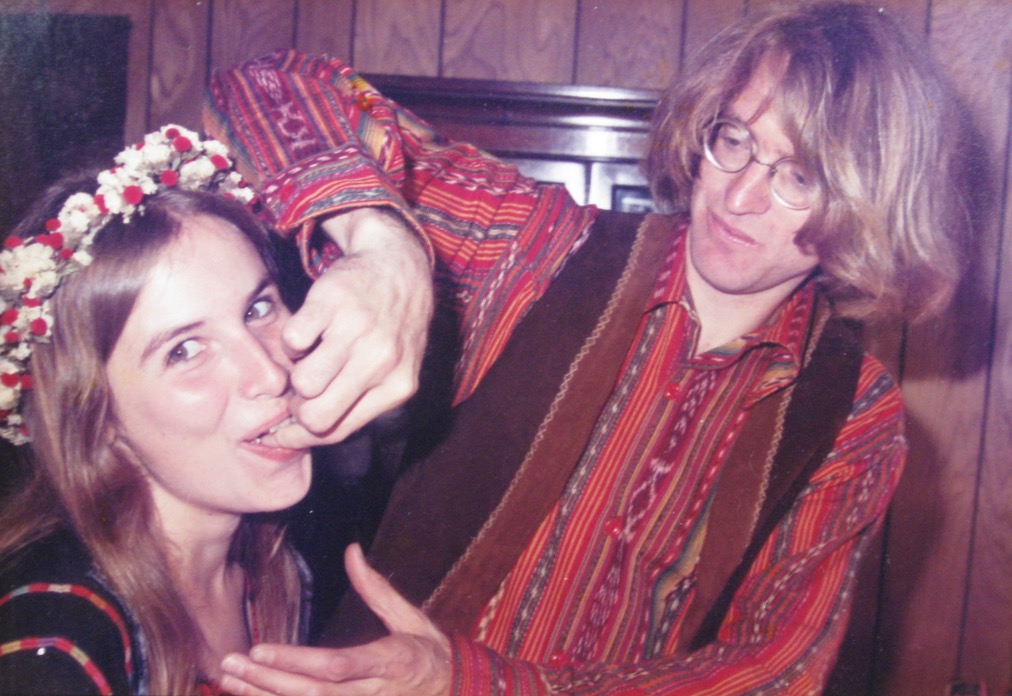
Gary feeding me the wedding cake at our wedding.

We were very young when we met and still young when we married. Lucky in that joining, as in so many things. Lucky my step-grandmother was a weaver. Lucky her second husband loved Gary. Lucky to walk off the street in Cannon Beach and get a job in a bakery. Lucky our sons were born early but healthy. Lucky to be together 49 years after our first “date.” Lucky to be alive. Lucky to live here with a man I love.

16105837_10154388706543667_103270127776112116_n

We’re lucky to agree on politics, on religion and ethics and human decency. We listen to different music and read different books but we like the same Irish and Australian television murder mysteries.

We are both losing weight these days and committed to cleaning out the house and our daily walks on the beach to pick up trash. He prefers rough agates and I prefer flat sand-smoothed stones. We both get excited about a nice piece of green sea glass. We both hope for blue.

The second photo above is from last year, the pussy-hat march in Astoria. If I take one today, I will put it at the bottom, because Gary’s hair looks better and he might smile for the camera if I tease him.

It is our anniversary, but there is nothing playing at the local theater we want to see and “so much food in the house” Gary doesn’t see the point of going out to eat. I agree. I have ice cream in the works, and luscious salmon in the fridge and two large ripe avocados. We can stuff ourselves if we want on favorite foods.

When we were still young, and only together for a few years, people asked me all the time how we’d managed to stay together. There is a line from Rilke about that, which I cannot quote accurately, but I find togetherness is a continual process of moving toward one another, of acceptance of imperfection—perfection is an inhumane notion if ever there was one—and a certain trust and determination, a willingness to give more than 50% in faith that so will my partner when I need him. He always has.

Yesterday we sorted through and cleaned closets and cabinets and today we will likely find something else to do. Being useful, doing productive things, makes us happy.

We’ve been happy together for a long time. That is love too.