REVISION

IMG_4653.jpg

I have a story under consideration just now at two literary journals. One of them has had it for well over a year. The other began considering it today. It is an important story to me for a variety of reasons and has received a good deal of praise from editors who “nearly” chose to publish it. Those personal rejections came from the more prominent journals. (It is some sort of irony that the journals who publish a larger percentage of submissions reject it quickly compared to the journals that accept only a fraction of one percent of submissions.)

The story matters to me, and that is why I keep sending it out. It is the reason I have restructured the story, changed the point of view, expanded it to over six thousand words and carved it back to barely three thousand. I have revised the story at least every six months for the past fourteen years. That is, I have dozens of drafts, some of them quite dramatically different..

I know when I wrote it because in 2005 I was admitted to an MFA program and this was the story I submitted with my application. It was the story that earned me a place in the program and that gave me my first response in an MFA workshop. I had experienced cruel feedback many times by then in various workshops and classes. I expected it. When the instructor objected to the twist at the end, I rewrote the story to reveal information early. The next editor found I’d tipped my hand too early. I moved things around again.

You get the idea.

A lot of life seems like that. You try to be polite and are accused of failing to address an issue head on. You’re more direct and someone’s feelings are hurt. Can’t you be more subtle? A little too small, too large, too fat, too thin, not beautiful enough, too clever by half. On and on. I get things wrong.

And then there are the people who stand by you and love you no matter what. You make mistakes and speak without thinking, you forget something that is important, or you insist on something that isn’t actually important at all. Or, at least I have done those things. What can I say?

My story is imperfect. My story is imperfect.

Back to work, honing my imperfect self, my imperfect story, the story of my life.

IMG_4792.jpg

‘Are we there yet?’

IMG_4718

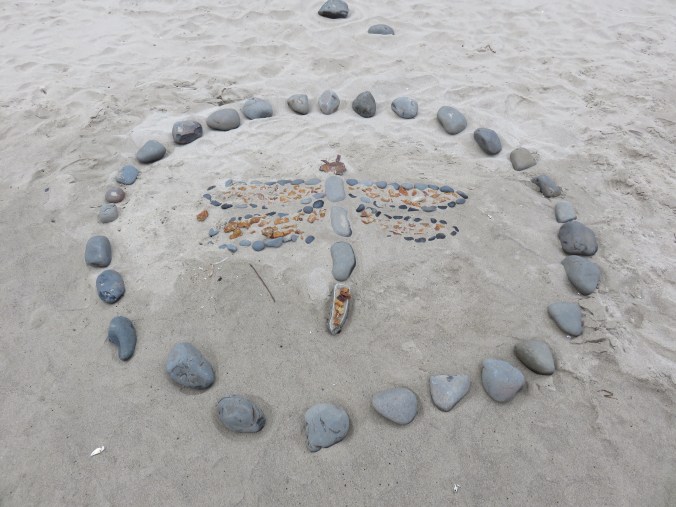
We found this about a mile and a half north. It had survived a couple of high tides, but not the one last night. It was gone this morning.

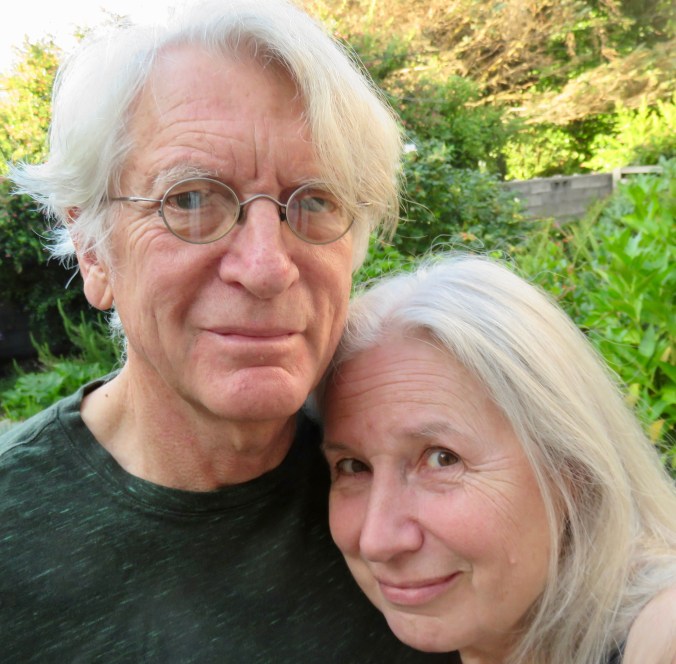
It’s one of those phrases. “Poor kitties” is another. I should probably list more, but two will do. Today is our anniversary. Forty-fifth, unless you count our time together as a couple, which pushes it to fifty. We have a lot of lines and inside jokes that no one gets but the two of us. We were laughing about that this morning as we walked. We were out for about an hour.

Nothing last forever, certainly nothing human. But we have lasted a very long time as a couple. Fifty years is a long time in people-years. Three or more lifetimes for a dog or cat. Thirty-seven thousand high tides.

Numbers.

Human beings are devoted to numbers. it is our fundamental technology, like nest-building for some birds. Spiderwebs. I recall being told that a mother cat licks each kitten by way of counting them. Perhaps. Certainly a mother cat keeps track of her kits. But cats care nothing for mathematics.

My English students complained about doing math in my class. I thought they should understand how many words they read in a minute, what a score of 67/90 points worked out to as a grade (74%, a C). They thought they should not have to deal with such calculation unless they were at the other end of the school in a math class. Once, when I passed back an exam worth 50 points, an Honors English student started to haul out his calculator. He was taking Trigonometry that term and needed a tool to calculate his grade? I about had a fit. Double your score and that’s your percentage! How do you not know that?

I was never one of those girls who are “not good at math.” I loved math in school. I still do. I use it all the time, numbers running through my head as I bake or sew, the way they used to run through my head as a runner. (When I could not compute minutes/mile on a run I knew I needed a walking break. Thirty seconds. Maybe forty seconds of walking. I would return to a run and recompute how much time I would spend on the distance.)

Hood-to-Coast is this weekend, that Mt Hood to Seaside relay. I ran it five times, 1996-2000, first out of the second van, about 16 miles total. My pace on a very good day running the beach or even highway hills in those days was 8.5 minute miles, but usually I ran a steady nine minute mile. I never got close to that on the Hood to Coast. In 1996, the temperature on my first 6.2 mile leg was 96°F, already rated “very hard” for hills and distance. I had never run in heat before, but I maintained a steady pace. The night run was another sort of revelation. I had never run in the dark before, and it was lovely. I calculated my speed throughout my three runs. Another runner commented that my first mile and my sixth were almost exactly the same speed. Oh yes.

My last long run was from home to school on the first day of in-service in 2011. I underestimated the distance by a half mile and I forgot to wear my new shoes. By the time I was into my sixteenth mile I ran slow and would have taken a ride if Gary had not lost me along the way. My shoes were flat and I damaged my feet that morning. My minutes/mile do not bear thinking about. I would never run further than four miles again.

Numbers.

Fifty years married. During that time, my husband and I have traveled together and apart, completed five college degrees, worked in a dozen retail businesses and for five public agencies, saw through life ten dogs and five cats and a conure and a parrot, raised two sons, lived in three homes, bought seven vehicles, but I will not count the times we each lost our tempers and did incredibly stupid, bonehead things for which we have been forgiven. The love does not take to counting.

This morning we took our walk. We walked north and then south to home again, about three miles. Sometimes we walked side by side and sometimes fifty yards apart. I picked up seven shells, he gathered seven bits of beach trash. We’ve missed our walk only a couple of times this summer. A few times we walked twice. Sometimes we walked a couple of miles, and on an ambitious day we walked five. I will be 67 in a couple of months, he will be 70 in eight days.

Those numbers do not matter at all, of course. That’s just our technology—a foolish way of measuring progress.

It’s about glancing up shore to see where Gary is walking. It’s about knowing he is there. It’s about the walk. Not about how far or when we arrive. We arrived a long time ago.

Happy anniversary, sweetheart.

PANTS IN THE FAMILY

http---cdn.cnn.com-cnnnext-dam-assets-190716065029-hillary-clinton-official-portrait.jpg

In their official First Lady portraits “20th-century predecessors show a parade of cream-colored gowns, strings of pearls and periwinkle skirts. Clinton rocked a pantsuit in midnight black.”

As first lady, she chaired the Task Force on National Health Care Reform, pushing a proposed healthcare system some in the media dubbed “Hillarycare.” That failed, but she found more success with 1997’s State Children’s Health Insurance Program, and then the Adoption and Safe Families Act, and the Foster Care Independence Act.

She worked with the National Institutes of Health to ensure more funding for asthma and prostate cancer. She did not, in short, stay home and bake cookies. Evidence of her own career is visible within the official portrait itself: Her book, “It Takes a Village: And Other Lessons Children Teach Us,” lies on the table beside her.

I remember having scabbed knees almost continuously as a schoolgirl. I was not allowed to wear pants to school, and my dresses were usually torn open under their short sleeves. I played horses and ran around during recess. My mother liked to say I was hard on my clothes  I liked designing clothes for dolls but not actually playing with them.

It was my mother’s idea to get me a Barbie. I thought the doll’s tiny feet made to wear high heels, blue eye shadow, and bright red lips were stupid. Her hairstyle too. 

In the mean time, I had my Aunt Marcia, who lived in the Bay Area—Berkeley and later San Francisco. She was married to my Uncle Harry, but then lived alone. She was the model I wanted when I was a girl. Not Barbie, but an independent individual. Aunt Marcia made the single life an option, something possible and even elegant. She had affairs and a dog and she taught college Sociology. She empowered my daydreams of a single life as a person in my own right.

Hillary Rodham Clinton would have been a good model. Though I’m sorry for her philandering husband, I might like her better for forgiving her husband and supporting him than my aunt who was the one philandering. She was pilloried for saying: “I suppose I could have stayed home and baked cookies and had teas, but what I decided to do was to fulfill my profession.” She was a lawyer and she took her turn supporting her family. I did that too, taking turns with my husband as the primary breadwinner. I admire what HRC accomplished, both what she did and what she tried to do.

Who wears the pants in the family? Everyone. There are plenty of women  who still believe that men should rule their households. My parents did not subscribe to that division of power. My husband and I do not either.

A family should not be ruled. A family should work together toward shared goals. It should be loving and caring and productive, not a dictatorship.

LESS HARM THAN GOOD

Susanna and the Elders, 1610, the first known work by Artemisia Gentileschi – Web Gallery of Art:   Public Domain

It might seem a modest ambition: to make less harm than good. Some will find it wholly inadequate. How can accomplishment come from merely doing less harm than good? I wonder myself sometimes. Progress is inadequately counted by dollars. Accomplishment is so often measured in influence, in having our way, in strength over others. Humility is not much appreciated these days. Assertiveness is attractive, and I have been assertive in my day, goodness knows. Goodness used to be measured in other ways, yet some days I aspire to modesty of effect. The desire to leave light prints upon the earth, to dance away without selfish pride, rest without sloth, find joy without avarice, change without harm, accomplishment without making losers of others. Not quite the deadly sins or heavenly virtues, but closer there. Closer to virtue.


This month is Camp NaNo and my commitment is to the modest goal of writing 31 hours in 31 days. Of three possible possible projects—summarize the novel, complete the post-apocalyptic story, write the textbook on teaching writing—the textbook seems to be my focus.

There is a story that George Eliot wrote Silas Marner while avoiding work on the much longer novel Romola. Romola was hailed in her day as a masterpiece, though few read it today. It is based, I believe, on the life of the painter Artemesia Gentileschi. I have read three books about her. I have read Silas Marner three times. I have not yet managed to complete Romola. Wikipedia claims the novel “was based on the life of the Italian priest Girolamo Savonarola.” Perhaps.

According to Wikipedia: “Contemporary and modern critics have questioned the likelihood of the level of scholarship attributed to women such as Romola in Renaissance Italy,” but Gentileschi became an accomplished and celebrated painter at a time when women were not allowed to paint, in the seventeenth century.  She was “an Italian Baroque painter, today considered one of the most accomplished painters in the generation following that of Caravaggio. In an era when female painters were not easily accepted by the artistic community or patrons, she was the first woman to become a member of the Accademia di Arte del Disegno in Florence and had international clientele.” Though I personally admire her life more than any paintings from that period, I am always surprised and annoyed to read the painter discussed as if her life and not her painting mattered most.

Eliot lived in Italy, would have seen Gentileschi’s work, perhaps have heard the dramatic story of her rape and revenge through painting religious subjects, placing her violator’s head under Judith’s dagger. She asserted herself in a period when women were expected to remain in the background. She was educated. She was strong.

The connection between Eliot’s fictional character and this historical woman seems to me irrefutable, though I have not completed the research to know if I am correct, to argue my thesis as I should. There was a time when I considered pursuing a PhD. This would certainly have been my thesis topic.

In another life, I might have done that.  Does anyone in their late 60s pursue a degree in order to prove a point? Pause. Remind myself of humility. [And, as I now understand from reading Romola, I would be incorrect.]

MOM at the BEACH

fullsizeoutput_fd3

My mother was named “Fay” for her mother’s first name and “Gordon” for her father. Born in 1925, she died in 2007. She and her sister spent all the summers of their childhood at the beach house, which my grandfather rebuilt and retired to in the 40s. Mom said she and her sister cried when electricity reached the beach house. 

In later years, my mother Fay Gordon would not recall carrying water for the cabin as a child, though surely she must have done this. The beach house had no utilities at all. Her mother, my grandmother Fay, cooked on a wood stove and heated water for weekly baths. The outhouse hung over the swampy next-door lot, and light for reading after the sun went down came from oil lamps. A marvelous, imperfect vacation all summer long. Paradise for children. 

Fay Gordon and her sister cleaned sooty glass oil lamp chimneys on Tuesdays. That was the only chore she spoke of. Perhaps the chore was lightened because the girls did it together as they did so many things together in the summers on the Pacific shore. They dug clams and used a long-handled rake to gather crabs for supper, but never ate the mussels. She had never eaten the wild salal berries either, fearing they were poisonous. Never gathered salmon berries or thimbleberries. Their choices were simple ones. Children pretended the sand was poison, arms held out, balancing barefoot on drift logs. The daily milk wagon, long walks to Neahkahnie Mountain for picnics and to pick huckleberries or a ride north for roller skating in Cannon Beach. She and her sister played all day, sometimes in company of cousins, and their mother cleaned and cooked. 

Her mother never complained about being stuck miles beyond the nearest road for three months each year. Cousins filled the upstairs dorm for weeks at a time. She sighed over her in-laws’ reimbursement for toilet paper, but dutifully collected the supplies they would need between Memorial Day and Labor Day. All carted from Portland to the beach house in June. She and the children first arrived by car or on the train as far as Seaside and then the long ride along the shore at low tide, the tight squeeze around Hug Point, the house opened from a long off-season. Mice had nested in the attic. Fay Gordon remembered painting the trim each year, or that it was painted each year a color she called “Chinese red,” bright red-orange. Surely she was not trusted at four years of age or seven or even twelve years with a bristle brush and oil-based enamel paint.


My grandmother baked and canned, cleaned, and did laundry in tubs by hand, even in the city. No servant like in the movies, just Fay, barely five feet tall, who was compelled at sixteen to decline the Reed College scholarship in order to help support her family. She had always worked hard. Once learning Latin and poetry and piano, then in a shipping office, and finally women’s work as a wife. 

It was only much later in her life that it occurred to Fay Gordon how these summers might have been difficult for my grandmother. Perhaps my mother’s idyllic barely-supervised summers were not easy for her own mother. Salt-stained clothing and baths and cooking and dishes for just herself and her daughters and often for another three or seven children, without running water or electricity.

“My poor mother,” my mother would say when she was old herself. “What a lot of work.”

But I wonder. Children off playing outdoors was likely a relief. Fay Gordon and her sister were stuck on a seastack when they failed to notice the rising water and had to wait out the tide. They came to no harm. Their dog chased up and down the beach until it caught the seagull and promptly let it go. No poisonous snakes or insects. No broken bones. No recollections of illness. Sand castles. Beach fires. The ocean’s roar. Freedom for their mother too?

My grandmother had summer to herself as well. Despite the labor, perhaps she spent hours each day beach combing, lying back on the sand under a canvas shade, reading. 

I like to think of my grandmother Fay enjoying her summer free of social duties and husbandly demands. My grandfather was known to be demanding. My grandmother was known to be kind. I like to think of her kneading her four loaves of Thursday bread as later would my mother when I was small, baking a pie with wild huckleberries, soaking clothing and hanging it to dry. Maybe even the work was pleasant when there was no one to insist it be perfect. Maybe the work was simple, satisfying, and like the weather, sweet. Lovely summers.

Even so, someone carried water from the creek. 

FINISH

IMG_4410

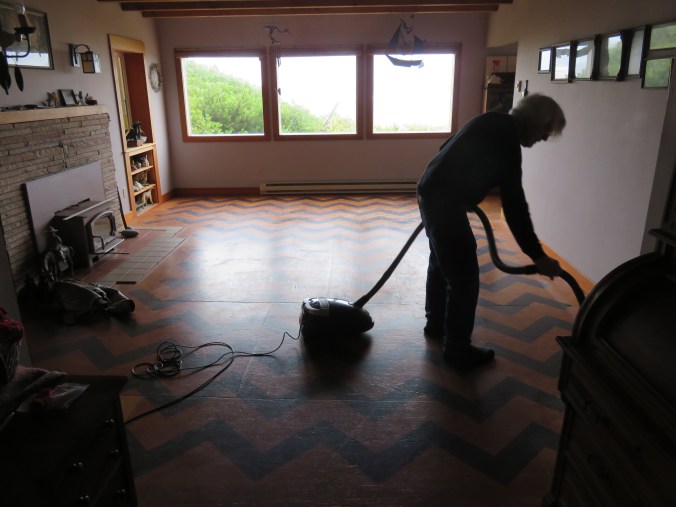
Gary vacuuming the floor for the second or third time before the fourth coat of varnish.

The plan was to put down a cheap floor and then after our sons graduated from college we would spring for hardwood.

A contractor suggested particleboard, sealed and oiled. The look was not what I was after. I chose A-face half-inch fir plywood. The A face is solid, with knots filled. It is not expensive—as best I can recall the four by eight sheets cost about $24 each in 1985. Fifty cents a square foot was about our speed.

A professional painter (the brother of an old friend) detailed a plan for finishing the floors. I wanted mostly wood showing but with a simple painted pattern. He suggested specific products and I followed his advice. I did a bedroom first with green zigzags, then the kitchen and dining room with an oversize black check, and finally the living room has dark purple zigzags. For each floor, I sealed the wood and then drew the pattern with a pencil and my grandfather’s steel rules. I painted the pattern with eggshell oil-based paint—on hands and knees—no painter’s tape but a steady hand. The varnish should have gone straight on after the paint cured, but the varnish was the most expensive step and I wanted some wear on the floor. Leaving the painted floors unvarnished allowed the softer parts of the grain to wear away with foot traffic. The grain becomes three dimensional. This is trendy today, but it was pretty much a unique look in the 80s.

Eventually I sealed the floors with the nasty clear varnish, three coats—two in the late 80s and a third in the 90s. The finish is hard but flexible enough for floors “with light use,” though my floors have always seen hard use, the tracks of children and dogs, sandy feet.

Yesterday I brushed on coat number four. Yeah, on my hands and knees with a four inch brush. It took an hour and my knees might be bruised.

Gary took me out for ice creams.

The stink was terrible in the house, but moving the furniture, books and CDs out of the space was probably the worst part of the process. Everything is crowded into spaces that were a bit crowded to begin with. The sofa is upended in front of the linen closet.

Before I could apply varnish, Gary vacuumed and scrubbed the floors once, I went over them, and then Gary went over them twice more. They show their age. Fir is a softwood and this floor has over thirty years of dents and dings and stains. We still prefer it to any replacement. In a week or two, we’ll put most everything back and clear the dining room and kitchen in order to put the last coat on those floors. Most people will not even notice a difference.

In the mean time, we’re sleeping in our younger son’s old room, two doors past the toxic varnish. We will avoid cooking—I will avoid cooking too much. We’d like to tear out the tile shower but scrubbing and scrubbing will have to do. For most of our marriage, we have made do with what was handy or free or could be done with least expense. And even now. But the ceilings and walls and floors all needed a definitive finish. Finishing. It’s an overwhelming task.

This is meant to be the last time. Once we complete the work we plan for this summer, I expect the walls and floors will do for the remainder of our lives—twenty years or so. If the tsunami doesn’t take this house first, our heirs will sell it or put down something else for people to walk upon.

TODAY

The fathers in my life have all been good men. I am grateful, too for the father-in-law who was so kind to me. Not everyone is so fortunate. These men did not ever, so far as I know (and I have always paid attention), abused people, picked fights, or assumed they were entitled simply because they were who they were. They were and are all the other things, the things anyone might hope for in a father: loving, patient, and present parents.

I have decided to cut back on gift-giving, at least a little because I overdo, and to do something otherwise for holidays and birthdays. So today, happy Fathers Day! And may the days that follow be fine and sweet!

IMG_0894 (1)

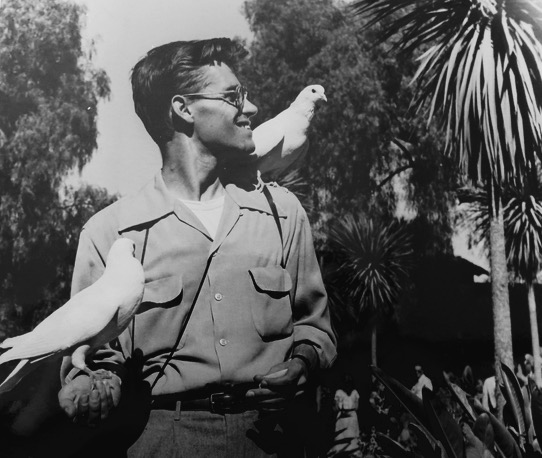
My favorite photo of my dad right after the war. (WW2)

IMG_4371

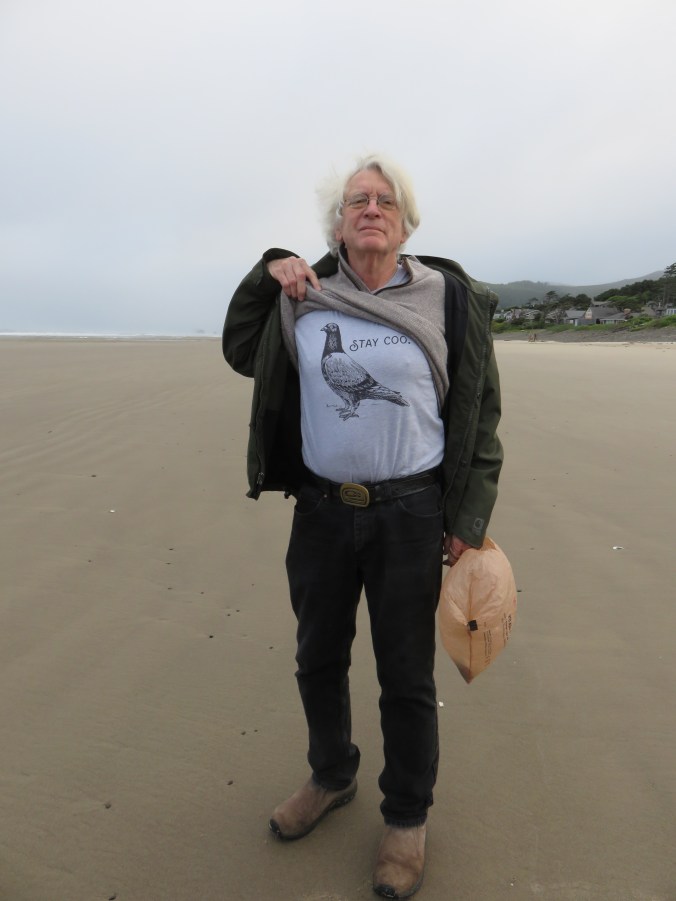
Gary had pigeons as a boy in Arizona. Here he is on our 40th anniversary on the coast! Today.

20190614_101952 2.jpg

Our firstborn in his daughter’s room. She has two dogs.

IMG_6911.JPG

Our son who says he has now “arrived at the fish pun landmark in life.” 

My favorite father poem. A poem I have shared many times. They often struggled to consider discipline a good thing, to recognize that the child’s screams are hysterical, not literal.

The Gift


To pull the metal splinter from my palm

my father recited a story in a low voice.
I watched his lovely face and not the blade.
Before the story ended, he’d removed
the iron sliver I thought I’d die from.


I can’t remember the tale,

but hear his voice still, a well
of dark water, a prayer.
And I recall his hands,
two measures of tenderness
he laid against my face,
the flames of discipline
he raised above my head.


Had you entered that afternoon

you would have thought you saw a man
planting something in a boy’s palm,
a silver tear, a tiny flame.
Had you followed that boy
you would have arrived here,
where I bend over my wife’s right hand.


Look how I shave her thumbnail down

so carefully she feels no pain.
Watch as I lift the splinter out.
I was seven when my father
took my hand like this,
and I did not hold that shard
between my fingers and think,
Metal that will bury me,
christen it Little Assassin,
Ore Going Deep for My Heart.
And I did not lift up my wound and cry,
Death visited here!
I did what a child does
when he’s given something to keep.
I kissed my father.


*And while I have your attention: Please don’t smoke. Both my father and father-in-law were killed by smoking, a habit they developed while serving their country during wartime. We know smoking is deadly. We know almost no one begins smoking after their childhood—I think of that every time I see a young person smoking. We all do stupid things when we are young, and cigarettes are designed to be habitual. And they kill. These smoking children cannot conceive of it now of course, but it’s likely that some day someone or several someones who love them will cry over their hospital bed. I know.

My favorite father poem. A poem I have shared many times. They often struggled to consider discipline a good thing, to recognize that the child’s screams are hysterical, not literal.


HABITS OF PLEASURE

IMG_4277.jpg

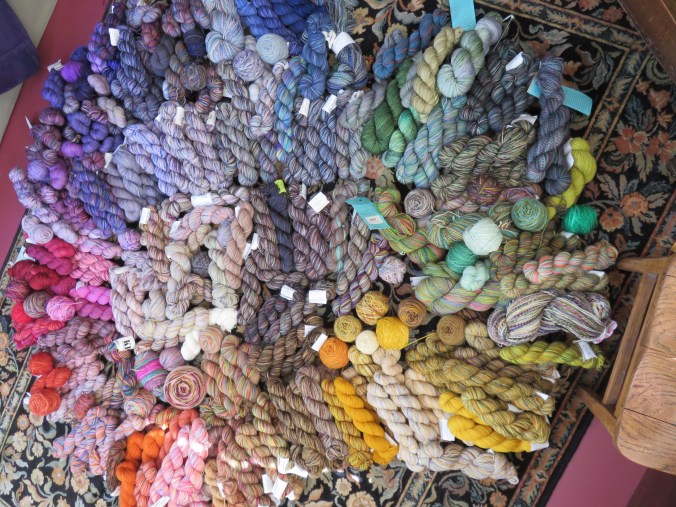
There are too many blues. I am not actually a blue person—I do not now have more than one garment in my closet with a pale blue pattern. What I have in my Made Things drawer is all from the other side of the spectrum. As a result, I have many blues, but mostly tipping toward green and especially purple. Not enough red. The red/pink bin is only a quarter full.

We all have our habits. My husband and I both love books and tend to fill shelves. Beyond that we have other things, too much of other things.

When I spread all my Koigu yarn and a handful of handspun skeins out in order to get them sorted back into bins by hue, he took a look and announced: “I am cutting you off.”

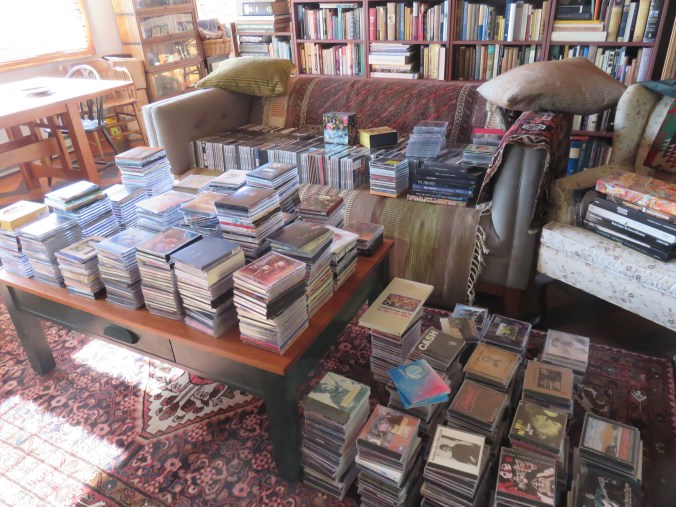
Then, the other day, he took all his CDs out of his bookcases. They filled the sofa and two chairs and made stacks a foot and more high covering the coffee table and the carpet. I tried to get a photo but could not get all the CDs in one shot. He did not count them. Suffice it to say he is cut off. He is humbled and sorry. “I am serious. You have to cut me off.”

IMG_4342.jpg

This is most of Gary’s CD collection, removed from shelves Monday. I think he meant to eliminate a few, but in the end, he spent an entire day (the day before yesterday) putting them all back. Every one. They are organized by artist and tradition or period. (Those are his books in the back too. Also organized by topic.)

Gary says, “It’s not a habit, it’s a sickness. Somebody please stop me.” He would like to blame Cervantes for some recent acquisitions because Don Quixote alerted him to even more music without diminishing his interest in Sami and middle Eastern, not to mention classic rock and roll. (No one should try to tell Gary about classic rock and roll.)  We will not go into musical instruments since he has friends with four times as many.

On the other hand, I felt free to order seven more skeins the other day. His pile is bigger than mine, more costly. And after all, I eventually wear or mostly give away my yarn when it has become something.

And when we spread them out, Gary might feel guilt, but all I can think of is how to put the colors together in order to make something, how that might be a shawl or blanket, those skeins might make a striped sweater. And then he plays a CD and his imagination soars, just like mine. Not “harmless” habits but beautiful.

Both of us know what sparks joy.

SHIFTING GEARS

fullsizeoutput_f54

The ocean yesterday morning. We had several insane bursts of rain later on, as if someone was playing a firehose on the house. No exaggeration!

Last month I determined to complete several projects, mostly knitting. I knit a narrow scarf, a huge shawl, a cardigan sweater for my granddaughter, and a washcloth—that last from a horrible but gorgeous cotton linen blend. I would make another washcloth if the yarn were not so stiff and rough that it hurt my hands to knit with it.

There were small writing projects I worked on and larger ones I skirted. I have ideas for two quilts and a couple of warps. Plenty of work is waiting for me. But instead of any of these, I am planning another knitting project.

fullsizeoutput_f56

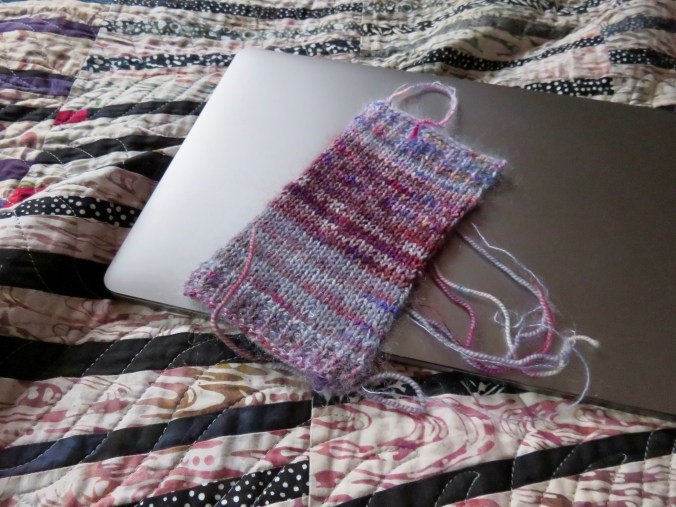
This little 4″ x 7″ swatch uses two yarns, a 2-ply Canadian merino in three colors and kid mohair/silk blends from Japan and Canada in two colors. There’s a sweater in this swatch—I just have to figure it out. In the mean time, I am writing out a pattern for my other granddaughter.

I knit a swatch and have been carrying it around for three days. Yesterday, in the coffee shop where I was meeting a friend to play Scrabble, and there was a woman knitting. I walked over and identified the yarn right down to the color: brand Malabrigo, yarn Rio, color Anniversario. Then I had to confess that no, I had not made my sweater.

That needs to change. Doesn’t it?


A PBS special about where we get our food claimed that human beings were nomadic for thousands of years until we began farming so we “didn’t have to move anymore.” The writer got that wrong. When we began farming, we could not move around anymore because we always had to be there to look after our crops. Farming did not allow us to remain in one place, it forced us to stop moving. There is evidence that this shift, rather than relieving us of a burdensome life of mobility, actually oppressed us, forcing our workdays to become longer, our labor more backbreaking. There is every possibility that this assumption that stability is preferable is mere bias. True, human beings developed architecture of stone once forced to remain in one spot, but we were already creating on a smaller scale.

Whether we traveled each day, or closed the door to a house every night, we created what scientists like to call artifacts. We call them garments, useful objects, pendants, and toys. We made art, we sang, and we told stories. These are human activities. Making stuff beautiful. This is what we do.


IMG_4321

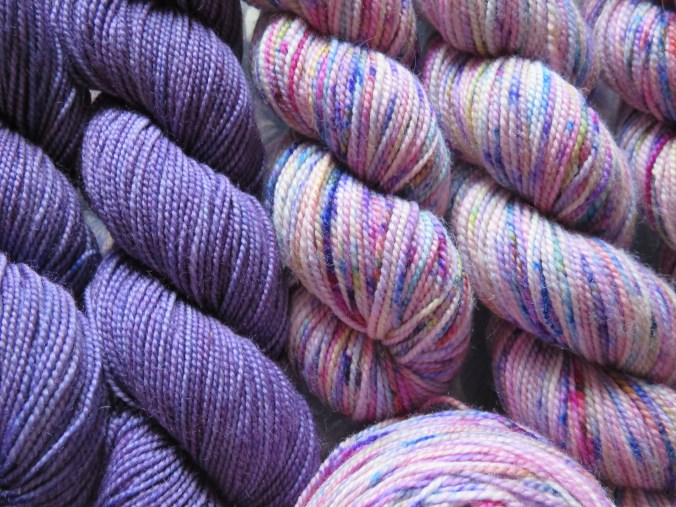
My older granddaughter told me the other day that she wanted purples and pinks, and here’s the start after combining and recombining many other colors. The mohair/silk blend will likely be burgundy, and that whisper-weight thread will tip these colors darker and redder. I still need to make a swatch. If I don’t like it. I reorder my colors until I get them right.

READING

IMG_4281

These days, Ruby objects strongly to having her photo taken.

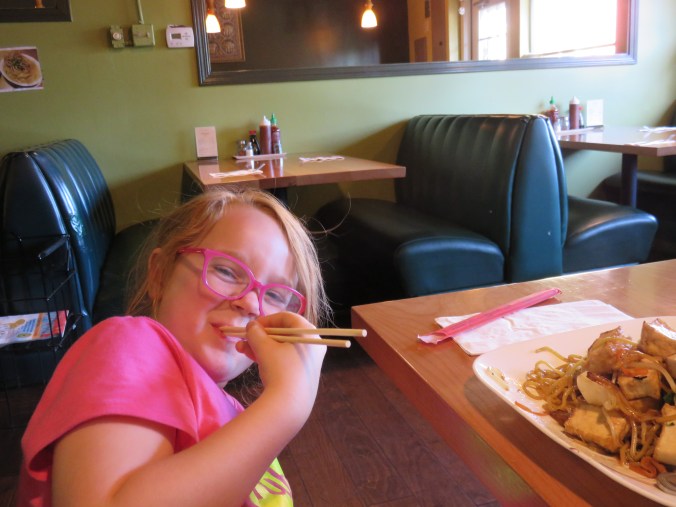
We took our granddaughter to her first literary reading on Monday. However, our adventure began with dinner. It had been a long time since we took her for Thai. She barely remembered—maybe she did not remember at all. She chose yakisoba from the menu because she knew the word from a report she did on Japan. She was efficient with chopsticks, eating all the tofu, the broccoli, and most of the noodles.

From there, we headed for the Powell’s Book Store on Hawthorne.

A Girl’s Guide to the Wild: Be an Adventure-Seeking Outdoor Explorer! A Girl's Guide to the Wild

Ruby McConnell’s A Girl’s Guide to the Wild: Be an Adventure-Seeking Outdoor Explorer! (Little Bigfoot) is the definitive guide to getting outside – for girls ages 9-12! In addition to basic outdoor skills, McConnell’s entertaining guidebook includes easy camping recipes, outdoor projects including science experiments and crafts, fun activity suggestions, and inspiring stories of diverse historical and contemporary outdoorswomen. The goal is to improve the quality of girls’ outdoor time by increasing participation and independence, making them feel comfortable and safe, and giving them essential skills and knowledge. Charming and approachable, A Girl’s Guide to the Wild will encourage both reluctant campers and budding naturalists to go wild and embrace the outdoors.

I admit that one of the reasons this reading had caught my eye was the author’s first name. This Ruby was a wonderful presenter with obvious experience as a presenter to middle school and other audiences. She had herself been a camp counselor with a summer camp name and I recognized the songs she sang from my sons’ time at camp. I recognized her energy and enthusiasm for family camping trips, the sincerity of her promotion of the outdoors. I have lived with that.

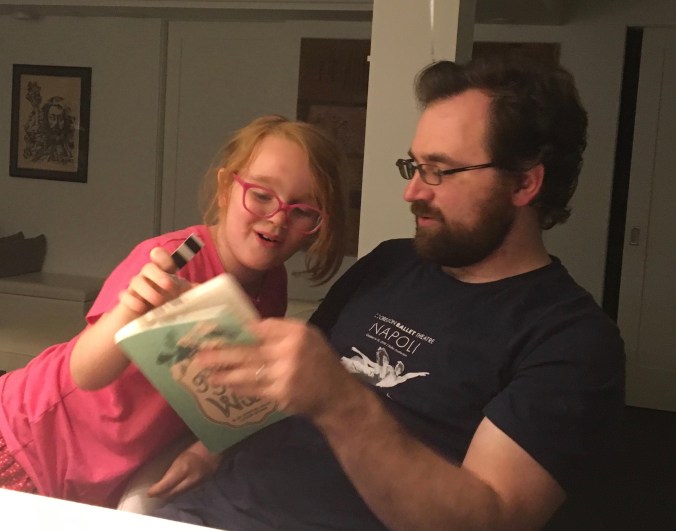
Ruby McConnell wants girls to overcome fear, find their courage and their community. She said it again and again, that bravery. She was also very funny and our Ruby giggled and laughed and people smiled to hear it. The Rubys got on well, and our Ruby was assured that people with her name were special, but she would not stand for a photo with the author, much as she enjoyed the evening. When she got home she read several pages to her dad. Her other grandmother sent the photo, taken while Ruby was having too much fun to notice. In her right hand might be the little bookmark made by our neighbor Tammy.

fullsizeoutput_f50