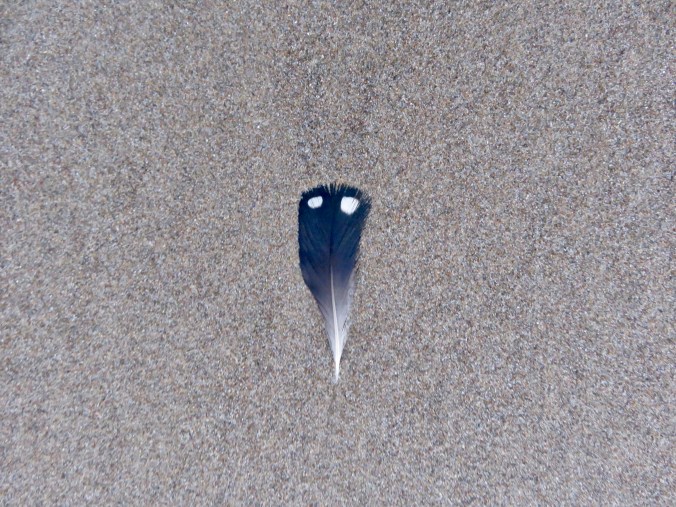
PROGRESS

We each found a piece of sea glass this morning on our walk. “Our work is done,” Gary said. It is a common line between the two of us, a joke, but also reflects our sense that gathering abandoned graham cracker packets and finding pretty things is our excuse for walking.

Recently, while we were gone, the people staying in the house next door lifted two sitting-logs over their fire and then deserted it. It was still smoldering two mornings later and Gary lifted the one end that was still hot and managed to toss it into the sea. People sometimes try to use sand to put out their beach fires, which rarely works and a smoldering fire stinks. I think people simply have an unrealistic idea of how fires burn. A tourist once built a tower of beachwood well over his head. Locals tried to talk him out of it, but he set it alight on a Sunday morning and then was gone home a couple of hours later. He seemed to think it would all go up in a blaze of (his personal) glory and be done. Gary helped put that one out too.

The tourists now staying in the house north of us put out their beach fire—ten barely-burned pieces of firewood!—so Gary didn’t have to this morning.

When we left the other day we had fog rolling in from the sea and it was thicker, unusually thick, the next day when we got home. Though we have back-up baseboard heaters in some rooms, we don’t leave the heat on when we are gone. The house was cold and the power had been out since early morning. Our neighbor said it was supposed to be back on by 1:30, but that didn’t happen. We were grateful for our wood heat as there is no natural gas and power does go out now and again.

The sun came out and a roll of clouds rested out on the horizon, one of my favorite things. It rained on us on our way home from our walk today. Now the world has gone pale gray, ocean and sky, a color I enjoy but not what most people declare as “good weather!” Nevermind.

fullsizeoutput_8f8I am doing well with NaNo, 22k words and over 80 pages as of this morning (about 4k are not new).

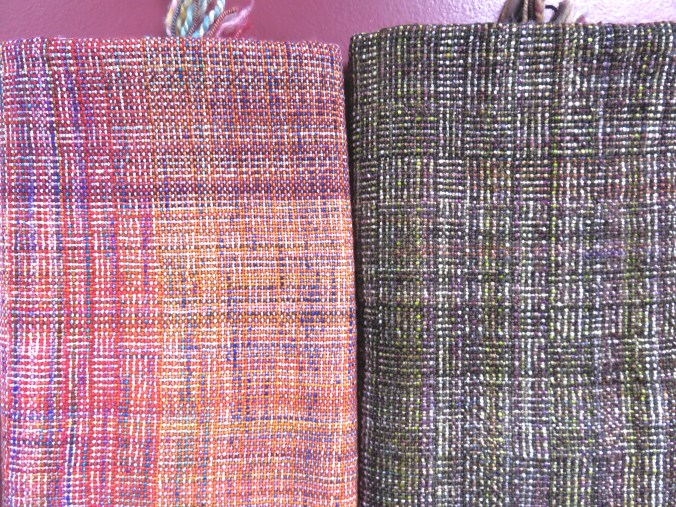
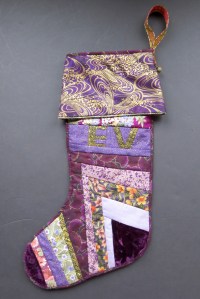
Yesterday I learned my visual art has been accepted for a local gallery show in December 2020. I will be putting on warps all spring. Purple, blue, pink. Green. I expect to have a dozen shawls, three large quilts for sale, and maybe a couple of pieced Christmas stockings.

I have been asked to lead a workshop for Willamette Writers in April. The coming year . . . fullsizeoutput_bed

In the mean time, My most problematic story is still waiting on a response since July 2018, and is short-listed at two other journals. I am resigned  to rejection all around.

SUNSET PIG

fullsizeoutput_10fd

…you might kiss one.

A group of at least a dozen people stayed next door this past weekend. (Gary says they were likely Swedish because of the white caps and running about barefoot on the sand and even in the water in November.) They took over the depression where Gary had his fire last week and burned two thick root knots that he’d left, plus some purchased firewood. They did not burn the log they sat on in the evening, which is a blessing. Tourists tend to lay huge drift logs over their beach fires and then walk off when they discover that the log needs hours to burn. Thankfully these people had a nice-sized and perfectly legal fire and then put it out before going to bed. (Gary hoped they might leave the remains of their cedar kindling, but they didn’t. Did it go all the way back to Sweden?)

The wood chairs still need painting, but a plastic chair Gary rescued from the rocks where it had drifted on high surf last month can stay out all winter. You would have thought I could manage to paint those chairs over the summer, but it didn’t happen and they stay under cover till I get them done.

There are a lot of other things I did not get done in the past months. I meant to make my oldest granddaughter a cardigan and two dresses. What was I thinking? I have not sewn a garment in decades. But like most women of my generation, I learned how to sew in school. I made a pullover cotton shift in seventh grade and a wool skirt the next year. My mother hated to sew but she taught me too. The last garment I can remember sewing was pure cotton onesies four our youngest son born in 1982. American companies were not making cotton clothing for babies because of flammability issues. We neither of us smoked then or now, so I found a pattern and learned to machine-sew cotton double-knit jersey. Dark green with rainbow trim. Bright red. I don;’t suppose I even thought to take a picture, though I can picture them in my mind’s eye even now. But now I can find organic cotton for babies and children, which is even better.

iu.jpeg

I am over 12k (of 50k) on my NaNo challenge this morning, and I seem to be writing something unexpected. I meant to rewrite a very old manuscript, but instead I am writing something new. It’s true I am using the same principle character and I imported a few pages that I had already reworked over the years, but even without those pages, I am ahead of schedule.

The best part? I am not sure where this story is going. And maybe even better (so the best-best): it’s funny. I have not written funny in such a long time. I have been giving the chapters titles a la Forster such as “In which Alice tries to solver her personal problems with a hammer.” So that is happening. And barely into the fifth day of November.

A strawberry-frosted cake is tricky in November. She wanted fresh strawberries and I avoid them out of season. No avoiding them for my granddaughter. A light vanilla cake, though I am partial to and only experienced with pound cake. I made a run at three cake recipes and strawberry cream cheese frosting. That last was not a win, though it tasted good enough and was a pretty color. I ordered freeze-dried strawberries, organic freeze-dried strawberries. Powdered in the food processor, they are a rich color that thinned down to a pretty pink. (I mean to try Swiss buttercream as soon as I get my hands on the right sort of instant-read thermometer.)

There is a cake in the fridge. Two pounds of out-of-season organic berries. I had dreams last night about making cake.

Gary and I both had a sore throat and sinus issues, but we seem to be better now. Our sore throats completely gone, no fever ever. I had to put off baking the final birthday cake till yesterday when I knew I was healthy again. Took my time. Photos later.


DOLLHOUSE

fullsizeoutput_1105

When I was a little girl, I was already fascinated by Japan—the architecture particularly, but also the clothing and food and toys. The fables. Because I lived in a suburb of Seattle, it was easy to visit the House of Rice or Trident Imports and lust after kimono and sandalwood chests.

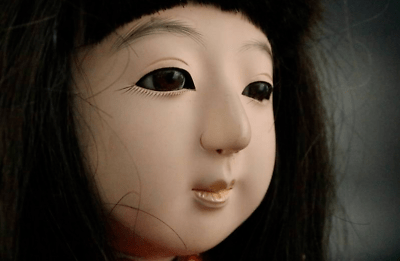
I did not play with dolls much as a girl, but I had a pretty toy geisha on a stand that held place of honor in my bedroom. My farvorite model horse was made of paper and lacquer, gray with a traditional fancy saddle. I didn’t like that his mane stood straight up, but I could not coax it to lie over. I have that Japanese horse to this day. It must be nearly sixty years old.

There are few other things I still have from my grade school obsession. I read a book about how to build a Japanese doll house and I sewed bedding, made the storage box of balsa wood—those things are gone, but the scale vases from an import store are carefully stashed.

My father worked for the Bureau of Commercial Fisheries. I ate sushi for the first time in the early 60s. This was during a Japanese/American fisheries conference. I didn’t like sushi then, but I did later. I have gathered books on Japanese building, on the impact of Japanese woodblock prints on the Impressionists.

This is National Novel Writing Month, and I am writing first thing each day in pursuit of at least 70k (NaNo’s goal is only 50k).  This morning of Day 4, I have written past ten thousand words. My intention was to take a very old manuscript of 80k that I began in 1996 and update it. That isn’t quite what I am doing, as it turns out. I have outlined 25 chapters and I am writing beginning to end, a chapter a day. When I was writing that earlier novel that inspires this one, I wandered all over the place, beginning the middle to end and back, from the points of view of eight characters. So far I have hardly looked at that old manuscript to write this one. Instead, I am sticking with the here and now. There is a ghost cat, maybe. There might be a diary, which was the center point of the earlier novel. Maybe not. I haven’t gotten to that chapter. I write my 1667 words and then some more, and then a bit more, and when the chapter is done and I have my words, I stop.

s-l400.pngWhen I meet my daily goal, I am allowed to do something else like look at Japanese dolls that I cannot afford on Ebay or watch a Korean historical romance (Rookie Historian Goo Hae Ryung) and admiring the costumes, one more episode till the end.

For many years, my life was cluttered like a Victorian drawing room—my time so tightly compressed, I barely had space to breathe, much less turn around. I worked eight hours, then came home and worked most of the evening. I neglected the house. I probably neglected my family and friends, though I did not notice at the time. The weekends were almost never time off—the shocking thing when I retired to teaching just a pair of college classes was discovering I did not need to work on Saturday and Sunday. I am still getting used to that now I am not teaching at all and all my time is wide open. Grace is emptiness.

Life can have space like a Japanese home. Floors empty to the walls, I cross freely from one side to another. There is the freedom to chose to sit on the floor and regain composure.

This clearing of space, this abandonment of possessions—well, the fabric for quilting, the yarn for weaving and knitting still arrive—this new-won spareness and simplicity.

But I am not talking literally. I am not living a cluttered life, but a gradually simplified, cleared away life.

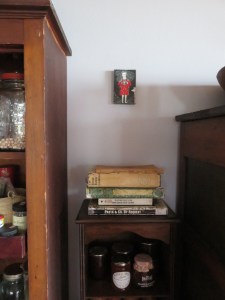
IMG_5098My obligations are easier to count, easier to recognize and balance. My clothing is spaced in my closet. I keep removing what I do not wear. I give away what I do not use. The little girl with the red dress and white ghost dog greets me each morning in my kitchen—hanging just there above the jelly cabinet and between the Forest Ridge bookcase I use as my pantry and the pie safe with my grandmother’s porcelain custard cups.

I have a cake to bake, birthday gifts to wrap today. My coffee is cold. I need more sleep.

I am speaking literally.

NaNo

fullsizeoutput_10aa

Yes, it’s true. I seem to be doing NaNoWriMo again. I am using the new site and not entirely happy with it. Not yet, anyway. I am a fan of statistics and they are not as clear and compressed as they were. The site finds that I have completed 4 projects or zero, 240k words or 0, depending. Maybe a little glitchy. One project shows zero progress when I know I completed it. So there might be bugs or maybe (more likely) I am just not used to it.

Anyway. I am writing a humorous piece about starting over. That is the hope. If there is anyone out there also doing this, please let me know here or on the NaNo site. My name on NaNo is “jpriddy.” I could use a buddy.


Speaking of names, there are several people named “Jan Priddy” in the world. I am the one who graduated from the University of Washington. I am the one who writes mostly adult works, who used to run distance, who has degrees in the visual arts but does not fashion herself as a “wildlife artist,” the one who used to have sighthounds and judge field trials and design logos for dog people. I am not the marine biologist in Alaska or the woman in England or the lay preacher in the middle of the country. Those are other Jan Priddys.

There is even another person with the last name Anderson-Priddy in Oregon, the last name given to our children.  I never thought that would happen.

AGING IN PLACE

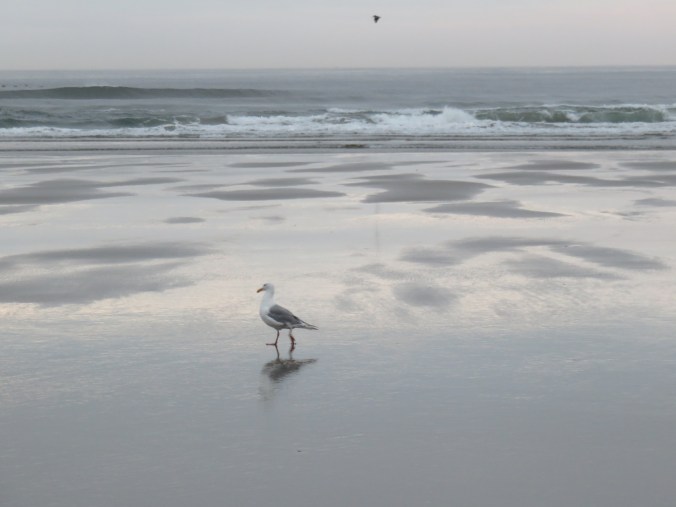
On the beach before dawn yesterday, rainclouds had moved off, and the sky was aqua over the ocean. My husband Gary and I followed the tideline until we met a friend and stood for a time admiring the cool air, the empty beach. We shared news of neighbors, and then said goodbye until tomorrow. We pass neighbors on our walks almost every morning—heading home while others are on the way out. 

Dark rainclouds moved toward us from the north, with a flag blowing from the east. We turned at Asbury Creek so as not to disturb seagulls resting onshore in the water. The rain began soon after that. I put up my hood when I heard it pattering on the back of my raincoat. The flag was blowing from the south by then, the rain moving in from the north. That’s the way it is sometimes, everything coming from directions that make no sense.

Are you worried about aging? No.

When we moved to Arch Cape forty years ago we were youngsters, and now we are the old timers. Just old, I guess. And lucky to be here. 

My grandfather built a duplex on the east end of our property. He rented the tiny one-bedrooms by the night, but Gary and I had managed an apartment building while we were in college and knew we did not want to impose short term rentals on our neighbors or ourselves. Our renters stay for years, and that is how we have afforded our taxes. Thank you, Gordon Keays Smith. And thank you, Genevieve, for leaving me the home that’s been in my family since 1911. Genevieve was Gordon’s third wife, the only one who out-lived him. My mother did not like her, but as weavers, Genevieve and I got on well. However, it was Gary who actually won us the house. Genevieve’s second husband, Colin, got on well with Gary, and he told her to leave us the house so we could move here and have a family. That’s exactly what happened.

When we arrived, we scrambled to support ourselves and raise our boys. Our neighbors were mostly elderly, in their seventies and eighties. Now we are the old-timers of the neighborhood. No family has lived here longer.

Are you worried about aging? No.

My husband and I are at that point in our lives when aging is impossible to ignore. We are retired. We walk miles each day, but we no longer run or drink three glasses of wine or ignore the need for an occasional nap. We have friends whose parents are still alive, but that is not true for us. We are our oldest living relatives. No parents, no living aunts or uncles, no older siblings stand between us and age. Gary has lived five years longer than either of his parents as well as his one elder sibling.

Surveys of mental health often ask whether the subject is worried about aging. I always answer no. I assume that is the right answer. But my answer is a lie, of course. I do worry about aging. For years this was more about planning and not really worry, but now it is both. I try to plan for diminished capacity snd I worry more about loss of vitality. I cannot help wondering what sort of denial people assume in order not to worry about aging. I see it coming, inevitable frailty and loss of mental sharpness. I know people ten years older than myself, even more than ten years older who get around fine, living active and meaningful lives. I would be happier if I could think only of them because they are doing so well. But I also have friends with cancer and dementia and some are already lost.

It began in the 1980s with HIV and AIDS. Suddenly people I had known for ten or fifteen years were gone. Cancer took our fathers. Heart disease took our mothers. My former students lost to accident, cancer, and suicide. Old friends droop and drop.

Are you worried about aging? No.

For years I watched the housing market in Portland. My plan twenty years ago was to purchase a small condo or house and prepare it for our use when we drove to town and for later, when we no longer drive, as a familiar place to move. (I was hit decades ago by a woman driving onto highway 30. My boys were still little and in the back seat. The driver was 80, and witnesses said she just drove into my path. My own mother at 80 was no longer driving, but had scared our sons with her erratic driving long before that. She too simply drove onto busy roads, assuming others would get out of her way. I vowed to quit driving before I became a danger to myself or others.)

My mother left me money that would have made this imaginary condo affordable, but I paid off our sons’ college debts instead, and then I forgave a loan to one and gave the same amount to the other in cash. How long ago was that? But I still look at vintage condos. I still imagine living closer to groceries and good health care. Our home is far larger than we need for the two of us. Downsizing is important to both of us and moving to a smaller place of just a few hundred square feet would have pushed that. 

Instead we are emptying this home of forty years. Clearing space, cutting back, making the rooms look more deliberately decorated instead of crowded with living. I have cleared out for too many other elderly people to want the full mess dumped on our children. Even some things we loved—furniture and books and yarn—have left the building. (Like Elvis?)

The house has reached the point where trips to a charity shop (three trips? six?) would put it in shape for someone to come in and clean for us when we can no longer do that for ourselves. Gary will object because he believes in doing for himself. The notion of “servants” offends him. We have always tried to do everything for ourselves: taxes and haircuts, gardening and upkeep. Not to mention the expense.

Are you worried about aging? No.

Times change. Neither of us are willing to crawl under the house or out onto our roof again. Gary still checks the attic and under the duplex, but he has to work himself up to do either, and I begin to understand why people hire an accountant to do their taxes.

We cannot afford a second place in Portland. Living here is our good fortune for a few more years. We will move to a downstairs bedroom. There is space for the TV and clothing. The books will be an issue. Gary has some sixty feet of bookshelves, all downstairs, but I have even more, almost entirely upstairs. Will I still be reading? Will I have abandoned my daily walks on the beach? Will the loom remain upstairs or will someone offer to cart it back down? The sewing machine is heavy too. Am I nearing the last quilt? Will I abandon writing?

At this point I should turn my post to something positive, find the gilt lining of my worries. Is there precious metal here?

Are you worried about aging? No.

The roof is leaking. Our taxes continue to rise in a manner disproportionate to our income. If we live long enough, we will stop driving and that will force a move. There is nothing within walking distance and no public transportation or Uber nearby. If I die first, Gary will be financially stable. There will be less money, but he will inherit my pensions. If he dies first, I will manage. If one of us needs round-the-clock care, the house might sell for enough to pay till we die. Or not. Depending.

What we leave behind will be the people we love and little else. That might be enough. It’s only what we do while we are here that matters. That much is true. Has there been enough? Some days I think there hasn’t.

I earned my MFA from Pacific University in 2007 and was the graduation student speaker. Twelve years later, in her graduation talk this past June, Jill Deasy noted: “Poet Kwame Dawes opened residency with a talk about these times we live in. He explained that ours is an age where lines blur between fact and opinion. It’s an age where one’s beliefs and one’s own ideas can be oddly proclaimed as truth regardless of evidence. Therefore, he said, our task as writers is to be honest about what we don’t know then recognize our ignorance is the beginning of understanding.”

Perhaps admitting fear is my first step.

Are you worried about aging?


FINDING HOME

fullsizeoutput_1070

Pieced squares from a dark corner—they have not yet been joined and this is merely twelve of eighteen pieced, of the eventual forty-nine in the center panel. I kept finding more golds and oranges for the stripes, so there will be another quilt, “Blue Streak,” once this one is done, I think.

Though the sky is clear blue and I sweat as I sew (which involves pressing with a steamy-hot iron after each stitched seam), I know the weather is changing. We can feel the cooling and are grateful for it. Our contractor assures me the duplex roof will be on “asap.” Our tenant does did not have water dripping from the ceiling during the recent rainstorm. And yesterday I found glass. All good.

Kids are back in school, we have less than a week left of summer, and last night I had a teaching dream. Most of my dreams about teaching from while I was actually teaching, at least the ones I remember, were about teaching a subject I knew nothing about. The Boer War or Physics. I would be standing before a class of teenagers, who listened intently to every word and took neat notes in a way teenagers never do in real life. I was aware, in a kind of horror, that they would remember what I was telling them, that they would recall all the details I was concocting about a historical event I could not claim to know. I was making stuff up and they trusted it. Is that every teacher’s nightmare? It was always mine, that I would mislead my students.

Last night’s dream was quite different. The dreamt students attended an elite private school, both boys and girls. (I taught for from 1976-1979 at Forest Ridge, a girls’ prep school in Bellevue, Washington.) Some listened and some were inattentive and a couple were rude, and I was teaching them something I am familiar with: “Thirteen Ways of Looking at a Blackbird,” which I taught most every year. I used to be able to recite Stevens’s poem, and in my dream I certainly got through introducing it as haiku and reciting several stanzas as well as the parody I wrote, “Thirteen Ways of Looking at Computers.” It was not a nightmare, nor yet completely peaceful. There was some rushing about toward the end, some issue with wearing only a tunic and underpants and searching for my pants? (Why dreams about nakedness?)

fullsizeoutput_1072

From the bottom, a chipped but well-buffed piece of blue-green glass and a beautifully rounded piece of faintly green glass, a rough agate, an “ugly clam,” and several “butterflies,” which are really the back plates of chitons. Two of those are fan-shaped “tail” pieces.

I slept long this morning, till after six. We were late out onto the beach for our walk, the surf is a tame animal today, and I do not need ice in my morning iced coffee. The coffee has chilled since yesterday and the heat has relented. I plan to complete three more pieced squares of the purple-and-orange quilt this morning, finishing the third row of seven. This afternoon, I mean to piece the entire fourth row of this center panel. That row will more clearly reveal the shift in background hue and shade. I might put this one on a bed.


IMG_4923Mom’s house, my parents’ house, the house I lived in from first grade until college, is owned by two delightful people who have remodeled and gardened. Marti showed me where she had transplanted the rhododendron and vine maple (acer), the way they used what we had called “the hut” as a workshop, the expanded master bedroom (just as I would have done) and second bath, the preserved paneling in the family room. They have lived in the house since buying it from Mom.

It was Gary’s idea to drive by last Saturday. When we slowed down, there she was working on the garden and Gary pulled the car over. Hello, I said as I approached her, forgive me but I used to live here. She smiled and said, Are you Mrs. Priddy’s daughter? and it was lovely. She and her husband Jay have lived here far longer than my family did. They have made it home.

Our home remains the Oregon coast. We have lived here now for over forty years. Gary was saying he had never lived anyplace for more than five or six years before we moved here. Often he lived in a place for a couple of years before moving on. There were the houses around Seattle, the three houses in seven Arizona years, more back in Shoreline and Seattle, the last two with me. I have only lived in six houses, counting the month with my grandparents in Portland before moving to Seattle in time for me to begin kindergarten. Most of my life has been in Oregon, more than forty-five years now. It is home.

I can see the ocean from here, and I should be knitting. I have thought of other ways to tell my butterfly SF story: as history or from the perspective of another character. I should be writing them. But there should be no shoulds. If it matters I will write it. If not, I won’t but do something else instead.

IMG_4919But I really must begin knitting my grandson’s sweater. I knit half the back before ripping it out last week. It was going to be large enough for him to grow into . . . in about five years! He chose the colors and was excited when I showed him the gauge sample. I need to start knitting again. Do I try using a top-down pattern, or merely revise my own so that it will fit him? Once I find an answer, I can begin again.

 

SPEAKING OF THUNDER


IMG_20190907_193043.jpg

The extraordinary lightning strikes began while we were at dinner and continued for hours. Strange to be visiting in Puget Sound when such a storm began. The photo of the large group of ten is taken at a restaurant just a short distance from where Gary and I graduated from high school—that’s Gary and me on the right. Gary’s brother (gray beard) is moving to Tennessee and this was the goodbye party hosted by his youngest sister (right at top).

It was an interesting weekend, if by interesting you include skipping our morning walk to drive north, shopping for yarn and tea on Bainbridge, a flat tire, meeting the lovely couple who bought my childhood home from my mother (a highlight—they really were delightful and thanks to Gary for insisting we drive by), checking into a split-level house converted to an overpriced hostel (mold in the bathroom, but we stayed less than 12 hours), dinner with family, storm, early rising just after two in the morning, getting lost in Woodway (turn right, I said, but he always turns the wrong way), and driving south on I-5 (the first time for us on that particular route in well over a decade, and then I drove from Longview to Seaside—my longest drive in a long time) to arrive home by breakfast time. Excellent leftover tomato pie waited in the fridge.

Glad we went, glad to be home again. I think it will take a few days to recover.


FREE ADMISSION

IMG_3616.jpg

When we were children the zoo in Seattle was free. There were no tickets, no guarded gates. You could walk in the main gate or by the elephant exhibit or from Lower Woodland or over by the rose garden on the south side. The Seattle Art Museum (then at Volunteer Park on Capital Hill) was free. I have photos of my brother and me on the backs of stone camels. The Seattle Aquarium was privately owned, but for a time my family had free passes because my dad worked for the Bureau of Commercial Fisheries and he knew the owner.

Writer Sandra Cisneros spoke about visiting the museum on the free day in Chicago as a girl. Access to such cultural sites without paying admission was a critical aspect of her childhood. Mine too. These places were beautiful and free.

It was what her family and mine could afford.

The Asian exhibit on Capital Hill is still perfectly clear in my mind’s eyes though I have not been there in over forty years. The elephant walking across clouds carved into pale jade. That spectacular collection has been undergoing renovation and will reopen next year. It will not be cheap to visit. Nearby is the brick tower I climbed in my teens and a conservatory where I recall the overarching tropical foliage, volcanic rock just inside the door to the right of the entrance, the cactus and rows of potted flowers. That glass house costs money to enter, a relatively modest $8 for the two of us if we went today because we are seniors. By contrast, The Burke Museum on the University of Washington campus, a place we used to wander in and out of without a thought, would cost us $40. The Museum of History and Industry, which was a favorite haunt in my childhood would cost about $36. The Pacific Science Center would cost us $48 for entrance but another $70 if we wanted to see everything. There are free days, usually once a month, for many exhibits, though not that one.

If we drove to Seattle (which Gary absolutely resists doing), the museums (some of them free one day a month) and conservatory (except on the first and third Saturday) will cost admission. The zoo has been on lockdown since Gary worked there in the 1970s. It was free when he started as a volunteer in the aviary, but admission was added while he worked in the commissary. This was particularly controversial at the time since admission fees did not go to maintain the zoo but into the general funds for the City. It costs $42 for a pair of seniors to visit today. Cheaper than the Pacific Science Center, more than the Burke. I don’t know where the funds go for all these attractions. I use Seattle as my example only because we once knew the city so well.

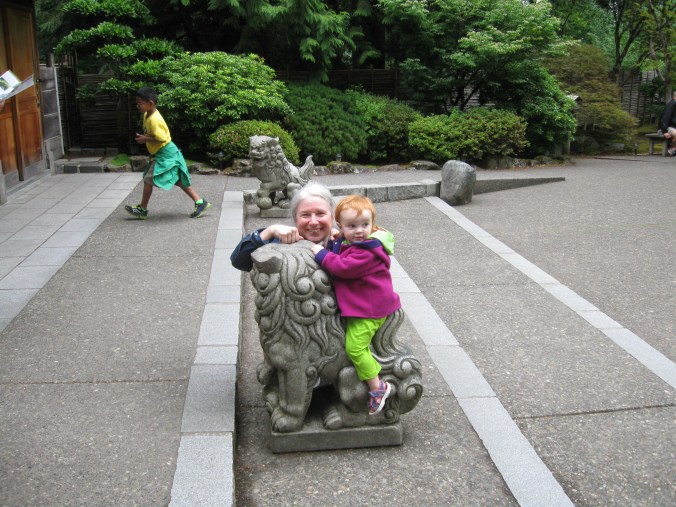
IMG_3624.jpgMore recently, when passes were on sale, we bought a family pass to the Portland Japanese Garden. We took our oldest granddaughter to these gardens several times when she was little, and she loved the “big fish” though she says she doesn’t remember anymore.
IMG_2021The gardens are crowded when we drive by, as we sometimes do on our way into town. For $110, we can purchase a senior family ticket to the Japanese Garden, and after concentrating on our house for the past couple of years, perhaps we will. Though it seems expensive, we can afford admission. Many families cannot.
I understand that people object to taxes and to paying for venues they never visit . . . and I think about the billions allocated for sports arenas, which are all about profits and competition and ritualized violence. And I think about the gilded screen with dozens of crows I saw as a child in Seattle, the science experiments, the wave machine, the Tiffany window—all those shared human cultural experiences I enjoyed as a child.

Public parks and museums should be free to the public, not restricted to those who can afford to pay. I wish everyone, every child, could experience what I did through public access. Very few can.


GARY’S PARTY

IMG_1016.JPG

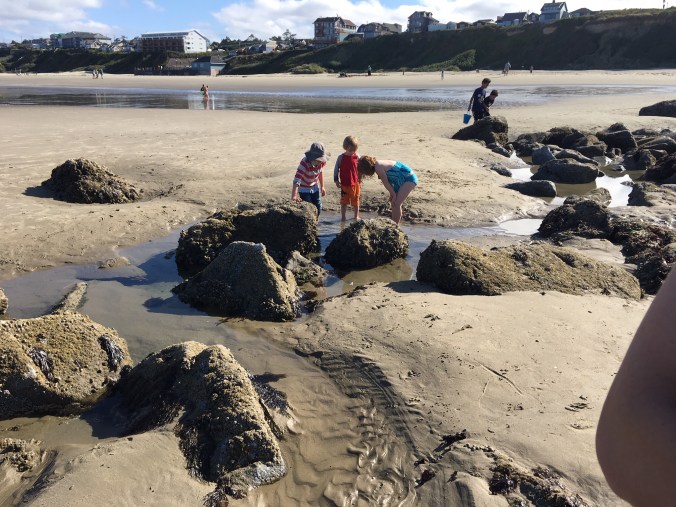
We almost always walk north. We went out before 7am for our walk this morning, before a quick breakfast and heading for home. But later in the morning two of our grandchildren and a friend’s son played in the tide pools, looking at hermit crabs. (Thank you, RO, for sending this.) Our three grandchildren enjoyed the party. The youngest stomped her feet and grinned. Such fun!

It was Gary’s 70th birthday Sunday, yesterday (it was also Lily Tomlin’s 80th and John at the Post Office had one and Barry Gibb became 72 and the guy at the market in Lincoln City turned 29). We drove down the coast in the morning, stopped at a farmers’ market, took our time. We didn’t have all that far to go.

We have been to the Sylvia Beach Hotel a half dozen times, staying in different rooms and enjoying the peace. We bring books or read what is lying about in this literary inn. I bring knitting. We walk on the beach and sit watching the ocean from the topfloor “Library.” Gary gets into the guests’ kitchenette before dawn and makes a pot of extra strong coffee. Not quite routine, relaxing.

We had made our reservation for the Emily Dickinson room and planned to have a meal across the street. No internet, no television, the Sylvia Beach is a peaceful Victorian on a bluff overlooking the ocean. Across the street is a great restaurant. Gary is particularly fond of the chef’s wife and had a photo of the car her dad drove in Australia. That was the surprise he planned. He had no idea people were coming until we came out of his favorite hotel to go toward his very favorite restaurant Ove Northwest. There was a friend in the doorway across the street. What is Rick doing in Newport?

We celebrated with our sons and their families and some friends. It is amazing that I managed to keep the secret for six months.

Gary’d never had a surprise party. He was stunned. He kept saying, IMG_4879How did you do this? In fact, I’m not sure Gary had ever had a proper birthday party before this one. He never had a proper party as a child. He claims I threw him a party forty years or so ago when we were in college, but I don’t remember.
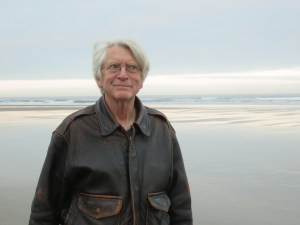
Gary is a self-effacing person, patient and kind under most all circumstances. He doesn’t ask for much or complain often. He loves cards and phone calls on his day. He smiles all the time but almost never for the camera. He was mugging for me this morning on our walk.

We’ll call this his first party. The very best. He could barely function when he began to understand what was happening. He just sat and looked stunned for at least an hour and Margaret kept his beer glass full. He was so surprised.

He says: Thank you. I love you.

IMG_4877.jpg

[Gary has read this now and complains that I have failed to detail my craftiness. Okay, I was pretty crafty. I am so very grateful for the people who were able to attend or who called or sent cards. He deserved this.]

WASTED

fullsizeoutput_103b

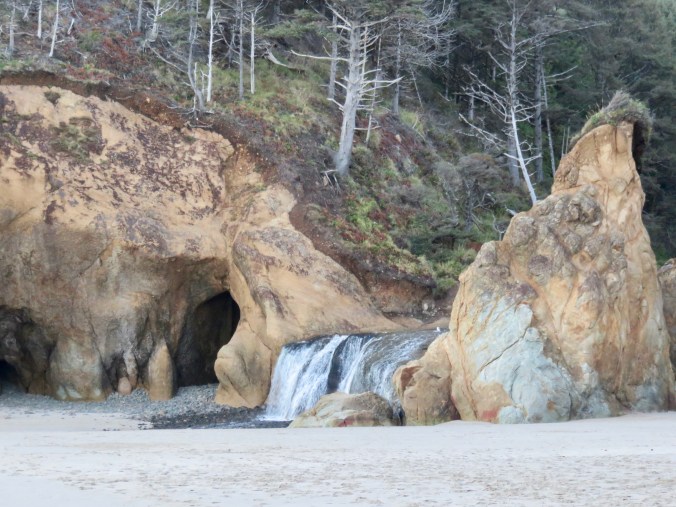
Yesterday on our predawn walk north, Gary stood on a rock that usually rises above my head from the sand. This summer it is nearly covered. This is the deepest sand we have had in twenty years. In January of 1999, a storm-driven high tide dug the basalt from under the sand into a high ridge and took out far more sand than usual. It’s taken all this time to see it return.

Wasted. Not drunk or high, I’m talking about money.

Our biggest waste was “The Maples,” a piece of land just over two acres that my husband and I purchased in the early 80s when our firstborn was a baby. I have photos someplace of me holding him in my arms. Above us are the enormous bigleaf maples that inspired our name for the property. It was on the other side of the coast range, up the Nehalem Valley on a road called Anderson, and a stream ran along the north side. No houses I designed had yet been built, but I had great hopes for that property, purchased on contract from a widow.

And then the sale of our Seattle house fell through. What year was that? We’d accepted a very long escrow in return for a very large earnest deposit of $5000. That was in the fall. It was the following spring, early June, a week before the sale was supposed to close that the buyers told us they’d changed their mind. “No hurry” returning the earnest money.

And the money was spent on The Maples. We didn’t have it. We could not pay back the deposit, which was paid to guarantee that the buyers would not do what they did. Change their minds. I was pregnant with our second son, and we had counted on the sale closing in order to pay off the land because we really could not afford the house payments as well as the land payments.

And suddenly we were in trouble financially with contract payments on the acreage and mortgage payments on the Seattle house. Remodeling on the house I had inherited from my grandfather’s third wife. Renters had been turned out of the Seattle house, as the buyers requested, and there was some damage from the buyers opening walls and from the house lying empty for all those months. We had lost the rent and now had repairs to make before the house could be sold. Less than month before our second child was born, I was not in a position to drive back to Seattle and do the work myself. My Visa bill already did not bear thinking about. We had hard decisions to make.

We gave the land to the people who had bought the property next door, just gave it away. They would take over our payments and Tootie Anderson, from whom we purchased it, would not miss payments she relied upon, and we would be out from under one of those monthly payments we could not afford.

The Maples were gone.

Gary has a hunk of quartz crystals found at the base of one of those spectacular trees. Gary calls it our “thirteen thousand dollar rock.” That was what we lost in down payment and monthly payments on the property we gave away.

There have been other wastes. When I opened this page, I’d intended to talk about my husband’s dismay when he found that a coat he purchased a few years ago, an expensive cold-weather coat, was on sale for a quarter of what he’d paid. There are plenty of examples of wastefulness, wasted spending. Bad meals in restaurants. A pair of shoes I could not return after they gave me blisters. Fabric. A braided rug. Gary has bought CDs he realized he already had, or once had and did not like. Three incomplete sweaters that I will never finish. I have bought yarn I never used.

In our downsizing process, I let go of many projects I no longer wanted to work on. I sold a few hundred dollars worth of yarn for $90 and gave away my enameling kiln to a former student. I never heard from her afterward. Perhaps she didn’t like the yarn. I unearthed additional tools related to the kiln that I would like to give her. Perhaps the kiln did not work. Perhaps this is her own story of waste. sigh

But most of our “wasted time” was not wasted at all. It was lived. Dozens of stories and several novels consumed half a lifetime and that was not wasted time even though they are unpublished. But money. Money is not something we are supposed to talk about. For almost the whole of my life I worried about money, a habit encouraged by my mother who actually prided herself on being a “worrier.” It is a waste of time, I think.

A friend referred to travel by train as a waste of time. But on the one train trip I took as a girl, watching the countryside pass by was not a waste. Biking across a landscape is not a waste of time, running the Hood to Coast was not a waste of my time. Walking the beach this morning—we plan to walk south around the Cape—is time spent, not wasted. Time lived.

There is rain today, cooler temperatures began yesterday and I slept right through the lightening and thunder last night. Slept a good eight hours. Not a waste. Life.

fullsizeoutput_103e

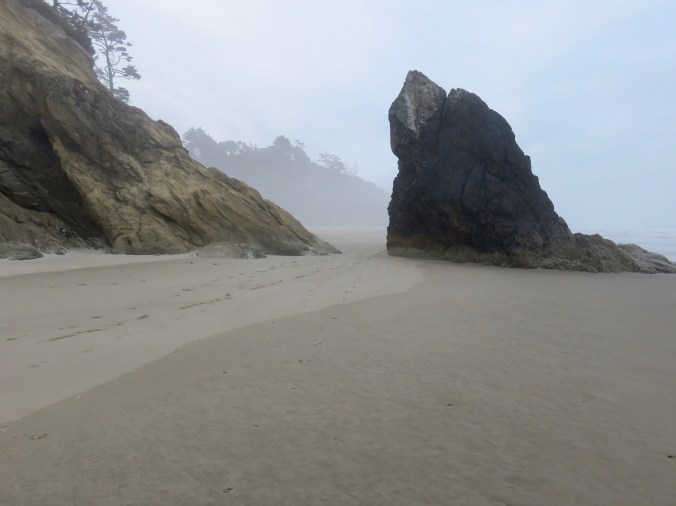
This is also from our four-mile walk, looking south. Last year we could not walk between the Seal Rock and the headland—the gap above that is filled with sand. Last year it never filled in even by August and there were pools of water and barnacled rocks. This year that is all under feet of sand.