ON THE OTHER HAND

IMG_5494

“…she had warts.”

A local Portland station urges neighbors to check in on one another. A photo shows a group of men standing in the street, spaced well apart, but talking about how they are doing in isolation and making plans to monitor how the neighborhood is managing.

I won’t pretend this is a silver lining here, but a few realities are being faced and some things are getting done. Continue reading

WOMEN’S WORK


cleaning1920-546x1024.jpg

March 1920 issue of the Delineator magazine, from http://thevintagesite.com/?p=611

A recent post on Apartment Therapy reviews how housework was done a hundred years ago. She describes following a housekeeping manual: “I Tried a 1920s Cleaning Routine for a Week—And It Was Nearly Impossible.” It wasn’t impossible, of course, but it was rigorous, with daily tasks and tasks completed on specific days. Monday was washing day. It was an entertaining read (and illustrated with photographs that do not come from the 1926 book).

“The good housekeeper must bring to her task of housekeeping every one of the qualities that make for a successful executive in the downtown business world.”

Brentnie Daggett, the author of the article, assumes the book was “written for professional housekeepers—teaching them how to take care of their clients’ spaces and manage their businesses at the same time” and that such a housekeeper would have the new gadgets such as an electric washing machine, vacuum cleaner, and dishwasher. She was wrong about all that.

First, the book was written for housewives not professional housekeepers, for married women whose profession was caring for their own home, not for hired staff. The illustrations in the article might depict a maid but should show a housewife wearing her apron, which she would certainly have worn while cleaning house. Most housewives learned their task from older women in their family, but sometimes a book was handy reference for tasks Mother did not explain thoroughly. I have several of these books, some of them quite expansive with chapters on dying cloth and stain-removal, on simple home repairs and pickles. Mrs Beeton’s Book of Household Management comes to mind.

The author of the AT article finds the cleaning process described in the Good Housekeeping book unworkable, even “impossible” yet she only does the morning tasks of breakfast and cleaning. She does try a bit of mending on Mending Day (Tuesday), but she does not mention luncheon, dinner, or entertaining. She also does not mention seasonal tasks such as canning.

Daggett uses an automatic washer and dryer, and I do not blame her for that, but it is very unlikely her great grandmother did. There is no mention of ironing. Untreated cotton wrinkles to a degree few young people would recognize today. In 1929, cotton fabrics were first treated with a solution of urea and formaldehyde, but it would be decades before wrinkle-resistant fabrics became common in American homes. In the 60s, all of our sheets were synthetic because my mother refused to iron sheets. I am 67, old enough to remember ironing my father’s shirts with an electric iron. The task took hours.

Most American homes would not have had anything electric in 1920, no washing machine or dryer, no electric iron, dishwasher, or vacuum. (As late as 1945, the majority of American homes did not have electricity at all.) I recall my step-grandmother doing laundry in a large room, necessarily large because it held multiple tubs of water, mangles and wringers I was warned not to touch. The clean laundry was hung outdoors on the lines strung in front of the vegetable garden.

Cleaning floors between full-on down-on-your-kees weekly scrubbing was accomplished by scattering dampened newspapers on the floor and sweeping them up with clinging dust. Carpets were taken outdoors to be beaten clean with what looked like a massive flyswatter. I had a vacuum cleaner when my children were small, and that took care of the carpets, but I also scrubbed the kitchen floor once a week.

“Clean enough to eat off the floor” was no joke. It was the goal.

Gas or oil lamps had to be cleaned once a week. My mother and her sister did this on Tuesdays during the summers they spent in the house where I now live. It had a wood stove and no electricity or indoor plumbing in the 20s and 30s.

Electric stoves were not in every home, and wood stoves had to be fed with wood that had to be cut and split and stored and carried indoors. The icebox mentioned in the Good Housekeeping book was kept cold with…ICE.

All this non-electric equipment was used every day and had to be kept clean. In the 20s there were no antibiotics and lifespans were lengthening less because of medical science than better nutrition and cleaner homes.

Unmarried people lived in boarding houses for most of the 20th century so that meals and cleaning would be provided and they could go to other jobs. Keeping house was recognized as a full time job and women who stayed home to keep house were on their feet all day, cleaning and cleaning and cooking and caring. And cleaning. 

My great grandmother Rosa [Garcia] Jackson supported her family by opening her home to boarders. She cooked meals and cleaned for pay and that supported her and her children.

My mother was also raised in a single parent household from the mid-30s. Her mother worked full time in a shipping office, but my mother and her sister and their mother all still had the housework to do after work and school. On Saturdays they rushed around to do all the “upstairs” housework in order to be free to attend a Matinee.

Housework was anathema to my mother for the very good reason that her mother never stopped. My grandmother took the bus into the city for her job and then came home to care for her daughters and the four-bedroom home she won in the divorce. She took no alimony and she was paying on time for the furniture her former husband had chosen. My mother avoided canning and embraced every “time-saving” household technique for the rest of her life. Think Campbell’s canned soup and instant mashed potatoes.

In my mother’s childhood winters, laundry was hung in the basement, a chore she hated so much that she used a laundromat throughout my childhood rather than have a washer and dryer in our home. Though she was a stay-at-home-mom throughout my childhood, housekeeping was a full-time job my mother was determined to escape. She was thrilled to return to paying work when my father retired early on disability and my brother hit his teens.

My mother recognized society’s devaluation of women’s work, and she resented it until she died.
 

ENOUGH

fullsizeoutput_1180

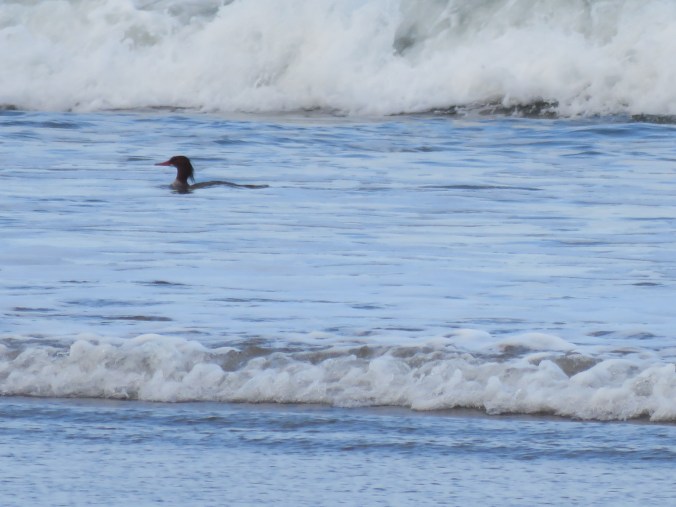
Years ago a friend who was visiting us looked at the shore and thought he was seeing soap suds or another form of pollution. It is, in fact, life. A heavy surf and a plankton bloom combine to make seafoam. There has been a great deal of it onshore this month.

We have been experiencing some “interesting” weather. Temps dropped down and there was snow in the Coast Range. Fortunately our son had already made plans to take vacation days to stay home with his daughter last week. We no longer drive in snow when we can help it.

Here the wind gusted to strong gales and we walked the beach anyway. High surf erodes the shoreline in some places and we find raw agates released by the tide. We get half wet day after day, pick up dozens of plastic water bottles, and the usual plastic bits and bobs—over 60 pounds of trash so far in January.

fullsizeoutput_1179A puffin died. We find dead seabirds on every walk. This one would be opened and the entrails and breast muscle eaten by the following day. It is our first dead puffin and so particularly sad, but seabirds die every day. And there is black oil all over the sand too. Crude oil? Someone illegally emptying bilge at sea? We can’t know.
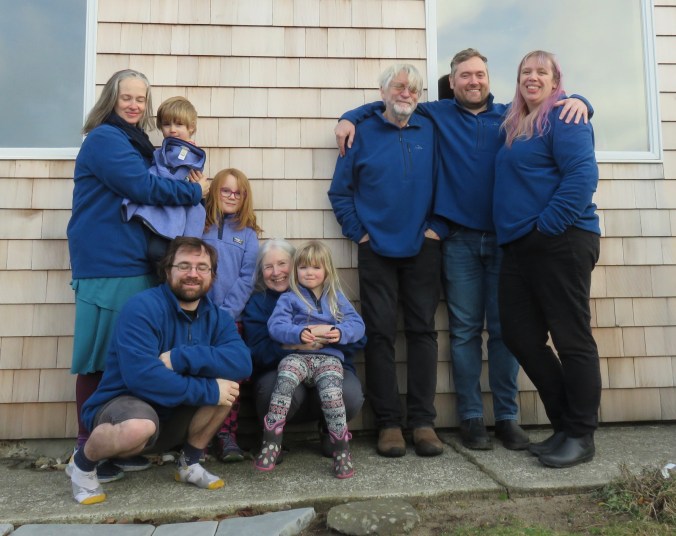
Last week we watched the helicopters flying south fast to the next beach and we knew this meant something bad. Emergency Fire and Rescue, the EMTs, three sheriff’s cars all with lights and sirens. Two young children drowned near our home. It didn’t seem quite right to mourn a puffin.

When I tried to warn a couple about the tide—they laughed when their dogs ran into the ocean—the man said “we know.” Their dogs don’t know. The next wave swept up a hundred yards over the sand and drove us, dogs too, all into the rocks.

People think they know about sneaker waves and “king tides” but they don’t. We have lived here over forty years and keep an eye on the ocean, move up shore when the surf becomes silent. (The crashing is usually safest—the sound of outgoing and incoming waves meeting. A sneaker wave is quiet and swift.) We spent most of the last week walking on the basalt rocks because even at low tide, waves swept all the way in, higher and higher. We watched waves sweep up over our pathway through the hedge, nearly to our yard. It is fascinated from the safety of our home, but we go out whenever we can. Not so very much glass has shown up, but pumice and plastic, those agates. Drowning. Death.

Lately we’ve walked the “inside” path on roads when waves swallowed sand and basalt rock whole. It’s safer than risking the shore. We often get rained-on during our walks, but we never head out into a heavy downpour. Yes, we have rain gear, and yes, we get caught in drenching showers. We see them coming but do not deliberately head out into a rainstorm. These things just happen.


  • I have set goals for quilting and weaving on Ravelry. At least 16 items for the Hoffman, one completed the other day as a gift. I have chosen yarn for a warp and I did (yes, I did!) cut that narrow warp clean through. I will chain it off my loom today and maybe begin winding the new warp. I wound off the skeins yesterday and chose possible weft. Everything is from my stash plus a huge skein especially ordered from Koigu in December. These blues are not my colors, but for a friend who retires in a month so I need to get cracking on.
  • Zero clothing purchases so far this year (yeah!). I have ordered seven skeins (plus another five mohair/silk skeins that I returned because the color was wrong and I do not have time for that much knitting), tea for Gary, a book.
  • No new writing, but I withdrew work from two journals that failed to respond to queries after holding my piece for months past normal response time—one had a piece for months before shortlisting and since has held it for another year. Yesterday I submitted a revised essay to an unlikely journal with a history of quick responses. So I worked on that and sent it off. I mean to allow my Duotrope folder to go empty. That goal can’t happen for at least another three months. On Submittable, the new submission has already shifted from “Received” to “In Progress.” Two older ones have not.
  • The manuscript, Butterfly Fontanelle, occupies my thoughts on most days, but I have not opened the file in a while. Where does her protein, salt, oil come from? How does she store food? How does she clothe herself? Does she need to create shelter? Does she stay in place or move? Why? The story has become a meditation.


not a YEAR END REVIEW


fullsizeoutput_116b

I just reread my year-end reports from 2018. (I have some work to do.) One of those posts was about what I had read. One of them had to do with paying for college. My mother was famous as a worrier, which was not great but did result in a daughter who was careful about money.

My husband and I have managed full retirement quite well financially. We are maintaining a small reserve in the bank, taking a day now and again to travel nearby and stay the night, and thinking ahead to what we need for the future. We need a new roof and some other major repairs. Our wood-burning stove needs replacing—it’s necessary in a location where the power routinely goes out in the winter, usually for a day at a time, but sometimes for a week. All of this means we have decided to budget more tightly in 2020 in anticipation of these expenses. We got through college without debt and entirely under our own steam because we had cheap habits and careful spending. Some of that is still true. We still do not smoke or use drugs. We drink good coffee and cheap wine. We have not eaten most meat for decades, not because we disliked meat, but because it felt morally wrong the way animals are raised, and increasingly dangerous to our health and the health of the planet. We eat organic food but plan to be completely vegetarian for the rest of this new year, abstaining from our habit of seafood once or twice a week. We’ll see how that goes. But cheese. We both think we will always have cheese.

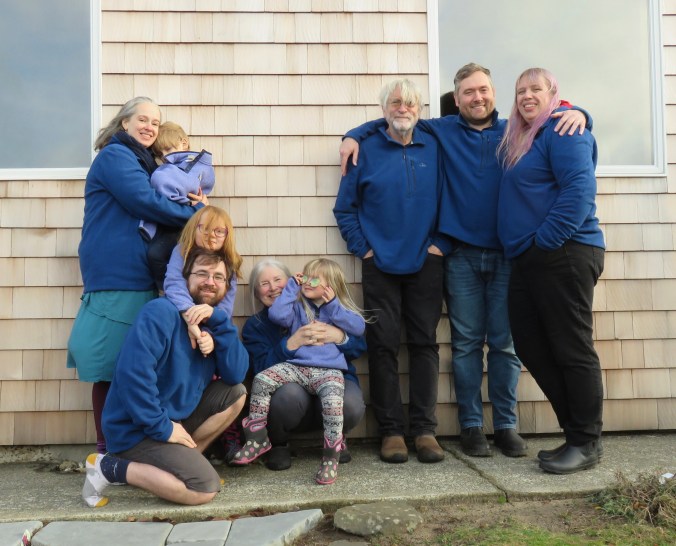
This past couple of days we had our children and their children here for a visit. The the tea party for the kids was a bust, but we walked the beach and I knit with Ruby. There was a scavenger search around the house with written clues (thank you, Emily), The Family Stone (thank you, Kerris), and eleven for dinner last night. There was a lot of food. My baking and cooking plan included a detailed timeline for chili verde, sautéing mushrooms and onions, roasting various vegetables, poaching salmon, putting together frittatas, frying latkes, Waldorf salad, pumpkin custards, cranberry bread and also orange-cranberry sauce, wild rice, and rugelach. I made vegetable stock. I cooked like a crazy person. Saturday morning, I baked two loaves of bread—which was not even on the list!

We managed. Everyone is gone now because of work tomorrow, and I would be feeling pretty great about now but did not sleep last night.

You do your best, and the best is never perfect, not even close. But you hope that the people you love most in the entire world understand you are imperfect but trying hard.

fullsizeoutput_1161

LATKES

IMG_5302

The last sweet potato latke, with cranberry sauce on a Rainbow Gate plate.

We have family coming for dinner next week, and I am test-driving family recipes and trying out a couple of new things. I hope to serve Waldorf salad (without nuts or brown sugar), cold poached salmon with sauces no one is allergic to, the mushroom-and-wild-rice casserole (without flour or butter or cream), Brussel’s sprouts, and “the chocolate thing” I used always to make for my college classes (without dairy or refined sugars or nuts). And latkes for Sunday breakfast.

Continue reading

CLEARING AWAY

IMG_5286

No, water is not supposed to be running down these stairs in “Sally’s Alley”. This is just up the beach beside the massive concrete bulkhead that used to contain a swimming pool. Gary calls this a “water feature” suggesting we have seen too many British gardening shows.

Heavy rain. Hard blow. High tides. The holidays. And knitting.

We went to bed too early last night and we are awake too early. Continue reading

WILD PLACES

fullsizeoutput_1138

When I was in high school the last of my grandparents died. And then in my twenties so had all the step parents—a lot of divorce in my family. My maternal grandfather’s third wife had taken a fancy to me and her second husband was fond of Gary. I’ve written about this before. It’s how we came to live in Oregon and raise a family here.

All of that happened together. We had gone back and forth about having children, but a key was wild spaces. My husband grew up in rural Washington and Arizona. Most of my childhood was in the growing suburbs north of Seattle. There were still cows at the end of the road, goats over the hill, and a small barn with palomino horses just a couple of blocks away. Best of all were the remains of second and third growth Douglas firs. The stumps of massive old growth cut down in the late nineteenth or early twentieth centuries were so old they crumbled rust red—I could dig right into them with my hands. Hidden away were ponds and swampy places. I watched frogs swim underwater and admired the water skippers on top. I tripped over the native blackberry vines, tore bracken from the earth and heaved it as javelins, put foxglove blossoms on my fingertips, and ate the sulphurous yellow blossoms of Oregon grape in the spring and the tart berries later in summer. My mother had no idea where I was most of the time. I brought home pollywogs and splinters. I came home filthy.

Gary had a similarly unrestrained childhood in the desert but also rattlesnakes and scorpions. I wrote my MFA thesis based on his childhood stories. Most of what I wrote was entirely made up, but once in a while, Gary would look up from reading one of my stories: “Did I tell you this? I’m sure I never told you this.”

I got it right.

Having children in the city, even in a house with cedar trees in the front yard and dogwood in the back, and just a few blocks from the zoo . . . that would never do.

Raising children at the beach felt possible. My mother would later declare the move to Oregon as a reason for having children “stupid.” It felt only right to me.

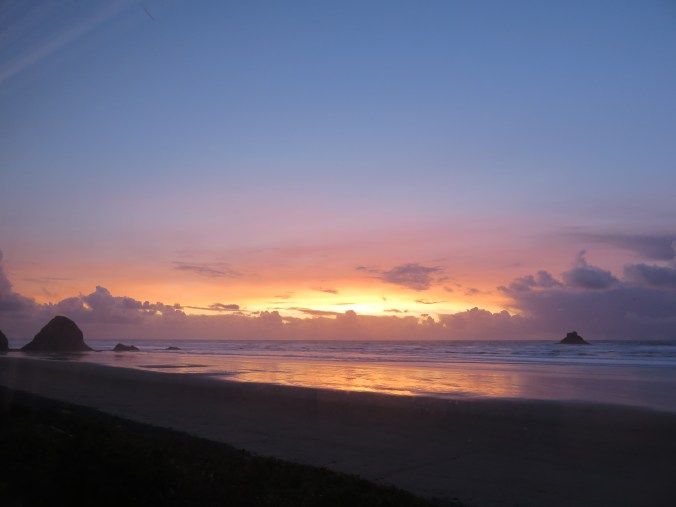
I hope my sons have their own stories of wilderness and sand, wetsuits and wild waves. Jellyfish and sand dollars, castles and glorious sunsets.

Overpopulation worried me even when I was still in grade school. I’m sure I have written about that before too. The world is too crowded these days and all the places I played growing up are paved over, fenced, and tame. Wild places are few and far between today. I just read that the Earth is predicted to have 10 billion people by 2050. That’s four times the population on Earth in the year I was born. Our sons and their wives and our grandchildren will live to see that coming crowded world. I probably will not.

May there be something left of wilderness for my great great grandchildren to enjoy. May they watch water skippers on the surface of ponds, frogs beneath the surface. Forest and water hidden away. May they know monstrous trees and places silent, still, and out of control.

ON NOT CONNECTING DOTS

fullsizeoutput_1129

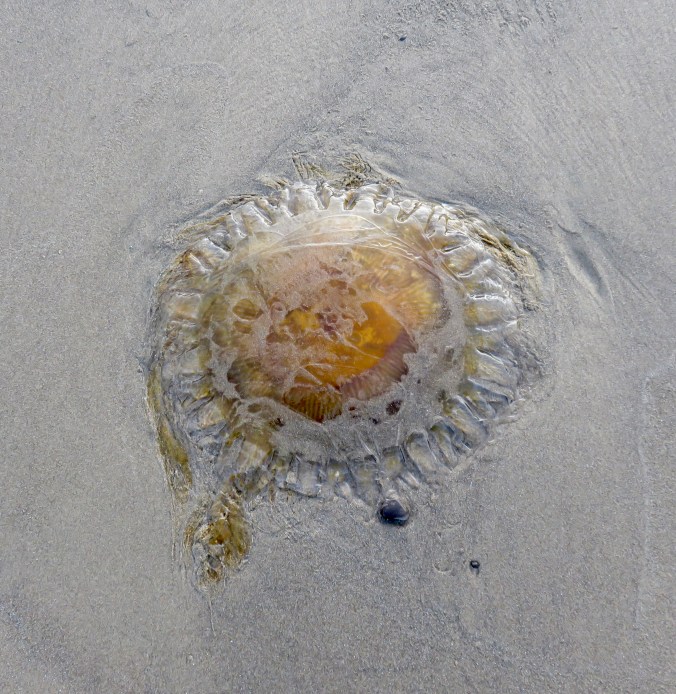
It was the orange jellies I was warned against as a child. The clear ones tended to be a couple of inches across when I was young. The orange ones were six or eight inches. This one is closer to eighteen inches. No, Daddy, I didn’t touch it.

We had such a wonderful Thanksgiving that I am embarrassed to think of it. I told Tammy on the beach this morning that I didn’t feel I deserved such a lovely day. She said, “It’s best not to connect the dots.”

Our drive over was uneventful—good news given forecasts of snow and ice. We walked in Forest Park with our younger son’s family, checked into a hotel, had dinner with our older son’s and his wife’s family, and then went back to the Kennedy School for a long soak in their pool. It was very cold and the soaking pool is outdoors. Bamboo and fats and palms rustled overhead, but the water was perfectly warm. We slept well, had breakfast and drove home again. Snow on the verges but no ice on the pass.

We also had an opportunity to drive in the city. Always an adventure. We were honked at twice, each time while waiting for a pedestrian in a crosswalk. People gave us exasperated looks for driving too slow—barely over the speed limit. (I have come up with a new safety rule about speed: drive at the posted limit plus 20% and other drivers will not throw up their hands.)

Today I received a link to a fascinating history of automobiles in the U.S. Apparently our “love affair with the automobile” began where Groucho Marx declared it so in a documentary financed by the car industry. Early on there were perfectly functioning electric cars and people walking, on horseback, or driving were not in such a rush. Most hated the new cars that only the wealthy could afford. All Americans would pay for the roads these drivers demanded.

In his 1896 essay making the case for electric vehicles, Salom decried the fumes associated with the internal combustion engine: “Imagine thousands of such vehicles on the streets, each offering up its column of smell . . . and consider whether such a system has general utility or adaptability.”

Instead of thousands of such vehicles, we now have more than a billion. Had the desire of working Americans for safety been prioritized and their enthusiasm for public space been respected, transport might have designed on the basis of public good rather than private enrichment. If that had happened, the planet would look very different today.

Instead, a relatively small number of entrepreneurs successfully campaigned to reorganize the country—and subsequently the world—so that their particular business model might succeed.—“The Car Culture That’s Helping Destroy the Planet Was By No Means Inevitable: On the Relentless Campaign to Force Americans to Accept the Automobile” bJeff Sparrow

Today is the last day of NaNo and I have over 53 thousand words. I think they are mostly in the right order, though I might have to flip chapters 19 and 23, which are both flashbacks and probably need to be in chronological order. I have marked the five chapters I need to develop further. Overall, it is way too short, but I think once I develop another plot thread (plot!) and those five short chapters, I might get to a more desirable length. I aim for 70-80k words.

fullsizeoutput_112bThis morning we went out for our beach walk on last night’s high tide line where we expected to find trash. We did and brought it home, and I found three pieces of glass, some shells and frozen jellyfish. When I was a girl, jellyfish were rare. I might see one orange jelly six or eight inches across in a half mile walk. These days we see dozens or hundreds, both blue and orange and ranging from an inch up to two feet across.
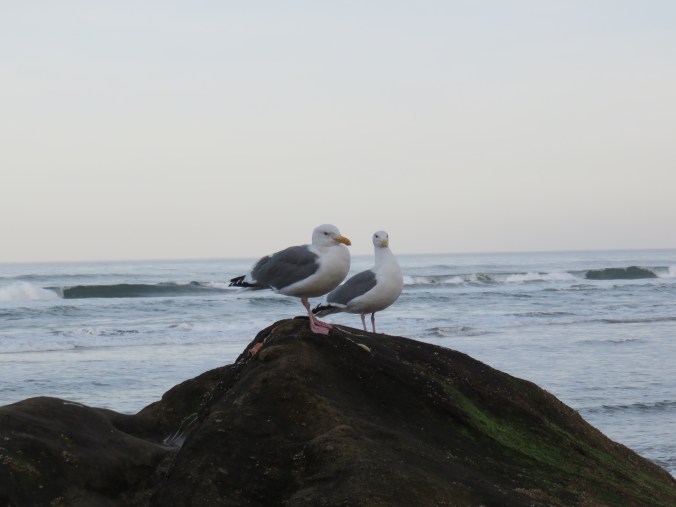
It was sunny and cold this morning, and we were glad to be out and home.


WITH OR WITHOUT

IMG_5134

We wish everyone a happy Thanksgiving. Alone or with friends or family. With or without turkey. With or without.

There is always something missing. In childhood that was whatever the parents were allowed to do that we, at seven and four, believed we were missing. As adults there is the glossy image in magazines and television of what holidays look like. They never looked that way for us. Disagreements and tension, jealousy and resentment. There are the missed opportunities and missed events. Mostly we miss people.

We hope to see most of our family today, but not one of our siblings. Most live far away. One has already died. One does not speak to me. I imagine some people assume that last is my fault. Sometimes I have too. But mostly I am over the rejected overtures and that particular guilt. I am thankful for that. I am thankful.

“When psychologists study siblings, they usually study children, emphasizing sibling rivalry and the fact that brothers and sisters refine their social maneuvering skills on one another. The adult sibling relationship has only sporadically been the subject of attention. Yet we’re tethered to our brothers and sisters as adults far longer than we are as children; our sibling relationships, in fact, are the longest-lasting family ties we have. . . .

“In one Swedish study, satisfaction with sibling contact in one’s 80s was closely correlated with health and positive mood — more so than was satisfaction with friendships or relationships with adult children. And loneliness was eased for older people in a supportive relationship with their siblings, no matter whether they gave or got support.

“That’s why it’s so sad when things between siblings fall apart. This often happens when aging parents need care or die — old feelings of rivalry, jealousy and grief erupt all over again, masked as petty fights ostensibly over who takes Mom to the doctor or who calls the nursing home about Dad.

“Many families get through parents’ illnesses just fine, establishing networks where the workload is divided pretty much equally. Paul and I did fine, too, throughout our mother’s progressive frailty and forgetfulness, and we also had no problem splitting the chores that arose in the aftermath of her death. But about 40% of the time, according to one study, there is a single primary caregiver who feels like she (and it’s almost always a she) is not getting any help from her brothers and sisters, which can lead to serious conflict.

“And because of the particular intensity of sibling relationships, such conflict cuts to the bone. People grieve for the frayed ties to their siblings as though they’ve lost a piece of themselves.”—“Here’s to Grown-Up Siblings and the Ties that Bind” by Robin Marantz Henig on NPR. [Well worth a read.]

That has been the other loss I grieve on top of parents, profession, and pets.

I am thankful for my husband, our children and grandchildren and their other families, for the memories of forty years of teaching, for art and the ocean, for still being able to walk miles, for my step-grandmother who left me this house, for books and so many decent citizens and those committed to justice and kindness. Thankful for the hard work of others who care about more than themselves.

And I am grateful that the water in the bird bath is not frozen this morning, and that in a couple of hours we may be safely on our way to see people we love.

Thankful.