‘When something like this happens . . . ‘

44758674_10219065663539373_8219845102713962496_n.jpg

Many people are finding it emotionally challenging to watch the news these days. They do not feel connected to events, to politics, to the ebb and flow of our national debate. I understand that.

Just last week I was thinking over my personal experiences with accidental shootings leading to lost use of legs, to murders, and to suicides—yes, plural for each. I have known no one who was killed by a serial killer or terrorist, but people I know have been crippled and murdered, and all were the victims of white men. There is nothing unusual about that. In my country, most murderers and terrorists have been white, male, and Christian, even when the majority of citizens were not.

I love and would trust with my life, most every white male I know personally. They would not harm anyone based on color, religion, or politics. They are joined to one another through their communities and by love and respect.

So then, the past few days.

Things happen. Terrible things happen to everyone. A father commits suicide in the driveway while his daughter desperately beats on the locked car doors and windows to stop him—something similar happened to more than one of my students. A girl slept on the dirt floor of a shed, determined to stay with her homeless mother who was mentally ill and drug-addicted. A father returned from Iraq with no visible wounds but still changed beyond recognition. A student hospitalized, not for the first time, in a mental facility. Mothers and fathers died. A student drowned. Students died in car wrecks. Students killed themselves.

Ask any teacher in a weak moment and they will share their stories.

Then there was the student who slammed a school desk into a wall, the one who threw a chair, a padlock. The ones who did not want me to know what bothered them. The cruel parent, the near fatal overdose, the guilty confession of keeping score of girls, the marks on my board to count off the days without drinking.

I do not know how to adequately respond to cries for help. I have done my best as a mandatory reporter. I have offered comfort, I have listened. I have tried to be what my students needed from me, and often I have failed.

What leadership and decency look like:

“When Rabbi Joseph Miller learned of the Squirrel Hill massacre, less than a mile from his own pulpit, he ordered the doors of his synagogue locked,” Franklin Foer writes. “Despite his congregants’ terror that they would be next, they recited the mi sheberach. They didn’t pray for their own protection; they prayed for the healing of others.”

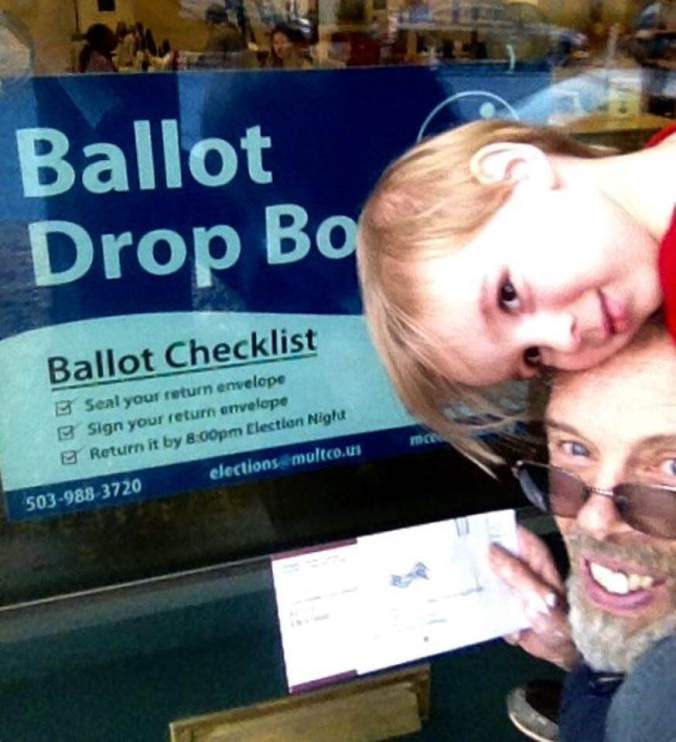
A dear friend has just managed to let those of us who were concerned know through social media that she is well, despite hospitalization with a terrible health crisis. She begs people will vote in lieu of flowers.

There is no point trying to avoid the pain. It comes and it comes. We can deny our responsibility or face what comes with compassion and care. The best we can do is take steady, honest steps toward healing our beleaguered nation.


THE ENEMY?

Pogo-1.jpgDoes it seem to anyone else that we have been going backwards?
When hundreds of terrified people flee violence, rape, and murder in their own country, it seems to me that the solution is to help make their country safer, not to turn our own country into a place where children are torn from their families—making my country into a scarier place than what people are struggling to escape does not sound like a viable solution. It makes us into the bad guys. I never wanted to be one of the bad guys.

“We have met the enemy and he is us.”

I have slept badly, eaten buttered popcorn (comfort food) because I am uncomfortable with the world, fearful of death, concerned for my country.

I know that America is not a perfect place, that we have done terrible things in our past. I willingly acknowledge and condemn our collusion and active violation of the rights and very lives of people indigenous to this land and to other lands. I do not need to list the abuses. We are a powerful nation and with power comes the potential for abuse.

But former abuses are not an excuse for future ones. It is not enough to say, as our current president has recently said, “You think our country’s so innocent?”

No. We have not always been innocent. But we have aspired to be great.

Failure to do the right thing in the past does not excuse our obligation to try to do better.

I used to insist my students memorize The Preamble. If you have ever seen the Constitution, it begins with “We the People” in enormous letters. The Preamble itself is specific and powerful as an outline of our goals as a nation.

We the People of the United States, in Order to form a more perfect Union, establish Justice, insure domestic Tranquility, provide for the common defence, promote the general Welfare, and secure the Blessings of Liberty to ourselves and our Posterity, do ordain and establish this Constitution for the United States of America.

The capitalizations and spelling are original.

And then there is the Statue of Liberty, which celebrated our centennial and spoke to the light of hope we offer to the rest of the world, and the poem, written by an American that is enscribed at the base:

The New Colossus by Emma Lazurus

Not like the brazen giant of Greek fame,
With conquering limbs astride from land to land;
Here at our sea-washed, sunset gates shall stand
A mighty woman with a torch, whose flame
Is the imprisoned lightning, and her name
MOTHER OF EXILES. From her beacon-hand
Glows world-wide welcome; her mild eyes command
The air-bridged harbor that twin cities frame.

“Keep, ancient lands, your storied pomp!” cries she
With silent lips. “Give me your tired, your poor,
Your huddled masses yearning to breathe free,
The wretched refuse of your teeming shore.
Send these, the homeless, tempest-tost to me,
I lift my lamp beside the golden door!”

Not to conquer but to raise the light of hope to all the world. That is our chosen destiny. Some will choose money over justice. Damned we are if that is our choice as a nation to choose profit over people. To institute brutality in response to brutality. To witness cruelty and respond with anything other than kindness—that would be a violation of our nation’s history and idealism.

We have a great deal to be proud of in our history, which is clearly flawed but always striving to be great, working to be good and just and fine toward all people in recognition of our shared humanity, in the rights of all people to seek life, liberty, and happiness.

This is my country, both imperfect and honorable. This is our principle of freedom and righteousness. May it yet prevail.

unSATISFIED CUSTOMER

95a8e252eca89dbaa7458a3c2b379aa0.jpg

The order.

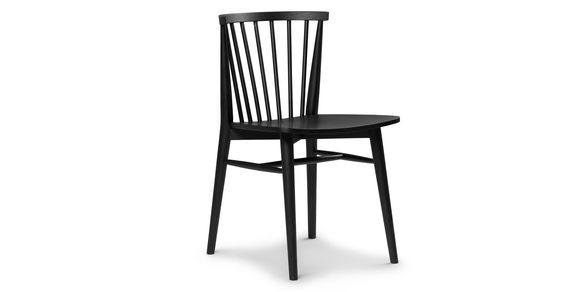
“Years and years and years ago” when Mom was still alive, I did what my mother had done and decided on solid black, spindleback wood chairs for her old dining table she’d given me. I wanted four chairs, and bought cheap, unfinished chairs and stained and lacquered them matt black. They are currently serving duty in my son’s dining room.

Our garage sale library chairs have been good, but they are too heavy to slide easily in and out at table. It was time, I decided, to get what I really wanted.

Anthropologie (see above) had chairs that looked right. Black. Spindles. Oak. I had a discount coupon. The coupon did not work, but I ordered the chairs anyway. I had not sat in them so I worried they might not be as comfortable as they looked.

They were beautiful and comfortable, apparently sturdy. We received only three, each with serious flaw—a cracked leg, a botched paint job, seat not fitting to the back legs. After a dozen emails and many phones calls, each with conflicting information and advice, the chairs are all returned, the lost one given up, the money refunded, and I have the option of ordering chairs “at any time in the future” with a 20% discount from Anthropologie. Probably not.

Then a desk I had saved for and ordered months ago arrived Tuesday and is stripy walnut like milk chocolate-colored teak. I wanted dark bittersweet black walnut swirls. Honestly, even the salesman recognized it was not what I wanted, and I think both of us hoped I would love it anyway. I don’t. I am a generation past and a generation too late for the Danish-teak-now-called-Midcentury-Modern aesthetic. I mostly did not like the style the first time around and have not warmed to its resurgence.

The desk will go back as well, and that is going to be an expensive return.

The disorder.

These are the concerns of affluence, I think, fussing over chairs and custom desks, as if they mattered. Money. I have tried to figure this out. I do love all this stuff, but lately we have been selling and giving things away, emptying closets and attic, and even my jewelry box. Most of my life I have accepted what came—furniture, people, jobs. Maybe that is a flaw in my character? A failure of common sense? Bad and good luck?

We have been shoveling out what came unbidden into our lives in order to trade up for things deliberately selected. Affluence again to have that choice. Entitlement.

What matters is that my husband and I go for our long beach walk each day, even when it’s raining. We sit at the table and share breakfast.

Spiders can hear human conversation, I am told. They know when we spot them working their way across the ceiling. They hear our alarm. They huddle down and accept our coming for them, or run for a crack in the ceiling.

Maybe I need to run away too?

We listen to and read the news and would rather worry about furniture.

Run away! Run away! Doctor Who shouts.

Yes, maybe that.

There is terrible news every day and no place to escape to. But we would like to escape from cruelty and willed ignorance and obsession over money, even our own.

Who needs a vacation?

I can count the days we have slept away from home during the past twenty years on my ten fingers. In 2003, Gary and I began calling a few hours in a daytrip to Portland our “vacation.” Since then we have had two nights in Orcas and one in Canada, two trips to Seattle and two nights at Nye Beach, a few nights with family in Portland (does that count if I have to cook?). Fifteen years and, okay, maybe we had a dozen nights away from home. More than ten nights in fifteen years. We talk about travel to Iceland and Ireland and Portugal. (I have always wanted to see Hagia Sophia and Crete.) Mostly we stay home and stare too much at our computers. Have we been investing in furniture in place of vacation?

We should try it the other way around. Or something.

Next week we will go for two nights without technology. When we come home, there will still be just two ancient chairs at the dining table, and that will be plenty for us. Perhaps the desk will have gone back to Portland by then, and I will continue to sit up in bed when I write.

In the mean time, vacations too are the concern of affluence. Give me time to think about that.

I’ll keep you posted.


PASSING

IMG_3471

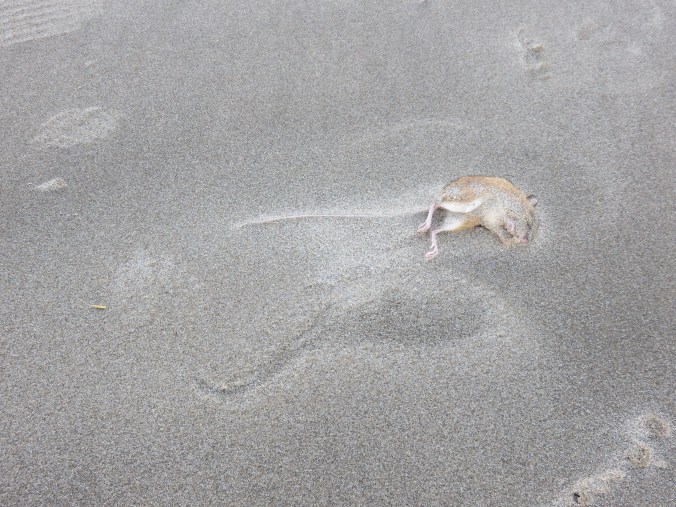
I passed this mouse on the beach—mouse?— half-covered by blown sand.

There is a novel by Nella Larson called Passing, which includes racial passing by a character. There are other sorts of passing. Passing by, passing judgement, passing the mashed potatoes. A running dog passing another is called a go-by and it’s a good thing. Passing over, we die.

Years pass too, time passes. But not really. We are only here from instant to instant, only really here. Life is not a train headed in a particular direction and we are not riding a carrousel in circles. We are here, looking ahead at what we hope or fear might be coming, basing our predictions on what we remember has already happened.

Today is my birthday. I am 66. We have already established that I am not any number of “years young.” But back in May, I decided to track my daily activities. Looking forward, I thought I should plan more decisively for writing and reading and walking and eating, taking the medication for my thinning bone, and drinking enough water, limiting alcohol—all the things my mother would tell me to do if she were alive, even while she failed to follow her own good advice.

A new post on the Brevity blog urges us to consider how easily we are distracted, not just by the distractions of phone calls and tweets, but by the time required to process and recover from them. Set priorities, set goals.

Most of the project goals I established in January and June are coming along. I lost fifteen pounds and I am walking an hour a day. I have seen my writing published eight times this year, which is fortune as much as effort. The only control I have over publication is submitting my work. Mostly I submit—terrible term—to journals that publish a tiny fraction of the work they receive. They might print a dozen stories in a year and reject ten thousand. Just yesterday I earned my 100th rejection for my writing, and it was, in fact, a writing goal for the year, one I could control by submitting my work many times. Score one for me! I passed my 52-book reading goal for the year too. I have a story that might become a novel next month during NaNoWriMo (National Novel Writing Month). In that story nearly all visible life on earth other than plants and insects dies. One woman is left alone wondering how she deserved to survive and was it punishment for something she doesn’t know she did? Too much time passes for her.

The Washington Post warns about an massive drop in insect life and the birds and reptiles that eat them on pristine tropical islands. Is it the result of climate change which impacts insects much more dramatically than I supposed? Or is this the result of the use of pesticides and defoliants? Some Devil’s Triangle of threats? Researchers can’t explain it, but they’re worried. So maybe I have my prophetic story backwards?

Or perhaps what I was told about Australian people is true, that they see humanity as forever facing the past, walking backwards into whatever unknown comes next.

I am merely passing by.


GROWING UP

IMG_3417

Yesterday, though it is October and cooling, the sun was bright overhead and we got in our two beach walks. A huge broken V of birds flew south so fast we were not able to identify the species. Not Canada geese, who fly slower and in a tidier skein and honk. Gary suggested cormorants.

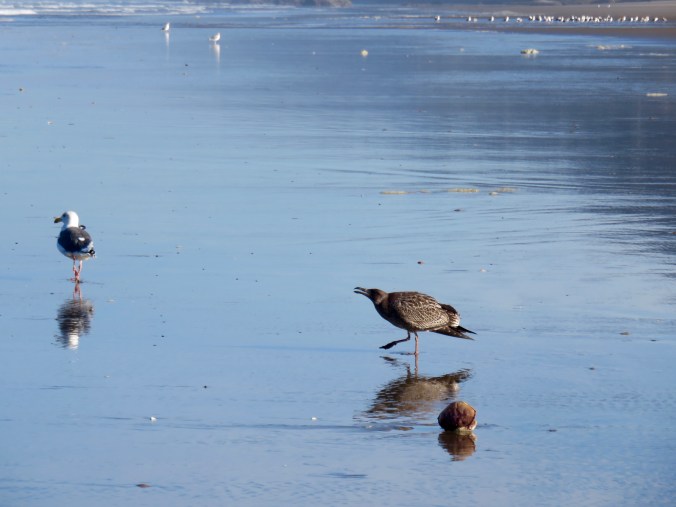
The juvenile gulls have mostly begun foraging for themselves, but we still see the occasional young bird begging its mother for food. The young gulls are fully fledged and as big as their parent, but still in dull gray child’s clothing. They duck their heads into their bodies, circle their parent and peep: “Feed me! Feed me!”

IMG_3424

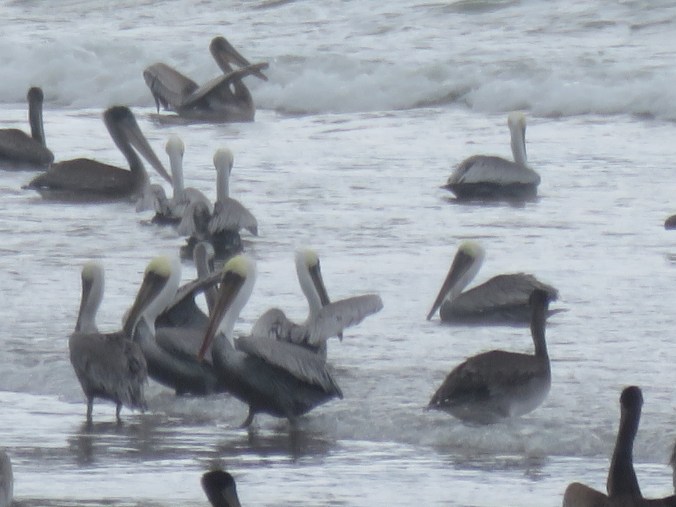
The pelicans, too, seem to have fully grown children still in baby plumage, though these larger birds have more dignity, stately in size.

Hild by Nicola Griffith of Seattle is a novel about Saint Hilda, an ancient woman, who begins in this telling as a three year old. Her life is at risk, and she has been warned: Quiet mouth, bright mind. She is to listen and connect all she observes and throughout her precarious early life, she attends those around her with power: to the words of powerful people, to the scent of boggy land and new-turned earth and blossoms. She hears how the winds rattles leaves and the rustle and tuck of creatures in the wild.

Hild flies with eagles. This is not so much magic—this is medieval history, not fantasy—as wisdom. Hild connect dots in the air that no one else pays the slightest attention to. She misses things, but her seeing is not represented as a magical gift, but as the result of her openness to everything around her. She is smart and strong and very tall at a time when these qualities were often confused with the right to power. Hild seeks the pattern, sees it build and twist and turn, looks for ways to use it to advantage, both her own for the sake of weaker folk.

Times have not changed so much. We still confuse size with virtue. And even now there are people seeking a pattern to how the world changes.

There was a royal wedding, my husband tells me, and people were complaining about the cost. In Crazy Rich Asians there is an insanely expensive wedding too, but at least in the latter fictional case, the parents were supposed to have done something to earn the price. I always cry at weddings, and I even cried during that fictional one. I cried at my own wedding, which cost only a couple of hundred dollars including my dress and the gold I bought to make our rings.

I was young when I married, but Gary and I paid for the ceremony. We were already past begging our parents to feed us.

These days I think it would have been nice to have a friend who threw me a bridal shower, a father-in-law who paid for a pre-wedding banquet, a mother who insisted on all the trimmings and paying for them. But these are things I did without quite happily at the time. And they would be distant memories now, less valuable that the dress still wearable though folded away. There is no genuine regret. It was a lovely weeding in my parents’ back yard under the pagoda tree.

Seasons pass and time gathers itself in lumps of memory. How I laughed from excitement during the ceremony. How my new husband wrapped me in his arms. How our grins made our teeth click ever so gently at that first married kiss.

IMG_3418

The parent has already provided a crab meal—stripped clean here—and walks away. However it strives to appear small and dependent, it’s time for this gull to grow up.

WAITING FOR THE SUN TO RISE

IMG_2210

I am reading historical fiction just now. The E key on my keyboard has worn down to a splotch—it’s happened before. I had trouble getting to sleep from dwelling on memories of attack. I am waiting for the light so that I can have my walk. I am trying not to make things worse on social media. I would like to have my say, to talk. But silence is safer. Most women have been taught to keep their heads down, to smile, to keep silent, and avoid stirring the pot.

Years ago, the mother of two students asked me whether I was a pot stirrer or oil on troubled waters. I admitted I was a stirrer. I laughed. She did too. “I thought so.” She handed me a packet. She had commissioned a pendant from an Alaska Native carver, carved wood with abalone eyes. It is a frog. I hold it often.

By Northwest Coast reckoning, it is the large animals—Bear, Wolf, Eagle—who quiet things down. They are the “peacemakers” and maintainers of the status quo.

But it is the small trouble-makers, like Raven, who created the world.

The smaller animals, often that black bird, who appear in stories to stir the pot. A Haida story explains how humanity came into being because of Raven’s mischief. It is Frog, not someone larger and stronger, who has the capacity to make change, merely by finding what is there hidden underneath the calm surface.

Maybe this is because the strongest ones want to keep things as they are? They are strong, after all, powerful and influential and capable of protecting their rank. Keep still, they warn, don’t make trouble. Let this go quietly and perhaps we will not eat you.

It is the small among us who stir the pot, looking to see what we might find underneath. There are people and place, ideas and movements, all begun by the little-small among us who will not rest, but must speak out.

When has silence ever kept us safe forever?

UNSUBSCRIBE

IMG_3358

When I throw an email away, it goes in Trash, but my system also selects what it understands I do not want to see and puts it in another folder as Junk. Junk never appears in my Inbox. Periodically, I review the emails in that Junk folder, just in case something is misdirected. What I find includes distressingly numerous sex ads, invitations to enlarge my penis, queries about whether I am my email address (“Is this xxxx.xxx?), and links to places I do not want to go. Rarely, I find an email from a website that I have recently been tossing without reading. I think my favorite Junk emails are the ones that allow me to “unsubscribe by clicking the link below.”

Uh-huh. That would be dim of me.

A reminder of one of the key warnings everyone receives upon accessing the internet: Do not click on links unless you are certain, absolutely certain, where it will take you.

Even the legitimate “unsubscribe” links at the bottoms of emails you once thought you wanted to receive and no longer want to receive, sometimes refuse to do what you have asked. After I unsubscribed from Subaru USA, I continued to receive emails from that national site, and also the regional site, the local dealership, and the Tump-supporter who sold me the car. I unsubscribed from each of them, several times each, and they still went on for weeks. I finally wrote snarky notes to two sources. They did not stop. Then I wrote to the dealership and said I would give them a lousy rating if they did not stop. They did.

Immediately after the last presidential election I began receiving emails from that man in the White House. Eventually, after I repeatedly asked, they stopped. Isn’t it enough that he appears more often at the top of my news feed from The Washington Post AND The New York Times?

The other day, when I was supposed to be getting a test National Alert message, I received an email from the woman currently married to man in the White House. Trust me, I never asked for this. I am hoping that will be a one-off.

In the event of a national emergency (aren’t we already having one?), my phone is not smart enough to receive it.

Just as well.

And now to go watch the new Dr. Who.

“Run!”


THE TRIAL

CH-MacKinnon-09_29_2018_original.jpg

“It’s not funny,” my husband said after staring at the cartoon above.


There is a nasty rumor I found on the Facebook page of someone trying to friend me. It claims Ford’s father was a CIA assassin. Seriously? This should be reported to Mulder immediately. And Scully.

Today, I wanted to turn away from all this ugliness. I wanted to weave and wind yarn, and begin knitting a cat sweater for my granddaughter.

Insane accusations will be given credence because we enjoy a good thriller. I do not think the past few days have been fun.

All I think is absolutely certain is that Kavanaugh drank way too much while a boy and a young man, and he failed to come to grips with that drinking in any useful way—he was still bragging about it in public a few years ago. On tape. So forgive me for not applauding his repeated remark in his well-rehearsed speech about liking beer. Did you notice he expected a laugh at the end of those lines the first time he delivered them? He waited for laughter. It was supposed to make him more human. “I like beer” that last word expanded to two syllables.

His own written notes in his yearbook, his own speeches, and the numerous recollections of people who knew him and the crowd he hung with confirm his drinking behavior. He admitted to falling asleep but not to passing out from drink? No, I do not believe him.

I found his testimony embarrassing, evasive, bombastic, arrogant, disrespectful, and often hysterical. I think people who fail to see this are not people I can respect.

I believe Ford. I believe the others who have come forward. I think he remembers enough to want to protect his behavior from public view.

Of those asking questions? I give a pass to Cory Booker who made me cry too. They rest can take their political messages elsewhere. They are beside the point.

The men in my family and in my life would not behave the way all these men behaved. They would not talk this way. They would not pass judgement before the trial. For the past two years I have listened to “locker room talk” that might be typical of vulgar 13 year old boys, but is not acceptable, is deplorable in a grown person.

Every woman I have talked to in the past few days has had her own stories. I have mine. The testimony Dr. Ford offered was entirely believable. She has nothing to gain and has already suffered death threats and attacks from Senators. He is in danger of losing the golden ring—the prize he has pursued all his life, from his tony prep school beginnings to the Appeal Court (a position, btw, which was not achieved without considerable controversy—it is a lie that his reputation was “without blemish”.)

On Facebook my posts since Thursday have been consistently supportive of Dr. Ford. They have been public. Why is this man at the other end of my county, who has reported over and over about Dr. Ford’s father’s supposed record, trying to friend me? We have many mutual friends, but he does not seem to be a former student. If he has looked at my page he knows I disagree with his own public hysterical claims.

How I see it: I think Brett Kavanaugh was brought up to be a good Catholic boy. I think he also felt enormous pressure to achieve—nothing wrong with that. By all reports he was generally quiet and respectful in his youth, when sober. But he is also, by many reports, anxious about belonging to a particular powerful group. He wanted to be cool. Very badly. He went where they went. He did what they did. He drank because they drank. I do not know if he lied about blacking out while drunk. No one I knew who drank during high school parties drank merely because they “liked beer”, they drank to get drunk, they drank to excess to falling down drunk. Often. I do not know if he lied about remembering his abusive behavior, in each case egged on by classmates he admired, whose position he envied. 

I see he is a judgmental man barely in control of his emotions. That alone should make him unfit to serve on the Supreme Court. In his hysterical claims during his opening statement and his ugly attitude toward those asking calm and reasonable questions, he reveals partisanship.


“Judge Kavanaugh’s troubling record on protecting the rights of the most vulnerable in our society convinces us that he is not suited for a lifetime appointment to the court,” [Southern Poverty Law] wrote. “Our concerns about him have been exacerbated by his seeming lack of candor during the confirmation process.”

What I think is that he remembers just a bit of his aggressive and out-of-character behavior while drinking. He remembers more than he wishes he did, and that is why he has been at such pains to publicly support women while also attacking our rights as human beings. He is an ambitious and aggressive man. That was clear from his opening address during testimony. I think he believes his most recent actions have made amends for those early transgressions. I think he believes he is among the entitled elite and no longer subject to question.

This last is clear to me, with all objectivity. He believes he is beyond the law.

We are on trial in America. We are on trial for our honor and willingness to do what is right, on trial for our capacity to reveal compassion.

Our rights as free human beings are on trial.

IMG_3360

VIOLATION


IMG_3354

The rape scene is explicit. I taught The Bluest Eye for 25 years. It is an extraordinary novel told from multiple perspectives. A little girl is ruined, driven insane and lost. The language is stunning, beautiful, masterful. I introduced the novel with an early event where a narrator describes being sick and feeling her mother’s anger. This anger is not toward her daughter, but toward the sickness, which the narrator eventually understands: “Love, thick and dark as Alaga syrup . . . welled up in that house”

The first pages tell the story. I always warned my students about the graphic description of the rapes so that they could skip those pages if they wished. Sometimes they asked to read another book, which I offered. I reread the novel every year with my students, but truthfully, I did not reread those pages myself every year. They are brilliant. Brutal paradox  is set up immediately in the book when Claudia McTeer describes how her vomit sticks to itself “so neat and nasty at the same time.” Ultimately about love, the eloquent revelation of pain never lets up. It is sharp and bloodying. Toni Morrison claims there is no understanding the why of her Pecola’s father violating his 11 year old child, of a community destroying her. We must be content with how.

Morrison accomplishes more than that, in my opinion. I always told students they might understand why Cholly Breedlove rapes his little girl, but that Morrison does not require us to forgive him. We are not asked to forgive him. We understand, but even so his actions are not forgivable.

______________________

The rape scene before me was explicit. I stood up and walked out of the room. My thoughts fluttered. Why? Generally, I am a determined viewer. I do not watch porn, but I do not enjoy scenes of sex in books or movies. Nudity does not bother me a bit, but violence with sex makes me cringe. Rape drives me out of the theater, off the page.

For most of my adult life, I struggled to understand why I reacted so badly to rape scenes in films and avoided them in books. I was never raped. I was never violated. It made no sense that I had such a visceral reaction to violation in fiction.

I wondered if I had suffered some trauma I had repressed? I raked through my memories for truth. Nothing. All through this, I was aware of an ugly experience from the age of 7 or 8. I knew it had happened, but my understanding of that event minimalized my experience. It was not so bad, I would think for many years after. After all, much worse things happened to others. Much, much worse things happened all the time.

“It isn’t necessary to minimize one group’s pain and suffering in order to legitimize another’s,” a former student posted on my Facebook page.

I think enormous stigma and shame is what all survivors share. Insistence that some suffer more than others—while certainly true in a general way—serves to separate us and undermine our shared felt reaction.

There is a reason that even today only a tiny fraction of rape victims of either sex report the crime. Recently, I have posted elsewhere that I was molested on the playground by a group of boys who held me still. I never told anyone at the time and did not even admit it as an act of molestation to myself or characterize the experience as a sexual assault for almost 50 years.

As a young teenager, men exposed themselves to me and I did not tell.

The one time I tried as a college freshman to report an event, I was treated very poorly. And I knew this was my fault. I had no words to describe it as anything else by mine. I had been told in an infinite number of ways from the sex education I received at home and at school to the general attitude of my culture, that if I was victimized, if something “nasty” happened to me, I had done something to “ask for it.” My fault.

Are we not still in that terrible place?

Being loud, insistent, bombastic even, seems to convince some people. When it comes from a man. Tears. Denial. The silence or the soft (female) voice is refuted. Why not talk about it immediately? Why talk about it at all. What did you do?

Society weaves a thick blanket of blame and certainty over who I was then. That absolute judgement that what happened to me, if it happened at all, did not matter. That, I knew.

And now I unweave this memory. I examine it. I consider the glee in the faces of those boys. Those boys who never had paid me the slightest attention in the past, a wonder to me, approaching me with grins on their faces. I was small, small for my age, and youngest in the class.

I could not tell you the boys’ names or the date it happened. I could describe the light, their faces, the buzz cut of the boy who violated me. I know where I was standing on the playground. I remember the weeds I ran through after running from the blacktop playground. I was surprised to have escaped. My arms had been pinned, boys all around me. Perhaps my passivity, my well-trained smile, left them unprepared for my explosion. I escaped, but they had already gained what they wanted. Hadn’t they? They were done with me. They let me go.

It felt like escape at the time. I had not escaped. They were through.

The story of that day never left me. I simply ignored the warning.

If, as a victim, I could not admit even to myself the trauma of those boys surrounding me on the playground, holding on to my body, and one boy thrusting his hand into panties, my abrupt realization of what he was doing, and my scream and abrupt break. Running away. My tears. I told not a single soul. I did not, in 1960, even have words to describe what those boys and that boy had done. I pushed the memory away. I told myself it was a minor event.

So many people have suffered so much worse.

HONORING ERROR

IMG_3343

Several dozen brown pelicans stopped by on their way south last week. A smaller group or 13 or 14 has arrived in the summer during recent years and generally stayed into the fall. 

When I was in high school, we told a joke: This life is a test. It is only a test. Had this been an actual life you would have been told where to go and what to do. 

We can choose what we do with ourselves and we can choose to seek meaning. But we must also accept that not everything that happens is within our control. Some things just happen.

There is a story about a man who was living a good life. He was thoughtful and kind, virtuous and loving. But then things go wrong for him. His family dies, his occupation dissolves, the very earth itself seems to rise up and spit in his cup.

“What have I done wrong to deserve this?” he begs the universe. He examines his behavior, seeking an explanation for his abrupt change of fortune. Has he erred without knowing? Has he committed some sin and failed to notice. Whom has he offended?

His friends ask him too: “Oh, man, what did you do?”

“Nothing!” the poor man cries. He reviews his own life for some explanation of his punishment and can find no answer.

After a lot of begging and eventual anger he understands that people should know better than to demand an explanation. There is none.

Bad things happen to people. Job, the man in the story, had more than his share of hardship arrive all at once. At one point all his family and wealth are gone, and he lies on a heap of manure, his body covered in sores. Job certainly experiences more than his share of bad stuff. He is warned not to look for a reason. He is assured that if there is a reason behind his suffering, he will never understand it. He shouldn’t even try.

This is life sometimes. Terrible things happen. Sometimes we bring that bad stuff right to our own door. Other times, it’s no one’s fault and there is no one to blame and nothing to be done with the sorrow and grief that come our way. 

We can only go on.

Success is like this too. Good and ill befall each of us. Some of our fortune we worked hard to earn—by kindly, wise choices or skillful ones. We learn from mistakes, they say, or we do not.

Eventually we are old with have more years to look back on than we can imagine right now, and like all old people who are worth anything at all, we will have regrets. We will look back at mistakes and wish we could rewind and repair them. We want to think we are wiser, perhaps, than when we were young. All those years of hard work and love and loss and suffering and hope. Surely those experiences made us better people.

Maybe it will even be true.

We will know more. Maybe we will read too many books. Maybe we will attend college and develop a passion for anthropology or linguistics or software engineering or Renaissance poetry. Stranger things have happened. A work-study job in a hospital will take us through nursing school instead of electric engineering. A terrible accident will cripple your future and suddenly instead of working as a personal trainer, we work in a London nonprofit aiding children of war torn nations. We thought we would study history and find ourselves doing pure math. We thought we wanted to live in the SW and find ourselves in Manhattan. Our life course will probably change and those experiences will change us. Some of our life experiences will take us wholly by surprise.

But who we are is who we are. We will not begin tomorrow or sixty years from now. Real life isn’t something that begins later, when we have more time; it’s something we’ve been living all along.

What’s true is that every choice we make, moment to moment, on the hardest days: on the day we think we are too tired to get up in the middle of the night to check the baby; on the afternoon we snarl at the Safeway cashier and realize too late that he’s doing the best he can; on the days we cheat and tell ourselves it doesn’t count because we are not that kind of person. Yes, we are. That’s who we are. At our best and our worst, often trying hard to do what should be done and sometimes failing. We are the person who let the baby cry for half an hour, the one who yelled at the mentally disabled clerk, the one who cheated. That is us.

But we are more. We are the same person who helped the woman with the screaming toddler get her groceries into the back of her car, the same one who smiled at our own little boy’s hideous handmade birthday gift, the same person who took an extra breath and admitted we didn’t get the work done on time, but tomorrow we’ll do better. And then tomorrow we do better. That is us too. 

I’m not saying there are two kinds of people in the world. I’m saying there are a lot of situations, and all of us, every single one of us with an ounce of introspection will have good and bad moments. Every single one of us will have to face terrible things. Sometimes we will not do our best. Sometimes we will have to forgive our own failures and mistakes and go on hoping to do better next time. If you think that’s easy, think again. 

Don’t pretend you haven’t made mistakes, but don’t forget that you need to forgive yourself for them. And when you do well, when you do something kind and generous and honest and open-hearted, notice that too. How you get to that place where you can stop blaming and starting forgiving—that’s called growing up, taking responsibility. It’s called being good. 

You need to go. You are far from the end of your journey.

This isn’t a test. It was never a test. This is your life, the only one you get. You have been told to go on and you have been told to do the best you can. It’s your life. Make good use of it.

People have been telling me lately that I look tired. Oh yes, it’s also how I feel. So very tired. Not enough sleep. Lying awake worrying. Unable to run off my stress. 

But here’s the other side of a hard day several years ago: The cat was asleep at my knees. Ruby had “called” twice to talk to her grandpa. Three students who worked very hard to get there will attend the colleges of their choice thanks to a Gates and two Fords. It was Saturday of a long weekend, and though I had two boxes of essays to review, that was the good news. I had a lot of students who had done their job that week. Some of them still had long labor before them, but they seemed willing to do it. I was thankful for their hard work. 

I am thankful for my own hard work—something I could not have said when I was seventeen and about to start college. I am thankful for my family, friends, and the people I work with. We all wish we could do more or have more at times, but it’s good to recognize what we already have, what we have survived and earned, that we have stumbled and stood back up, and that there are places we still want to go.

I understand the limits of my power. I no longer expect or even desire wealth. I try to make a difference, a positive difference in the lives of people I know. I have my regrets, but I accept my disappointments and I forgive my own failures. It’s never too late to do the right thing next time. I just have to see, really see what is here before me right now. I have to look ahead to the path I intend to follow. And then…

I walk on.