CROWS STORY

IMG_3239

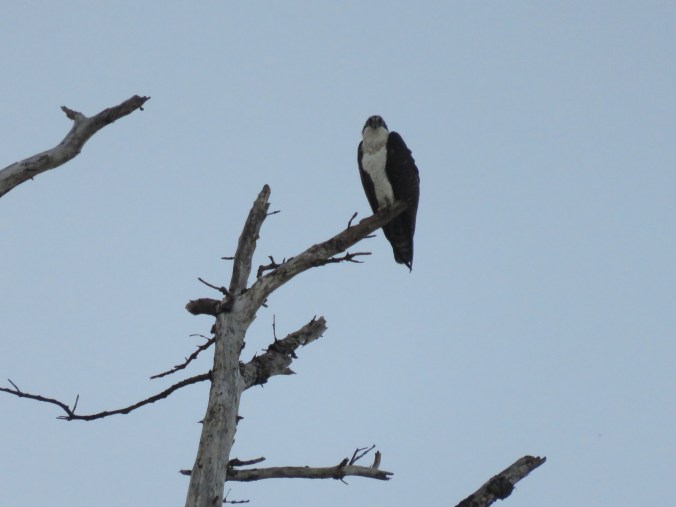
Two ravens and one of the local ospreys, top.

I have a brief creative nonfiction essay in issue 59 of Dinty Moore’s Brevity. All the work there is nonfiction and very short (under 750 words). My true story, “A Murder of Crows,” recounts an event from some years ago at a local summer camp.

This journal’s website has been a valuable resource for my college students over the past ten years. Students read essays and write précis on craft essays found at the same site. Then they go on to write their own creative nonfiction.

My work has been featured several (8? 9?) times on the Brevity blog.*

IMG_3243

The osprey from another angle. (I know this should be a photo of crows.)

  • I went to the Brevity blog and did a count. Thirteen times. Who knew?

HELP, I’VE FALLEN BUT I GOT BACK UP

IMG_3294

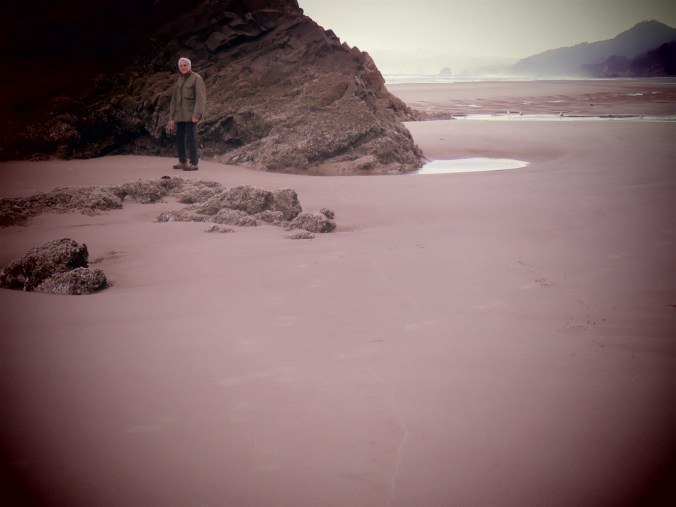
I fell hard yesterday. I was doing something stupid, trotting backwards as I tried to photograph my husband and a seastack and he kept walking right out of my frame. (If he knows he’s being photographed, he mugs or frowns. Photos of Gary smiling are pretty rare.)

So I was backing up to keep Gary in my photograph, and I tripped over a rock poking out of the sand that I had failed to notice and landed hard on my back. The smooth wet sand was hard as concrete. I did not land on the rock.

Still on the sand, I held still to discover how badly hurt I was. Would I be able to stand up? Had I broken my pelvis? I hurt. Gary had been watching me and wondered what I was doing. He says he thought, “Why is she trotting backwards? She’s going to hit that rock.” Then I did and he trotted over to me.

When he arrived, he said: “What are you you trying to do?” I snapped back at him, and he considered that a good sign. I hurt.

When I was pregnant with our first child I tripped and landed in a seated position. I damaged my tailbone. The doctor said it might have been cracked, but they couldn’t Xray because of the baby, and “there’s nothing we could do for you anyway.” Time would heal me, not any treatment they could offer beyond over-the-counter pain meds such as Tylenal. That was almost forty years ago, but I remembered that pain and considered that I might have cracked something in my pelvic area, but there wasn’t much to be done about it.

Aside from, maybe, my little toe and the little finger on my right hand, I have never actually broken a bone. Usually, I am a good faller. I could probably recall every time in my life I have ever fallen. Never from a tree, but once on my bike as a child. I jumped from a second story window, but that was a stupid choice, not a fall. I’ve been thrown from horses without a mark. One fall while pregnant, once I tripped over the oversize shoes my podiatrist insisted I wear, before I was used to them. About fifteen years ago, I fell while running hills when I missed my footing at the edge of pavement on the highway. I got right back up and kept running. This time was not like that.

After a half minute assessing my condition, flat on the sand, I rolled carefully to the side and got up. Yes, hurt. Not broken, not flashing or searing pain, nothing stabbing or worse on standing. We continued our walk, stopped when we got to a stream we could not cross without getting wet, and turned for home. I took two aspirin, sat carefully, discovered what movement hurt more or less, and went back to work on a quilt. A few hours later I took another dose of aspirin, and that’s all I have done. A former student, now nearly a nurse, warned me not to use aspirin, so I stopped.

Gary told our older son on the phone about my fall, which I had not planned to reveal to anyone. Like their dad, sons worry.

When I got out of bed this morning, I felt odd in my head—not pain, but fluffy, disconnection. I lay back down for a time, considering the possibility of concussion. When I got up again, I felt the same wooly-headedness, and I was careful.

So maybe a cracked bone, certainly some bruising though nothing shows, and maybe a concussion—I hit the back of my head hard. I will take it easy for a few days. I will not think too hard since research suggests that an active mind after a concussion slows recovery. I think about my students who were in car crashes, suffered concussions and came back too soon. I think about the coach who put his own son back into a game after he suffered a concussion. I think about my age and that I am too old to risk the loss of brain function. I think worrying probably isn’t good for me.

My husband brings me coffee in bed each morning. My favorite grandparent, my step-grandfather Lavin Hansen, whom I called “Papa,” brought coffee to my grandmother in bed each morning.

The mind travels even when the body is in pain.

PURSUIT OF FLYING

IMG_3225

Linking to an article about “lawnmower parents” triggered an interesting discussion on my Facebook page. Some were defensive about “rescuing” or failing to “rescue” children. Others pointed out that some children genuinely need more guidance than others due to disabilities and disadvantages that may not even be visible.

As a private and public school teacher, I saw how it worked both ways. Most parents are doing the best they can, and doing fine, I think, but I saw this over-correction now and again all the years I was teaching. I saw it among privileged kids in the prep school where I first taught, and I saw it among local elite teaching in a public school, especially athletes, whose parents and school officials placed the ability to play above every other consideration. Perfectly capable students would not contact me, but sent their parents in to ask for favors. Parents would defend a students who had deliberately abused the system. Parents did their students’ work for them. Other students had no advocacy at all.

The article defends support for students with genuine needs, which may be entirely invisible. For example, friends thought it was ridiculous that a young woman was afraid to take the bus downtown alone. When I found out she’d been in the foster system all her life, it made sense to me. She may have aged out of the system, but she likely had little support at any point of her life. My brother-in-law is schizophrenic and could not complete his paperwork even though he was halfway through high school at the time. Such young people need guidance and support more than most, and often longer than might seem necessary to the casual observer.

On another note, one reader described arriving at college and finding herself incapable. “I did not have parents [who over-protected me] but I still had the reaction described after my first difficult college class at 18: ‘Begin planning for the inevitable destruction of their college career/future; Assume they failed because they’re stupid; Collapse in on themselves and give up completely and stop trying.’ ” She could not handle the experience and left college after her freshman year.

Many very bright and capable students arrive at college without the skills they need to thrive, and this may have little to do with parenting. My brother began college without the academic skills necessary to manage the major he was pursuing. As a teacher, he was determined to challenge his students in ways that allowed them to do well later on. My own experience was almost the reverse. I was extremely well prepared for my major and when I began teaching I was determined that my students would feel the same confidence I enjoyed in college. Resilience in both my brother’s and my own case was based less on our self-confidence than on genuine, earned capability.

I had the added disadvantage of being female. And women are given confusing signals about behavior. To be successful in any endeavor demands skill and a modicum of self-confidence. Some situations demand diplomacy and tact, while others demands assertiveness. Women receive a mash of conflicting messages pretty much from the moment they were born. No one ever lifted Sojourner Truth over any mud puddle, but she was expected to project the same retiring and gentle femininity as a white woman expected to spend all her days tatting lace without distressing the menfolk.

The recent flap over Serena Williams behavior during a tennis tournament and the response of a referee is a case in point. In the opinion of many observers, Williams was clearly being targeted, and the penalties were out of line compared to responses to male players exhibiting the same behavior.

Of course, what do I know?

I know that when we protect too much in the classroom, when our response to children facing difficult challenge is always to make the work “easier” we teach them that they are incapable. Telling a class day after day that work is easy (whether this is true or not) leads them to assume that the scarier reality of struggle means they are “stupid” instead of simply learning.

My goal in the classroom is to make difficult concepts as managable as possible. I do not pretnd that what I am asking from students in “easy.” It is not easy, it is very hard. My job is to make the work managable, to break it down, support growth, and promote self-confidence through acheivment of earned skill. Students must have the skills they need to be confident in school. They should be encouraged to do more than is entirely comfortable. They should be inspired to sustain their purpose and goals even in the face of fear. They need to be taught that they can overcome obstacles and that struggle is someone everyone deals with every day.

Many activities human beings actively pursue are very hard and very scary—many sports, bungee jumping, mountain climbing—yet somehow that high does not transfer well to education. There is a rush of adrenalin from pursuing a complex idea that we cannot quite wrap our mind around, just as there is when pursuing a sport. Maybe that mental rush is something we would all do well to pursue.

Do better because you can.

USE YOUR WORDS

Last year a student argued that black people were not being unfairly targeted by police because unarmed white people had been killed by police too. Entirely absent from the student’s research was some simple math which would have revealed, that yes, it’s true Whites as well as Blacks are killed, but black people are disproportionately likely to die, even while unarmed, at the hands of police. According to research by a Nebraska criminologist, in 2016, “police killed 38 unarmed blacks and 32 unarmed whites. Whites accounted for 49 percent of all 2015 fatal police shootings, while blacks constituted 26 percent.” According to the U.S. Census Bureau, 12.3% of the U.S. population is black, over 76% are white. Being Black in America is dangerous.

Black Lives Matter was formed to address this terrible reality.

I think most people know this, unless they just don’t want to know it.

Beyond that, I am a person committed to language, to the use of “every day” when I mean something that happens each day, and “everyday” when I mean it is ordinary.

How we use our words matters. I have thought a lot about the “All Lives Matter” slogan, which entirely misses the point, and other wording that is offensive. My husband has called a Portland television station when he heard the term “gypped” used. He explained patiently that it is a racist and bigoted term.

On the other hand, sometimes a little knowledge is a tricky thing. A video on Facebook declared “Gypsy” so offensive that it was written “G—y” and bleeped. Well, maybe, but some Romani people actually embrace that term, and the video utterly failed to address the many other self-proclaimed terms used by Romani around the world.

And then there is “white trash” which is definitely a bigoted slur against poor white people during a period when many Americans have been told that their poverty is their own fault. “White trash” is also something else, perhaps something worse than a slam against poor whites. Think about how it sounds when someone says it: “white trash.” The emphasis (the accent) is on “white” as if distinguishing between this poor “trashy” person from all other trashy people? from others who are not white? “Don’t be trashy like . . . ?” You might think I am being picky here, but I don’t think so. The use of the term and the way it is said implies a depth of insensitivity and racism that even the user might not recognize.

I know, I know, I am going to have to hear about “political correctness” which is itself a misunderstood and misused word. The left brought it to America as satire fifty years ago, adopting a communist term and using it ironically. It was a joke. Today, almost no one uses it except as a slam against people choosing language and ideas intended to be courteous. Notice, next time you hear it used. “You are being politically correct.” Hear that sneer? Someone is trying to shut up another person, most often a person who is merely attempting to be polite.

Language matters. We misspeak, we are rude out of ignorance . . . and we apologize. We try to avoid offense because it matters that we not hurt others’ feeling. That is at the basis of a civil society.

It is an everyday struggle. If you are at all astute about political realities, you do not say what Ron DeSantis said the other day. An ordinary person in some all-white rural backwater might hear such a thing without immediately recognizing the loaded language DeSantis used. It is impossible to believe a smart politician was unaware.

“At a dinner with Mattis and Gen. Joseph F. Dunford Jr., the chairman of the Joint Chiefs of Staff, among others, Trump lashed out at a vocal critic, Sen. John McCain (R-Ariz.). He painted the former Navy pilot as cowardly, falsely suggesting he took an early release from a prisoner-of-war camp in Vietnam because of his father’s military rank and left others behind.

“Mattis swiftly corrected his boss: ‘No, Mr. President, I think you’ve got it reversed.’ The defense secretary explained that McCain, who died Aug. 25, had in fact turned down early release and was brutally tortured during his five years at the ‘Hanoi Hilton.’ ”

For an ordinary person to have gotten this story wrong is one thing, for the leader of our country, it is pathetic. The rest of the world is paying attention.

That is, ordinary people in their own homes are allowed to misspeak—we all make mistakes and inevitably will. Our leaders are supposed to be better than this. Public speakers are supposed to think first. Every day.
CRUEL & UNUSUAL

Love is love. [This was written but not posted many weeks ago.]

From The Hill, a primarily political newspaper in Washington DC. This is not how I want my home state to appear in the national news:

An Oregon school district reportedly forced an LGBTQ student to read passages from the Bible as a form of punishment

The World in Coos Bay, Ore., reports that the student’s allegations were detailed by the Oregon Department of Education (ODE) in a March 6 letter to North Bend School District Superintendent Bill Yester. 

The ODE is investigating claims that an LGBTQ high school student was forced by a school administrator to read the Bible while they were being “disciplined,” according to The World.

It reported that ODE officials are investigating whether the forced Bible reading violated the student’s First Amendment rights, including the Establishment Clause which recognizes the separation of church and state.

The district, about 200 miles south of Portland, initially denied the allegation, but the administrator ultimately admitted it in an interview with the ODE, The World reported.

On a separate occasion, a different teacher reportedly equated same-sex marriage to marrying a dog during a lesson.

Do I believe this happened? Of course I do.

A teacher at my high school once told me over the lunch table that she could se no difference between homosexuality and bestiality.

Was the person serious? Yes.

Did the person teach Health? Yes.

Did I respond? Yes, I did.

As if speaking to a child, I explained that bestiality was sex between species, which is not found among wild species. Homosexual behavior, by contrast is found in most species. It is perfectly natural.

FLOOD WATERS

IMG_2658

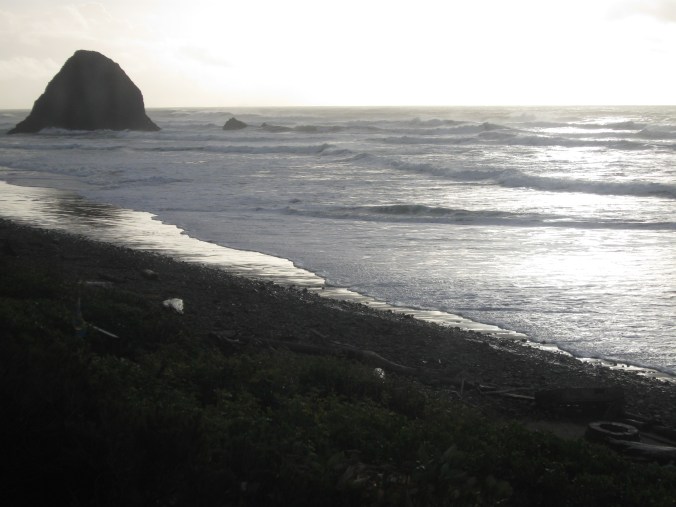
We live right onshore, just a few bare feet above sea level. Every day we watch the Pacific Ocean wash in and out just beyond our front yard. Since 1979, the ocean has slid through the path in the hedge and onto the grass just twice. The Cascadia Fault is a concern, but like most coastal residents, we are in deep, deep denial. (Not that the rest of you are not.)

When it inevitably comes, the quake will be strong enough to knock me down, unless I am already lying or sitting. It will be vigorous enough and last long enough to topple trees and drop buildings. Some areas with sand instead of soil will liquify and what was supported a moment ago will sink—quicksand. Our garage and other doors will go out of plum and refuse to open ever again.

My running shoes are beside the fireplace, where there has been a masonry pile for over a hundred years. It is the only part of our house that has not moved, not even a millimeter. I put on my runners.

I will head out what we call the front door, assuming it opens. Or perhaps the other door just twenty feet further east. Either one takes me into the atrium, a long roofed area with fiberglass far overhead. Normally I would go out the garage door, but the electricity is out and the shaking has caused enough damage that I assume the garage door will not open manually. I pull Gary’s maul from the workbench, close my eyes against flying glass, and bash the sliding glass door. The gate on the side of the yard will be hard to open, but I will manage. The shortest route would be north and then south, but that would take me through fifty feet of dense underbrush and wetland. I will run two hundred feet south, turn left, and then head for the highway, north to St. Peter the Fisherman, and then straight east and up hill.

Somewhere along the way, and aftershock will strike.

GARAGE SALE

IMG_3108

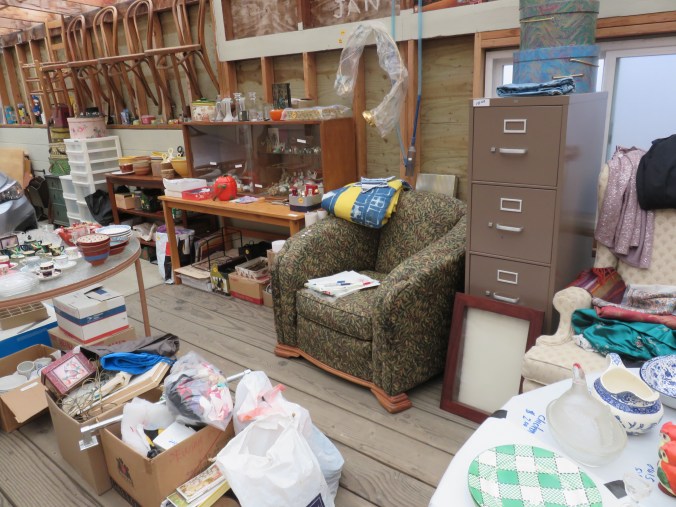
We gathered. I gathered some of it, not counting what my mother, aunt, grandmother, and other relatives failed to deal with. There were unsorted boxes in the attic that NO ONE wanted to deal with. We tried to give away a lot of things that were immediately useful—to someone else—but much of that stuff has been weighting us down for decades now. Some family was resentful about selling, but I feel they should have, and would have been welcomed to, deal with it themselves.

Some people deal with objects immediately. When I gave a gift to a friend recently, she immediately disposed of all the packaging in the restaurant where we eating. I suspect she does that with everything. She will say she lives in a small house, but it’s more focused than that. She has set some sort of internal line and chooses in every moment not to cross.

Our garage sale has many, many beautiful, useful, and valuable items. It’s not that we do not appreciate them, but we have other valuable and useful items already in use. These lived in boxes for too long. It is time they found a more appreciative home. Time for them to be used.

READING SCIENCE FICTION, pt. 1

IMG_3093

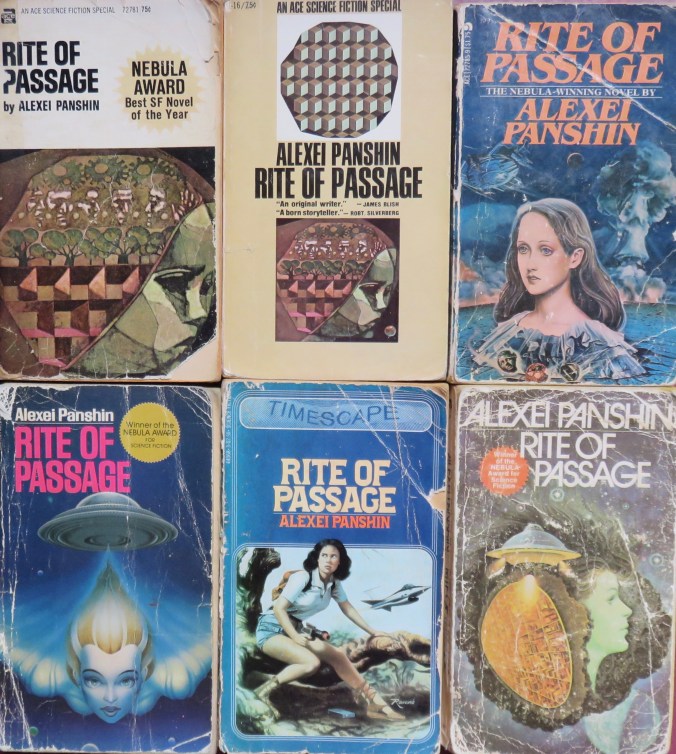
I could pretend to love The Left Hand of Darkness, but I never did. I could acknowledge that I do love many other novels such as Ursula K. Le Guin’s The Dispossessed, Vonda McIntyre’s Dream Snake, and Molly Gloss’s The Dazzle of Day. But my favorite science fiction novel is Rite of Passage by Alexei Panshin. Above are a few of the covers of this science fiction novel title.

The first time I read it, I was in college and about the age of the main character as she tells her story.

Rite of Passage is a science fiction novel by American writer Alexei Panshin. Published in 1968 as an Ace Science Fiction Special, this novel about a shipboard teenager’s coming of age won that year’s Nebula Award, and was nominated for the Hugo Award for Best Novel in 1969.—Wikipedia

This is the dystopian coming-of-age novel people should be reading, what is known as “hard” science fiction because there is no magic, no fantasy, only scientific possibility. There are also no clear villains, just people doing the best they know how to take care of the themselves and their own. The “heroes” are flawed, the ethical choices are not clear cut and tidy, and no one is shot with an arrow.

Mia Havero is a “little black-haired, black-eyed girl” of about 12 at the start of the story she tells of her rite of passage. Few of the covers I have seen indicate that the designers had actually opened the book, much less read it. Upper left and middle are solid. Sometimes what you see is not what you get.

I was reminded of this a day or two ago when I found a meme in my feed with a misquote of the Constitution of the United States. The meme contended that if the President were impeached, he and all his people (VP on down) would be forced from office. A lot of people liked the meme. People who have college degrees and should know better. And I will admit that I would be happy to see the back of Pence and the rest of Trump’s minions, but that is not what would happen.

That so many people accepted this meme as true was disappointing. I was left wondering if no one else remembers anything from our Constitution?

Does no one verify their sources anymore?

The left has been eager to throw up their hands at the ignorance of those supporting Trump. I have witnessed this again and again. Sadly, there is plenty of evidence that those on the right believe exactly what they want to believe. It is so much easier than actually finding out what is true. Those on the left do that too sometimes.

There is this simple black-and-white view of the world that is not the least helpful to accomplishing anything. It’s comfortable to discard another’s viewpoint just because it differs from our own, to ignore the demands of people we do not identify with. Working to hammer out solutions is messy compared to simply “laying down the law.” The Russian interference in our national conversation has done further damage to thinking that already viewed “compromise” as a dirty word.

We seem unwilling to understand that the world is not a YA dystopia with an evil force (them) fighting to take down those fighting purely for good (us). Reality is a whole lot of people with different ideas about how to achieve justice and liberty. When we acknowledge that complexity, we will get farther as a nation. There are times when the only solution is an imperfect one, when you get a little of what you want and I get a little of what I want, but no one gets buried in the process.

I read science fiction to find a laboratory for possibility. I already know how things can go wrong. I am interested in how things go right without the intervention of comic book heroes. Plenty of science fiction and fantasy is just another world struggling for power, but some science fiction and fantasy looks hard at difficult ideas. Not the dark lord or evil empire, but really people struggling to do their best.

Mia Havero is a Latina name. The author is American, and his book is back in print.

“The Nebula Award-winning novel, back in print at long last!

“In 2198, one hundred and fifty years after the desperate wars that destroyed an overpopulated Earth, Man lives precariously on a hundred hastily-established colony worlds and in the seven giant Ships that once ferried men to the stars.

“Mia Havero’s Ship is a small closed society. It tests its children by casting them out to live or die in a month of Trial in the hostile wilds of a colony world. Mia Havero’s Trial is fast approaching and in the meantime she must learn not only the skills that will keep her alive but the deeper courage to face herself and her world.

“Published originally in 1968, Alexei Panshin’s Nebula Award-winning classic has lost none of its relevance, with its keen exploration of societal stagnation and the resilience of youth.”—Fairwood Press

CAN YOU HAVE TOO MANY BOOKS?

tlmcgb68mogpbd6ewbnh.jpg

I saw a meme on Facebook the other day. The wording was something like: “I decided I needed to lose 10 pounds last year, and after six months I am doing great—12 pounds to go!”

That is the irony when our best intentions go backwards. I have some personal experience with that. I have been watching my eating, drinking, and walking for the past 7 weeks and have lost the 8 pounds I gained since last December after deciding I needed to lose 14 pounds. I sleep better and my feet feel better when I weigh less.

During that same time, I taught two college writing classes, read 38 books, completed weaving three 82″ lengths and seamed them into a 75″ x 82″ blanket + fringe, planned a quilt, submitted stories and poems and essays, several published pieces and a story due out next month plus an essay out in September. (I will inflict links to these publications upon you once they are live.)

We walk the beach most days for at least two hours. I have picked up a few hundred pounds of trash since January, and 98 bits of sea glass so far just in July. People ask Gary and I all the time what we are finding. “Do you find agates?” they invariably want to know. We always find agates. We don’t even gather most of the agates we find, not even a quarter of the agates we find. What we carry away is mostly plastic trash. You knew that.

I watched the second season of the Netflix series, Anne with an E, which I loved from the first episode and this second season more than ever with challenging issues of sexual orientation and race. The novels are pretty “safe”, but the series takes chances and flashes back to the early years not only in Anne’s life but in Marilla’s and Matthew’s lives. The characters are thus more well rounded and meaningful, more real and less white-washed cardboard characters. The Irish actor playing Anne really is not “pretty” by the standards of those days, but bursting with energy and imagination as she should be. Green Gables is depicted here in the same way that Wicked seems to portray a genuine Oz. All the magic, but a grown-up and serious version—charm without flinching.

My own flinching is mostly about too much stuff.

My goals for the year, my husband’s and my goals for the year, include gutting the house. Going leaner, you might say. We are emptying out closets and shelves, the dozens of pretty pictures that have no walls to hang upon. Gary took everything out of the attic which still had things from my mother’s house, unexamined items from her sister’s home, boxes of ceramics I made in college decades ago now.  Nothing goes back in the attic. I am about to empty four bookcases of nonfiction and poetry. A lot of the books and at least one bookcase will go out the door. We are preparing for a garage sale and major gifts to Good Will in the near future. I keep going through books and moving stacks out of the house.

Despite all that, I ordered a book the other day. I ordered three towels on sale and I ordered two skeins of yarn, even though I have SO MUCH YARN! Too much. Too many books. Too many Christmas ornaments. Too many family pictures in frames. Too much stuff. The greatest appeal about moving into a smaller house—something we fantasize about from time to time—is the need to divest.

More important than divesting is the imperative to stop accumulating. It is possible to stop. I believe it is possible, but I have to skill in that direction.

The Green Gables house in the new series is sparse and clear. The table is set for dinner in a dining room that has no other purpose but dining. The meal is eaten, the table cleared, the ceiling is the primary decoration. Beautiful unpainted boards.

No cell phones, no music but what people made for themselves. I am not so foolish and as wish myself back in that era. Dentistry. Vaccinations. Voting rights. I know what I would lose.

But Anne’s daily walk through the woods. Writing with pen and paper. A fox in the forest. People who make immediate use of nearly everything, or they do not keep it at all. Anne has little, but holds so very much. She is creative and imaginative and loving and kind. Her ambition is generous and heartfelt. She asks for little, but the best of everything. Her best is not about gilded rooms or extravagant praise. She might enjoy those things, but there is something precious and few about her longings. More does not mean better, as I was warned in childhood.

May I at least have more of Anne? And maybe a few pounds less of me.

UP?

IMG_3079

I have spent two days trying to get online with WordPress. Yesterday the site told me that I did not exist—not my password or email.

Yet here I am.

I have no idea what happened.

Am I back? Fingers crossed.

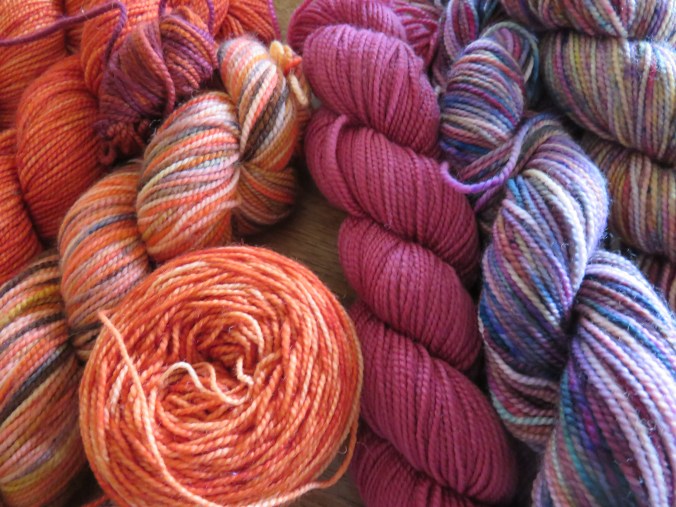
Yesterday I finished seaming three woven panels together. The yarn up above is on its way to being something later this summer. I cleared off my work table and folded the leaves back in. Gary is preparing for the garage sale we plan for next Friday. Lots of Christmas ornaments and other lovely vintage and antique items.

I have ordered a desk, which Gary has been nudging me to buy for months. I had saved more than half the cost and perhaps the garage sale will allow me to pay it off.

There were 200 yards of sand at the end of our walk. We found 26 bits of sea glass. On our way home from the long walk, a woman asked Gary if his trash bag had oysters in it. Oysters? No. Beach trash and a strange rock—oysters do not grow on our shore. They like a sheltered environment, a bay or cove. We have mussels and razor clams. Just now the Dungeness crabs have been molting and the little sand crabs (seagull eat them) are laying eggs.

The horizon is still misty after 10am.