WRAPPING UP

fullsizeoutput_e57

The year is not over, but with Hanukkah already past, five days to the beginning of winter, and just over two weeks till 2019, “the season” is closing in. The day before yesterday I wrapped gifts for twenty people. Yes, I am amazed too. We sent out fewer holiday cards, but we did get them out.

It was been an interesting year, and by “interesting” I mean in the sense of the Chinese curse: May you live in interesting times. I mean both marvelous and traumatic for me personally. A man who pursued me on the beach, screaming obscenities, pretty much ruined summer, and then the Kavanaugh hearings brought up old stuff I could have lived without reliving. The determination of people to deny a bad word about the dead, the continuing horror that is the current national administration . . . I did not sew a dress. I did not bellydance for an hour a day. I recklessly ordered a custom desk, but when it arrived it was nothing like what I asked for and it took a month to get the brute out of my office space.

I might not be blamed for feeling a little down.

Instead, we feel cheered to have paid off our mortgage this year. We are not yet accustomed to having disposable income. There is a large open space in the middle of my office space that I quite like. I read several dozen books and gave away books, and there will be more about that later. Reading aloud to my husband is something we have enjoyed in the past. Just now we are beginning the fourth book of Patrick O’Brian’s 20-volume series. It’s my third time through and it’s better each time.

We replaced our skylights, repaired some plumbing, and I painted the entire upstairs myself, including floors. We have been seriously divesting lovely things we do not need, have no room for, and our family doesn’t want either. The attic contains only a cardboard box and plastic tubs to catch the leaks, and no rodents. It’s never permanent, of course, but Gary got the job done. (Next year, the roof itself needs replacing, obviously, and the deck now has holes large enough for both my feet to step through.)

We went on vacation, several times, and not merely 6-hour daytrips to Portland that we have counted as “vacation” in the past 16 years. We went to Canada for two nights, Seattle, Forest Grove, Nye Beach, and Decatur Island. Nine days away. Imagine!

I sold a story and an essay—yes, actual money changed hands. I did not find an agent for my newest novel, but that is the result of my determination to indulge in an unpalatable structure. I am working on something else now. Plus, during NaNoWriMo, I wrote a lot of new material, and in the new year, I will work on that too.

On the visual arts front: I knit hats and sweaters; wove blankets, scarves, and shawls; and pieced one completed quilt. This was not all I had planned and a baby blanket is still waiting for me to complete a warp on the loom so that I can put on a blue-gray warp. Still.

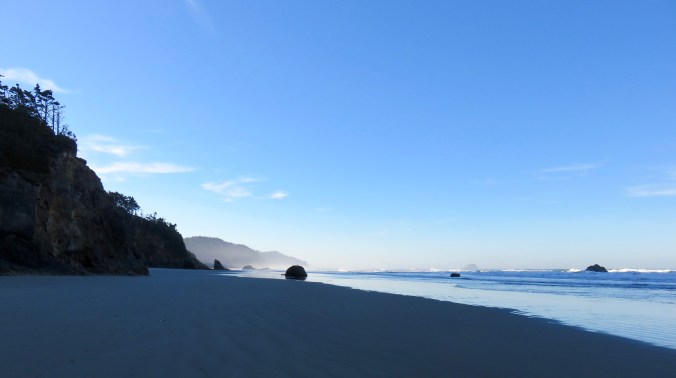
Gary and I picked up half a ton of trash off the beach, and gathered an assortment of seaglass, shells, and pebbles that I have only half-sorted.

I taught Writing 121 and 122 last school year, and I have begun teaching that series again this month with a large class of willing and capable students (hooray!). This Thursday, a half dozen former students will be speaking to my college class about their college experiences. I will have made at least three batches of “the chocolate thing” from a Canadian recipe. (That making will happen after I get home late from school on Wednesday.) It is cream, good chocolate, egg yolks, and a tablespoon of orange liquor for nuance.

51mVnm2RrDL._SCLZZZZZZZ__SY500_SX500_Confirmation of my order of The Speed of Darkness by Muriel Rukeyser revealed the cover image, which I immediately recognized. I thought: I have that book already, downstairs in Ian’s old bedroom on one of the poetry bookcases. I have not yet looked to be certain it’s there. If this book was inherited from my aunt or mother, and I have possessed it all this time without reading it, well, that would be both bad news and good, wouldn’t it?

My husband is most pleased that I am regularly using my grandmother’s desk. It is tiny, a ladylike drop-front desk of satinwood, and unsuited to spreading out. I must confine my mess to a narrow surface and that might be a part of the appeal. I generally sit on the sofa with my laptop, or in bed as I am now, typing this post, but I open that drop-front desk each morning and sit at it for a time, and then in the evening, I plug my laptop in on a chest to my left and close my grandmother’s desk. Gary finds all of this precious.

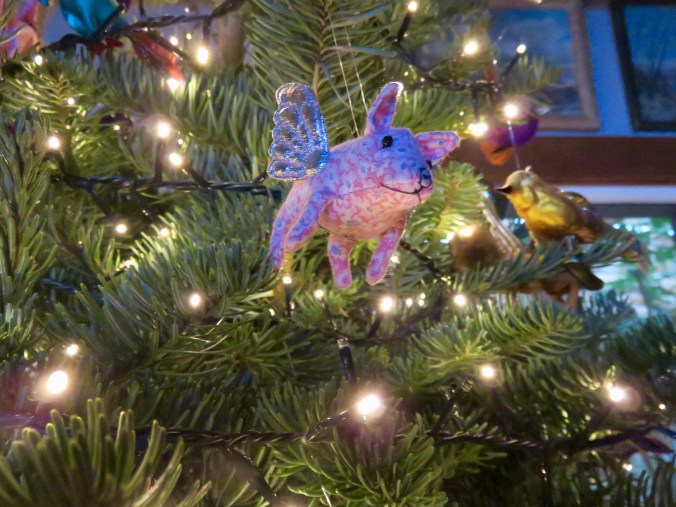
IMG_0015aThe tree downstairs has a thousand LED lights and is decorated with glass birds and tiny stuffed, winged animals made by Margaret Swanson-Vance of SewWing Studios. Some are more than 30 years old. This flying tiger has painted embellishment by her husband, who has passed (marked T  W  MS ’94 ‘Nar Bachcha’). The silver-winged pig at top is brand new. Upstairs is a little white paper tree in the front window. It has only a few lights and white ornaments, some of which are also from Margaret. A unicorn is on its way.

I have learned to bake panettone this fall. The sourdough start has not died but provided waffle batter, sweetrolls, and crumpets throughout the year. I did not make jam or jelly, but there are packets of fire-roasted peppers in the freezer, and we picked up tamale-ground organic masa from Three Sisters Nixtamal. For our Christmas there will be tamales! I plan to bake panettone, rugelach, and pecan cookies for the holidays, too, though it’s tight between the beginning of Winter Break (this Friday) and Christmas Day (next Tuesday).

We’ll manage in joy.
 

TELLING

IMG_1117

My husband said to me this morning, “You are always in teacher-mode.”

As a result I posted a warning and got my ears boxed. Actually several times, and I deserved it at least once.

I have been irritating people I like and love with posts on Facebook. Here’s the one I defend:

The death and funeral of George H.W. Bush. I did not him like as President, and I find little reason to like him better as a public figure now that he is gone. People who were not even born when he was president, or who were not old enough yet to enter school, object to articles I offered to provide “a little balance.” I was reminded of the glittering idealism of his administration I found in a The Washington Post opinion piece:

“Abraham Lincoln’s ‘better angels of our nature’ and George H.W. Bush’s ‘thousand points of light’ are companion verses in America’s national hymn, for Lincoln and Bush both called on us to choose the right over the convenient, to hope rather than to fear, and to heed not our worst impulses but our best instincts,” Meacham said.

The title of the article, not the excerpt I posted, drew fire. The man is dead. There has been extensive coverage elsewhere in the press dealing exclusively with what a wonderful person Bush was and about the details of his career and of his funeral. Television stations and national newspapers streamed the entire event without comment and also posted his son’s speech with explanation of the events he referred to (all very respectful), etc.

Years ago the local weekly newspaper carried a story about the death of a former student. The author managed to make the poor girl appear in a bad light, taking comments out of context from another teacher, editorializing on the passing of a teenager. I was heartbroken to read it. She was only a girl and allowed to make mistakes. No one chose her to be the leader of the free world. Her life should have been her own.

Though my impulse is to admit my failings, often in public—and they are legion, usually the result of losing my temper—I would hope to escape anyone noting them after I die. Though I worked for most of my life as a teacher, the job is not political. I have surely made mistake and caused harm, but I did not lead my country to war. I did not neglect public health. I have not been accused of molesting anyone.

When a neighbor died recently, my husband spoke at her memorial. We’d had our differences over the year. We both irritated one another at time. We had our complaints. But we also had a friendship of over 30 years. We kept an eye on one another’s homes. We called one another when the whales were passing. We chatted most every day. I would not more have dragged out petty disagreements than my underwear. We had a personal relationship not a public record between us.

Presidents are different, after all. They deliberately choose a public life. Their public words and actions are subject to public scrutiny and that brings a level of judgement most of the rest of us are spared. It was a public event of national importance, not a private funeral. Days of news have lauded him. I understand that some people are incapable of hearing a bad word about anything relating to a dead person. I have felt that way myself when a local paper offered unkind comments about a former student. But this is also about my country and my country’s leaders. I detested Bush in life as a president, but it’s clear he was much loved as family member and friend. His son’s speech and others were touching. I can respect the private man without pretending to admire what he did as President or after as a public figure. Here are a few of my grievances concerning the man’s public life:

Clarence Thomas (nominated) and Kavanaugh (campaigned for)

AIDS

the Middle East

the Kurds encouraged to rebel and then offered no support when they did

So much damage still filtering down on where I and others live.

He was Presidential, granted. He was, by all reports a kindly and generous man in his private life. I might even have shed a tear watching his funeral. I can see he was loved and that people sorrow at his passing. Does this mean I must appreciate him as a former president?

If the current president outlives me—it is possible since he has far better health care than I will ever be able to afford—will I be expected to say only nice things about his time in office? Are there nice things I could say? Perhaps. Perhaps his family and friends will laud him as a courageous leader making American great again.

Though I am only an ordinary private citizen, I beg to disagree.

CHARITY BEGINS

Southern Poverty Law Center tracks hate crimes from racist and the political right and left. They make a difference.

More than forty years ago, our friend Bunny told me that she donated $100 each month to charity. Her food budget was less than half that. I was stunned that she was able to afford this. And then I realized I could too.

As a result, I began donating to organizations I could see working in the world while still in college and self-supporting. I gave monthly to PBS because we watched their programs, and then I gave to the American Civil Liberties Union (ACLU) because I knew what they were doing to fight for legal principles here in the United States. I continue to give clothing and other household discards to Goodwill and local charities. Gary gave them his last car a few years ago. I gave my beloved VW to OPB.

One year my brother gave a farm animal in our names to Heifer International. The next year, I gave goats in the names of family members as Christmas presents. Then I discovered that another organization did the same thing with lower overhead, so I gave bees and farm equipment through OxFam.

Charity Navigator is one watchdog of charities that helps people find where to direct their donations in order that the money will do the good work they hope to see done here or abroad. I read about charitable organizations, Google for news about them. Talk to people and search for pros and cons and other organizations that do similar work. I check their ratings for how they spend the money they receive. There are many worthwhile local charities.

For many years after I began teaching art, I gave to the University of Washington School of Art, in gratitude for scholarships that allowed me to work my way through college without debt. (It helped that I was willing to live in poverty during those years.) I refuse to give to my grad school alma mater because they surveyed me for what I thought about them starting a football team. I responded that it was an enormous waste of money. Like nearly every college and university in America, they will lose money on their football team. They will have to find other donors who are football fans. That is what I tell them when they call. [For a small college that turned away from sports to emphasize academics, read about Paul Quinn College. To understand why football creates issues for others, consider what people will do in order to win. Consider Baylor.]

For nearly all of my adult life, I have given to organizations I learned about through specific worthy projects. Toni used to write letters for Amnesty, and I have supported Amnesty International since 1974 because they oppose torture and other political abuses of power. I give Wikipedia Foundation a donation periodically because I use their site often and because I applaud their work in making information readily available for free. I give to Partners In Health because of Kidder’s book Mountains Beyond Mountains. I give to Southern Poverty Law Center because they track hate crimes, take abusers to court, and offer support to communities through many programs including Teaching Tolerance, a free magazine I used as a teacher.

Sometimes I give to other organizations such as the free nonfiction website Brevity or to projects devised by my students. We gave to the campaign of Hillary Rodham Clinton. Twice.

For most of his working life, my husband worked in grocery stores. I was mostly a public high school teacher. We can afford to live in a beautiful home on the coast because it’s been in my family since 1911. We have never, as my mother would say, “had money” in my family but my mother began donating to animal charities late in life. We still get those mailings, but we choose to give elsewhere.

Throughout our childhoods, our families worried about paying bills. We struggled to pay for food and tuition while self-supporting in college. During the years our children were young, we barely kept our heads above water. And then there was tuition again—our sons’ undergraduate and my graduate studies. I used my inheritance from my mother to pay off our sons’ college debts. (My friends have pretty consistently judged that a mistake, but so far, we are not sorry.) We managed. Our frugal habits and careful planning seem now to have paid off.

We are both retired, but we are not poor, and other than books, his music, and my yarn our tastes tend to be modest. We can afford to pay our bills. We can afford to drink wine on occasion and to stay overnight at mid-priced hotels. We still send money, usually $100 to several of the charities I have mentioned but sometimes more, and in leaner times I have given $20 or less. Just now, we are planning our giving. The Visa bill is paid and despite unexpected home repairs, we will share what we have.

It is a good habit and I am a fortunate person. I can afford to support charities.

Maybe you can too.

HERE! ROVER! THANKSGIVING!

IMG_3685

This morning Gary and I walked the length of the beach to the north. We were out for two hours. A little more. We started early, but it is a holiday weekend, and there were many people on the beach we didn’t know. Most of them had loose dogs with them. Several of the dogs were Golden Retrievers. Some of the retrievers were well-mannered. One barked and growled and ran at everyone. Like the rest of them, this dog failed to respond when called and, like most, was not on leash. The owners apologized for their dog’s aggression (genuine dog people would recognize his behavior as that spoken of as a “spook” and fear-biter) but the young couple did not have a leash with them, so they continued down the beach apologizing to the people their dog harassed and the dog continued to not come when called. It is why there is a leash law, for dogs like this Golden Retriever, whose behavior was not at all characteristic of that breed. Most of the dogs we met were perfectly behaved. The little King Charles Spaniel greeted me like a friend. I have pet her before.

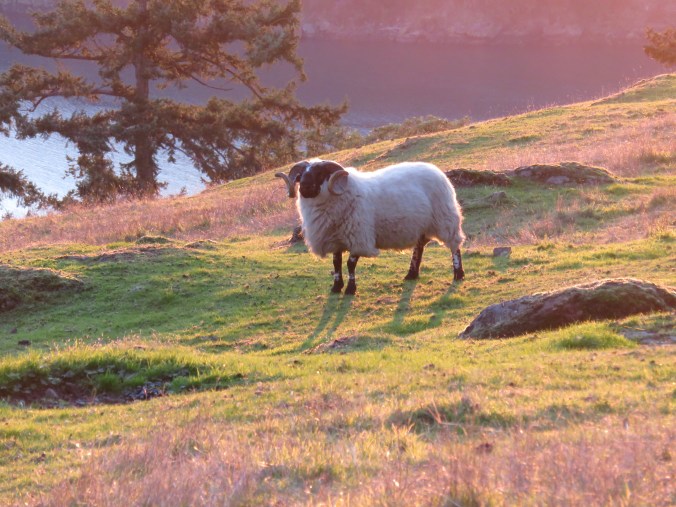
I found some peculiar rocks and each of us found a small piece of glass. Last week, on an island, I found a half dozen pieces of glass, all thin and nicely frosted, none of which would have survived long on our coast. I found lovely pebbles there, a nearly spherical rock, and we will be talking about that trip forever. It felt like a secret place, that island, a magical, liminal space. I feel not quite comfortable about naming it. The grass is very green, thin over stoney ground. The sheep are entirely wild, and the world is silent and still. The view was so quiet that I stared for many minutes at a time to convince myself I was not looking at a brilliant photograph.

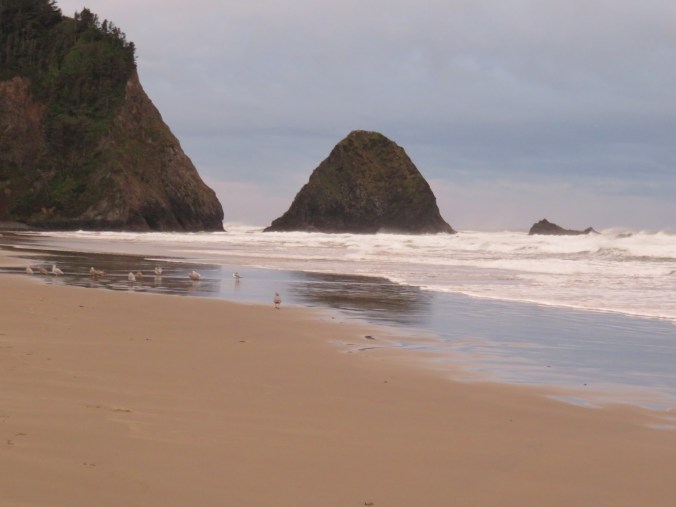
Here, our view is forever moving, the waves close enough to hear, sometimes, each tipping breaker. Mostly, however, it is a roar. Ruby once asked us to turn it off, that sound.

We spent Thanksgiving in an entertaining hotel. It was a good night, but there were quibbles. The homeless man in the sitting room where I was grafting Ruby’s birthday sweater together. He had recently been in one of the rooms, delighted with his shower. He rubbed his head with a white towel and rubbed his elbows with lotion from a tiny bottle just like the lotion bottle in our room’s bathroom. Harmless and cheerful, but he may have caused some guests to leave the room. Several hotel blunders made us laugh. Nothing terrible—two little spiders in the bathroom, litter under the bed—but enough that we thought I must write about it when we got home. Gary should be beside me, helping me to remember all the funny things I am forgetting here.

Instead, Gary is downstairs sorting through the folders, pamphlets, papers, and other items I have already sorted. A week or so ago, Gary moved 16 “bankers’ boxes” into the living room for me to sort. Yesterday I finished going through them. Student work and lesson plans, papers from 20 and 30 and 40 years ago. I reduced the pile of boxes by 75%, which Gary declares a success. He is going through my discards to be sure I don’t throw something away that I might regret. He insists I keep my horse scrapbook from 1962—racing results from Longacres and articles with horses clipped from The Seattle Times. I remember each clipping.

When Gary began resorting, I organized Christmas gifts, labeling them with post-its, identifying the intended recipients. That did not take long. I need to attach the sleeves to Ruby’s sweater and address holiday cards. My NaNo count is at 63,256 words, including a just-begun new story. I should be working on that.

We took a break and checked our Visa bill. Yikes! And they said our account “may have been compromised” and they are sending a new card. I thought we might buy some organic cotton washcloths and sheets online, but I’d best wait. I made a frittata for breakfast using leftover curry and put butter to chill in the freezer to make pie crust. Then I came upstairs to my grandmother’s desk to write an overdue blog post.

A moment ago, as I typed, two youngsters were playing in the ocean, barefoot, in November and in an outgoing tide. People worry me sometimes. Our ocean is not a tame beast. Those little girls were just outside my window, but thankfully they have returned to the rental house next door and a youngish man is playing frisbee with a slightly older boy on the sand.

Just now Gary laughed while sorting downstairs. “What?” I said. “Oh nothing. I love you!” he called up the stairs. He has found something ridiculous, something I did.

That butter has been in the freezer too long now, and I will have to take it back out to warm slightly before I can make pie crust. Gary asks for only one thing at Thanksgiving: pumpkin pie. The filling is begun. It will be dinner tomorrow, only a few days late.

IMG_3697
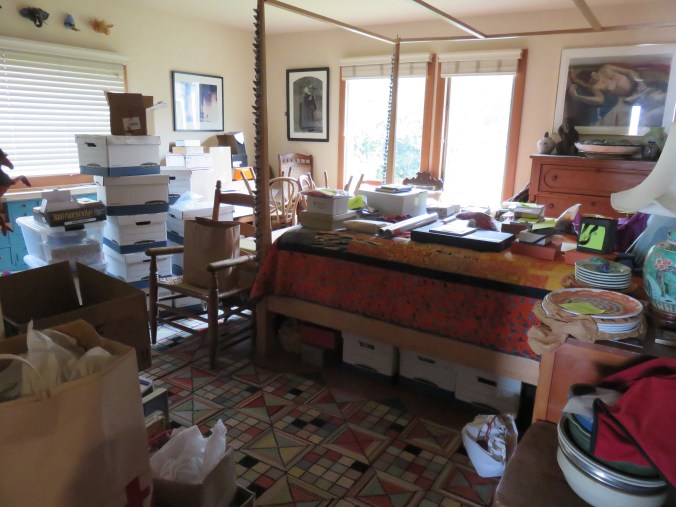
Above is a photo of “Alan’s room” which we are using to stage the holidays. Gary insisted I take a photograph because the entire room is thrashed at the moment. Nearly all the boxes in the photo are now empty including those way at the back and the one visible on the left. The paper shopping bag at the left, the one on the chair, and others on the floor are empty too. (The 4 original Thonet bentwood chairs—middle, back—are over a hundred years old, still sturdy, and free to a new home. Anyone?) Everything on the bed is a gift and labeled. I could be wrapping them just now, but no, not just yet.


TIME OFF

IMG_3640We went away for the weekend.

Such a simple thing to do though rare for us because for all of our marriage until recently, we had the animals to consider. There were dogs, usually five or six of them. There were the cats, only one at a time. Zora bit. Leakey pined. This recent trip was easy too because the friends we stayed with took us to an island without internet, a quiet place. And they spoiled us completely. Fed us and entertained us and managed our travel. The silence was dream-like and I dreamt so clearly and with such authenticity that that I was certain it was real.

Perhaps that was because the silence and beauty overwhelmed imagination.

Backing up, late afternoon on Thursday my new computer arrived. I can never get Apple to accept a password or change it or manage it at all, but my Time Machine transferred all data. The next challenge was passwords because my old computer knew them all and this new one does not, but must be taught. [Eventually Apple allowed me to change my password, after at least nine years of receiving the message “This action cannot be completed at this time”, but then I had to reteach the new computer website passwords again.] I opened the newer version of Pages and searched for features hidden in different places. But already this new Pages is old, and I have been prompted to download the newest version, free, but another adjustment.

I was perfectly content with how things worked with my old version. On the plus side, this new laptop weighs two and a half pounds less that my last. The trade-off is that it is smaller and no quicker, but the battery is spry. As I type this, I have been on the internet, Pages, and email for over two hours and used 13% of the battery. I did not even remember to turn down the backlighting of keys.

In any event, I left my new laptop at home and we have only a flip-phone, nothing smart at all, so for three days we avoided news and I was spared word-processing. I walked beaches with such a foreign assortment of pebbles and gravel and stones that I hardly knew what to look for. On our beach, the rocks lining the beach are basalt with occasional sandstone or agates, shells, feathers, and trash. We gather trash. I confess I gathered trash on the beaches in the San Juans too. Impossible to ignore the habit. Plastic and styrofoam, but no beach toys.

I am overwhelmed by the hospitality we received over the weekend.

I brought back a fistful of what I term “pinkies”—tiny pinkish pebbles. I found as many as I already had found, though what I already had was collected over months and years in a narrow stretch of beach. On the island, I found agates the size of a five-year-old’s fist and one in the shape of a heart. I found a beautiful granite egg.

Monday morning I completed my NaNo officially, but I was not done at 52k words. I wanted at least 8k more, preferably 70k, which has been my minimal goal with novels in the past two years.

Today and for the foreseeable future I will be struggling with Apple. Everything was fine on this new laptop, at first. There were the normal struggles to locate information and actions that I was used to finding in another place, but I could access my files, the internet, and email. Now I cannot access my email—the old messages show, but I cannot send or receive new messages. This has something to do with the iCloud and two-part authentication, a level of security I do not even want.

I am near throwing this little laptop through a window. Of course we have double panes . . .

BURNING

IMG_2225

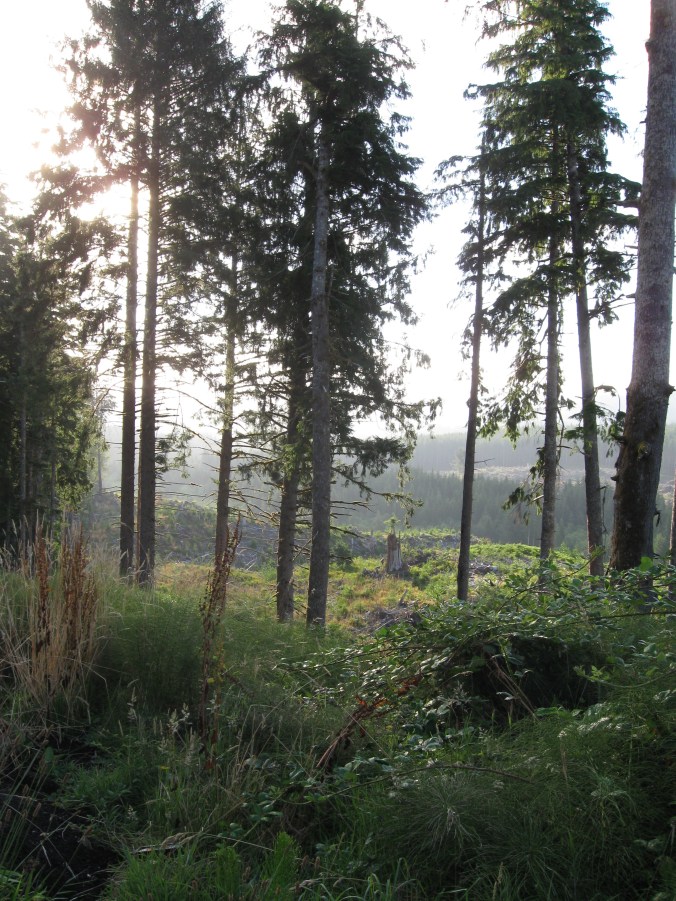
This is “managed forest” in the Coast Range. There is an abundance of fuel for fire.

The West is burning.

In 1975, Canadian friends picked me up in Seattle to ride with them to Colorado. The driver was Jeff, and Jeff smoked cigarettes. At one point, he tossed the lit butt of a cigarette out his window. It was early September, the end of a long, hot, dry summer. We were in eastern Montana and there was nothing, absolutely nothing to stop a fire in those grasslands.

This was something I knew was dangerous. I had been raised with respect for forest, and by a father who never tossed his cigarette butts. I said something from the back seat of the van. Maybe I said it was dangerous to throw a lit cigarette out the window, maybe I merely yelped and said he shouldn’t do that. I don’t remember what I said. I was thinking at the time about what I knew about fire, and cannot recall my words, What I remember is his irritated response.

“What do you care? You don’t live here,” he said.

Maybe we argued after that. Reasons lined up: I did live there. It is my country, my nation. My father was born in Montana. This sort of reasoning that because it would not be my field that burned I should not care was immoral. I should care. He should care.

The West is burning. The human body count continues the rise.

Pundits, politicians, and ordinary people would like someone or something to blame—errors in forest management, a camp fire, climate change, an unusually dry summer. All of the above? Answers are rarely simple.

Someone always points out that Native peoples set fires (every time, I see it). This doesn’t make setting fires a good practice. Humans in every culture have done foolish and cruel things.

Europeans drove entire herds off cliff faces. The BaMbuti pigmies roast songbirds alive because it makes their flesh more tender. Londoners drank water contaminated with typhus. Stupid.

My point is that what a small population can get away with is not necessarily the answer to our troubles today. One post I read claimed that Fewer trees/acre does not signify. I know from walking in the coast range that trees were once further apart. This was first, pre-logging, “old growth” trees with stumps six feet across. Most Americans will never see old growth trees that massive. And even so, there were forests so dense, a horse and rider could not pass between them. Most forest fires used to be started by lightening strike. Today, most are begun by humans.

The West is burning because we have more forest remaining in the West compared to the East; because climate change is causing forested, moist places to become drier; and because we start fires with cigarettes and electrical sparks and camp fires and good intentions.

“California’s fire record dates back to 1932; of the 10 largest fires since then, nine have occurred since 2000, five since 2010 and two this year alone, including the Mendocino Complex Fire, the largest in state history.” Undergrowth, including the low growth after an area has been logged and replanted, allows for a fast-moving fire. The Tillamook Burn of 1933 destroyed 390,000 acres in western Oregon. The next three Tillamook Burns would take over 400,000 additional acres. It was so huge my mother and her sister swam in a warm ocean, and came out covered in soot. That one started from a spark from logging operations. A couple of years ago there was a fire a half mile east of our home in the coast range. That one started from a slash burn that went out of control in high winds.

Fire suppression, which worked for most places, played a part, but climate change, weather, and human beings played critical roles. Well, human beings mostly.

Even “controlled burns” get out of hand, and the research does not entirely support any method currently used to prevent fires, other than not starting them to begin with.

The West is burning and we are looking for someone or something to blame.


THESE VIOLENT DELIGHTS HAVE VIOLENT ENDS by Caitlin Gildrien

I don’t want to write
about California. I don’t want to look.
Did you know there were two new litters
of mountain lions in the Santa Monica mountains?
A mama can only carry one at a time. I don’t know
why that’s the thing that breaks me. It’s the world
that breaks me. We’ve broken the world.
Just past the tweet that tells me about the kittens
is a thread about Romeo and Juliet,
the Claire and Leo movie version,
and that is what I click through. How I loved that movie,
the fish tank, the kissing. I wanted to live
in a world like that, a world like this world
except slant. Better lighting, better language.
How you can understand it best
by not listening too closely. I think too much.
All the fish in that tank scooped probably from the sea;
how the sea is failing. I wanted to love someone
until they would die for me. I wanted to be the one
they would choose to carry out of the burning world.
When the fish stocks fail, when the Amazon tips
past the point for which it can compensate
with the meager reforestation it is allowed—
there should be nicer language for this in a poem,
I’m sorry. I just keep thinking of Juliet, who thought the sea
was infinite and so a good metaphor for love.
But we’re determined to find the bottom
of any bounty. They thought this continent
was boundless, too, and scraped it clean
to prove themselves its better. They.
Did you see that storm of smoke,
utterly apocalyptic, over the highway?
It makes a person say God. God, lift me
by the scruff. Or the throat, maybe.
All of us, maybe. Shake hard.
Be rough with love.

—from Poets Respond
November 15, 2018

__________

Caitlin Gildrien: “A friend who is a science writer tweeted about the mountain lion kittens, and though of course the costs of these fires are deep and broad for humans and for the rest of the environment, that fact really shook me—as did the way that Twitter shoves the somber and heartbreaking up against the trivial as though they are equally weighted. I was born in California, though I live across the country now, and it’s been increasingly painful each year to watch the fires become more uncontrollable. It’s one of the many reasons I fear for our future.”

Reprinted without permission. It made me cry.

VETERAN’S DAY

IMG_3604

We watched birds on the beach this morning, but it is Veteran’s Day, so Gary and I talked about our dads’ military service.

Gary’s dad joined the Army during World War 2, but was mustered out as a result of a hernia. He joined again, this time the Army Air Force and spent the war in Texas working on planes.

My dad joined the Army too. He served in France and Germany, was present at liberation of a concentration camp in Germany, and met the King of England while on leave. He was injured and earned a Purple Heart. He almost never spoke of the war other than to joke about rations, about how the men used their gas masks to carry things and he hung his on the back of a Jeep and laughed watching them away.

He contended that men who bragged about their wartime experiences had not seen what he saw.

What is most memorable to me was asking my dad about how he got into the service. Was I an adolescent when I asked? Older?

He said he joined because he would have been drafted anyway. Everyone had to go, he said from his corner of the sofa in the living room.

My mother was in the kitchen, wiping counters, but she stopped and moved to the edge of the room. “Art, that is not true. You wouldn’t have been drafted,” she said. There was anger, bitterness in her voice. “No. You worked in a sheltered industry. You did not have to serve.” He’d been at McDonald-Douglas, building planes my father-in-law took care of a thousand miles away. My mother went on muttering about his disastrous first marriage, the damage his wartime experiences had done him. She did not mean the leg injury and hospitalization. She did not know about his addiction to pain killers, a detail he revealed to me and warned me not to tell my mother. “She doesn’t know.”

On that day, I stood in the dining room where I could see them both. I looked from one to the other, knowing each was telling their truth. My father was beginning his long debilitation RA. Perhaps I was already a teenager at the cusp of my political awareness when I would march against the current war in Vietnam. The war was a problem for many people because the reasons for our involvement were clearly excuses, with no end in sight.

My father was proud of his service in the Second World War. My mother’s sister joined the Marines right out of high school, even though they arrested her best friend simply for having parents born in Japan. People did what they had to.

Another thing my father said about his war was that people who criticized the capitulation of France in the Second World War did not understand how that country had suffered a couple of decades before. I studied history, so I thought I knew, but it would be many years before I fully understood what he meant. It was a novel, a French historical novel, that revealed the incredible suffering of the French during the Great War.

The United States came late into each of the wars, late into the Great War, the Second, and Vietnam. We were spared the worst of things in those World Wars, entered the next ones thinking we would again be the great rescuers we had been before. We were wrong about that.

We had entered into war with Spain under false pretenses. Mark Twain wrote as much in his bitter satire, “The War Prayer” which was so critical of the paradox of any war that it could not be published in his lifetime. American entry helped to end two World Wars, and but our interference has been making trouble for self-determination around the world before and since.

I feel no happiness on Veteran’s Day. It is not a day to be happy. I honor those who risked their lives in the belief that they were helping to preserve a safe place in the world. They did their best, and sometimes they died. Sometimes they even achieved peace. These days, I find it hard to see how that goal is being served.

I would like the world to be safe for everyone.

13498088_10153800182133667_9184182959186154569_o.jpg

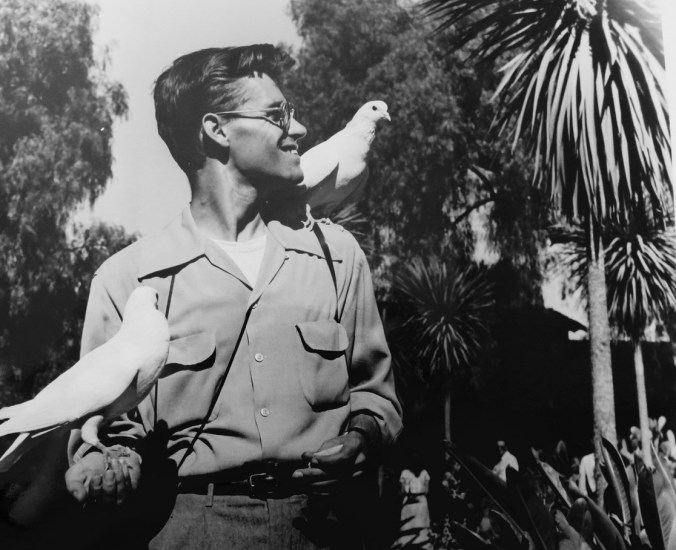
Today, he would have been diagnosed with PTSD. My mother always insisted that his experiences in the war “destroyed” my father. Here he is just after the Second World War.

RELATIVE

IMG_3580

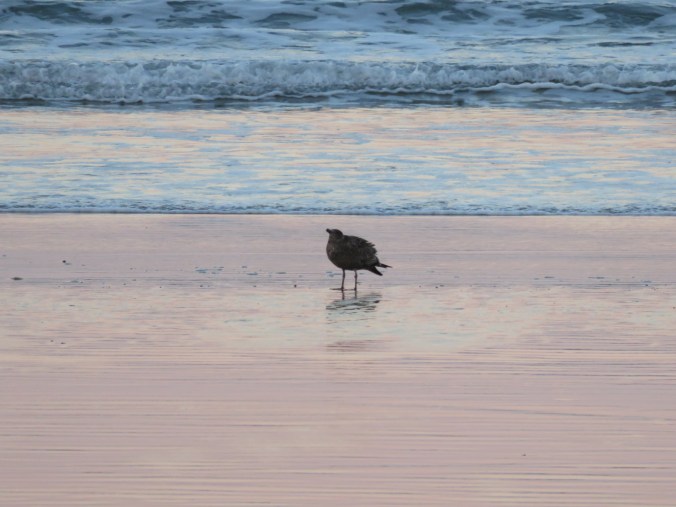
This young seagull was peeping for its parent, but that adult flew away.

When my husband was young, sometimes he would sit on the back steps in a parched Arizona payday waiting for his dad to get home with groceries. Another family of four children was left alone for the weekend that turned into a week or maybe two. The woman who told me about her childhood was not sure, only that even the mustard was scraped out of the jar by the time Child Services showed up.

My own childhood was not so deprived. I went without dental care and my mother mixed powdered milk and when I first tasted a real butter pat, it was like candy to me. In kindergarten, I had two skirts and three short-sleeved Orlon sweaters. For Easter, I had a new cotton dress. It is odd the things you remember. But we were never hungry, and my father’s mother and aunt had enough money put by that it was safe to assume we could borrow money if things got desperate, which they did on occasion.

This is to say, I was not raised poor. Raised poor is hunger and no one to turn to who is better off. “Poor” is so bad that we make up euphemisms like “economically challenged” or my students say a person is “not very rich.” No, poor is not having enough money to pay bills even though you live cheap. Poor is embarrassed because even when everyone in the household is working hard to earn money, money is still “tight” and bills are sometimes late. Poor is being blamed in our country.

And that isn’t fair. Innumerable studies show the sort of income necessary to pay for housing in different parts of the country. Recent studies are equally clear that poor children almost never receive the quality of education wealthier parents give their children. Their health care isn’t as good. What they suffer damage in childhood that their ability to improve their lives, quite permanently.

The truth is that wages have not kept up with inflation—they have been falling behind for decades. Telling someone that if they want to earn money, they should get a better job is like telling a person waiting in a wheelchair to run to the head of the line, like telling the five year old to reach something down from the top shelf, like asking someone who is starving in a third world country: “Well, for heaven’s sake, go to the store and buy some food!”

Sometimes we simply fail to pay attention.

Poverty is lousy circumstance, not a character defect.

I am reading Adrienne Rich’s essays in her new collection, Essential Essays: Culture, Politics, and the Art of Poetry, edited by Sandra M. Gilbert. Rich was a force of nature, a woman who found compassion for others when she granted it to herself. She reminds me that compassion is necessary, that affluence is not a free pass to righteousness, that everyone faces difficulties in life and it’s a good thing to remember that sorrow and trouble come to each of us.

Here is the first poem I ever read of hers:

Prospective Immigrants Please Note

Prospective Immigrants Please Note
Either you will
go through this door
or you will not go through.

If you go through
there is always the risk
of remembering your name.

Things look at you doubly
and you must look back
and let them happen.

If you do not go through
it is possible
to live worthily

to maintain your attitudes
to hold your position
to die bravely

but much will blind you,
much will evade you,
at what cost who knows?

The door itself makes no promises.
It is only a door.

Thoughts from Adrienne Rich

I believe that poetry is asking us to consider the quality of life. And it is reflecting on what makes it possible for us to continue as human. Under the barrage of brute violence, numbing indifference, trivialization, shallowness, that we endure.

Even when I was very young, I was reading poetry, looking for what it could tell me about how to live. For me, poetry has never, ever been just an escape from the world, an escape from history.

I think in this poem, what I am talking about is the choice that we can make, to move deeper into things, or simply to live worthily, maintain your attitudes, hold your position, even die bravely, but not to see what might have been seen. Not to grasp what might have been grasped. And that is a choice, for us all, whether in poetry or in life.

Our country has many truths, but certainly one of them has to be that this was never a democracy. That this was a hope of democracy, an enormous, an enormous hope for true democracy, and that it failed many people from the outset and it’s failing more people now.

I think that more and more people feel uncared for, feel that their lives are not only unvalued, but meaningless. Feel that though they may care for their lives, no one else will. Feel that the only way that they can protect their survival and their interests is by the gun. I’m afraid that many people feel an enormous desperation which plays into the propaganda of hate.

I think that poetry speaks beyond that, to something different. And that’s why it can bring those parts of us together, that are both in dread, and which have the surviving sense of a possible happiness, and a possible collectivity, a possible community, a loss of isolation.

These reflections are excerpted from an interview Bill Moyers did with Adrienne Rich in 1995 as part of The Language of Life series. Rich died in 2012 at the age of 82. You can read the transcript of her entire interview with Bill in our archive and read more of her poems at Poetry Foundation website.

NOT BOX

IMG_3567

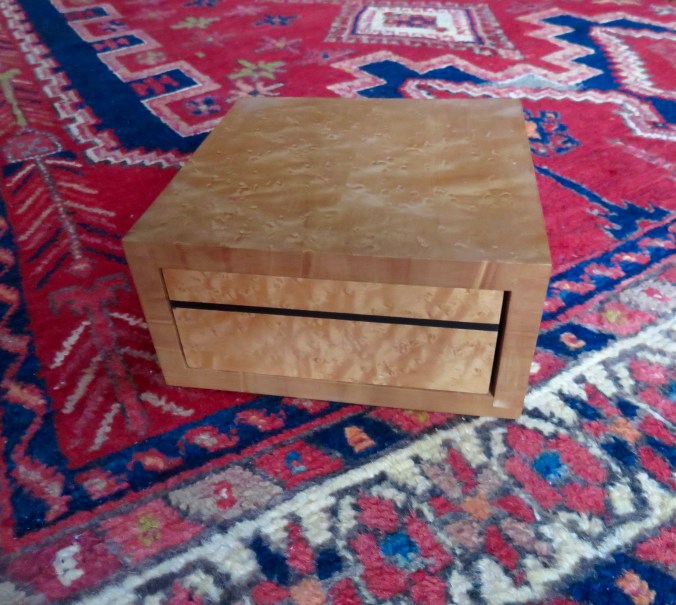
The “Not Box” made from a single narrow board in 1974.

I felt the cold coming on Monday night. I tried to convince myself it was nerves. It is my first real sickness since I retired.

On the 7th of July, I put money down on a desk that I had been saving for since the year before. On the 7th of November, they finally came and picked up the desk that had sat unused for three weeks. It was not what I wanted, not what I ordered. Wood this shop calls “Western Walnut” is sourced on my coast and every example on their website shows wild, dark chocolate, purply grain. Deep. Rich. I showed the salesman exactly what I wanted. What I received was a beautiful desk of milk straight grain like milk chocolate teak. It about broke my heart. (It will look fine in some trendy mid-century modern house—I’ve no doubt it will sell once it’s on display in their shop.) They tried to make it good, but not hard enough. I am sorry for this very expensive lesson learned, $620 at least to ship it here and back, and yes, I am expected to pay both ways. If they try to bill me for restocking too, I suppose I will shriek.

Wood grain and color is variable, unreliable, as I know from experience. The appearance of rough cut hardwood lumber can be deceptive. Picture cedar fence board—that is the surface, splintery and dull—and wetting the wood gives a hint of its finish color. The only way to be sure is to plane it smooth.

In college I went down to the Seattle warehouses to sort through rough hardwood boards. Stacks leaning against the wall and into racks in rows. I found a single rough maple board that would reveal tiny knots, a pattern called birdseye maple. The “eyes” are tiny knots, and such boards are generally sliced thin and used as veneer. Constructing even a small object out of solid birdseye seems a little wasteful, but it’s what I did in college. I ran it through the planner to find the pattern and then designed and built an object to use every scrap of one small, narrow rough board. I made a “Not-Box”, a single drawer in a box with a stripe of black ebony, a precious strip of black wood, also purchased rough and planed to 1/8th inch. I have the leftover ebony, barely two inches wide and a foot long, still flat and true, smooth and hard as glass after all these years. I think, sometimes, of make=ing something of it. I could score lines and create a ruler.

I bought walnut too, back in those woodshop days, choosing boards in the rough and no certainty about how it will look until I’d run it through the hog. A family friend gave me a fourteen foot “English brown oak” board he’d had nailed to the inside of his workshop for decades. In 1974, my friend and I ran it through the planer in the University of Washington shop. “I want to show you what we did,” said the patient shop foreman who was teaching us how to use tools. There were chips all over the cutting edges. He had never seen oak do that to a planer, what teak can do without using carbide steel. Later my son would use some of that wood to fashion a guitar in high school.

I made a walnut triptych frame for cloisonné enamel and an ash bench which I have never used. My joints were never perfect. Wood is not forgiving of error. Even metal can be reworked, and I was raising sterling from a flat disk into a tall, narrow vessel at the same time I was making mistakes I could not correct in wood.

I know about wood.

This morning I feel better, though I was lying in bed when they picked up that desk yesterday. (The careful men scarred the walls carrying it up and scarred it again going down, but our narrow staircase has seen worse. I will repaint.) I had not left the house since the previous morning. Our granddaughter does not know how to talk on the phone. I have managed over 12k words for NaNo, thought I think I wrote only 149 words yesterday. I have not been knitting or weaving or piecing, and only a little reading. I have slept. I have avoided the news. It is not good enough.

This morning I feel better. My throat is not so sore and I can breathe through my nose. Better, not well. Gary wants me to stay home today. He tries to take care of me, but the Senior Research Papers are due tomorrow, so I will head to school early this afternoon, just in case.

Gulls are running across the roof.

I might get a walk today. A light run used to be my cure for a cold.

PREPARATION

IMG_2587

The rain is finally here, and the tide sweeps up over sand that has been dry for months. The last time we drove over the coast range, vine maples were turning scarlet and purple.

It is only October for one more day and I have been receiving weekday recommendations for holiday preparations from Apartment Therapy. I do not live in an apartment, and the therapy offered is useful to me mostly for the photographs. (I am one of those people who almost never reads magazines, not even the captions. I only admire the photographs. Now, between Pinterest and the library, I don’t buy magazines. It is a financial savings like quitting smoking, except I never smoked.)

The weekday emails have advised me to make a gift-giving list, purchase just one holiday gift, organize my holiday card strategy. Mostly I have found myself one step ahead in planning and preparation. Nevertheless, I enjoy the reminders. My favorite so far is “Do an act of kindness on Day 4. I sent a card to someone who was recently unkind to me. This was intended both as kindness and as a way of reconnecting with a person I care about.

eqyzrphyqtzfbwzzftrqlfqqwqfrjhqpsywsdypftppt~.gif

DAY 8:

Book an appointment or service you need for the holidays.

Think about that thing you always put off or forget until late in the season, when all the good appointment times are taken or—gasp!—your favorite provider is all booked up through New Year’s Day. Today, call them up or fire up the app and make the appointment.

Nothing came immediately to mind.

If nothing immediately comes to mind, here are some services that might jog your memory. If you read something and your gut screams out, “oh RIGHT,” that might be the task for you today.

  • haircuts or color
  • eyebrow grooming
  • manicures and pedicures
  • spray tan
  • facial and spa services

The list goes on quite a bit further, including pet care, house cleaning, travel, and professional photographs. But I got stuck on the first five that concern personal grooming.

I have not had my hair cut since the mid-60s. The last time I put color on my hair was a few years ago when I was playing with purple. Mostly I was fortunate in my eyebrows, which used to be quite dark and well-shaped. They are now going gray, and I cannot be bothered. I have never had a manicure or pedicure and every time I consider the process, I remember that I really do not enjoy strangers touching my body in an intimate way, and I think about nail fungus (which I dod not have and do not want). Spray tan reminds me of the person in the White House, so that’s out. Facial and spa? My skin might thank me, but it seems a waste of money.

The man whose admiration I care about, the only man I feel any need to impress, is easily impressed. Frankly, he is the only man I am interested in. Lucky, yes.

[Next month, though I have not even used mascara or lip gloss in a while, this may change. Hanging around with teenagers tends to make me feel dowdy. A little color?]

Thinking over all of this had me reviewing what my holiday preparation actually look like. I buy gifts all year long, I plan gift wrapping, which is the most onerous task of the holidays. We mail only a few gifts. I design cards (though so few people send them anymore that some of the fun is lost). I bake and decorate the house with lights and ornaments and nutcrackers.

Teaching is not part of my holiday preparation, but my part-time job teaching college writing begins next month. Three weeks sandwiched between Thanksgiving and Christmas, and right on top of Hanukkah. (It will be a busy time because I have 33 students on my role and I am scheduled to use a math teacher’s room. At least the desks are flat, though when I went in for a peak I could not find 33 chairs.)

Years ago, we hosted a holiday party on a mid-December Sunday. It was an Open House in the afternoon, usually 2 to 4 so that it was clearly not lunch. We furiously cleaned before the party. I came home after work each day and worked my way down the refreshments list, baking and freezing.

We did not serve alcohol, and that might be the secret to having a pleasant time. I made mushroom pastries and curried filo triangles, fancy cakes with nuts and fruit, a Java cake, cookies, and a dip made with homemade chili relleno and a pound or more of grated cheddar that always disappeared moments after I put it on the serving table. It was not lunch, but people could get a meal out of it.

We invited family, the neighbors and everyone we worked with. Sometimes we had over forty people in the house at once. People stood around and talked and we played the Muppets’ Christmas album or The Anonymous Four. Though I am uncomfortable in social situations, it was not a long party, and a lovely time. Post party clean-up took only a little over and hour. By dinner time the house looked neat and festive and we generally had enough leftovers that I did not have to cook for a couple of days.

[Our first Saluki, during her first Christmas party, peed in the middle of our bed in front of Ted Tallman, who asked, “Does she do that often?” No, never before or since. She disapproved of the crowd.]

One year, my brother and mother (who lived nearby) gave their excuses, did not attend, and we stopped after that. It seemed a lot of trouble with so much preparation and almost no one reciprocated.

It’s been a long time, but I think about those parties still. I miss the preparations! I miss the people!

Maybe it is time to reestablish that tradition. Either that or find a hotel and fly away.

Those parties demanded a lot of planning and cleaning and baking, but I love to bake, and the result was smiling with friends and a week before Christmas, our home was beautiful.

This morning we heard rain and tomorrow is the start of National Novel Writing Month. I will be writing each day, and for the month, if there are any post, they will likely be brief.