MEMORIAL

fullsizeoutput_f42

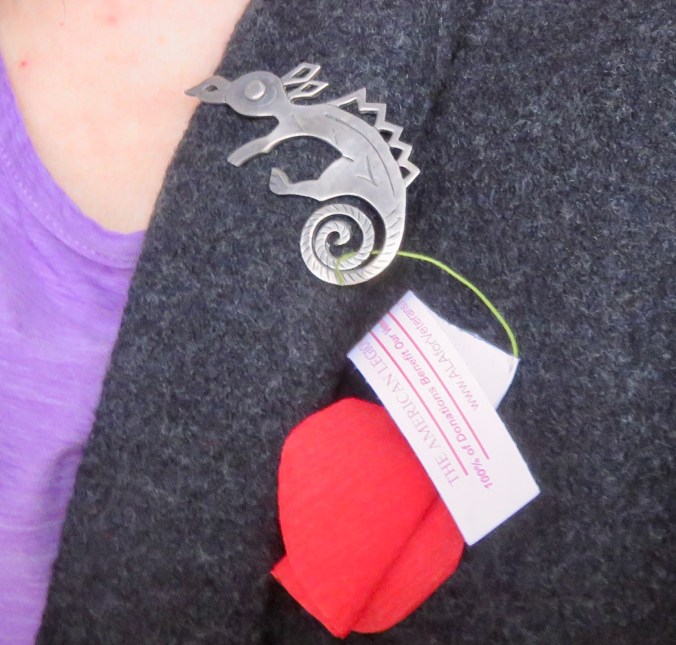
When Gary was a little boy, he sat at the dining table with his mother and made red poppies for Memorial Day. Like her husband, Alta (“Anne”) served stateside during the Second World War. She gathered little red cloth petals, wound them onto a wire to be worn in honor of our veterans.

My husband buys a poppy each year. Today they are made of paper. For a time we had chain of them hanging from the rearview mirror of the car. The tradition dates back to a famous poem from the First World War:

In Flanders Fields

In Flanders fields the poppies blow
Between the crosses, row on row,
    That mark our place; and in the sky
    The larks, still bravely singing, fly
Scarce heard amid the guns below.
We are the Dead. Short days ago
We lived, felt dawn, saw sunset glow,
    Loved and were loved, and now we lie,
        In Flanders fields.
Take up our quarrel with the foe:
To you from failing hands we throw
    The torch; be yours to hold it high.
    If ye break faith with us who die
We shall not sleep, though poppies grow
        In Flanders fields.


The poem above is often formatted incorrectly. It is a form—that is, prescribed lines and rhyme scheme are followed by the poet. McCrae was Canadian and he died in the war, as many of the so-called War Poets of the Great War did die—Wilfred Owen, Rupert Brooke. Siegfried Sassoon (a British officer) survived despite wounds and decorations, despite his letter to The Times in which he called out the powers-that-be for needlessly sending troops into combat when a negotiated peace was possible. “I believe that this War is being deliberately prolonged by those who have the power to end it,” he wrote. He would have been tried for treason, but another poet declared him a victim of “shell-shock,” and he was sent to an infamous, tortuous asylum, Craiglockhart War Hospital. He survived. He returned to the front—why should his men die without him. Throughout, he wrote poetry. “The dynamic quality of his war poems,” according to a critic for the Times Literary Supplement, “was due to the intensity of feeling which underlay their cynicism.” “In the history of British poetry,” McDowell wrote, “[Sassoon] will be remembered primarily for some one hundred poems . . . in which he protested the continuation of World War I.” He survived that too. I honor him.

Today is the day Americans celebrate Memorial Day, in honor of our fallen. Our great war was the Civil War, the only war on home ground, the only one with fatalities on a scale approaching the losses suffered by Europeans during the wars in the twentieth century. This violence that we accept as the inevitable price for our freedom.

I turned on the television after our walk, just as we finished breakfast. Bird was on, Forrest Whittaker coming home drunk. “Is he going to hit her,” my husband says. “It’s in the room.” Charlie Parker is talking to his wife, everything is all about him. The violence simmers. I turned off the show when the inevitable hit occurs. I wonder what this assumption—mine, my husband’s, society’s—says about men and violence.

What does this tell us about what is inevitable, about what we should accept and even approve in pursuit of a contrary goal of peace. The advice to bullied children to hit back. The determination to “fight” cancer as if it were a war, striving to kill the enemy, instead of striving for life. Always an enemy in sight.

My father and aunt also served in WW2. My aunt served in San Francisco and my father was present in the “liberation” of a concentration camp in Germany. He would not tell me details. The date was writ small on a scrap of paper in his wallet. However much he honored women, he sheltered his daughter from that horror. I am (mostly) sorry for that protection.

That belief in protecting women seems to me at the heart of the brutality we too often suffer. This belief that somehow because I need protection I am also less capable, or less deserving of honor and respect. A student this past spring told me that most of the #MeToo movement was lies and exaggeration. He was always polite in speaking to me except in this. It did not occur to him that his belief was trumped by my personal experience, not even after I revealed it to him.

Emma Thompson wrote: “If a man has been touching women inappropriately for decades, why would a woman want to work for him if the only reason he’s not touching them inappropriately now is that it says in his contract that he must behave ‘professionally’?”

In a recent interview she was asked how men who have behaved badly and been caught might “come back” after the #MeToo scandal. She said that was less her concern “at the moment” than concern for the women who had suffered over all that time.

It is not only women who are concerned about the abuses of powerful people. It is not only women who have suffered. It is not always women who demand change. Men demand it too, some women are untroubled. Our views are not entirely determined by gender. Does this surprise anyone? As one obvious example, I have often wondered how any righteous woman could possibly support Trump, but they do. We share the capacity to be blind, indifferent, biased, and unfair.

Women and men are not actually very different biologically either—seriously. In our genes, we are very nearly identical. Yes, sexual characteristics, penis and vagina. Men are generally bigger, but some women are taller than most men; some men are smaller than most women. The same applies to body strength and tone of voice, muscle mass, inclination to violence and other behaviors. Societal classifications of masculine and feminine are both slippery and confining. I have often wondered, going back to my teenage years when several of my friends were out, how much easier we would be in our skins if the expectations for our behaviors and goals were less inevitably tied to our more obvious gender.

I know so many women of my generation and even of the current generation whose expectations are driven by gender stereotypes. I was born in 1952 and my own mother was a stay-at-home parent. Though she defined herself as a feminist and warned me never to trust a husband, she also assumed I would marry a man who would “take care of me.” She thought I should “have a skill to fall back on” and she meant typing. Refusing to learn to type was my act of teenage rebellion. Despite this, I know what society expects of me as a person: to be a woman. I know myself as a woman. I know feminine. I am those things. I have played that anticipated role all my life and I cannot set it down as a burden. It is wound into my identity.

There are other ways of defining the self. There are opportunities for both men and women to be greater than their assigned roles, to be stronger and kinder and better, more forward-thinking and courageous.

“In Flanders Fields” the poppies grow. What does it mean to “break faith” with fallen soldiers? Does it only mean fighting on? Or might the fight extend beyond the battlefield. Might keeping faith demand more of us that mere brutality. Might it demand another sort of courage and honor, some act more tied to life. I would like to think so. We do not live in a film with the script already written, the violence simmering.

None of this is inevitable. We might keep a better faith. I hope my granddaughters and my grandson will not remain as harnessed, fallen into socially defined roles as my own generation. Trapped by the foolish notion that the best will win; that best is defined by hitting hardest. That is a fall.

I might wish our children had greater freedom, not to fall on their swords, but to rise to their own best selves.

5 EAGLES

IMG_4226

A tourist approached the feeding eagles and drove all but the least confident flier off. She told me she was afraid the non-flier was hurt. What did she think she could do to help? It remained on the sand for twenty minutes or more and then flew away south.

We had never before seen five bald eagles at once on our beach. Clutch size of eagles has been rising ever since Rachel Carson’s Silent Spring alerted the general public about the dangers of DDT. (Before we began poisoning crops, bald eagles in Chesapeake Bay had clutches of four or, rarely, five eggs. The average size clutch was 2-3. In the 60s this dropped mostly to 1 egg. Average clutch size has been slowly rising ever since the banning of that poison.*) Gary assumed bald eagle laid 2 at most “Like normal birds” (he means pigeons). I had not known eagles ever hatched 3 eggs. But here they are.

These parents, the successful breeding pair, have brought out their youngsters each late spring. Inevitably the youngster lands on the beach, finds her or his feet on flat and wet sand and stands in the shore, often for many minutes. Eagles always look a little bit pissed off. It is their expression formed by keen eyes and a downturn in their sharp beaks. I like to imagine they are unhappy with the wet and flat ground, an unfamiliar surface.

Whenever an eagle shows up, crows arrive to harass it. (Crows routinely harass the red-tails too.) We once watched an eagle harrying an injured gull, that itself was then bullied by a half dozen crows. Eventually, even gulls arrived to drive the eagle away. The adolescent eagle moved off north, stood for a time on the sand, but that injured gull would be eagle food before the day was out.

We never interfere. These are wild things and their lives should now be messed about by human being. (It is a different situation when the animal is endangered as a result of human action to begin with.)

The five eagles from the other morning were eating a large fish, the remains of a huge sturgeon—head and spine were thrown up on the rocks by that night’s high tide.

fullsizeoutput_f3d

That is the head of a sturgeon, the prize that attracted ten raptors to our shore.

The breeding pair always appear smaller than their youngsters. They are relatively new to our area. When we moved to my grandfather’s house forty years ago, there were no eagles (no ravens then either). This pair, the ones we like to think of as “our eagles,” appeared more than a decade ago and began bringing out their adolescent children soon after. This is the first year they have successfully raised three.

fullsizeoutput_f3f

This photo shows the two white-headed parents and their three plain brown children, plus a couple of crows. This is only part of the show.

It was a spectacular day for raptors. In the sky and on the beach we counted the five eagles, three turkey vultures (also a first) and two other raptors that Gary thought might be the osprey, which we have identified recently fishing just offshore. (A neighbor claimed they were red-tail hawks and there are red-tails a dozen miles north on the other side of Tillamook Head, but we did not see the telling red tail and we know to look. We have recently identified Cooper’s hawks in our own yard, but they are smaller than the birds we saw. The pair were probably ospreys, but I do not have a photo to prove it.) The entire local murder of crows arrived, the raven pair too.

In any event, ten raptors at once. Ten.

They are one sign of a healthy ecosystem.

*I do not know any high school science teacher who routinely assigns the work of Rachel Carson, the Great Parent of the modern environmental movement. Rachel Carson was a marine biologist and already a published author when a friend wrote to her about how spraying had caused songbirds to drop dead from the trees in her yard. Because it was not her field, Carson tried for some time to find someone within that discipline to write about the dangers of pesticides, but there were no takers. The chemical industry was and remains a powerful lobby. Finally, Carson did the research and wrote the book herself, knowing full well the chemical industry would do whatever it took to destroy her. They did.

How have we come to “trade the fiddle for the drum”?

xclouds.jpg

Fiddle and the Drum

And so once again,
My dear Johnny, my dear friend,
And so once again you are fighting us all,
And when I ask you why,

You raise your sticks and cry, and I fall,
Oh, my friend,
How did you come,
To trade the fiddle for the drum.

You say I have turned,
Like the enemies you’ve earned,
But I can remember,
All the good things you are,

And so I ask you please,
Can I help you find the peace and the star?
Oh, my friend,
What time is this,
To trade the handshake for the fist.

And so once again,
Oh, America my friend,
And so once again,
You are fighting us all,

And when we ask you why,
You raise your sticks and cry and we fall,
Oh, my friend,
How did you come,
To trade the fiddle for the drum.

You say we have turned,
Like the enemies you’ve earned,
But we can remember,
All the good things you are.

And so I ask you please,
Can I help you find the peace and the star?
Oh, my friend,
We have all come,
To fear the beating of your drum.

by Joni Mitchell

.

Years ago, I transcribed the lyric from this song (from her 1969 album Clouds) for use in my Honors Junior English class during the six weeks we spent on poetry in the spring. I had to play it several times because I am such a slow typist. My husband confessed he had never listened to the words before. He is a guitarist and had skipped this song since it is sung a cappella. New respect.

As poetry, it is one of her simpler pieces but timely.

I don’t quite HATE FedEx

Just saying. The company has, on occasion, delivered a package to us. Sometimes there has been a guy who knew his way around. More often whoever is delivering it tries a neighbor, leaves it unprotected in the rain, or otherwise screws up. I have cancelled orders online if the only delivery option was FedEx. Some days I really cannot handle the frustration.

Like today.

This afternoon, they knocked at our tenant’s door while we were home, left a “delivery attempt” sticker (no address, no addressee, no tracking number, no certainty that the missed delivery was of my laptop) and—did I mention?—we were home!

Speaking of not having a tracking number . . . it would have been nice had someone alerted us that the package was coming today. Alas. No email from FedEx, nothing from Apple. Nothing.

Our neighbor brought us the FedEx tag.

I looked up their number online. And then the computerized answering system. Well, you know how that goes. I had no tracking number. None of the key elements the computer wanted me to read slowly were on the slip. Eventually, after some loss of temper and dialing zero, “You would like to speak to a customer service representative. Is that right?” And I talked to an actual real person told me there was absolutely nothing he could do.

I said he could look up my address and confirm that the delivery was intended for me. Oh, yes, he could do that. Sure enough. It was my computer on the truck. It’s in Astoria now, or will be soon. No, I can’t go get it. It will be delivered tomorrow by 4:30. Or around 4:30. Or not. So we will be home watching all day tomorrow.

The inconvenience of modern technology. Especially communication. Trust me, as a 40-year high school teacher, I can assure you.

Okay, then a very polite, well-spoken young woman called me—how did she get my home number? All is not forgiven, but if I have my computer back tomorrow (between 10 a.m. and 4:30 p.m.), I will be in a much better mood.

Then there was the incident with the out-of-state neighbor putting up an eight foot fence a few feet from all the windows on one side of our house. These people are running a commercial rental and have already aggravated the homeowner north of them and east of them. Today was our turn.

So for this I borrowed a computer to blog?


CRASH

grayscale photo of explosion on the beach

Photo by Pixabay on Pexels.com

My computer screen went all magenta last Friday and is being (hopefully) repaired. Maybe by the weekend—they said maybe earlier, but I think it may have died at a mere six months and two days, an infant laptop still under warranty. It has been flakey since I first opened it, and one son shrugs and laughs, they other tells me that the last good Macs were from a few years ago when an owner could change the battery without driving all the way to Portland because everything is now glued in place. Fortunately, I had backed-up my computer just hours before. (I am working here on a borrowed computer.)

By good fortune, I was reading Dreyer’s English, which is the most entertaining writing style guide I have every read. (There are plenty of funny ones—none so funny as this.) I needed a laugh.

This morning I read a Goodreads review of a book about Chernobyl:

“Chernobyl was not a single event but was instead a point on a continuum; the radioactive contamination of Polesia lasted more than three decades. Chernobyl territory was already saturated with radioactive isotopes from atomic bomb tests before architects drew up plans for the nuclear power plant. And, after Chernobyl as before Chernobyl, the drumbeat of nuclear accidents continued at two dozen other Ukrainian nuclear power installations and missile sites. Sixty-six nuclear accidents occurred in Ukraine alone in the year after Chernobyl blew. More nuclear mishaps transpired after the Soviet Union collapsed, including the fires in the Red Forest in 2017.

“Calling Chernobyl an “accident” is a broom that sweeps away the larger story. Conceiving of the events that contaminated the Pripyat Marshes as discrete occurrences blur the fact that they are connected. Instead of an accident, Chernobyl might be better conceived of as an acceleration on a time line of destruction or as an exclamation point in a chain of toxic exposures that restructured the landscape, bodies, and politics.”

Students have frequently horrified me with their eagerness to embrace nuclear power as perfectly “clean” and the best solution to our energy needs. They did not have duck–and–cover drills (yes, now I not only know how to use an en dash but how to make them), and they never watched the based–on–reality Silkwood (1983) or spookily–prescient The China Syndrome (1979). Those real life accidents at Five Mile Island (1979) Chernobyl (1986) and even Fukushima (2011) are just too long ago in the minds of teenagers.

When I was a teenager myself, my father was confident that we would solve the problems of storing nuclear waste with fusion plants—that was fifty years ago. I have never felt so confident that technology and science would solve the problems at the pace they created them. So tell me: How are those fusion plants coming along? And do you have any idea how long nuclear waste remains toxic? Go look it up.

Some days it seems everything is eager to explode.

On an entirely different note, I walked through a department store while waiting for my computer appointment. In the children’s department there were two adorable items, and only two, with huge monograms: a sleeping bag and coverlet. I wish I’d had my camera. It was astonishing to find LOGAN on my right, to make a half-turn, and find RUBY. The first names of our two oldest grandchildren.

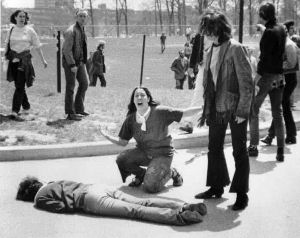
‘4 Dead in O-hi-O’

The best-known popular culture response to the deaths at Kent State was the protest song “Ohio”, written by Neil Young (who was Canadian) for Crosby, Stills, Nash & Young. Gary was playing the song early this morning, one of only two he plays on specific days. The other is for the day he failed to pass his draft physical. Both are connected to the Vietnam War, then often spelled Viet Nam.

Forty-nine years ago today.

“The Kent State shootings, also known as the May 4 massacre or the Kent State massacre, were the shootings on May 4, 1970, of unarmed college students by members of the Ohio National Guard at Kent State University in Kent, Ohio, during a mass protest against the bombing of Cambodia by United States military forces. Twenty-eight guardsmen fired approximately 67 rounds over a period of 13 seconds, killing four students and wounding nine others, one of whom suffered permanent paralysis.

“Some of the students who were shot had been protesting against the Cambodian Campaign, which President Richard Nixon announced during a television address on April 30 of that year. Other students who were shot had been walking nearby or observing the protest from a distance.

… “The question of why the shots were fired remains widely debated.

“Many guardsmen later testified that they were in fear for their lives, which was questioned partly because of the distance between them and the students killed or wounded. Time magazine later concluded that “triggers were not pulled accidentally at Kent State.” The President’s Commission on Campus Unrest avoided probing the question of why the shootings happened. Instead, it harshly criticized both the protesters and the Guardsmen, but it concluded that “the indiscriminate firing of rifles into a crowd of students and the deaths that followed were unnecessary, unwarranted, and inexcusable.”

“The shootings killed four students and wounded nine. Two of the four students killed, Allison Krause and Jeffrey Miller, had participated in the protest. The other two, Sandra Scheuer and William Knox Schroeder, had been walking from one class to the next at the time of their deaths. Schroeder was also a member of the campus ROTC battalion. Of those wounded, none was closer than 71 feet (22 m) to the guardsmen. Of those killed, the nearest (Miller) was 265 feet (81 m) away, and their average distance from the guardsmen was 345 feet (105 m).

“There was a significant national response to the shootings: hundreds of universities, colleges, and high schools closed throughout the United States due to a student strike of 4 million students, and the event further affected public opinion, at an already socially contentious time, over the role of the United States in the Vietnam War.”—Wikipedia

Kent_State_massacre.jpgThere was a march in Seattle after the killings at Kent State. It was 1970, and Gary was working at the University Book Store since the year before while he was still 1A. (Few businesses would hire a man with that status—who knew when he might be called up for the war?) His physical in June of the previous year changed his status to 1Y, and he was “safe.”
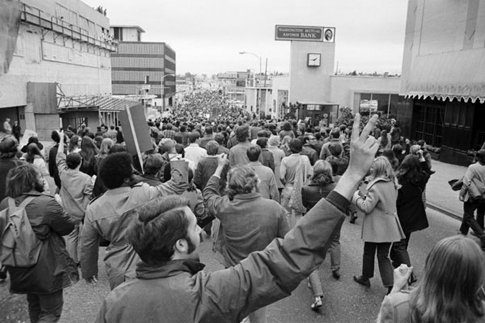
That  day, the management of the book store told employees if they wanted to participate in the Kent State march, they were free to go. Feelings about the war had shifted dramatically in the country. Increasingly, soldiers were not viewed as heroes, but as victims of an unjustified and criminal violence.

Gary walked from work and remembers looking down a major street as he marched and seeing a solid wall of people walking before him. march-on-45th-485.jpg

I was still in high school during those years, of course, but I also went to marches, including that most significant one. Thousands of people started in the University District, marched downtown and then back to the U District on the Express Lanes of I-5, because the mayor closed the lanes to traffic. News reports I can find describe the day in a way quite different from what I recall. Many thousands of students marching, yes. Police in riot gear, not so much. (That was a different day when I was shoved from a sidewalk onto a street downtown by officers in riot gear. Imagine the threat I posed, all 114 pounds of me!)

There are three distinct memories I have of that day in May 1970. As we walked through downtown streets, professional people came out of office buildings in their three-piece suits and in pumps and walked with us. I saw that happen. We passed buildings I knew, though I saw no one I knew. Perhaps Gary and I were walking together then, but that is not part of my memory. It was the sense that so many people opposed the war, so many ordinary decent people agreed the killings were unAmerican.

I walked quickly to get to the front of the marchers. I would not attend the rally at the end, because I had to get back to my mother’s car. I was in a hurry, because I had to be at work for the evening and closing at my job at Taco Bell where I’d been working since the year before. Because it was not my first march, I recognized people—some of them specifically from other rallies and some in a sort of general way. A handful of dark-suited men at a previous march taking photos were not part of the anti-war movement. On that day, despite the many thousands of people I saw, there were people who did not belong, men I thought of as paid agitators. Some scruffy men at the front of the Kent State march were not familiar. They turned over trash cans and newspaper stands. These strangers were trying to start trouble, trying to make a peace march violent and we didn’t let that happen. As we righted trash cans, people standing on sidewalks cheered us.

At work that late afternoon, I had changed into my uniform but I was still wearing my black armband. My boss confronted me, asked me why I was wearing it, told me to take it off. I did remove the band, but then he said it served those protesters right that they were shot. They had no right to go march, that they were throwing rocks. I said, fine, you go downhill with a handful of rocks and I will stand uphill with my rifle and let’s see who gets hurt. This exchange happened in the front, but with no customers around. I was shocked, horrified, and I remembered the people who had joined the march downtown, the ordinary adults who marched with us. And then I turned, walked around the steam case, past the sinks, the stoves, and his office, and out the back door. I got in my mother’s car and drove home. I found out later from the assistant manager that Rob thought I was in the bathroom for at least an hour before he realized I’d left. He wanted me back, but I never went back to work at Taco Bell.

I often recall those days of marching for peace, our optimism that we could make the world a better place, that our protests would change the world. In some ways they did. Anyway, times did change.

Rob would watch the store sometimes from across the street, using binoculars to ensure there was always someone up front, that we did not close early, that we did the job right. He also shorted our paychecks and did not pay us at all for closing, and I had gotten very good at that, developing a system that covered all the cleanup and mopping and storing of food to get us done and out the door in minutes.

When I found out that a new boy I was training was already paid more than I was, I confronted Rob. “But Tim is a boy and has a car,” he said as if even an idiot could see that. I might have had a car if he’d paid me more, I said, though in fact my money was set aside for college. It was really a terrible job.

I am proud of that day, start to finish. I am proud of the anti-war movement. Increasingly as I age I wonder what sort of madness takes us into sport and war with the foolish notion that the “best man” wins?

Sometimes good people are shot while crossing campus between classes. Sometimes good people have to stand up for what is decent and right. And, of course, often the “best man” is a woman.


Camp NaNo day 21

IMG_4054

Camp NaNoWriMo word count: 35,516 as of 6:30am on Sunday, 21 April 2019 (Passover began Friday and today is Easter)

EMD word count: 75,504 and I am working on Part 3!

Yesterday we went out on the beach for three hours. We carried home a load of trash, but did not even make a dent. Some irresponsible boat has emptied its bilge or failed to stop a fuel leak—black all over the sand. Sixteen pieces of seagrass including a small piece of cobalt blue. 

The immediate duplex interior repairs are complete, and the siding is done and the old deck is torn off (though we blew our wad before getting anything new). We still have repairs on the duplex stairs and little decks and the roof alone will cost us a couple thousand more, but most everything I can do is done. I found oil base paint matching the kitchen walls so I could spot-paint and not paint the entire room! Hung all the blinds, including the new room-darkening blind for the bedroom. Gary figured out how to reset the clock on the range, and I painted out the rusty face of the fridge in the oil-base eggshell pale sage green used on the floor pattern. If our new tenant is patient, I will buy a can of white enamel and repaint the interior trim around the door the end of next week. (I do not have the energy necessary to drive 16 miles and buy more paint.) But I am still calling it done. 

This is also a good day to remind myself that my goal for CampNaNo was to write 10k words and complete four pieces I could submit. I have over 35k and five pieces. I sent two off last week and I have three more to go out soon. I am reworking the novel—I have lost track of how many drafts, but this is a major rewrite with many changes I should have completed long ago. I think I might have a draft of “Butterfly Fontanelle” that I can share . . . perhaps sooner than I thought. The truth is I have not thought this story ever would be completed since I finished the first draft and got feedback, and accepted it was far from done. Stubborn cow that I am, I have revised in a way completely opposite of what I was advised. The butchery I plan will remove most of what my reader wanted me to preserve. Perhaps I am as contrary as my mother. [My husband will laugh when he reads that. He always knew.] 

fullsizeoutput_f26

It is a robin’s eggshell found in our path

It is time to let my grandmother’s quart canning jars go. Anyone? I have, in my day, filled dozens of quarts with peaches, pears, applesauce, and tomato sauce, but I cannot imagine doing it again. This year I will make jam—batches of raspberry, strawberry-pepper, apricot-ginger-lemon, and blackberry in half-pint jars and call it good. 

And it is spring, clearly spring with vast flocks of birds v-ing overhead in recent days. The whimbrels have been seen (twenty yesterday right out front) and the vast mixed flock of little shorebirds that lift like a veil swirl up and around and then drop together back on the sand.

And I say I am done painting, but I might use leftover “Stetson” paint from long ago to repaint our Adirondack chairs, which are sorely in need. Or the wall of the garage. Somehow, this does not seem like so much of a chore. (Maybe because I already have the paint?) 

“How many of Trump’s followers or those who might otherwise be tempted to vote for him in 2020 will recoil from this moral squalor?

“Donald Trump is the living embodiment of the seven deadly sins – pride, greed, lust, gluttony, wrath, envy and sloth – and he is the precise obverse of the seven virtues as enunciated by Pope Gregory in 590 AD: chastity, temperance, charity, diligence, patience, kindness and humility.

“Legal debates about obstruction of justice are fine. But no voter in 2020 should be allowed to overlook this basic reality: Donald Trump is a morally despicable human being.”—Robert Reich, former U.S. Secretary of Labor

fullsizeoutput_f27

And today from MindShift:

“Teaching parents about their own behaviors and training them to change might be just the kind of treatment kids with anxiety need to help break the cycle. A Yale University program helps train parents with different ways to respond to a child’s behavior. Angus Chen writes:

” ‘The parent’s own responses are a core and integral part of childhood anxiety,’ says Eli Lebowitz, a psychologist at the Yale School of Medicine who developed the training.”

Don’t make a fuss. The “hard-hearted” mother who asked, “Are you bleeding?” probably had the right idea. Don’t make a big deal and our children learn to face their fears.

On the other hand, Trump.

post-AWP


IMG_3994

So we went, I saw, and we came home again. Fourteen thousand people. I saw Marvin Bell entering the building as we drove past. I am mostly the invisible woman, too old to matter, but there were amazing people all around.

My choices of what to bring home were determined by money ($15) and covers. I am a genuinely shallow person who chooses books for their covers. Then I read the first page. Believer is stunning. Witness (a journal I have long admired) gave me a free issue because I rolled 9 three times in a row. Ruth Gundle (bless her!) handed me Judith Barrington’s newest. I could not resist buying Karen Joy Fowler’s new collection of short stories (charged it!) and then three volumes of poetry (Dan Kaplan’s cover was not great imo, but a peak inside revealed his write is). I could have spent a couple of days trolling literary journals. I had less than an hour.

I went to only one presentation (seriously, just one) and it was a perfect choice, even though I am not teaching anymore:

S157. The Most Versatile Essay: Flash Nonfiction in Any/Every Classroom. (Brian Benson, Allison K. Williams, Sayantani Dasgupta, Anna Vodicka, Celeste Chan) Even the most reluctant-to-write students take to flash essays. Drawn to their economy, they’re won over by the urgency and potency of the form. From the academy to the incarcerated, beginners to advanced, flash nonfiction is a boon to writers of all stripes, and a vital part of teaching in the technological age. Panelists will discuss the versatility of the form, successful teaching strategies, prompts, exercises, and go-to resources from a range of educational settings and pedagogical perspectives.

Panelists represented programs from all over the U.S. and the world. Hugo House in Seattle, The Attic in Portland, as well as academic and commercial backgrounds. Pages of notes! I received a wealth of excellent advice from five people who write nonfiction, are active members of writing communities, and shared years of specific, hands-on experience working with young adults and adults. Though I have taught for 40 years, I learned from each member of this panel and left feeling energized and excited by approaches that were entirely knew to me.

I hugged Allison, shook Dinty Moore’s hand, bought Karen Joy Fowler’s new book, two poetry books from Burnside Books, plus another book written by the person working that booth—gorgeous all! I rushed through the Book Fair. Presses I have submitted to, presses holding work, some who have sent me kind rejections, and others who sent me form rejections. It was pretty overwhelming.

And then I sat and talked to Molly Gloss and Bette Husted and when Karen Joy Fowler showed up, we all talked.

I had arranged to meet Gary outside at 2:30, and as I went down the stairs I could see him through the window. There he was on the sidewalk talking to Ruth Gundle while she waited for Judith Barrington to pick her up. Brilliance everywhere I looked.

Five hours of literary illuminaries.


Gary felt I should mention the $4.25 for a Pepsi. He’d waited in line for 10 minutes and felt disheartened by the price. He left his change as a tip, and it wasn’t cold, though the young man who handed it to him was touched to receive a tip.

I had told him I would not be buying lunch. That much I know about conventions. He is still ranting about that Pepsi, “my AWP experience.” He was a grocer for much of his adult life and knew what was paid for that Pepsi.

Bette or Molly told me I’d missed Nisi Shawl. I missed Debra Magpie Earling. There were many people I would have enjoyed shaking hands with. I took no photos, though I had my camera with me. I knit a couple of rows on a baby blanket. I limped.

AWP

fullsizeoutput_edf

There are beautiful and interesting places all over the world. This is mine.

So yes, I am going. I am going to the national conference today, just for a few hours. Originally, because it is in Portland and has not been here in ages and because I know many people who will be attending and serving on panels (though specifics were hard to come by unless an individual posted them) and because, you know, I realize I should go, I was going for three days. Then I thought we would dive in twice, over the Coast Range and through the woods, but no.

The truth is that conferences overwhelm me. I am always glad once there, but . . .

It was two of our grandchildren who drove over the river and through the woods to grandmother’s house. They arrived in time to keep me home for all but one day. (And I will not post photos I did not take, but it was a really wonderful visit. We played Uno and made jewelry out of shells found on the beach, and I made waffles.)

The Burnside Bridge is down for repairs and Gary had planned to drive that way. We disagreed about how far the Oregon Convention Center is from Powell’s City of Books (no one should miss that). Gary thought it was miles, I thought it was closer. Google Maps suggests a 26-minute walk, 1.2 miles. I will wear my walking shoes just to get around the convention center. I used to take students to Powell’s on unofficial field trips.

So today. I hope to finally meet Allison Williams in person, and to visit with Bette Husted and Molly Gloss, and why didn’t I email Felicity? Jeannette will be busy and I have not heard from others. This is the disadvantage of leaving Facebook last month.


Harriet Tubman

2017_30_47_001detail.jpg

The Emily Howland photo album containing the portrait of Tubman, (above: detail, ca. 1868) was unveiled this week at the Smithsonian’s National Museum of African American History and Culture. (NMAAHC, Library of Congress)

800px-Harriet_Tubman_by_Squyer,_NPG,_c1885I have added the photo above to the post from this morning: UNDERGROUND RAILROAD. Harriet Tubman would have been about 36 years old.

The photo at left is the more familiar one from when she was in her sixties, long after the Civil War.

According to Wikipedia: “Harriet Tubman (born Araminta Ross, c.  January 29, 1822 – March 10, 1913) was an American abolitionist and political activist. Born into slavery, Tubman escaped and subsequently made some thirteen missions to rescue approximately seventy enslaved people, family and friends, using the network of antislavery activists and safe houses known as the Underground Railroad. She later helped abolitionist John Brown recruit men for his raid on Harpers Ferry. During the American Civil War, she served as an armed scout and spy for the United States Army. In her later years, Tubman was an activist in the struggle for women’s suffrage.” Also known as “Minty” and “Moses” for obvious reasons, Harriet Tubman died at the age of 90 or 91.

She served her country and its people in every possible way, with honor, courage, and dignity.