UNDERGROUND RAILROAD

I was reading The Underground Railroad by Colson Whitehead. In a blurb on the back cover, Oprah Whinfrey urges people to buy a second copy for a friend “because you are definitely going to want to talk about it.” Someone asked me to be that friend.

This fantasy fiction details real atrocities committed against African Americans over the past two hundred years in the fictional life of a woman named Cora, born a slave. There is no fiction in these burnings, beatings, and other bald unwarrantable usurpations Whitehead describes, though they are unlikely to have all been experienced by one person, and did not occur as described since some events are expanded in scale or compressed in time, and some happened in the following century. (Those alterations and inventions do not make the suffering any more disturbing, but considerably less so. I kept wondering why it was necessary to exaggerate an already abominable history? My friend tells me she can set history aside, but I never can. She’s right about that.)

And then there is the literal manifestation of railroad tracks and engines underground. Sometimes they went the wrong way. I liked that a lot. Such is real life. Sometimes.

Cora jumps on the underground railroad without knowing its destination, just desperate to escape. There was no telling. From Georgia, her first ride takes her to South Carolina.

Late in the novel, Cora begins working on a side branch of the underground railroad—no engines here, only a hand-driven cart through a narrow tunnel headed north from Indiana. There’s more. But step aside for a moment.


There was a real woman in Indiana working for the Underground Railroad during the first half of the nineteenth century. She was born a free person in the slave state of Delaware in 1823. She traveled all over, and she would eventually marry and raise two children. Her husband died four years after their marriage, and like many woman in my family, she supported herself and her family. Her home in the last years of her life in Washington DC has been designated a National Historic Landmark. She is easy to research.

“Mary Ann Shadd Cary (October 9, 1823 – June 5, 1893) was an American-Canadian anti-slavery activist, journalist, publisher, teacher, and lawyer. She was the first Black woman publisher in North America and the first woman publisher in Canada.

“Shadd Cary was an abolitionist who became the first female African-American newspaper editor in North America when she edited The Provincial Freeman in 1853.

“During the Civil War, at the behest of the abolitionist Martin Delany, she served as a recruiting officer to enlist black volunteers for the Union Army in the state of Indiana. After the Civil War, she taught in black schools in Wilmington, before moving to Washington, D.C., where she taught in public schools and attended Howard University School of Law. She graduated as a lawyer at the age of 60 in 1883, becoming only the second black woman in the United States to earn a law degree. She wrote for the newspapers National Era and The People’s Advocate and in 1880, organized the Colored Women’s Progressive Franchise.

“Shadd Cary joined the National Woman Suffrage Association, working alongside Susan B. Anthony and Elizabeth Cady Stanton for women’s suffrage, testifying before the Judiciary Committee of the House of Representatives, and becoming the first African-American woman to vote in a national election.”—Wikipedia

Undergroundrailroadsmall2.jpg

A nineteenth century map of the Underground Railroad.


I felt held at a slight distance from Cora. This impression was underscored as I read accounts of real women living in slavery in Mother Is a Verb by Sarah Knott. This well-documented nonfiction about mothering, speaks from the author’s personal experience as a new mother and from first-person accounts of real women from hundreds of years past. Two pages about slave labor in the fields created a greater intimacy than I found in The Underground Railroad. I felt at once that I was reading truth, and I never quite felt that in the novel. (Perhaps arguing with his mucking about with history.)

Nevertheless . . . Whitehead is a wonderful writer, and I waited to fall under his spell; he certainly casts one.

“Before the book the only thing to read was what came written on a bag of rice. The name of the firm that manufactured their chains, imprinted in the metal like the promise of pain” (235).

Their chains do not belong to them.

2017_30_47_001detail.jpg

The Emily Howland photo album containing the previously unknown portrait of Harriet Tubman, (above: detail, ca. 1868) was unveiled at the Smithsonian’s National Museum of African American History and Culture. (NMAAHC, Library of Congress)

SEASONAL CHANGE

fullsizeoutput_ed8

The spray from waves turned to rainbows on the last day of winter.

This last week was mildly eventful and full of change. The final three days of winter brought a stiff east wind—which locally is sometimes quite warm in winter. For three days we enjoyed temperatures in the 70s, which would be a warm day for us in summer! It was a particular relief after the nighttime lows in the 20s the month before. And I took advantage, emptying two rooms so that I could paint floors (more on this later).

Then, naturally, the first day of spring saw an abrupt dip in temperature and a bit of rain. The change of season triggered a series of wild thoughts. We might use our passports to go someplace further than Canada—Ireland? Portugal? Italy? We have only visited the U.S. and two provinces of Canada. Is it even possible to travel anymore without a smart phone? I surveyed the stacks of books that have gathered since I last edited my bookcases—time to sort again. There are shelves of books kept specifically for teaching. Some reorganization is called for. Some hard choices about what books might leave the building. I still have books from childhood, but my house can have too many books once they start appearing in stacks on the floor.

I lay awake one night imagining tearing down our duplex. Though my grandfather rented these units by the night, we have always tried to find full time tenants. Homes all around us have become high-end by-the-night rentals and local people have trouble finding housing. Houses turn into business opportunities, cleaners arriving every few days, a half dozen cars across the street, vacationers replacing residents. Some local residents only venture forth very early while visitors sleep in. (Some rarely visit the beach at all.) We recognize that our local community will continue to change. Wealthier people will supplant those of modest means, while we have determined to rent to the latter and resist this “business opportunity.” It has been such a challenge at times—but then we have met some wonderful people too, and our remaining tenant needs his home. A neighbor came by with a suggestion for tenancy. He also rents only long term.

A good friend was visiting family and stopped by for a chat on Saturday. Everyone seems to be telling me about their children, a subject I confess to finding fascinating. How is it that for much of my life—all the pre-child years—I thought babies were all alike and raising children uninteresting? Now, even now as a grandmother, I find children marvelous.

The official spring Beach Clean-Up wasn’t finding much trash out front (we pick it up every day—a burst pipe just the day before), but while we sat in our dining room with our visitor, and a truck drove on the beach to load and haul away the cut-up tree we’d taken out of the garden. Gary was waiting for the tree to dry, for a day without wind, and we’d have had a small fire on the beach. He is, actually, quite relieved it is gone, but we didn’t understand why a cut-up five-inch trunk and some boughs needed to be hauled off. Hopefully it’s being turned into mulch, which is better than us burning it and less work for us.

I made sourdough crumpets.

We were very glad to reconnect with a local contractor we like and trust. He came by and we outlined a series of repairs and one upgrade. Several evenings with incredible sunsets, and the moon . . . oh! the moon was full and copper-bright!

The taxes did not get done last week before the start of spring. There is still a great deal of painting to do on our rental. A neighbor dug what we assume is to be the grave of their dog. We witnessed a dogfight on the beach—well, not a fight, a bullying attack by a local dog upon a somewhat smaller and entirely inoffensive visitor. No permanent damage, but low moments for the week. I did a bit of knitting. Slept badly. Began reading aloud from the ninth O’Brian Maturin/Aubrey novel. Gary seems to have been successful in getting the rats out from under the duplex. The doves are cooing louder and louder as their nesting season begins. There is a mango-sherbet sunset as I write this. Walked the beach each day. A mix.

We had seven good walks, drank a bottle of sparkling wine over a long evening, and changed our flannel sheets for percale. It’s that time of year.

fullsizeoutput_eda

This is what a light gale force wind does: blows the waves backwards into the sea—gorgeous!


PLAGIARIZED REVIEW

tlmcgb68mogpbd6ewbnh

What a Google search has to say about Anne with an E:

This reimagining of the classic book and film is a coming-of-age story about a young orphan who is seeking love, acceptance and her place in the world. Amybeth McNulty stars as Anne, a 13-year-old who has endured an abusive childhood in orphanages and the homes of strangers. In the late 1890s, Anne is mistakenly sent to live with aging siblings, Marilla and Matthew Cuthbert, who live on Prince Edward Island. Anne, who proves to be uniquely spirited, imaginative and smart, transforms the lives of Marilla, Matthew and everyone else in their small town.

And what I found in a stupid review of “Every Netflix Original Show, Ranked from Best to Worst”:

“Netflix’s re-imagination of the beloved book series takes place in the 1890s and follows a young orphan who has endured abuse both at orphanages and the homes of strangers. Things begin to look up when 13-year-old Anne is mistakenly sent to live with her aging sibling on Prince Edward Island. In this welcoming small town, Anne is finally able to unleash her spirited and unique personality.

“The series starts off as quite bland and then, somehow, manages to become even duller. The acting is forgettable and Anne with an E does not do justice to the original source material. Although it’s beautifully shot, the serene landscapes cannot make up for the dreary dialogue and snoring plot lines There’s a high chance you’ll fall asleep while watching this snoozefest.”

You see the problem? (Not the typo I copied and pasted.) Anne is not sent to live with “her aging sibling”; she is sent to live with “aging siblings, Marilla and Matthew.” The nincompoop who wrote this stupid review had A. not read the books, and B. not watched the series either. She plagiarized the summary from another source, and got the details wrong because she A. had not read the books, nor B. actually watched the series. Stupid. So. Dishonest, stupid, and, I don’t know, did I mention stupid? How could she possibly know plot?

I only found this review from November of 2018 this morning. A more careful reading of her sources or actually watching the series, not to mention a quick read of the Wikipedia page would have aided this reviewer.

Some of our favorites made the “Best” ranking, but we were surprised to find others missing. It’s all about opinion, of course, like it or not. The reviewer is certainly entitled to her opinion, but when her opinion is so clearly misinformed and borrowed—I can think of no more polite a term—where is the credibility? I was never a fan of the Anne of Green Gables books (or the Little House on the Prairie series either—the class and race and gender issues put me off), but my husband and I were delighted with what was done with Anne.

Anne with an E is a story for grown-ups. Some children’s stories are best left to childhood.

It’s a little like trying to reread the Black Stallion series and then realizing it is no longer enough that the leading character is a horse. Instead, watch the gorgeous film version, a collaboration between one of the greatest cinematographer and editor teams ever.

In any event, the rest of this reviewer’s rankings did not mesh well with our opinions. In many cases her “Best” was unwatchable while wildly popular series such as Grace and Frankie were marked as “So-So.” I only chose to read the one complete review because it surprised me. Why would I trust the rest of her rankings?

It is worth noting that while Anne with an E ranked the “Worst.” On another site, I read this morning at least 97% of actual watchers loved it according to a another source. So do we.


ONLINE PRESENCE

IMG_3976

When we planted a rose the other day, we accidentally dug up this person. We let the salamander rest in the birdbath while I ran for my camera. Northwestern salamanders (Ambystoma gracile) can reach 10″ and like cool, wet places. We put her under the rosemary and trust she is well.

I quit Facebook last month, and my teaching job once I’d handed in grades last week. On the beach this morning I found four small pieces of seaglass. I have painted the floor in the entry and hall a dark blue-green. Now I am sitting in the atrium, waiting for paint to dry, reading aloud to my husband, and sipping wine too early in the day.

Our upstairs tenant has vacated after lending out the place to at least 16 people, and we plan to be more assertive about how future tenants use the place. There is a lot of “wear and tear” type damage, and we have painting to do there as well. I patched a couple of dozen holes, repairs a split in a door, and Gary must wash the rest of the cobwebs and dust out of the room before I can paint. I have already done my painting for the day. (Not really. I must put on the second coat before I go to bed.)

We think we might furnish the little apartment, first built in 1934 and remodeled completely in 1989. It is an idyllic location for a writer or for anyone looking for peace and quiet. It has a clear view west to the Pacific Ocean from bedroom, living, and breakfast nook. The kitchen looks east. My grandfather rented it out by the night, and Genevieve did the same right into the 1970s. We have always looked for longterm renters, but that has not always gone well. There is a burn in a counter from a tenant who lied about not smoking.

In any event, it would be fun to furnish. It might be fun to rent to writers. Or I might be kidding myself.

Yesterday we were busy with housekeeping chores—new door for the apartment, repairs to the stairs in our house, re-siding the west elevation that is sandblasted right down dangerously close to nothing, and the deck has holes. I emptied a room and painted the floor. Two coats. Gary worked under the apartment. We kept right on going and Gary did not want to talk about doing anything today.

Maybe two walks on the beach. Maybe I will paint a couple of walls. A ceiling.

A LITTLE PAIN

fullsizeoutput_ed0

My students are on drugs.

A few years ago, most of the students in my class were on drugs, mostly a cocktail of prescribed anti-depressants. Seriously. I know this because they told me themselves. Most were taking drugs prescribed for them by local doctors or therapists. More recently, several students told me that they too, were on meds. Setting aside those rare individuals (they do exist) who will require a lifetime of medication, most people do not. Teenagers are distressed but most should not be on any form of medication. There are few mood-altering medications that have been tested and found both safe and effective for someone under 18. Almost none are. Local doctors, many with no more than minimal training in treating psychological issues, prescribe anti-depressants for my students that have not been proven to be either safe or effective for teenagers. Aside from physical health, there is the danger of suicide.

With even less expertise—and I am merely well-read, so it’s fair to say it, “What do I know?”—I would argue that most of the teenagers I know who are depressed have good reasons for their feelings. That is, they are not mentally ill, but responding rationally to horrific circumstances. They are taking drugs to mute feelings no one should be surprised that they feel. They are told that their frustration, sadness, grief, confusion, and desperate longing are signs of mental illness. I wonder sometimes if these professionals remember their teenage years at all?

Instead of developing a strategy to cope with life, they may be addicted . . . or suicidal. Suicide rates in the U.S. have been climbing ever since the introduction of antidepressants. These students may find themselves on drugs for years, even for the rest of their lives. That isn’t necessarily their fate.

Some day, they might choose to stop. And that is likely to be tough. Doctors have tended to dismiss the withdrawal symptoms of people who have spent years on mood-altering medication. More recent studies suggest that the challenge of abandoning mood-altering medication is formidable. Neither is it an impossible task. With patience, it can be done.

Most recently professionals have been working on strategies. One might be as simple as slowing everything down.

In one 2010 study cited in the new paper, Japanese researchers found that 78 percent of people trying to taper off Paxil suffered severe withdrawal symptoms. The research team had them taper much more slowly, over an average of nine months and for as long as four years. With this regimen, only 6 percent of subjects experienced withdrawal.

In another study, Dutch researchers in 2018 found that 70 percent of people who’d had trouble giving up Paxil or Effexor quit their prescriptions safely by following an extended tapering regimen, reducing their dosage by smaller and smaller increments, down to one-fortieth of the original amount. This is the regimen recommended in the new paper.—The New York Times

Just as we having been asking patients to withdraw from medication too fast, we are doing other things wrong. Our lives are all about hurryhurryhurry. It is good advice to slow down. That seems merely impossible advice in modern society. Our environment is toxic in other ways.

Beyond social media, we breathe and drink poison in our water and eat it in our food. We do not sleep enough. We spend the majority of our time communing with machinery rather than people. We do not enjoy our daily chores, we hardly know how to feed and dress ourselves. We obsess over any number of trivial fears and inconveniences that simply do not matter at all.

The New York Times wonders will we have a Mac or Amazon household? Why put down the laundry first when we can tell a machine to turn on a light? Why walk clear across the room to the lamp? We might wonder if it really is too much to reach out our hand and turn the lights on and off with a switch? Flush the toilet. Lock a door.

We are a marvelously adaptable species. We can develop any number of skills. We did not evolve as a species to require a third of us to take lifelong prescription medication. We did not evolve to be “night owls.” We did not evolve to interact more often with machinery than other human beings. Nearly our entire species evolved to eat cooked food, mostly vegetables, to sleep in the dark, to live in community and in close physical contact—actually touching—other people.

Sometimes terrible things happen and we mourn, we regret, we grieve. I have a friend with a serious mood disorder who is permanently on antidepressants. His medication mostly works for him, but he says he misses the highs that he lost with the lows. His is a lifelong addiction.

Modern medicine is just one of the factors that has extended average lifespan. Our water is cleaner. Our food is inspected. Our medications diverse. Vaccinations have saved the lives of millions of children. Medicine is not always an easy fix.

We have an “opioid crisis” just now. The president wants to blame this on people who bring drugs across our southern border. But it is not the drug cartels who created the addiction. People choose to abuse. I know I am supposed to view drug abuse as a disease, as out of control, but this view seems to exist only in relation to certain drug abuse and not other, to certain people and not others, and that is something of a lie. Years ago a local doctor warned that people in her profession were overprescribing powerful narcotics and that patients were demanding them. “A little pain is not a bad thing,” she insisted. She was at least a decade ahead of her time.

A little pain is what all of us experience. Sometimes a great deal of pain dumps all at once and bends us double. That is also part of every person’s real life. The death of parents and loved ones, the frustration of a goal, fear, loss, grief. It is what we all must expect and overcome.

Today we work hard, overburden ourselves with worry and anxiety, and stare at screens. We fail to do what our mothers always told us: Take care of ourselves. If we are burdened by feelings of sadness we might be wise to investigate how we live our lives day-to-day before we assume our despair is who we are. Our easy fix makes us weak and dependent.

Sometimes we are ill and need intervention, but sometimes we are overwhelmingly sad or tired because our lives are depressing and exhausting. We accept pain as our due but want a simple solution. And our medication is making us sick.

Maybe it is time to look for healthier solutions.


update April 2019.

From The New Yorker article “Bitter Pill.”:

“Laura had always assumed that depression was caused by a precisely defined chemical imbalance, which her medications were designed to recalibrate. She began reading about the history of psychiatry and realized that this theory, promoted heavily by pharmaceutical companies, is not clearly supported by evidence. Genetics plays a role in mental disorder, as do environmental influences, but the drugs do not have the specificity to target the causes of an illness. Wayne Goodman, a former chair of the F.D.A.’s Psychopharmacologic Drugs Advisory Committee, has called the idea that pills fix chemical imbalances a ‘useful metaphor’ that he would never use with his patients. Ronald Pies, a former editor of Psychiatric Times, has said, ‘My impression is that most psychiatrists who use this expression’—that the pills fix chemical imbalances—’feel uncomfortable and a little embarrassed when they do so. It’s kind of a bumper-sticker phrase that saves time.’ ”

One challenge is that many patients, like Laura in this article, and many therapists as well believe implicitly in that “chemical imbalance” line. It is more accurately a deception.

Abdul Aziz

Abdul Aziz doesn’t think he is a hero. Allah had not chosen that time for him to die, and he believes he did what anyone would have done in that situation. May he be blessed for his courage and honor grace his steps.

These have been days it has been difficult to stay off social media.

Men with guns, men who talk and talk about manliness and who are afraid to be without weapons have always struck me as particularly fearful, cowardly, and weak. The actions of this father of four sons make me cry for pride.

“Three-year-old Mucad Ibrahim is the youngest victim of the mass shooting in Christchurch, New Zealand.

“Mucad Ibrahim was wearing little white socks, the type with grippy stripes on the bottom so that toddlers don’t slip, when he was carried out of the al-Noor mosque in Christchurch.

“His shoes were still at the entrance, where he’d left them when he arrived for Friday prayers with his father and older brother. His big brown eyes, usually alight with laughter, were closed as he was rushed to the ambulance.

“That was the last time his family saw him.”—The Washington Post

WHAT I KNOW ABOUT GUNS

On NPR, a high school senior talked about how his “support for the 2nd amendment” had not changed after the death of his sister at the hands of a gunman a year before. I wondered about that capacity for changing my mind. My personal experience suggests that people are foolish to place faith in guns to protect themselves. But even I have changed my mind about some aspects of gun ownership.

My father fought in the Second World War. He never bragged about his experiences in France and Germany. He did not, as a rule, talk about them at all. At a Father-Daughter Banquet when I was in high school, the father of a friend was bragging about what a great time he’d had selling on the black market in San Diego during the war. Other fathers compared their wartime experiences. I saw the pulse beating in my father’s temple but he said nothing until we had left the building. “Men who talk about war that way—they did not experience the war I experienced.” [He is not alone in this observation. The pretty, glamorous, and heroic version of soldiering shorts the reality.]  

There were at least four guns in my house while I was growing up: two handguns and a target pistol and a rifle. They were kept unloaded and partially disassembled and in a locked storeroom. I held each one under the supervision of my father, knew enough to determine whether it was loaded and to load and unload, and I was taught absolutely and positively never to point any sort of weapon, not even a toy, at another person. My brother and I were seriously dressed down for playing games with my brother’s toy cap pistols. “Aim at the ground. Never at a person,” he told us, the blood pulsing in his temple. 

In high school I had classmates, wealthy classmates, who hunted all over the world, bringing home trophy heads. The way they talked about their kills was all brags and ugly.   

My brother, aged fifteen and angry that a neighbor’s dog kept wandering into our back yard and sometimes chased our cats, threatened to shoot the dog if it trespassed again. He had our father’s target pistol in his hands. He pointed it. The police arrived, but my brother was not arrested. 

(He was arrested years later for an assault on his wife requiring medical attention, but even though his mental illness and anger issues are pretty well documented, he claims to have a permit to carry a concealed weapon. He says “carrying” makes him feel safer.)

My high school Chemistry teacher separated from his wife and walked to the edge of Interstate Highway 5 and shot himself fatally in the head. 

My brother’s high school Spanish teacher held up a bank. 

While I was in college, two young men barely in their twenties and in entirely unrelated accidents became paraplegics. In each case, Scott and Dan had attended a party out of town—and in small towns only a few miles apart in SW Washington—where someone else found a hidden gun and it went off in their hands. The guns were pointed down, the bullets passed through the second story floor, and into the spines of Scott and Dan. These young men never knew one another. 

A few years after that, a woman I knew was traveling alone and camping in northern California. She had a handgun for safety, and one night waved it around after having had a too much to drink. Nearby campers were alarmed and called for help. An officer arrived, Ingrid’s gun went off, and the officer shot her through the spine. Another paraplegic. 

More recently, a convicted violent felon was unable to purchase a gun legally in Oregon so his friend bought one and gave it to him. He got drunk one night and attempted to kill his former girlfriend’s mother. (He thought the mother was the reason his girlfriend broke up with him.) He shot at the mom through her kitchen window. No one was injured but Tim went back to prison. 

A friend walked her three-year-old across the street for a playdate, and that other toddler walked out of the garage with a pistol dangling from his hands. He was barely able to hold it, but he managed. 


When I moved to a rural community and taught students who filled their freezers with a buck or bull elk each year, I changed my mind about what I had considered the evils of hunting. These hunters are not hunting just for sport, they are also feeding their families. I respect that. 

I did not change my mind about arming school teachers. I liked my colleagues, but there isn’t one I would trust with a gun. Even highly trained police officers most often miss their target during a violent incident. And because the likelihood that they would find a rational use for it before some kid found it. And because my brother was a teacher for fifteen years. And because most of us at one time or another exercise bad judgement. 

I do not know anyone who avoided being murdered in their bed by drug-crazed home invaders. I hear that story—usually about their neighbor’s uncle’s friend—but I do not know anyone personally to whom it has happened. Statistically it is not reflective of the reality that the person most likely to be injured by a gun is the owner, and my personal experience suggest that the statistics about gun injuries and death are trustworthy. I know paraplegics, convicted felons, and dead people. I am tired of people misquoting the Bill of Rights. Nothing in the Constitution guarantees the right to own what my neighbor has in his closet. 

The Second Amendment to the Constitution states: “A well regulated Militia, being necessary to the security of a free State, the right of the people to keep and bear Arms, shall not be infringed.” It was written at a time when the United States had no standing army, when “arms” included swords and bows and arrows and muzzle-loaders, and citizens were expected to stand with their neighbors to protect our nation. For most of U.S. history the Second Amendment was not interpreted as protecting individuals from bad government, but as a way to support their country. The emphasis was on “well regulated” as much as “keep and bear Arms.” 

Like most Americans I do not want all guns “taken away” but regulated. I do not want my neighbor to have a Howitzer or a military-style weapon—few people would. I believe that this American obsession with “gun rights” has become dangerous and even foolish. Scary/ People who do not know another word from our Constitution can quote just those dozen words about their right to bear Arms. Quick! Recite the First Amendment, the one the founders put first. 

I’ve read a great deal about gun violence during my life. I know that forty thousand Americans die from gunshots each year, mostly as suicides. I know people who keep an entire arsenal in their attics—these are not the people who butcher a deer each year. I know that every week a toddler finds a gun and shoots someone by accident. Toddlers shoot more people than terrorists in the United States (truth). Sometimes a toddler kills someone else, a sibling or parent. Most often the toddler shoots him or herself, and about half the time that precious child dies.

How I would live with that if my child found my gun and shot himself and died? 

I feel bad for Scott and Ingrid and Dan and their families and friends, not to mention my old Chemistry teacher and the neighbor whose dog was threatened. But I also feel bad for the two people who picked up weapons not knowing they were loaded. I feel for the officer who crippled a woman in the course of doing his duty. How must he feel about that incident for the rest of his life? I feel for people forced to participate in entirely unnecessary violence. We forget sometimes that, as most soldiers who have seen action will tell you, it is not easy to kill someone, not because the death is hard to achieve but because it is not easy to live with having done it. 

This is what I know. Everyone’s experience is different. Mine tells me that a lot of entirely untrustworthy people have way too many guns, that hiding a gun in a place no one will ever find it is a doomed fantasy, and that expecting even good people to consistently handle weapons with care and accuracy is a pipe dream. 

I need a license to drive a car. There’s nothing in the Constitution guaranteeing my right to do that. Our founders did not anticipate cars, and they did not anticipate a weapon capable of firing a dozen rounds in seconds. (Buying a gun in the United States is easier than almost anywhere in the world.)

Near the end of his life, my father changed his opinion about gun registration. “I think they should be regulated.” We had debated this for a decade—debated many things all my life—and this was the first time he changed his mind. 

The rest of the country is mostly on board. According to The New York Times editorial: “Gun makers will face a jury. But it’s the play-soldier subculture they’ve promoted that’s being judged.” Like the rest of us, the gun industry is about to be held responsible for its products and for the way it has promoted them.

It is time.

PIE DAY

fullsizeoutput_ed3

She said she’d gotten into the program because she was from a Brahmin family and had gone to Scripps. “He’s sorry now,” she told me. “I’m not what he expected, and now he won’t even talk to me.” The young woman had relocated thousands of miles from home for the program, but realized all too soon that she was a disappointment to her thesis advisor. Only one of the graduate students was allowed to call their department chair by his first name. This young woman felt like a failure at twenty-two.

I worked with a woman at the University Book Store who had made a mistake too. Florence had a job during the war as an engineer, and then the war ended and so did her job, her parents were ill, and she spent most of the rest of her life caring for them. By the time I met Flo, she was in her 60s or 70s, her hair still dyed red, working close to minimum wage because she’s lost most of the middle of her life. I met two sisters, in the 80s in Iowa. They too had cared for ailing parents, had never worked, and were too proud to accept pubic assistance. Those three women had led good lives and were aging into desperate poverty.

Just now, a great many students who struggled to achieve their educational goals are reevaluating everything they have been taught about hard work and persistence and earning their way. Richer parents bought their children admission to college.

The world is not fair. We hear that all the time. Yet many well-off people cannot seem to overcome the belief (a Puritan belief) that financial life success indicates human merit.

We do not live in a meritocracy where each person earns their place. Most Americans build on what is handed to them. The Horatio Alger story of rags-to-riches is a myth. Almost not one does that. People born rich become richer. People who claim they were born “middle class” went to private schools and do better, sometimes than their parents. Most often in American today, being born poor predicts a life of poverty. Merit has almost nothing to do with it. Good people who are kind to small animals and children, attend regular religious services, do favors without even being asked, and pay their taxes, are poor in the United States.

I figured this out a long time ago. We cannot be whatever we want to be—not all of it and not all at once. It’s another of the great lies that if we tried we could have anything we want.

In our lives we will make hard choices about family or career, risky job or safe choice, more money or more interesting co-workers? Sometimes we might even make the wrong choice, but more often there will be the details of accident that make all the difference. Our parents’ marriage or divorce or choice to have neither; the randomness of who interviewed just before us turning the mood in the room sour; the moment we paused and turned right instead of left. And that is not all.

Unless we have the money for the private education—forget charter schools, we are competing with schools demanding the tuition of a private university—and test prep and parents who can afford to bride their way in, not to mention the legacies who gain them a few extra points on that entrance calculation—there is no level playing field.

“And if you’re a high school senior lucky enough to have won this genetic and demographic lottery yourself and thus improved your admissions odds some, keep this in mind: You may have earned the grades and the scores to put you in the running, but you are also the beneficiary of enormous, unearned economic privilege.”—TNYT

Over the years, I have written recommendations for students who went on to graduate from high-prestige schools such as Yale, Brandeis, Brown, Reed, Stanford, Duke, University of Chicago, and Pepperdine, not to mention the Naval Academy and Quantico. They are painters and doctors, nurses, engineers, college professors, “drug pushers” for Merck, private pilots for famous New York Senators, and Department Heads for major city governments. They have died of cancer in their 30s and in car accidents and by suicide, and some survived those catastrophes. They have married both badly and well. Some of them came from families below the poverty line, and some others from considerably above it. Three were Gates Millennial Scholars, several won Ford Fellowships, and perhaps a few graduated without any college debt at all. Some of them are so widely admired for their general goodness that no one would question their right to good lives. And some have lied snd cheated right along and still found happiness.

Nothing in life, and certainly not in American society, is certain.

The students from well-off families have an easier time. I know we are supposed to pretend that everyone has problems. Even Cheryl Strayed warns not to assume other people’s lives are easier than our own. How about the other way around?

Truly, if that student’s parents are addicted to drugs, he is from a single-parent family struggling to get by on a minimum wage job, or a parent or sibling dies while she was in high school? There is suicide or rape or life-changing illness? I think it’s only right to assume that student had a harder time than I did.

I went without dental care for some of my childhood. We had powered milk and Kool-Aide and margarine, only rarely real milk, and never soda or butter growing up. Sometimes my parents borrowed a couple of hundred dollars from my grandmother to get by through an emergency, sometimes my mom hid from the paper boy because she did not have the few dollars she owed him that week. I never had a steady allowance as a child, never took lessons after school like most of my friends, and never took the Ski Bus because there was no money for things like that.

My family was not poor. After all, I had a grandmother who could load us $200, but we were close enough to poverty that I could guess about it, and my husband comes from generational poverty. Most of my life with Gary and working with students has been an education in inequity.

It is a splendid splinter of optimism to tell a child they “can be anything you want.” The back side of that promise is the bleeding when it’s plucked—the sense of failure when they do not measure up to “anything they want.” Many of my students have lived lives that warned them about dreaming too high.

But while I argue that “anything” is unrealistic, most of my students underestimate their power. They can be more, have more, achieve more.

We are a country, a society eager to punish failure. We are less happy to help correct mistakes than we are to see them penalized.

Just every now and again—compassion, empathy, understanding. Being rich might mean a great deal of hard work, earned success. But poverty is not personal failure. It might just be a misstep, a life devoted to care. It might want no more than not judging. Success is more than affluence. A meaningful life is not judged by paychecks and net worth.

And then Swedish Greta Thunberg has been nominated for her activism regarding climate change, a 16 year old with Aspergers. She might do anything.

Next month there will be rhubarb, but I think I have berries in the freezer. It’s Pi Day, 3/14. I’m going to bake a pie. [It’s blackberry, not cast in stone, and we each want our slice.]

fullsizeoutput_ed4

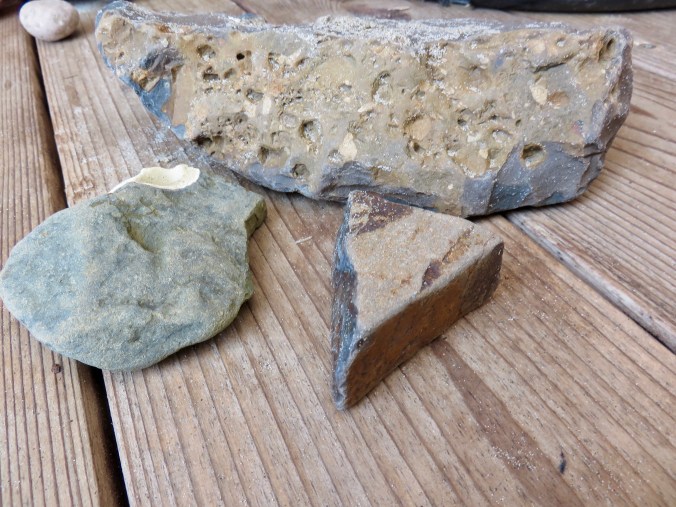
What we are mostly looking for during our beach walks is sea glass (see top) and what we mostly find is trash. But today, Gary found a wedge of stone “like a piece of pie. And it’s Pi Day!”

“REVERSE RACISM”

fullsizeoutput_ed1

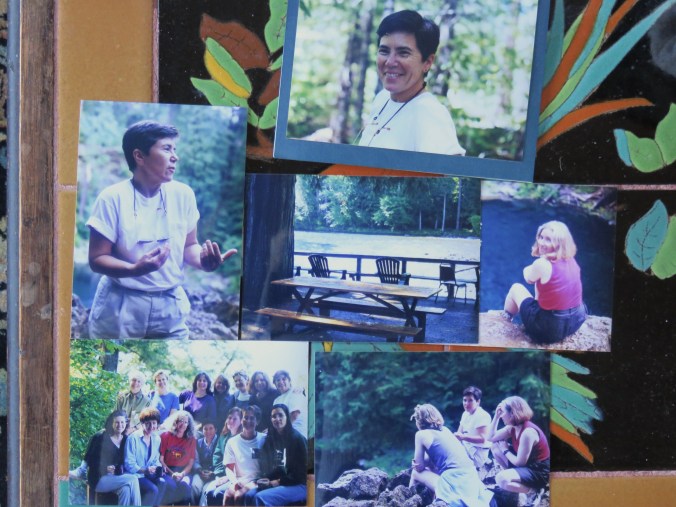
Photos from 1997 at The Flight of the Mind—a poetry class taught by Janice Gould (top and upper left). I put it here because The Flight of the Mind was a writing retreat for women, and it made me a writer, and because I did not understand until I attended the first time how important it was to be a woman and a writer, to hear only women’s voices for a week.

When white people complain about “reverse racism”, it’s generally because they have been badly treated by a person of color.

“I’m not arguing that racism doesn’t exist, it’s more obvious than ever now. My statement is regarding reverse racism, which some people argue doesn’t exist.”—on Facebook

I would agree with those “some people.” Set aside bigotry and bad manners. This theory of “racism” is that it exists only where it benefits one group over another. In America, even if someone is rude to me because I am white (because of my race) I might feel rotten, and the mean person might feel triumphant, but that mean behavior gains them absolutely no material advantage. On the other hand, the only time I have been followed by security at Nordstrom was when I took in a tote big enough to hold a car with merchandise to return. It doesn’t work that way for people of color in the US. Send a black child into Nordstrom on any errand and they are likely to be tailed.

White people make more money, white men make more than that, attractive white men fare best of all. But just because a guy is white, male, and good looking doesn’t mean everyone is nice to him.

There are enough mean people in the world, people who are not normally mean but are having a bad day and people who are easily triggered that we experience unpleasant interactions now and again. The white woman I know had such an experience and claimed she was the victim of reverse racism.

I understand. And I was hoping to explain another perspective, another point of view, and the reason some say “reverse racism” does not exist, can not exist. Racism might merely be prejudice. I say mere, not because prejudice or rude behavior is a small thing, but because racism is a powerful thing—beyond bias or preference and unreasonable dislike, racism is the power to cause damage.

Racism, then, is the advantaging of one group at the expense of another.

The term “racist” applies specifically to those who do benefit under the system that promotes and supports it. That’s true for white people in the U.S. today. Doing absolutely nothing to earn or maintain their privilege, white people have advantage in our society. This is not to say that a white person has no problems. Any American may suffer from poverty or other disadvantage, but on top of that, a person of color (most colors in the U.S.) also suffers from their race, a disadvantage that, unlike education or language or even sexual orientation, cannot be escaped or denied.

Is it possible for a person of color to arbitrarily and unfairly dislike a white person? Sure. It’s unkind and wrong and bigoted. However, by definition, this still isn’t “racism” because that person of color does not benefit from their bigotry. He or she already suffers in a racist system and has no personal power to overcome it. The term “reverse racism” is thus itself considered racist, representing only a white perspective. It perpetuates an us vs. them mindset, which I don’t think most of us want.

The very word is loaded. Using the term “racist” is so loaded with anger and resentment on all sides it is difficult to talk about. But here I am trying.

Winter Term, 1971, I was singing “Amazing Grace” just after 7am while waiting for the beginning of my second Drawing course. I was just eighteen and the vast studio space made my voice sound better than it was. Two black women walked through the room, complaining loud enough for me to hear about white people taking their songs. It was unjust since the author, a white Scot, belonged as much to me as them, but I stopped singing. I knew that. But I also heard them. I heard.

They did not say that to hurt me, and it was not reverse racism. They were protecting their own narrow space in the world.

When white people complain about reverse racism, it’s generally because they have been badly treated by a person of color who calls out their race as the reason, or who merely notes their race in passing.

When a person of color talks about racism it’s generally because our entire social structure is biased against them.

Peggy McIntosh first explained to me what “white privilege” means in her 1990 essay. (If you don’t know the essay, click the link to the pdf. It’s pretty mind-blowing.)

I don’t do anything to earn or maintain my privilege as a white person. It is just there, and too often I take it for granted. As an old woman now I recognize how much else I have taken for granted because English is my first language, because when I was young I was pretty, because I was intelligent and well educated, and because my parents taught me to value information and a solid argument.

Racism only counts when the general culture is there to back it up.

There really is a difference here. Years ago, my son’s orthodontist told me, “Well, you know it’s our sons who suffer from all this talk.” A well-respected professional in those days, he went on to complain about his son not getting into dental school, how that was all the fault of “reverse discrimination” and completely unfair. I politely disagreed until, as I was walking out of his office I sent my teenaged son ahead and went back to less politely disagree.

[Our fair-haired sons had plenty of advantages and were perfectly capable of finding their way without whining about a tiny boost given to other kids. I already knew that one likely reason his son did not get into dental school was a drug conviction. What I did not know until much later was that this “orthodontist” was unqualified for his position, and would eventually be forced out of his practice for incompetence.]

We all hit bumps in our road through life. In high school I heartily resented the after-school jobs of friends who pushed papers and swept floors of their fathers’ offices for double the pay I received working at Taco Bell. I worked minimum in college too while my brother gained a workstudy job at the University that also paid double what I earned in the music department of the University Book Store. He was the second child in college, and even though our parents didn’t contribute a dime toward either of our educations, he was judged the more needy. And then again, maybe it was because he was a boy.

So I say this now, all these years later, though I never did at the time, and the upshot is that I would not have wanted my brother’s job. I learned a lot about music selling records. A graduate student played “Syrinx” by Debussy just for me before going off to study with Rampal. That happened because I asked what was in his case, because I begged to see his flute, because I begged him to play. Because he chose one of my favorite pieces, standing there on the other side of the counter in the music department of the University Book Store.

Over the years, I overcame bad teeth, poverty, social awkwardness, and gender. On top of all that, I did not experience racism. It was purely my luck. I did nothing to earn it. I was a member of the dominant race in my country. When people described me, they did not bother to say I was a white girl. That was taken for granted.

Only those two painters commented on my race. It had never happened to me before. All these years later I have wondered if one of those women remembers me from that day. Many years later she became a friend when we both attended a writing workshop together. I have sometimes thought of asking if she remembers. But no. It is enough to know her for herself.

A little humility. Gratitude. Acceptance. It is enough.


SLEEPING IN THE DARK


According to a 2018 map from Wikipedia, the blue shows DST in the northern hemisphere, and orange DST in the southern. Most of the rest of the world, the gray areas, ignore it. The dark gray indicates nations that once used DST, but gave it up.

People are arguing again about DSL. They are talking about it in Congress.

We went to bed late on Sunday night, hoping to trick our bodies into more quickly accepting the time shift to Daylight Saving Time. I had set my watch forward before going to bed on Saturday and Gary was still correcting the clocks the next morning. The clock in the kitchen resets itself, which results in it going a little crazy twice a year. The hands spin around the hours a couple of times, maybe wind backwards and eventually settle on what the nation insists is the correct time.

I feel a little bit like that clock myself.

The last two nights I woke once in the night and then again in the too-early morning, On Sunday I tried to convince myself that 5:33 was really the time I might normally wake. It felt like 4:33. The sun would not be up for another three hours. With my laptop in bed, I waited for light and considered that for the next week before Spring Break I will not be getting up in the dark and leaving for school in the dark and arriving at school… in the dark. That’s only because I fully retired the other day.

DST doesn’t give me more daylight. The best it can do is give me more daylight at the end of my day while stealing it from my mornings. Maybe that works for some people. They go for hikes or something after work. I used to run before going to school and DST messed that up. At the end of a nine or ten hour workday I never feel like going out for that run or otherwise enjoying daylight recreation. The best I might manage at the end of a long day is a few minutes at my loom or a glass of wine on the deck. I’d like the sun to be setting about then, along with my energy.

In 1895, a New Zealander who collected insects in his spare time, wanted to shift his work schedule so that he would have more daylight hours after work to collect his bugs. Eventually, beginning at the outbreak of WW1, most of the world would adopt the plan (the blue and orange areas on the map above), and while many countries have more recently abandoned the practice (the dark gray areas), still more than half the world’s population shifts their clocks forward in the spring and back in the fall.

When America first adopted the policy in 1918, it was so unpopular that it went away 7 months later, after the war. But “War Time” was reinstituted in 1942 by FDR. Nixon signed the Emergency Daylight Saving Time Energy Conservation Act of 1973 and even then it wasn’t consistent throughout the U.S. DST was extended in 2005 under the second Bush’s watch, beginning a week earlier in the spring and ending later in the fall, which is out of sync with most of the rest of the world. Not everyone is happy about all of this. Some U.S. states still refuse to shift their clocks forward and back.

The stated goal for DST is to save fuel and thus money, but with modern heating and cooling and the use of electric lighting and so forth, the practice probably does not save a dime, and several studies have shown that DST actually costs the U.S. as much as billions of dollars each year. Worse, its affect on sleeping patterns may be damaging our health and safety.

Ask anyone with small children what it’s like to turn those clocks forward in the spring. The following week is a mess for children who did lose an hour of sleep and often must wait for busses in the dark. Among high school students I see only negative results. They are driving to school in the dark, which can’t be a good thing. Though teenagers often fail to get the sleep they need and have erratic sleep patterns, they respond badly to the shift to DST and we teachers gear up for short tempers and impatience among our students, not to mention ourselves. We are all adjusting to one hour of lost sleep.

This adjustment to change in our internal clock can take only a few days for up to a week and some scientists blame the difficulty of this shift for a national increase in accidents, heart attacks, and suicides during the week following the spring shift to DST. This surge in deaths and near-deaths doesn’t happen in the fall. Apparently getting an extra hour of sleep doesn’t do anyone much harm.

They are arguing in Washington DC again about DSL. There are proposals to make Daylight Saving Time permanent or to eliminate it altogether. Though their interests were often cited when I was a girl, farmers generally don’t like losing morning light. Some business interests such as “the golf industry and the barbecue industry have been big promoters” of DST because there might be profit at stake. The PTA is more worried about children’s disrupted sleep and the danger of darkness on their way to school. I automatically side with children over profit.

By 7:30 on this morning, I felt like getting up. There was, finally, light in the sky, light I was used to seeing an hour earlier, according to the clock. I am normally an early riser—the result of living most of my life with a husband who is a morning person. I like to tease about how I “trained him” but the truth is he’s trained me too. I like the morning and I like having daylight to start my day.

I don’t like getting up in the dark. I don’t need time after work to collect bugs or golf. If, like me, you’re feeling a little tired or out of sorts this week, blame Daylight Saving Time.

This is one problem with a clear cause and a clearly negative effect. Unless you are selling barbecues.

I don’t know. Turn on the porch light and have your BBQ burgers anyway?