DAWN

IMG_2210

Last night someone was blasting (illegal) fireworks at 10pm. Explosions in the dark—oh what fun . . . for someone. A month or so ago visitors complained to us about construction noise from a remodel across the street from their rental that prevented them from sleeping in past 8:30am. We smiled and exchanged looks. This has become one of our favorite examples of absurdity on the part of people who live in bubbles of their own making.

People complain about the dawn chorus but play their stereos on full blast all afternoon. It’s the same with tourists stepping off curbs in the middle of the block in Cannon Beach without even checking traffic first. They are affluent white people, of course. They are on vacation and everything must be perfect for them.

It’s happening in France too. The New York Times today reports about a French rooster in a favorite vacation spot that bothers vacationers. A fisherman has been asked to replace his hedge with a concrete wall because the birds living in the hedge are noisy and wake vacationers. People move to the country to get away from smog, traffic, and sirens and then object to the sounds, smells, and other inconveniences of country life. They have learned to shut out much of what might bother me about city living, and whine about what I actually enjoy.

My husband opens our bedroom window early each morning specifically so that we can listen to the dawn chorus. We had already been in bed for some time when the fireworks started up last night. Some beachfront homes sport enormous spotlights that shine on the beach (which in Oregon is a public park) because they thinks “it’s beautiful.” But if they wanted to look at the water, they had hours of daylight to admire the view. Instead they really look for a few minutes and then forget to turn off the lights, which shine all night and do damage to wildlife. All because we are afraid of the dark, afraid of wild creatures and of going to sleep when night arrive, of sounds and smells of nature. Even time.

The Grand Canyon is now a Dark Sky Park. “The designation places the Grand Canyon into esteemed company with more than 60 dark sky parks, communities, and reserves in the United States.” Light pollution on our planet is a very real problem. Years ago I wrote a snarky essay as a model for students about how offensive I found lighting when I wanted to run by moonlight. I discovered my personal objection was really beside the point. Lighting creates a host of problems for human beings and animals, birds and general health. We converted our outdoor lighting long ago to avoid lighting the sky when nature is dark. We never leave our lights on all night and not only for that reason. It might be safer in the dark, and it it is certainly healthier. Numbers on the clock have become more important to human beings than actual time. Despite the fact that “noon” means that time when the sun is at its zenith, some people want so-called Daylight Saving Time to run year around, with “noon” at 11am. If people wanted more hours of daylight, they have only to wake with the sun.

Are all these disconnects from the realities of nature a matter of privilege or modernity or just plain stupid?

Instead of resetting clocks, shutting up nature, and sleeping hours past dawn, perhaps it’s time to rethink this absurd denial of nature. Turn off the electric lights. Hear the birds. Understand that we live on a planet not merely in manufactured spaces. Birds sing. A raccoon crossed our yard this morning and they run across our roof at night. A weasel lives in the hedge, and pet rabbits and dogs should not be turned out “to run” in the wild. Baby seals are left to rest on the beach by their mothers and do not need to be rescued. Storm-battered waterfowl will die or survive without assistance.

Allow the wild to be what it is. Live with it.

DRONES

When I was a girl, my dad built gliders and small free-flight model planes. We joined other enthusiasts and took them far out in the country to a grassy field. Some people had remote control and could turn their craft, the chassis a foot or a bit longer. My dad’s went up and then came down. Sometimes this meant a long run to collect them. Everyone flew their balsa wood and silk span planes until they were battered past flight. We took our models home and my dad would splice and repair, adjust balance, tune the tiny engine, spread new paint—orange because it showed up well in the grass.

They were noisy and useless, but far from crowds, never a threat to safety or privacy. Adult toys requiring careful design and skill to fly.

More recently, a drone flew by our front yard, which fronts the beach. The drone paused briefly at eye level, twenty feet from where my husband and I sat in chairs in our yard. Technically, perhaps, its flightpath was perfectly legal.

We flipped the drone off. It was an instantaneous and shared choice. (And not something I am inclined to do. We both laughed.) The device had moved on but turned back immediately and hovered for a long moment, confirming our suspicion that it carried a camera, watching and perhaps filming us.

If I’d had a pellet gun that day and the skill, would I have been tempted to shoot down that spying drone just past my hedge?

You bet.


SPRING

We have been busy this morning: I baked a pie, Gary did laundry, we picked up the mail, I read aloud, but first thing this morning we enjoyed a nearly a three-hour walk. We walked from spring right into summer at 8:54AM. Today is the first day of summer and the morning sky showed cobblestones overhead, mist along the shore.

IMG_4419.jpg

The seagulls do not mind us much—so long as we walk in some direction other than straight at them, so long as we do not stare, and so long as Gary does not tease them by making claws of his fingers and muttering Kitty-kitty-kitty. We do not like disturbing them at their rest.

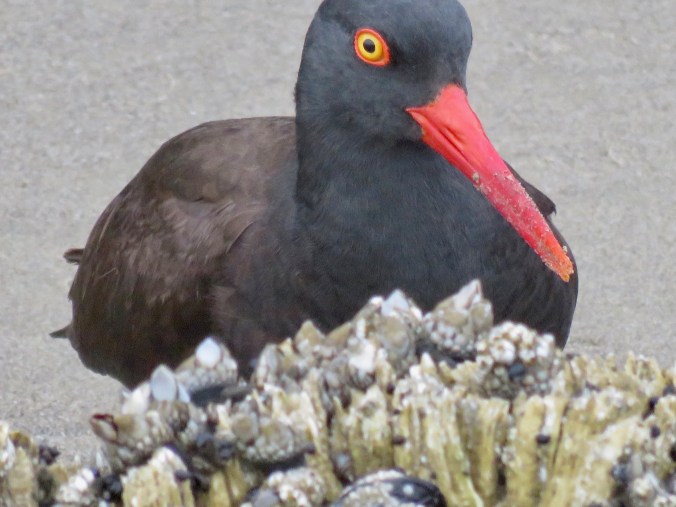
The black oystercatchers who nest at Hug Point did not mind us either today. They glanced at us, but seemed not to mind and continued foraging for sand crabs (?) and mollusks. We assumed their babies must be out of the nest, but then a walker with a dog came along and they went into their act of distraction. Not here! Not here! they seem to cry. They raised their wings and danced all around.

IMG_4426.jpg

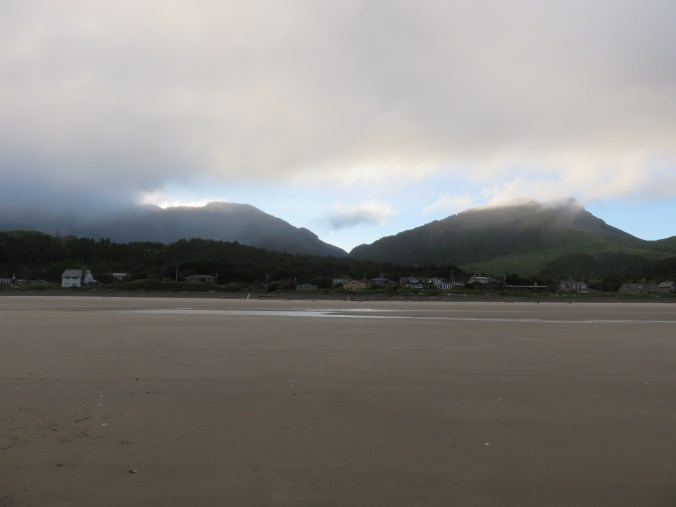
Hug Point is so-called because in my mother’s childhood and before travelers used the sand to get to our beach, hugging this headland. The highway didn’t come through until the 30s. A path was partially blasted around Hug Point, concrete poured to make it navigable by car, while the horse-drawn milk wagon went right through the creek and tide pools.

IMG_4441

There are still traces of concrete at Hug Point (you can see a bit in the foreground below), but much of that old roadway is worn away. When we decide to “walk long” we mean walking north around this headland.

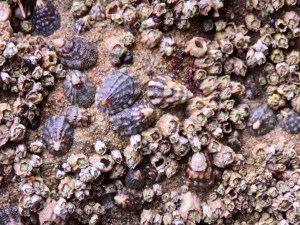
Limpets and barnacles on the sandstone, shown here. Anemones and gooseneck barnacles and chitons too.

IMG_4439.jpg

On the way home, Gary wanted a photo of thumbs-up in front of a rock that seems to have the same attitude.

IMG_4423.jpg

LET THERE BE JOY

Academy of American Poets
75 Maiden Lane, Suite 901
New York, NY 10038
info@poets.org

Dear Friend,

Please join us in congratulating our Chancellor Joy Harjo on being named our nation’s newest Poet Laureate! Harjo was elected an Academy Chancellor earlier this year and received the Academy’s Wallace Stevens Award for proven mastery in the art of poetry in 2015.

As a poet, a teacher, and a literary leader Joy Harjo has touched many lives and many communities. She now has what is one of the largest platforms a poet can aspire to and it is a well-deserved honor. We’re thrilled for Joy and for the nation on this historic appointment.

We’ve enjoyed wonderful partnerships with our Poets Laureate. Since the position was created in 1937—a year after our organization was incorporated—more than half of the poets in this esteemed role have been Academy Chancellors. We look forward to continuing our tradition of celebrating our nation’s Poet Laureate and supporting Joy however we might.

Read this special Q&A with Joy about her new role.

Learn more about Joy Harjo.

Read poems by Joy Harjo.

Sincerely,

PERSONAL

IMG_4373

It was probably 1973 and Gary and I were managing the apartment building while we were students at the University of Washington. I was just twenty years old when we had dinner with the owners of a cat we liked, Slump. Slump’s people were educated and had traveled and in the course of the meal I began talking about an horrifying situation, a news story about abuse of women in an Eastern European country. Gary recalls this and also Tom’s response: “What do you care? You don’t know those women.”

Mitch McConnell does not understand why Jon Stewart is so upset about the failure of Congress to make adequate provisions for First Responders who were exposed to toxic substances while protecting and rescuing people, and later bodies, from the Two Towers after 911. He didn’t get why Stewart was “all bent out of shape” about caring for these sick and dying men and women. (You might recall that First Responders were assured they were in no danger from toxins, which was later revealed to be a lie from the Bush administration.)

“I want to make it clear that this has never been dealt with compassionately by Senator McConnell,” the former Daily Show host said. “He has always held out until the very last minute and only then, under intense lobbying and public shaming has he even deigned to move on it.”

Why, McConnell wonders, does Stewart care so much?

Why should anyone care about anything that does not directly impact them?

I would like to think most Americans would be as confused (if not downright horrified) as Stewart feels. Compassion is not dealt out evenly, but a complete lack of it is puzzling to me. We are seeing it a lot lately, these men and women who have so recently entered politics, this current regime devoted only to power and position.

But still. As you do unto the least of these . . . why is that so mystifying?

FIRST RESPONDERS

jon-stewart-dc3-ht-usatoday-ml-190611_hpEmbed_7x6_992.jpg

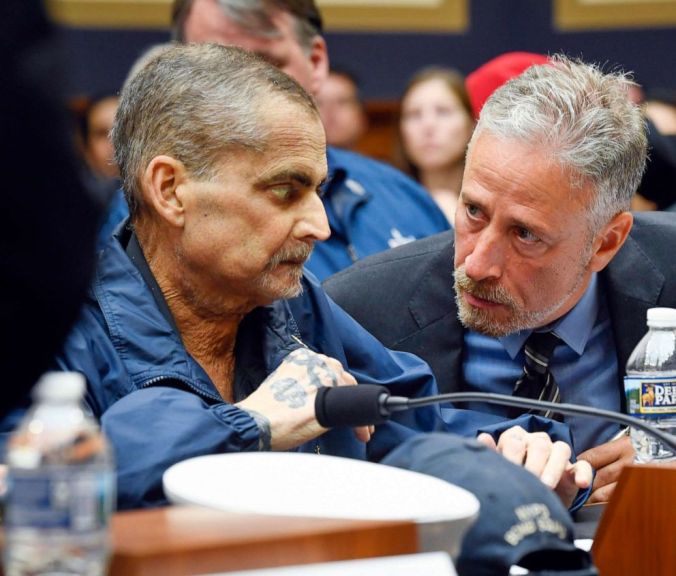
“Behind me, a filled room of 9/11 first responders, and in front of me, a nearly empty Congress,” Stewart said.

John Stewart spoke to many empty seats in a House Committee about the needs of first responders. All these years later and the men and women who responded “in five seconds” to a disaster: “I’m awfully tired of hearing that it’s a 9/11 New York issue. Al-Qaeda didn’t shout death to Tribeca. They attacked America, and these men and women … brought our country back,” and are still having to beg for relief.

“I’m sorry if I sound angry and undiplomatic, but I’m angry, and you should be, too, and they’re all angry as well and they have every justification to be that way.”

Watch the PBS News Hour video: https://www.youtube.com/watch?time_continue=10&v=HT5FTrIZN-E

Stewart alludes to a Senator who has held up funding as a political tool? That’s Mitch McConnell.

Truth to power.

CLOSING

fullsizeoutput_f6a

I discovered yesterday that Tin House is closing after this month’s issue. I already knew about Glimmer Train, Shimmer, and the end of Apex except as a publisher of books. These were all excellent publications. The New York Times is only writing about Tin House, because the founding editors are in New York?

Sometimes I really do wish there were a newspaper on this coast I could subscribe to.

Penguin has reissued No-No Boy by John Okada. It’s an important novel that I read for a graduate class on Asian-American literature taught by a San Francisco University professor in a class at Portland State. Despite the fact that the novel was already reissued (the copy I read with an introduction by Lawson Inada), Penguin has chosen to completely ignore previous copyright and to claim the novel is in the public domain.

Sometimes I wish New York(City)ers were not such “a bunch of hustling people all squeezed up together being ‘Eastern!’ “—Lorraine Hansberry’s character Walter Lee Younger in A Raisin in the Sun.

A New York editor reportedly complained about a West Coast novel because it “has all these trees.” City people.

Reading the editor’s description of their literary journal, I found two women’s names in the list of authors they were proud to have published. Both names were misspelled. Ursula K. Le Guin. (She always included the K. and Le Guin is two words, not one.) The first woman to publish science fiction under her own name was Clare, without the I, Clare Winger Harris, not Claire.

And don’t get me started on the lay/lie issue in print publications—everybody has trouble getting that right, it seems, but some of us take the trouble to doublecheck this obvious trip.

Yes, peevish today, on a minor note, and despite the fact that my own line-editing is never perfect.

I am rereading Wild Life by Molly Gloss.


READING

IMG_4281

These days, Ruby objects strongly to having her photo taken.

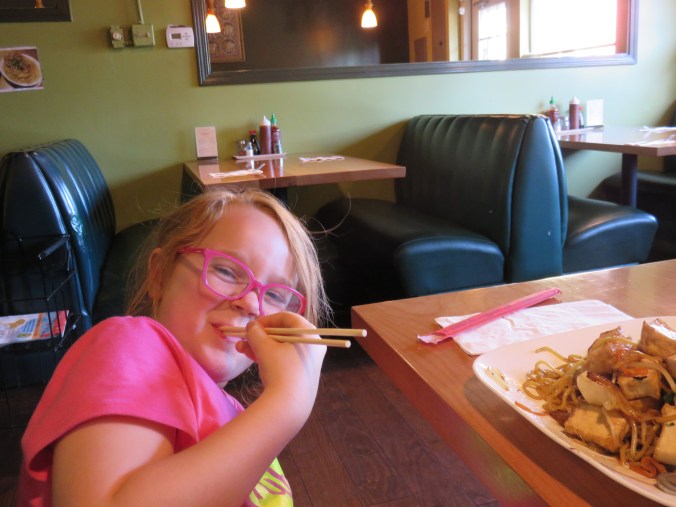
We took our granddaughter to her first literary reading on Monday. However, our adventure began with dinner. It had been a long time since we took her for Thai. She barely remembered—maybe she did not remember at all. She chose yakisoba from the menu because she knew the word from a report she did on Japan. She was efficient with chopsticks, eating all the tofu, the broccoli, and most of the noodles.

From there, we headed for the Powell’s Book Store on Hawthorne.

A Girl’s Guide to the Wild: Be an Adventure-Seeking Outdoor Explorer! A Girl's Guide to the Wild

Ruby McConnell’s A Girl’s Guide to the Wild: Be an Adventure-Seeking Outdoor Explorer! (Little Bigfoot) is the definitive guide to getting outside – for girls ages 9-12! In addition to basic outdoor skills, McConnell’s entertaining guidebook includes easy camping recipes, outdoor projects including science experiments and crafts, fun activity suggestions, and inspiring stories of diverse historical and contemporary outdoorswomen. The goal is to improve the quality of girls’ outdoor time by increasing participation and independence, making them feel comfortable and safe, and giving them essential skills and knowledge. Charming and approachable, A Girl’s Guide to the Wild will encourage both reluctant campers and budding naturalists to go wild and embrace the outdoors.

I admit that one of the reasons this reading had caught my eye was the author’s first name. This Ruby was a wonderful presenter with obvious experience as a presenter to middle school and other audiences. She had herself been a camp counselor with a summer camp name and I recognized the songs she sang from my sons’ time at camp. I recognized her energy and enthusiasm for family camping trips, the sincerity of her promotion of the outdoors. I have lived with that.

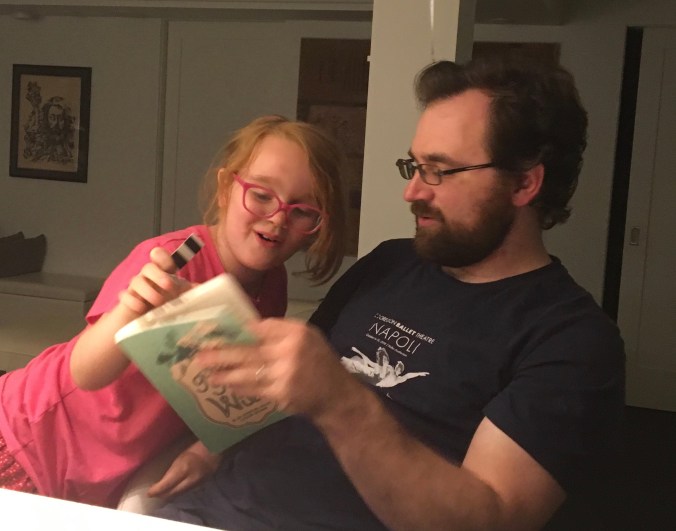
Ruby McConnell wants girls to overcome fear, find their courage and their community. She said it again and again, that bravery. She was also very funny and our Ruby giggled and laughed and people smiled to hear it. The Rubys got on well, and our Ruby was assured that people with her name were special, but she would not stand for a photo with the author, much as she enjoyed the evening. When she got home she read several pages to her dad. Her other grandmother sent the photo, taken while Ruby was having too much fun to notice. In her right hand might be the little bookmark made by our neighbor Tammy.

fullsizeoutput_f50


LUCKY ESCAPE

fullsizeoutput_f45

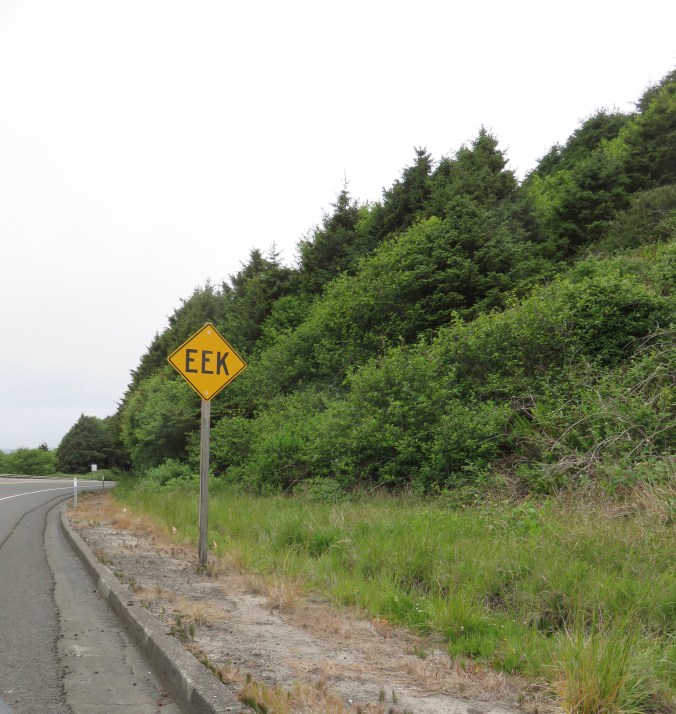
Last week, a sign on the highway at Silver Point said “EEK” instead of warning of “Elk” crossing.

If the weather had been better 75 years ago, yesterday would have been the anniversary of D-Day. [The D stands for “day.”] Instead, it was the Golden Anniversary of my husband flunking his draft physical. He did nothing to deserve this, but each year he celebrates his fortune in being spared Vietnam.

This is not about to become a blasting of veterans. Many of my favorite people—my father, Aunt Marcie, Jim Fukano—are veterans. Jim even served in that war that Gary escaped and remains in touch with the men he served with. Most of his older relatives spent WW2 in concentration camps right here in the U.S. Like my father he died not talk much about his wartime experiences. Despite humorous tales of K-rations and long marches, I know my father saw horrible things. My mother said the war, as it inevitably does for any soldier seeing combat, damaged him. My father, if he was within hearing when she said such things, would say he would never have found his wife, married, had the life he enjoyed if not for the war. There would be a moment of standoff. “Art—” my mother would begin.

Gary says “there is a certain amount of [both] happiness and guilt associated with my celebration.” Neither of us heard glamorous stories about the war, but our parents met as result of service to their country. That generation was irrevocably changed by the experiences growing up in the Great Depression and living through the war.

We have Ernie Pyle’s books recording the war in the house. My father, like many servicemen, admired Pyle who reported from Europe and then from Japan. The New York Times has a feature today about the war reporter who, according the Truman, “told the story of the American fighting man as American fighting men wanted it told.”

“Until D-Day, war had largely been an exhilarating experience for Pyle, terrible but often uplifting. Ten days after the landings, the awfulness of all the death he was witnessing in the ‘thousands of little skirmishes’ in the hedgerow country of Normandy was carving away at his mental state. He reported having knots in his stomach from ‘constant tenseness and lack of sleep.’ In a letter back home, he confided that he had to ‘continually fight an inner depression over the ghastliness of it all.’ ‘Sometimes,’ he wrote to Miller on June 29, ‘I get so obsessed with the tragedy and horror of seeing dead men that I can hardly stand it. But I guess there’s nothing to do but keep going.’ “

We found glass on the shore yesterday morning, then hung house-letters to distinguish each of our tenants’ front door as well as our own doorbell. Someday I will address the awkwardness of entering our house through the garage to the atrium and then to the front door. Some day.

We had friends, Becky and Mark, over for dinner, a late dinner for us because they are both working and could not get here till going on seven. Clams and huckleberry cake were the highlights in food, but the talk nourished, our shared hopes and dreams. Food for the heart.

Then this morning, an email overview of top stories in TNYT, “Their Fathers Never Spoke of the War, Their Children Want to Know Why”:

“Less than 3 percent of the 16 million American veterans of the [Second World War] are still alive, and all are in their 90s or beyond. Now their relatives are often turning to experts to help them decipher billions of pages of military records to piece those stories together.

” ‘Sometimes they start to cry on the phone about how much they loved their dad, and how he had horrible nightmares, but would never talk about it,’ one researcher said.”

Ernie Pyle cph.3b08817.jpg

Ernie Pyle. My father looked a little like this. So did my father-in-law. Most of those who served in his war had that serious, lean look. America came out of the Depression during the war. Pyle did not survive but was struck in the head and killed by enemy fire in Japan.

My father would be 94 this November. That seems remarkably old, but members of his family mostly did live into their nineties. If lung cancer had not taken him in his sixties, he might well be alive today.

I meant this post to be cheerful, but the truth is that contemplating war always brings tears. I write with the morning chorus of birds outside my window, a celebration of another key. I cry for the waste, the suffering and misguided determination that does not end, for the 20,000 attacks on Yemen by Saudi Arabia in the last few years  (mostly using planes and bombs from the U.S. and Britain), for anger that pushes us from principle to spite, for determined vengeance and retribution, and for pursuit of power that so often perverts and perpetuates this monstrous suffering.

I wonder when we might learn to settle differences some other way that does not give nightmares.

TAKE A WALK

IMG_4176

Walking is healthy exercise. Taking time out from your busy life is mentally healthy too.

A website recommends planning a 30-minute walk this weekend because “here in the age of binge watching and sedentary smartphones, that we all could stand to move around a bit more.” They aren’t wrong about that.

They have three pieces of advice: wear walking shoes, plug into your device—”Podcast, audiobook, or music, walking is the perfect time to get lost in something out of the ordinary. If walking isn’t particularly appealing to you, listening can also make the time go by faster”—and “bring a buddy.”

Plugging in and conversing with a “buddy” at the same time? Maybe choose? There might be conflict between the second and third bits of advice. There might be conflict between the second bit of advice and that desire to escape our ordinary plugged in existence.

Aside from the advantage for women of being obviously plugged in as a way of “tactfully” ignoring street harassment, being plugged in means we are less available to our surroundings, less attentive to both beauty and potential hazards.

Walking someplace, anyplace, that is green or wild or beautiful, or perhaps has traffic, might suggest that listening to surroundings would be better advice. Listening to a device just means a walker continues to carry ordinary life around like baggage. The point of going for a walk isn’t merely to escape the home, it’s to escape to someplace. Be here now. Listen to the wildlife. Listen to the air moving. Listen to our own thoughts. Seriously, if listening to our own thoughts is unbearable and we need electronics “to make the time go faster” maybe the most important reason to go for a walk is to slow time back to a human pace.

My husband and I walk at least each morning for 45 minutes or longer. Sometimes we walk side-by-side, sometimes we separate while Gary searches one stretch of beach and I search another. We go out early to avoid most other walkers—the visitors are generally plugged in with necks bent and their eyes focused on their phones. They walk the Pacific shoreline and are oblivious to their surroundings.

Local walkers all walk early. We see Tammy and Larry and John, who go out alone. We see other locals who come out to walk together, mostly with their dogs. We stop and chat sometimes. Other days we merely lift an arm in greeting and carry on.

Our walks are the most important time of our day. We hear the surf and the birds.

My advice for taking a walk this weekend:

  • Wear good walking shoes
  • and pay attention.