Step 4: stalling

fullsizeoutput_100c

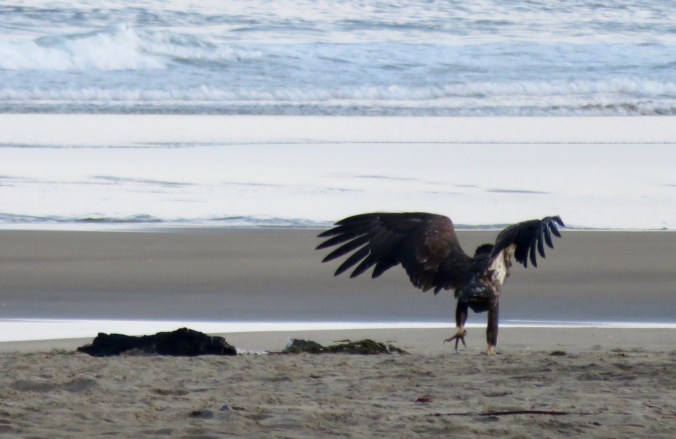
This is a new bald eagle, born this year and still in juvenile plumage. She was chased off by a tourist’s dog, but came back to feed soon enough.

This has been a bustling week. I am sipping ice water and Vera is playing on Acorn (my subscription runs out in a week or two). We are just back from an evening walk on the shore. Cool air blows in from the skylight and it’s hard to imagine knitting a sweater. Last weekend our younger son and his family were here and my grandson apparently thinks I am magic. He asked several times when his new sweater will be done. I think he expected me to answer: this evening or perhaps tomorrow. I told him perhaps by his sister’s birthday. That gives me until Guy Fawkes Day. I have four sweaters lined up. And just now the room is heated to over seventy degrees.
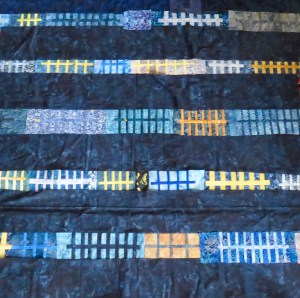
fullsizeoutput_1006I am stalling. Today I could have joined the blocks of the blue quilt at least into strips of dark dark blue and strips of lighter pieced strips. Instead, I have picked Blue Ladders up in stacks and laid out the beginning of the center panel of another blue quilt in squares. I won’t be casting on a sweater any time soon.

This has been a week. Monday was Scrabble. That was relaxing enough.

Tuesday, the neighbor’s dog Raven got lost. Gary went a little mad chasing around looking. He had seen the dog and recognized she was lost. The beach is overwhelming, sometimes even for local dogs and Raven is a rescue. But found again and safe at home.

Wednesday, we watched a paddle boarder thrashing about out past the surf line for an hour with increasing anxiety. He turned toward shore two or three times and paddled hard without making progress. He fell into the water over and over, a dozen times before I walked out onto the shore to get a closer look. Locals don’t usually surf this shore and maybe falling into the water every couple of minutes is normal? I called the Coast Guard thirty minutes after that, but then he seemed to change his mind and paddled south with the current. He’d been in the water a long time, but seemed to be wearing a wetsuit. Still, the danger was there, a current and an outgoing tide, night coming on soon. He came almost all the way in and then went out past the breakers again. I met others who were concerned. Cannon Beach Rescue showed up. He’d been out for over two hours by then and was a couple of miles south of where he’d first been spotted by a tourist staying well north of us. Eventually a member of the rescue team went into the water and swam to him towing her board. He finally paddled in on his knees and came ashore and I watched all that through binoculars. I called back to the Coast Guard, as I’d been asked to do. I apologized for wasting their time. The Chief Petty Officer thanked me for paying attention.
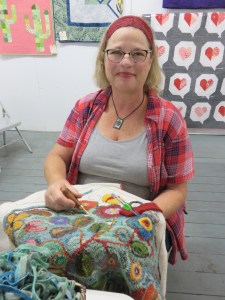
IMG_4672Thursday, we went to the Tillamook County Fair. I was a little disappointed in the quilts this year, but the rug tufters had lovely work, and as always I was tempted. (Just what I need, another project!)

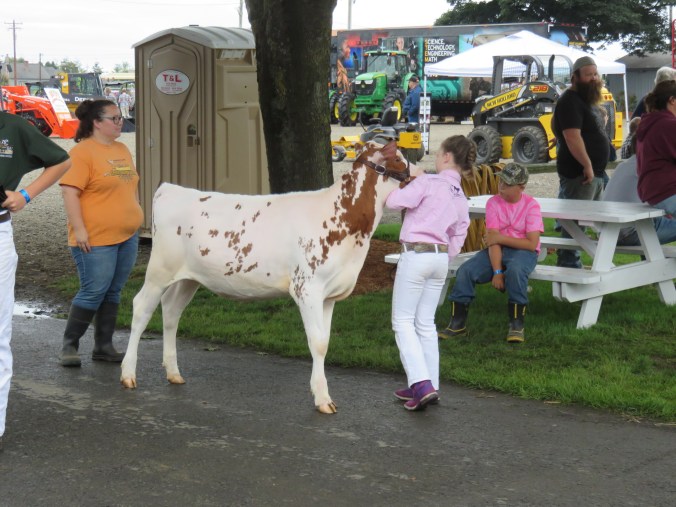
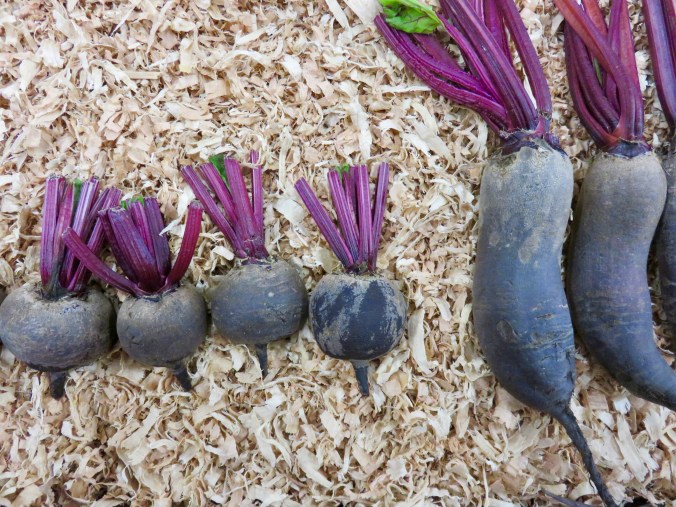
The pony rides had all appaloosas. The veggies were delectable, the cows looked at me when I told them they were beautiful, but there are fewer cows brought into the fair barns than when we first attended decades ago now. This year there were no goats or sheep or pigeons, but a strong showing of pigs and chickens and rabbits. Lots of children were showing their calves and fully grown cows too. This girl (below) got several wet kissy-nudges from her pretty calf.
IMG_4679

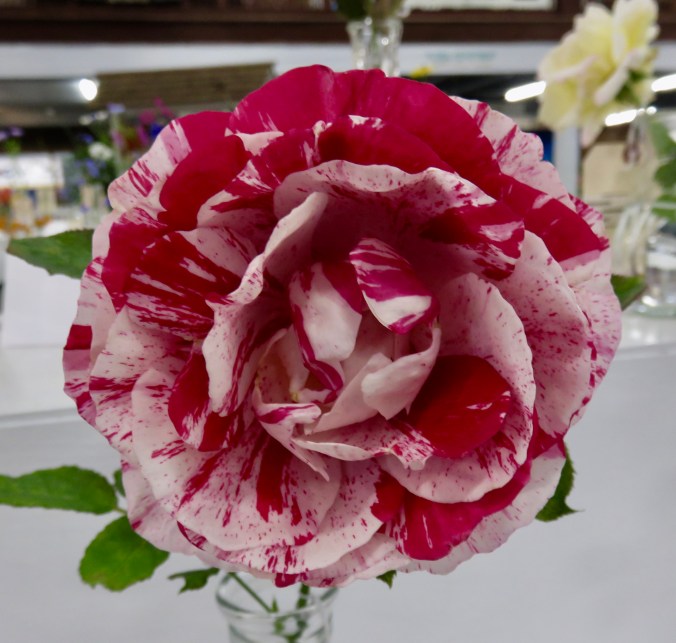
The flowers are among my favorite exhibits. The Tillamook ice cream cone was great, but the onion rings came in a half-size paper dish. Those are my gavotte fair foods. Gary bought a new belt and Gary drove to Astoria to renew his driver’s license.
fullsizeoutput_1013

fullsizeoutput_1008

Friday, the sun set spectacularly and today we decided not to drive into Portland.

I have not touched my sewing machine since making a skirt for Ruby last weekend. Maybe tomorrow I will work on a quilt. Maybe I will even sew. Maybe I will only make tortillas and enchiladas. Maybe I will sit on the sofa and read. It’s been a week.
STEP 3: moving stuff around

fullsizeoutput_ff3

These batiks are entirely from my stash—some of the fabrics are decades old, off cuts from previous work, scraps smaller than a sheet of paper. So far, they are individual blocks that look messy because nothing is trimmed and sewn together. The wider dark bands will not be so wide once they are joined. The lines will be straighter. The colors are close.

This could go on for days or weeks.

About half of my blocks are done—the blue-and-yellows photo shows eighteen of twenty completed so far. I might piece thirty more blocks, but twenty would work for the front.

There are two more lines of narrow pieced blocks to make. And then the dark-on-dark wider strips. I might have all the blocked pieced by next week. Since the pieces are not attached to one another, I can move blocks around. The large wide one in the lower left quarter of the photo looks too light for the wide dark bands. I might cut it down narrower or find another place for it. Perhaps both. Deciding exactly what will go where is an ongoing consideration.

Usually, I end up with more blocks than places to put them in the project they were designed for. I have a strip of pieced squares from a cherry-blossom quilt. I used leftover squares from my grandson’s quilt to make a bank for his stuffed toy. Everything finds a place eventually.

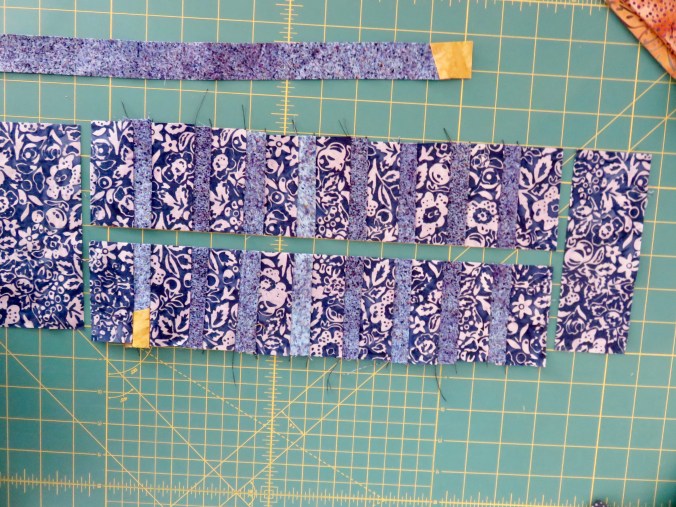
The “Rain” quilt lay on the bedroom floor for weeks while I decided about the stripes, rearranging them, shifting colors. Below, on the left, the first iteration with strips of colors for the center panel laid in place. On the right, the final choices, stitched into blocks but the blocks not yet joined. There would be a double border too, also pieced.

And then there is piecing the backing. (I am already trying to find a way to avoid that task.)

fullsizeoutput_ff7

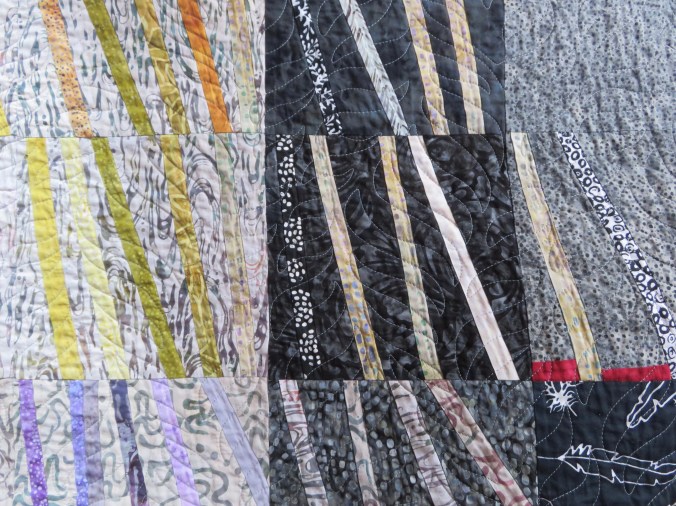
Close-up of “Rain.” Left is center panel, middle is first border, right is second border. I had to purchase only a half yard of dotted gray fabric to complete this quilt, the rest from my stash.

STEP 2: cutting

fullsizeoutput_fea

I particularly love this batik fabric, but I used a favorite speckled fabric for the bars, and a bit of yellow. There are not many yellows in my stash, but I mean for this to be a blue and yellow quilt.

An email this morning showed me a knitting pattern I liked. I never knit from patterns, but I often use patterns to push myself in a new direction. This one has a fancy design on both the body and sleeves. What I found interesting was the raglan sleeve shaping and that it is knit top-down. That is something I never do. I bought the pattern and discovered it has short rows, something else I have never done before. Two new skills!

I am up for that because I recently learned to do a twisted rib and I am eager to incorporate that into a sweater. I have the yarn and it’s green. But I also have yarn for a Koigu and kid mohair-and-silk sweater in smokey violets. The gauge for the purples is close enough to the gauge of the new pattern, so I watched a YouTube video about German Short Rows linked in the pattern. Very easy, very smooth, and the woman said, when it got a little counterintuitive, “Trust in the lord and keep knitting.” I am not religious, but the sentiment delights me.

Trust the process.

The quilt is coming along. I generally prefer to piece square blocks, but this time I am working in random-length rectangles. It may not sound like much of a challenge, but the shapes are pushing me outside my comfort zone. At least two blocks a day should see me done by the end of August, front and back too perhaps.

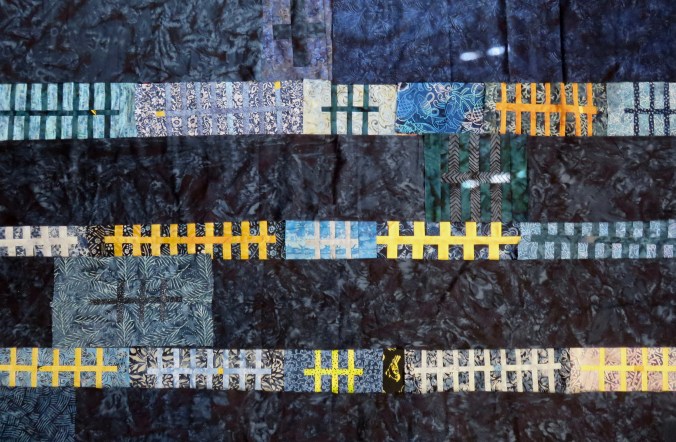
fullsizeoutput_feeHere are the first few blocks laid out in stripes. I have begun cutting and piecing, eight blocks so far. Laying out the pieced blocks on the floor tells me how far I have to go and how different combinations of hue and value work. These blocks are not sewn together and they will be moved around as I work. I mean to alternate wider and mostly solid dark stripes with narrower and mostly pieced stripes. Some fabrics are so charming in their pattern I will include them as whole blocks rather than piecing.
I should name the pattern I am piecing—in fact, it probably has a name, but I have never seen it before. It is an embellishment of Chinese Coin, a traditional quilting pattern of multi-colored horizontally-striped vertical bars alternating with solid vertical bars. But really it is a pieced version of a pattern I wove into the center of a weft-faced rug that was itself based on a Colonial American doubleweave coverlet pattern called Snowball and Pinetree. I enjoy reinterpreting traditional textile embellishment from other sources—weaver’s log cabin used in a quilt, knitting a quilting pattern of equilateral triangles, a common fabric piecing design. (I should have kept that sweater purely for the pattern. My family found it ridiculous, however, so off it went to a charity.)

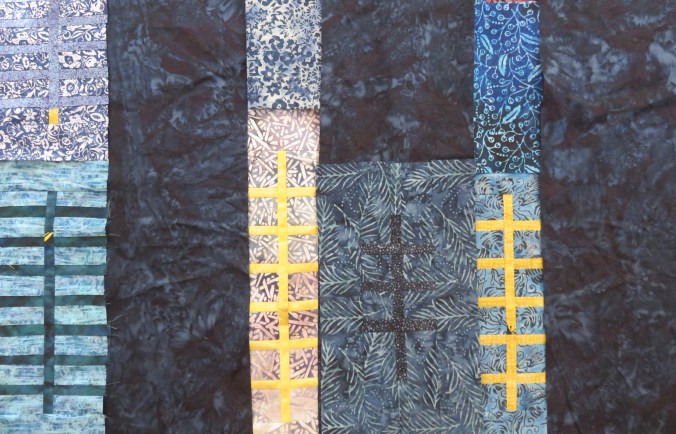
The pieced blocks will have skinny vertical lines crossed on the horizontal such as the yellow on blue in the photo. There is also a wide blue-on-blue block between the two yellow ones in the photo. Some of the center bars in the pieced blocks have a spot of another color—the yellow tip of a speckled blue bar upper right (part of the block shown half-finished in the photo above) and a bit of yellow in the dark blue bar of the block just south of that one. I will use about fifty fabrics in this quilt, all from my stash. The backing too, I hope to piece from my stash. Even the thread I am using is leftovers. Black so far, and on my second bobbin.


STEP 1: vision

IMG_4589

The first step is staring at colors. This might last for a few days or weeks or even years. I had the defining fabric for my “Rain” quilt waiting for at least twenty years before I figured it out.

The patterns of these collected blue fabrics are all over the place: sea shells, blueberries, stripes and sailing ships, speckles and dots and stars, flowers, leaves, swirls and zig-zags. The flying geese fabric might be thirty years old—batiks, as best I can recall, were still relatively new on the market. The fabric itself is somewhat heavier than what I find today. They are all batiks. The yellow birds on black are a color on black—a combination I rarely find these days—purchased for my youngest grandchild’s baby quilt several years ago. One bird for this quilt.

The process is slow, but much of my process is invisible. I have laid out fabrics for weeks at a time, once I figure out the pattern. I think about what to do until I can construct the quilt in my head, and then I build that vision relatively fast, usually in a few days. Years ago a non-artist friend complained that I had completed a gouache painting in a few hours—yes, but she did not count the staring and the thinking, or even the preliminary sketches. She didn’t see any of that.

I have to see the work entire before I begin the easy part, that making.

A compilation of squares and rectangles, each with an X in the middle? I’ve done that before. All squares with skinny bands? I’ve done that too. Alternate the bands horizontally and vertically? Grade from light to dark? Shift the size outside to inside or top to bottom? I never use patterns and I am not generally fond of blue, so this one is particularly tricky. I have reorganized these colors since I took this photo. There are a few turquoises and purples mixed in with the cobalts. There is also a stack of yellows and golds, by way of contrast. I would like to add hits of orange.

I’ve been messing with these colors for well over a year. Gathering them longer than that, without those fabrics admitting they want to be anything. The other day, while dozing half-awake before dawn, I envisioned a blue quilt based on the old “Chinese coin” pattern, narrow bands of stripes, skinny on fat and divide by bands of solid color. That idea makes me squirm, so it’s probably the one I should pursue. The temptation is always to choose the easier option, and I have to work hard to resist doing the fast and easy thing. I have considered making two blue quilts—the easy one in squares, the harder in stacks of coins.

I’ll let you know.

JUNE ROSES

IMG_4360

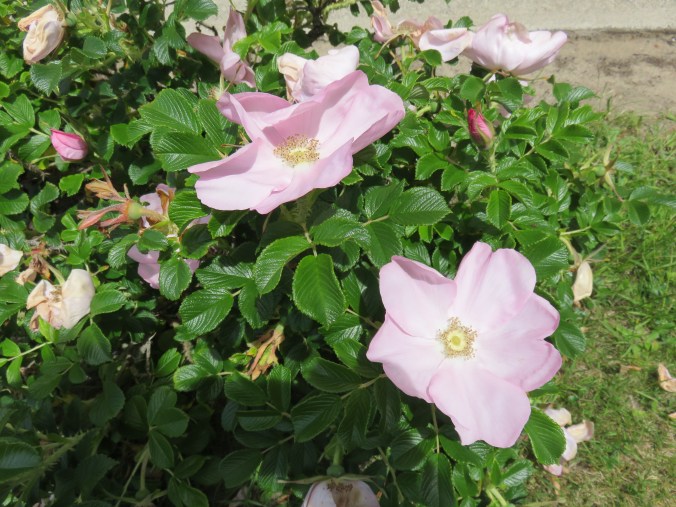
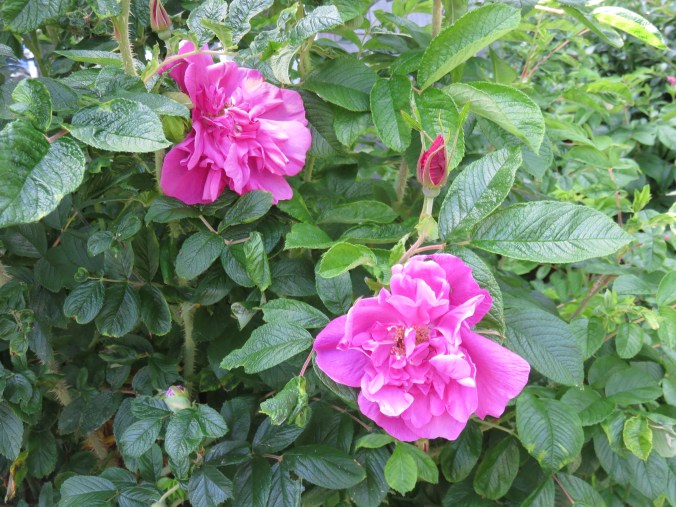
The semi-double Hansa is a rugosa rose. This one is planted on the east side of our property. I took it as a volunteer from my mother’s garden. The rose it sprang from is no longer there, and ours has to be cut down from over seven feet high here, where it is also sending out plants to fill the bed.

Oregon is home to the City of Roses, Portland, where there is an official test garden and several beautiful public rose garden parks. My grandmother had roses planted along her driveway, mostly memorably Oklahoma, a deep dark red.

Here on the coast, however, salt and wind and cloudy days are a bit of a challenge for hybrid teas and the other well-known roses. What does well here, aside from the wild roses that we fight from taking over, are mostly the rugosas, which require no special care, are disease resistant, and shade tolerant. I counted ten varieties of rose in our garden. The raccoons takes the best hips, and our tenant eats the hips from Hansa.

IMG_4358

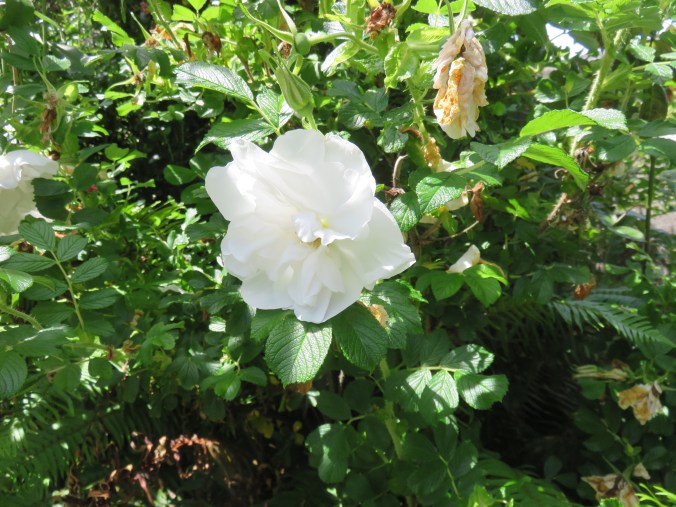
Double De Coubert is another rugosa, marvelously scented. It has long been my favorite. We also have a rapacious single white that would happily take over the world.

IMG_4352

We think most years that this low-growing rugosa in our front (ocean-side) yard has died. It is the last to leaf out, but then blooms for a long time. The flowers don’t look impressive in a photo, but they are five inches across, their spicy scent fills the yard, and the hips are spectacular. They are little small red apples and a chipmunk gets them every year.

IMG_4357

This little beauty was a risk this early spring. It is not a rugosa, but I could not resist the photograph showing the dark burgundy eye and bright stamens. Then it bloomed!

fullsizeoutput_f70

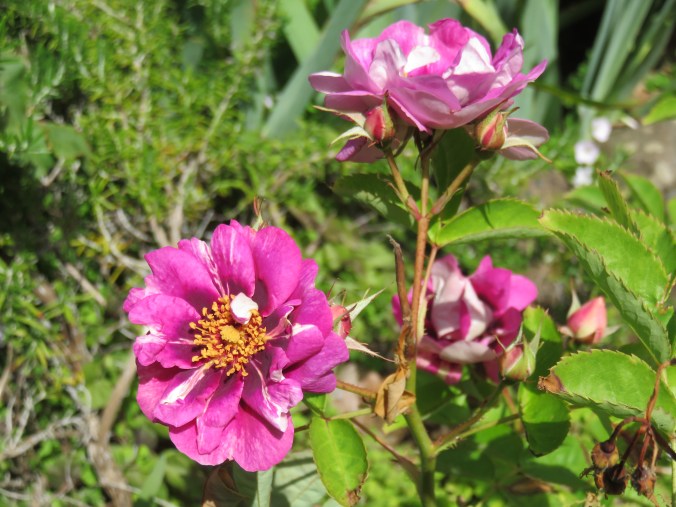
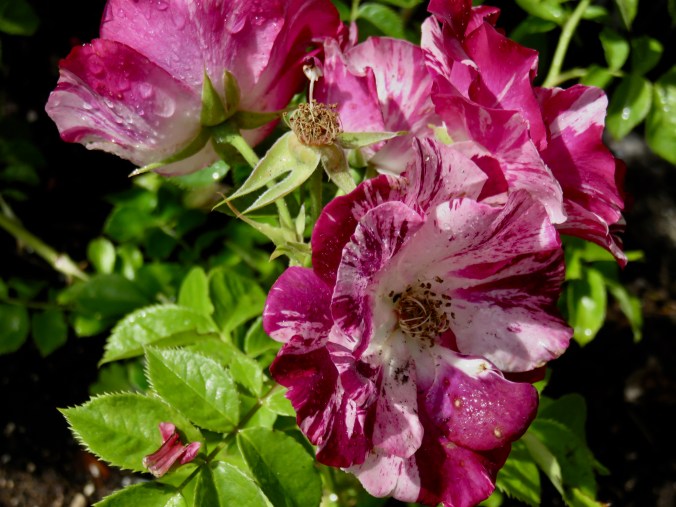
This rambler has medium-sized flower, good scent, and it is striped. I adore stripy flowers, and the colors are just right. The last striped rose did not survive, but this disease-resistant, shade tolerant variety seems determined. We will build it an arbor if it does. The tag says it reaches 12-14 feet.

It is June and the garden is lush: “Everyone looks like a great gardener in June.” I can’t remember who said that, but it’s true. We look brilliant.

HABITS OF PLEASURE

IMG_4277.jpg

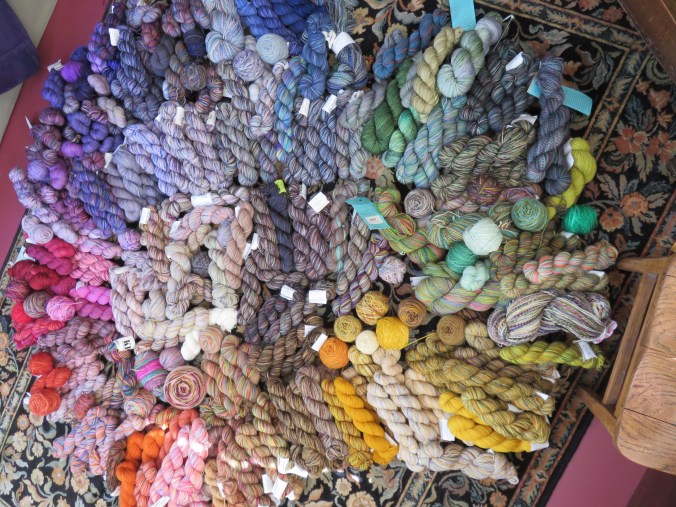
There are too many blues. I am not actually a blue person—I do not now have more than one garment in my closet with a pale blue pattern. What I have in my Made Things drawer is all from the other side of the spectrum. As a result, I have many blues, but mostly tipping toward green and especially purple. Not enough red. The red/pink bin is only a quarter full.

We all have our habits. My husband and I both love books and tend to fill shelves. Beyond that we have other things, too much of other things.

When I spread all my Koigu yarn and a handful of handspun skeins out in order to get them sorted back into bins by hue, he took a look and announced: “I am cutting you off.”

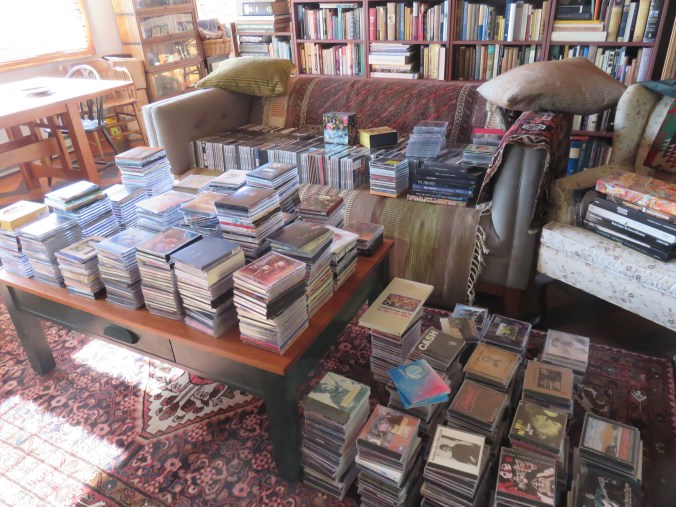
Then, the other day, he took all his CDs out of his bookcases. They filled the sofa and two chairs and made stacks a foot and more high covering the coffee table and the carpet. I tried to get a photo but could not get all the CDs in one shot. He did not count them. Suffice it to say he is cut off. He is humbled and sorry. “I am serious. You have to cut me off.”

IMG_4342.jpg

This is most of Gary’s CD collection, removed from shelves Monday. I think he meant to eliminate a few, but in the end, he spent an entire day (the day before yesterday) putting them all back. Every one. They are organized by artist and tradition or period. (Those are his books in the back too. Also organized by topic.)

Gary says, “It’s not a habit, it’s a sickness. Somebody please stop me.” He would like to blame Cervantes for some recent acquisitions because Don Quixote alerted him to even more music without diminishing his interest in Sami and middle Eastern, not to mention classic rock and roll. (No one should try to tell Gary about classic rock and roll.)  We will not go into musical instruments since he has friends with four times as many.

On the other hand, I felt free to order seven more skeins the other day. His pile is bigger than mine, more costly. And after all, I eventually wear or mostly give away my yarn when it has become something.

And when we spread them out, Gary might feel guilt, but all I can think of is how to put the colors together in order to make something, how that might be a shawl or blanket, those skeins might make a striped sweater. And then he plays a CD and his imagination soars, just like mine. Not “harmless” habits but beautiful.

Both of us know what sparks joy.

SHIFTING GEARS

fullsizeoutput_f54

The ocean yesterday morning. We had several insane bursts of rain later on, as if someone was playing a firehose on the house. No exaggeration!

Last month I determined to complete several projects, mostly knitting. I knit a narrow scarf, a huge shawl, a cardigan sweater for my granddaughter, and a washcloth—that last from a horrible but gorgeous cotton linen blend. I would make another washcloth if the yarn were not so stiff and rough that it hurt my hands to knit with it.

There were small writing projects I worked on and larger ones I skirted. I have ideas for two quilts and a couple of warps. Plenty of work is waiting for me. But instead of any of these, I am planning another knitting project.

fullsizeoutput_f56

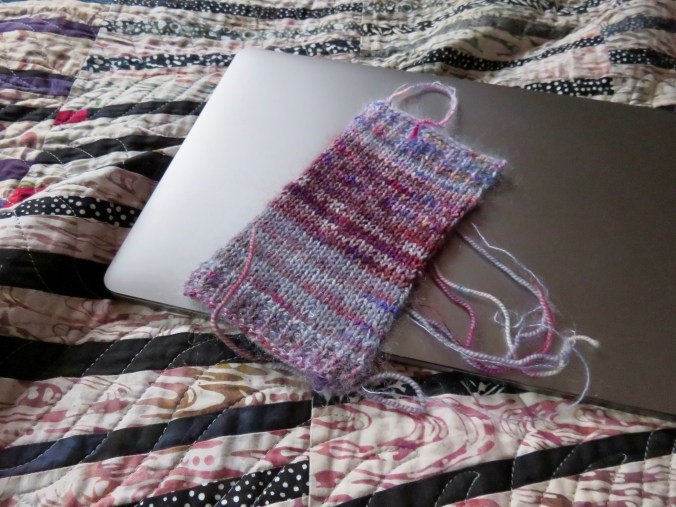
This little 4″ x 7″ swatch uses two yarns, a 2-ply Canadian merino in three colors and kid mohair/silk blends from Japan and Canada in two colors. There’s a sweater in this swatch—I just have to figure it out. In the mean time, I am writing out a pattern for my other granddaughter.

I knit a swatch and have been carrying it around for three days. Yesterday, in the coffee shop where I was meeting a friend to play Scrabble, and there was a woman knitting. I walked over and identified the yarn right down to the color: brand Malabrigo, yarn Rio, color Anniversario. Then I had to confess that no, I had not made my sweater.

That needs to change. Doesn’t it?


A PBS special about where we get our food claimed that human beings were nomadic for thousands of years until we began farming so we “didn’t have to move anymore.” The writer got that wrong. When we began farming, we could not move around anymore because we always had to be there to look after our crops. Farming did not allow us to remain in one place, it forced us to stop moving. There is evidence that this shift, rather than relieving us of a burdensome life of mobility, actually oppressed us, forcing our workdays to become longer, our labor more backbreaking. There is every possibility that this assumption that stability is preferable is mere bias. True, human beings developed architecture of stone once forced to remain in one spot, but we were already creating on a smaller scale.

Whether we traveled each day, or closed the door to a house every night, we created what scientists like to call artifacts. We call them garments, useful objects, pendants, and toys. We made art, we sang, and we told stories. These are human activities. Making stuff beautiful. This is what we do.


IMG_4321

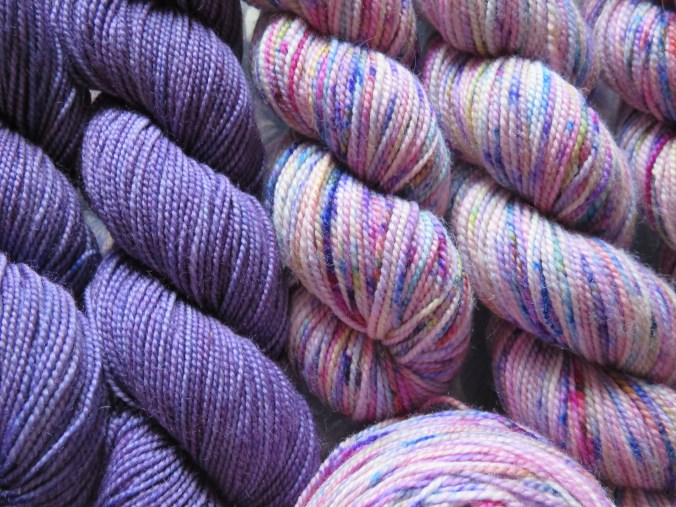
My older granddaughter told me the other day that she wanted purples and pinks, and here’s the start after combining and recombining many other colors. The mohair/silk blend will likely be burgundy, and that whisper-weight thread will tip these colors darker and redder. I still need to make a swatch. If I don’t like it. I reorder my colors until I get them right.

BOOK ORDERS

IMG_4120

I think of this as the Big Altar. Sometimes in summer that back wall shows lime green.

I received notice this morning that I saved $5.66 on the order of a book I have absolutely no memory of ordering six months ago. And another one, a book costing over twenty-five dollars, hard cover, by an author whose name I do not recognize, is coming in September. I think I must have read a short story by this person on-line. Maybe?

What I was actually thinking about this morning was the sound of the dawn chorus—the chattering and peeking and calling of a variety of songbirds that I particularly enjoy in late spring with my bedroom window open. Too quiet this morning. I hear the eurasian doves flirting. I hear the ocean, always the ocean. I hear my husband clearing his throat downstairs.

And I was reviewing memories of other lives I have lived. Pushing teaching off to the side, I was once a goldsmith, a sighthound field trial judge, an illustrator, a teenager. These were exhausting and interesting occupations—still fascinating to me after all this time.

My husband came upstairs and told me that I was not hearing the birds because they did not come on duty for another twenty minutes. I wanted to believe he was serious.

A crow.

I opened the novel the day before yesterday and worked for a couple of hours. I found a typo. I found a half-page repeated twice because I had rewritten it and then failed to delete the first version. I liked the first version better so I deleted the revision. I think I have still failed to scatter the ashes of the dead. If I open the manuscript today in order to scatter the dead, I think I will only find a typo.

I will begin the right front of my youngest granddaughter’s pink cardigan instead.

IMG_4122

This is the Little Altar.

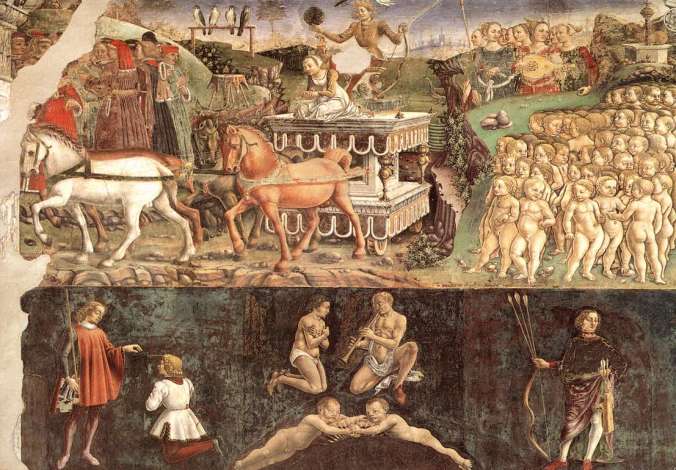
Francesco del Cossa

3may_1.jpg

Allegory of May – Triumph of Apollo, a fresco by Francesco del Cossa (c. 1430 – c. 1477) was an Italian Renaissance painter of the School of Ferrara.

“Cossa is now known for fresco decoration of the summer pleasure villa/palazzo known as the Palazzo Schifanoia, located just outside the city gates. Together, they painted a series of the elaborate allegories around the themes of zodiacal signs and months of the year. These were only partially restored in the 20th century, and there are three that are reasonably assigned to Cossa. Of these, one of the most remarkable images is the horde of naked toddlers in the Allegory of May – Triumph of Apollo.”

“The façade was originally decorated with a cornice of feigned battlements, its surface smoothly stuccoed and decorated with geometric designs of highly colorful imitation marbles, which have been lost, lending a somewhat dour public face to Palazzo Schifanoia that was not what Borso d’Este intended. The rich white marble entrance door survives, though its tinted colors have weathered away and art historians disagree whether it is to be attributed to the painter-designer Francesco del Cossa or to Biagio Rossetti. Above the arched door, flanked by pilasters, the Este arms are displayed and the unicorn, a symbol of ducal benevolence and the source of patronage. In 1493 the terracotta cornice was added to designs by Biagio Rossetti, who was also commissioned by Ercole I d’Este to extend the palace.

“From the Salone dei Mesi the visitor once passed directly into the gardens reached by a monumental stair from the summer loggia, structures that were demolished in the 18th century. After the Este left Ferrara in 1598, the palazzo was inherited through successive heirs, eventually by the Tassoni family, its frescoes whitewashed over. Eventually, during administration of the duchy as part of the Papal States, with a Habsburg garrison, it became a tobacco warehouse and manufactory. When Palazzo Schifanoia came into the possession of the comune of Ferrara in the aftermath of World War I, only seven of the months in the Salone remained legible.”—Wikipedia

Listing this under the category of “color” is a stretch. I had to create “ART.”

NINETY-SEVEN

img_3832

I was ill recently, only a cold according to the NP, but one that many seem to have suffered from over weeks and months. I hoped to avoid that as I had not been sick for five years, not since the last time I forgot my flu shot. I forced myself to rest. To eat. To lie about and accomplish nothing.

This goes against the grain for me, this doing nothing. I was too ill to argue.

I watched television each evening. I discovered Silent Witness, a BBC drama, and with over 20 seasons I hoped it might last me until I was well (I managed to watch only the first 8 seasons on Amazon Prime). I binge-watched all of Marie Kondo. I saved an episode of Monte Don’s Big Dreams, Small Spaces for the last thing I watched before going to bed at 8:30 each night. We are in the 3rd season and I will be sorry when it’s done. He always cheers us.

Gary insisted I go to the the walk-in clinic after five days of being sick, and the NP I saw correctly diagnosed my main problem as a lack of sleep. “Rest,” she told me.

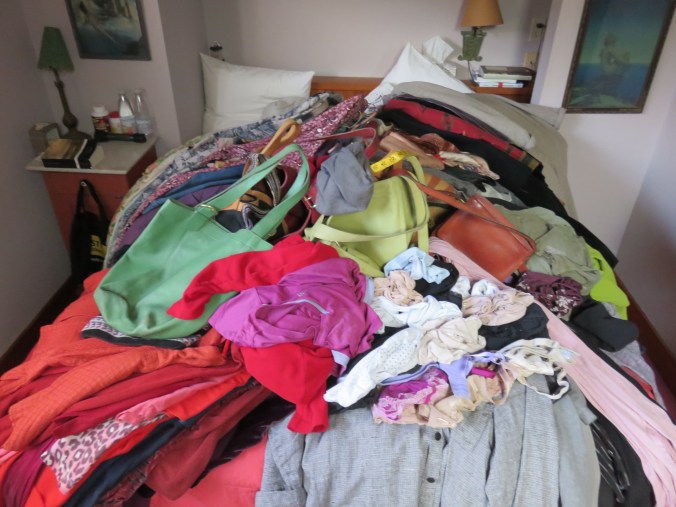
Like the rest of Netflix watchers—and there are apparently so many clearing house that charities are overburdened with unsparklifying clothing cluttering their lives—I watched people dump their entire wardrobes on their bed to make an enormous pile. I thought: I do not have that much, but I could do this.

About the third day after I thought this, I put all my clothing on the bed, on a morning I felt somewhat better and made a not-quite enormous pile. A pile. Not as enormous as some. Then I spent an entire day. I did a little and rested and did a little more. I was ruthless about clothing that sparked guilt or frustration, even including a sweater I’d had for little more than a year. Many things went to charity. A silk skirt I probably could still wear but have not worn in many years goes into a box for my granddaughter. A gorgeous handmade ethnic jacket will go to a friend, who will wear it. I never will.

In my closet now are 97 items of clothing. I counted. Pants, sweaters, shirts, tank tops, a single plain black skirt, dresses and jackets and coats. I counted all five coats and the three kimonos I have not worn in the last 10-20 years but I am keeping because they are beautiful and I love them. My closet is leaner and neater. It is mostly black and gray and shades of red. And kimonos.

[That count does not include the bathing suit I have not yet worn, but hope to (+1). I did not count the running gear I wear each morning on our walks (+9 items). I did not count any of my underwear such as bras (+5) or panties (+10) or socks (+?). Shoes, boots, runners, and gardening clogs (+12). Scarves which are mostly sentimental or home made (+?). The purses and other bags received a thinning, but I plan to review them again. So really, perhaps double my modest count if I include absolutely everything, including the Liberty scarf I bought the first time I went to a a show circuit in Canada. I went through my jewelry box last year and gave modest family pieces to my daughters-in-law. I won’t count that.]

I cleaned out, made space, held each item and judged how it impacts my life, how it aids or detracts. It felt silly to actually speak to things. The result has been a pleasure. A simplification and relief. Nothing is crowded. I like everything I kept.

fullsizeoutput_eaa

Sometimes I feel like my life could use Marie Kondo. I should eliminate the activities and obligations that do not spark joy. I should pass them along. I feel that way just now about teaching, because I am behind in grading and feeling guilty and inadequate. And then, when I am actually talking to students, I know I love my work. I love this. So instead, like the beautiful silk kimonos I have had for forty years and the little green cotton top I have had since high school—I keep what makes me smile.

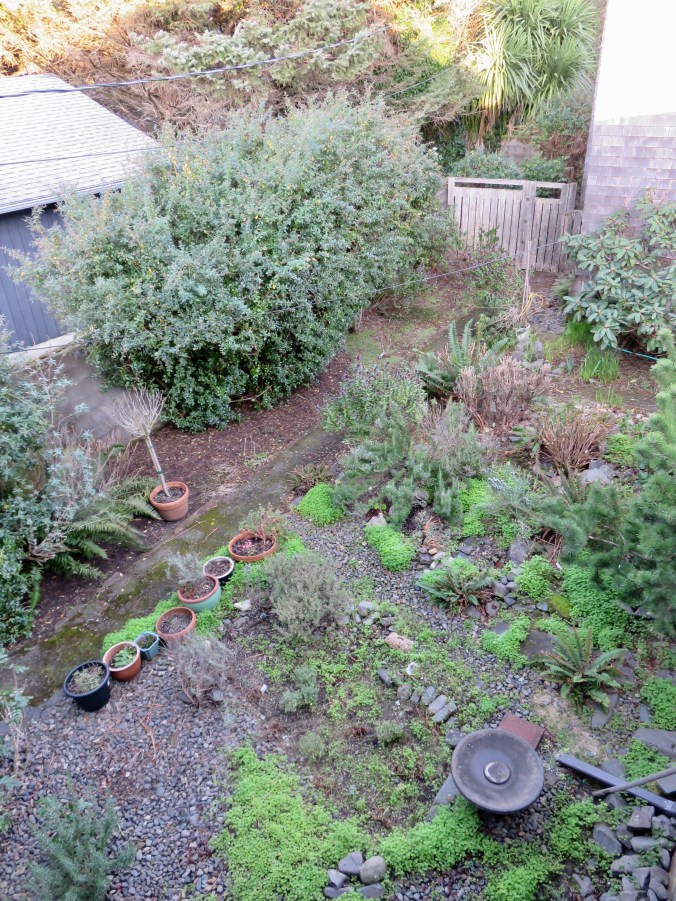
We are talking about the gardens. The middle yard was once a “dog yard” fenced and graveled to keep our dogs safe. Since we no longer show dogs, have not had more than one dog for nearly 20 years, and now none at all, use of space has changed. It is not used at all. I planted it with hydrangeas grown from cuttings, carmine-flowered escallonia, the white rugosa rose “Blanc Double du Coubert,” butterfly bush, hebe, lamb’s ears, and blue-flowering ceanothus. I wanted plants that would bloom, mostly remain green throughout the year. I wanted a pretty place where we could sit, and we did do that for a while. But we were still both working and tired and it rains.

I planted three rhubarb plants before the fourth survived. The single white rose has become a monster. The escallonia are monsters too. Naturalized Montbrecia did not fit into my original blue/violet and white color scheme, but I let it prosper and added “Lucifer.” Ferns and a pine tree and other volunteers have been suffered to stay. For now. Rosemary did well. We will likely plant more.

More recently, newly planted Japanese iris have survived and also three thymes. One of the ceanothus was moved to save it from strangulation by the escallonia and it thrives near the ocean. Our garden is wild and beautiful but a genuine mess of overgrown and neglected plants. This year we will give it some work. Monte would have us clear the space completely, but I will not do that. These plants, some of them, spark joy. I will keep what I love, and I will move and replant and discard according to a plan I have not yet devised. I have measured. I will draw it to scale as I once drew entire houses.

Monte’s people generally have a budget of at least hundreds and often thousands of pounds. I will not, but some of his people have done quite well on no budget at all. I might purchase another rose, a few bedding plants, a replacement for the variegated hebe that we lost one hard winter.

Gary wants all the gravel gone. All the big stones. I want a pretty flat space in the middle to sit in the sun with my husband, drink tea or wine, not think too much. I have chairs. I have a small table. The surface might be stone we already have, or gravel, or something else. We haven’t decided, but it will be simple and plain and there will be a few potted flowers because I do have pots, many more flowers everywhere. Lettuce.

Like my closet. Like my writing goals. Like everything. Easier, simpler, and intended to spark joy.