CLOTHES HORSE

fullsizeoutput_10

The “Flamingo” quilt before being cropped and the edges bound. The white showing around the edges is cotton batting; the red showing on the very outside beyond the batting is the backing.) My quilts generally begin with a signature fabric that drives the design. In this case, I was captivated by an Indonesian batik in a Japanese plum-blossom pattern, imported and sewn in the United States. This is one of the pieces that will go into a local show in December 2020. (Assuming they allow me to bring such large works.)

Gary sewed a button on the other day. A few months ago I made repairs to quilts I’d sewn for our older son—quilts that are decades old and have been through the wash too many times. I recall my dad talking about learning to darn socks in the Army. I know, in theory, how to darn socks and I even have a favorite pair of wool socks that need darning. I also have a tweedy charcoal/brown silk noil sweater that I bought at Banana Republic that needs some attention under the right arm where the stitching has come undone. It was originally intended for one of the boys—it’s a man’s sweater—but none of them wanted it. I took it for myself and despite the label that says “dry clean only” have been machine washing it in cold water and hanging to dry for over twenty years. It will take me a few minutes to repair.

Repairs have become rare. Continue reading

SUNSET PIG

fullsizeoutput_10fd

…you might kiss one.

A group of at least a dozen people stayed next door this past weekend. (Gary says they were likely Swedish because of the white caps and running about barefoot on the sand and even in the water in November.) They took over the depression where Gary had his fire last week and burned two thick root knots that he’d left, plus some purchased firewood. They did not burn the log they sat on in the evening, which is a blessing. Tourists tend to lay huge drift logs over their beach fires and then walk off when they discover that the log needs hours to burn. Thankfully these people had a nice-sized and perfectly legal fire and then put it out before going to bed. (Gary hoped they might leave the remains of their cedar kindling, but they didn’t. Did it go all the way back to Sweden?)

The wood chairs still need painting, but a plastic chair Gary rescued from the rocks where it had drifted on high surf last month can stay out all winter. You would have thought I could manage to paint those chairs over the summer, but it didn’t happen and they stay under cover till I get them done.

There are a lot of other things I did not get done in the past months. I meant to make my oldest granddaughter a cardigan and two dresses. What was I thinking? I have not sewn a garment in decades. But like most women of my generation, I learned how to sew in school. I made a pullover cotton shift in seventh grade and a wool skirt the next year. My mother hated to sew but she taught me too. The last garment I can remember sewing was pure cotton onesies four our youngest son born in 1982. American companies were not making cotton clothing for babies because of flammability issues. We neither of us smoked then or now, so I found a pattern and learned to machine-sew cotton double-knit jersey. Dark green with rainbow trim. Bright red. I don;’t suppose I even thought to take a picture, though I can picture them in my mind’s eye even now. But now I can find organic cotton for babies and children, which is even better.

iu.jpeg

I am over 12k (of 50k) on my NaNo challenge this morning, and I seem to be writing something unexpected. I meant to rewrite a very old manuscript, but instead I am writing something new. It’s true I am using the same principle character and I imported a few pages that I had already reworked over the years, but even without those pages, I am ahead of schedule.

The best part? I am not sure where this story is going. And maybe even better (so the best-best): it’s funny. I have not written funny in such a long time. I have been giving the chapters titles a la Forster such as “In which Alice tries to solver her personal problems with a hammer.” So that is happening. And barely into the fifth day of November.

A strawberry-frosted cake is tricky in November. She wanted fresh strawberries and I avoid them out of season. No avoiding them for my granddaughter. A light vanilla cake, though I am partial to and only experienced with pound cake. I made a run at three cake recipes and strawberry cream cheese frosting. That last was not a win, though it tasted good enough and was a pretty color. I ordered freeze-dried strawberries, organic freeze-dried strawberries. Powdered in the food processor, they are a rich color that thinned down to a pretty pink. (I mean to try Swiss buttercream as soon as I get my hands on the right sort of instant-read thermometer.)

There is a cake in the fridge. Two pounds of out-of-season organic berries. I had dreams last night about making cake.

Gary and I both had a sore throat and sinus issues, but we seem to be better now. Our sore throats completely gone, no fever ever. I had to put off baking the final birthday cake till yesterday when I knew I was healthy again. Took my time. Photos later.


IT’S NOT YOU, IT’S ME

IMG_4937.jpeg

I hope to take my third quilt up to be quilted this week—that’s it above while it was about a third complete. I am waiting to hear when I can deliver it because I need to send my laptop in for repair. Again.

I have been using a Mac daily since 1990 and until this one I never needed a repair. I replaced my best laptop at the age of nine, about 112 years old in computer years. But this one I am working on right now is still under the original warrantee. Months ago, the screen started pixilating in dark areas. Shadows in images were no longer black but turquoise or peacock green or cobalt. Or white. Bold Helvetica showed up as outline text. The weird appearance got worse and worse. Eventually the entire screen turned to pastel snow in horizontal bands.

Imagine trying to explain to a young tech person what’s wrong. They kept wanting to see it, or have me email or send them something. I kept having to explain again that the computer was unusable and I have no smart phone. (One of my sons keeps trying to remedy that by giving me an iPhone. I probably should let him.)

Anyway, my computer went to the Apple store where it was diagnosed as troubled, then it was sent away, and shipped back to me good as new inside a week.

But now it’s doing it again. I can still use it, but I figure it’s heading again toward pastel snow. I hope if I send it in they will see the problem.

I’m not going to freak out about being without my laptop for a week. I no longer teach so I am not depriving students of immediate access. But just in case you try to get ahold of me in the next week or so, just so you know, my computer is in repair limbo.

It’s not you, it’s me.

CLIMATE CHANGE

IMG_4963.jpg

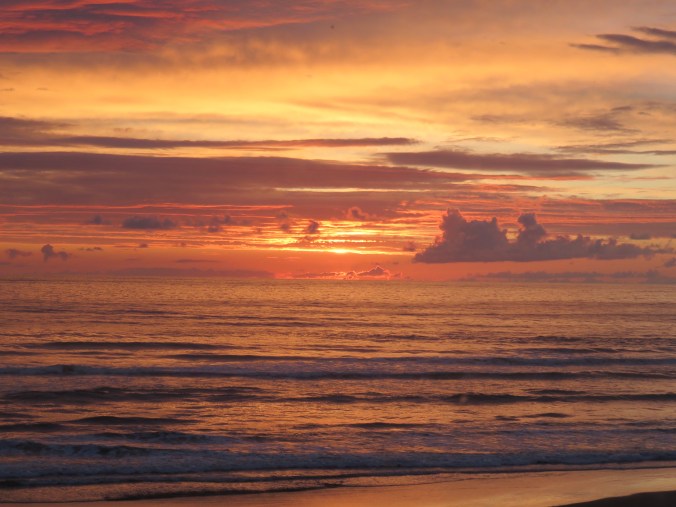
The sky reflects in the washed sand.

The rabbit has been at my roses again. Gary put wire around the denuded stripy rambler and it leafed out again and bloomed, though it did not have the energy to send out much new growth. The other new, pink, rose in the front came back without help, but apparently the rabbit has been only waiting on salad. The stems are naked. Again.

We like the rabbits even so.

Gary and I have been out in the garden each day, attacking the escalonia, potting up flowers. There are little plants coming up all over the front yard where the deck used to be. The montbrecia came up first and the rabbit bites off a blade in the middle and then chews it right up to the end. Since then, snow-in-summer and violets and lamb’s ears are coming along.

We have been watching the Monty Don gardening shows, including Gardeners’ World. The BBC presenter talks about gardening in ways I have never heard in an American show or from any American nurseryman. Don puts up netting and wire against invading rabbits and cabbage worm, but he spends a lot more time talking about flowers and other plants and environments that attract and feed bees and moths, birds and other wildlife. Wildlife is a priority. He also realistically and explicitly addresses the challenges of gardeners’ more urban environments and the growing impact of climate change. Heat and drier summers. The challenge of new pests and the loss of native plants unable to survive the new normal. The world is changing.

IMG_4959.jpgOn our two-hour walk yesterday we saw a little display, a faerie-fort created by some visiting children. There are painted messages and careful arrangements of vegetation they found on the shore.

Where we live.

IMG_4756

World bird populations are in trouble. A recent study by Cornell shows a 30% drop of breeding birds, and loss of many species. In the mean time, an organization did a brown pelican count recently and decided they are doing fine. Most days I have counted a dozen or more each day. On a good day, there are too many to count—a great squadron or scoop or pod (or maybe a group of pelicans is called a “colony”?) flies on and offshore. We used to hardly see them, and then ten or fifteen years ago fourteen stayed all summer. It’s been a growing population.

We got our flu shots today and put the quilt back on the bed. The weather is changing from summer to autumn. It is a pleasure not to have to consider the heat.

I have been staring at the inner border of the orange and purple quilt for a few days, moving strips here and there, cutting new stripes, and I think it is ready to be sewn. I even took the step of applying for a show. I don’t expect to win one, but I have enough work to share. Either that or shift the quilts on four beds for newer ones.

Some change is good.


OH DEAR

IMG_4920

Another one.

Wasn’t I going to make something completely different? A story?

“Autumn Garden.” All batiks, about a hundred different fabrics so far here. All those skinny strips will be pieced into the squares.

THE COLOR PURPLE

IMG_1989 - Version 2

““I think it pisses God off when you walk by the color purple in a field and don’t notice it.”—The Color Purple by Alice Walker

My favorite pair of gloves are purple. They are not quite dark enough because I want the shade to conceal stains. That sounds practical, but I also prefer the shadows, which are not always practical. Just now I have fabrics spread out over the floor again. I am looking at a triad of deep purples and lime-sage greens and brilliant bittersweet, all batik. Waiting all over the floor because I have no wall space. Not practical.

My walls are painted pale tints of plummy gray, but what draws me to purple is the darkness. Purple has a royal association for many people, a sophisticated color. It might remind me of pain. As one example, I have been thrown from horses, kicked and bitten by them. People do die falling from a horse, but for pure suffering during recovery, I cannot recall anything more painful than that perfect purple-dark bruise risen on my shoulder that took a month to begin fading. That is what I think of first when I think of purple.

Violets have volunteered in our front garden. There is mostly only sand from where we removed the deck, the montbrecias coming up everywhere and mowed half down by the rabbits. (The rabbits have become large, and yesterday we watched one eat an entire dandelion—good bunny.) but just at the edge, between the expanse of sand and the hedge. a violet.

Many things that are called purple are not purple at all. Male purple finches have a reddish head. Purple prose is the overblown decorative fluff that gives English teachers a headache. On the other hand, blueberries are more purple than blue. The indigenous blue huckleberries make purple pies. Carrots were originally a purple root—the orange we know today is a sport that became so popular in Europe the original color is an oddity in modern markets. Few would consider purple carrots anything but fantasy. 

The tall flower spikes of Digitalis purpurea, as its name suggests, is usually light purple. When we were young, my girlfriends and I plucked the hollow flowers from foxglove spires as tall as ourselves. They bloomed on the edge of the woods and we slipped a glove onto each finger. We knew the flowers (and the stems, leaves, and roots) are toxic. Digitalis is the medicine my grandfather took for his heart, and too much can kill, but we ran with our purple-gloved fingers fanned before us in games. I always assumed that the foxglove of childhood games and that I saw along my drive to work each June was native. But it is an invasive species, just another European, like most of my ancestors. Maybe this is the source of my complicated love affair with purple.

The Purple Heart is a military medal for physical injury in the field of battle—implying nothing about the actions of the wounded, other than to honor the wound. An award for suffering.

Pretty purple things: amethyst and iolite and tanzanite and the opaque sugilite. The thick petals of orchids can be many colors, but the color “orchid” is violet. I have dyed wool lavender with iris flowers. That iris tint fades in sunlight. It is fragrance as much as hue: violets and lavender, the tuberose, iris, lilac scents. Somehow I associate purple as much with folly as with bloom—the pain bruises.

Yet, as a textile artist, it is the color I reach for, covet, value and strand in weaving. I choose to spice yellows or orange in a composition, to spark pinks or green. It is a hue that wants to shove gray around. And that is probably appropriate since purple has a long association with power. The ancient Tyrian purple dye worn by popes and sovereigns for thousands of years was harvested from the mucous of three species of predatory sea snails, known collectively as Murex. The fluid protects the unhatched eggs of the shellfish and drives off predators. It can be harvested by killing the snail, but also through “milking” the mucous gland of the creature. Rare but stubborn, the color, a clear reddish-violet to my modern eye, withstands fading through wear, light, and washing. The dye was already ancient when Aristotle, who was so right about some principles and so very wrong about so many particulars, detailed its production.

In the mid-nineteenth century, a British chemist invented the first aniline dye, originally called Tyrian purple and then marketed as mauve, a delicate, slightly grayed, reddish-purple. (Mauve pronounced with a long O, not a soft ah sound.) The first chemically created color ever. It is on the edge of being a cool color, found on the color wheel opposite yellow-greens. 

In youth I leaned to warmer colors—orange, vermillion, russet reds, dusty pinks, burgundy, and wine red. My preferences changed over the years and purple moved from a supporting role in accessories to center stage. This shift is reflected not only in what I wear, but in what I want to touch. I wore bellbottoms striped in black, lime, pink, and purple when I was fourteen. I dyed my hair purple when I was sixty, a joke on the old ladies of my childhood who used rinses to counter yellowing that turned their gray hair from murky yellowing gray to distinctly violet. 

Purple is the foil that makes paler, more timid tints dance. Purple is the look-at-me color, associated with power, with royalty, nobility, Lent, Easter, and Mardi Gras, but very rarely named as favorite. Studies suggest that it is a color preferred by artistic folk, more often women than men, older adults rather than younger ones, and that was the character of the room when I took a class taught by Jungians on Art Therapy. 

Sandra Cisneros had to fight conservative design review to paint her San Antonio, Texas Victorian home purple, a periwinkle blue, and pale blue-violet tint by my estimation, but the color proved to be historically accurate. There are painted ladies in San Francisco—not women, but the grand tall Victorian mansions of that city—painted in shades of violet. A favorite house in Seattle is a smokey violet shade I found on a paint chip called “Stetson” with a bright red door in the 70s before that became cliché. Hyacinth macaws are purple, and the queen of England is known to wear tints of that particular blue-violet. It is stitched into the border of a a sari or the facing of an Afghan dress. 

It makes a pattern in concrete sidewalks, city sidewalks built with glass “prisms” faceted to direct light to anyone working in the spaces beneath. Clear glass pavers were made with manganese to clarify the glass, but eventually the iron that once clouded the glass swaps ions with manganese and over years of exposure to sunlight, the clear glass turns purple. There are such sidewalks across the country in Texas and British Columbia, Seattle and New York City. Nearby in Astoria, broken pavers have been replaced. Many have been damaged over the years, but the surviving glass in sidewalks is generally quite purple. 

Violet is on the edge of wavelength in light that humans can see. Shorter X-rays and gamma rays and ultraviolet exist beyond the visible violet, just as microwaves and radio waves lie on the other side of the light spectrum beyond red. The rainbow shows purple inside the sweep to fairy gold. Some gifts seem the work of the supernatural. In The Color Purple, while discussing their view of God, Shug tells Celie she thinks God wants to be loved, “I think it pisses God off when you walk by the color purple in a field and don’t notice it.” We are supposed to appreciate the gift. 

We are supposed to appreciate the gift of that richness and precarious pleasure, the flower that blooms for a day, the shellfish that guards its eggs with purple mucous, the semi-precious gemstone, the pebble in the water, and even the fresh bump on an elbow, the toxic flower that cups a fingertip, the fine line between the violet we can see and the next shade over that is invisible to our eyes. There is beauty, but concealment too, a warning both ways. My purple gloves are meant only to protect my hands from the cold. In sunny weather I require some other protection. It is ultraviolet that burns our skin.

AMAZING NAMES

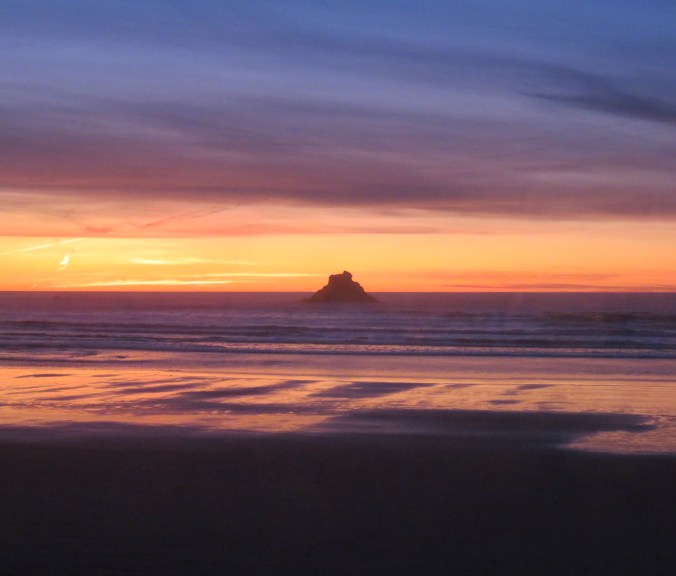
fullsizeoutput_fd3

“Not many things are orange . . .” Really?

On 10 September 2015, I created a folder on my computer titled COLORbook. My intention was to complete a series of chapters about color, an entire book of nonfiction about my personal and cultural understanding of color. The idea had been stirring in my head for a long time. My earliest essay about color I can find was created 2006 about orange. “The word itself traces its lineage from fourteenth century English, back to Old French or perhaps Spanish through the Arabic nāranj, the Persian nārang, and eventually to the Sanskrit nāranga, meaning orange tree, a word that might derive from an even earlier term meaning fragrant. Our word for the color orange and the fruit have an ancient co-existence, but the citrus fruit came first.” The color name or the name of a citrus fruit or acknowledgment of the incredible scent of fruit and flower, orange blossom.

Anyway, I meant to write a book about color. I had completed several chapters and begun thinking about sending them out when, probably in 2017, I learned of the book On Color by David Scott Kastan with Stephen Farthing. It was released last year and I have just begun reading it. I will have to stop soon. It is making me cross. The obvious reason is that I wish I’d written it and I am annoyed that I didn’t.

It’s probably for that reason that I am arguing with the book. There are marvelous lines like “The sensation of color is physical; the perception of color is cultural.” The book does a very nice job of explaining color as wound into perception and culture. Homer’s “wine dark sea” seems to trouble a lot of people including these authors who desperately want Homer to have said the sea was blue. Water has no color, but reflects the sky. Maybe saying the sky or sea were indigo blue seemed entirely unnecessary. I look at the ocean every day, for hours at a time. The color I remark upon is a deep green, which is not typical but a personal preference. Perhaps the wine reference refers not to hue, but purely to darkness, richness. A dark sea. I have seen that—even seen it dark and the color of wine. Color is very much a matter of context, both physically and culturally. The Kastan and Farthing book does a good job of introducing that confusion.

But then another sort of confusion: “Not many things are orange” the book states by way of explaining why the color orange was there, of course, but the color name of “orange” did not exist in English until the fruit arrived in England. There was no word for that color until the fruit. It was unnecessary, they suggest. (Really?) Chaucer refers to a color “betwixe yelow and reed.” (He knew how to mix paint colors? The connection is not so obvious as the authors claim. I have taught enough small children and older ones how to combine primary colors to make secondary colors to know that most do not see this without aid.) But the authors make a gigantic leap in claiming there was no need for the color name because not many things are orange? How about sunsets, rust, and hair we call “red” to name just three? “Not many things are orange . . .” Only autumn leaves, chickens and foxes, fire and flower stamens. Apparently the word was necessary in India for millennia before it reached the British isles.

[Fewer things are purple, but that word is very old in English, from the Old English word purpul from Latin purpura, from the Greek πορφύρα (porphura), the name of the Tyrian purple dye made from a Mediterranean shellfish. Maybe I will post my essay on the color.]

310euHZLD2L._SX328_BO1,204,203,200_.jpgAnyway, this is probably a better book than I would have completed, had I completed mine. Twenty-two pages of endnotes, so the scholarship is solid. The stories I found in my research seem to be mostly covered here, and my copy purchased at a local bookstore is a squarer shape than what I see on Amazon. A pretty thing.
Despite Crayola crayons and poster paints, Hazel Koenig at the University of Washington introduced me to color theory. Pink is a tint of red, brown is a shade of orange. Pigment combines three primary colors and black and white in ways quite unlike color in light (which achieves all colors from red, blue, and green light). The four-color printing process (cyan, yellow, magenta, and black) has always amazed me—how do yellow and magenta combine to make pure red? Amazing.

Some of my essays are here on my blog if you searched for them. “Color Blind” and “Blue Sky” for example. I also wrote about orange and hot pink and little black dresses, ten chapters in all for my COLORbook folder.

I never got to yellow because I left off writing new chapters when I understood that someone else had written and published my book. It is not the first time.

In 1995, I completed the first draft of a terrible novel, and then I began better one. This was called Clean Away (working title was Bitch Trial) about four generations of women in family facing similar struggles over and over and perhaps doing better and better at coping. The central character, the daughter and granddaughter of older generations and the mother of a younger one, finds her grandmother’s diary behind a wall in a tiny family house in Astoria. This reveals a scandalous secret and places her own life in context. I worked on that book for a few years and then abandoned it when I learned of a new novel with a similar plot. I read all the way through that one. It was very good. My book was funny and the other was not, but mine was never published.

I used to write funny. That got lost for a while. I blame my poor mother. (Mothers so often get blamed for everything.) By 2002 my mother’s health was undeniably failing and my husband and I took care of her, someone told me I was the “most dysfunctional person” he knew and stopped communicating with me, and I lost my sense of humor.

Perhaps I only misplaced it, setting it aside for best. Perhaps it was unnecessary at that time. Not many things are funny? Or perhaps humor may be returning.

Most afternoons I watch the sky change color, the darkening sky blue overhead and shifting to orange on the horizon without passing either purple or green. Amazing. “How we are named and what we are called” is a phrase that runs around my head. It titled a story about Arizona that I wrote twenty years ago. It is the paradox of naming and valuing what we name. It explores that power of naming and of un-naming as Ursula K. Le Guin imagines in her story “She Unnames Them” where Woman lifts names off living creatures, removing the burden placed upon them. Some species insist their names are theirs and pets demand their personal names, but all are assured they are welcome to keep whatever names they believe suit them.

English is not the final word, nor the oldest in the world. Imagine a color book written from the other side of the world. China’s imperial yellow, red wedding dresses, white for funerals. I would read that.

Orange is one of the oldest words because so many things are orange.

STEP 7: Choice

Making choices is exhausting. It is rewarding. It is power but also wearing. Like many things that matter, the creative process pays and pains.

Rebecca Solnit’s Men Explain Things to Me contains an essay about Virginia Woolf and uncertainty. The truth about wandering in the dark. In a journal entry of 1915 Woolf wrote: “The future is dark, which is the best thing the future can be, I think.” Certainty belongs to the past (and is not so very fixed there), but hope is what drives us toward the future. Solnit writes: “To me, the grounds for hope are simply that we don’t know what will happen next, and that the unlikely and unimaginable transpire quite regularly.”

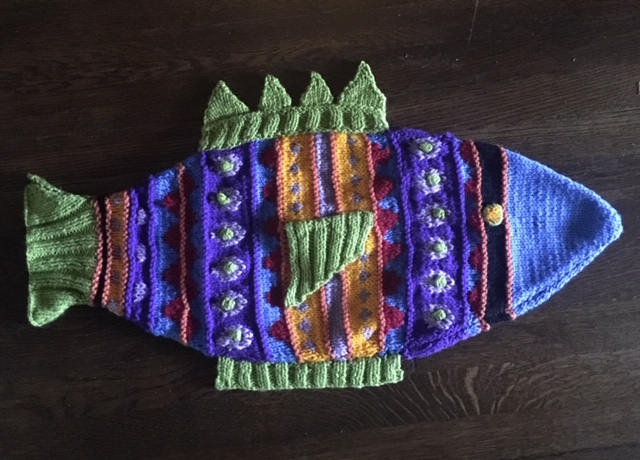
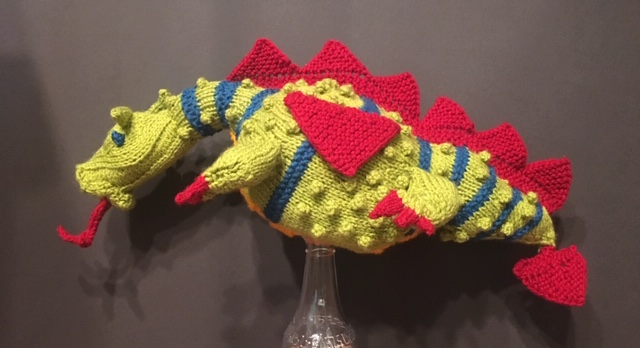
My friend Madora Lawson is a creative person, as are many of my friends. Madora is my friend who made a career of her creativity as an interior designer. She emailed to tell me that a post where I revealed that I rarely used a pattern prompted her to knit without a pattern. See what she made!

image2.jpeg

image3.jpeg

She cannot even remember how she made that dragon’s legs.

It works like that sometimes. We create something, make a series of choices in color and stitch and a dragon has toes!

The toes up top are from an aging walking group who took a weekend and learned to knit slippers from Madora. Each person had plenty of colors to choose from, stitches to try, closures. Being clever takes energy and courage. The reward is something fun lovely grand and strange.

Painting walls builder’s beige or gray is easy. Following decorator’s advice, copying a style. Even when it works, looks appealing and safe. Where’s the fun in that?

Creativity demands the courage to make another choice. The bright textile on the wall, the yellow button on a turquoise strap, the zig-zag dorsal fin, the peculiar combination of orange and electric blue mohair. It’s coming.

Who knows where one choice might lead? Solnit joined anti-nuclear activists in the late 1980s. They “did not exactly shut down the Nevada Test Site, our most overt goal, but inspired the people of Kazakhstan to shut down the Soviet Test Site in 1990. Totally unforeseen, totally unforeseeable.” It might argue for a certain recklessness, a measure of faith in accident and free choice.

In the mean time, I finished the central panel of BlueToo.

fullsizeoutput_101e

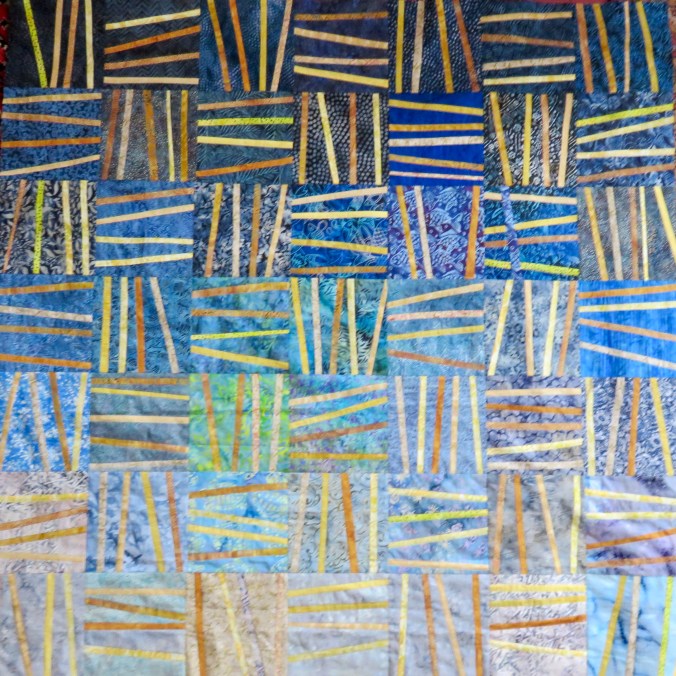
Fifty-some batik fabrics, five hundred pieces, and going-on two thousand yards of thread. So far.

STEP 6: Accident

fullsizeoutput_1019

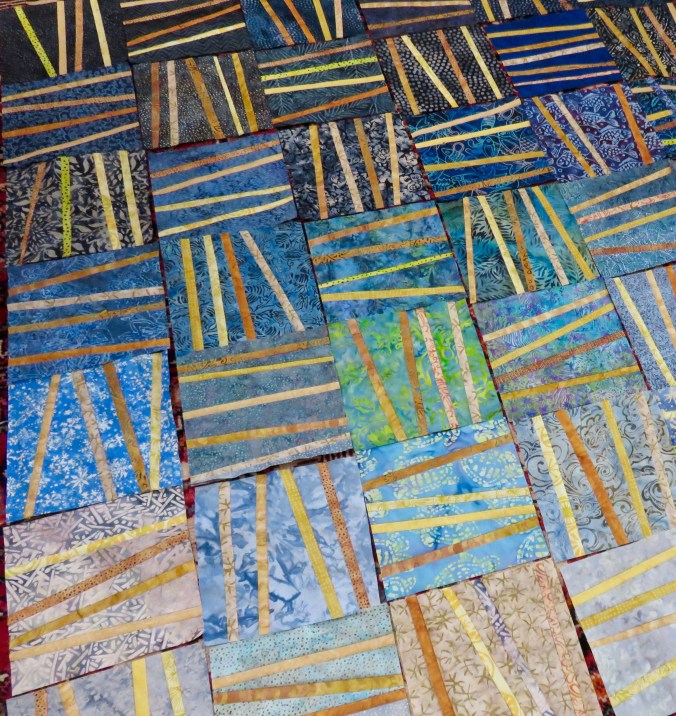
Above are a few of the forty-nine pieced square blocks laid out on the floor. The photo distorts them; they are each 8.5″ and carefully squared. So far I’ve used over sixty batik fabrics and cut over five hundred pieces of fabric. And this is only the center panel They will make a center panel 56″ x 56″ once they are stitched together, of an eighty-inch square quilt.

The second blue quilt was meant to be simple. I set specific, easy guidelines in order to piece it quickly and with a minimum of fuss. It’s that staring process, the decision-making at every cut and sewn seam. This color or that one, this way or that, rearrange and rethink the border? It was meant to be almost thoughtless but then the inevitable accidents. Most blocks were planned to be too large and I shave a quarter inch or as little as a sixteenth off the edges. A block might also too small or too dark or pushy or bland. I add another stripe or one going the wrong way, choose a different color or move the whole block to the other side of the quilt. Accident forces me to make decisions I might otherwise avoid, but accident has always served me as an artist. The writer Ron Carlson argues for something similar in writing fiction. Don’t allow serendipity to be cleaned out of writing. Let it flow. It is random chance that often hands us our finest work.

Decades ago, as a Metal Arts major, I was careless firing a base coat of enamel on square of copper sheet. The glass enamel color was called “Pigeon” a pale, perfectly transparent blue-gray. Fired over scrubbed copper it took on a lavender glow. Stenciled on copper, leaving some of the metal bare and then overfired to nearly 1700°F, the copper turned gunmetal-black, the enamel went palest blue-violet. The accidental firescale could be scrubbed off, leaving a line of black firescale on the edges of the enamel. I used that. Later, after deliberately overfiring sample tiles, I began using larger areas of firescale, enameling over the top and producing a unique metallic gleam. It was accident at first, and then a signature effect. It started by mistake.

Mistakes take time. Few are really useful. They are frustrating and not easily corrected. I have picked out stitches plenty of times making this quilt. Changed my mind in an instant. I could follow a quilt pattern or use a kit. There are plenty around that prescribe specific patterns and fabrics. I would not be constantly making choices, and choice is the hard work. But without choice, where’s the fun? I’m only barely interested in covering a bed. I am making art.

Mistakes push me, force me to reconsider, to change direction, to accept what happens sometimes and other times to fix it.

Mistake was at the first and will be at the last, so long as we don’t give up.

“The most important thing a writer can do after writing a sentence is to stay in the room. The great temptation is to leave the room to celebrate the completion of the sentence or to go out in the den where the television lies like a dormant monster and rest up for a few days for the next sentence or to go wander the seductive possibilities of the kitchen. But. It’s this simple. The writer is the person who stays in the room. The writer wants to read what she is in the process of creating with such passion and devotion that she will not leave the room. The writer understands that to stand up from the desk is to fail, and to leave the room is so radical and thorough a failure as to not be reversible. Who is not in the room writing? Everybody. Is it difficult to stay in the room, especially if you are not sure of what you’re doing, where you’re going? Yes. It’s impossible. Who can do it? The writer.”—Ron Carlson, from Ron Carlson Writes a Story

STEP 5: doubt

fullsizeoutput_1017

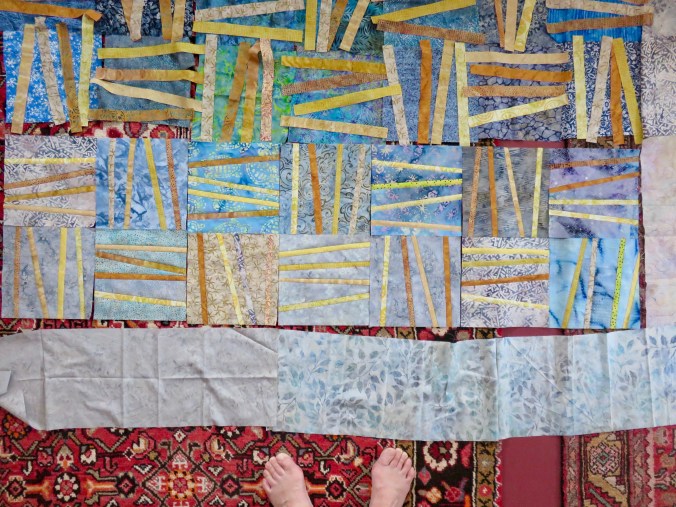
Here are the first two lines of seven. Maybe a little bland so far? Not quite what I had in mind? Once the squares are pieced and sewn, the effort in the first two rows is inevitably tame, inevitably distant from my vision. I began sewing the paler squares, the ones I like least. sigh

I fret and then will rush on to complete the more dramatic rows. I work vertically instead of horizontally, light into the dark. Maybe then I can find the stronger yellow-to-blue tension.

The inner wide border was to be two yellow or orange stripes on each pale blue bordering square (that’s the uncut band just in front of my feet). Now I think maybe dark blue stripes on the pale. Maybe three? Maybe even four? Maybe a narrow orange frame?

The narrower outer border? Four inches wide or thereabout. What do do about that? Color? Stripes? Once I have pieced all these squares, I might be stuck and will soon return to Blue Ladders, the other blue quilt.


More excitement from rentals. A neighbor filed a complaint about the people who pissed on our path, for the cars parked everywhere. This morning there are cars parked all over for another house, which would prevent a UPS truck passing. Not to mention a firetruck or Medic. Apparently there are rules about rentals and parked cars. Our neighbor will likely complain about this rental as well. People always assume it is me, but I have no idea where he is lodging his complaints.

Fireworks (illegal and all summer long) and people pissing in public . . . police and emergency vehicles will come if a life is endangered and that is reassuring. If only they can get here past the parking situation.