An imperturbable demeanor comes from perfect patience. Quiet minds cannot be perplexed or frightened, but go on in fortune and misfortune at their own private pace like a clock during a thunderstorm.—Robert Louis Stevenson
We could say we are looking for sea glass, but we never do. We could say we are looking for agates, which is also true, but what Gary tells people is: “Rocks.” This is also true, though not completely true.
This posting concerns gathering treasure from the beach, reviewing promises and lies, and a fictional story about “abused” kittens—no animals harmed in that story. Oh! And I will be selling my weaving at an event sponsored by the Cannon Beach Art Gallery. Note that I say “selling” but actually mean “offering for sale,” which is not the same thing. About ten skeins of hand dyed wool in each length…
The best advice my mother ever gave, and these were words she said to me hundreds of times: Think how the other person feels.
She meant to help me be a kind person. As a child I went to Unitarian Sunday school. Later I attended worship at many churches and temples and houses of worship. Though not religious, I wanted to be a good person. I wanted a clean conscience and self respect. I think that’s what my mother hoped for. Mom meant for me to consider the struggles, trials, and pain of other people and how that influences their actions toward me. She did not mean that I should consider myself last, but thinking how others feel has helped me consider motivations and sometimes allowed me to be kinder to myself. It certainly has forced me, sometimes, to behave better.
I thought I was done posting. I hid my posts in April, then opened them again a month later. And now I try to post. Gary says it’s good that I post. This past week has been especially…. hard? painful? heartbreaking? Is there a word strong enough to explain? Lately, as I walk Portland streets and see someone smoking, I have said out loud: You have known your whole life that cigarettes are poison. These are times when saying anything to a stranger might result in being shot in the face. Safer to post here.
Throughout my life, I have been prone to periods of profound sadness. This is one of those times. I think it is a rational response to the situations just now.
The greatest advantage to living long is knowing things will be better, that I will feel better after a while. I know this, though I do not feel it. I know it’s true.
I will feel better. Maybe nothing will improve, but I will manage.
There are people in the world who built a cellphone large enough for a horse. They taught horses to use it to text messages. (There’s a video showing all this on the website.) The horses might not see the point, but horses play. I suspect most animals have a sense of humor.
We did not walk to the Portland Rose Garden today, as we often do, but I saw a huge cascading rose outside a flower shop. Flushed with tiny white single blossoms, it grew twelve or more feet up and arched over the door of the shop and the sidewalk. The owner of the shop had no idea what variety it was. “It’s a volunteer that’s come up through a crack in the pavement.” She says it sets hips, tiny and red. I will return to collect seeds.
Below, a poem.
BOTANY LAB
by Jan Priddy
A generation ago in my Botany lab,
my partner bends over specimens, scalpel
poised like a paintbrush. He slices flowers
perfectly in half; my turn to peer
through the microscope. I count stamens
and ova. As I draw diagrams, search
for proper names in the text,
I do not notice silence
until it’s broken. Someone,
also hunched over high black counters
and flower parts, asks the air, What sets
human beings apart from the lower animals?Tools comes an answer from across
the room. Aren’t we the only species
which makes and uses tools? We decide
not, since Goodall documented chimpanzees
fishing for termites. Playing, I hear my partner
assert. Man is the only animal that plays.
I look up from the sexual organs of plants
and smile. I think he’s wrong, though I am
not the first to say it. My dog plays with me,
says another Botany student. But my partner
argues with pets. They are domestic animals,
tainted by association. Fawns, we offer,
adolescent lions. Juveniles, he shakes his head.
Adult otters swim purely for fun, we counter.
Porpoises leap in the wakes of ships, squirrels
play tag in trees, foxes pounce on dandelions.
His forehead puckers, scalpel painting the air.
Really?
Under my microscope, a five part flower,
many stamens, fleshy calyx-tube.
Family Rosaceae,
genus Rosa,
species multiflora,
precisely like
the illustration in my text—
a local flower I see each day.
“Botany Lab” was first published in StringTown, 2001
Sunrise here.Sunset there.The shift and play of colors…
I am sitting up in bed as I write, and before me is an abstract expressionist painting by a friend of my aunt Marcie (Marcia Smith Aron). Marked 1959 and “Floral Growth” on the back, it is tied to memories from my aunt’s house in Berkeley when I was a young child, and later to her San Francisco house. Bright with egg yolk yellows and intense pastels. Mom said the painting had been held by her sister for safe keeping. After my aunt died and the painting came to me, I traced the artist. By then, she lived just a few blocks away from where Gary and I first lived in Big Pink in the U District of Seattle. She had turned to calligraphy, become famous for it. Midori Kono Thiel was sorry to hear my aunt had died, delighted her painting was still alive, but no, she didn’t want it back. So that colorful oil, flush with memory, hangs across from our bed in Portland.
Hardly anyone will recognize the letters I used to title my thoughts today. “Any Solid Color Other than Black” is a class in AKC shows for American Cocker Spaniels (ASCOB is pronounced ass’ cob). For the record, I have never owned or shown American Cocker Spaniels of any color, though I do have a scar on my upper lip from being bitten by one when I was a small child.
This is not a post about bites or even dogs. There are no assignments or exercises. A few crows. Trees. Our condo news.
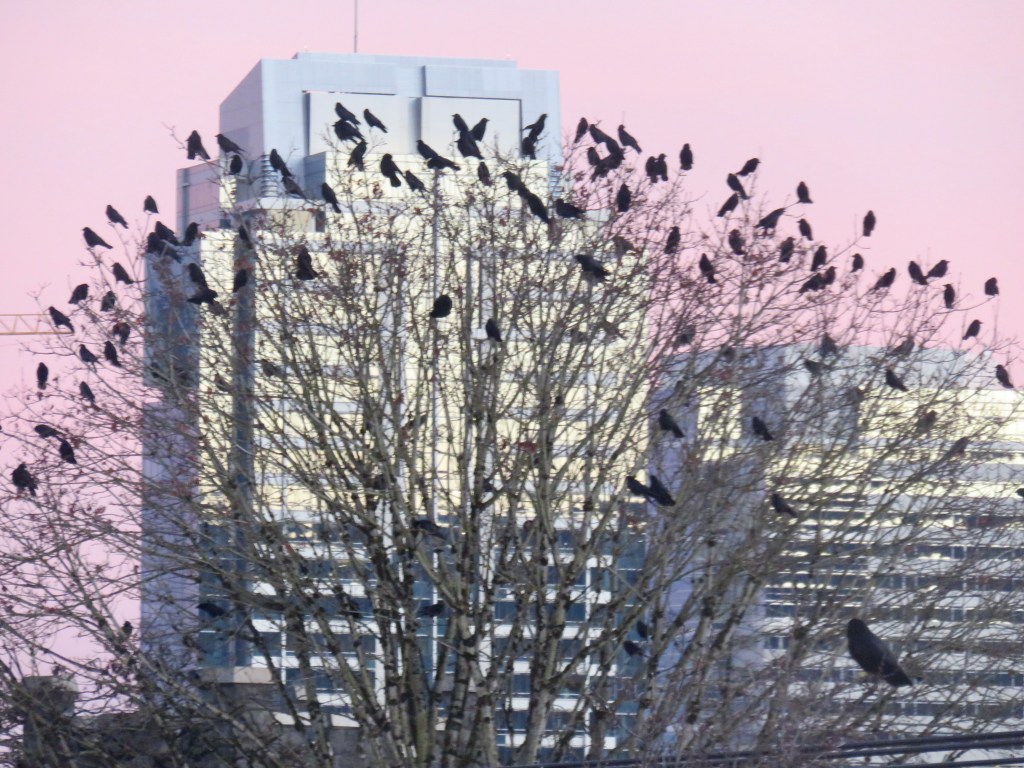
We like crows. Above is a tree with over a hundred crows, but there might have been a thousand nearby when I took this photo. (HINT: this was not the only tree, and most of the birds were flying.) There are “local” birds, but they gather as a massive flock (“murder” seems unkind), usually in late afternoon but on their own schedule. Continue reading →
Several recent attempts at reading have been… depressing? discouraging? demeaning? Delight might be what I am after. I am wide awake in the middle of the night. Eight hours last night, tonight just four? I don’t know, maybe it’s time for some serious funny.
Just now, our son Ian is making short films. (The ballet is at rest and he is between random gigs so keeping busy.) I came across this one almost by accident. He rarely tells us about shows he’s working on, and this video is delightful: “Harry Potter Can’t Blink.” (Honest, you want to see this.)
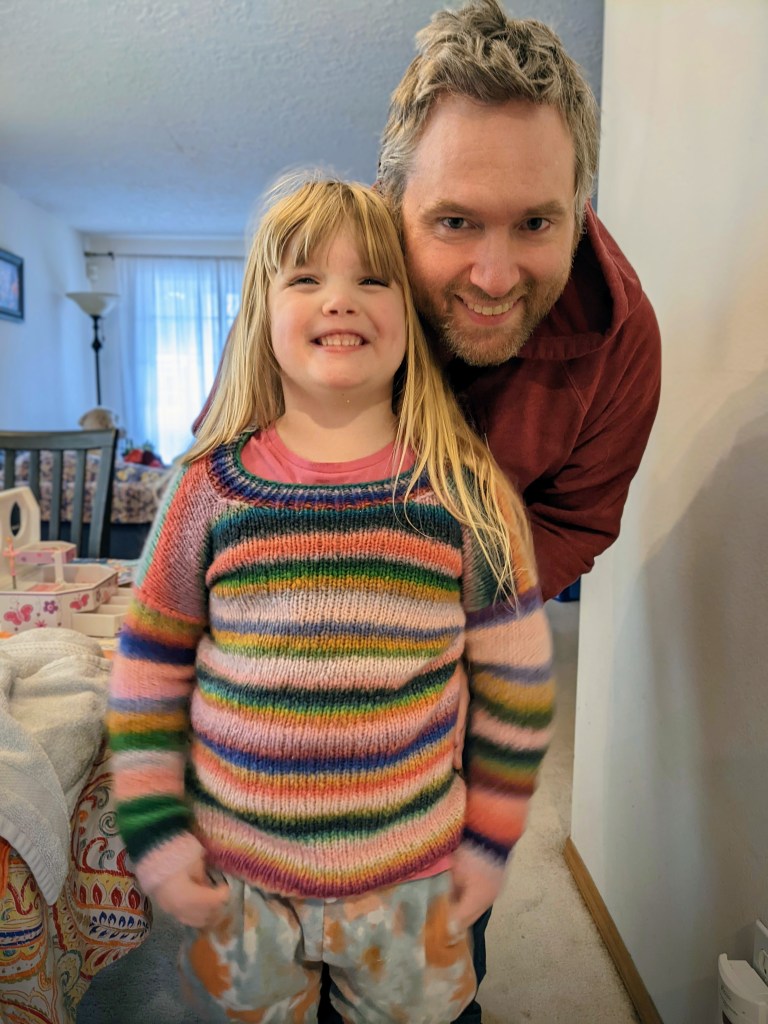
Our son Alan and his daughter E.V. wearing the sweater I knit her for Christmas.
I had to think hard about what happened in 2021. It was not a terrible year, not even a bad one. “Inconvenient”, as a friend suggested in 2020, a year that felt much worse. So goodbye to two years of pandemic and hello to a third. I have plans.
I was writing a card to Bette and realized that most things do not matter… the passage of time, the work I still miss doing, the “accomplishments” I would like to detail—none of that really matters. What matters is beauty and people. People and beauty.
So here is beauty that I have seen in the past year.
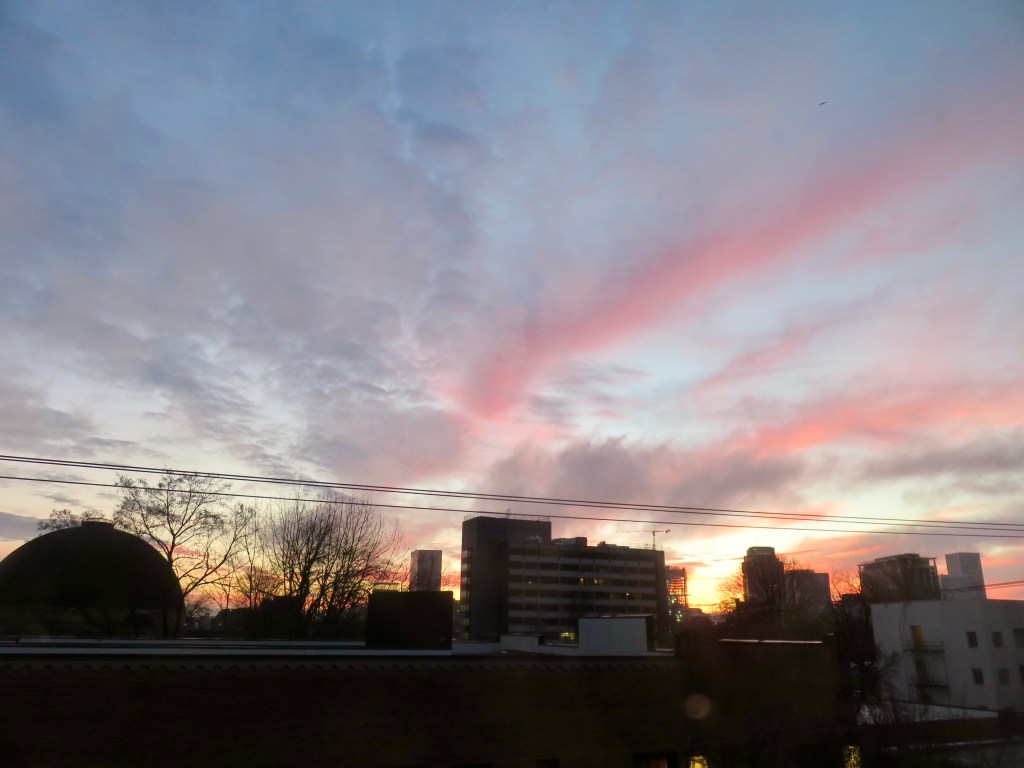
JanuaryFebruaryMarchAprilMayJuneJulyAugustSeptemberOctoberNovemberDecember, Portland in sunrise
I could have chosen photos of eagles or of highways or flowers. I could have chosen photos entirely of the people I love. I could have chosen other landscapes or birds. These images were chosen because they are what I have looked at early in the morning and thought: beautiful!
Thank you, John Keats. We only remember this stuff because it matters.
Ode on a Grecian Urn  (1809)
by John Keats

Thou still unravish'd bride of quietness,
       Thou foster-child of silence and slow time,
Sylvan historian, who canst thus express
       A flowery tale more sweetly than our rhyme:
What leaf-fring'd legend haunts about thy shape
       Of deities or mortals, or of both,
               In Tempe or the dales of Arcady?
       What men or gods are these? What maidens loth?
What mad pursuit? What struggle to escape?
               What pipes and timbrels? What wild ecstasy?

Heard melodies are sweet, but those unheard
       Are sweeter; therefore, ye soft pipes, play on;
Not to the sensual ear, but, more endear'd,
       Pipe to the spirit ditties of no tone:
Fair youth, beneath the trees, thou canst not leave
       Thy song, nor ever can those trees be bare;
               Bold Lover, never, never canst thou kiss,
Though winning near the goal yet, do not grieve;
       She cannot fade, though thou hast not thy bliss,
               For ever wilt thou love, and she be fair!

Ah, happy, happy boughs! that cannot shed
         Your leaves, nor ever bid the Spring adieu;
And, happy melodist, unwearied,
         For ever piping songs for ever new;
More happy love! more happy, happy love!
         For ever warm and still to be enjoy'd,
                For ever panting, and for ever young;
All breathing human passion far above,
         That leaves a heart high-sorrowful and cloy'd,
                A burning forehead, and a parching tongue.

Who are these coming to the sacrifice?
         To what green altar, O mysterious priest,
Lead'st thou that heifer lowing at the skies,
         And all her silken flanks with garlands drest?
What little town by river or sea shore,
         Or mountain-built with peaceful citadel,
                Is emptied of this folk, this pious morn?
And, little town, thy streets for evermore
         Will silent be; and not a soul to tell
                Why thou art desolate, can e'er return.

O Attic shape! Fair attitude! with brede
         Of marble men and maidens overwrought,
With forest branches and the trodden weed;
         Thou, silent form, dost tease us out of thought
As doth eternity: Cold Pastoral!
         When old age shall this generation waste,
                Thou shalt remain, in midst of other woe
Than ours, a friend to man, to whom thou say'st,
         "Beauty is truth, truth beauty,—that is all
                Ye know on earth, and all ye need to know."
The truth isn’t always beauty, but the hunger for it is.
—Nadine Gordimer
I don’t know if any of this is true—that beauty is truth or that an urn can speak to any truth—but it is beautiful. And we do hunger for both beauty and truth.
May your day be beautiful… a blessing on your house.
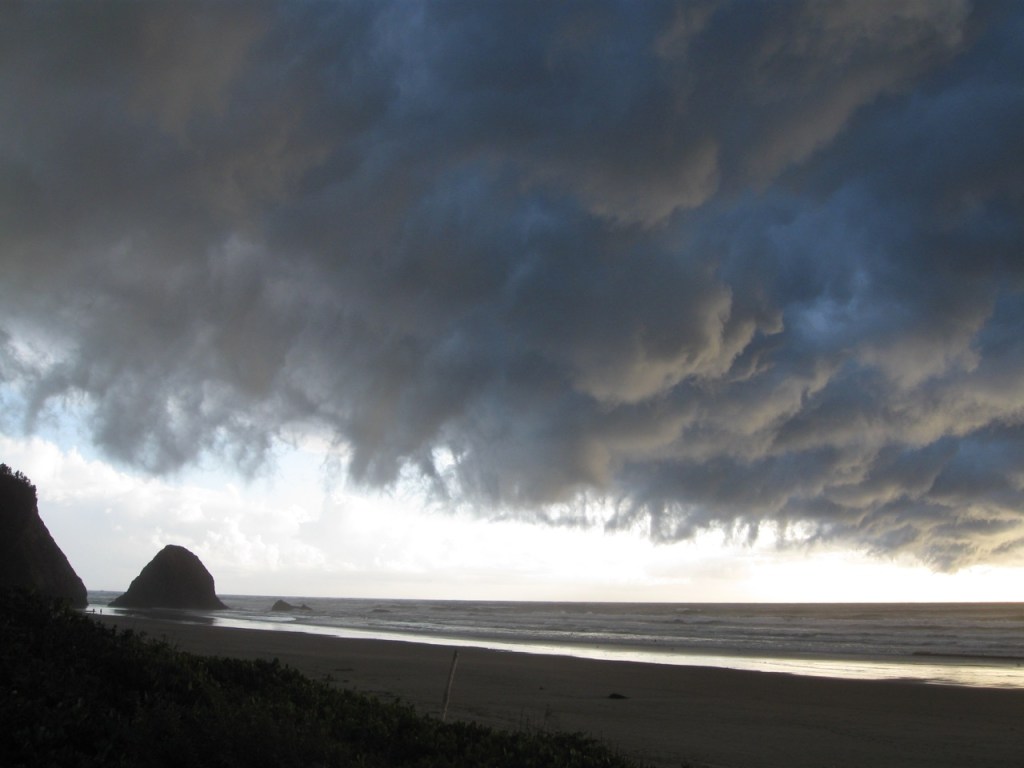
West back to the beach—snow all the way except for this brief clearing in the sky.
The sky was beautifully pink yesterday morning and after a mile of walking, I ran an unofficial 5k on sand without wetting my feet. I was out of breath but not breathless at the end of my run. I felt light-headed and bent over for a couple breaths. It is not the first time I have wondered if my blood pressure might have gone down closer to what it was when I began running in the 90s. Decades ago, when I told my mother my blood pressure was 90/60, she said, “That’s ridiculous. You would feel dizzy when you got out of bed. ” Well, yes I did. Often.
This was not the photo I was looking to put here, but it’s pretty and in seasonal colors. Two of these weavings went to a dear friend on the birth of her baby. One is at home here in Portland. It’s significant that the warp included skeins of lovely Koigu merino wool in day-go “mistake” colors I had not meant to order. Goodness come sometimes, not because we planned for it or earned it or even necessarily deserved it, but just because. Continue reading →
I submitted my “Butterfly Fontanelle” novella to a literary press a couple of days ago. It has remained untouched since January. I had hopes for it when I began four years ago, but then lost faith. Today I reread the beginning of a letter responding to that novella. One of my favorite writers wrote: “I really do love this story! The imagery throughout is gorgeous, and your conception of the Daughters, every detail of their lives, their behavior and appearance, their singing—all of it—feels startlingly original. Amazing, really.” That’s right at the beginning of her comments, and I cannot say how startling it was to read that, to find such words of praise. I knew if I continued to read the letter, I would find her suggestions and questions. I did revise in response, and revise yet again in a further draft. And again. I even tried changing the title. I submitted. Rejection without comment. There is no knowing if I improved the piece and evidence I didn’t, but I think it’s better even if I failed to take it where it needed to go. I did try.
Anyway, I sent it off, my first submission in ten months. I hadn’t intended to submit anywhere ever again. I posted that notice on my publications page and have only been writing here, in my blog, and a few scraps of poetry, or what might become poetry if I had stuck to the page. I haven’t. [“Seat in chair.”]
A lot has happened.
This is one of my favorite photographs I’ve ever taken. In recent years I have used photographs for my winter cards and had them professionally printed, but for a couple of decades before that I designed, drew, and made cards, cutting linoleum blocks or illustrating family dreams for the New Year in pen and ink. Mimi wrote that some of those old cards are part of Janice Gould’s library collection. It fair took my breath. I had only just noticed that of all the art hung in our new condo, there was nothing from me. This year, perhaps I will return to that old custom. Gary thinks so.Continue reading →
It’s been many years since I took a class from Ursula K. Le Guin and in one of them she talked about the Chilean poet Gabriela Mistral. She was incensed at how little work of hers was available in English. After all, Mistral was a Nobel laureate, and her work was important. Le Guin had majored in French in college, but over the years she indulged in translation. (I taught a speech from one of essay collections called “Hunger” from a speech she delivered to a fundraiser-luncheon. In it she translated a poem from the Spanish by Pablo Neruda. Students struggled sometimes with Le Guin’s short speech, even to identifying the main idea, which was hunger, as set up immediately by the title.) She determined to study Spanish to do justice to Mistral. Other readers will judge how well she managed to maintain the music and meaning of this poem.
NOTE: On the Poets.org website, the translation is listed before Mistral’s words. I have placed the original Spanish first.
La Contadora (The Teller of Tales)
     by Gabriela Mistral
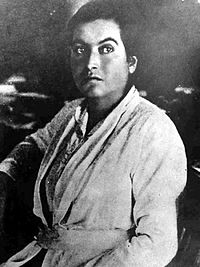
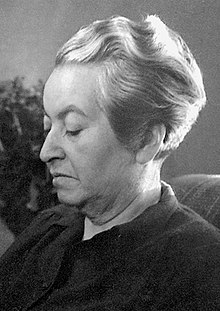
The Chilean poet, Gabriela Mistral, also known as Lucila Godoy y Alcayaga (1889-1957), was the first Latin-American writer to receive the Nobel Prize in Literature (1945). Born to a family of teachers, she mentored Pablo Neruda who would also with the Nobel. Unlike him, however, not enough of her work existed in translation to English. (A bi-lingual edition by Doris Dana published in 1971, 272 pages, and some translations by Langston Hughes.) Ursula K. Le Guin studied Spanish in order to change that.
As a younger woman
Mistral may be most widely quoted in English for Su Nombre es Hoy (His Name is Today):
We are guilty of many errors and many faults, but our worst crime is abandoning the children, neglecting the fountain of life. Many of the things we need can wait. The child cannot. Right now is the time his bones are being formed, his blood is being made, and his senses are being developed. To him we cannot answer ‘Tomorrow,’ his name is today.








 IMPERFECT PATIENCE