An imperturbable demeanor comes from perfect patience. Quiet minds cannot be perplexed or frightened, but go on in fortune and misfortune at their own private pace like a clock during a thunderstorm.—Robert Louis Stevenson
We’ve seen many orange jellyfish [west coast sea nettle, Chrysaora fuscenscens] stranded onshore in the past week. This is one of the half dozen largest from yesterday, about two feet across that center section, another 20 inches wider if measuring the splayed “arms'”, and yes, these sting. The colorless to blueish ones, moon jellies [water jelly, Aequorea sp.], don’t sting—just don’t touch any jelly and then put your hand in your eye or mouth. I’ve never been stung, but I’ve known to be careful since I was little.
I walked more than three miles yesterday and I wasn’t even sore when I got home. Miraculous! Gary and I went north to our “Turnaround Rock” a mile and half, up and down the beach, backtracking and noting how high the sand is. It was the furthest we’d walked since April. We met two local people we hadn’t seen in months. Earlier this week, we met a friend we hadn’t seen since last year! They all said they’d wondered what happened to us. It was my foot.
I had an idea of where I was going when I started Part 1, but that got lost. The most magical thing I do is writing—making a reality that hadn’t existed before I created it. I think it through. I trust the process to yield.
The dawn, the dawning of an idea, the beginning that is colorful enough to foreshadow an ending. All begins with the best of intentions for meaning, the hope that completion makes an understandable whole.Continue reading →
Jakey Lebwohl, Emma Park, and Zach Rausch on the Substack* After Babel published a meticulous documentation of an education system that is failing too many students. All students had been improving in pretty much every area, and then about 2010, that improvement mostly stopped. The drop in skills such as reading and math is particularly noteworthy among the lowest-performing students—the kids already disadvantaged in school. This is pretty much equally true for all races, genders, and socioeconomic groups.
Clouds on the horizon are a favorite, especially the big rolls of cloud that ofttimes obscure the sunset, but color is a beautiful and to any day.
I was a student in excellent public schools (ranked second in the state of Washington at that time) from 1957 until my high school graduation in 1970, and then an excellent public university (University of Washington) for six years when I graduated with 3 degrees, cum laude, and Phi Beta Kappa. One distinct advantage I had throughout my education was teachers who were highly qualified, even over-qualified for the work. Memorable teachers were women with limited opportunities (secretarial, teaching, and nursing) and men from working class backgrounds (industry, farming, service) who were the first in their families to have the opportunity to earn [safer] white-collar jobs as a result of the GI Bill. Teaching never paid well but had the advantage of offering most people a reliable income and summer weeks to take a second job. Many teachers had the advantage of being treated as professionals. The unpaid or partially-pay sabbatical year every six years of teaching encouraged teachers to behave as true academics who pursued further degrees and research projects. Travel was understood to be educational for teachers and was tax deductible. [I owe everything I know about flying buttresses to that tax deduction!] Those genuinely educational perks are gone, and in my state tenure for public school teachers was eliminated in 1997.
In every way, and especially now under an administration that wants to cut all federal funding, public school teachers are treated as factory workers. No offense to factory workers, but I could have done that job straight out of high school.
In fact, my brother earned a 2-year community college degree that prepared him for a factory job. There, he earned more in his first year than he would ever earn later as a teacher in the mathematics and science departments of the public school where we both taught.
The counselors where I taught would never have urged the future I was steered toward by my school counselors. My math and spacial reasoning scores were right near and at the top [I test well], but I was a girl so it was fine whatever I chose so long as it suited my future as wife and mother. Mom wanted me to prepare for the future as a secretary, the counselor told me my goals of architecture or interior design were ridiculous, my counselor flirted with me, and I chose the School of Art.
Beginning in 1976, I taught Art in a girls’ prep school for 3 years, subbed, and then taught English and Art and English-related electives in a rural public school on the Oregon coast, and college Lit and Writing for the next forty. All this to say, I’ve been watching the evolution of public education for my entire life.
I taught with few teachers as capable as myself, several who treated teaching as an easy job (it’s not easy if you are doing it well), and many who did not last as teachers but left for better-paying work in a cocktail lounge or industry.
Another issue was the over-emphasis on college as a necessary step in every single child’s future. That view took hold by the 2000s. Where does that leave the teen without interest or capacity for college?
But the other major factor affecting student learning that I witnessed was Common Core. Standards were based purely on multiple choice test data. “Teaching to the test” replaced innovation and adaptation to student interests with dull routine test-prep. I was discouraged from teaching anything but nonfiction. I was required to explain how each lesson prepared students for testing.
Further, though I taught the use of computers in all my classes, I never allowed cell phones in my classroom, and the shift to on-screen learning has proved to be a disaster for human beings. I was in an early cadre of teachers approached and asked to participate in training for on-line education. It was horrendous in the way it valued rote response and failed to address either student needs or creative thinking. I used to tell my yearbook students: “There is nothing that can be done on computer that cannot be done by hand with a lot more time.” That’s true of page design, but people are not yearbook pages. Yearbook pages must first be imagined by people. [Even using AI would require someone to initiate the project.]
People invent themselves and require human responses to guide them forward in a way useful and meaningful to them. That requires attention, skill, and compassion. It requires money.
CHEAPER is CHEAP. But “cheap” is not what human beings aspire to be.
The current powers that be only want education to be cheap and simple. People’s lives should not become cheap, and they are never simple.
The people who have pushed and are pushing education in this disastrous direction over the past fifteen or twenty years have a couple of things in common: They are not teachers and they don’t care much about what happens to other people’s children.
Rich people will spend a lot of money to convince the public that we [they] shouldn’t be taxed so much for public education. They will “prove” that we are wasting money and spending too much. At the same time, they send their own children to private schools with tuition costing four or six times as much [or more] as is spent on public school children. “Separate but equal” was always a myth of the caste system, and now they want vouchers and tax rebates for their exclusive and elite schools. They want to pretend they are handing over control to states. they want to pretend that Alabama will ensure its children receive an education comparable to Massachusetts’. They want to pretend that if Alabaman children are poorly educated, it’s their own fault.
People without experience in public schools insist they know how to make them better.
Pardon me while I detail improvements in cardiovascular surgery.
Pay them less, require more yearly online multiple choice tests (I was taking seventeen), and more surgeries with less time off.
There we go! It’s so simple! A child could do it.
I rarely draw, and this pencil sketch might be 30 minutes of work. (In person, the penciled eyes glint.) I work primarily as a three-dimensional artist, a preference I identified when I was 12, after I designed the school spring program cover for silkscreen printing, and printed it.
I have been clear that I hate Substack, but at the same time, I do read a few with some regularity. If I were still teaching, especially since I integrated math and science and history with literature, I would require students to read Heather Cox Richardson for the way she threads ideas through America’s past.
Several years ago, if I were still teaching, I would also have taken The Heritage Foundation off my recommended right-wing reading list. That resource was once balanced by The Nation thirty and even less than twenty years ago. [I doubt my student fully appreciated how hard it was to keep an ideological balance of persuasive sources. I was never able to include FOX as a credible text source because the only credible texts were straight news I could find anywhere—the semi-credible and genuinely wacko right-wing “opinions” were only spoken.] There was a time when I read Heritage regularly. I didn’t often agree, but I could assure students their site didn’t lie. That’s no longer true.
I understand from reviews that at least some readers and professional reviewers are relieved that Sue Prideaux in her new biography, Wild Thing, exonerates Gauguin’s egregious sexual relationships with girls and women because the times were different. How nice. [The French, among others, have long struggled to recognize sexual exploitation of female children, not to mention adults, but there has never been a time when misogyny and outright cruelty were not objectionable to those who suffered. It’s one thing to acknowledge that bigotry such as antisemitism and racism and sexism were tolerated and even encouraged by those in power; it’s quite another to insist that these attitudes and transgressions went unnoticed, that such bigotry was somehow rendered benign because a few declared it was.]
Paul Gauguin, Aha Oe Feii? (What! Are You Jealous?) from 1892*Continue reading →
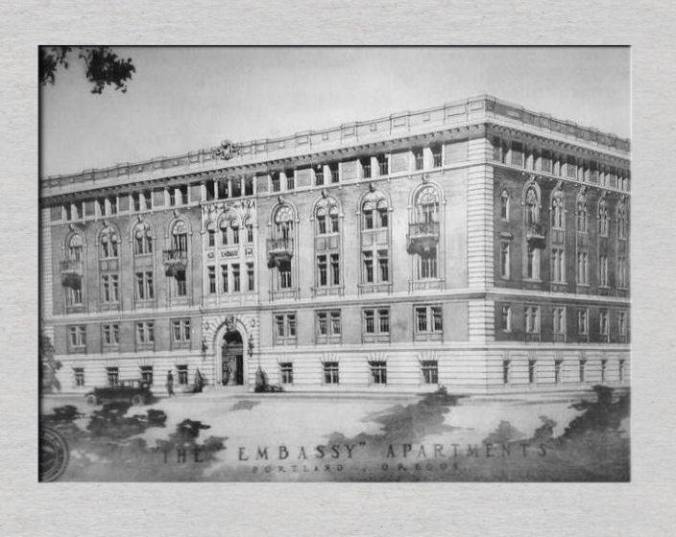
The 1923 elevation drawing by architect Carl L. Linde, a copy of which is hung opposite the elevator on the first floor, does not indicate the colors for the entry facade. The drawing does seem to show the surround as somewhat lighter than the tinted concrete and the doors as quite dark. Dark, varnished “Philippine Mahogany” was used throughout the building and survives on the back of the outer doors and the inner entrance doors, and the hall side of each apartment door. Though somewhat damaged, this woodwork remains beautiful and original. The outer doors have, aside from scratches and gouges, rot at the bottoms. Ideally, the doors should be taken down and repaired or completely rebuilt to the original design, which would be very expensive.
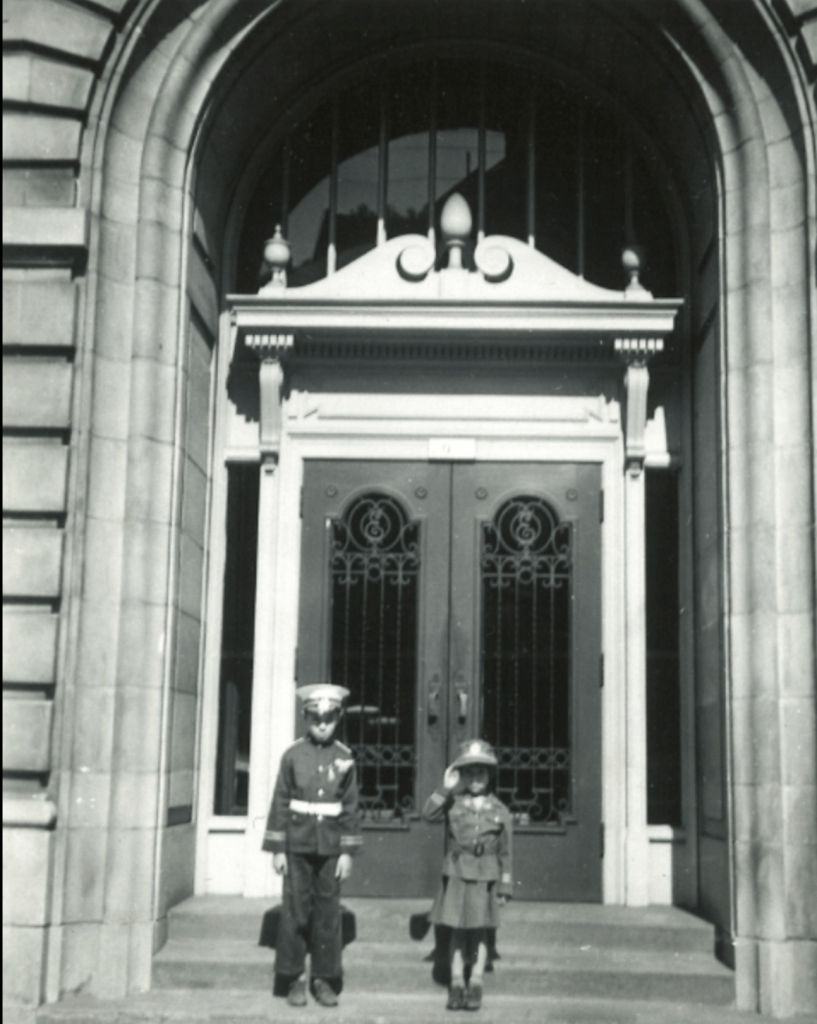
This B&W photo from WW2 shows the contrast between the very pale-painted surrounding woodwork and dark mahogany doors. The iron grillwork on the doors was removed years ago, but the Association has one as a model that could be used to replicate them.
The more recent colors fail to match the values of the doors and surrounding woodwork.
LEFT: This is how the entrance looked four years ago. Many residents loved this. The painted black and gold surround and green doors were cheerful and distinctive. Nevertheless, the color choices are totally out of line for the period (1924) and had detractors who viewed them as inauthentic. RIGHT: This is the way the entrance looked yesterday. The value of the surround is closer to the original facade, but in a pale cream and a putty that’s darker than the original. The brown chosen for the doors themselves was also wrong—too light and the hue is not close to the originals of this building on the National Historic Register.
The aim was to approach with paint the hue (color) and value (darkness or lightness) of the original doors. At a local paint store someone color-matched dark-stained Philippine Mahogany, a mahogany-like color. It’s a couple of steps darker than a paint color original to the building and still found on the inside of the storage room doors, so there was some historical consistency.
That same someone prepped and put one coat on the doors. The first resident passed while walking his dog right at the start of the repaint. “What are you doing?” “Painting the doors.” He said, “Not good.” By the time it was half done, several passing people complimented the new color. A resident loved it. Another resident was expected to yell, did at first, but then said thank you.
The cost of repainting the doors and surround in green, black, and gold has been bid at least $6k. Here is a stylish upgrade for no cost to the Association at all.
The goal was to take the front doors back close to their original appearance. The very dark red-brown shows up with elegance against the putty and cream of the surrounding woodwork and plays to the color of the hundred-year-old brick.
The shadow doesn’t do justice to the beautiful millwork and neither does that putty color, but it works better overall with the newly darker-colored doors. Someone would like a second coat, but maybe best to see who yells.
28 September 2025: My intention in this post was to explain what I did and why. Because I have recently been called out for failing to apologize for breaking “the rules we all agree to” I will confirm that I immediately apologized to the Board months ago, in writing, and now add to everyone in the Embassy: I am sorry for offending community standards and breaking rules.
We’ve been having an exciting spring so far, which reminds me of that Chinese curse: May you live in interesting times. It’s an English translation of a genuine Chinese curse, but I heard it when I was still quite young, perhaps in my 20s. Wikipedia reminds us of the obvious that the “expression is ironic: ‘interesting’ times are usually times of trouble.” I would add complication and challenge. Today’s interesting times mostly seem concerned with graft and bullying and self-aggrandizement. Alas, I am not the one profiting, gaining power, or advancing my image.
My best time was eight minutes and some seconds per mile (maybe more than thirty, but not much) over highway hills in the rain. I was a lot younger then, had been training for a half marathon in Seattle, and that fast run on steep hills resulted in injury.
But that’s not what we meant, is it?
We want my best time on vacation or during sex, or whatever. My best time as a writer. My best time writing or weaving or knitting or playing with my children.
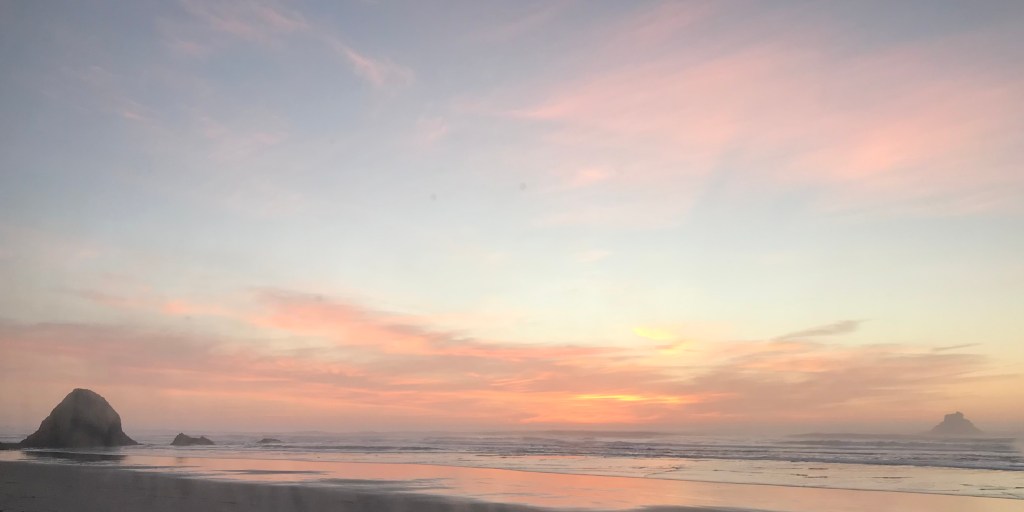
Sunsets are always pretty. We like the magenta and orange ones but also the palest gilt edges under horizon clouds.Continue reading →
Many things have happened that got in the way of blogging, but the gist is: Facebook, a minor medical issue that got complicated (not mine and mostly okay now), and developmental editing of my novel. Reading. And now NaNo.
I am told I should explain about NaNo. National Novel Writing Month (NaNoWriMo) is November. It is online, motivational (for me), free, as private or public as you want it to be, and I’ve done it before a few times. Each morning this month, I write on my laptop—the laptop I am using to write this long-overdue post—and then I post my progress on the NaNoWriMo website.
First, I concede that I possess the arrogance of a person with experience. This is tempered by the many things I don’t know or how to do—many more unknowns than knowns. Even so, there are things I have been doing regularly for decades. I may not be the best or perfect at doing all those things, but I do know what I’m doing.
.
I will use the example of Paul Hollywood, a professional baker who has written books about baking, and has been the host of The Great British Bake-Off (known as The Great British Baking Show in the U.S.) since it began. I willingly concede he knows more than I do about baking. He achieves perfectly even bakes and has experience with more products than I ever will. He is a professional.
I was reading an article about why older people need more friends and suggestions about how to find them (do something different, take up a hobby or join a club) when a woman we met on the beach a couple of times this week and chatted to, rang our garage doorbell and offered her contact information.
Life is wonderful that way sometimes. Full up with wonder.
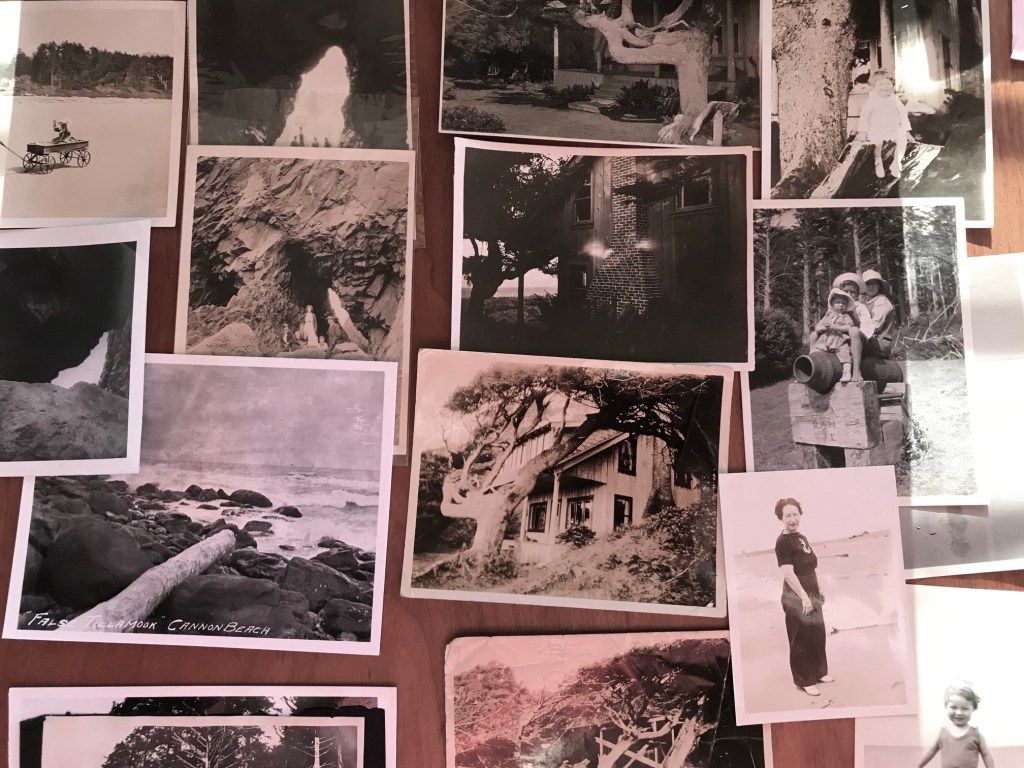
Early snapshots from my family’s summers at Arch Cape. One at left is dated 1913 when this was still called Cannon Beach. In the middle is the old “beach house” my family used Memorial Day to Labor Day until the 1940s. At right is the first cannon found onshore in 1846 (rediscovered in 1898 according to Wikipedia), my grandmother Fay Fletcher Jackson Smith just after the Great War, and my Aunt Marcia as a toddler in 1925. Gary insists we sort them all by the end of summer. He warns: “It’s going to take weeks.”Continue reading →










 IMPERFECT PATIENCE