Assignment #5: weird revision [last]

IMG_4426.jpeg

This is a black oystercatcher. We hear them south and see a mated pair to the north on walks. This photo was taken at a distance using a zoom.

During April, I gave my students poems. Poetry was one of the fatalities of the misguided school reforms of a couple decades ago which insisted English teachers toss most of our curriculum in for a focus on nonfiction. Don’t get me wrong, I had always included nonfiction in my curriculum, but we all deserve poetry in our lives. We all deserve stories, and we should have respect for fiction, since all the ancient texts, all of scripture everywhere in the world involves the supernatural.

“Actress Amber Tamblyn is a passionate poet, and the above quote ‘eat poetry so that your body is made of it’ reminds me of something she said in an interview. When asked ‘why do we need poetry?’ she said, ‘Because we are the poem. Poetry is the thing you don’t write, it’s the thing you feel, it’s what you kiss, it’s what you sleep in, it’s what you smell, the way in which we need each other, the way in which we understand death without having experienced it.’ ” Continue reading →

Assignment #5: color poem

IMG_5713.jpg

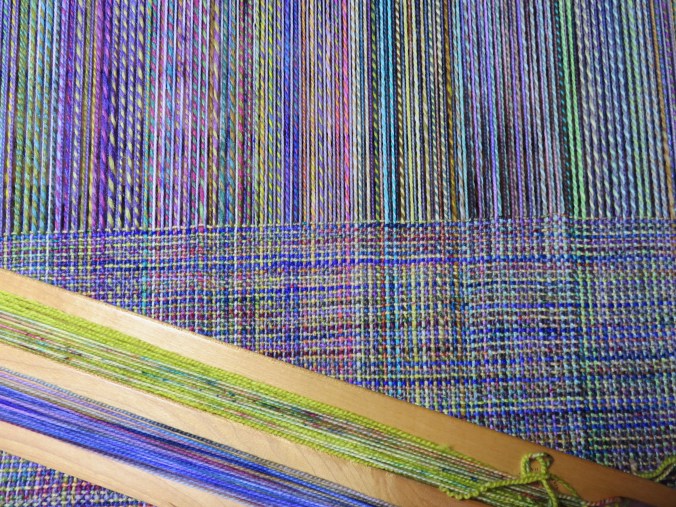
Three shawls woven on the “Carnival” warp.

This last assignment is poetry. Below are two 20-minute poem prompts. Choose.

IMPORTANT: My 20-minute exercises were inspired by prompts provided in the back of Dorianne Laux and Kim Addonizio’s marvelous craft book, The Poet’s Companion: A Guide to the Pleasures of Writing Poetry (W.W. Norton, 1997). Their original exercises are much better than mine. (You should buy the book.) 

1st option: Metaphor & Simile 

COLOR: What it is & what it’s like

DIRECTIONS:  Write in response to each bulleted item in order:

  • Choose a color such as blue or yellow or red, black or white, violet—whatever. Keep your color in your head for now and don’t write it down on your page.
  • Without including the name of your color, make a list of 6 things that are that color. 
  • Now stretch and add three more things to the list that are the color, then three more, but these should be more complicated things that you have to explain in a phrase—“a four day old bruise” might be yellow, but it’s not the first thing most people think of when they think of that color. (But still don’t say the color.)
  • Complete the sentence: If [someone famous—name them] had a [something—name it] it would be [write your color]. 
  • Complete the sentence: When [name someone] feels [some emotion—name it] in his/her sleep, she/he dreams [describe your color, again without naming it]. 
  • Complete the sentence: When I am [name an emotion] I feel that [describe an object or a place you care about]  is [name your color]. 
  • What does it sound like? “It sounds like…”
  • What does it smell like?
  • What is the texture of your color? 
  • When or how is it terrifying? 
  • When or how is it loving?

Revise, rearrange, & rewrite your list. There’s a poem on Bracken‘s “Hopelings” (sparks of hope in the time of social distancing, which are each lovely in themselves) that might have begun with this assignment called “A Pair of Gloves” by Rebecca Hart Olander. I urge you to click the link and have a quick read.


2nd option: Persona

The River-Merchant’s Wife

        by Ezra Pound

While my hair was still cut straight across my forehead

I played about the front gate, pulling flowers.

You came by on bamboo stilts, playing horse,

You walked about my seat, playing with blue plums.

And we went on living in the village of Chokan:

Two small people, without dislike or suspicion.

At fourteen I married My Lord you.

I never laughed, being bashful.

Lowering my head, I looked at the wall.

Called to, a thousand times, I never looked back.

At fifteen I stopped scowling,

I desired my dust to be mingled with yours

Forever and forever and forever.

Why should I climb the look out?

At sixteen you departed,

You went into far Ku-to-yen, by the river of swirling eddies,

And you have been gone five months.

The monkeys make sorrowful noise overhead.

You dragged your feet when you went out.

By the gate now, the moss is grown, the different mosses,

Too deep to clear them away!

The leaves fall early this autumn, in wind.

The paired butterflies are already yellow with August

Over the grass in the West garden;

They hurt me.  I grow older.

If you are coming down through the narrows of the river Kiang,

Please let me know beforehand,

And I will come out to meet you

   As far as Cho-fu-Sa. 

This poem is an English rewrite of an Italian translation of a Japanese translation of a very famous Chinese poem. Depending on who you talk to, it’s a mediocre translation of a great Chinese poem or a great poem inspired by a conventional Chinese original. I have talked to two Chinese-born American poets who gave me these widely diverse opinions. 

Regardless, this is a persona poem—written by a man from the point of view of a child bride who has grown to love her husband. At the end she promises to come as far as it takes (Cho-fu-Sa might as well be the moon) to reunite with her now beloved husband.

Write a poem in which you briefly describe defining moments in your relationship with another person. You might consider choosing a parent or friend as well as a lover. You might choose, as Pound does, to inhabit the character of someone other than yourself. In any case, these moments you describe should demonstrate an evolution in your relation to that person. Your initial response, how you came to know the person, how you came to care for and miss their absence. Address that person directly as “you” in your poem.

NOTE: At each stage you may improve the poem. Weird revision strategies later this week!

ART STUDENT

fullsizeoutput_c7d

The Brahma Teapot with the lid off and tipped back to show the bull. I made an entire teaset (the goldsmith who commissioned it did not want anything representational) and dozens of mugs in this style back in the day. The clay looks like porcelain, but is only a low-fire white clay. The patterns are underglaze and protected by clear fired glaze.

Back when I was an art student, I thought I might earn money, if not actually a living, from my art. I envisioned a dramatic difference in my life compared to how I was raised.

I was first a Ceramic Art major at the University of Washington. In the clay side of the Fire Arts Building, we were divided into throwers and handbuilders. I was a handbuilder and our work was primarily sculptural art. It was gallery stuff and I did eventually exhibit in galleries and museums (Bellevue Art Museum and Tacoma Art Museum), but selling was what throwers did because they were in to “production.” That is, they made many of a single shape and sold bowls and mugs and so forth. The year of the first University Street Fair in 1970, I had still been in high school, but I sold handbuilt work. I did that again after I had studio space in the Fire Arts Building, in 1972 perhaps. I took over firing the Skutt kilns with everyone’s work, and completed dozens of handbuilt mugs for sale. A year or so later I juried in to the Bellevue Art Fair. I handbuilt entirely different mugs, dozens of mugs in the style above, and I was disappointment when a friend came along with her ceramic-handled flatware and sold more than I did. I mean: crushed with envy, destroyed. Of course, she is still making a living with her art, so she had the better instincts even then.

Long story short? Selling my work became a painful experience. I gave work away. I traded a teaset for a stunning 8″ gold stickpin. I completed two other pieces on commission and was shafted one of those times. I should focus on success, but I wanted then (and still today) to be the best or not at all. Selling, despite my day job in retail, remained a frustrating and unsuccessful experience, a reflection of failure, inadequacy, foolish hope.

But here I am, weaving shawls for sale. A stack of three quilts, unpriced but intended for sale. And my stories too.

I was still almost young when I began writing seriously. I had a fantasy of selling my first novel and making enough money to create that coveted dramatic change in my fortunes. I would quit teaching and write full time. I would pay off my mortgage. I had the same fantasy about the second (also unpublished) novel.

The first time I made actual money from a story was just a couple of years ago with “If It Were True Owls Dream” which was a fantasy story. My first fantasy and first cents-per-word payment. It made me laugh. I did not need the money as I felt I had and no longer had delusions about fame and fortune. By then I was beginning to wonder about how to construct a story where (nearly?) all sources of conflict were absent. And I thought that perhaps I could make some money selling SF/fantasy. Maybe. Or not. Did it matter?

But then Trump and covid19 and rejection from publishers. I send essays off to Dinty Moore and he is kind enough to publish them in the Brevity blog. Mostly recently I wrote an essay about the creativity we will find after much of what we assumed was true about the world, how things work, and ourselves is unraveled. That essay goes live next month. Does anyone think this will be over next month? Convince me.

And then I decided to serialize some of the story that has consumed my writerly imagination for a long time, years. That is why bits of “Butterfly Fontanelle” showed up here. A little at a time goes up as I work through the only draft I could find on this computer. There is a 37k word version someplace, I think. I am working from the fourteen thousand word version. It’s growing a bit. Each day I work on it, I am a little bit surprised at what is happening. I am trusting that by the time I put up the 15th or 18th installment, it will end properly, that it will have gone someplace. I honestly cannot recall how this one ends. Not for sure. Maybe. We’ll all find out together.

And I have retired from teaching. The mortgage is paid. And here is a dramatic change to my life.

assignment #4 revision: Idyll

IMG_5693.jpeg

This is the first couple of inches of the third shawl on the “Carnival” warp. I completed more than ten inches before the sun went down. I might get all three off the loom tomorrow, surely by Saturday. We went out to collect the mail yesterday, so I might begin another pair of socks.

Hello. Before the revision strategy, a confession. I have been in a bit of a muddle lately. I “turned off” the news two days ago—tossed the email updates unread, and stopped checking news sources online or Johns Hopkins statistics. I think it did me some good to take a break. For example, I noticed I’d miss-numbered the assignments and fixed that. I slept better last night.

Continue reading →

SHUT DOWN

Gary and I were awake at three this morning. I am trying not to read the news, not to compulsively check statistics for an entire day. I deleted unread all the news in my mailbox right away this morning without even reading headlines. Instead, I worked on the story, revising what will go live today. Gary has brought me coffee, and then drank it himself. Coffee allows him to go back to sleep. (which we did.)

I think today I will finish the second shawl of this warp. I was still weaving yesterday past seven in the evening so there is not so much left of that dreamy ocean-colored shawl. (The photo shows just the start of that piece.) I usually take a risk with the third length of weaving, choosing unexpected colors for the weft. I am not decided how the last will go, will I use the odd multicolored skeins with violet that I have laid out or something entirely different?

Continue reading →

ASSIGNMENT #4: The Idyllic Place

IDYLL:  a simple descriptive work in prose or poetry that deals with rustic life or pastoral scenes or which suggests a mood of peace and contentment.  
IMG_5687One of the things going on in The Adventures of Huckleberry Finn, perhaps the main thing, has to do with the essential decency and indecency of human beings. Huck himself is an innocent, accepting the bigotry of his time because he assumes his “betters” are actually better. Even so, he will risk his soul for Jim. And the grown man and father, Jim risks his freedom and life to safeguard the life of a child, which makes him the most moral person in the novel.

Okay, set that aside. (You might not even agree with me.) It is a (failed) Hero’s Journey and safety is generally found only when Jim and Huck travel, danger in staying in one place and with other people. The most peaceful passage in the entire mad run is Jim and Huck drifting south together on the river.

Connection to landscape often provides a vivid sensation of peace and contentment. Twain’s Huck Finn finds easy living and contentment on the Mississippi. Huck’s idyllic description of life on the river begins with the final three sentences of Chapter 18 and continues through the first few pages of Chapter 19 (below). Notice how he continues his conversational style, and utilizes description which includes all his senses—touch, taste, smell, sound, and sight. Twain gives the reader a specific event—the sunrise—and makes this experience live, a written “picture postcard” of a happy place and time.

This was an experience Samuel Clemens knew well personally. He worked the river—it was his childhood ideal, an adult accomplishment, and the source of his pen name: mark twain=safe water. I like to think he carried that memory of life on the river with him throughout his life and travels. If you can visualize a peaceful place, it is yours to visit whenever you have need.

The assignment: Describe such a peaceful vision from your own life—make your vision draw the reader into your experience. Use informal language but no use of 2nd person/direct address!  Search your memory for a complete picture, gather it up, using all of your senses. Make this place breathe using a specific time or event. There is no plot, no cause/effect relationship, no character development; this is not a true story, but is a true description of an experience.

Spend some quiet time thinking.  Choose a real place which was peaceful for you—on the ocean, in the woods, up a tree, hiking in the hills, or walking on the beach. I have also read wonderful “idyllic” papers which bent the rules a bit to talk about personally moving places—the locker room after a football game, scouting hunting trails, shopping with an aunt, on stage waiting for the curtain to open (my personal nightmare), an entire day up in a treehouse, driving to visit grandparents, surfing. List some features, details, and then ponder. Give this idyllic vision a chance to grow in your head before trying to get it all down on paper. The idyll is a personal description rather than a narrative or academic essay.

I have written about waiting for my sons to fall asleep before filling their Christmas stocking (they were in college at the time), hitting the magical three and a half miles and felling runner’s high, walking the beach, and weaving shawls.

This is a “SHOW,” not a “TELL” paper, but showing with all your senses. It is important that your description demonstrate the sensory experience of your idyll. Don’t tell the reader how happy and peaceful it is—detail the sounds, tastes, smells, sights, and textures that cradle those feelings.

DIRECTIONS:  This is a descriptive paper with a very personal slant, as if speaking to someone you want to be there with you. No character development or plot, but your description may move through space, sensation, emotion. This is about a PLACE, not a person or event!  Personally meaningful setting, no significant dialogue (except perhaps to get you there), full and complete description. As always, write long and carve back. Revise it to a standstill.

NOTE: a weird revision strategy will follow later this week. Really it will.


The Adventures of Huckleberry Finn by Mark Twain

the end of Chapter 18 and the beginning of Chapter 19

We said there warn’t no home like a raft, after all. Other places do seem so cramped up and smothery, but a raft don’t. You feel mighty free and easy and comfortable on a raft.

Two or three days and nights went by; I reckon I might say they swum by, they slid along so quiet and smooth and lovely. Here is the way we put in the time. It was a monstrous big river down there— sometimes a mile and a half wide; we run nights, and laid up and hid daytimes; soon as night was most gone we stopped navigating and tied up—nearly always in the dead water under a towhead; and then cut young cottonwoods and willows, and hid the raft with them. Then we set out the lines. Next we slid into the river and had a swim, so as to freshen up and cool off; then we set down on the sandy bot- tom where the water was about knee deep, and watched the day-light come. Not a sound anywheres—perfectly still—just like the whole world was asleep, only sometimes the bullfrogs a-cluttering, maybe. The first thing to see, looking away over the water, was a kind of dull line—that was the woods on t’other side; you couldn’t make nothing else out; then a pale place in the sky; then more paleness spreading around; then the river softened up away off, and warn’t black any more, but gray; you could see little dark spots drifting along ever so far away—trading scows, and such things; and long black streaks— rafts; sometimes you could hear a sweep screaking; or jumbled up voices, it was so still, and sounds come so far; and by and by you could see a streak on the water which you know by the look of the streak that there’s a snag there in a swift current which breaks on it and makes that streak look that way; and you see the mist curl up off of the water, and the east reddens up, and the river, and you make out a log-cabin in the edge of the woods, away on the bank on t’other side of the river, being a woodyard, likely, and piled by them cheats so you can throw a dog through it anywheres; then the nice breeze springs up, and comes fanning you from over there, so cool and fresh and sweet to smell on account of the woods and the flow- ers; but sometimes not that way, because they’ve left dead fish laying around, gars and such, and they do get pretty rank; and next you’ve got the full day, and everything smiling in the sun, and the song- birds just going it!

A little smoke couldn’t be noticed now, so we would take some fish off of the lines and cook up a hot breakfast. And afterwards we would watch the lonesomeness of the river, and kind of lazy along, and by and by lazy off to sleep. Wake up by and by, and look to see what done it, and maybe see a steamboat coughing along up-stream, so far off towards the other side you couldn’t tell nothing about her only whether she was a stern-wheel or side-wheel; then for about an hour there wouldn’t be nothing to hear nor nothing to see—just solid lone- someness. Next you’d see a raft sliding by, away off yonder, and maybe a galoot on it chopping, because they’re most always doing it on a raft; you’d see the axe flash and come down—you don’t hear nothing; you see that axe go up again, and by the time it’s above the man’s head then you hear the k’chunk!—it had took all that time to come over the water. So we would put in the day, lazying around, listening to the stillness. Once there was a thick fog, and the rafts and things that went by was beating tin pans so the steamboats wouldn’t run over them. A scow or a raft went by so close we could hear them talking and cussing and laughing—heard them plain; but we couldn’t see no sign of them; it made you feel crawly; it was like spirits carrying on that way in the air. Jim said he believed it was spirits; but I says:

“No; spirits wouldn’t say, ‘Dern the dern fog.’”

Soon as it was night out we shoved; when we got her out to about the middle we let her alone, and let her float wherever the current wanted her to; then we lit the pipes, and dangled our legs in the water, and talked about all kinds of things—we was always naked, day and night, whenever the mosquitoes would let us—the new clothes Buck’s folks made for me was too good to be comfortable, and besides I didn’t go much on clothes, nohow.

Sometimes we’d have that whole river all to ourselves for the longest time. Yonder was the banks and the islands, across the water; and maybe a spark—which was a candle in a cabin window; and sometimes on the water you could see a spark or two—on a raft or a scow, you know; and maybe you could hear a fiddle or a song com- ing over from one of them crafts. It’s lovely to live on a raft. We had the sky up there, all speckled with stars, and we used to lay on our backs and look up at them, and discuss about whether they was made or only just happened. Jim he allowed they was made, but I allowed they happened; I judged it would have took too long to make so many. Jim said the moon could a laid them; well, that looked kind of reasonable, so I didn’t say nothing against it, because I’ve seen a frog lay most as many, so of course it could be done. We used to watch the stars that fell, too, and see them streak down. Jim allowed they’d got spoiled and was hove out of the nest.

Once or twice of a night we would see a steamboat slipping along in the dark, and now and then she would belch a whole world of sparks up out of her chimbleys, and they would rain down in the river and look awful pretty; then she would turn a corner and her lights would wink out and her powwow shut off and leave the river still again; and by and by her waves would get to us, a long time after she was gone, and joggle the raft a bit, and after that you wouldn’t hear nothing for you couldn’t tell how long, except maybe frogs or something.

After midnight the people on shore went to bed, and then for two or three hours the shores was black—no more sparks in the cabin windows. These sparks was our clock—the first one that showed again meant morning was coming, so we hunted a place to hide and tie up right away.

DREAMING


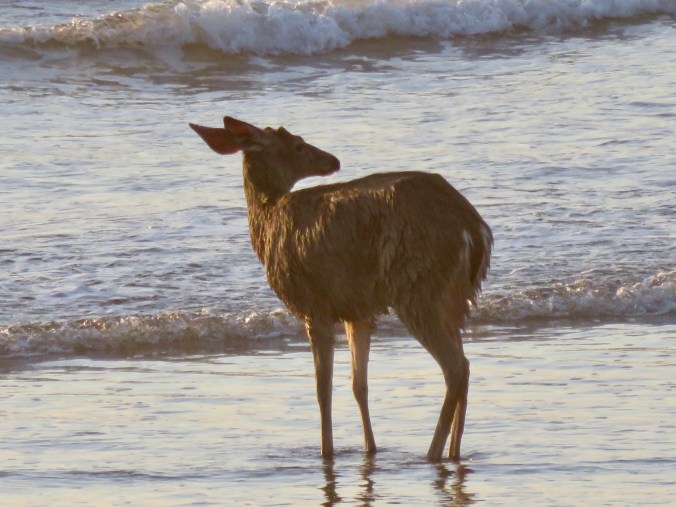
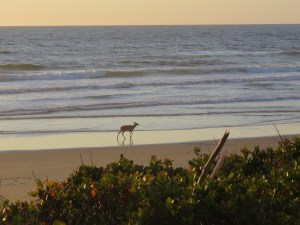
IMG_5660.jpegLast night, just before sunset, a deer appeared on the shore. Not a good thing in daylight. She was wet and confused and kept to the surf line. We see deer tracks frequently in the sand on our morning walks, but never the two deer themselves. This one moved along just fine, though she did not look happy, and the tourists with their dogs had all gone home. Local dog-owners came out on the beach, saw the doe, and leashed their dogs. Perhaps she had been separated from her companion, which I assumed from its smaller tracks was a yearling fawn? She stood right in front of our house, trotted north and then back south. And then the sun went down.
This morning, I dreamt we were living in our first house in Seattle again. Our dog Volant Sequoyah (“Bowzer”) had jumped the fence into the neighbor’s fenced yard and I’d left him there for a day and a half to teach him a lesson. Ian and Kerris showed up with packages of ground beef and hamburger buns just as I brought Bowzer home, and we didn’t want it because we’re vegetarian, but I thought about feeding Bowzer the meat. He was hungry. There was also a sequence of visiting the local school, which had been temporarily housed in an upper floor of a fancy office complex.

Well. Dreams are like that sometimes, a mixture of what we know and wish and experience muddled with places we have been, people we care about. Alan commented on the phone that the house yesterday that the house he and his wife first bought was up for sale and that set me thinking about our old house in Seattle. Online it is valued at nearly a million dollars. We paid less than twenty thousand for it in 1975.

At the beginning of 1978, Gary had left the zoo job and was tutoring American Indian students in the Edmonds School District. He had just been accepted to a grad program at the University of Washington’s School of Education for the fall. He planned to teach elementary school. I think he would have been wonderful at that job, he enjoys goofy humor and his impulse toward soothing and calming others would have served his students well. I was teaching art classes at Forest Ridge, an elite girls’ prep school on the other side of Lake Washington. We had six Afghan Hounds then, including Bowzer and his sister, and were active in showing and lure trials. I was a licensed field trial judge and we traveled often across the PNW and to Canada for shows and field trials. Instead, Gary’s father was dying of cancer, his family was falling apart and he quit school to support them. My grandfather’s third wife died and Genevieve left me the family house at the urging of her second husband. We thought we might buy land outside the city.

Instead we decided to have a family. We moved to my grandfather’s beach house in Oregon, the state where I was born. Gary took a job in a farmers’ co-op because he had worked in the Woodland Park Zoo commissary before he started back to school. we had our children, and I became an English teacher.

All in all, the dream seems more likely than that doe in the waves.


IMG_5656I should note that I took the photo above with a zoom from our deck. We are careful to avoid approaching wild animals. It is distressing for the animal and can make a bad situation deadly. Locals understand it is best not to “help” a wild thing.
Oh! I should have put up Assignment #3, only because I said I would do five. No one seems to be writing them, but I will post “The Idyllic Place” tomorrow.


PEACEFUL DAY

fullsizeoutput_11dd

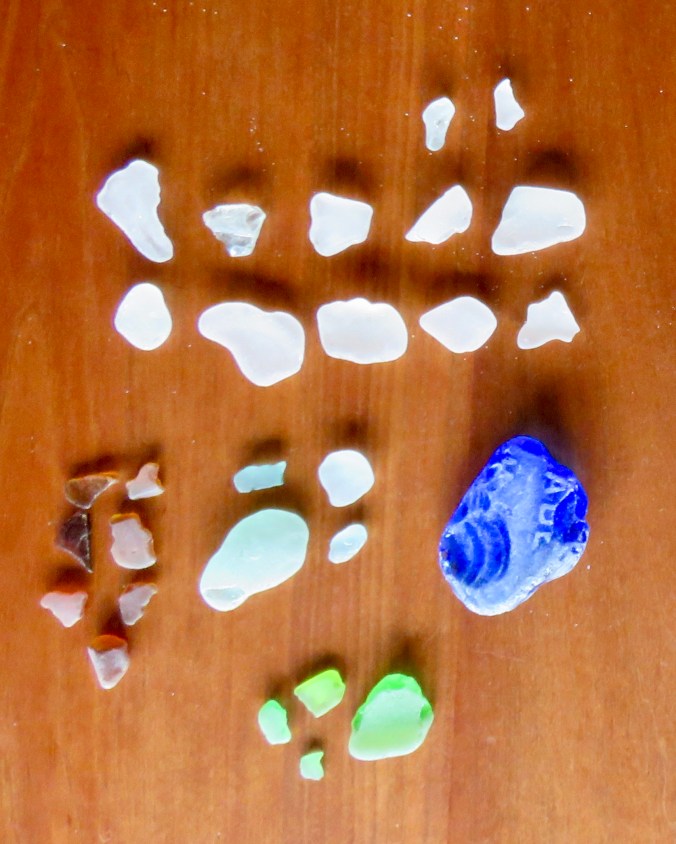
We each have our favorite colors of sea glass. Gary almost never finds the dark orange “brown” glass. Cobalt blue (the piece above is more than 50mm across and 6mm thick) is cause for celebration.

Today I will bake rolls and roast green beans. My mother would have made lamb, but we are vegetarian and I have a casserole of mac&cheese already made and ready to go in the oven. I found fresh blueberries on our weekly grocery run, so there will be a pie. No ice cream, but blueberry pie. We will sit at table and remind ourselves of our good fortune. Continue reading →

CARNIVAL

IMG_5639

My third day working on the “Carnival” warp with just ten inches woven. (I discovered that the acid green I’d hoped to use was from a very old first dyelot of the color and the yarn itself thicker than the others. I finished off a very old blue skein like that in the recent blue warp.) Twenty or more inches today, I hope, and I will bake bread. We had salad last night for dinner! Such a relief after no fresh greens for a week. Salads for the next couple of weeks, and I have leeks to make leek soup, potatoes to go into the soup or for oven fries, cheese!, green beans I will roast tomorrow. Potato chips are a treat.  Continue reading →

TEACHERS & other essentials

Nurses, doctors, firefighters, the EMTs who answer calls, ambulance drivers, therapists, technicians, and pharmacists.

A local hospital administrator must leave her infant son to ensure medical care is available for the rest of us.

Like other essential services, children need education and local teachers are still at work, striving to accomplish what they can without actually having students in front of them. It is a challenge. One teacher, working from home in her basement, commented, “As you can imagine, it is not best practices just to put your assignments online and think they will be able to do them.” She has always done so very much more than that. And every day.

A local trucker friend who delivers fuel is also working, often with people who do not think any of this is a big deal. He worries about his mother, in her 90s.

The nearest grocery is five miles from us and having trouble keeping supplies in stock. Their employees are gloved and masked, but they are still open.

Our favorite bakery in Tolovana delivers bread at their door.

No one wants to take cash, but we are not spending much either. We stay close to home and do not sleep well the night before we must go out. But there are invisible people still plugging way and keeping things moving, people who still go to work each day, people who log on to their computers and do the job, people who are old themselves but still taking care of older relatives, people who fill my yarn and book and CD orders, people who gather to sing virtually.

Thank you. Thank you every one.