SPRINGING

IMG_5606

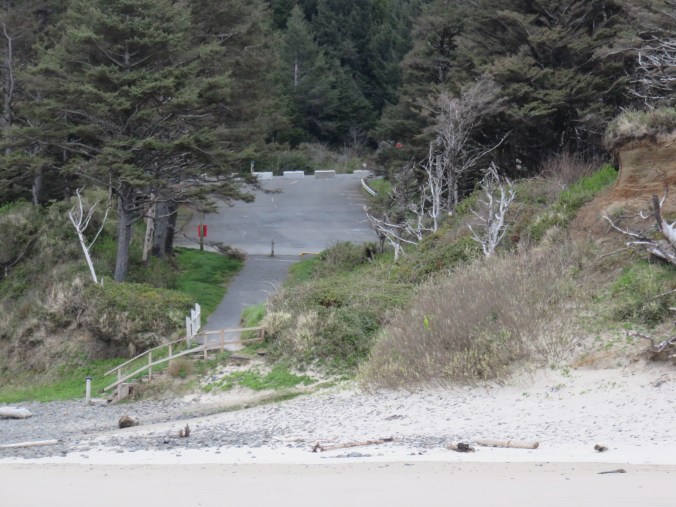
Gary and I used to run up this hill. I’ll call it a 30° angle, but I’m just tossing out a number. It felt like pretty much straight up.  (At top you can see the concrete barriers blocking the parking lot.)

We went for a long walk the other day—two miles from home and then back with another mile or so of up and down shore to hunt for agates and sea glass. I finished the pair of socks I’ve been knitting and washed and blocked them. I should have baked bread but we got by with the last slices. The moon really was lemon that night. Continue reading →

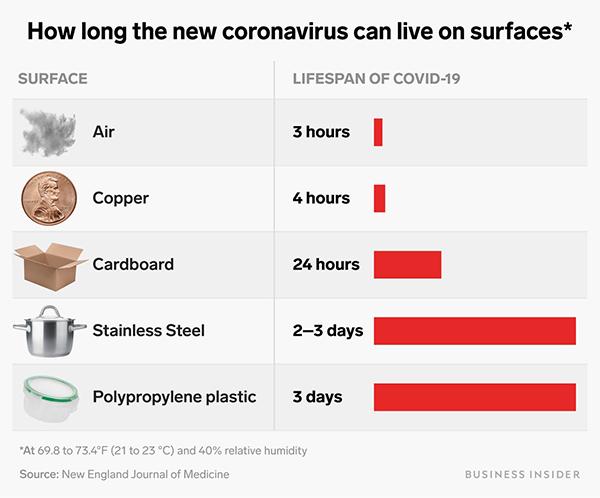
HOW LONG? 2 charts

5e7787ee1378e37a8a67d1925e8cdb448427e964fd756ce6.jpeg

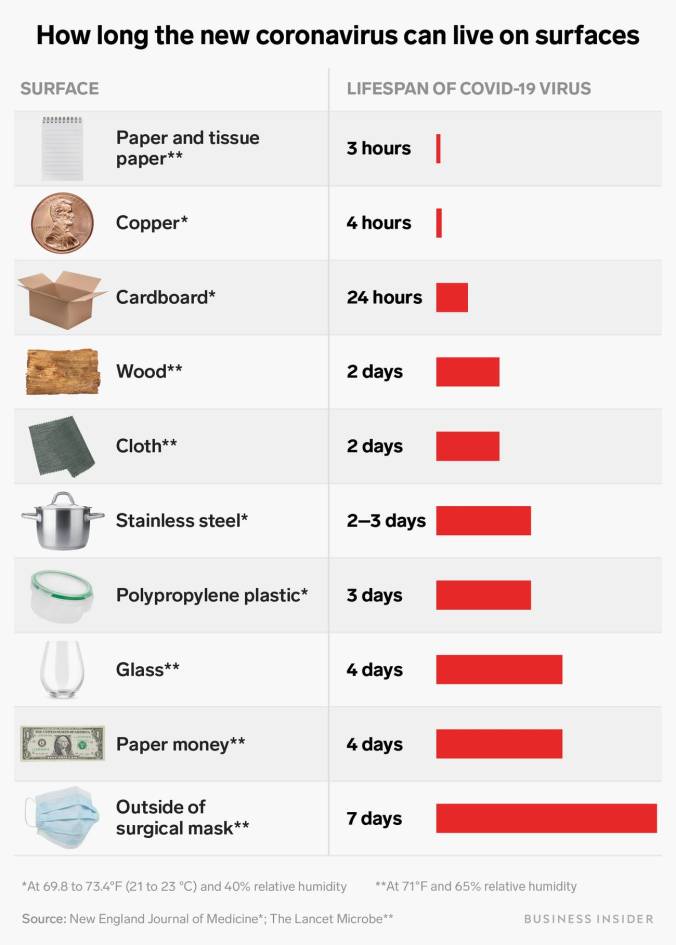
“How long the coronavirus can survive on surfaces

“The researchers behind the new study tested the virus’ life span in a 71-degree-Fahrenheit room at 65% relative humidity. After three hours, the virus had disappeared from printing and tissue paper. It took two days for it to leave wood and cloth fabric. After four days, it was no longer detectable on glass or paper money. It lasted the longest, seven days, on stainless steel and plastic.*

“Strikingly, the authors wrote, the coronavirus was still present on the outward-facing side of a surgical mask on day seven of the investigation. That’s the longest duration of all the materials they tested.”

NOTE: It lasts longer on cooler rather than warm surfaces. Some research has also suggested that increases in relative humidity reduce how readily the virus can spread between people. Your mail is most likely safe on delivery according the the article.


Gary wiped down a wine bottle with alcohol wipes, but we’re mostly avoiding bleach. Mostly, we allow things to sit for days. We wish freezing or refrigeration made a difference (no). We wish vinegar killed it (acidic—wouldn’t that be nice? but no). We wish we didn’t have to think about this at all.


from Business Insider. https://www.businessinsider.com/coronavirus-lifespan-on-surfaces-graphic-2020-3?utm_source=DI20B8U3&utm_medium=email&utm_campaign=20_feb_corona&utm_term=04_06

RLP: Idiot Drivers

Idiot Drivers

I drive a small car, my husband’s little red Honda Civic hatchback, and one thing I that makes me crazy is when drivers of giant SUVs come right up behind me and tailgate.  A couple of days ago I was driving home from work and an SUV merged from highway 26 onto highway 101 right behind me.  I could tell the driver was mad at me that I didn’t brake to let him in in front of me because he waited till his merging lane ended before he slowed and cut in about five feet behind me.  The speed limit changes to 55 mph right about there and I was speeding up but I kept speeding up to a little above the speed limit and even so he tailgated me all the way to the passing lane.  He whipped on by me in the left lane and then moved back into my lane about a hundred feet ahead of me and slowed back to the same speed he was going before he passed me.  So what was the big deal about passing me if he didn’t actually want to go any faster?  He just had to be in front of me.  It just shows America is a dangerous place to drive.  I am more likely to die on American roads than in most nations of the world.  There are 15.2 deaths/100,000 in the U.S. compared to 6.0 deaths/100,000 in the United Kingdom.  In fact, a German data base survey of twenty-eight participating countries showed most reporting death rates in the single digits with only Portugal, Poland, Greece, Korea, and Luxembourg showing higher death rates than the U.S. (“Selected Risk Values”).  We’re all a little crazy on U.S. roads. Something must be done to make the road safe from crazy drivers.     

There should be some way to safely respond immediately to the stupidity of drivers who tailgate, cut people off in traffic, or drive way too slow or too fast.  My solution is to issue an “idiot pistol” to all drivers in good standing.  This gun would be turret mounted on the top of my car and respond to verbal direction.  I would simply say the license number or describe the location of an offending driver’s car and say “fire.”  The idiot pistol would shoot a dart directly into the back of the car where it would harmless attach itself and release a large two-foot orange and purple flag saying “IDIOT!”  I would feel revenged right away and for a month the driver would have to drive around with a sign proclaiming him an idiot.  There would be no permanent damage to the car, but if a single driver accumulated four flags in a four week period while offending four drivers in four separate incidents of stupidity, the car would be impounded.  Of course, everyone makes mistakes once in a while and this would act as an immediate reminder and lesson to all drivers, while seriously punishing drivers who consistently drive like idiots.  

I like the idea of punishing offenders on the spot and firing darts into the back a cars could certainly make me feel better when I’m cut off in traffic, but even I can see there are problems with my plan.  I’m as susceptible as anyone to irritation, bad temper, and error.  My goal is to make the roads safe from foolish drivers, but shooting at them could be counterproductive.  I could end up acting like an idiot myself and chase down another driver, succumb to road rage, or pay more attention to getting even than driving safely.  I might overreact to an honest mistake or choose to pick on someone I have a grudge against.  Four friends could gang up on a common enemy in order to cost him his car.  Most people can’t afford to rush right out and replace an impounded car.  I know I would be in a bad spot if that happened to me.  Finally, aside from issues of safety and fairness, this system would definitely be expensive to set up and monitor and there isn’t any existing technology to safely shoot the harmless but non-removeable darts in the way I recommend.  

Nevertheless, idiot drivers are a real and ongoing problem and all sorts of strategies should be considered in order to address the problem.  There are laws dealing with these things.  We all need to respect the need to abide by laws designed to guard us against our own deep, sincere need to drive like fools at time.  I think it should be against the law to use cell phones on the road as it is in many other countries.  All drivers need to more considerate of existing laws regarding speed limit and other traffic signs, as well as use common sense about recommended speeds, spacing on the highway, and demonstrate courtesy when merging and passing.  We could brand or tattoo notice of traffic violations on people’s foreheads.  That would certainly get their attention.  Maybe it’s not legal or nice, but driving like a creep isn’t very nice either.  Too many people behave as if laws apply only to criminals and not to them.  Maybe more police on the road would help, better education when learning to drive, remedial classes for people with bad driving records.  Maybe some rock star, Sting perhaps, would take up the slogan, “Don’t be an idiot, drive sensibly” and make it cool to be a cool driver.  

In desperate moments I’ve considered desperate measures to get even with drivers who scare the pants off me.  I would like them scared too, and at least publicly embarrassed by their poor driving habits if not thrashed and arrested.  But I drive a little car and I’m not interested in declaring war on the highway.  The truth is that I can’t make others drive better, I can only practice what my husband suggests:  “Drive like they’re all crazy, because some of them really are, you know.” His attitude is international.  The Chief Superintendent of Police Traffic Headquarters in Hong Kong said just the other day: “smart drivers always assumed that other drivers were inexperienced and careless.”  After a widespread courtesy campaign, death rates in Hong Kong dropped to the record low of only 3/100,000, a fraction of what they are in the U.S.  So I think I’ll be safer if I listen to the experts and my loved ones and take care of myself without seeking revenge. I will be polite. If someone wants to merge in front of me I’ll try to let them.  If they want to drive faster, I’ll look for a place to pull over. If some motorhome is creeping along at 35 mph in a 55 zone with no passing lane for a mile, I’ll take a deep breath and ask myself why I’m in such a hurry. I don’t want to get so bent out of shape about other people’s idiocy that I become another idiot myself. Though I can’t change the rest of the world, I can try not to let the rest of the world ruin my day.      

ASSIGNMENT #3: Real Life Problem

IMG_5573

Essayist and memoirist William Kittredge was born in Portland, Oregon but lives now in Missoula, Montana, I think. He did a presentation at my first MFA residency about writing an essay. He insisted that he couldn’t tell anyone how to write an essay, and then he did. Define a problem by telling a story about it. Then propose a solution by telling another story. Explain why that solution won’t work with another story . . . at least that’s how I remember it.

This assignment works a lot like that and is straight out of my high school playbook. I have written it many times and I can always make myself laugh because it’s silly and satisfying. It can be written in one sitting, but I like to do it one paragraph at a time. In a classroom, we draft the first paragraph on a Monday in twenty minutes, and I would allow students a few more minutes to complete it—working on a new step each day, by Friday students had a complete draft. They had to count their words and meet the minimum. Two hundred words is not a long paragraph and most students wrote closer to two-fifty words. It doesn’t matter too much.

ASSIGNMENT:  Write an essay of five or more paragraphs humorously addressing a minor real life problem (no pornographic or vulgar problems or serious problems like world hunger), propose a silly or ridiculous solution, identify the flaws of your solution, review other silly and reasonable options for solving the problem, and conclude what is being done and should be done to address the problem. We’re joking!  One step at a time. 


#1 the PROBLEM Hook your reader and explain the problem you are concerned about by telling a true short story about your personal experience with this problem—an anecdote. Explain why it bothers you, maybe explain why it’s bigger than it looks—show the big picture. State the overall problem in a sentence at the end—your thesis.  The toughest thing about this paragraph for many people is telling too much of the story. Write about 200 words.  very short story, big picture, thesis sentence

#2 a SOLUTION Propose a satirical “ridiculous” solution to your problem, one that is not vicious (no decapitations!).  This solution is not realistic, it must seem both sincere and silly.  Explain how your solution would work. Make it sound as reasonable as you can, step by step, in detail. Don’t hurt anyone with the solution, not even as a joke. In paragraph #2, I have proposed an “idiot gun” that shoots darts into the back of bad drivers’ cars with a huge banner proclaiming the driver and idiot. I have commandeered a flock of trained seagulls to poop on the spotlights shining on the beach. A student imagined a trap door that would open under his mother’s feet and drop her in a pile of dirty laundry when she asked if he had any homework. None of these solutions in possible or practical, some are completely unfair and foolish. No worries. You’ll be admitting that in paragraph #2. Have fun with this, explain why it is a satisfying solution. In my experience this is at least a medium length paragraph. Write about 200 words.   

#3 the HOWEVER Explain the problems with your ridiculous solution. Think hard and enumerate them all. Be specific. Consider safety, expense, practicalities, legalities, fairness, other considerations. Perhaps even some of the problems with the solution are silly! You should have at least four problems with your solution. In my experience this is medium length paragraph. Write about 200 words.   concede the flaws in your silly solution

#4 other OPTIONS What else could be done or is being done about this problem?  Again, be specific, briefly describing each option in a sentence. These options may include both realistic and silly possibilities. You should have at least six options with your solutions, each explained briefly and carefully. This is usually my longest paragraph, sometimes I must break it into two.  Write  about 200 words.  consider many options [NOTE: sometimes this one gets out of hand with too many options. You can carve back to the best one later or make two paragraphs.]

#5 CONCLUSION Redefine your problem. Summarize the good, the bad, and the ridiculous. What has been done, is being done, will be done, should be done? What are the consequences of this “real life” situation? Revisit your anecdote at the beginning—what did you do in that situation and how did it turn out? Are you satisfied with your on-the-spot reaction or could you do things differently? Step back from your rage, frustration, and spite—be sensible here.  In my experience this is a medium to long paragraph. Write about 200 words.  recap, reconsider, get real [NOTE: again, sometimes this gets out of hand. You can carve back or make two paragraphs.]

You can add to your satire after the first draft that explain the problem, offer a solution, agree or disagree with your solution. The sources themselves can be ridiculous. Write long, butcher back.

The most important part of any essay is our ideas and what we write, but an essential part of this assignment is to eventually acknowledge that this really is a trivial complaint. And even though we’re kidding, the joke goes over better if we “tell it with a straight face.” 

And, of course, I won’t be looking over your shoulder or giving you a stamp when you achieve content and word count for each paragraph. Bill Kittredge advised aiming for the same length of paragraphs throughout. You don’t have to do that. You don’t have to do any of this.

But if you write this assignment, it will make you smile. I think I can promise that.

And a reminder that this is National Poetry Month—a reminder to me since I have ignored this for almost a week. (for several years I used to post a poetry prompt each day of April). I think it might be fun to write this as a poem. Maybe “fun” is the wrong word. Engrossing? Better than watching a bad series on Netflix? A form poem would be particularly challenging. Villanelle? Sestina? Anyone? Anyone?
STATS

Explain this, as of 4 6 April:

219,564 residents in Jackson County; 2133 2269 tests; 33 confirmed cases, still no dead

346,868 residents in Marion County; 1567 1716 tests; 188 198 confirmed cases, 5 dead

In Jackson county, as of 4 April, Oregon had managed to complete 1 test for each 102 residents.

In Marion county, Oregon had tested 1 in 221 people. Yet Marion has many more cases and five people have died.

In our most populous county, Multnomah, as of 6 April there have been 4209 4603 people tested with 209 233 confirmed cases and six seven dead. There are 811,880 people in Multnomah County, which means Oregon had tested only 1 on 193 176 people in our most densely populated county, but six seven have already died.

There are 3,831,074 people in Oregon, 18,925 19,556 have been tested (one person in 202 195), and 999 1068 are confirmed positive, 27 have died.

What’s the deal with Jackson County? And while I’m at it, what’s the deal with that person with Marin County, California plates shopping at the local grocery?

Yeah, I should be nicer, but Gary says my mother would be proud of me: “Going through everything, trying too make sense of the puzzle. That’s what your mother did.” It’s true, Mom cared about numbers and fairness.


SCHEDULE

IMG_5593.jpg

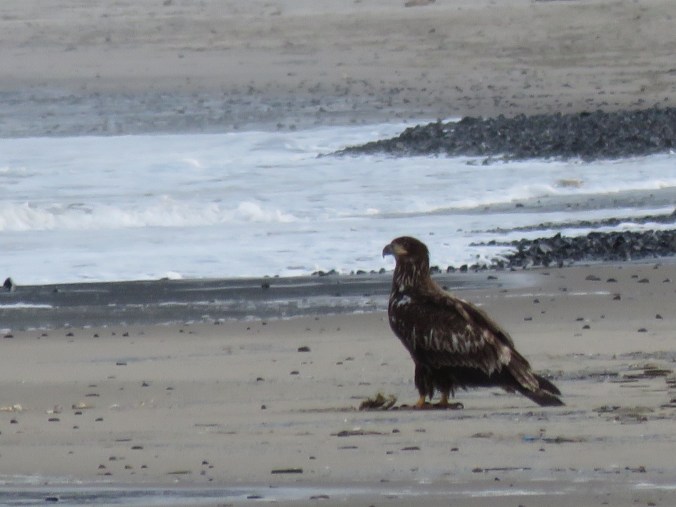
The first few times a juvenile eagle lands on shore they stand around for several minutes (up to an hour). I always assume they are unhappy to be wet and to be forced to launch from flat sand.

Today, a walk creek to creek, a juvenile eagle, meditation on the value of lies, and a little brainstorming to prepare for Monday’s writing assignment. The best one is above, the lies below. So brainstorming.

Monday’s nonfiction writing assignment was a great favorite with my students, the assignment they completed early in the year and which they still loved by the end. It will be satirical and more than a little silly. It concerns a trivial annoyance.

Continue reading →

update on BLUETONGUE

IMG_5571.jpeg

The photo has nothing to do with any disease. This is a beaching of many thousands of tiny Velella vellella. They can grow to be a few inches long, but these are as small as the head of a pin.

I posted a few days ago about my friend who, years ago, was accidentally infected by bluetongue, a disease she was studying in sheep. She insisted that she could not possibly have the disease, but that she certainly had the antibodies in her blood. The disease of cloven-hoofed mammals, was not supposed to infect humans at all. But it did.

Not that it matters all that much to most of us just now where covid19 originated, but it seems that deliberate release has been ruled out, but an accidental one has not. Pangolins apparently have little to no part in this disease—it’s bats. Covid19 is derived from a coronavirus infecting bats. Here’s the catch: there were no bats in the seafood market where the disease supposedly first appeared. A wild bat might have infected someone in the market, of course, but more troubling is that nearby was a lab studying coronavirus in bats. Again, there is absolutely no one (outside of the wackjob conspiracy theorists) who believes it was released deliberately on human populations. It’s more likely someone was either very unlucky or simply careless.

“Richard Ebright, a Rutgers microbiologist and biosafety expert, told me in an email that ‘the first human infection could have occurred as a natural accident,’ with the virus passing from bat to human, possibly through another animal. But Ebright cautioned that it ‘also could have occurred as a laboratory accident, with, for example, an accidental infection of a laboratory worker.’ He noted that bat coronaviruses were studied in Wuhan at Biosafety Level 2, ‘which provides only minimal protection,’ compared with the top BSL-4.” —The Washington Post, 2 April 2020

With over a quarter of a million Americans already diagnosed with covid19, having a look at how this started is going to matter in the future if we have any hope of surviving a repeat. (A reminder the the great influenza pandemic of 1918-19, the so-called “Spanish Flu,” was not from Spain and may have started in Kansas. Troop movements spread it all over the world. According to the CDC: “It is estimated that about 500 million people or one-third of the world’s population became infected with this virus. The number of deaths was estimated to be at least 50 million worldwide with about 675,000 occurring in the United States.”)


source: “How Did Covid-19 Begin? Its Initial Origin Story Is Suspect” by David Ignatius

https://www.washingtonpost.com/opinions/global-opinions/how-did-covid-19-begin-its-initial-origin-story-is-shaky/2020/04/02/1475d488-7521-11ea-87da-77a8136c1a6d_story.html?

#2 REVISION

IMG_5553

You might have guessed because my post yesterday is already halfway there. (Or, like a family member who read it, decide that this assignment is all too sad.) If you wrote a list of things you lost, today write what you found. You can write it as a talk-back to the lost list, interleave what’s lost and found (as I did), or take it all the way (as I intend to do) and replace the lost with what is found.

I keep thinking of more things I found:

The dawn chorus.

Cumin, cardamom, and chipotle powder in my cooking, that cinnamon tastes different when it’s from Vietnam, and that turmeric does more than make commercial mustard yellow.

Caramelized onions.

Algebra.

Coffee.

My husband.

Running!

Crow quills. (The tiny dip pen points used by Edward Gorey.)

Edward Gorey, who illustrated to scale.

Aagah, who came to us completely wild, when she jumped the seven foot wall and I chased her for two miles and found her at the edge of the old reservoir, miserable in the rain, and after that she trusted me.

The maze of Knossos, the architecture of Gaudi, the paintings of Artemisia Gentileschi. Hagia Sophia.

How to knit many colors from Kaffe Fassett.

Color.

 by Edward Gorey (By Source (WP:NFCC#4), Fair use, https://en.wikipedia.org/w/index.php?curid=35531939)



LOST & FOUND

IMG_5564.jpg

I am writing right here. Right. Here.

Four friendships lost: Carmen died, and even though the break between us was because of things she did, it is only my fault we never made it up and there is no going back because she has died. When I finally got around to searching, I found only the notice of her mother’s death and it listed Carmen as among those predeceased. I did try to make it up with Pat and Denyce but they are still not speaking to me. Knowing how the break-up happened with women I once corresponded with near-daily does not help. That there was nothing terrible about the break-up from my point of view (we did not betray or steal anything, and I never stopped caring) does not alter the fact that they will not respond to me. I find it is my failure.

A fourth best friend from First Grade moved away when we were little. We shared a love of horses and she had horses.  Continue reading →

POWELL’s


IMG_5541.jpeg

I love Powell’s Book Store, well, of course I do! What’s not to love about a book store that shelves used and new books, the largest book store in the United States. (Perhaps still the largest in the world?) May the store continue to thrive.

Founded in the 70s, the store was relatively good to employees until the owner claimed betrayal when workers tried to organize. That happened years ago, and the fight was bitter but the store is unionized. Later, when Michael Powell’s daughter took over the business, the corporation fought against raising what remains among the lowest corporate tax rates in the nation. Reviewing their Mission statement and list of seven “Values” the closest they come to valuing their employees is “We’re conversation starters. We’re an eclectic team of readers with broad interests and strong feelings about the books on our shelves. And we’re committed to sharing our knowledge and enthusiasm with our customers every day.”

Sadly, employees are not always as well-informed as you would hope. Gary was in the checkout line when Ursula K. Le Guin walked through the store. Gary turned to the young checker, and gestured. “That’s Ursula Le Guin.”

“Who?”

The most famous author in Oregon.

Anyway, qualified help is often an issue. Here’s the latest from Publishers’ Weekly:

“Powell’s Books announced that they have rehired some of the employees they fired earlier in the month due to strong online orders. It was widely misreported that the store has rehired over 100 people—whereas what ceo and owner Emily Powell wrote on Facebook was that ‘over 100’ people are working at the store again. The union representing many Powell’s workers clarified to the Oregonian ‘that the bookstore has only recalled 49 union workers, and said that the rest of the people now working are managers who are doing the frontline selling, shelving and shipping jobs that used to done by union workers.’ (In mid-March the store laid off roughly 85 percent of its 400 employees.)

“Note, too, that Powell wrote they will not pay vendors ‘for the time being,’ while acknowledging ‘we can’t do that forever.’ The statement goes on, ‘Our focus is on keeping Powell’s moving, keeping our community healthy, taking care of our wonderful customers, and having as many folks working with health insurance as our sales can support.’ “

Recently we have sold several hundred dollars of books back to Powell’s. Gary is the one who manages this and each time the buyer comments on the perfect condition of the books. If I have read them, they still look brand new. My family was always meticulous in our care of books. And we still have thousands shelved in our home. (Yes, you can have too many books.) There is no “free public library” that we can access. The nearest one is useless, and I have to pay to use the one fifteen miles away. And they are all closed now anyway. If I love the book, I keep it, and if not, it’s sold. I thought very highly of My Dark Vanessa, but I passed it along and Powell’s bought it, even though the cover says it cannot be sold.

Both my husband and I have ordered books from Powell’s this month. At least three books are waiting for us to pick them up during our next run to the post office.

I’m guessing that Powell’s can afford to pay their bills.