Author: janpriddyoregon
STRANGE DAYS
Yesterday was our 46th anniversary, and today the people who own the house north of us called me a “b—-” and a “f—ing b—-.” Several times, actually. I was told to go in the house, that I did not understand what was happening. That I did not understand psychology and using that language was entirely within their rights.
You have to wonder about people like that. How do they manage communication within their own families when someone disagrees with them? Does anyone dare?
•
•
•
•
HOUSE KEEPING
I have bread rising just now. After I’d put the dough into an oiled bowl—the perfect size with a silicon lid that exactly fits—I washed the measuring cups and the scrapers, the measuring spoon and the mixer bowl and paddle, and finally, since I was at it, the coffee cups from breakfast. Then I dried and put everything away, wiped down the counters, and remembered my mother.
It was my job to do the dishes by the time I was eight—never my brother’s job as he was given the lawn and paid more to do it in his adolescence and teens, facts I resented even then. But for at least the past twenty years or so, washing the dishes has been my husband’s job. We both had full-time jobs outside the home by then. I had more homework. (“You are never off the clock,” he observed more than once. He came home and left the work at work.) I cook. He cleans. I paint walls. He gardens. (I do feel I got the better end of the deal.) We are meticulous about sharing how money is spent. (Except for gifts to one another—we are even allowed to lie about that.)
Anyway. Dishes. The hot tap water scalded my hands and I hated rubber gloves. The entire task was nasty and I resented it.
A couple of years ago we were staying at friends’ beautiful cabin. After a lovely dinner, our host was washing the dishes and I did not help. I knew I should lend a hand but I felt rather helpless. Perhaps it had been too long since I did dishes or I was lazy? Perhaps I had lost some measure of self-sufficiency?
So my friend washed the dishes, dried and put them away, perhaps. I was not paying full attention. Then, in a final step, she wiped out the sink, and it all came back to me. My mother always wiped out the sink and wiped down the counters after doing the dishes. She used a mop to scrub the kitchen floor.
I had done that myself, once upon a time. It struck me, oddly, as a powerful wave of memory, of habits discarded, or skills set aside by necessity because of the long hours I worked while teaching and advising yearbook, caring for children, writing, and completing a fourth degree.
I used to wipe out the sink.
I used to get down on my knees and scrub the floors each week, tip furniture back and vacuum every other day, brush my teeth twice a day, floss, and carry out the trash. I took my young sons out for a walk and often carried at least one of them home again. I canned tomatoes and peaches too.
The mystery novels I am reading just now obsess over protecting private schools and colleges where all “the best people” and “the best women” attend school. Since I am reading this author’s books in chronological order, I note the author becomes increasingly willing to acknowledge politics, her own feminism, and her fear of aging, but she never lets up on class snobbery, which she fervently denies, of course. Those best people. Or as Woolf’s character Mrs Ramsey in To the Lighthouse declares to herself: “the fact that there is no reason, order, justice: but suffering, death, the poor.”
I paused for a long time over “the poor.”
There is a grammatical structure called parallelism in a list, something I used to teach. “I went to the store to get apples, milk, pepper, and toilet paper.” A list of nouns separated by commas. (That last comma before the “and” is referred to as a “serial” or “Oxford comma,” and some of us have strong feelings about whether it should be used. Yes, it should.) Parallel structures exist in any list, such as verbs—”He ran, jumped, and fell down”—and can be more than single words—Over the river and through the woods, to Grandmother’s house…” To be parallel, a list of nouns must be all nouns, all verbs of the same tense, all prepositional phrases, or whatever.
Life, Liberty, and the pursuit of Happiness. [I double-checked the caps—Jefferson capped his essential human rights.]
Pause and look again at Woolf’s three words, “suffering, death, the poor.” Suffering and death are situations, but “the poor” are people. Suffering and death afflict everyone, may be avoided or delayed but not escaped. According to the structure of this sentence, so are the poor. An inevitable affliction? She could have said “suffering, death, and poverty” to herself. Poverty is another affliction, though not one this particular character ever experienced. Neither did Woolf herself experience poverty. (She and her husband owned properties when she complained of poverty.) It is poor people who are the affliction in this grammar.
Before we begin talking, as some people like to do, about class warriors, consider the inequality of the battle. Consider who is winning in a battle against poverty and who loses. Consider who fights from gilded mansions while whining about class warfare.
Self-sufficiency is a major reason I do not have my hair cut, have not visited a “beauty salon” since I was a child. I cut my own hair and when I colored it with henna or purple dye, I did it myself. I have never had a manicure, though I have considered one. I have changed tires and headlights myself, painted walls and laid tile, and built fencing and wainscoting. I have never sheered a sheep, but I have carded, spun, and dyed yarn. Over the years I have experimented with most every traditional woman’s craft and a good number of those given to men. Gary and I have never hired anyone to clean for us or to run errands or to do the gardening. Sometimes cleanliness suffered, the errands were not done, and the garden was a wreck. We were okay with that for a variety of reasons. It didn’t matter compared to the rest. Usually, we could not afford to have things done for us. We always believed we should do for ourselves as much as possible.
As we age, this will change. Two lamps are waiting to be installed in the ceiling outside the laundry. We will not be the ones to install them. Gary is forbidden to go on the roof. I refuse to crawl under the house ever again. There will be tasks we ignore or hire others to complete.
Poverty is not something I can personally cure. “The poor” are sometimes “the best people.” I know this from my lived experience.
And while I would be a fool to think anyone is ever entirely self-sufficient, I can still bake bread. I can wipe out the sink when I am done.
•
•
•
WHAT WE DO
Former Arizona Representative Gabby Giffords, shot in the head in 2011 as she held a constituent event, set the message for the DNC last evening: “Today, I struggle with speech, but I have not lost my voice. America needs all of us to speak out, even when you have to fight to find the words. We are at a crossroads. We can choose to let this continue or we can act.” She implored listeners to vote.
In a somber speech, former President Barack Obama warned that, in this election, American democracy is at stake. He outlined the strengths he sees in Joe Biden and Kamala Harris, then warned people not to let “this president and those in power… those who benefit from keeping things the way they are… [to] take away your power. Don’t let them take away your democracy…. What we do echoes through the generations.”
It was a powerful speech—one for the ages, really—and it set up the night’s final speaker, California Senator Kamala Harris, now the Democratic candidate for vice president.
Harris tied Obama’s theme to her own story as the American-born child of immigrants, reminding us that America is a “a beloved community where all are welcome.”
But not everyone sees America that way. “I think we need to ask ourselves, why don’t they want us to vote?” she said. “Why is there so much effort to silence our voices? And the answer is because when we vote, things change. When we vote, things get better…. Years from now, this moment will have passed. And our children and our grandchildren will look in our eyes and ask us: Where were you when the stakes were so high? … And we will tell them. We will tell them, not just how we felt. We will tell them what we did.”
—Heather Cox Richardson
“Don’t forget: Joe and Kamala can win 3 million more votes and still lose,” Hillary Clinton said. “Take it from me.”
•
•
OPPORTUNITY
Someone using Mauritius as their home address visits my blog most days. I have access to view-counts and country-counts. I know where in the world my viewers are logging on and how many pages have been viewed from each country. I can’t help being curious about who is reading my posts from Mauritius. I know where that is, but not who.
The pandemic has cost me travel and entertainment and face to face meetings, Scrabble games and Farmers Market shopping. But some things might might change permanently, and some of those changes might be . . . at least interesting.
As one example, some events I would never have traveled to are now scheduled as online meetings. I can attend an Adroit issue launch, for example. I’m not certain I could do that before. I’ve been invited via email to several readings I am certain I could never have seen before. Living in a tiny community of mostly vacation homes in Oregon, New York City public readings might as well have been on the moon.
I understand people missing the “water cooler” moments and the schmoozing and drinking after-event events. Since I never enjoyed those sorts of gatherings, this is no loss to me. I see opportunity here.
Another opportunity is a sensible reorganization of clocks. Since much of the world ignores real time anyway—noon no longer means when the sun is at its zenith—maybe rethink this whole clock thing. Clocks made sense once upon a time as a way of dividing time. Now they are simply a matter of numbers telling us what to do when. And this is complicated by the way time zones divide up the world.
If I want to speak to a person in a London shop, for example, I must first look up their hours of operation online. Then I call up a conversion table to find out what 8am is local time. Then I can schedule a call.
Imagine that the entire world went on Greenwich Mean Time, the time I increasingly find on charts and websites these day. That is, today would begin just after the clock showed midnight at Greenwich, but it would be today all over the world at the same time instead of already tomorrow in some places—or is that yesterday? It would still be inconvenient to wake in the morning and find that the London shop had already closed at 5pm, but it would be open at 8am, which would be early afternoon for me tomorrow, and 8am would be 8am all over the world. London doesn’t currently observe GMT, which adds another wrinkle. In a worldwide system of GMT, they would, and if they wanted to open for business an hour later in the summer, they could do that.
Sure, confusion at first. We are fond of our numbers. Locally, I would be waking with the sun about 1pm, but the time would be 1pm everywhere. No confusion about whether it’s today or tomorrow in Hong Kong. (Seriously, you are never confused about that international date line?) Hours posted would hold true all over the world. Could I get used to rising when the clock says 1pm instead of 6am and heading for bed when my clock says 4am? They’re just numbers. I think I could accustomed myself to the numbers. My internal clock wakes me at sunrise and sends me to bed at dark.
In the mean time, I would still wonder who looks at my blog in Mauritius late in my night?
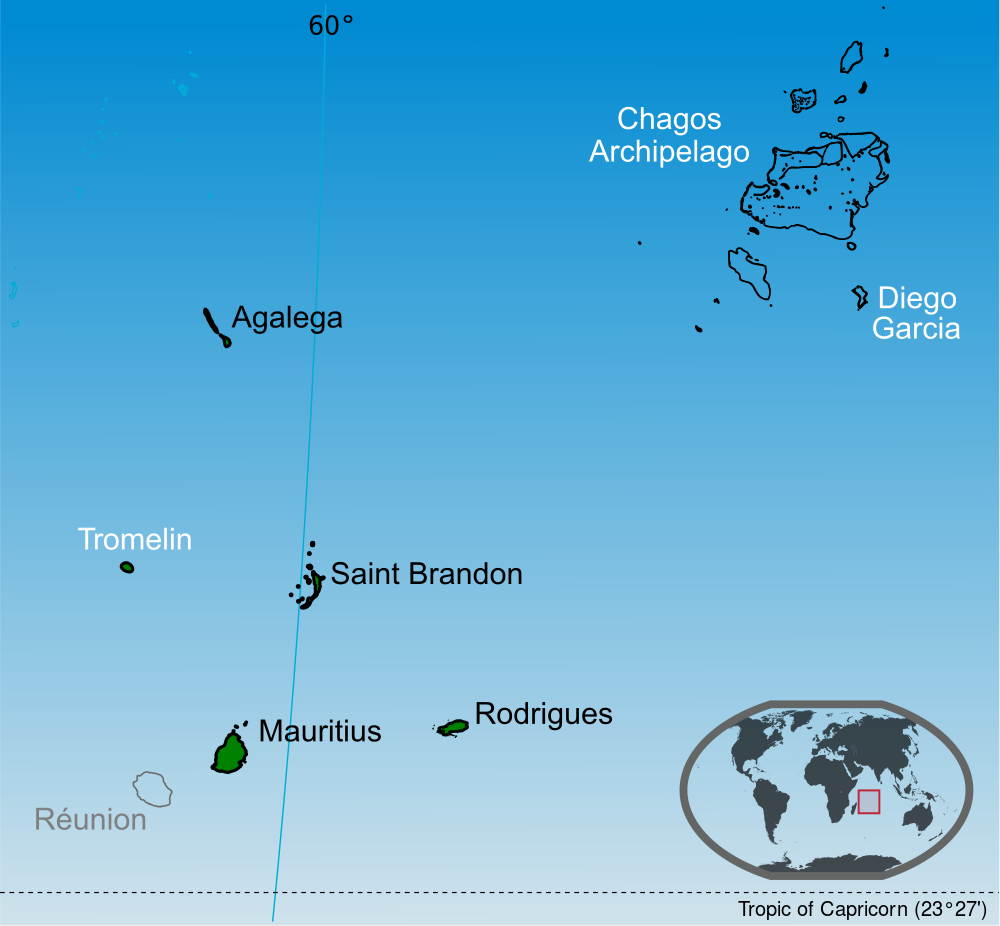
I know about these islands because one of Patrick O’Brian’s Aubrey/Maturin novels is set in the islands. This image is from Wikicommons.
WORKAROUND
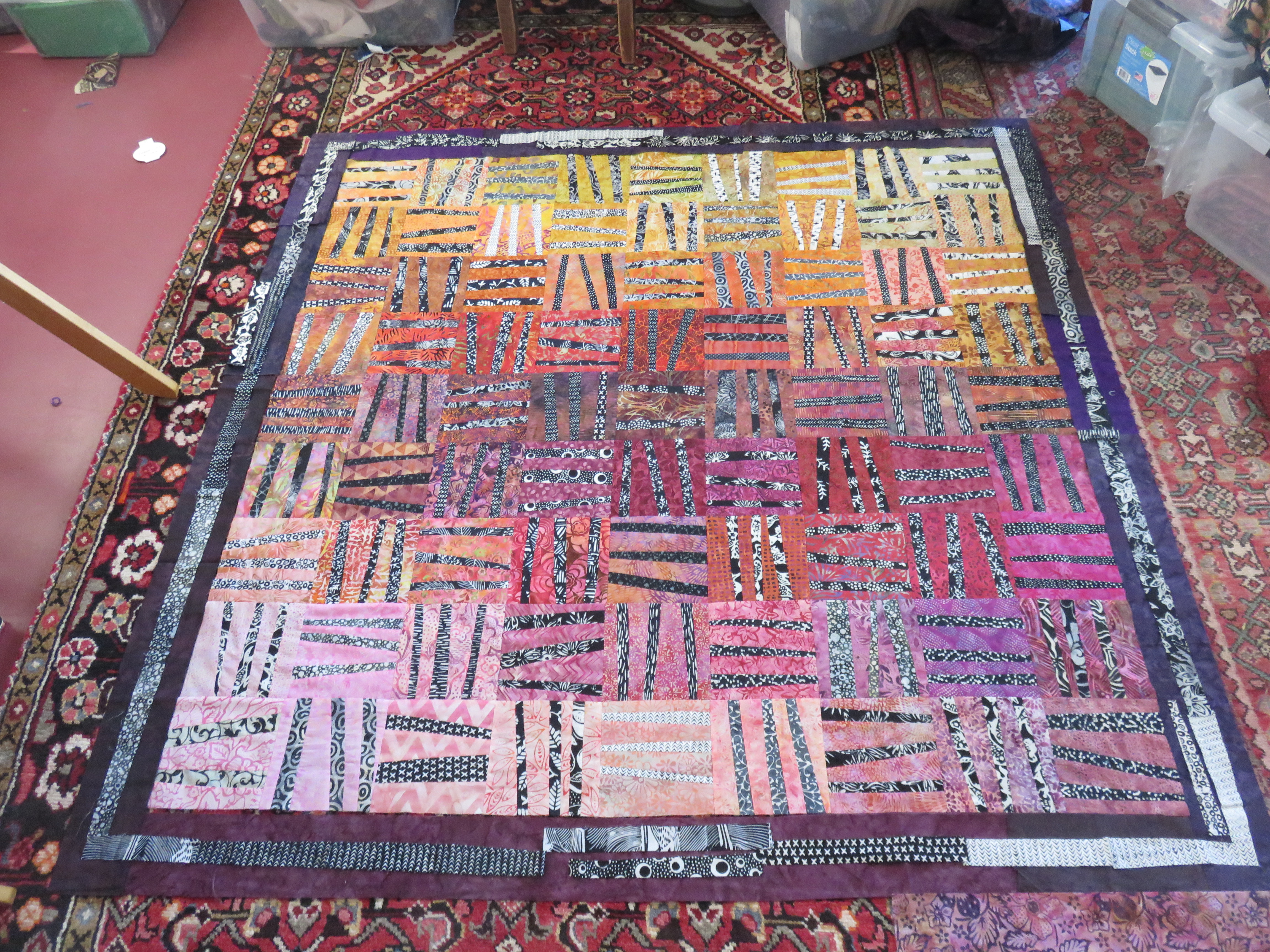
The center panel is composed of eighty-one different patterned squares, crossed by twenty or thirty different black and white cotton. The split frame is of several purples, and these each change from step to step. There is also a pieced border.
There is more to this post—I figured out a workaround.
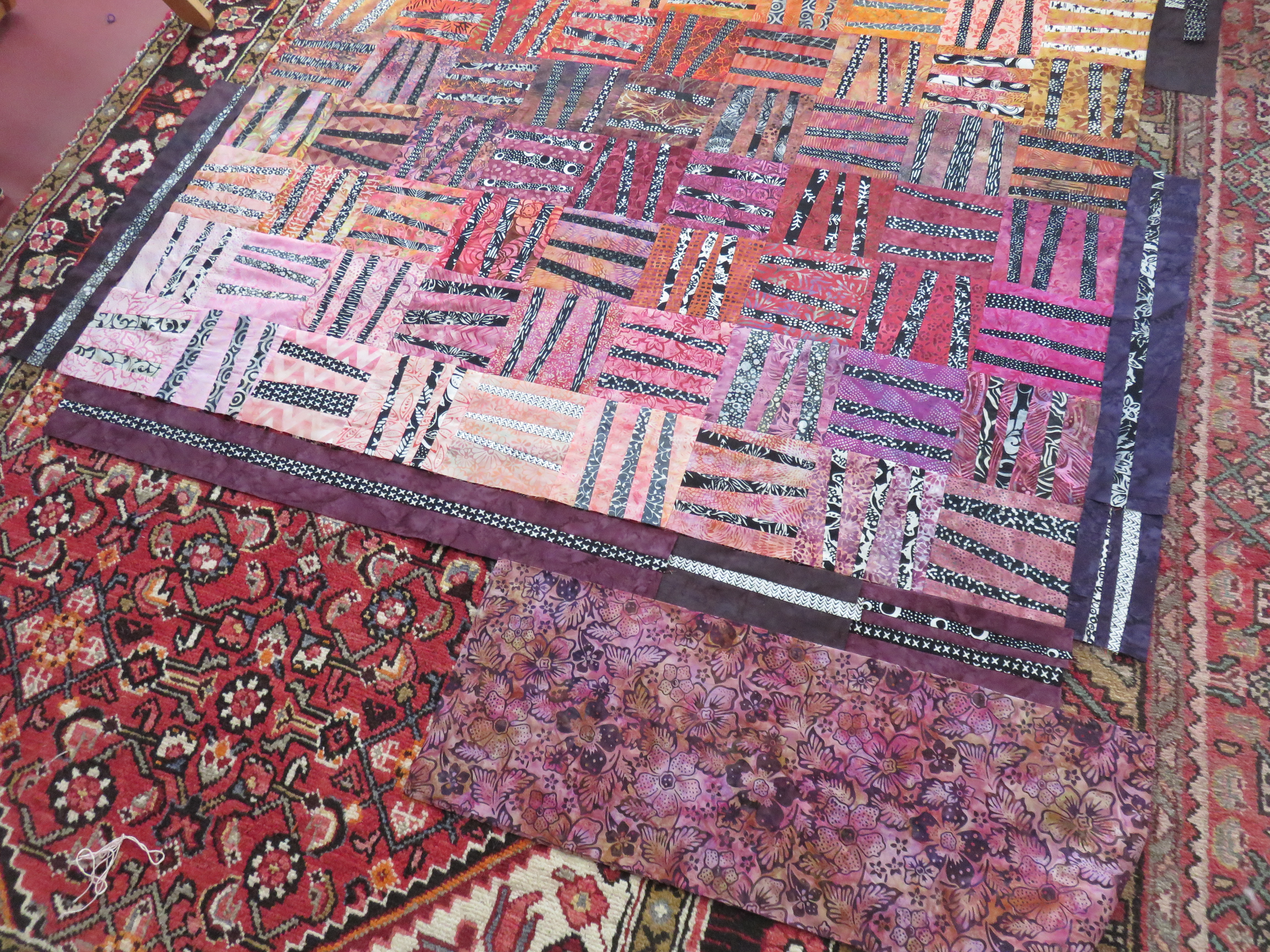
Above is the center panel with the border pieces, unsown and just separate pieces of fabric laid in place. Below is the border pieced without corners and not yet joined to the center—trust me, it evolved. It’s entirely sewn as of now, and today or tomorrow I hope to complete the border, trim the backing, and fold it all up so it’s ready for Linda Pinkstaff at Astoria Quilting to work her magic. We will carry them north in the next week or two. Perhaps by then I will know what I am doing next.
Yesterday I got stuck. We walked north to Arcadia Beach, two miles away. I made granola and peanut butter cookies that were mostly peanut butter, a riff on Maida Heater’s recipe. Gary liked them, and he’s always insisted he did not care for peanut butter cookies. I finished the dreadful novel I began earlier in the week, skimming the less savory parts.
What I did not do is work on this quilt, which now has a name: “Aurora Which Means Dawn.” That is a line from a Golden Book about Sleeping Beauty. So perhaps I should call this “Sleeping Beauty”? Except it’s not a sleepy piece but bright day. It is my fifth quilt during the past year. Can that be? I have not made that many quilts in a year before. Let me think. Why would that be?
Some people bath less often, some are drinking too much, some quarrel with or avoid their family, some have shifted their political priorities—perhaps a national healthcare system and stable income seem more reasonable necessities when the alternative is bumping into sick people who cannot afford to take better care of themselves?
Anyway, I’ve tried most of the above, and settled on rewatching favorite television series such as The Mentalist, Psych, and Monk while working with color. I must have a couple hundred skeins of Koigu wool, a fine, two-ply Canadian merino that is hand painted. I have hundreds (plural) of different batik fabrics gathered over the past twenty or thirty years. Some are were once lengths of a yard or two, but most were never more than a quarter yard, now reduced to scraps.
My work is not mere craft but neither is it great art. There is art in the design and craft in the making. There is pleasure in looking at the many patterns and rich colors.
FLAMBOYANCE

One adult shown among a flamboyance of gray flamingo youngsters who haven’t yet eaten enough pink shellfish to turn pink—wait a year and they will become more flamboyant.
Twenty-five thousand adult flamingo couples are summering in the salt marshes of southern France, the largest number since naturalists began counting them forty-five years ago. Over 60,000 flamingoes total—12,000 babies so far. They are harmless to man and beast, eating only krill, tiny saltwater organisms they filter through their beaks in a system not so different from what baleen whales use the filter small fish, krill, copepods, and zooplankton from the sea. The whale babies look just like their parents.
We appear like or unlike our parents, can be trusted or not trusted even by them to do what is expected. Most living things gather.
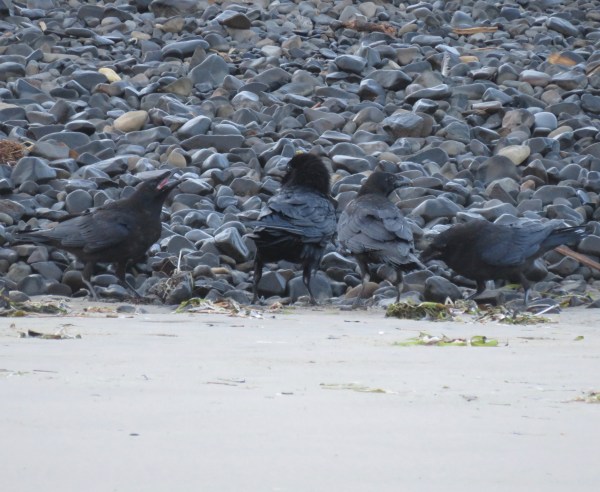
The youngster on the left is still begging for food. The gull babies do that too.
A group of ravens can be called many things. Here, the term “conspiracy” of ravens works for me. (I have never appreciated the term “unkindness of ravens”). The two raven youngsters look just like their parents—one has a fluffy head and is slightly bigger, but that might be one of the youngsters.
They are still hanging around together, though one of the adults sometimes wanders off on scouting missions.
Gary broke up a leftover waffle and some crumbs and put them out on the sand at the beginning of our walk the other day. The ravens stuck around long enough to say thank you.
You’ll have to take my word for it that this photo shows three black oystercatchers.
We spotted the black oystercatcher youngster with its parents the other day at the north end of our beach. I did not zoom to catch which of the three was the child, but it didn’t really matter. I snapped the photo in the fog as we passed at a distance. We’re just grateful the baby is doing so well.
We are careful not to approach birds resting on the sand. If they are not flying, they likely want their rest, but it’s tricky for them with so many loose dogs. A photographer deliberately frightened dozen of birds off the sand just to get a photo of them flying.
That’s not as bad as the people trying to “rescue” baby seals (highly illegal and often fatal for the seal pup left onshore by its mother) or young eagles (disturbing any member of an “aerie of eagles” is also illegal and dangerous for the fool trying to “rescue” one). Or the man throwing a ball for his dogs into the surf in an outgoing tide. [This is why Gary does not like me to go with him when he gets the mail. He says I bark at people—I did bark at that man with the throwing stick. “They’re hunting dogs,” he said. “They trust you,” I responded. I saw a dog rolled right under waves, come out of the surf and absolutely refuse to go back in again. The dog was smarter than the owner.]
The wild things are right not to trust us, to focus a wary eye on our movements. We are not of their group, not trustworthy or predictable and kind. The wild rabbits (a nest) nibbling rose hips in our the front yard, the jays (a party) cruising through, the garter snakes (a bed), and gulls (a colony) and know to avoid us.
We try not to disturb the wildlife. When we must pass birds onshore, we walk steadily, avert our eyes, and direct ourselves away, away!
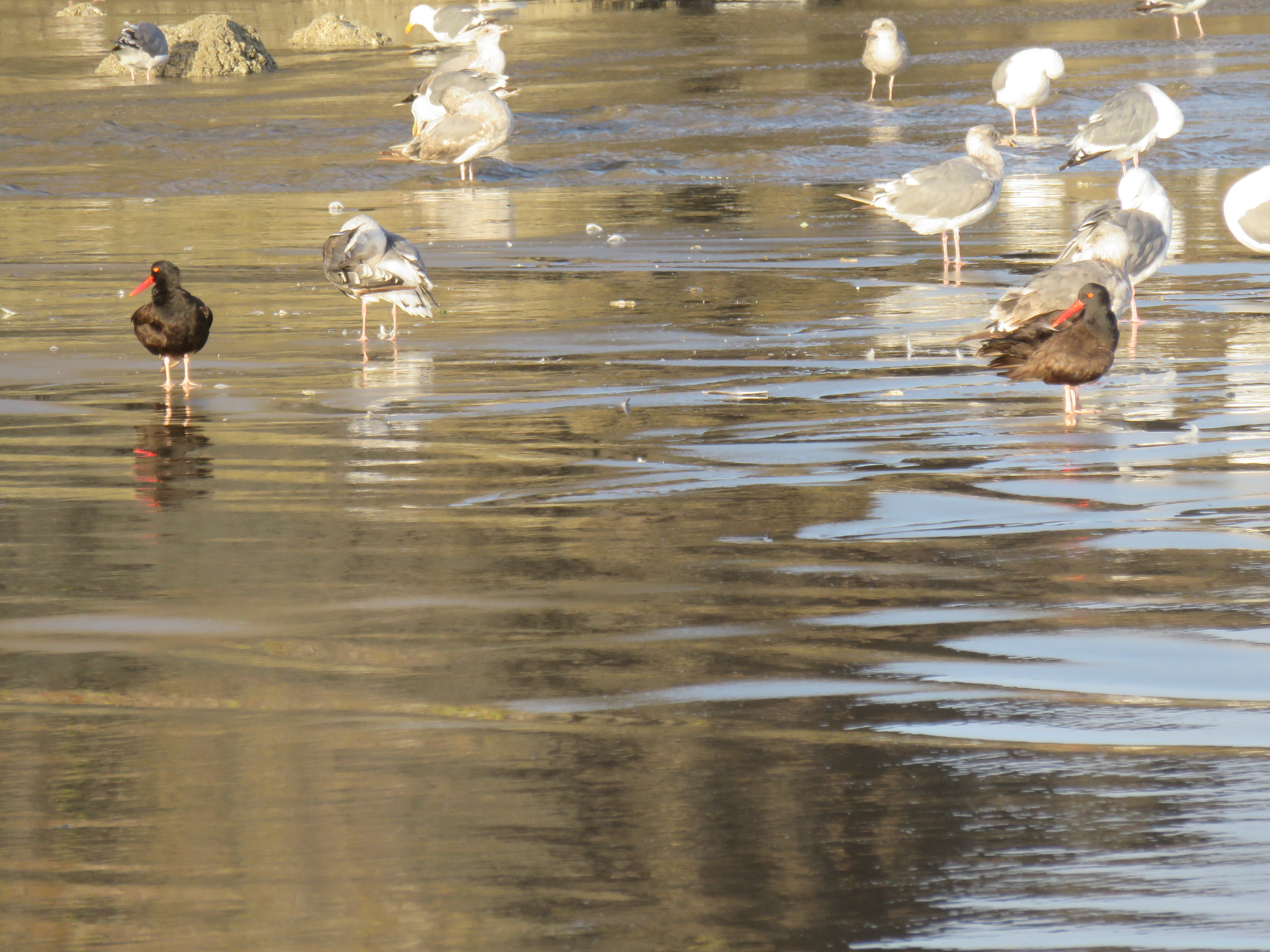
These two black oystercatchers are not the same pair. There is a
“parcel” or “stew” of oystercatchers nesting south of us.
The featured image at top is from Wikipedia: “James’s Flamingos at Laguna Colorada in Bolivia” “Young flamingos hatch with grayish-red plumage, but adults range from light pink to bright red due to aqueous bacteria and beta-carotene obtained from their food supply.”
The adolescent flamingos with one adult is a Getty image taken off the Smithsonian page
PICTURING HAPPINESS
The Reading Under the Gun (or RUG” was a timed writing assignment. I gave students a limited period of time, a short text, some provoking questions, and required them to write until I said stop. The assignment was worth five points. Even if you answered the questions wrong or went off topic, so long as you wrote, you got the points. Sound simple? It was harder for some than you would think. Some didn’t want to do more than the minimum, they filled a page and then wanted to stare into space. I could be sticky about it.
It was a grade-builder, rewarded for effort. If I did my part well enough, they learned how to read quickly and think deeply about texts. They observed and recorded the obvious. They took risks and made personal connections. They didn’t always appreciate it. Regardless, they almost always liked the particular reading below. It was often their favorite of the year.
Some of my students were lucky people and had been protected and blessed all of their lives. But that good fortune doesn’t last for anyone. We do not get to live pretty lives all of the time. All of us suffer and change happens and we grieve for what is lost or never arrived. But every one of us has moments worth treasuring. The snapshots we hope are true.
From Life magazine, September 1991, “Picturing Happiness” by Lynda Barry:
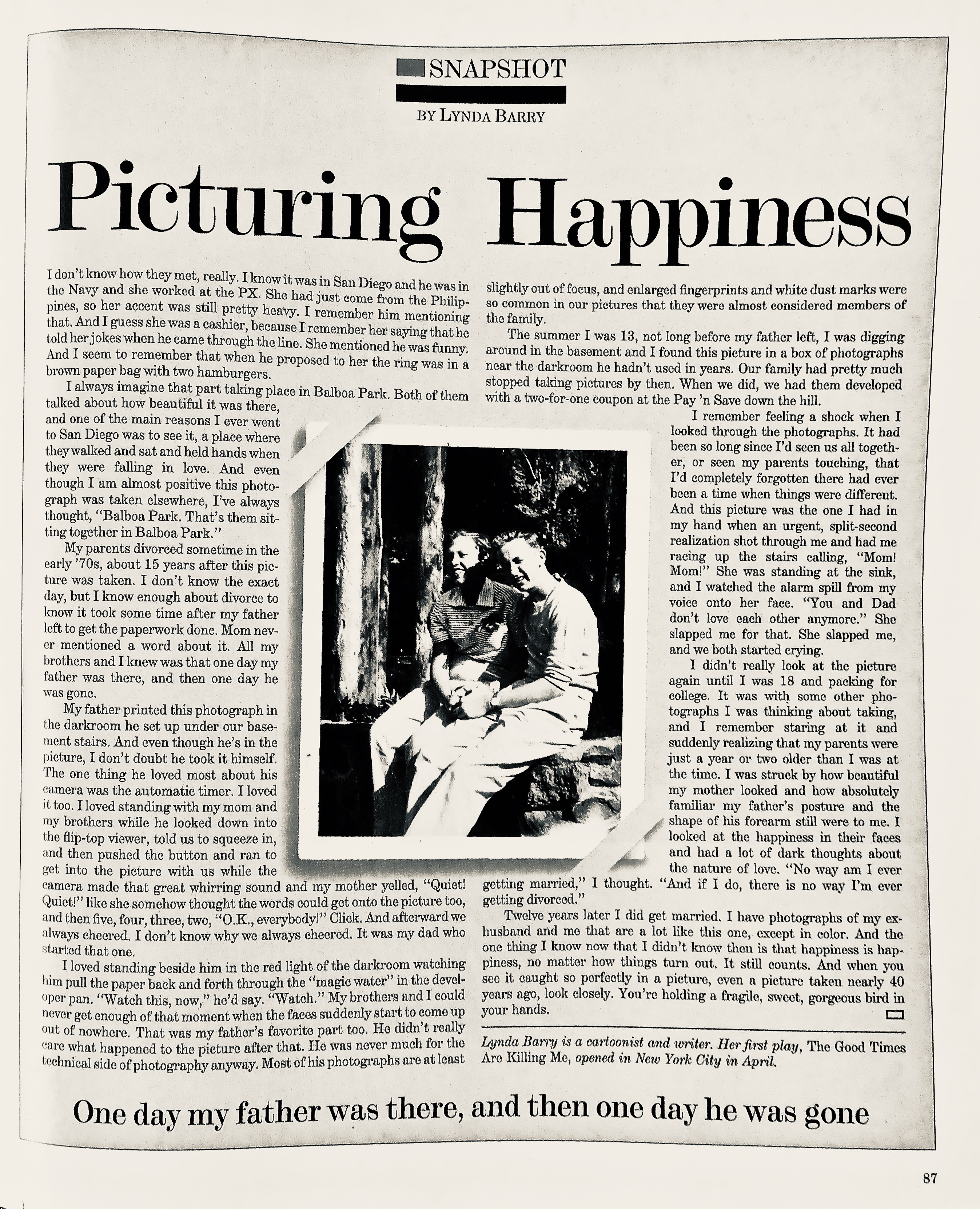
“Happiness is happiness, no matter how things turn out. It still counts. And when you see it caught perfectly in a picture taken nearly 40 years ago, look closely. You’re holding a fragile, sweet, gorgeous bird in your hands.”
We saw the black oystercatcher baby yesterday morning and it’s doing fine, my center panel is joined together and the 3″ frame is cut and pieced, the next quilt is already in planning, and I made blueberry crisp.
HIGH SCHOOL SWEETHEART
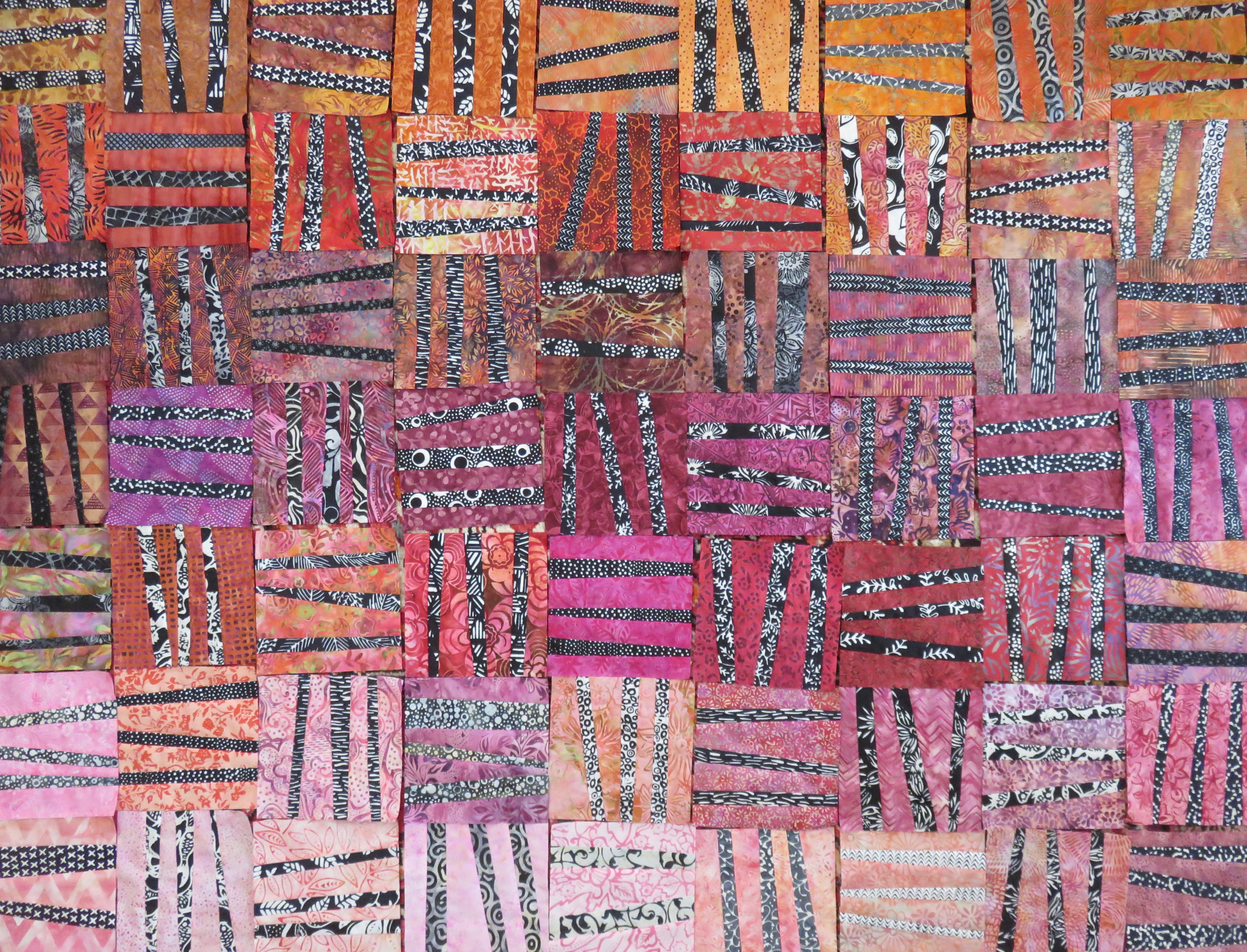
This quilt is a version of the one I made for our oldest granddaughter’s bed here at the beach. I am still rearranging as I work through piecing these center squares. (They have shifted from what is here—see top photo.) I hope to have all 81 squares joined by next week. Then I will add a pieced frame and a pieced border, washing the backing that came today in the mail, and folded quilt top and backing into a bag for Linda. Seven rows of nine pieced squares, just lying in place the way they were made. The last row was pieced yesterday, and after a last review in predawn to check the arrangement of values, today I will begin joining the squares to make the center panel.
My husband and I have a lot in common, things you can’t see, and a couple you can. We once lived a half mile apart, and we graduated from the same large suburban public high school, though we did not meet until before my senior year. Our DNA is largely Northern European. Gary has more African; I have more Native American. We both look White. At one time our hair was the same color. It’s the same color now.
We met through mutual friends, the Edmonds Unitarian Church, and rock music. Gary was born in Seattle but spent seven years of his childhood in Arizona. I was born in Corvallis, but lived briefly in Portland then Seattle. We would graduate, first Gary and then me, from the University of Washington with Honors and Phi Beta Kappa. We were overqualified for most of our jobs. We worked hard. We shared a commitment to doing the best we could. We shared values. We shared a commitment to our marriage.
But our backgrounds are different.
Gary’s parents met during the war in Arizona, both of them in the military, and they married in Roswell, New Mexico. Gary doesn’t know if it was in a registry office, a roadside chapel, or a church. My parents met in college at the UC Berkeley after the war and were married in a Unitarian Church in Berkeley, California.
My family had me and my brother, and debating was dinner table entertainment. Money was often tight, but Mom took art classes, and my dad worked for the Bureau of Commercial Fisheries as a research librarian.
Gary’s family had six children, they argued out loud. His mother never learned to drive, and his father scrambled to provide for his large family as a carpenter.
My dad had been married before he met my mother, but he and his parents as well as my mother’s parents were divorced. Most of that generation remarried in my family. My paternal grandmother, who raised my dad, never did remarry. My dad was raised in a household of women: grandmother, mother, and aunt. His aunt taught business courses in the LA school system.
Gary’s maternal grandfather had many children (fourteen? seventeen? I always forget), two wives or maybe three in Oklahoma, and worked his whole life as a sharecropper and day laborer. When his first wife died, he gave his children away on a street corner. His paternal grandfather was a contractor who immigrated from Finland, married a widow, and died coming home from a tavern.
My dad was Army in France and Germany, Gary’s dad was Air Force stateside. They both began smoking Camels in the military. Both died of lung cancer. My dad the week before Christmas, Gary’s dad on Mother’s Day. Our mothers did not remarry.
One of our struggles as a young couple was about “discussion” because his family yelled, mine debated. Each of us found the other’s yelling/debating distressing and argumentative. We shared concern with ethics, liberal politics, appreciation of art and music and theater and cultures around the world. We shared a determination to stay together. Both of us worried, but about different things. We “took turns” being sad. [“You can’t be depressed, it’s my turn to be depressed.”] Like any couple, we had our disagreements and misunderstandings. I think, together, we made a good couple. We balance and support and love one another.
My mother actively disliked her in-laws. And that was too bad. We spent all our holidays with Mom’s family in Portland, which was wonderful. Gary’s father’s family never thought his mother was good enough—truly unfair. Once he died, most of the family cut off all contact. Still, his is an enormous family and Gary feels close to siblings, nephews, nieces, and a cousin.
Gary’s family was kind to me. I was a little out there, but they were good to me and I love them.
We thought for a time that we would not have children at all. It was not part of our plan when we married. But then, like a decision to marry, one day it felt right. We talked and made a series of decision about moving back to Oregon and having children. Two children. We love them both and their families. We are proud of our sons.
My parents didn’t like Gary much early on. Fifty or so years ago, my father said he didn’t think Gary was “tough enough.” [I can picture him saying that, a cigarette in his bruised arthritic fingers, and how I thought wtf? at the time.] But it was Gary who stuck it out with me, who was the stable member of his family, who took care of the home front when my dad was dying. It was Gary who made my mother coffee and cleaned her kitchen and stopped by the house three times a day for years, caring for her like a son while her own son was away. In the end, Mom appreciated him. After she died I went through her papers and found written notes to change her will, favoring Gary in the months before she died.
I favor him myself. He is a good man, a good father, and has made me a better person. We will have been married for 46 years a couple of weeks from now. We were together as a couple for five years before that. I just heard from a former student who seems to married her high school sweetheart this spring. It’s rare that such relationships last. Sometimes they do. Our first date was in August too, in 1969. Lucky. Lucky. Lucky.
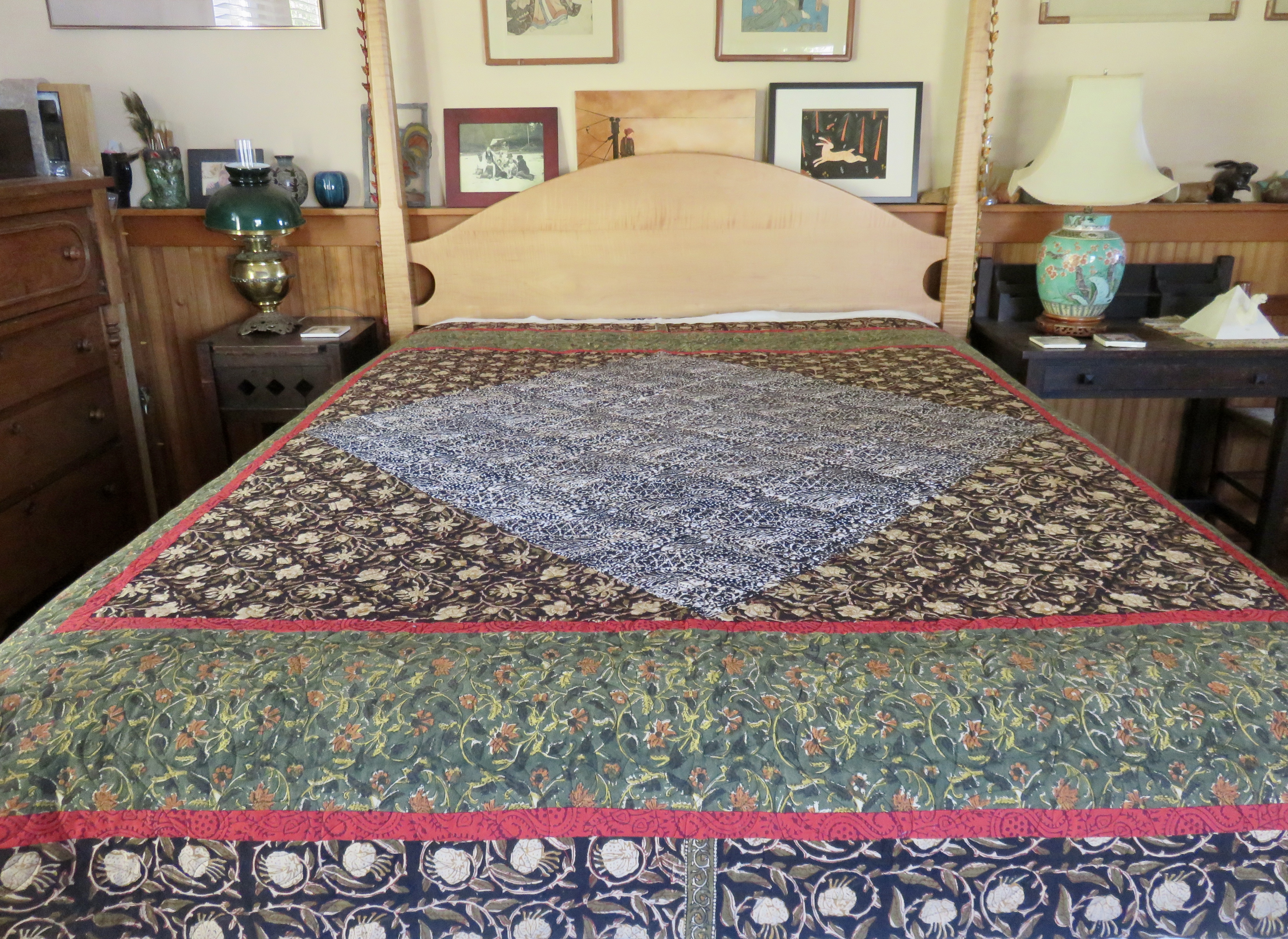
Once I had the eighty-one squares pieced, I opened the package with the quilt I picked up from Linda Pinkstaff last week. It is hand block-printed vintage Indian cottons from Cargo. This is the top, with the center diamond a true batik. I still have to bind it.
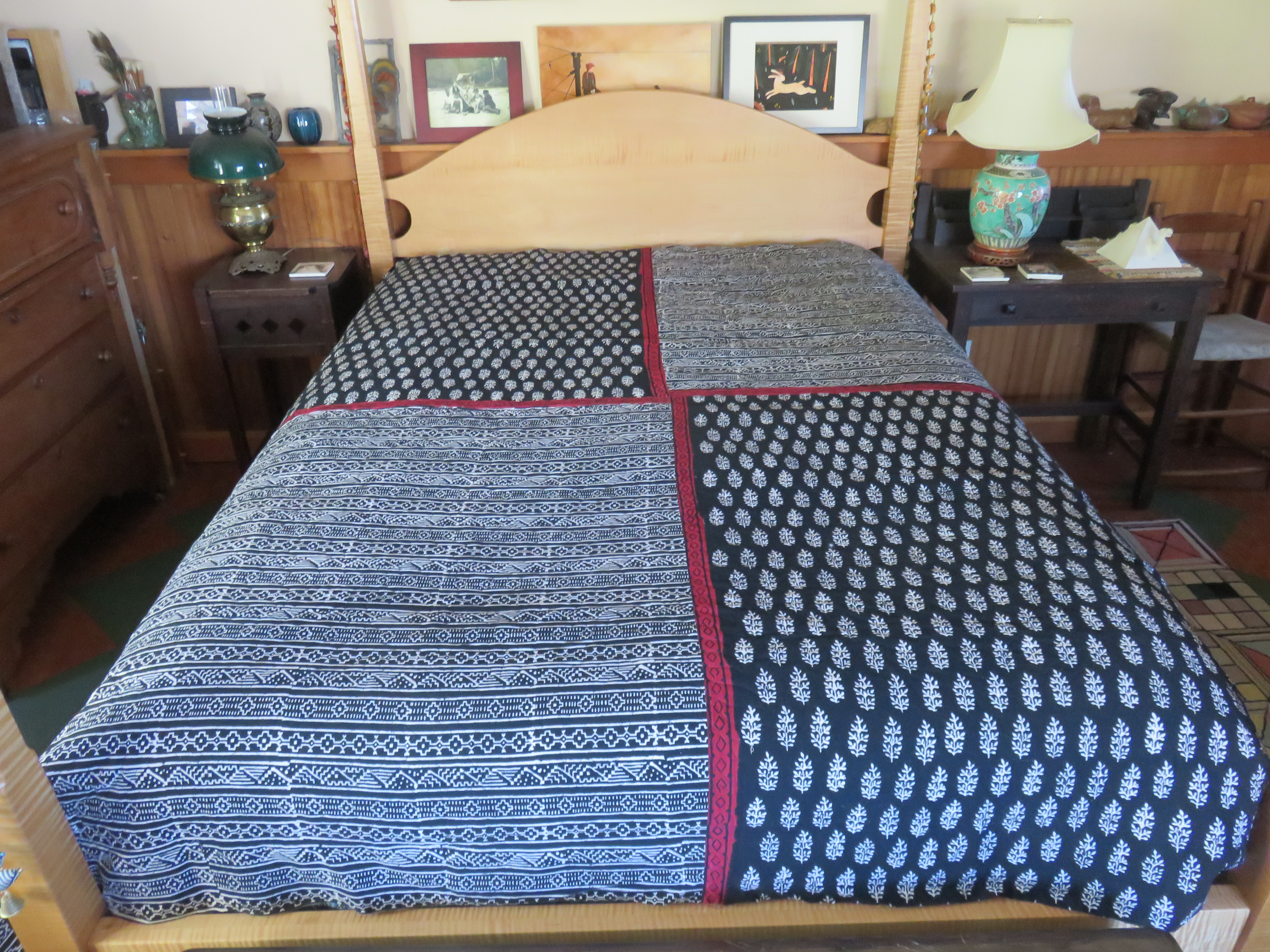
The back is black and white a red, a completely different set of block-printed cottons. There was only red on one selvage, so I cut and pieced the back to take advantage of that. It is a special piece and Linda was right about the quilting pattern. [84″ square]
•
•
•
TESTING

I created this “TEST” with the new Editor for WordPress. I find the “Classic” version I have been using and which suited me perfectly has lost function.
Continue reading
