TRUTH TO POWER

Below is yesterday’s entire post from Heather Cox Richardson that arrived in my inbox after midnight. I know people do not read my blog for political wisdom, but I need to clear the air. My grandchildren can’t breathe. Richardson has more than enough wisdom to share. I wish more people were reading her. It can be empowering to remind ourselves that the majority of Americans care about democracy and our nation, are concerned about truth and justice—what in my childhood was termed “the American way of life.” This is a reminder to vote.

Letters from an American September 15, 2020

Heather Cox Richardson

Exactly a year ago, after about a six-week hiatus during the summer, I wrote a Facebook post that started: 

“Many thanks to all of you who have reached out to see if I’m okay. I am, indeed (aside from having been on the losing end of an encounter with a yellow jacket this afternoon!). I’ve been moving, setting up house, and finishing the new book. Am back and ready to write, but now everything seems like such a dumpster fire it’s very hard to know where to start. So how about a general overview of how things at the White House look to me, today….”

In my roundup, I noted that we had just learned that a whistleblower from within the intelligence community had filed a complaint that the inspector general of the intelligence community, Michael K. Atkinson, deemed “credible” and “urgent.” This meant that it was supposed to go to the Director of National Intelligence to be cleared of anything that needed to be hidden, and then sent on to the House Intelligence Committee. But, rather than sending it to the House as the law required, Trump’s then-acting Director of Intelligence, Joseph Maguire, had withheld it. On Friday, September 13, the chair of the House Intelligence Committee, California Democrat Adam Schiff, had written a scathing letter to Maguire, telling Maguire he knew about the complaint—we now know that Atkinson had alerted him– and that Maguire had better hand it over. Schiff speculated that Maguire was covering up evidence of crimes by the president or his closest advisors.

Readers swamped me with questions. So I wrote another post answering them and explaining the news, which began breaking at a breathtaking pace. Within a week, we had learned that the day after Special Counsel Robert Mueller had testified before Congress and seemed to shut down any further investigation of the 2016 Trump campaign’s ties to Russia, Trump had tried to pressure Ukraine President Volodymyr Zelensky into announcing an investigation into former Vice President Joe Biden’s son Hunter. On July 25, Trump suggested to the new Ukraine president that he would release funds Zelensky badly needed to continue Ukraine’s fight against Russian incursions only after such an announcement. And people asked more questions, and I wrote another post…

And so these Letters from an American were born. 

In the 365 days since then, we have lived through the Ukraine scandal, which revealed that the president was secretly running his own foreign policy team whose goal was to strong-arm Ukraine into helping the president’s reelection campaign. Their attempt to get Zelensky not to run an investigation but rather simply to announce one reflected backward onto the 2016 campaign. The 2016 Trump campaign hammered on the Clinton email “scandal,” and badly damaged her candidacy. But, in mid-October, the final report from the State Department concluded that there was no systematic mishandling of information, that people tried to follow the rules, and that none of the information that did get mishandled was classified at the time (some of it was retroactively classified by the Trump administration).

We lived through the abrupt withdrawal of U.S. troops from northern Syria in early October 2019, leaving our former Kurdish allies to be murdered by Turkish troops, just as experts had warned would happen if U.S. troops pulled back. ISIS freed compatriots from jails and launched new attacks, and Russian troops moved into the positions we had held in the region. 

We have lived through the House impeachment hearings in October and November, when it became clear that the Republicans were not, in fact, interested in whether or not Trump had committed “high crimes and misdemeanors,” but rather in badgering witnesses to provide sound bites that could be stitched together into a fictional narrative on social media and the Fox News Channel. Then, on December 18, for the third time in history, the House voted to impeach a president. Driven by the Democratic majority, it impeached Trump for abuse of power and obstruction of Congress.

We lived through the Senate impeachment trial early in 2020, where Republican Senators refused to hear witnesses or subpoena documents. On February 5, the Senate acquitted the president of the charges. All but one Republican senator voted to acquit. Utah’s Mitt Romney voted to convict on abuse of power. 

We lived through the purge of career government officials and their replacement with Trump loyalists that began two days after Trump’s acquittal. On February 7, Trump dismissed Lt. Col. Alexander Vindman from his position on the National Security Council, where he was an expert on Russia and Ukraine. Vindman had been on the July 25 call and testified before the House Intelligence Committee under subpoena, that White House officials had put the transcript of the call onto a high security server, where national security secrets are held. Vindman also explained that the readout Trump provided the public did not contain key parts of the conversation: Trump had explicitly mentioned both Burisma—the company on whose board Hunter Biden sat– and the Bidens themselves. Trump also ordered the ouster of Vindman’s twin brother, Lt. Col. Yevgeny (Eugene) Vindman, an Army officer on the NSC staff. Since then, Trump has continued to replace career officials with his own loyalists throughout the government everywhere from the Department of Homeland Security and the United States Postal Service through the CDC and the Voice of America.

On the same day he was retaliating against the Vindmans, Trump picked up the phone and called veteran journalist Bob Woodward to tell him there was a deadly new virus spreading around the world. It was airborne, he explained, and was five times “more deadly than even your strenuous flus.” “This is deadly stuff,” he said. He would not share that information with other Americans, though, continuing to play down the virus in hopes of protecting the economy.

This, almost 200,000 of us have not lived through.

And now, as the coronavirus continues to ravage our country, our people, and our economy, the president is trying to win reelection by dividing us, convincing enough voters that “radical leftists” are destroying “Democrat cities” that he can emerge as a “law and order” president. He is suggesting that any result other than his own reelection will be illegitimate, and that he should get a third term because of how badly he has been treated in the first. 

It has been quite a year. Those of us who are exhausted have earned it.

But from the chaos and crisis of this past year has emerged a renewed dedication to democracy. You see it in Lt. Col. Vindman telling his father that he would be all right if he testified before Congress against the president, because “this is America… and here, right matters.” You see it in the incredible work of the House impeachment managers and their constant invoking of our Constitution, our laws, and our principles. You see it in how Americans have come together to take care of each other when the federal government went AWOL during the pandemic, and in people of all ages and background mobilizing for Black lives.

You see it in people donating money to candidates and causes, organizing voter drives, and making sure their children and their parents and their cousins and their friends are registered to vote and have a plan to do so. You see it in people working for a cause that is important to them, calling their elected officials at all levels, writing letters to the editor, and pushing back on the false narratives that spread through social media and from there to our communities. 

For me, though, I see it most of all right here. I see it in how many of you bother to read these long and complicated letters and who write to ask questions, send me news articles or personal stories, make corrections, and say how afraid you are that we might lose American democracy. I see it in your insistence on facts and accuracy, your constant questioning, your dismissal of trolls and bots, and your kindness to the community you have built. Most of all, though, I see it in your overwhelming support. 

I am not exaggerating when I say I have come to see myself simply as a translator. I could not do this without you. 

Thank you all for being along on this journey.

2 two

Allegretto Lentissimo

Rain on our rooftop, dribbling, draining down 
the side of the house and across the concrete 
walkway my grandfather poured, all of this new 
moisture pouring back toward the sea. The air 
moves counter-tempo, slow rolls from ocean 
onto land, a white mist upon thirsty soil, smoke 
overlaid, rain gathering, silencing fetid reek
with wet. I am so very grateful for the patter 
on skylights, the cooling air, the way my husband 
wraps his arms around me as we look to changing 
weather. Chosen, explored and confronted, it might 
promise something beyond metronome ticking, 
the warning of this new pattern, this heat. Dim
puddles from our past and of our future. Time 
passes through like wind over water. 

•

•

•

SMOKE

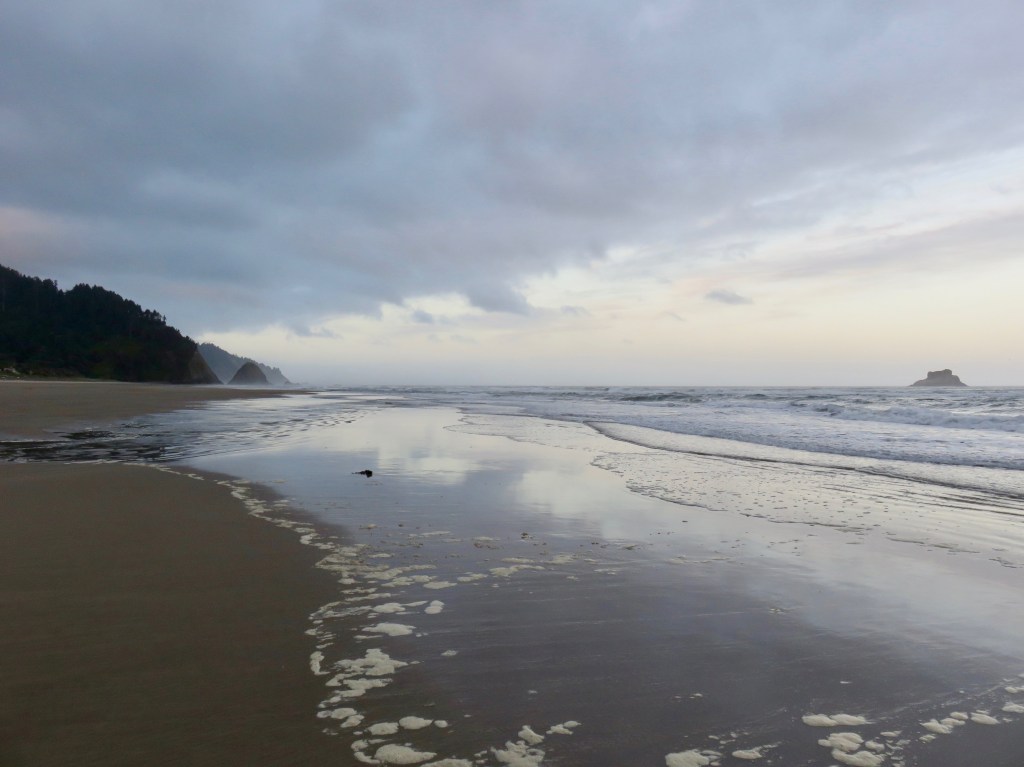
This is as clear as Castle Rock has appeared since Monday. It’s right there just left of center, 0.6 miles offshore. Much of the week we have not been able to see it at all, even though we know just where to look. Smoke between here and there has turned the air yellow, the sun, even at noon, no brighter than an orange ball in the sky.

My tongue tastes copper metallic. My throat feels the smoke. Sand blew in the skylights open at the beginning of the week.

Gary and I live in my grandfather’s house on the Oregon coast. My family has been here for 109 years. My mother recalled the Tillamook Burn, the first one. She and her sister played in an ocean that was warm and returned to the house covered in soot. She said it was wonderful fun, but their mother was exasperated. All water in 1933 had to be hauled by hand and warmed on a wood stove. There was not yet a road to leave and my grandfather only came on weekends. Thinking over that story my mother told me, I think my grandmother must have been terrified.

That first of the Tillamook Burn fires began 14 August 1933 and was not extinguished until rainfall put it out the 5th of September. My mother was eight years old. All told, 350 thousand acres burned during those weeks. While that fire still burned, my mother, her sister, my grandmother and grandfather drove north on the beach and then east to escape to Portland, Oregon where they lived nine months of the year.

(The second fire burned 190 thousand acres in 1939, the third burned 180 thousand acres in 1945, and the fourth 32 thousand in 1951 before I was born. These mostly burned over the same ground.)

Yesterday, Portland had the worst air quality of any city in the entire world. By this afternoon more acres had burned in the past three days than during all four Tillamook Burns put together. People died—no one is certain how many in my state. Nearly a million acres have burned in Oregon. Many fires are still completely out of control, “uncontained.” Some are predicted to continue burning right through Autumn and into Winter. Firefighters (30% of them college students) are overworked and tired.

The number of acres that have burned in the state in the last three days is almost double the amount that typically burns in an entire year. “We have never seen this amount of uncontained fire across the state,” Governor Brown said.

—The Oregonian

Here, visibility has closed off views north, south, east, and west. The smoke has been so bad sometimes that we could not take our daily walk or open windows. It is worse in the Willamette Valley and further down the coast.

Irresponsible locals blew illegal fireworks into the air at the edge of the State Forest a few days ago. People walk toddlers on the sand. Tourists who arrived yesterday in the rental house next door are burning a wood fire in the fireplace. We shake our heads.

Isn’t it obvious why a smokey fire is a terrible idea? Even on vacation? While forest fires make breathing “hazardous” in nearly the entire state and thousands are homeless? They probably put the air conditioning on because the weather has been unseasonably hot. (But no, they opened windows.)

The yellow sky holds a blood red disk. 
The air burns orange, the light 
all tinted brass. Take care, dear friends, 
it's dangerous. We all still hope 
we'll survive this year, more than that: 
live to see a yellow sun again, 
a blue sky, clouds, and rain in puddles.
Share my faith in future better times, 
in quiet walks, a song hummed, truth
told, the news of birds returned to nest.

• from the State of Oregon:

Stay safe from wildfire smoke

As wildfires continue throughout the state, please continue to take care of yourselves and those around you. Keep an eye on local conditions in case evacuation levels change and find resources at wildfire.oregon.gov.

With wildfire smoke creating unsafe air quality conditions that are expected to persist for several days, please remember to follow these tips to protect yourself and your family:

  • Stay indoors as much as possible.
  • Limit activity outdoors.
  • If you have heart or lung disease or respiratory illnesses such as asthma, follow your health care provider’s advice about prevention and treatment of symptoms.
  • Reduce other sources of smoke, such as cigarette smoking and wood-burning stoves, for example.
  • Check current air quality conditions. Go to oregonsmoke.blogspot.com to find the current air quality and wildfire smoke resources.
  • Stay hydrated. Drink plenty of water.
  • Remember that while cloth masks and face coverings do not protect you from wildfire smoke, they do offer protection against COVID-19. N95 respirators may offer some protection if properly fit-tested and worn. Otherwise, they may create a false sense of security. N95s are not available in children’s sizes.
  • Learn more about the dangers of wildfire smoke and how you can stay safe by visiting healthoregon.org/wildfires.

•

It is probably fair to note that the State officially asked people to avoid outdoor fires in April. April.

•

‘BOFFIN’

Smoke was easy to see over distance. The western sky was brown. This is not an accurate photo of the what the sun looked like yesterday evening. It was blood red and we could look right at it a couple minutes after this photo was taken, with no after-image at all.

A “boffin” is a pejorative term for the cliché absent-minded professor or scientist.

We are still in summer.

Yesterday, as a result of strong winds beginning the evening before, the power was out here and everything with it. Our flip phone had only two bars and we expected it to run down any second. Even so, Gary was on that phone first thing yesterday morning and found an electrician to have a look at the downed mast that serves our duplex and the power company to disconnect that mast until it can be repaired. The repairs are happening now.

So, more than a day without power, expensive repairs, and so much continued wind and smoke from fires around the state that it remains unsafe to go outdoors for our walk.

And it’s summer.

I spent much of yesterday knitting and plan to do that again today while I watch No Highway in the Sky (1951) on DVD. Jimmy Stewart plays the boffin, a Rhodes scholar who never went home but has continued his scientific research in England at an aircraft company. The film has its roots in Nevil Schute’s novel No Highway with an epigraph from “The Wanderer” by John Masefield:

Therefore, go forth, companion: when you find
No Highway more, no track, all being blind,
The way to go shall glimmer in the mind.

Theodore Honey (Stewart) has a theory about vibration causing metal fatigue. As a result the metal in tailpiece of a passenger plane will fail and the tail itself fall off after a measured number of hours of service. Honey is interested in theory alone, not the realities of planes carrying passengers and crew crashing in the wilderness. And that has already happened: a plane has crashed killing all passengers and crew. The tailpiece is missing from the crash. A new administrator at the aircraft company places great faith in Honey, in science over convenience, but others think the boffin is simply crazy.

So here we are. We dismiss the warnings of science at our peril.

Global warming, or “climate change” if you prefer, has been predicted and tracked for decades by scientists. It was controversial at one time, say sixty years ago—that is, there was a time when thinking people disagreed. Rachel Carson, author of Silent Spring (1962), accurately predicted the devastating results of use of DDT. When the poison was outlawed bird species began recovering. In the forty-one years we have lived here, we have seen the return of eagles and pelicans (both endangered in the 60s), as well as two species of jay, ravens, and others. Carson believed in the 1950s that climate change was not human-caused but the result of natural shifts in weather.

Carson died as a result of complications from breast cancer in 1964 before she could see what she started. Despite her background as a marine biologist, she wrote Silent Spring to warn of the dangers of 20th century pesticides, herbicides, and other poisons because no one else would. In the end, people listened to Carson’s warnings and outlawed some of the poisons. She was right about that but she was wrong about global warming.

More than fifty years later, there is no real controversy among scientists about global warming. The cause of climate change is human activity destroying forests, burning fossil fuels, and so on. Human activity will destroy human populations just as DDT destroyed bird populations. It is happening now and has been happening for a very long time in human years; it’s just that we have been hundreds of years noticing. Since the start of the Industrial Revolution. The world is warmer than it would have been without our greed for energy. Temperatures rise of even a few degrees is enough to alter weather patterns that cause drought, melt glaciers, raise sea level, generate more hurricanes and other storms, and other aberrations. Human behavior is the cause, just as we were the cause of near extinction of eagles and brown pelicans.

Technically this is just the beginning of fire season in the western United States, and already millions of acres are burning, records are being set for high temperatures, and firefighters choke on smoke.

And it is still summer. We saved some of the birds. I would like to think we could save us all.

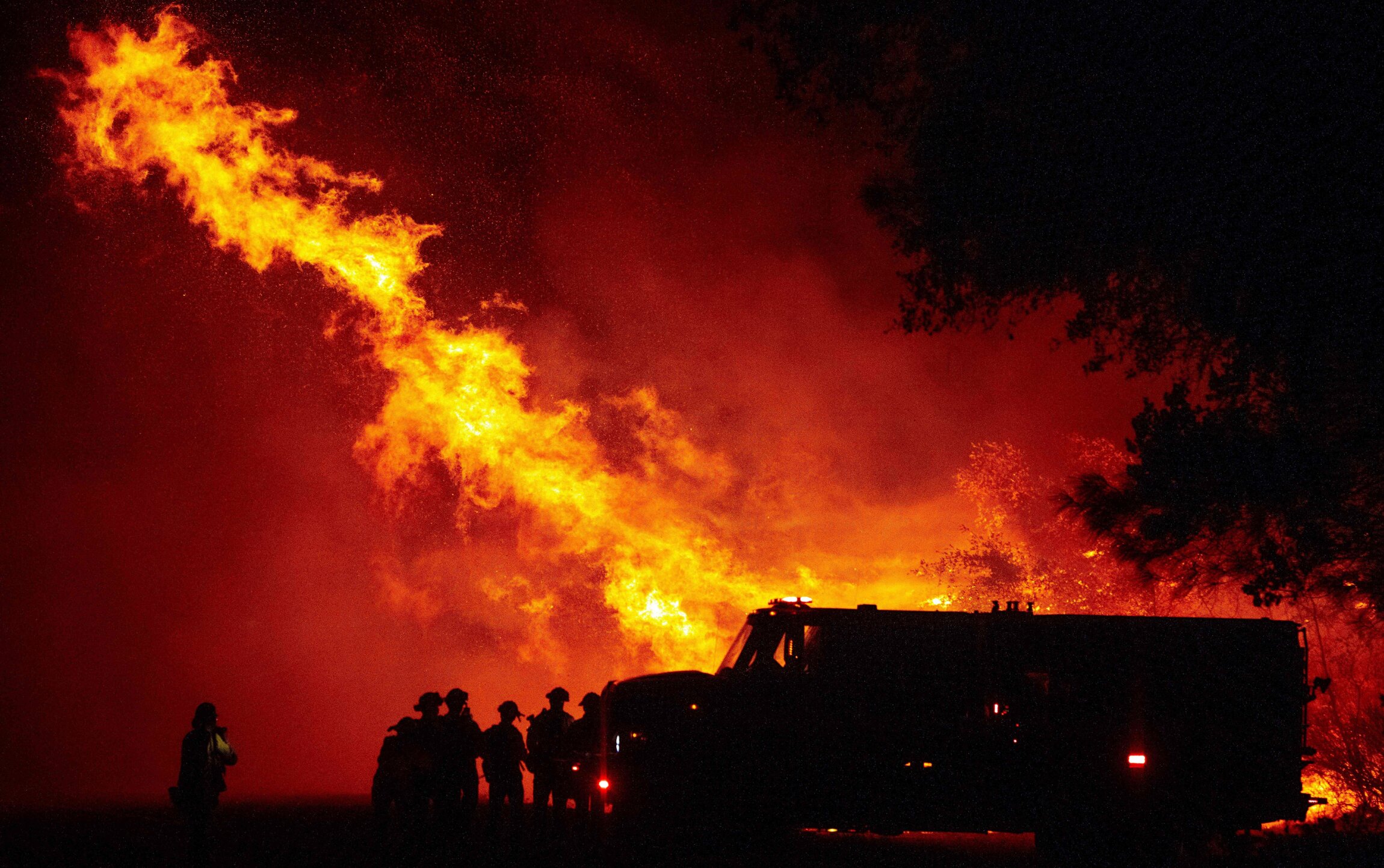
Butte County firefighters watch as flames tower over their truck at the Bear fire in Oroville, Calif., on Wednesday. Fires are burning from Washington state to Southern California.

“In southern Oregon, people in parts of Medford, Talent and nearby communities were ordered to evacuate the area immediately on Tuesday, with officials citing the imminent threat of fast-moving fires. The entire town of Phoenix [Oregon] — which has several thousand people — was told to leave. …

“Deputies in Clackamas County, southeast of Portland, spent the night going door to door to make sure residents knew they had to get out, the county sheriff’s office said. …

” ‘We’re in an unprecedented fire event,’ Oregon Gov. Kate Brown said, urging people to follow evacuation orders, ‘try to reduce your smoke exposure – and take care of each other.’ …

“Across the region, 15 new large wildfires were reported on Monday alone, the National Interagency Fire Center said. That makes at least 87 large fires, which have burned more than 2.7 million acres. Even in places where flames haven’t reached, massive amounts smoke have filled the sky, making it difficult to breathe.”—NPR

Yesterday evening we could not breathe the air that came through an open window. Before summer ends, no rain predicted.

The tail is falling from our plane, and the boffin is still shouting to be heard.

•

Do I need to note that there is a burn ban in effect? Perhaps I should. Yet tourists and less reputable locals have burned cordwood and drift on the beach each evening . . .

“DEQ, in conjunction with the Oregon Department of Forestry, Oregon State Fire Marshal’s Office, Oregon Department of Agriculture and Oregon Health Authority, is asking people to refrain from all outdoor burning activities until further notice.   

“For more details, please visit the “DEQ response to COVID-19” web page.

“As of April 3, 2020, DEQ, along with its partners Oregon Department of Forestry, Office of the State Fire Marshal, Oregon Department of Agriculture  and Oregon Health Authority, is asking people to refrain from all outdoor burning activities until further notice.”

Updated 9/8/2020: The fire restrictions maps below are having technical issues. Please no burning or campfires while a red flag fire weather warning is in effect until further notice.    

State of Oregon: DEQ

•

•

•

1 one

Crime tenting cities—my side, 
your side, my vision, yours.
Sometimes there is a right side. 
Sometimes truth clamors beside 
us, riding our hearts, crying, 
crying in the night to be heard. 

In the sweating darkness, 
the red lights scream brightness 
against the tender stars, the sirens 
and screaming, sweat dripping 
salty into open mouths, 
their righteousness unbolden. 

Is there never a time when violence 
does not excite, when tears 
fail to touch the rim of our glass? 
Everything shatters, everything ends,
is that the truth we long to hear
or the angels of our better nature? 

So dear to clearing fog, a mist 
rises before us as we walk north, 
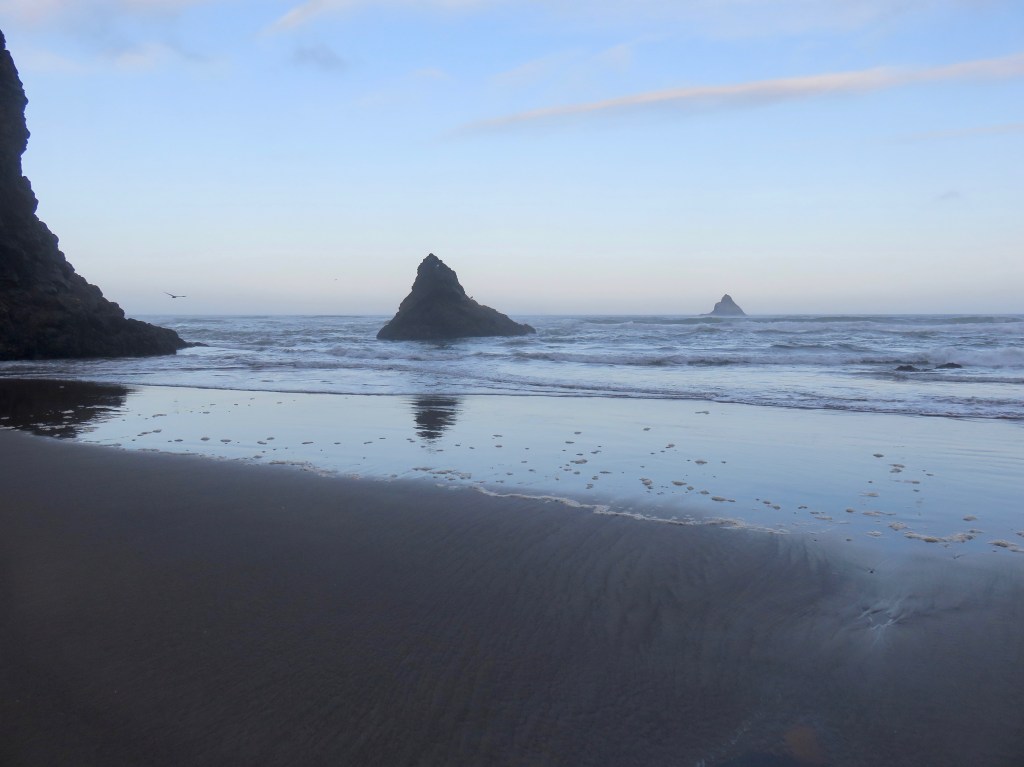
and to the west there is a stone at sea, 
a waiting monument to patience,
a vision, a warmth of community. 
Our witness crowds the horizon.

•

•

•

THE BOSS OF ME

Who was the boss of me? Most often that would have been my mother. Corporal punishment was extremely rare in my childhood. I ran wild in the woods and rode for miles on my bicycle. I came home with frogs and splinters and muddy clothing with the knees worn through. I do not recall being punished for any of that. On the rare occasion I was in deep trouble, I was sent to my room. (“Time Out” had not yet been invented, but “Go to your room until I tell you that you may come out” was pretty much the same thing.) Sending me to my room, I would eventually overhear in adult conversation, was not entirely successful. It seems I liked being in my room and would draw or read books without noticing my punishment.

Mostly I was well behaved. I said please and thank you as I’d been taught. I asked permission. I do not recall ever being deliberately rude to anyone except maybe my brother. Even sibling harassment (which flowed both ways) rarely occurred within earshot of my parents. That definitely led to banishment to my room. I was given rules about how to treat other people. Talking back, disrespect, refusal to do my chores—none of that was tolerated. “Think how the other person must feel,” my mother would say. Think how the other person must feel. I heard it a hundred thousand times. I believed her when she said it was important. She was almost always right, and I wanted to be good.

One painful example of my failure to be good involved thank-you notes. The very idea of writing a thank-you note made my stomach twist. I remember the feeling clearly all these years later, and also that I did not know what to write or how to do it. I suggested that Mom write the note and I would sign it. She actually did that once before she gave up entirely. My resistance was a mystery to me even as a child. Why couldn’t I write the thing? Sixty years later, I think I know. I really really did not know how to do it. There were no lines on the inside of the card, the card was very small, and I was used to lines and big pages and a fat pencil. I needed a model, or for my mother to help me create a model of a thank you note. All I had as an example of writing to my grandparents was watching my mother write letters. A hundred lines of neat writing on thin stationary was not something I could imagine doing.

It sounds ridiculous now to say that I did not know how and needed a model with the words “Thank you Gaga and Papa for the toy rabbit. I played with it all day. Love, Janice,” but I think it’s true. I needed my mother to write out the words for me on a sample piece of paper so that I could understand where to start and where to end. I dearly loved my grandparents. I just did not know how to fit my words on the card.

When I was teaching English to 16 and 17 year olds, I often found myself taking students step-by-step through tasks and ideas that seem obvious to most adults. We memorized The Preamble, wrote essays, took notes in several styles, and we studied the difference between fiction and nonfiction, considered how a person may be wrong without lying, and that it is important to thank the person when completing a personal interview.

When I insisted my Honors students address and mail me a one-page letter proposing their research topic, writing the letter was only half their battle. For a few years, when college applications were still on paper, I insisted they mail the letter to me. They were horrified. (Seriously.) I gave them a printed template for the letter—an outline for four brief paragraphs in full block business letter form with directions—and handed out #10 envelopes. (It was not safe to assume they had access to envelopes at home.) I drew an envelope large on the whiteboard, and demonstrated where to write their return address and the address they must send it to. Yes, they would have to buy a stamp. I told them what it would cost.

No one complained that they already knew this stuff. Almost none of them had ever mailed a letter before. Several told me after the fact that they had never before entered the Post Office, even though many of them did not even have home delivery of mail. They knew how to do many difficult things, but there were massive gaps in their experience even on simple tasks. This was not anyone’s fault. They were smart students, capable and generally willing, but like the definition of “pejorative” and typing an m-dash, they had no experience of how to do it. I needed to explain step by step.

That was me writing a thank you card when I was six. It is like taking a bus, filing taxes, changing a tire. Basic, maybe even essential skills, but someone has to show us the first time. [Full disclosure: I cannot use a smart phone. Yes, I can text—though I don’t—and search the internet, and I am confident I could manage more if it were necessary, but no one has offered to show me how to do anything, and so long as I can avoid figuring it out on my own, I will.]

When I finally sent a colored pencil drawing of a dragon as my thank-you, my grandmother unfolded and pressed it flat, framed it, and Papa put it up on the wall. I was astonished. I had not thought how they would feel. But my mother would continue to remind me.

Simple courtesy is not automatic. If there is crude language or anger or name-calling in the home, a child does not learn that these are unacceptable in the world at large. [I was sent home from school with a note when I was six or seven because I had used a swear word I’d heard at home. That was a mistake I struggled not to repeat with my own children.]

Students deserve respect. And that sometimes meant a detailed explanation of the difference between vulgar language and actual swearing and why the latter is particularly offensive to some people. I assured my students that I was not personally offended by most language, but that it was likely hurtful to some of their peers. In addition, I absolutely did not tolerate racist, sexist, ablest, homophobic, or other bigoted language. I told them such bigoted remarks were personally painful, that I hoped they would show respect toward me as I did toward them. Am I ranting? I do not think so, not quite.

But wait, there’s more. I insisted on some courtesies as necessary to life, just like changing a tire or using a phone. Know how to ask a favor, how to express gratitude, how to respond to someone who has lost their temper. Think about how the other person must feel.

The danger, as I saw it, was that without considering how others felt, my students were likely to be far from home some day and unknowingly offend a person they had absolutely no intention of hurting. That would be sad, I told them, wouldn’t it?

[For years, I also suggested in conversation the very real danger that when they were far from home they would use bigoted language that would get them “stabbed through the heart.” And then that happened to a student I knew. The boy lived, but being rude to some smaller, harmless-looking individual, he discovered they had a bigger cousin.]

Think how the other person must feel. Teasing, loudness, cruel words—think how the other person must feel.

It’s easier, lazier I would argue, not to hold standards, to give in or fail to follow through and strive to be consistent, fair, and clear. Isn’t that the perennial complaint: Kids these days! I hear that even from people younger than myself. But I think they are wrong that kids these days are different. Kids have not changed. Parenting is not harder or easier. I don’t think it was any different for me or my mother or her mother before that. Maybe we can do better.

My mother did not always exercise perfect judgement. She was not perfect. She made her mistakes. But she was the boss of me—as was my dad, grandparents, teachers, and other trusted adults. Mom set standards for my speech and other behavior that continue to guide me in the right direction. She did not necessarily reason with me as a child; she told me that certain words, attitudes, and behaviors were unkind or dangerous. You are not to do that again. It was not a negotiation. It was a rule.

One of the most helpful parenting tips I ever received had to do with the presentation of important rules. Some rules you can work on (guidelines, aspirations?), some are absolute and should not be followed by “okay?” I hear it all the time, that near-automatic request as if for agreement from the child. Do not hit the cat, okay? is not the message you want to deliver. Try: Do you understand? Do you promise? Don’t ask them to agree or disagree unless you are prepared to have them respond to your okay? with no!

I hear that “okay?” at the end of all sorts of parental directions, as if the child has a choice. But sometimes they do not. No toys at the table because banging metal cars dents the wood. You will brush your teeth in the bathroom because it’s easier to clean spit off the mirror than this couch. You will not say mean things to your grandfather because he is trying to help you and you will hurt his feelings.

It’s fair for a child to ask for reasons, and it is fair that a parent does not budge if the reasons seem unreasonable to the child. It is not okay to hit the cat. Not ever. You will not hit the cat, full stop. I want you home for dinner. Call me when you get there. Do not use that word when you are at school. There is no discussion or negotiation about such rules. The child does not have to like these rules or agree to them. They are about proper behavior.

“You will write a letter proposing your research topic, put it in an envelope, and ensure it will arrive in my P.O. Box by next Tuesday.” A discussion follows of how that may be accomplished, of how the mail is delivered, what happens if the letter is late or incomplete. I can explain and defend the need to do it. They have a choice of topic and thesis, Helvetica or Times New Roman font. Not writing the letter is failure of the assignment. Write the letter and mail it. , okay?

The other parenting tip I learned was about threats. Never threaten to do anything you will not actually do. If you threaten to send a child to her room for the entire morning if she hits the cat again, you better be willing to follow through. Mean what you say, make rules only about what is necessary, and if you give directions, do not ask for permission that they be followed but whenever possible offer choices or options you can live with.

As parents, our job is to provide guidance and rules. Maybe we can reason with the child, but if they do not care to listen about the danger of turning the oven on without permission, we insist anyway. Maybe we bargain about playtime and chores and bedtime. We negotiate: do this and you can have that. We do not always give them options. Sometimes we must be the parent: we insist this is what must happen. Behaviors with the potential for injury, pain, offense, unkindness are not subject to negotiation. We do not ask them if it’s okay. We can and certainly should explain the how’s and wherefores of accomplishing what is necessary, but certain behaviors are not acceptable. You will not hit your brother. You will eat your dinner if you want dessert. I am proud of you for holding your temper. I am glad to see you being so careful not to hurt the cat. I know you are disappointed, but I love you anyway.

My mother was the boss of me. During a shopping trip she told me that the four-poster bed I admired was a stupid choice. I was forty years old that day. Mom was still trying to tell me what to do and I was a mother of two teenagers. It made me shrug and change the subject. Well, Mom was not perfect, but she was a good mother and taught me a lot. She irritated me, but I didn’t argue. We moved on to look at chairs because she needed a chair. I bought that bed twenty years later after she died. I laugh when I tell the story because I love her and she loved me. Right or wrong, she was still trying to do her job.

And I was thinking about how the other person must feel.

OUR ACTIONS/OUR CHOICES

“Liberty lies in the hearts of men and women; when it dies there, no constitution, no law, no court can save it . . . while it lies there, it needs no constitution, no law, no court to save it.” 

“What then is the spirit of liberty? I cannot define it; I can only tell you my own faith. The spirit of liberty is the spirit which is not too sure that it is right; the spirit of liberty is the spirit which seeks to understand the minds of other men and women; the spirit of liberty is the spirit which weighs their interests alongside its own without bias; the spirit of liberty remembers that not even a sparrow falls to earth unheeded; the spirit of liberty is the spirit of Him who, near two thousand years ago, taught mankind that lesson it has never learned, but has never quite forgotten; that there may be a kingdom where the least shall be heard and considered side by side with the greatest.”

jurist Learned Hand (1944)

While we enlist our reason and heart to understand our fellow Americans, we prevail.

Billings Learned Hand January 27, 1872 – August 18, 1961) was an American judge and judicial philosopher. He served on the United States District Courth for the Southern District of New York and later the United States Courth of Appeals for the Second Circuit. Hand has been quoted more often by legal scholars and by the Supreme Court of the United States than any other lower-court judge.—Wikipedia

He married Bryn Mawr graduate Frances Amelia Fincke and they had three daughters who posed for painter Maxfield Parrish. Hand demands respect for his defense of free speech and support of equity under the law, his public discretion and private struggles to protect this nation and our Constitution against all comers. A lifelong republican, he cautiously supported FDR’s election as President and fought for justice and fairness throughout his life.

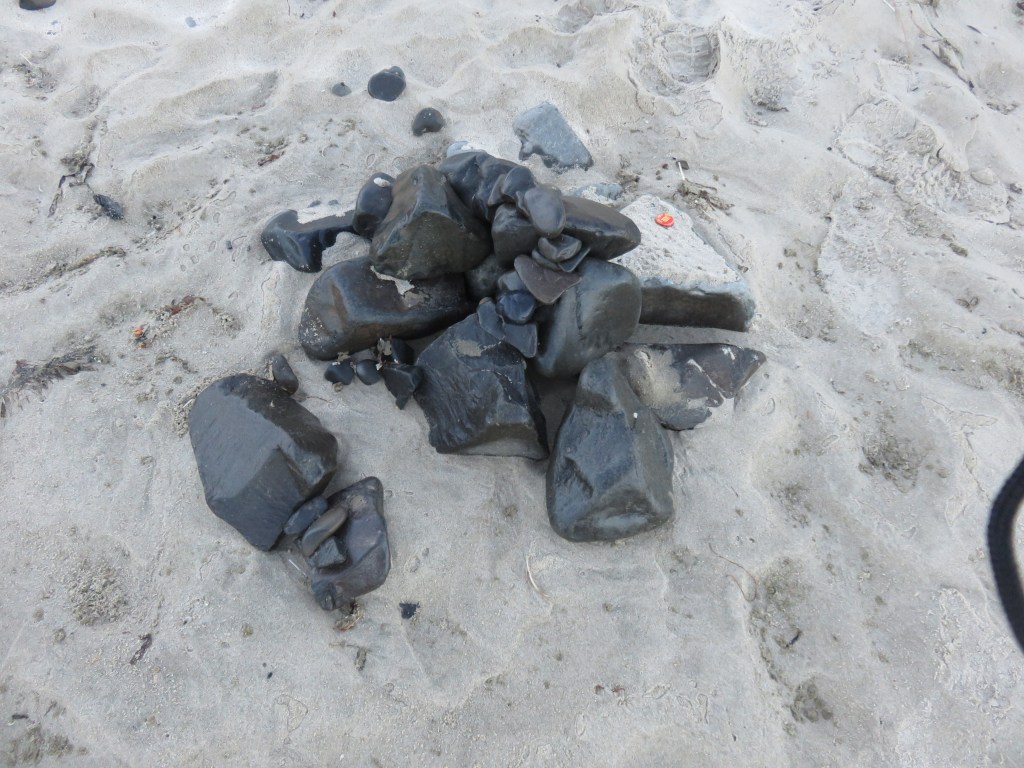
The “Ocean Shrine” built by my granddaughter who says it’s where you put offerings to the ocean.

GRAMMAR again

Some mornings there is really no excuse for fussing about grammar and I resist. On other days, it just might keep slapping me in the face. I am not a grammarian and often have to look up rules. My understanding of these rules of grammar is the result of determined study after the age of forty.

In my youth, my understanding of grammar rested entirely on what sounded right.

If the verb tense or sentence structure sounds right, I generally assume it is correct. However, sound is a reliable model of proper speech only if it’s what has been heard growing up or has otherwise become habitual. I used to tell my students that if they grew up in an English-speaking household that consistently used formal register English they had an unearned advantage over students who had not. They should be grateful for their “ear” but not smug.

My childhood was financially modest but linguistically advantaged—that is, thanks to the G.I. bill, my only aunt (on my mother’s side) and my father both went to UofC, Berkeley, and both eventually completed masters degrees though no one else in their families had previously attended college. My parents often quoted Shakespeare and sang Gilbert and Sullivan lyrics. I heard proper English spoken as a child in my immediate family. That’s my luck.

What sounded right to me generally was correct. As a result, I never learned the rules of grammar, never bothered with any of that. A mistake. [I have always been a poor speller. Maybe the bad spelling is somehow connected to this? Arrogance? I used to warn my students about my poor spelling, which was nonetheless better than most of theirs. “If you see me misspell a word on the whiteboard,” I told my classes early in the school year, “go ahead and correct me. I will not be offended.” I modeled looking things up. As an adult, I worked hard to improve my spelling, and I still make mistakes, sometimes because of my poor hunt-and-peck typing and other times because I am just careless. I struggle with overuse of commas, I think, as a result of reading too much Victorian literature, which revels in them.] I read a great deal. I took two years of Latin in a public school and should have taken a third year, but it seemed at the time that even Cicero could not repay me for an entire year of Caesar’s Gallic Wars.

These days I still look up words and grammatical rules. I also occasionally add to a modest file of published errors. Here are a few:

“A man was seen with a gunshot wound laying motionless on the ground in the area near where the opposing groups had fought and where mace had been deployed.“—yesterday’s The Washington Post [“laying” should be “lying” Laying refers only to an action done to something. e.g. I was laying down the book, while I was lying down to read.]

“Thompson performed a driving maneuver that led Lewis’ vehicle to crash and came to a stop.“—NPR, 17 Aug 2020 [“crash and came” should be “crash and come”]

“They can make a child too listless to pay proper attention in school or so sick she misses many school days.”—NPR [If the author wants to avoid the growing gender-neutral use of “they” as a singular pronoun, there is still an easy fix: “They can make children too listless to pay proper attention in school or so sick they miss many school days.”]

“Good morning. Joe Biden and Kamala Harris made their debut as running mates. The British economy sunk into its deepest recession on record. And the QAnon conspiracy theory has found its way to the mainstream.”—The New York Times [I am fairly certain it should be “sank” unless they mean “has sunk,” which would also work in this context. I looked it up to be sure.]

“Her three decades of high-stress nursing was behind her.”—Goodreads novel blurb [“was” refers back to “three decades” and therefore should be “were”—though I might be wrong about that: “High-stress nursing was behind her.” “Her three decades were behind her.” To my ear the “of” makes the “high stress nursing” a modifier, not the subject. Dreyer might disagree.]

“Gaudí’s ambitious design originally featured 18 towers, including 12 for each of the biblical disciples, but as the Associated Press notes, it’s possible that some of these spires will never be erected.”—Smithsonian [I am certain the author does not mean there are twelve towers for each of the disciples. Aren’t I? “…including a tower for each of the twelve disciples.”]

“Martin Gugino, a 75-year-old protester, lays on the ground after he was shoved by two police officers in Buffalo, New York. Jamie Quinn, via Reuters”—TNYT photo caption [again, should be “lies”]

I note these things because I paid for access to most of these typos, because news published in mainstream media should be able to afford a proofreader/line editor, and because I cannot help myself. No, that’s not right: I choose not to stop myself from pointing them out. I believe I have an excuse for my errors, but refuse to grant The New York Times the same tolerance.

[An applicant for a position as Head Secretary at my school twenty or more years ago failed to get an interview because the current Head Secretary did not like having her three grammatical and spelling errors pointed out to her. She tossed the application. She was most indignant when she told me this.]

Again, I will reiterate that I am not a grammarian and I make mistakes all the time myself both here and in conversation. I have worked to achieve a technical understanding of grammatical rules because I was an English teacher for most of my professional life. I believe people should care enough about their jobs to continually work to be better at them. [I know what a “comma splice” is, how to explain the concept to my students, and why it should not make college professors and high school English teachers scream in fury, but that it does. That’s why they should avoid them.] No one likes errors pointed out to them. Well, most people don’t.

Someone did yesterday.

In my daily life I cling stubbornly to what sounds right and what sounds wrong to my ear, but I have studied the rules of grammar and I am willing to improve. Even now that I am retired. [And, no, that is not a complete sentence—incomplete sentences have been one of the feature of modern writing that I have learned to adjust to. And ending on a preposition too.]

For example, the word “boughten” sounds wrong to me. I have looked it up after finding it in a novel. Webster insists there is such a word, but I cringe to hear or read it. Boughten? ouch

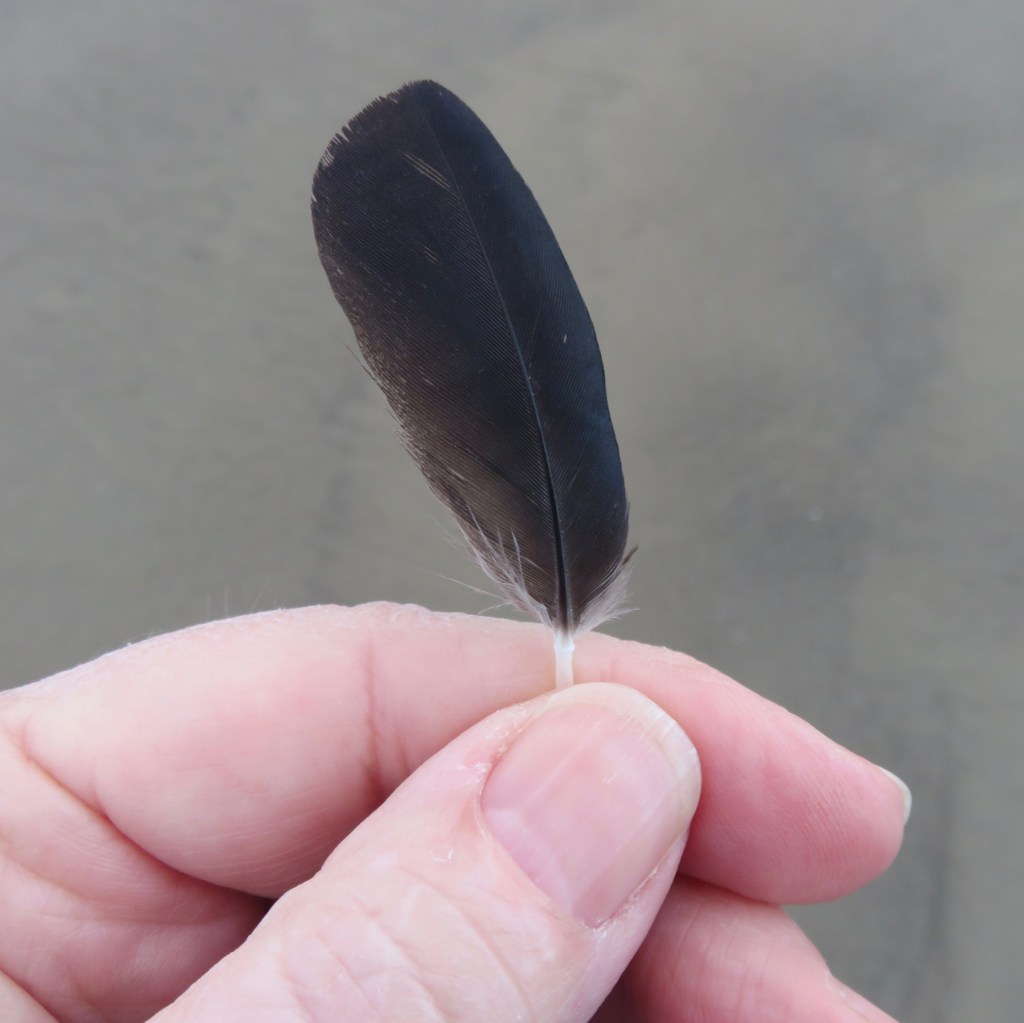
I rarely pick up feathers on the beach—there are so many in summer. But this little beauty caught my eye.

I will also note the I could not find a way to change the color of my text (which is why I used bold above) or to indent a block of text (the other reason I used bold above), but just now I discovered how to do those things and how to wrap an image with text using this new editor—though I may have to figure it out all over again next time I want the effect.

Machinery does not come any more naturally to me than grammar. I have to work at it until I can internalize the process and it becomes habitual.

This morning I learned that I won a free book, PR for Poets by Jeannine Hall Gailey over at her blog. Her blog is a pleasure. She is a kind person who speaks forthrightly about her health struggles and generously about her fellow poets. I rarely think of myself as a poet, but I do read poetry and routinely compose in my head, and I have published poetry.

Poetry, in my life, has offered a strategy for organizing and crystalizing my life experience. A revelation of truth and connection. Poetry allows the world to rest here, just between my fingertips, just at the edge of my understanding. A fluttering demand to be recognized. A rare flighting bird.

Gailey’s book might be just what I need to rediscover my off-and-on-again daily poem habit.

the BLUE HOUR

The “blue hour” is a name for that period where there is light enough to see, but the sun has not yet risen. This time bridges time between darkness and the golden hour, those periods just before sunset and after sunrise when the light differs from ordinary daylight.

As might be assumed from the name, the light at end of day is gilded, even, and without shadow. Entire films have been photographed during the golden hour in smaller latitudes and during the right season when that period lingers longest. Near the equator, the magic might last minutes, but moving toward the poles the Hour might be a full hour because of light bending around the world.

I find some details of Wikipedia‘s “golden hour” entry confusing. We see a noticeable warm light extending long after sunset, but the morning light is clearly blue before the sunrise, become bright and yellow only by contrast once the light hits the sand. That is, perhaps because of the ocean, we see a “golden” light after sunset until dark in the evening and only blue light in the morning. Having learned the term first from cinematographers and second from experience, my understanding may be insufficiently scientific.

In photography, the golden hour is the period of daytime … during which daylight is redder and softer than when the Sun is higher in the sky. 

The period of time shortly before sunrise and shortly after sunset is called the “magic hour,” especially by cinematographers. 

The period of time shortly before the magic hour at sunrise (or after at sunset) is called the blue hour, when the Sun is at a significant depth below the horizon and residual, indirect sunlight takes on a predominantly blue shade.

—Wikipedia

Blue Hour is the title of a book of poetry by Carolyn Forché.

    come, love, through burning 
    composed of light 
    converging on my own life
                   from  "On Earth"

The blue hour is the time of day my husband and I walk out on the sand, unmasked, and alone. Before sunrise. Before the day begins its busy work.

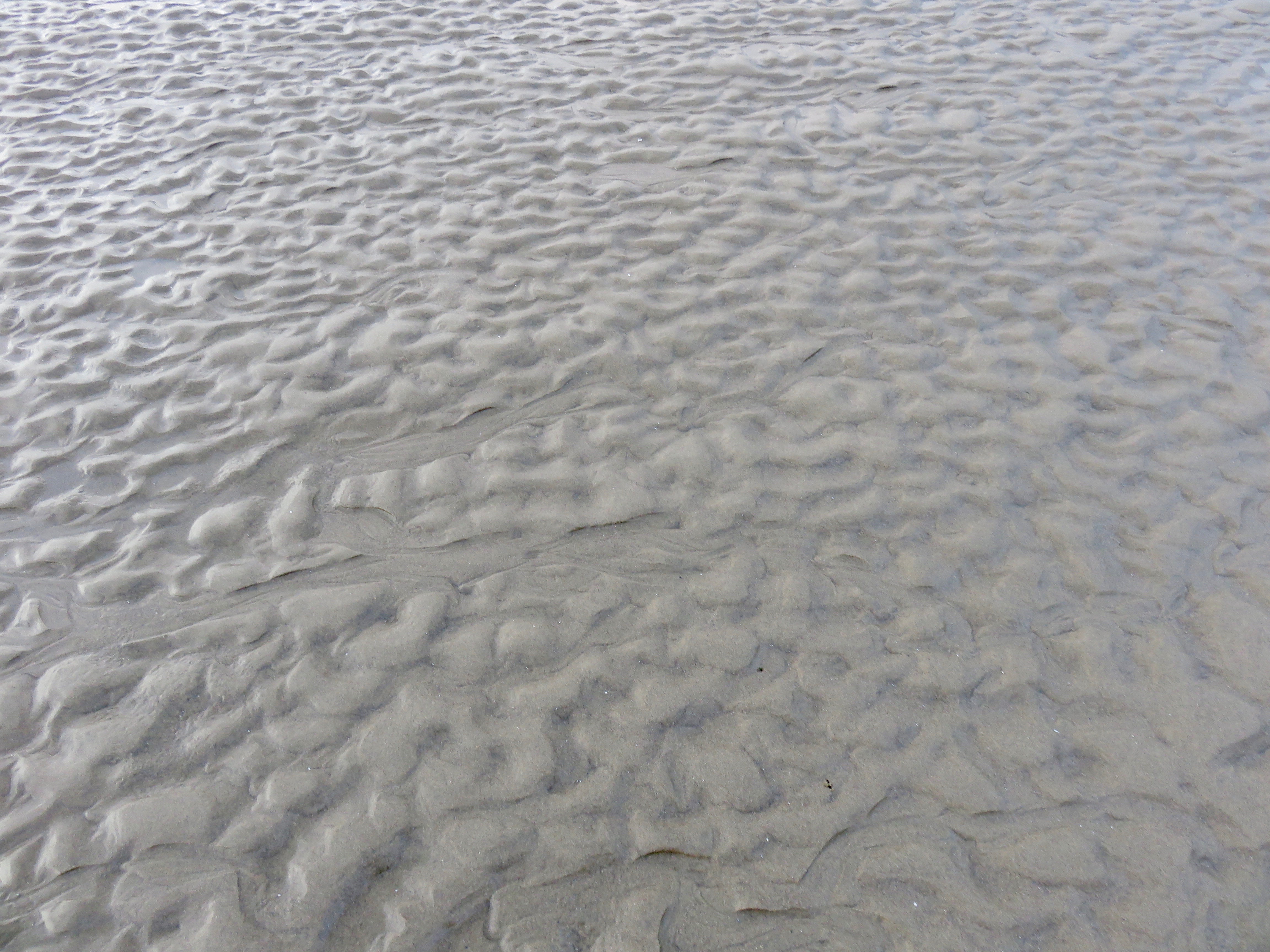
The blue hour reveals sand newly swept by the sea.

The blue hour is the time of tiny shore birds rising and settling, rising and settling, search and searching.

The blue hour witnesses gulls eating crabs cast onshore.

The blue hour is given over to breaking waves and mere silence underneath.

The blue hour precedes the blind light climbing the coast range and casting brilliance out to sea and finally onto the sand.

The blue hour is cool and clear, damp and dim.

The blue hour.

The pure clean daylight makes an end.

Ah! I have learned how to change text color, single space multiple lines, and indent text—hoorah!

•

•

•

MORNING WALK

This is why we walk early.

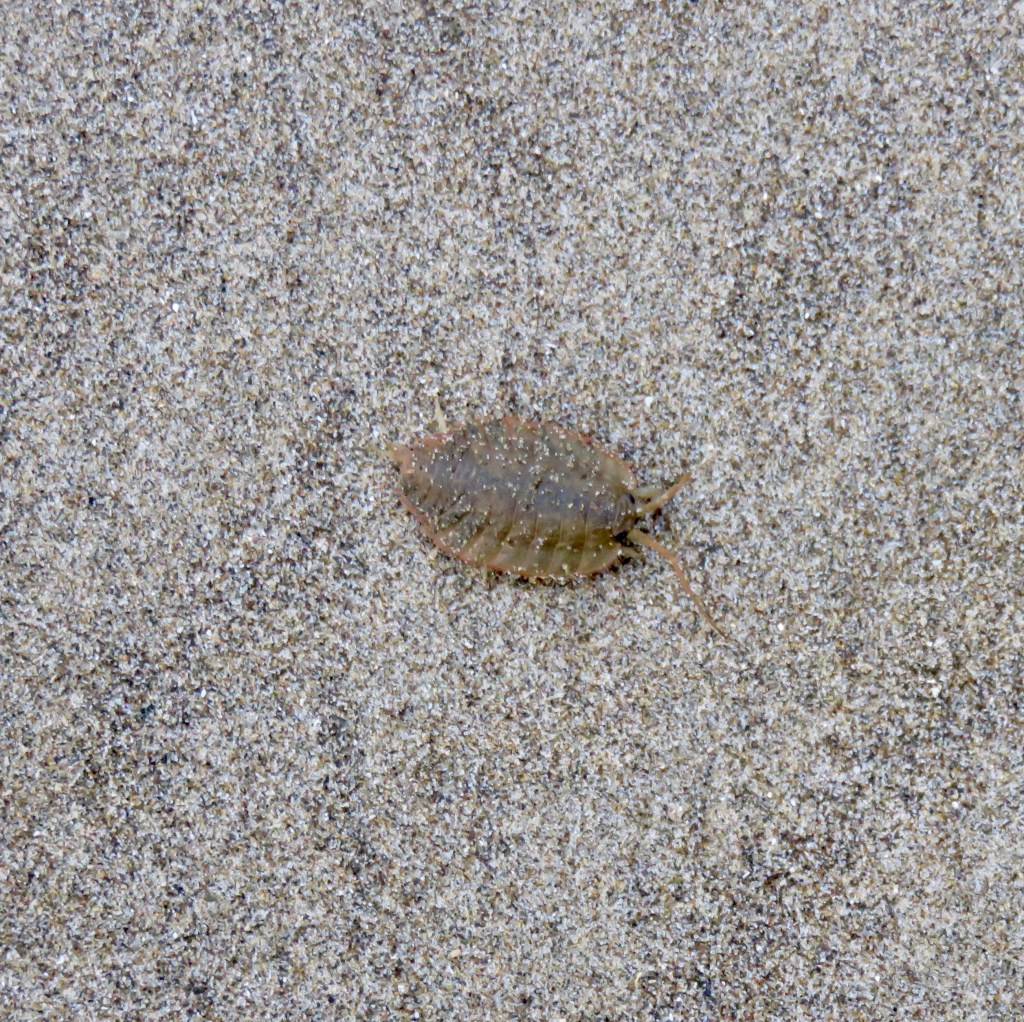
Our walk is what begins our day, what gets me out of bed and moving so that we can walk tide-washed sand and get home before the crowds. What we see on our walks—crabs, isopods, a moth caught on the wet sand, seabirds and eagles, the sand crabs and hoppers of various sorts—decorate our path. There were no chitons, none at all this morning, on the headlands or seastacks, but juvenile gulls still cried for their mothers to feed them.

When my nearby footsteps alarmed this isopod, it flipped onto its back, rolled up just like a pill bug, and then flipped back onto it myriad legs and scurried on. It was more than an inch long

The odd little fellow rushing past us was an isopod, a sort of catch-all term covering the ten thousand other species of Isopoda, an order of crustaceans that include woodlice, what we called “pill bugs” when I was little. The Isopoda include 4500 species that live in or near the ocean, 500 on dry land, and the other 5000 in fresh water. They are found worldwide and the land-based species are entirely herbivorous and harmless to humans. Some marine species bore into wood (such as boats) or are parasitic to fish, shrimp, or crabs. The one I saw this morning was likely a rock lice or sea slater, considered a terrestrial isopod, though its habitat includes tide pools—the entire splash zone. Taken together, this order lives everywhere in the world, from the tropics to the edges of the Arctic and the continent of Antarctica.

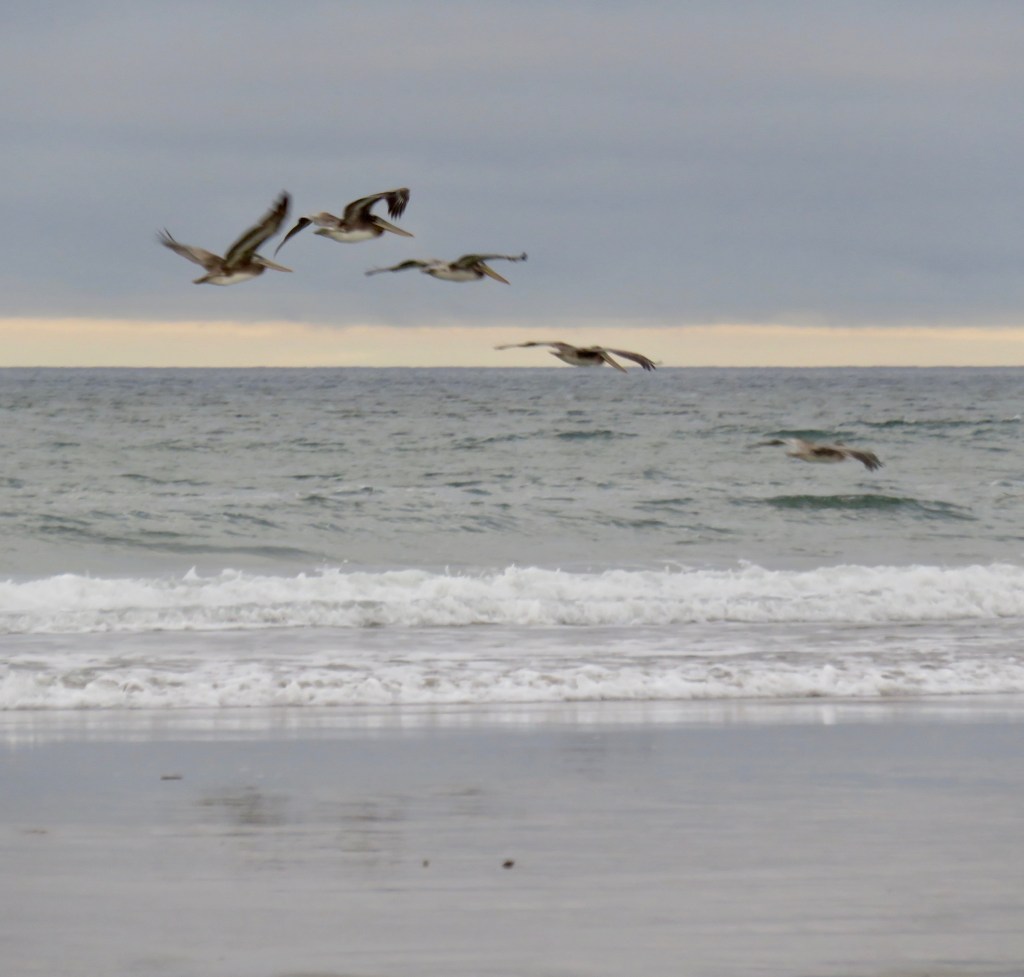
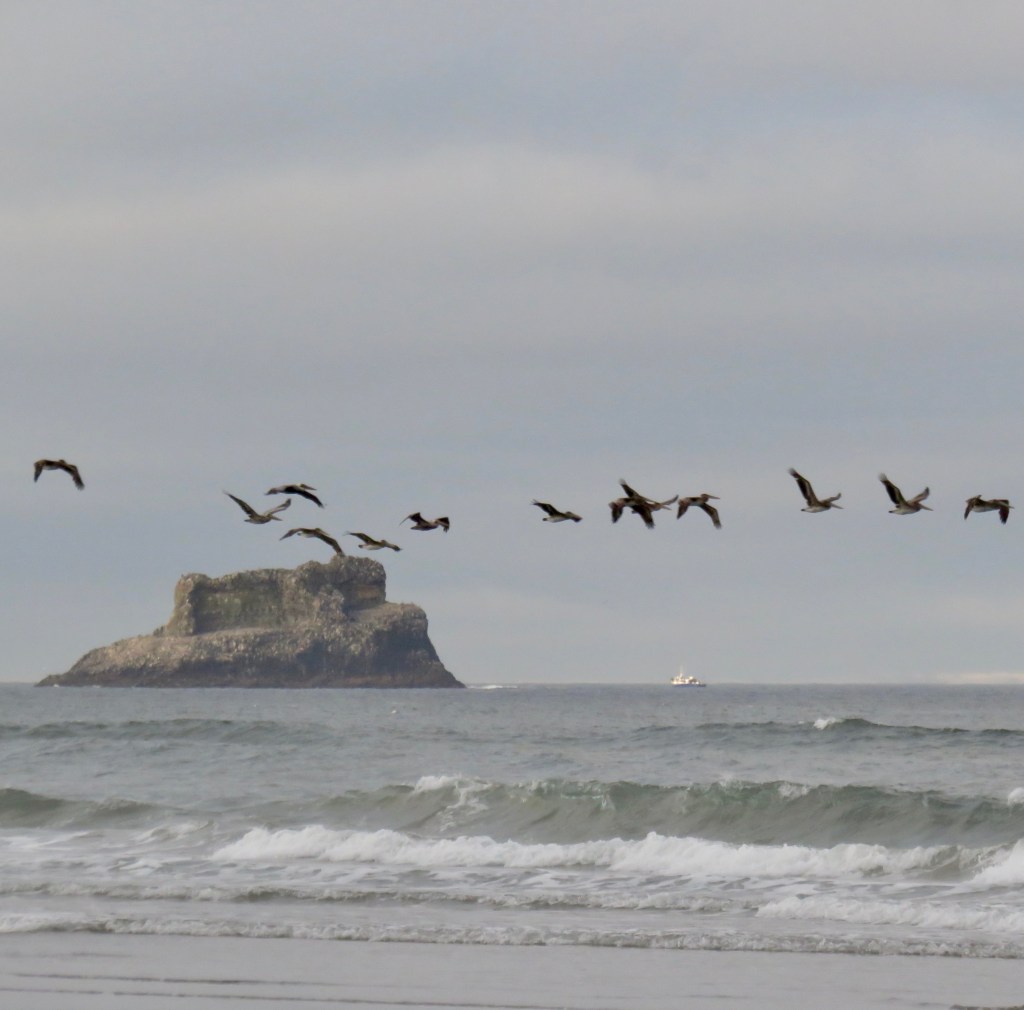
We walked long this morning and after touching stone at Hug Point, hundreds (Gary says thousands!) of pelicans flew past us heading north. The first group of seventeen was followed by a small group of five, which appeased us since we suspect they are almost always in even numbers. (They are monogamous for the breeding season.) Then a group flew just outside the surf line, too many to get an accurate count, and another group and another and another all the way while we walked the two miles home. 

This is part of a group that flew between us and the surf. Some groups flew out near the horizon, usually in a looping line.

The brown pelican (Pelecanus occidentalis) was identified and named by Linneaus in 1766. It is found from the mouth of the Amazon River and Galapagos Islands north into Canada on both the Atlantic and Pacific shores. It was listed among the endangered species by the U.S. from 1970 until 2009, but thanks to the ban on DDT in 1972 the species has recovered and today is listed of “least concern.” The local subspecies is californicus, which breeds on the California coast. A large seabird, our brown pelicans are the smallest of their kind. Their flight feathers are dark brown when I find them onshore, and sometimes a foot and a half long. They have a wingspan of about seven feet (6’8″ to 7’6″) but weigh seven to eight pounds. They spend their lives almost entirely at sea. They glide steadily near the surface and we enjoy watching them dive into water for fish. Pressed to catch up with their pod, a pelican can move very fast indeed. They can perhaps fly at speeds past 50mph, and live for decades.

When we moved here forty-one years ago, neither of us recall seeing these birds at all. Then one summer, there were a few who passed, then fourteen arrived one early summer and stayed into the fall. That might have been fifteen years ago, perhaps more recently, perhaps in 2007. We see them each year now and long lines of hundreds sometimes pass, but usually a dozen or more hang about, fourteen or eighteen, throughout the warmer weather. They have flown right in front of our windows—their strange pterodactyl faces, always seeming to be pointed north. Most often they glide a few feet above the ocean, between breakers or just outside the surf. But other days we see them far out on the horizon, moving in smooth, graceful arcs.

We are always heartened to see the pelicans. Thank you, Rachel Carson. Thank you thank you thank you!

•

•

•