
I have always dreamed in color, brilliant skies and water and greens. I might be flying on the back of a horse or flying as that horse. My bad dreams are typical: unprepared for something like a test (grades 1-12), a class (university), teaching (standing before students and teaching something I know almost nothing about). For many years I dreamt of running into a friend who committed suicide—so glad to see him and laughing, then screaming and crying. But the good dreams, my favorite dreams are about flying over wild land.
Memory. Change. This post isn’t about dreaming; it’s about landscape.
The forest to the east had just been clear cut when we moved to my family home 44 years ago. The consolation, I told Gary at the time, was that it would be 30 years before it was cut again. That seemed like a long time when I was in my twenties. It was actually longer before it was cut, and even so, I nearly cried when I went up into the hills and found them logged and the ground scraped, so that even the huge old stumps marking my run were gone. Everything was different and mostly dead. I have not run the hills since. When a neighbor advised me a few weeks ago to run the forest, I could not even breathe. Too many new houses, roads opened for development, and of course the people who live in rebuilt houses or new houses on new roads now want any further nearby development stopped.
I get it. I’ve felt that way most of my life. When my parents moved us to Shoreline, north of Seattle, my backyard was five minutes from forest, swamp, and cow pasture. Goats, palomino horses, beehives. All that was gone by the time I graduated from high school.
The other day, the same neighbor who wanted me to run the forest went off on me because I mentioned escaping the weekend crowds to our little condo in Portland. She said people having two homes were “the problem,” angry, she rushed off because we had nearly ruined her morning.
I can’t help feeling the justice in some of what she says. As a class warrior, I am not comfortable with privilege; I recognize that I have it. Two homes? What right does anyone have to two homes?
My community, however, was always about second homes. My great grandaunts bought the property in 1911, built their house with no running water or electricity, and camped under a roof from Memorial Day to Labor Day. My great grandparents, grandparents, great aunts and great uncles, the few cousins, and my mother and her sister and various friends stayed there too, all summer. The outhouse was built over the swampy creek next door. There’s a nightly rental on that land now.
There is a photo of our house, the first one that my grandfather remodeled and later dismantled and rebuilt, showing only forest all around. My personal memory does not go back that far.
From the 1950s I have seen the coast change. I remember before St. Peter the Fisherman church was built, before the houses north and south and east of ours were built. The sewer system is new in my lifetime, and the old power lines with glass insulators are replaced with larger poles. There was only the deli-Post Office on the west side of the highway and the gas station on the east side. Only a handful of houses once lined Shingle Mill, and three oceanfront houses nearest the creek are built on land that did not exist. There was a rock shop and Cold Comfort Farm near there, and these modest buildings have been rebuilt into much larger vacation rental properties. I remember before most of the houses in my community were built, when northernmost “Kent Price Park” was leveled and only a single home built on that quarter-mile stretch that now has a vacation home every fifty feet. When we drove to visit my grandfather and his third wife Genevieve, we always missed the turn off the highway because no houses were visible from the road nearby—the turnoff itself was nearly invisible. Almost all the homes were second homes. The difference now is that most houses are short term rentals and the owners do not spend the summer, and only rarely stay even a week. The houses themselves are massive.
My father liked the new big A-frame house when it was built a mile north in my childhood, but that has recently been replaced by a bigger black house with a butterfly roof. I like it better than the A-frame, though the trendiness of nearly black homes is already wearing thin. As I run along the beach, I can look up to the oceanfront houses that are replacements of older homes and the ones built where there were once only trees. I remember when highway 101 ran through Cannon Beach instead of around it, when the arch at the cape was two arches, and before that when it was still filled with rubble and I could not quite get through. Even recently the shore would be mostly empty except on rare weekends. I recall a student who had graduated in the 1990s visiting in the 2000s and seeing people all over the beach. “What happened?” she exclaimed. The people I meet onshore these days are all newcomers. I can’t blame them for wanting to live here, but I miss the way this part of the coast looked like a wild place, Miss how it used to be. I prefer to look away. Memory and nostalgia.
Gary finds Seattle almost unbearable because it has changed so much since we lived there. I have only recently understood that I feel much the same way about our coastal home.
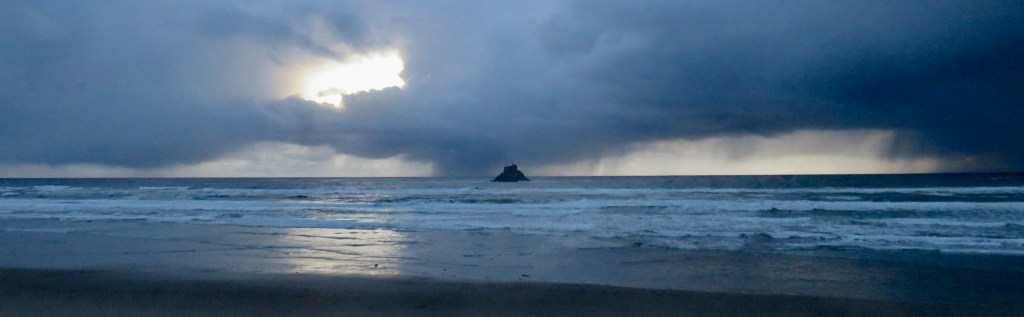
On my runs I look at where I put my feet, at the shore ahead, and west to the water to the west. I look east only to see the tops of the nearby peaks, birds, the sky. This is a steady presence, what I love. Change… not so much. I try not to look.
The steady line of houses, almost none of them occupied full time, so many of them hosting a stream of tourists—all that development—distresses me. Ultimately, it is all that development and tourism, not the second homes—there were always second homes—that ruins the coast for me. It is not ruined, of course, but for me the change is distressing. It is the primary reason I like running at 6am—the sand is empty except for the occasional local, dog, and tracks of wildlife.
Portland is a city and though I lived here for a time as a child and have spent, cumulatively, a few years here, I do not have an attachment to any wilderness past near our condo. It has not altered much in my lifetime other than the unhomed. (Is that really a more polite word for homeless?) My grandmother’s house on the east edge of the city is ruined—the cherry trees and garage long gone, trees cut, split-level houses where there used to be gardens and forest—and I will not go there again. But our condo is a 1925 Historical Register building surrounded by buildings as old or older. I am sorry the crazy retail store Dazzle is gone but Budd + Huck is in that storefront now. The changes at the coast bother me the way the changes in Seattle bother Gary. We walked those landscapes for all our young lives and they are destroyed. We talked about this shared dismay yesterday, Gary and I, and understand one another better, I think.
 IMPERFECT PATIENCE
My daughter is loving Seattle and will probably stay there after she graduates from SU. She hates what has happened with Portland since she was younger. I enjoy visiting her at college. Her area of the city is pretty kewl.
LikeLiked by 1 person
We none of us want to see our favorite places change! I don’t like downtown Seattle but most of the rest of the city, like Capital Hill, doesn’t disturb me as it all does Gary.
LikeLike
I bet your great grand aunts and great grandparents and Bert Patton knew each other. The land we are on now was owned by the local Clatsop tribe first, then Kent Price (Dale remembers his real estate office across the street was defunct when Dale was here as a boy), then Bert Patton, then Dale Mosby. Bert worked at the Big Creek Logging Company near Knappa as a blacksmith and built the log cabin here we think 1916 because we have a photo of it with that date on it. It has been remodeled twice since then. Cold Comfort Farm was an antique store started by Travis Tyrrell and his1st wife. Send me in a separate email who the names are of your great grand aunts and great grandparents, and I will check to see if they are in our guest book that goes back to 1925. I suspect not because they had their own shelter. Dick of the Clatsop-Nehalem Confederated Tribes remembers stories of his ancestors on the Arch Cape Beach, and has a photo of one of them holding a razor clam on the end of a stick. They would roast them over the fire that way. I am still trying to create an oasis here and not be disturbed by all the strangers here who are trying to find their own temporary oasis. Huge stumps should be protected. Another reason people have two homes is because the services here are not stellar. Resources on trying to find a gardener, construction worker, efficient transportation or finding adequate and timely medical care are extremely difficult here. I want your salal muffin recipe.
LikeLiked by 1 person
Oh, my, I’d forgotten about the local Kent Price office, but we knew Travis (but not his first wife) and Irene and Mrs. Christie. Our family is in Arch Cape Chronicles, if you want names. My mother talked about using a garden rake when they wanted crab for dinner. And I completely agree about the huge stumps and about services. (Just had a crown prep done.) And I will email my muffin recipe when I can get to it. It’s Fanny Farmer’s blueberry muffin recipe but subbing salal berries, which Gary much prefers!
LikeLike
Instead of traveling internationally or nationally you enjoy your second home in Portland.
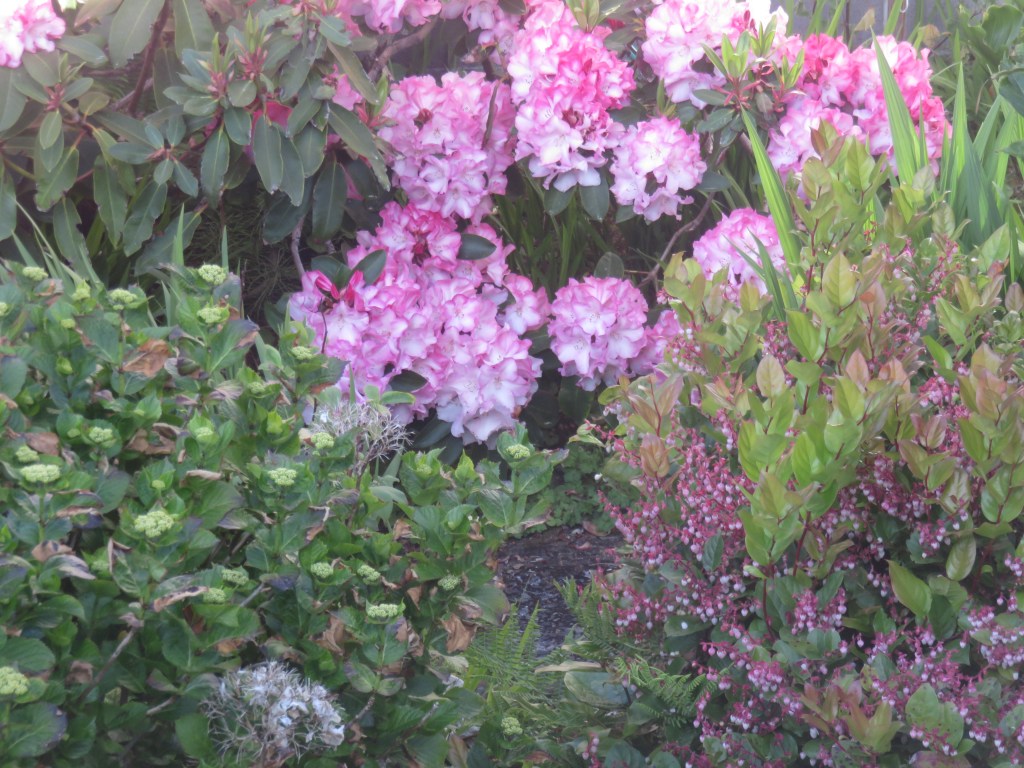
Another lovely photo of your garden. Yarn in jewel tones!
Change good or bad it happens.
LikeLiked by 1 person
Thank you, Toni—you are a sweet comfort. For decades we could not travel because of the pets. It’s true. Our mortgage paid off and we were used to being frugal. Our splurges are books, music, yarn, food, and driving to Portland!
Yes, changes happens. And it’s worth mentioning that when I was at the AWP, a friend said she was proud that Seattle had grown far beyond having just one industry as a major employer! We both recall when Boeing lost a military contract android off so many people that the billboard went up: “Will the last person to leave Seattle please turn out the lights!”
LikeLiked by 1 person
from Centennial by Michener—Gray Wolf said only the rocks last forever—we hope
from David Bowie’s Changes song—he tried to warn us yet
from me about the dynamic rather than static situation—even if the lights were turned off—I don’t think anyone would notice or care now—which is part of what freaks us out as well as in—yikes!!
LikeLiked by 1 person
I read from those that had some connection with Arch Cape from past family or friends.
I can recall Arch Cape from my grandmother’s little cabin in the early 1940’s and the times I spent with her as a small child. The wood cooking stove, gathering wood for it, home maid bread, bacon, eggs, hot cakes, digging clams, crabs with a garden rake and even fishing in the surf. Our neighbor was Bert Patton, Ms. Benson, Angelo Costenzo, Ethel Le Gault, Mr. Markum as some of the locals. We had black out curtains as soldiers walked the beach on curfew. One night we had a soldier knock on our cabin door to say we had light showing and we must check our black our shade. I remember his helmet, rifle, and uniform and very nice and friendly. I would go to the beach and play in the sand but was warned not to pick up any strange objects. Their was fear of a Japanese invasion as a submarine had surfaced on the north coast and fired cannon fire on it. Arch Cape was a gathering place for the Archer and Ellis family. My grandmother built her little cabin in 1919 and all the building material came down from the open tide by truck from cannon beach. I have seen Arch Cape from many years and have many fine memories of it. Ronald Bruce Ellis
LikeLiked by 1 person
My great grand aunts built the first little house here in 1911. There was only one dormer in the upstairs, no electricity or running water. The family name was Smith and they were here Memorial Day to Labor Day. My grandmother, Fay, brought her two daughters for the summers, cooking on the wood stove and caring for her daughters and cousins.
The shore was lined with trees.
After WW2, my grandfather dismantled the house and rebuilt it as a one-story retirement home he lived in year around with his third wife Genevieve, who was a nurse and weaver. Some decades later, Bill and Mamie Markham built a house a hundred fifty feet north. Their son John still lives there.
My husband and I moved here in 1979 and had the half story put back in 1984 to make room for our two sons. I laid the floors, painted, and had to wait decades for proper kitchen cabinets. We planted pines, but only one has survived. The house north of us had forty-seven pines doing well, but then all but one cut down.
The world changes. The ocean rolls in and out regardless.
Thank you for sharing your memories.
LikeLike