CREATIVE
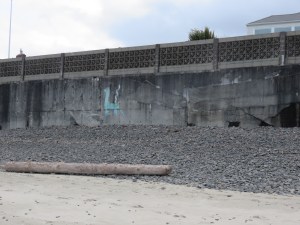
An alpaca chalked onto a concrete wall.
The new warp is green, cool, the color of lichens and shaded moss, the color of celadon porcelain, all the watered hues of seaglass found tumbled in basalt on my shore Continue reading
My neighbor always used to blame me whenever she caught a cold or flu—”You gave me this”—and now I know she should have washed her hands before touching her face. I do not think she will be able to blame me for this. “Worser and worser” was the ungrammatical line from my childhood. A new Brevity post about how to write during this pandemic is meant to be a list of humorous writing prompts. The author suggests subtly informing your younger self to learn to cut your own hair. I have cut my hair since I was fifteen. Continue reading
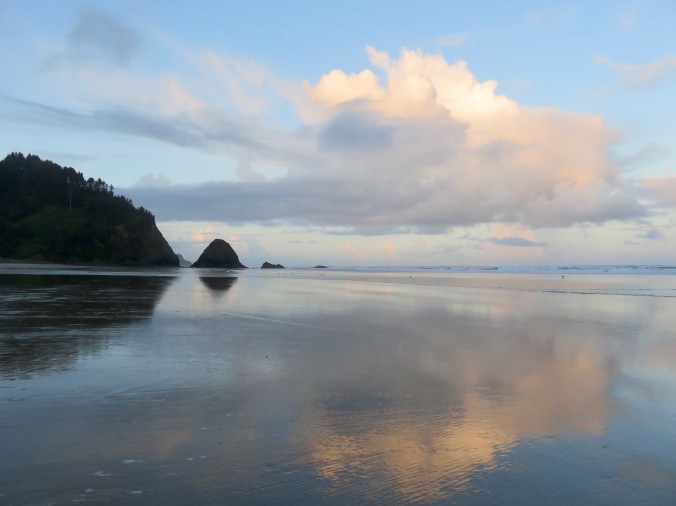
It started with East wind, which was warm and dry on Friday and floated dry grains of sand across the shore. That called up the memory of walking Bowzer and how he stood so tall and alert, looking far off north until he noticed the sand accumulating on his feet. He would pick up each foot and shake it free of sand and then prance to avoid it gathering until his attention was caught and he would stand still again, the process repeating itself. I dreamt of the Afghan Hounds the other day.
And today we have been isolating for two months. So I thought about my clothing and my shoes and where we might have gone and what me might otherwise have done in the past two months. I am not among those working as a cashier, though I did that work for years. I do not take care of sick patients nor am I forced to work overtime because the job I do is essential. I have no job.
I have too many shoes. Nine pairs on the rack I assembled when I was Kondo-izing my closet, including slippers and pink flowered Crocs, four pairs of booties, two pairs of sandals, and the pair of flats I keep only because my mother ordered them for me. Tucked in the bottom of the closet there are three pairs of Eileen Fisher shoes found cheap, or relatively cheap, on sale, the black cowboy boots I bought at a garage sale ten or fifteen years ago, and my old Bean boots purchased when we first moved to the beach some forty years ago. And also two worn pairs of black boots too disreputable to wear to work. Except I no longer work.
What I actually put on each morning are my runners, even though I no longer run either. Mostly, I wear the same running gear I bought in the 1990s with grey t-shirts and good socks. I put on a bra the other day and it improved my profile, but I am out of the habit. I did not wear a bra in my senior year of high school because P.E. was no longer required, and I did not put one on again until I’d completed three degrees at the University of Washington and started my first teaching job at a Sacred Heart prep school.
These days I dress as if for a run and after our hour or two morning walk shift to clean cotton jersey pants and top, bare feet, sometimes a sweater or my bathrobe. We always go out early, always have. (Now we go out extra early to avoid the tourists and second-home owners we wish stayed sheltering in their own homes. License plates from Washington and California.) Soon we will be ordering our lives to avoid the heat of the sun. Already I am barefoot most of the day, with or without clean cotton socks. Gary reminds me this is an improvement from when I damaged my feet in 2011 and could not even stand for long without orthotics.
Most of my wardrobe is useless, unused for two months and likely to remain so even after the current emergency. There are dresses I have owned for twenty years that, barring moths, will be wearable when I die because I have no where to wear all that lovely silk and wool and that perfect silk-and-linen blend. I can see now that the garments are unnecessary. I took out all my earrings last month. Five empty holes. I wish I had not lost one of my little sterling Laurel Burch birds on the beach, but even if I had them both, it would only be to have and hold. The pair I pierced my ears for. Precious objects (object) of sentimental attachment sitting in a drawer.
Other than walks, I leave the house once a week these days. Without the pandemic, we would have daily driven to pick up our mail six miles away. Many more trips to purchase groceries. We probably would have gone to Portland at least five or six times, to the Farmers Market and Powell’s Book Store and out for lunch and to visit our sons and their families. Cargo to see Calli. I might have made strawberry jam by now (there are eight jars of mango chutney instead). We had planned a drive to Canada, the Black Ball to Victoria and two or three days at Elaine’s. Now I daydream about San Francisco, maybe in October of 2021. I weave but I am not entirely hopeful that the show I am weaving to prepare for will take place in December. The work passes the time. Like spending an afternoon making more chutney than we will eat in two years. Even without the pandemic, it was a good use of my time.
Without the pandemic, there would probably still be at least six shawls from two warps finished, but maybe not three warps—nine shawls folded away—with a fourth going through heddles today. I likely would have visited the yarn store in Victoria and Churchmouse on the way up north.
Without the pandemic, we would have finished reading books eighteen and nineteen in Patrick O’Brian’s Jack Aubrey and Stephen Maturin series by now because I generally read aloud on a drive and now we are busy in separate rooms. Maybe we would have read the last one of the series and started something new by now.
Without the pandemic, Gary and I would still be gathering trash from the shore during our morning walks, another two hundred pounds or more in two months. I would still be coming home from those walks with a sore back. So there is one advantage.
Without the pandemic, I would have gone to see my dentist about the pain in my jaw by now. We would have had friends over for dinner. We might have gone to visit friends, sat in their living room, and told stories. I would have played at least eighteen games of Scrabble. We would have gone out for a meal. I would not be baking all our bread. I would not have perfected my recipe for sticky buns or made my very best brownies ever. I would not now be nurturing five kinds of vegetable seedlings. Losses and gains.
Without the pandemic, we would have been able to choose gifts for family in person, and I would have made cakes for two grandchildren’s birthdays. I would feel optimistic that my fifty-year high school reunion would take place in September. We would attend. Family members who need medical care would be receiving it. I would not worry less.
Without the pandemic, “Virtually Normal,” the Brevity blog post scheduled for next week would never have been written. Perhaps I would have written a poem for each day of the last month—I’ve done that for years past. My presentation for Willamette Writers would have taken place in Newport last month, so that would have been another trip. Instead of posting assignments online, I would have had the opportunity to share in person.
Without the pandemic, my novella might remain languishing in a computer file instead of being shared on line for a month, or maybe I would have revised it for NaNo and rediscovered how fond I am of that thought experiment. As it is, I have a page of revisions, additions, and possibilities for when I am next moved to write fiction.
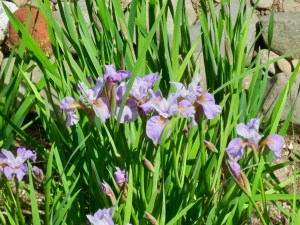 How has life changed for someone like me? A person who is able to isolate with someone they love, but who still feels what is missing? The iris are in bloom. The little flowers volunteering in the front garden would open their faces to the sun. Maybe the middle garden would have less attention. I would have bought starts instead of planting seeds.
Regardless, the tides sweep in high and low. Weather moves through. People and places exist even if I do not get to see them in person. I hope it has not all been bad for fortunate people like me, that even as I miss many things life has changed for the good in some small ways. I hope the useful changes become permanent. I do not believe that what does not kill us always makes us stronger because sometimes what does not kill us leaves us crippled and unkind. Surely we all know that is true. Nevertheless, hardship might reveal to us our power, render us flexible and compassionate. We might find the legendary workaround.
I believe that any time we are forced to do something difficult, something that will not kill us, we should change, and that we should do our best to ensure that the changes we find in ourselves and in our world are for the better.
Happy Mothers’ Day!
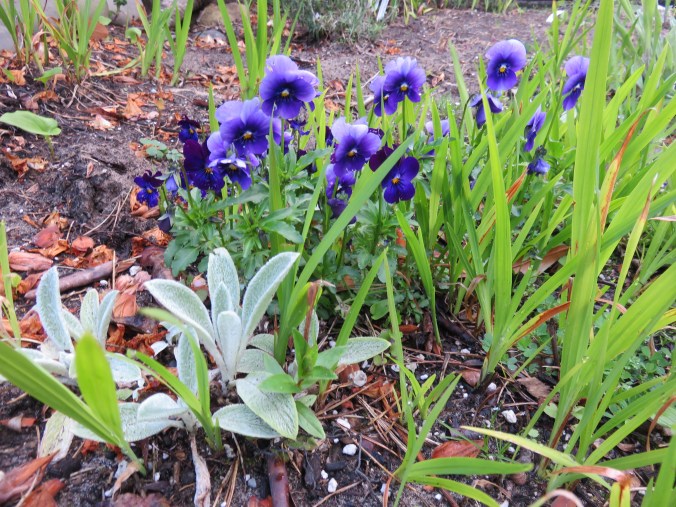
FOR AHMAUD ARBERY, AN UNARMED BLACK JOGGER KILLED FOR ALLEGEDLY LOOKING IN THE WINDOW OF A HOUSE UNDER CONSTRUCTION
that day I wasn’t shot for trespassing.
It happened nearly two decades ago.
There are literal black swans. But the expression “black swan” when not speaking about birds means something else.
A black swan is an anomaly. It is the thing that careful observations and experience tells us cannot happen… and then it does.
For example, living in 18th century England, I could have looked at literally hundreds of swans, maybe even have seen every swan in Europe. Every single one would have been white. And it would have been reasonable for me to conclude that “Swans are white. They are all white. Every single swan I’ve seen in my lifetime has been white and therefore swans are white and no other color.” I would have made a rational and reasonable assumption based on extensive experience. Then a British naturalist came back from Australia in 1790, a continent I hadn’t even cared existed, and announced: black swans!
Who knew that everything I assumed was proper and normal could flip over in an instant?
That’s a fairly simplistic example of what some scientists call a “black swan problem.” This is something else: a newer idea called “black swan theory”. We humans are too reliant on prediction, too trusting that the world unfolds in some reliable and predictable order, when in fact, our world is closer to random chaos (if I can use that term without evoking chaos theory, which is something else). Two black swans.
An entry in Wikipedia explains it like this: “The [black swan] theory was developed by Nassim Nicholas Taleb to explain:
“Unlike the earlier philosophical ‘black swan problem,’ the ‘black swan theory’ refers only to unexpected events of large magnitude and consequence and their dominant role in history. Such events, considered extreme outliers, collectively play vastly larger roles than regular occurrences.”—“Black Swan theory” Wikipedia
The older “black swan problem” was a simple matter of logical deduction. That’s what I did in my 18th century example: Every swan I have every seen is white, therefore all swans are white. Then I discover even a single black swan and my theory about all swans is destroyed. The revelation of black swans is not even dramatic enough to count as a black swan in black swan theory where black swans are game-changers.
Black swan theory concerns something more dramatic than an error in reasoning. Taleb describes an event that for good or ill shocks people experiencing it, could not reasonably have been predicted, and dramatically impacts lives. However, in hindsight people struggle to rationalize what has occurred as a predictable event (which is isn’t). Think 911, or perhaps the discovery of antibiotics. Taleb’s argument is that while we can not, by definition, predict black swans, we should understand that we can’t predict the most transformative events we will face. In the mean time, we should work hard to minimize the disasters and exploit the gifts they bring. These things will happen.
Most of this theory is over my head, I must admit. I have Taleb’s book, but have only paged through and not studied it.
[NOTE: There is limited assertion just now that covid-19 is a black swan. Since intelligent people in medicine and government the world over were predicting a pandemic in the near future, it really does not make the cut.]
The concept, however, of events that cannot be predicted and how we respond to them is interesting, even for this philosophical amateur.
Maybe that’s because I am a grandmother.
Most of a child’s day, when it’s an interesting day, is made up of black swans. (For literal black swans too.) Babies know their parents and their own room and bed and clothing. But consider: every time something new happens—mom has curry for lunch, someone sprays perfume, a new song plays on the radio, radio!—it’s a brand new thing that they’ve never experienced before and could not have predicted. Black swans everywhere from the baby’s perspective.
Although newborns should be protected from unnecessary exposure to germs and disease, children who lie in a crib all day in a quiet room with little hustle and bustle fail to develop normally. The newest theories of encouraging childhood development all emphasize exposing them to many colors, textures, and experiences. Further, there is ample evidence these days that an excessively clean environment actually leaves children susceptible to allergies.
By the time they are a few years old, most children have been exposed to a great variety of sights, sounds, tastes, smells, and environments. They have begun to understand “normal.” The normal clatter and roar of the city is no more disturbing to an urban child than the normal sounds of birds and wind-blown branches are to a child-raised in the country. Eventually they come to understand and anticipate patterns of behavior and speech that the adults around them have been demonstrating for their entire lives.
And then one day, out of the blue, parents announce they are divorcing—tragedy—or the child hears an opera—a gift. Black swan, black swan! This is the way the world changes fundamentally and forever for a child. This is not a black swan event for the world, but on an individual level, the world changes.
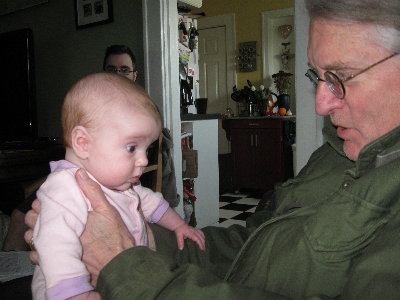 Taleb is concerned with international events, events that impact large numbers of people. Read the book and see what this is all about. In the mean time, my husband, who was certain that becoming a grandfather was not a good idea, took one look at Ruby as an newborn and—BLACK SWAN!—the world changed. He could not have predicted, could not have planned for how one little baby changed everything. Epiphany. Marvelous joy! Going on nine years . . . still amazing.
For the record: this wasn’t a surprise for me. I know who I married.
First mother swan swimming lesson for newborns 2006 Ibirapuera Park”
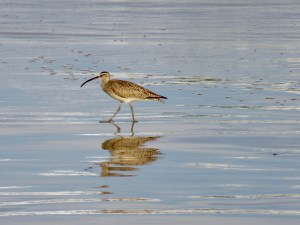 By the time my watch alarm went off at 6:30, we were already on the beach. Not much luck with glass today, but two dozen whimbrels. (Gary counted fifty-one gathered the evening before in front of our house.) They moved out of our way as if we were just another harmless animal. And that is what we are. Gary will tease seagulls by calling “Kitty kitty kitty” but we are both careful not to disturb the whimbrels. They were not here when we first moved to the coast in 1979. They had been here, of course, but many of the birds we treasure each day had mostly vanished and have begun reappearing in the decades we have walked the shore.
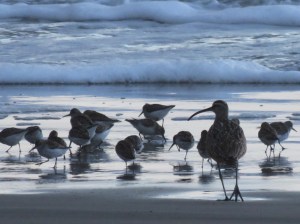
one whimbrel and part of the large flock of very fat sandpipers.
Yesterday we saw a large flock of Western sandpipers and were hailed on twice during our morning walk! When I was a runner, I was always too hot and I enjoyed cool, damp days. But even then I drew a line at hail. Yesterday we came home soaked but the little hailstones did us no harm. The sun burned off all the clouds before we’d fully warmed back up in the house.
The rest of the day was all blue skies and tourists. Today there are high clouds but no sign so far of rain. If the beach remains empty, we might even get our second walk.
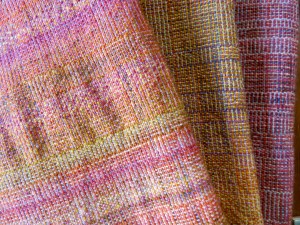
Three “Marigold” shawls
I also finished the “Marigold” warp yesterday, washed and hung the three shawls to dry. This morning I folded them and put them in the cedar chest. Each one has gorgeous hand-painted handspun yarn in the weft, which I should steam press to flatten, but I tolerate a bit of ripple. I meant to make a mostly black-and-white Indian black print quilt next, but what I really want to do is put the next warp on. I have yarn for green or brown, but I am waiting for more Koigu. I might try for another peacock warp.
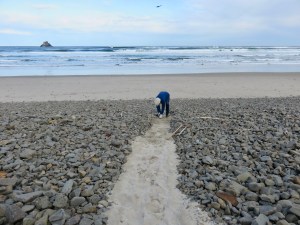
Gary rebuilding the bottom ten feet of our path, washed out last night.
The high tide wiped out the bottom ten feet of our path, but Gary has already rebuilt it. We (or really I) used to build the path the end of March each year. Sometimes it would wash out entirely and I’d have to start over. This one is wide and softened with sand Gary hauled from the beach.
Works Progress Administration “(WPA; renamed in 1939 as the Work Projects Administration) was an American New Deal agency, employing millions of job-seekers (mostly unskilled men) to carry out public works projects, including the construction of public buildings and roads. It was established on May 6, 1935, by Executive Order 7034.”—Wikipedia Continue reading
“Butterfly Fontanelle” was the title of a short story I began writing more than three years ago. The fontanelle is the soft spot in the top on a baby’s skull where the bone has not yet quite closed over the brain. A “butterfly fontanelle” is the shape of such a soft spot, like two paired wings. Human babies, like most all mammals, are born before they are mature. A newborn cobra can already bite and kill you. Mammals may be able to stand but most are still becoming. For example, most people know a puppy’s eyes remain closed for a couple of weeks after birth, but her ears are sealed shut too. A puppy cannot learn until she is about three weeks old. Human babies . . . must gain sight and depth perception. Infants are becoming human.
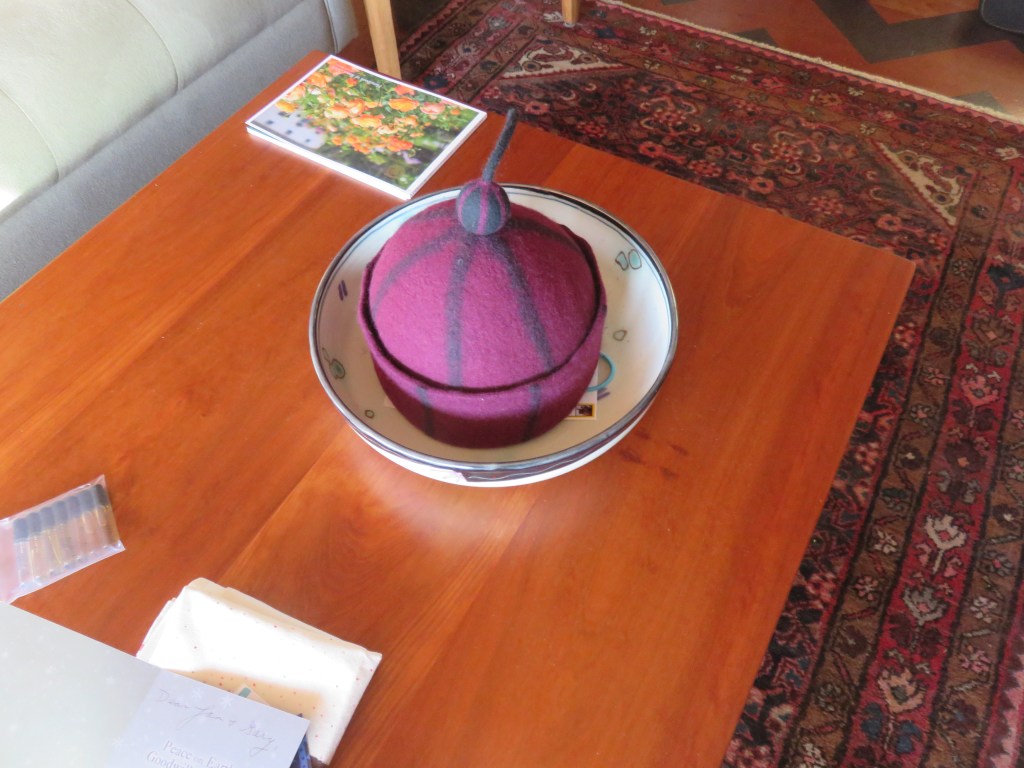
But first, because this has been a hard week, I want to share a publication on the Brevity blog: “Art Saves Lives” I am wearing my felted Acme hat, handmade on the east slope of the Olympic Mountains.
Continue reading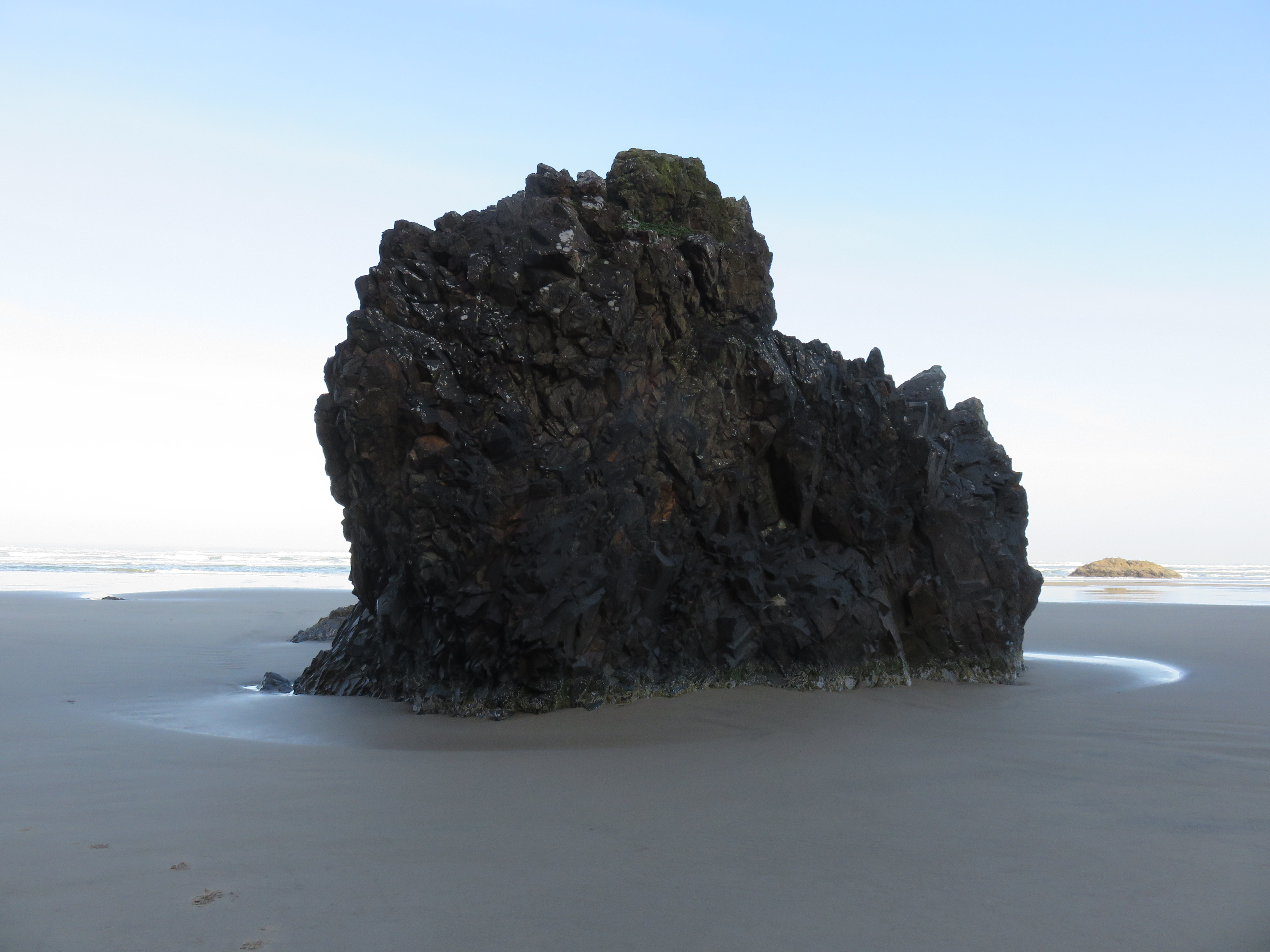
This rock is larger than it might look, about a mile and a half from my home. The sand has been coming onshore earlier than usual, but it is still about twenty feet high. I used to walk here with my boys when they were little. They climbed the rock and often wanted to be carried home. They took turns. I could not carry them both together very far, but I recall when I was young enough to try.
I wake most often in the middle of the night these days. I know before I look at my watch what time it is, usually within a few minutes. I wish it were near dawn, but it’s not. It’s not even 4:30am, when I would not mind so much being awake. I turn and look for a more comfortable position in bed. I know it’s 2:15am or 1:30. Get up and go to the bathroom? Sometimes. Sometimes I will read a few pages and that settles me. Usually I lie looking up into darkness, then close my eyes and go back to sleep. It doesn’t always happen that way. I’ve noticed after our weekly trip to pick up our mail and groceries, I might lie awake until dawn. “Going out” is stressful.
 &PRIDE Press