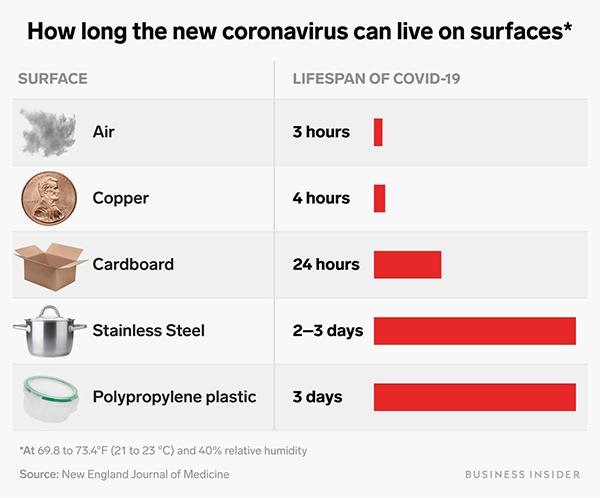
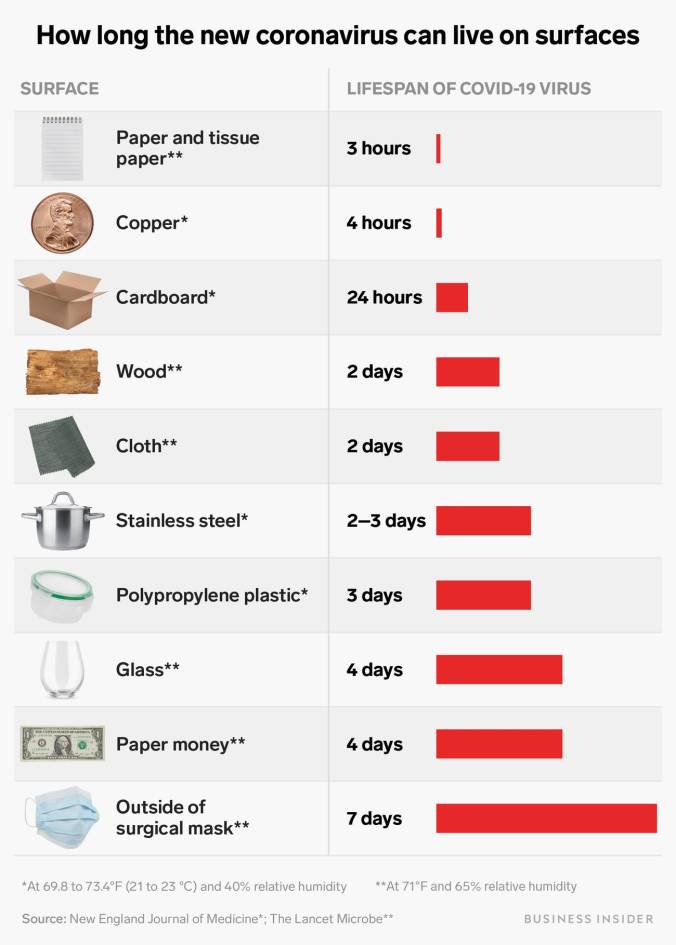
“How long the coronavirus can survive on surfaces
“The researchers behind the new study tested the virus’ life span in a 71-degree-Fahrenheit room at 65% relative humidity. After three hours, the virus had disappeared from printing and tissue paper. It took two days for it to leave wood and cloth fabric. After four days, it was no longer detectable on glass or paper money. It lasted the longest, seven days, on stainless steel and plastic.*
“Strikingly, the authors wrote, the coronavirus was still present on the outward-facing side of a surgical mask on day seven of the investigation. That’s the longest duration of all the materials they tested.”
NOTE: It lasts longer on cooler rather than warm surfaces. Some research has also suggested that increases in relative humidity reduce how readily the virus can spread between people. Your mail is most likely safe on delivery according the the article.
Gary wiped down a wine bottle with alcohol wipes, but we’re mostly avoiding bleach. Mostly, we allow things to sit for days. We wish freezing or refrigeration made a difference (no). We wish vinegar killed it (acidic—wouldn’t that be nice? but no). We wish we didn’t have to think about this at all.
from Business Insider. https://www.businessinsider.com/coronavirus-lifespan-on-surfaces-graphic-2020-3?utm_source=DI20B8U3&utm_medium=email&utm_campaign=20_feb_corona&utm_term=04_06
 IMPERFECT PATIENCE
Jan, From everything that we have read – vinegar unfortunately will not work to kill Covid-19, although both alcohol and Clorox do.* Also, the virus survives in refrigeration and freezing**, but heat kills it.
*. https://www.consumerreports.org/cleaning/common-household-products-that-can-destroy-novel-coronavirus/
* * A 2010 study used two viruses that are related to the COVID-19 virus – – – – – Researchers found that both lower temperatures and lower humidity helped viruses survive longer. In particular, at 4 degrees C, or 40 degrees F, and 20% relative humidity, more than two thirds of the viruses survived for 28 days. On the other end of the spectrum, at 40 degrees C, or 104 degrees F, and 80% humidity, the viruses survived for less than 6 hours.”
LikeLiked by 1 person
Thank you, Shirley. I was mostly joking about vinegar, but feared as much about refrigeration and freezing. And thank you for the links.
LikeLike
The best overview of hopes for a vaccine I have found: https://www.theguardian.com/world/2020/apr/06/when-will-coronavirus-vaccine-be-ready
LikeLike
AND a very fine review of what early lockdown has accomplished in New Zealand and Australia.
https://www.theguardian.com/world/2020/apr/09/have-australia-new-zealand-stopped-covid-19-in-its-tracks-coronavirus
LikeLike