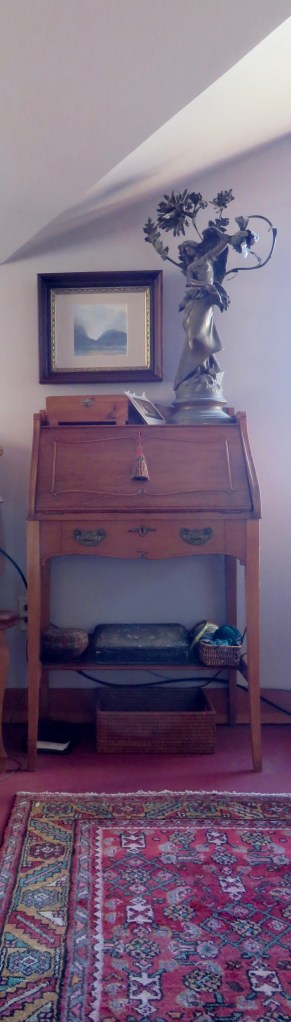
My grandmother’s desk.
My step grandmother gave a mandolin to Gary many years ago. He had the instrument cleaned and repaired but then nearly sold it after she died because somehow an essential family connection had slipped by him unnoticed. When I explained it had belonged to Genevieve’s father, he took it out again and held it. “Then it stays.” He also has a guitar made the year I was born. I like to think that is one reason he treasures it, but it’s the tone. I know it’s the pure, lovely tone that earns it a place in our home.
A friend chided me on Facebook: “NEVER get rid of musical instruments.”
The note was in response to my post of Gary with his Guy Fawkes bonfire and my words: “Gary is on the phone lamenting every single splendid guitar he ever let get away (not to mention the awful ones he laughs over), in his entire life. It is a painful litany and one I have listened to too many times.” The bonfire was of attic refuse from ten and twenty years. I told him about never getting rid of instruments. Gary says, “I get that.” Books, too, I was told should never be allowed to go.
There is a part of me that completely agrees. Books and music and art are essential and precious. Ridding oneself of such things suggests we do not want them, and that is almost never the case. We want it all.
We never want to “get rid of” musical instruments or books.
Sometimes we choose to let go.
Over recent years, I have given away or sold hundreds, perhaps even a thousand books. I just counted twenty-eight bookcases in our home, some as wide as six feet, others just two. Some are six feet high, some just three. There are thousands of books in our house. None are kept in the attic anymore, and only a few dozen are stacked on the floor behind the couch upstairs. I am not allowed to discuss Gary’s instruments in details, but he has “several.” I have books I walked down to the bookshop in Aurora Village to buy when I was twelve, and books I finished reading last month. We have no free local library, so most of the books I read were purchased used, often from Powell’s Book Store in Portland. I no longer keep books if I do not love them.
My husband and I, as I have explained in earlier posts, are engaged in Swedish Death Cleansing, a pragmatic approach to discarding and giving possessions we do not need.
I sort through my clothing. I love clothes, always have, and I know I have too many hanging in my closet, not to mention the tub of genuinely vintage things I have held onto since high school and college. I give things away to charity. I cannot keep it all.
Recently, I went through my jewelry box. I pulled out family pieces for my daughters-in-law. I set aside pieces for my granddaughters. And I gave a box of jewelry to my son to sell on Ebay. We offered many things to family first. People, in case you have not noticed, no one wants the family furniture or china or sterling either. You jewelry is costume or old fashioned or both and no one wants it. If he or anyone liked something, I said to keep it. The money will pay for a new roof next year, or at least a tiny corner of a roof.
Sometimes possessions accomplish more negative than merely taking up space. I gave away my enameling kiln, sold boxes of yarn for a fraction of what they cost me. I was not using them, and their existence in our home felt like a reproach, a lack of industry. And honestly, industrious is pretty much my middle name. I let things go to relieve guilt for not having made more of them.
And sometimes we have had no choice but to sell.
Decades ago, Gary sold his amp because his dad was out of work and could not afford to pay bills. In college we sold our entire collection of Maxfield Parrish prints. We did not mean to “get rid” of them, we needed money to buy bread and pay tuition.
Sometimes by choice, but always the result of some sort of need.
These days, stacks of books everywhere in our house meant I could not find the one I wanted amidst the dozens or hundreds I would never open again. I still have thousands of books on shelves.
Guitars and books have left us because we were not using or reading them. Sometimes Gary traded up for a better guitar. He could not afford to keep every one he ever owned, and we would not have had space to store them. And there is no one to love them when we are gone. If we are not enjoying them, they simply take up space.
Not everyone is experiencing this, I understand that. We could have left our attic stuffed, and I could expand my clothing to fill every closet in the house. But we have sorted attics for others who passed and did not want to leave that task for our family. Our family does not have room for even the stuff we love best, much less the stuff we are indifferent to.
There is an entire social network, an industry of sorts, devoted to reminding us again and again that we are not our possessions, that this gathering of objects is an inadequate substitute for gathering of the self, for questioning and self-awareness. Humility.
My husband and I took stock after dealing with the deaths and possessions of relatives. Our lives were cluttered and if the clutter was not useful to us nor interesting to our family and friends, I still believe it is for the best to let it go to someone who cares.
We do not rid ourselves, we let go.
 IMPERFECT PATIENCE
Divestiture of stuff is freeing. I’ve been doing it in bits and pieces since my husband died; some things took longer than others and some I haven’t been able to unload yet. Most of the stuff that was easy to toss was mine – I was stunned at the stuff I had saved over the years – old college exam papers, booklets from historic sites in the UK I had toured, and kept the booklets, intending to read them later. Surprise, never did. Four pairs of really beat up pointe shoes I hadn’t danced in since I was fifteen. I’m sentimental, especially about books, but I’ve made it to the point where I only keep the ones I know I still want to read or reread. I hope your cleansing process leaves you feeling unburdened, not bereft.
LikeLiked by 2 people
“Unburdened,” yes, that is the idea. Letting my mother’s doll collection go was impossible, until I did it, and I still have so many of her things, really. It is the memories that matter, and most of them will die with me. If no one in my family wants mementos, and I dod not need them, why keep them. As another example, I read dozens of books a year and the ones I do not love, I sell or give away.
LikeLike
This was important for me to read. I am a saver and am slowly letting things go. It feels like a betrayal, but I’m letting myself believe it is for the best and that challenge leads to growth.
LikeLiked by 1 person