The tiny closet of our condo is already stuffed with clothing I rarely wear. I need to purge. This is the story of our times. We focus on gathering until we run out of room and have to wonder: Why do I need this?

The tiny closet of our condo is already stuffed with clothing I rarely wear. I need to purge. This is the story of our times. We focus on gathering until we run out of room and have to wonder: Why do I need this?
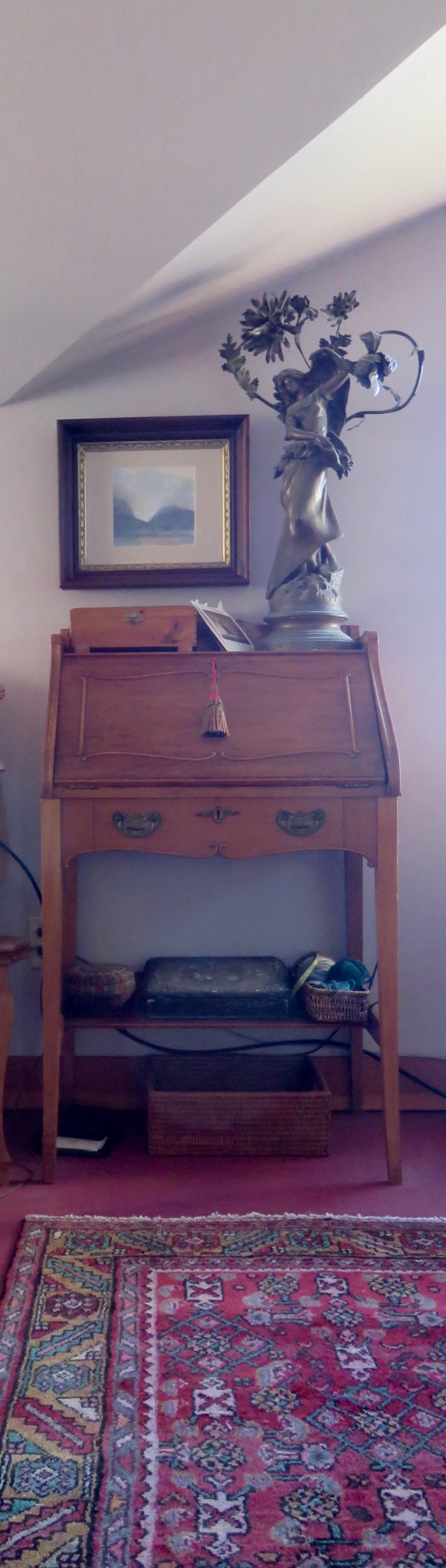
My grandmother’s desk.
My step grandmother gave a mandolin to Gary many years ago. He had the instrument cleaned and repaired but then nearly sold it after she died because somehow an essential family connection had slipped by him unnoticed. When I explained it had belonged to Genevieve’s father, he took it out again and held it. “Then it stays.” He also has a guitar made the year I was born. I like to think that is one reason he treasures it, but it’s the tone. I know it’s the pure, lovely tone that earns it a place in our home.
A friend chided me on Facebook: “NEVER get rid of musical instruments.”
The note was in response to my post of Gary with his Guy Fawkes bonfire and my words: “Gary is on the phone lamenting every single splendid guitar he ever let get away (not to mention the awful ones he laughs over), in his entire life. It is a painful litany and one I have listened to too many times.” The bonfire was of attic refuse from ten and twenty years. I told him about never getting rid of instruments. Gary says, “I get that.” Books, too, I was told should never be allowed to go.
There is a part of me that completely agrees. Books and music and art are essential and precious. Ridding oneself of such things suggests we do not want them, and that is almost never the case. We want it all.
We never want to “get rid of” musical instruments or books.
Sometimes we choose to let go.
Over recent years, I have given away or sold hundreds, perhaps even a thousand books. I just counted twenty-eight bookcases in our home, some as wide as six feet, others just two. Some are six feet high, some just three. There are thousands of books in our house. None are kept in the attic anymore, and only a few dozen are stacked on the floor behind the couch upstairs. I am not allowed to discuss Gary’s instruments in details, but he has “several.” I have books I walked down to the bookshop in Aurora Village to buy when I was twelve, and books I finished reading last month. We have no free local library, so most of the books I read were purchased used, often from Powell’s Book Store in Portland. I no longer keep books if I do not love them.
My husband and I, as I have explained in earlier posts, are engaged in Swedish Death Cleansing, a pragmatic approach to discarding and giving possessions we do not need.
I sort through my clothing. I love clothes, always have, and I know I have too many hanging in my closet, not to mention the tub of genuinely vintage things I have held onto since high school and college. I give things away to charity. I cannot keep it all.
Recently, I went through my jewelry box. I pulled out family pieces for my daughters-in-law. I set aside pieces for my granddaughters. And I gave a box of jewelry to my son to sell on Ebay. We offered many things to family first. People, in case you have not noticed, no one wants the family furniture or china or sterling either. You jewelry is costume or old fashioned or both and no one wants it. If he or anyone liked something, I said to keep it. The money will pay for a new roof next year, or at least a tiny corner of a roof.
Sometimes possessions accomplish more negative than merely taking up space. I gave away my enameling kiln, sold boxes of yarn for a fraction of what they cost me. I was not using them, and their existence in our home felt like a reproach, a lack of industry. And honestly, industrious is pretty much my middle name. I let things go to relieve guilt for not having made more of them.
And sometimes we have had no choice but to sell.
Decades ago, Gary sold his amp because his dad was out of work and could not afford to pay bills. In college we sold our entire collection of Maxfield Parrish prints. We did not mean to “get rid” of them, we needed money to buy bread and pay tuition.
Sometimes by choice, but always the result of some sort of need.
These days, stacks of books everywhere in our house meant I could not find the one I wanted amidst the dozens or hundreds I would never open again. I still have thousands of books on shelves.
Guitars and books have left us because we were not using or reading them. Sometimes Gary traded up for a better guitar. He could not afford to keep every one he ever owned, and we would not have had space to store them. And there is no one to love them when we are gone. If we are not enjoying them, they simply take up space.
Not everyone is experiencing this, I understand that. We could have left our attic stuffed, and I could expand my clothing to fill every closet in the house. But we have sorted attics for others who passed and did not want to leave that task for our family. Our family does not have room for even the stuff we love best, much less the stuff we are indifferent to.
There is an entire social network, an industry of sorts, devoted to reminding us again and again that we are not our possessions, that this gathering of objects is an inadequate substitute for gathering of the self, for questioning and self-awareness. Humility.
My husband and I took stock after dealing with the deaths and possessions of relatives. Our lives were cluttered and if the clutter was not useful to us nor interesting to our family and friends, I still believe it is for the best to let it go to someone who cares.
We do not rid ourselves, we let go.
I saw a meme on Facebook the other day. The wording was something like: “I decided I needed to lose 10 pounds last year, and after six months I am doing great—12 pounds to go!”
That is the irony when our best intentions go backwards. I have some personal experience with that. I have been watching my eating, drinking, and walking for the past 7 weeks and have lost the 8 pounds I gained since last December after deciding I needed to lose 14 pounds. I sleep better and my feet feel better when I weigh less.
During that same time, I taught two college writing classes, read 38 books, completed weaving three 82″ lengths and seamed them into a 75″ x 82″ blanket + fringe, planned a quilt, submitted stories and poems and essays, several published pieces and a story due out next month plus an essay out in September. (I will inflict links to these publications upon you once they are live.)
We walk the beach most days for at least two hours. I have picked up a few hundred pounds of trash since January, and 98 bits of sea glass so far just in July. People ask Gary and I all the time what we are finding. “Do you find agates?” they invariably want to know. We always find agates. We don’t even gather most of the agates we find, not even a quarter of the agates we find. What we carry away is mostly plastic trash. You knew that.
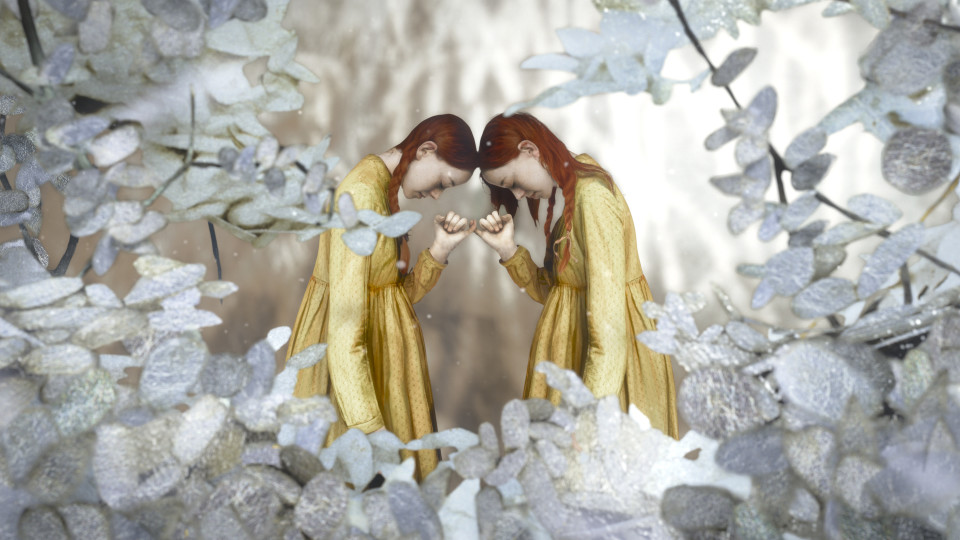
I watched the second season of the Netflix series, Anne with an E, which I loved from the first episode and this second season more than ever with challenging issues of sexual orientation and race. The novels are pretty “safe”, but the series takes chances and flashes back to the early years not only in Anne’s life but in Marilla’s and Matthew’s lives. The characters are thus more well rounded and meaningful, more real and less white-washed cardboard characters. The Irish actor playing Anne really is not “pretty” by the standards of those days, but bursting with energy and imagination as she should be. Green Gables is depicted here in the same way that Wicked seems to portray a genuine Oz. All the magic, but a grown-up and serious version—charm without flinching.
My own flinching is mostly about too much stuff.
My goals for the year, my husband’s and my goals for the year, include gutting the house. Going leaner, you might say. We are emptying out closets and shelves, the dozens of pretty pictures that have no walls to hang upon. Gary took everything out of the attic which still had things from my mother’s house, unexamined items from her sister’s home, boxes of ceramics I made in college decades ago now. Nothing goes back in the attic. I am about to empty four bookcases of nonfiction and poetry. A lot of the books and at least one bookcase will go out the door. We are preparing for a garage sale and major gifts to Good Will in the near future. I keep going through books and moving stacks out of the house.
Despite all that, I ordered a book the other day. I ordered three towels on sale and I ordered two skeins of yarn, even though I have SO MUCH YARN! Too much. Too many books. Too many Christmas ornaments. Too many family pictures in frames. Too much stuff. The greatest appeal about moving into a smaller house—something we fantasize about from time to time—is the need to divest.
More important than divesting is the imperative to stop accumulating. It is possible to stop. I believe it is possible, but I have to skill in that direction.
The Green Gables house in the new series is sparse and clear. The table is set for dinner in a dining room that has no other purpose but dining. The meal is eaten, the table cleared, the ceiling is the primary decoration. Beautiful unpainted boards.
No cell phones, no music but what people made for themselves. I am not so foolish and as wish myself back in that era. Dentistry. Vaccinations. Voting rights. I know what I would lose.
But Anne’s daily walk through the woods. Writing with pen and paper. A fox in the forest. People who make immediate use of nearly everything, or they do not keep it at all. Anne has little, but holds so very much. She is creative and imaginative and loving and kind. Her ambition is generous and heartfelt. She asks for little, but the best of everything. Her best is not about gilded rooms or extravagant praise. She might enjoy those things, but there is something precious and few about her longings. More does not mean better, as I was warned in childhood.
May I at least have more of Anne? And maybe a few pounds less of me.
 IMPERFECT PATIENCE