SHE WAS THERE

merlin_134075493_127ddf2c-eada-4871-a472-57bc6f168d0e-superJumbo.jpg

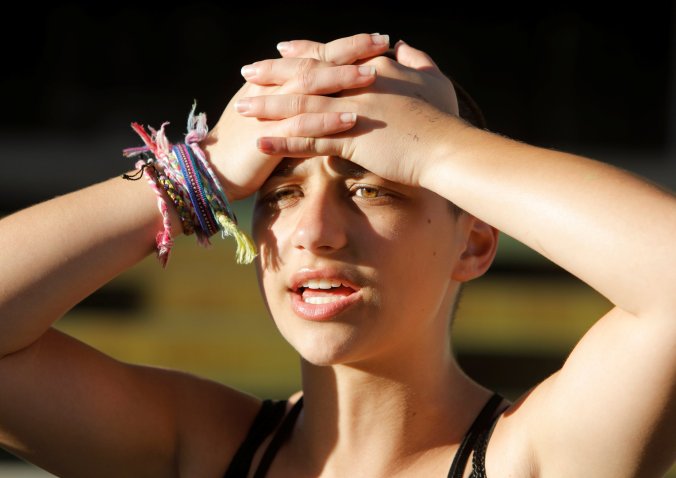
Florida student Emma Gonzalez to lawmakers and gun advocates: ‘We call BS’

SaveSave

HEROIC MACHO MAGIC

If 17 children hadn’t been shot and killed three days ago, I might not have disliked Black Panther so much that I had to stand and walk to the back of the theater. Explosions, chase scenes, and brutal battles with black men killing other black men with the underlying thesis of absolute honor and inherited rule.  It is based on a comic book, after all. There is no reality here, but black and white. Simple good and evil. Here the black people are mostly good. Mostly. I tried to reason with myself throughout the showing. It’s a comic book. It’s not meant to be realistic.

It is also reflects the real life fantasy of those men who insist on open carry and who stash too much ammo for dozens of weapons in fear of “tyrannical government.” They never outgrew the simplistic ordering of a world into bad guys and good guys. They want to be the main character. They see themselves as the hero in a struggle between good and evil. They live in a comic book world. They believe their violence solves all.

The Tomatometer certified the film fresh. Gary was suspicious, but neither of us could not find a bad review. It was playing 20 minutes away, which is our local theater. It was supposed to be a great film. We were hopeful.

The film has a lot going for it: strong gorgeous men and women with intelligence and honor. And while most reviewers avoid saying so, it is refreshing to see so many black performers in one film. The acting was fine. I am always grateful to see Forest Whitaker, though he wasn’t given much to work with here, and his purple costumes were embarrassing. Angela Bassett’s white gown and headdress* in her first scene were questionable. She deserves better. Dana Gurira, Lupita Amondi Wyong’o, and Letitia Wright were wonderful. Except, most of the time, the movie was not about them or any of the performers. It was mostly about blowing things up, killing, noise, and death. (There are only two white characters with speaking roles—one good, one bad. Martin Freeman’s voice with an American accent is so odd, I wondered if his lines had been dubbed.) The ultimate story is well-intentioned, but there are too few funny lines. By the time the cute rhino showed up, I had lost my sense of humor.

Superheroes. This is a wildly popular film, but . . . two observations.

The first will likely seem petty, but it’s serious to me because I have a lifelong love of architecture. The interiors are pretty standard comic book dark swooping expanses of plastic and pseudo-technology. But the city in Wakanda is a westernized hodgepodge. No architects, anthropologists, or anyone with even minimal understanding of traditional architecture anywhere, much less sub-Saharan Africa, were consulted. Someone did a google search. Maybe. Supposedly the production team wanted to honor the rich diversity of the continent, but they also included images from the comic. The home city, isolated and culturally rich for generations, is a hodgepodge: a Disney fun ride here, a UAE fantasy hotel there, ugly buildings lifted willy-nilly from downtown developers all over the world, as if no one considered there might be a regional unifying aesthetic. There is an “outdoor” set, a hundred feet of marketplace selling baskets I can find at Whole Foods. The two dominant towers owe something to structures such as those below. Perhaps that google search found a picture of Mali. Alas, the designers did not bother to explore the engineering of these buildings or to understand how such a city might grow organically. They threw in everything as if the way a western modern city is developed were realistic for a traditional culture. A “love letter to Africa”? No, a mess.

EPA_Djenne1_ml_160714_16x9_992.jpgOn the other hand, the hair and shaved heads were stunning. A shawl knitted from Noro yarn worn in one scene was also beautiful.


It’s probably fair to mention that the original comic was written by two white men, Stan Lee and illustrator Jack Kirby in 1966. Some of the more childish visuals and plot devices can probably be traced back to them. They seem to have done most of their research, pre-Google, by looking at racist cartoons. A Ubangi labrette and a green suit and tie.

178084-004-A7B85647.jpg

But that’s not what most upset me. It was kingship and royalty, and the non-stop violence where good always triumphs that rubbed me the wrong way. This too is from the original comic book. News flash: Most sub-Saharan African cultures did not have inherited kings, and winning the fight doesn’t prove anyone is the better man. There is no magic in inheritance that delivers to the best man the right to rule or guarantees he will win his throne in a fair fight. Virtue does not result in possessing the bigger gun. We see this again and again, these fairy tale assumptions that ultimately the “just ruler” will be born and that the best man will win. Virtue will triumph because in a fair fight the good guy, born to his position, will prevail. It is a peculiar ethos in the fiction of a nation founded on egalitarian ideals: all human beings are equal under the law and deserve to have their rights to life, liberty, and pursuit of happiness protected without regard to position or power. Puritans aside, we were not founded to believe that might = right. The real world does not work that way.

In the real world, powerful weapons inflicted on other nations are not shot down by a self-sacrificing white man, they are sold for billions of US dollars. In the real world, good guys do not always win the fight, but are shot in the hallway of their school. In the real world, a 16 year old with access to technology does not invent magical cure, but hacks into world banks. In the real world inheriting privilege rarely results in sharing with the needy, but in bullying and profit held close.

But this is America and we like our violence and our fairy tales writ large and loud. Nudity offends us, but apparently a scene where relatives attack one another with machetes is okay. All will magically be forgiven when the ruler lays down his weapon?

My husband laughed at a lot of things that were not meant to be funny. I was bored sometimes waiting for the action to end the the story to recommence. But then, I am not the intended audience eager for bashing and kabooms. I do not read comic books. I had to remind myself that was what I was watching. I was bothered by the visuals. Gary was bothered by the music. Both of us were horrified by the violence. It was a disappointing film for us.

Gary commented that it might have been better had Wesley Snipes made it in the early 1990s, or someone had made it at a time when CGI and pyrotechnics were less available. There might then have been more character development. More story. Maybe.

It’s a comic book. I am grateful to see so many fine actors in one film. I am sorry it was this one.

______________________________________________

*Nearly everywhere in the world, and throughout history, white is a color of grief and mourning. Is she wearing white in mourning? I might have appreciated that, though no one else wears white, and the shapes of headdress and dress are princess-film standard, what the Good Witch wore in The Wizard of Oz.

In the West, the bride and groom wearing white at weddings is originally a Jewish custom probably dating back at least 700 years. The colorless, undyed fabric may be symbolic that the bride and groom are the treasure, and earthly garments are nothing. The practice was never widespread, but then Queen Victoria wore white at her wedding. Perhaps she hoped it would make her small body stand out, which it did. Unlike every other bride at that period, she need wear her wedding gown only once and could put it away. White shows the dirt, as mothers used to say, and cleaning all those yard of silk would have been a challenge. Most brides in the nineteenth century wore colored cotton and continued to wear their wedding dress for special occasions until it was unwearable. In isolated regions of the American west, she might wear it to church each week for a year to insure that every member of the widespread congregation could see it. [I can’t help this. I know this stuff and it just wants to be let out.]

SaveSave

SaveSave

PREDICTABLE

As a teacher in public and private schools for over 40 years, I have never been injured by a student, but among other incidents, students have

yelled and sworn at me

thrown a chair at the wall

thrown a heavy metal padlock at me (it missed)

drawn a penis on a classroom poster

written about how they threatened suicide in order to get what they wanted (a gun) and how successful that threat was with terrified parents

wanting to “kill an animal in every country in the world”

emailed about holding a knife against their own throat

claimed to possess a concealed weapon permit (and to be “carrying”)

This all from white, male teenagers. Girls have been angry at me on occasion too, but never threatened me or anyone else. Such lashing out is not unusual. It has always been hard to be a teenager. And as a teacher, telling them what to do, I look like the bad guy. Sometimes I am the bad guy, though I try to be fair. It is predictable that I am blamed for more than I could possibly be at fault for. It is the job, the position of authority. Almost always this lashing out came from students who had, one way or another, been subject to brutality: abusive parents, dictatorial households, overwhelming loss and fear. I worked with Child Protective Services and my administration when the threats were to safety (suicide or abuse or a danger to another person) but I never turned over someone for a threat against myself. Frankly, it did not occur to me.

They were troubled, angry, lonely, depressed, resentful, disappointed. They were looking for an answer. They were looking for someone to blame. A way out. They were not mentally ill. Neither are most shooters. Their actions are not predictable, but an AR15 is. It has no use but murder.

I will say it again: We have an obscene faith in the United States in the power of violence to solve our problems.

We are wrong.

THE NEW YEAR

IMG_2821

Sea glass found during February 2018 walks . . . so far.

Every morning, my husband and I walk the shore. We usually head north toward Asbury Creek, or what even-now-I-am-not-certain might be Shark Creek. I have a map from decades ago and those creeks flow in other places.

So we walk north. We almost never go out in rain, but we can see the rain shadow coming. Some days we when know we will get wet, we walk anyway.

We recognize people on our walks, Tammy, “two-dog-man”, Larry, “the owners” (Gary’s name for the people who think this is their world and we merely live in it). There is the man who fishes the surf. Two friends from the north end we only meet when we cross that creek. Other people we know slightly or whose dogs we know.

Mostly, it is in the summer that we talk to visiting walkers. We wait for the tide to reveal sand or a shower to pass by, and then out we go. We pick things up and strangers ask us what we are picking up. If that is the question—What are you finding?—the answer is easy. We gather trash. Plastic bottle caps, spent fireworks, candy wrappers, shovels, abandoned beach toys, bits of nylon cord and plastic rope in blue and green and yellow and red, some thin and others thick as a baby’s wrist. We find toothbrushes and insulating foam, plastic cups, cigarette butts, and broken white spoons. Golf balls and grocery bags, crushed clear bottles and broken take-out containers. We find other people’s trash and we gather it. Too often these days we find a film of diesel on the sand, seasonally we find purple sailors or plankton.

If they ask us: What are you looking for? The answer might be different. We find limpets and scallop shells, pumice from Mount St. Helens’s explosion in 1980 still floating, smooth flat agates and quartz crystals in milky clear and gold and orange, and—best of all—what we are looking for: bits of glass from cobalt to pale green and clear. We find beauty.

After Yeti died last summer, we visit the Oregon Country Fair and drive the coast and make quilts and weave and garden and paint our bedroom ceiling to floor and then the rest of the upstairs floor, we write and listen to music and make our own, and we sort file cabinets and books and thin our possessions since nobody wants any of it. We have over twenty people visit in August, and that is a little crazy but important too. Jan does NaNo again. Gary is loving Estonian choirs, Jan cannot seem to stop teaching, and Gary takes care of the house.

We find life.


SaveSave

WHAT VIOLENCE SOLVES

One of my students recently wrote a research paper arguing that corporal punishment should be banned in our country. I was familiar with his compelling arguments. Other students have made the same argument and backed it up with overwhelming evidence that corporal punishment is ineffective in changing behavior, can cause lifelong emotional damage, and inevitably sends the wrong message: I [parent] am bigger and older, and therefore I have a right and obligation to beat you for failing to behave the way I want you to: Spare the rod and spoil the child. It is from Proverbs, but might better be accepted as a metaphor for discipline rather than a literal injunction to beat children with a stick as proof of love. Research does not support the practice.

Over the years, this issue of physical punishment of children has come up again and again in my classes. We talked about it when we read The Adventures of Huckleberry Finn and when we read Their Eyes Were Watching God. Students who have been hit or spanked almost invariably defend the practice as necessary to instilling respect, morality, and proper behavior in a child. Almost invariably, these are students who struggle with those behaviors. Their defense of corporal punishment also ignores classmates who are models of respectful, moral, and consistently appropriate behavior—students who were never spanked at all, but received consistent and gentle guidance.

Each side of this debate is surprised to hear from the other. Some have faith in violence as necessary to righteousness; others recognize violence as a questionable last-resort response.

Increasingly, the United States is isolated from other first world nations which do not allow corporal punishment of children or prisoners and which have outlawed the death penalty. We kill and hit because we believe it this is the only right, fair, and effective thing to do. We believe it is necessary.

We are wrong.

We are the only nation in the world that routinely sees school children shot dead in public schools. A recent study reveals that since the infamous shootings at Columbine in 1999, 270 American schools have suffered shootings. Thousands of children were witness to that violence. Imagine children growing up and perhaps growing old with the images of dead and dying classmates, blood on the floor of their classrooms, and politicians who claim their hearts bleed but do nothing to stop it.

It does not happen elsewhere in the world. Australia had a mass shooting, changed their laws, and has not suffered another. Australians are not better people than Americans—no, I do not accept that. Canadians own guns too. The Swiss require military training of all male citizens. Many countries lionize violent sport. (Watch a rugby match and come back to argue that football is more violent.)

Our video games are violent, but that is a reflection of our national love of violence, our belief that violence is the ultimate adjudicator of righteousness.

I have come to understand that it is not guns, but our determination that they are necessary. It is a paradox: True, guns do not kill people, people do, but our sick need for guns makes us the sort of people who use guns to kill. It is not that we are inherently violent people that is killing, but our conviction that violence is effective.

Americans believe that violence solves everything: crime, childhood foolishness, boredom, loneliness, illness, heartache.

Americans are not bad people. Our laws, however, seem to insist that the proper response to a man with a knife is another man with a gun, that the response to a man with a gun is more men with guns. We are afraid and our fear makes us dangerous. (A  student once told me that being armed was the only way he felt safe. With youth and nearing a foot over me, I still confessed to him that he being armed did not make me feel safe. He was deeply offended.) We have many guns in our country, mostly in the hands of a fraction of our population—and it is a fraction of that fraction who are so fearful walking about in broad daylight that they must always be armed, have a stockpile of military-style weapons hidden at home, and enough ammo to execute an entire neighborhood.

It is a critical misunderstanding to conflate hunters who walk into a forest, get their deer, and walk it back out, skin and dress and stash it in their freezer, with those men who must own an AR-15 in order to feel themselves as safe and whole men.

That frantic need for gun ownership, too often, is cowardice. A couple of years ago, two men stalked back and forth across the street from a Portland elementary school with open carry, causing the entire school to go into lockdown. These men were not supporting the need for a “well regulated militia” but revealing their own fear, disguised as pointless bravado. They were so frightened themselves, they wanted the rest of us to feel fear too. The Second Amendment does not guarantee me access to every sort of weapon, and our founders could not have envisioned how military hardware would have evolved. We do not have well-regulated militias any more. We have the most powerful military in the world.

I have often been frightened alone in the dark. I have never been armed. I have never been so frightened that I wished I could shoot someone. I have never wanted that on my conscience.

What do the school killers have in common? (Research is actually forbidden.) They are mostly frightened, unhappy, but perfectly sane white boys with access to weapons that no responsible person should keep in their home. They also believe they can solve their personal grudges and frustrations with a gun. Because violence can solve anything.

They are wrong.

GRAVITY

GRAVITY

 for Gary on Valentine’s Day

I do not thank gravity, or the world

spinning nearly 900 miles per hour.

No thanks to the sun rising behind

my house, Apollo’s daily chariot race.


Spinning nearly 900 miles per hour,

the Earth whirls—this is how you

make my home. Apollo’s chariot racing

across my sky the way dreams


visit Earth whirling. The way you

make us possible over and over,

planed across the sky. The way dreams

make everything possible, kisses


make possibilities again and again.

No end to our promise to one another.

Make everything possible, blessed

and plausible. Purple and gold sky


begins our promise to one another.

The sun sliding into the sea entire

and plausible. Polish, gilded light

only our beginning, our promise.


The sun slides into the sea entire.

How we began, how the bodies join,

only our beginning. A last promise

to gratitude, spun even in gravity.

SCARLET!

LLD5345_comp.jpg

SCARLET by Michelle Horgen

February 28 – March 25, 2018, Portland Playhouse

Condemned by her community, Hester fights to build a life for her and her daughter in Puritan Boston, Massachusetts. Funny, sweet, and heroic; this new musical based on Nathaniel Hawthorne’s The Scarlet Letter stars Rebecca Teran, Isaac Lamb, Susannah Mars, Darius Pierce, Dana Green, and many other Portland favorites!

  • Website: portlandplayhouse.org
  • Phone: (503) 488-5822
  • Address: 602 NE Prescott St, Portland, OR 97211

I feel safe recommending this play with great enthusiasm, knowing the source and having seen and heard excerpts. I already have my tickets!

UNFORTUNATE ACTIONS

for Camille, a Gary story

I have done a lot of stupid things in my life. I will tell on myself that I once kicked a car on a public street. It is only fair to myself to explain that I was crossing the street at the time, a block north of the Blue Moon Tavern in Seattle. The car drove in front of me. This would have been about 1974 and I was young. The car did not hit me or swerve toward me, but I hauled off and kicked it as it drove past. The driver stopped and yelled at me for it. Fair enough. I was not in a crosswalk, he said. But I was crossing at a corner, and pedestrians have the right of way.

Gary does not believe in kicking cars. He speaks respectfully to crows and ravens, doves and pigeons. As a childhood pigeon fancier, he is not overfond of raptors. If he had a choice, he would choose the robin over the hawk every time. However, he has been known to bark at dogs that make him uncomfortable. This is unsettling to dogs who recognize a challenge when they hear one. Sometimes the does not go as well as it might have, if Gary had kept his canine comments to himself. Still, he does not bite.

A year or two ago, we were driving home from our Post Office box in Cannon Beach. We entered highway 101 at Sunset, heading south. It is a scary entrance because visibility is poor and the merge lane is uphill and very short. My mother was in her mid-70s when she confessed she never looked before merging at that entrance. “They can just wait for me,” she said and giggled. That was when I realized I did not want my children in the car with her anymore. (They later confessed that her driving was sometimes frightening.)

Anyway, this one day Gary saw a car coming south on 101 and had to come to a complete stop to allow it to pass. The out of state driver in the car behind us was in a tizzy. He honked and drove up close behind. When we came to a full stop, he lost all patience. He pulled his car out onto the highway, swung around, managed to miss the car on the highway, but passed us. Then he stopped his car in the merging section of the highway right in front of us. Gary had the presence of mind to immediately put the car into reverse. He had backed up about thirty feet when the other driver got out of his car. He was driving a Quantum 45, Q45. I asked Gary just now because I don’t know cars well enough to remember.

So he stood on the pavement, his face twisted in anger.

“It’s a freeway, asshole!” the man shouted. There was a moment we were afraid he might charge at us or shoot us, but then he got back into his car and screeched away.

It was a frightening event. Both Gary and I were rattled and upset. “It’s not a freeway,” I muttered, “it’s a highway, asshole.” Then we were quiet the rest of the way home.

“It was partially my fault,” Gary says now. “I was in his way. If I hadn’t been in his way, none of that would have happened.” You’d have to know Gary to hear his voice.

Since then, the event has come up again and again. The driver of the car stopped behind us honked at us to move, in the Pearl District of Portland. We waited for the pregnant woman to push her baby carriage across the street (in a crosswalk, no less). A tailgater. A not-quite-stop at a Stop sign.

In those moments, one of us is bound to snort with a sort of hysterical glee. “It’s a freeway, asshole!” we shout.

And we laugh like the idiots we are.

SOCIAL MEDIA

Many recommend that writers maintain a presence on social media as a way to promote themselves and their work. Sometimes, too, it is seen as a way of supporting other writers. Facebook, blogging, twitter, Pinterest, Instagram. Do these and other methods of online communication foster genuine social interaction? After active participation for a decade, I am inclined to say: Usually not.

A peer from my MFA program first urged me to begin a blog because I was depressed as a result of life events, and I was not writing. For years after, I routinely posted links to my blog essays on FB. Many people clicked “like”, but by reviewing the stats on my blog, I knew almost no one was actually clicking the link, much less reading my blog. I was active on FB each day, but now less often. I wrote 1000 essays for myself online. Then I stopped, and I returned to the page.

My reviews on Goodreads took some of the weight off my need to correspond. I find that most of the people who have friended me read only YA rather than the more demanding books I choose. In fact, most do not read at all. They listen to audio books. Since I live in an isolated rural community, I hunger for writing peers. I do not find them there.

This new WordPress blog has only one essay, written just the other day. I have not bothered posting a link on FB because I know few will look at it even if I do. Author Allison K. Williams has something to say about good literary citizenship, and it mostly does not involve social media. I am grateful to FB for reconnecting me to people in my past, but I am less certain how, or if, social media supports me or anyone else as a writer.

Periodically, I suppose, I must reconsider.