If 17 children hadn’t been shot and killed three days ago, I might not have disliked Black Panther so much that I had to stand and walk to the back of the theater. Explosions, chase scenes, and brutal battles with black men killing other black men with the underlying thesis of absolute honor and inherited rule. It is based on a comic book, after all. There is no reality here, but black and white. Simple good and evil. Here the black people are mostly good. Mostly. I tried to reason with myself throughout the showing. It’s a comic book. It’s not meant to be realistic.
It is also reflects the real life fantasy of those men who insist on open carry and who stash too much ammo for dozens of weapons in fear of “tyrannical government.” They never outgrew the simplistic ordering of a world into bad guys and good guys. They want to be the main character. They see themselves as the hero in a struggle between good and evil. They live in a comic book world. They believe their violence solves all.
The Tomatometer certified the film fresh. Gary was suspicious, but neither of us could not find a bad review. It was playing 20 minutes away, which is our local theater. It was supposed to be a great film. We were hopeful.
The film has a lot going for it: strong gorgeous men and women with intelligence and honor. And while most reviewers avoid saying so, it is refreshing to see so many black performers in one film. The acting was fine. I am always grateful to see Forest Whitaker, though he wasn’t given much to work with here, and his purple costumes were embarrassing. Angela Bassett’s white gown and headdress* in her first scene were questionable. She deserves better. Dana Gurira, Lupita Amondi Wyong’o, and Letitia Wright were wonderful. Except, most of the time, the movie was not about them or any of the performers. It was mostly about blowing things up, killing, noise, and death. (There are only two white characters with speaking roles—one good, one bad. Martin Freeman’s voice with an American accent is so odd, I wondered if his lines had been dubbed.) The ultimate story is well-intentioned, but there are too few funny lines. By the time the cute rhino showed up, I had lost my sense of humor.
Superheroes. This is a wildly popular film, but . . . two observations.
The first will likely seem petty, but it’s serious to me because I have a lifelong love of architecture. The interiors are pretty standard comic book dark swooping expanses of plastic and pseudo-technology. But the city in Wakanda is a westernized hodgepodge. No architects, anthropologists, or anyone with even minimal understanding of traditional architecture anywhere, much less sub-Saharan Africa, were consulted. Someone did a google search. Maybe. Supposedly the production team wanted to honor the rich diversity of the continent, but they also included images from the comic. The home city, isolated and culturally rich for generations, is a hodgepodge: a Disney fun ride here, a UAE fantasy hotel there, ugly buildings lifted willy-nilly from downtown developers all over the world, as if no one considered there might be a regional unifying aesthetic. There is an “outdoor” set, a hundred feet of marketplace selling baskets I can find at Whole Foods. The two dominant towers owe something to structures such as those below. Perhaps that google search found a picture of Mali. Alas, the designers did not bother to explore the engineering of these buildings or to understand how such a city might grow organically. They threw in everything as if the way a western modern city is developed were realistic for a traditional culture. A “love letter to Africa”? No, a mess.
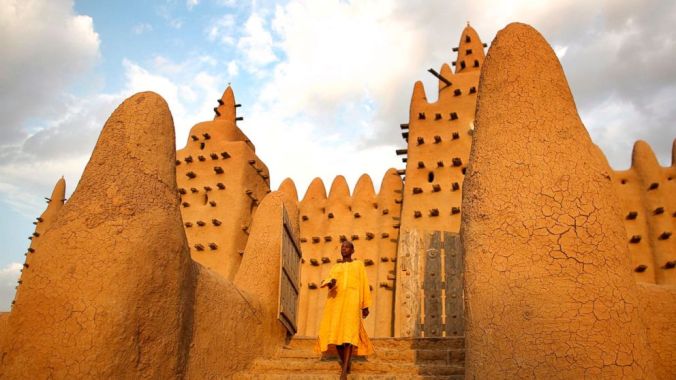 On the other hand, the hair and shaved heads were stunning. A shawl knitted from Noro yarn worn in one scene was also beautiful.
It’s probably fair to mention that the original comic was written by two white men, Stan Lee and illustrator Jack Kirby in 1966. Some of the more childish visuals and plot devices can probably be traced back to them. They seem to have done most of their research, pre-Google, by looking at racist cartoons. A Ubangi labrette and a green suit and tie.
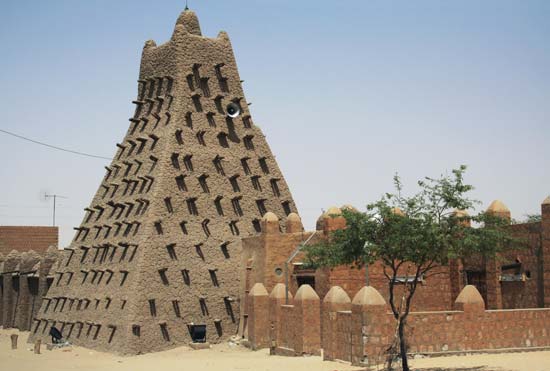
But that’s not what most upset me. It was kingship and royalty, and the non-stop violence where good always triumphs that rubbed me the wrong way. This too is from the original comic book. News flash: Most sub-Saharan African cultures did not have inherited kings, and winning the fight doesn’t prove anyone is the better man. There is no magic in inheritance that delivers to the best man the right to rule or guarantees he will win his throne in a fair fight. Virtue does not result in possessing the bigger gun. We see this again and again, these fairy tale assumptions that ultimately the “just ruler” will be born and that the best man will win. Virtue will triumph because in a fair fight the good guy, born to his position, will prevail. It is a peculiar ethos in the fiction of a nation founded on egalitarian ideals: all human beings are equal under the law and deserve to have their rights to life, liberty, and pursuit of happiness protected without regard to position or power. Puritans aside, we were not founded to believe that might = right. The real world does not work that way.
In the real world, powerful weapons inflicted on other nations are not shot down by a self-sacrificing white man, they are sold for billions of US dollars. In the real world, good guys do not always win the fight, but are shot in the hallway of their school. In the real world, a 16 year old with access to technology does not invent magical cure, but hacks into world banks. In the real world inheriting privilege rarely results in sharing with the needy, but in bullying and profit held close.
But this is America and we like our violence and our fairy tales writ large and loud. Nudity offends us, but apparently a scene where relatives attack one another with machetes is okay. All will magically be forgiven when the ruler lays down his weapon?
My husband laughed at a lot of things that were not meant to be funny. I was bored sometimes waiting for the action to end the the story to recommence. But then, I am not the intended audience eager for bashing and kabooms. I do not read comic books. I had to remind myself that was what I was watching. I was bothered by the visuals. Gary was bothered by the music. Both of us were horrified by the violence. It was a disappointing film for us.
Gary commented that it might have been better had Wesley Snipes made it in the early 1990s, or someone had made it at a time when CGI and pyrotechnics were less available. There might then have been more character development. More story. Maybe.
It’s a comic book. I am grateful to see so many fine actors in one film. I am sorry it was this one.
______________________________________________
*Nearly everywhere in the world, and throughout history, white is a color of grief and mourning. Is she wearing white in mourning? I might have appreciated that, though no one else wears white, and the shapes of headdress and dress are princess-film standard, what the Good Witch wore in The Wizard of Oz.
In the West, the bride and groom wearing white at weddings is originally a Jewish custom probably dating back at least 700 years. The colorless, undyed fabric may be symbolic that the bride and groom are the treasure, and earthly garments are nothing. The practice was never widespread, but then Queen Victoria wore white at her wedding. Perhaps she hoped it would make her small body stand out, which it did. Unlike every other bride at that period, she need wear her wedding gown only once and could put it away. White shows the dirt, as mothers used to say, and cleaning all those yard of silk would have been a challenge. Most brides in the nineteenth century wore colored cotton and continued to wear their wedding dress for special occasions until it was unwearable. In isolated regions of the American west, she might wear it to church each week for a year to insure that every member of the widespread congregation could see it. [I can’t help this. I know this stuff and it just wants to be let out.]
 IMPERFECT PATIENCE
I too was a bit disappointed in Black Panther. It had it’s wow moments for me as a African American woman who does not see so many black characters in a comic book movie. It followed the usual plot line for a super hero movie. I loved the costumes especially the knitted cowl scarf Lupita wore during the winter scenes. I agree that the city did look like a hodgepodge.
LikeLiked by 1 person