MISSING THE WINDOW

IMG_3522

I am not the sweep of sand or the sky overhead. I am not the cape thrusting out toward the ocean. No, not even the seastack standing off the cape. I am the tiny bump, barely visible beyond.

The Director of a writing event responded the other day to my application for a Fellowship. I thought I was a good fit when I sent it off. Connection to the West was essential, a writer without major accomplishments, no book out nor a book deal in the making. I have been writing for decades now and still no book. I am not new to writing, and so the Director wonders if “perhaps your depth of experience and accomplishments may make you overqualified for the … program.” He is kind, he offered options, he urges me to make my case. The response is well-intentioned—actually generous. This begs the troubling question: So why don’t I have a book already?

I ask myself that question too often already. 

Have I missed the window for growth, improvement, a book publication? Am I under-skilled? Overqualified? Most always I am overqualified, to be fair to myself. I taught in a public high school while trailing an academic history of multiple degrees from the University of Washington, cum laude and Phi Beta Kappa, and an MFA in writing from Pacific University.

Writing is hard. I have worked many relatively “easy” jobs that were not easy at all in retail, fast food, a bakery, and direct mail. I sold tacos and quilting fabric and fancy pastries I made myself. I designed logos and promotional materials and packaging as a freelance graphic designer. My work was exhibited in galleries and juried into museum shows. I designed and drew plans for entire houses, and for a time I worked for an architect. For 3 years I taught art in a girls prep school, and for 25 years I taught English and Illustration and yearbook in a small rural high school. I was overqualified for most of those jobs, perhaps all of them. And none of this was easy; none helps just now. 

Being overqualified has mostly meant that I was determined and inventive in doing the job. Or perhaps that is just my way of approaching work, meaning always doing the best I can.

And here, again, the fear that my best will never be enough. I set that aside, that little confidence-killer. Where I am is the result of doing what so many writers must do for years and years: maintain a life and a family and work that pays the bills, and writing at four o’clock in the morning before I get up out of bed to do those other things that I must do. 

I don’t like thinking I have missed my window. Eight publications and 114 rejections this year, 56 of those rejections from agents. Lack of a book contract is not from lack of trying. 

Next year, I will not reapply for that Fellowship, no, of course I will not. I appreciate the Director’s kindness in contacting me and explaining his position, as well as his willingness to reconsider. But I completely understand his point. Moving on now . . .

Nevertheless.

My writing life does not carry an expiration date. I am certain I will face many rejections again next year, far more rejections than acceptances, but that I am qualified to claim my prize as an experienced writer who usually knows her mind, and who will not stop writing in the face of rejection. I will whine and squiggle and hide under the bed when they arrive, but then I will come back out and write some more. There is still so much I want. I want acceptance. I want readers. I want more stories and essays and words on the page.

I still want that book contract.
ON NOT WRITING

IMG_3497

The process is frightening, this writing process. Unlike the performance, the meal, the quilt (I am knitting just now) there is no clear completion. We can only rarely say with any lasting conviction that we are finished writing.

We merely choose to stop at some point.

We live with our writing for such a long time (even if that time is only a pair of years) and there is no precise point where we can stand back and say with confidence: It is done. The work itself makes these demands upon us. It makes us doubt in return for only slivers of certainty. Those slivers, however, those instants when we feel with certainty, however rare, are slender payment for time and purpose. Our book is worth that. At the least, I would like to believe the work is worth this. In any event, I am driven to it and even when I am not writing, I dwell upon that writing process.

I have been down these past few months, not making much headway though determinedly planning to write a novel next month. This next week will be “next month” and I am unsure.

Of course I can write a novel in a month. I can rack up 75k words in four weeks. I have done it more than once. But there is that terrible doubting voice shrieking at me: What is the point? It hammers and whispers and questions and whines, yes but? until I think of setting everything aside.

I have been told often enough that I seem certain, that I appear absolutely confident and sure of my course. Yet, as I was told during a wonderful class on world religions, years ago, faith is a willingness to live with doubt. Why should anyone be surprised to learn than the future does not feel so certain from my side?

When my husband and I decided to have children (we wanted two), it took me a year to become pregnant. There was no reason I should not have conceived immediately. I had taken the pill but that was years before. I was healthy, in good weight. We certainly tried. After a year, and because I had been reading right along, and because friends had struggled to become pregnant, I knew there might never be the planned baby. We might not have children. I accepted that possibility.

During that infertile year, I considered that my husband and I had been happy together for a long time (ten years by then) and should certainly continue to be happy without children, if it came to that. I knew individuals and couple with good lives and no child. I reasoned with myself that we would be fine.

This was not a matter of planning, but of acceptance of the inevitable. It was a matter of dealing with what I could not control.

And then I was pregnant with Alan. I like to say that Ian took three days.

Writing is not childbearing. But in some ways, I feel the connection between birthing a child and a novel. It is true that childbirth could kill me, but I never feared for that. I was in labor three days with our first child, and that pain is no more vivid that the agony I have experienced writing. Both child and book must eventually be allowed to leave.

That is the struggle I feel just now. Our sons are grown and off on their own. We are grateful for phone calls and visits. They will never be so close as they once were, and that is painful at times, but also as it should be. We raised people capable of managing their own lives, not permanent infants but adults now who come to us as equals.

The novel, however, that I am setting aside . . . that remains an infant, remains dependent and with no external life.

We had dinner the other day with the owner/editor of a small press. She urged me to pursue digital publication and build a platform with followers. She also confided that her own digital sales were down from over a hundred to fewer than a dozen a month. I cannot help but feel her advice might have worked a few years ago.

I do not even own a Kindle. A friend self-published without great success. So I have my doubts.

This morning I read a comment to Allison K. Williams at the Brevity blog post:

This is spot on and infinitely encouraging. But “Two years of generating material, two years of dicking around, four years of fallow time where the manuscript reproaches me from my desktop every time I open the laptop, and two years of getting down to business” had me laughing out loud in appreciation and recognition of my own process.

I had a mentor (painting, not writing, but it applies) who told me, when I was complaining about not painting as much as I thought I should: “you’re still doing the work, even when you’re not working.” After a long dry spell, a friend came back to his work beyond where he’d left it.

There might be something coming next, but I do not yet feel it. I am not writing anything just now, except these lines. Perhaps I am only in a period of rest, The quandary has stopped me cold. As if I had managed birth only to find the baby perfect and perfectly dead.

It is time to allow this novel-child to slip away, and move on.


FLYING ON

IMG_3370

When I prepared my application to the MFA (Masters of Fine Arts in fiction) at Pacific University, I needed a short story, a very brief literary analysis essay, and a personal statement. This was 2004. My mother had been dying for over two years, and my brother had declared me “the most disfunctional person” he knew.

I had recently unshouldered the yearbook and left the high school cross country team, but I was teaching high school English full time, and visiting my mother at least three times a day since her collapse in 2002. My husband, too, carried this burden, stopping on his way to work to get Mom up and make her coffee, at lunch, and again on his way home. I have my annotated calendars from those years. They do not list these and other daily tasks or fun events as they would have during my working-my-way-through-college years. They note my mother’s hospital visits.

There was a four day period that included my high school Open House and three visits to the ER. I never missed school. I trudged on.

It’s true that I felt disfunctional. I was overworked, but I did not have the leisure to alter my obligations. I loved my mother and she was too stubborn to change. I was only halfway through the most stressful and painful and emotionally destructive period of my life, but I was doing the job. All the jobs of teacher, wife, mother, and daughter.

In the midst of this chaos, halfway through what would be the five years of Mom’s dying, I began to carve out a new life for myself. Our older son had completed his first college degree and our younger son, despite taking time out for commercial and regional theater and a leading role in a film, was completing his degree. I was, I see now, adjusting to my life chaos, struggling to regain space for myself as an individual.

My application to an MFA program, then, was essentially a survival strategy. I have absolutely no memory of what I wrote in my personal statement. I wrote my literary analysis about how Edward P. Jones details events without reflection in The Known World. And then, because I had never written a story longer than ten pages, I set out to write a story of close to twenty.

“The Promised Hour” was based on a pair of a true events, one of personal experience in college when I believed a child was being molested and I confronted the man after the Seattle Police said they could do nothing. The other, more recent event, concerned a local doctor, a man I knew whose daughters had gone to my sons’ grade school before moving out of the area. After his wife left him, the doctor deliberately bankrupted his practice and then seized and murdered his children and killed himself.

These deaths were reported in the newspaper and had a devastating impact on my community, on the people who knew the girls, teachers who had cared for them in the classroom, neighbors and school friends. I kept trying to understand how that mother could ever recover.

That was the story I told, the story of a woman carving out existence after devastating loss. I told it badly, I was later told, but well enough that someone thought I might have potential as a writer of fiction.

The story itself went through endless revisions. I mostly stopped keeping track after the first forty or so rewrites. I moved events into and out of chronological order, added and deleted scenes and details. Removed characters and created them. The story has since been submitted to literary journals a few dozen times. Sometimes it is summarily dismissed. A few journals kept it for months past their normal review time. Some wrote back with admiration and perhaps even sincere regret, but always rejection.

Then, in 2016, I turned it into a novel, which allowed me room to explore this woman’s life after death, the years of clawing her way back to life. Only fourteen drafts of the novel, and I am done rewriting. That novel has done no better than the story in submission. Mostly, it does not get past the query letter.

Everybody’s Mother Dies, a literary novel of about 78k words, follows a woman’s odyssey through grief. 

Thena Justice was building a new life near Seattle after the death of her mother and breakup of a terrible marriage when her former husband murders the neighbor-babysitter and their daughter before committing suicide. Lost in grief, Thena first hides in a friend’s converted garage, then in a tiny cottage on the Pacific coast, thrashing her way through apathy, anger, and routine. Instead of returning to Puget Sound, she moves to the city where she was born, takes the bus to a retail job each day, and keeps her head down until a child crying in the night wakens whatever it is that gives existence meaning. 

One agent wrote:

But no, I’m sorry.  . . . I read this query letter, it’s thoughtful and well-written. I don’t, however, have the mental energy to read a novel of this description, the world has become such a violent and angry place, I find myself unwilling to read fiction which deepens that impression. I’m sure there are others who will disagree with me and toward that end, best of luck.”

Though I rewrote the query, too, others do not disagree with her. Even the reader who read the entire work and liked it ultimately said no,

“I would love to take your manuscript on and work with you in placing it, but I’m afraid my current workload simply wouldn’t do it justice. This project requires care and attention – because it is no doubt a beautifully quiet yet impactful story – that I don’t feel I can give. I say this with a heavy heart.” 

Whatever care and attention it requires is beyond me. Though the bulk of my story is about recovery, not the devastating loss that demands it, I cannot help but respect these views. The world has become too angry and violent. And I have written my story badly.

Two agents and seven* small presses have sample pages, and then I will regretfully put this work aside permanently.

Sometimes the only way to survive is just to fly on.

IMG_3390

*I had to go look this up. Not four, seven.


BOOKS I TAUGHT

phony.jpg

A student wrote to me the other day to thank me for assigning Mountains Beyond Mountains when she was  junior in my class. The young woman is in her third year of medical school and credits Tracy Kidder’s true story of Dr. Paul Farmer for inspiring her ambition. It was not the only nonfiction I taught, but it was the only nonfiction book I taught.

I showed films to introduce my students to other lives and other times. I am proud that I taught the novels Their Eyes Were Watching God, The House on Mango Street, Things Fall Apart, and A Yellow Raft in Blue Water.

A self-proclaimed “non-reader” in my regular English class agreed to keep reading Yellow Raft after I’d read the first chapter of part one “Rayona” but could not read “Christine” because she was “too much like my own mom.” So we struck a weekend bargain. He would read seven pages and if he still couldn’t stand to read that part of the book, I would given him a summary and he wouldn’t have to read the rest. He came back to class on Monday and declared he “loved Christine.” She helped him understand his own family and the fictional character remained her favorite in the novel.

Sometimes we find ourselves or people we need to understand in a novel.

I taught both The Catcher in the Rye and The Adventures of Huckleberry Finn for over 20 years. 

I generally shared William Raspberry’s column about Huck Finn, and worked hard to introduce my students to satire. The novel was a consistent failure in my Honors classes. These “good readers” were unwilling to slow down and hear Huck and Jim speak, they were too good at skimming. As a result they found the novel unfunny and boring. However, when my voice could manage it, for several years I read nearly the entire novel aloud to my “regular” students. They got every joke.

Huck is a poor boy with a rotten father, a racist boy who eventually learns to respect and honor his friendship with the young man, the slave Jim. He is on a hero’s journey but he fails because he does not figure out that slavery is wrong. He cannot overcome society’s instruction about what is decent and proper. Even at the end, he believes it is a sin to help a runaway slave. Nevertheless, he is willing to go to hell rather than betray a friend: Jim, who is far craftier and kinder than Huck recognizes. Jim reveals himself as one of the view decent adults in the novel when he risks his life staying with the critically wounded Tom. Some students responded to the moral lesson in the novel and the humor throughout. Many missed it completely.

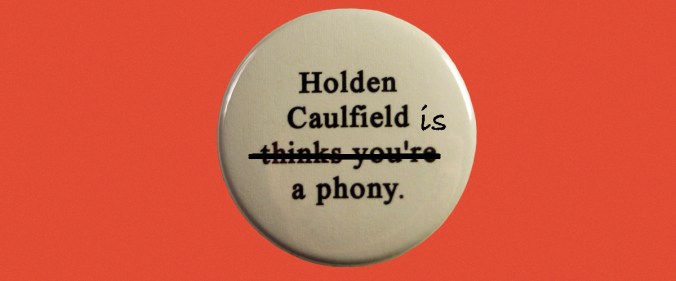
By contrast, for more than twenty years, students loved Holden Caulfield in The Catcher in the Rye.

Holden is a rich white boy attending elite private schools but with neglectful parents. He is grieving and riddled with guilt. He does not overcome these challenges. Parents of my students sometimes balked at the language, but the real problem with this novel, from this parent’s perspective, is that Holden is suicidal throughout and in a mental hospital as he relates his story and he’s been there for months and still lying about where he is and why.

Teaching this novel allowed students to develop understanding of “voice” in literature, and to realistically extrapolate Holden’s future (they were never optimistic). One girl waited after class to speak to me and sobbed that Holden would not like her if they met. Sadly, she was right. Holden’s tolerance for most people is slim.

I used Jane Smiley’s ridiculous take-down of Huck Finn and Calvin Trillion’s questionable 50th anniversary review of Catcher in order to introduce my students to opposing views, to critical thinking, and evidence-based argument. The more they liked the novel, the more passionate was their response to the reviews. To be fair, however, even people who had not initially liked Huck Finn sometimes became fans after recognizing the false equivalency of Smiley’s comparison of Huck Finn to Uncle Tom’s Cabin. As if Jane Austen failed because she did not write novels more like Charles Dickens.

Eventually the tide turned for Holden, and one year a majority of readers found Holden “annoying.” I gratefully replaced him with Jason Taylor in Black Swan Green by David Mitchell. That book also contains language, but deals with bullying and class. Jason is also a relatively affluent white boy, but younger and in many ways nicer than Holden. He is not oblivious to social injustice. He is not so obsessed with his own suffering that he is largely incapable of noticing others’. 

We read all of The House on Mango Street aloud in class, each student choosing a story to read and I read the rest. It is brilliant and a superior trigger for personal stories. We talked about fiction and creative nonfiction and prose poetry. It’s all there.

I taught Toni Morrison’s first novel The Bluest Eye for 25 years. I warned students about content. I advised them to skip pages or call me if they had trouble. I had an alternative and more euphemistic novel in the wings. But Toni Morrison is our only living Nobel novelist, and she is among the best writers to ever exist. There are no substitutes. She writes about love, including the love of little black girls, the most neglected of all. She teaches paradox of pain and beauty, of survival when someone loves us and tragedy when we are unloved.

Isn’t that what all novels are about?

MY WRITING LIFE

IMG_2766

I began writing fiction in 1990 when I was hired to teach English at Seaside High School. I believed myself wholly unqualified to teach English (and others have agreed), but I had taught art in an elite prep school for three years, picked up a Social Studies endorsement through exam, and substituted in the Seaside District for eleven years. I had 20 undergraduate English credits. I had never considered teaching English. Nevertheless, the Chair of the English Department at that time knew me well as a substitute teacher and argued that I was better read than she was and urged me to apply.

My hiring was contingent upon gaining a certification in English. I took another test and began taking graduate classes that summer. In the fall, I was teaching English. Among my advantages were an excellent public school education and substantial experience as an essayist.

My first novel was written over the summer of 1995, working with a student who also wrote a (better) novel. Both were read my the editor of a major publishing house. My student’s manuscript received the better response.

My second novel, Clean Away, was written from multiple points of view, nine women representing several generations of a family over many decades. Certain experiences seem to repeat themselves through the generations. I began that in 1999 and it was funny.

My third novel, A Single Fact written in 2002, was the very rough draft I later rewrote in 2017. The main character of this novel is a teenager who is having a rotten senior year and afraid the only thing worse than high school might be that nothing better will come next. The title story was published by CALYX in 2006 as “A Single Fact Can Spoil a Good Argument.”

All this time I was working 60-80 hours a week teaching English and advising the yearbook. When I crawled out from under the yearbook in 2002, I found I could not slow down. I wrote more.

In 2007, while completing my MFA, I compiled Blonde Indian, later retitled Living in Snake Land. These linked stories about a poor white boy are set in 1961 in Phoenix, Arizona. That novel-in-stories is number four.

In 2007 I completed an MFA in fiction from Pacific University. Three of my dearest friends came to my graduation—two of them from Seattle. It was a great day, and Gary preserved that for me by not telling my that my mom had been back in the hospital until all my obligations in defending my thesis, a public reading and craft talk, were complete. She died a week later.

I dropped 40 pounds in the next few months. I stopped writing. I struggled to regain optimism, to regain my stride, whatever that might be.

Revision happens in people’s lives, too. I retired from teaching full time in 2015 after nearly 40 years of teaching art and English in private and public high schools. I think I am, I was good at my job. My greatest joy is hearing from former students who discover I taught them something useful. I think most of us hope to be useful.

In November of 2016, I  took the 4k short story, “The Promised Hour,” that I wrote to apply for my MFA and wrote from there. I had rewritten that story dozens of times (literally) and submitted it dozens of times but it couldn’t find a home. I hoped that maybe what it needed was to become a novel. National Novel Writing Month (NaNoWriMo) offered me an opportunity to race through a much longer version of that story.

Since then, I revised the novel going-on eight times. I originally hoped for 60k but did better than that, ending the month with over 75,000 words. By it’s 8th draft, it was retitled Escape My Heart of Sorrows. By the eleventh draft it had seen several new names, the best of which was suggested by a former student who got it from her husband, Painting Over. I am working on draft 14 now and still dithering about the title. Maybe Everybody’s Mother Dies. This is novel number five and it is not finished.

My work has earned many awards including an Oregon Literary Arts Fellowship, Arts & Letters fellowship, Soapstone residency, Pushcart nomination, and publication in the Brevity blog (several times), The MacGuffin, CALYX, Work Magazine, Raven Chronicles, Ink Filled Page, The Humanist, North American Review, and anthologies about running and race. There is a list of all my publications, or most of them, under “Publications” on this site. There are links to all the works available online.

I thought my second NaNo year in 2017 was time for something completely different, stories or fantasy, but I changed my mind at the last minute. Instead of a new piece, I returned to an earlier effort, the novel from 2002. I altered verb tense, added and changed characters, and introduced the crime I originally intended to provide more tension. So those were the differences. A familiar first person voice but an entirely new book. I hoped to complete 80k and I got 75k. I was okay with that, but since then I have completely lost track of that novel and begun working in a new direction.

Last year I surprised myself by writing a fantasy story, “If It Were True Owls Dream,” which will be published in August in Liminal Stories. (When that goes live, I will provide a link.)

In April 2018, I wrote 15k of a science fiction novelette. Writing science fiction is new for me though I have been a fan for many years. In the fall I intend to add 50k to an existing short manuscript. But I might be still busy rewriting novel number five, the one that began as “The Promised Hour”:

The way back from loss may seem unimaginable, but people do it all the time. Thena Justice was building a new life near Seattle after the death of her mother and breakup of a terrible marriage when her former husband murders the babysitter and their daughter before committing suicide. Lost in grief and guilt, Thena first hides in a friend’s converted garage, then in a tiny cottage on the Pacific coast, thrashing her way through anguish, apathy, anger, and routine. Instead of returning to Puget Sound, she moves to Portland, Oregon, the city where she was born, takes the bus to a retail job each day, and keeps her head down until a child crying in the night wakens her sense of agency and hope.

It sounds a sad book, I know, but it is all about survival, about hope. My interest is in how we regain an active role after a calamity and that is the focus of this story. Would you read it?

For several years I blogged at Quiet Minds, which is now renamed and active here on WordPress as Imperfect Patience. I send work out. I am still teaching college writing in Winter and Spring Term, at least I hope I am.

I walk the beach. I weave. I write. I am mostly retired, but I am not done.


SaveSave

DONE/NOT DONE

Eight hours, then six hours the next afternoon, then a day off, then another seven hours revising my 2016 novel after working my paying job. I have queried it more times than I am willing to admit and under four different titles. (The husband of a friend suggested the title last week that I think has stuck.) I have written eleven drafts of this novel. It has drifted up and down between 75 and 82 thousand words. Two agencies are interested. I just queried another agent, and I have sent out 22 story submissions this year. In March, because clearly I have too much time on my hands, I committed to writing a 40-page novelette and a new poem each day in the month of April.

Ask me how that’s going.

I have a few lousy poem drafts and 21 pages of a science fiction short story that is already too long and does not want to be novelette. (We’ll call it the “pigeon” story, because it does actually have a pigeon in it for about a page.) I really do want to put the pigeon story aside because it gets more strange and complicated every time I think about it. And anyway, it’s done. Isn’t it? Sixty-five hundred words is long enough and I should stop. Shouldn’t I? Or maybe it’s only that I do not want to give it another 20 pages. It’s a lot more work for a story that is strange without being actually horrifying, and which no one will like, right? Maybe I am even afraid of what will happen if I do write more? That is entirely possible. I am not sure if there is a market for stories this long, and the story itself is creeping me out more than a little bit.

Like so much of what I write, this one, the pigeon story, starts with a story about birds. I have another creepy bird story that already wants work. It has crows. Maybe I can set this 21-page pigeon story aside and work on the crow story for a few days. The owl story is going to be published. I am afraid to look at it again. Heaven help me, I know I would begin to revise.

My husband and I went on our first actual vacation in fifteen years last month—all the way to Victoria in Canada. Both of us are familiar with Vancouver Island and Victoria from our youth. Gary had Unitarian friends there when he was a teenager and I used to show dogs and stay with friends on the Island.

We did not take a device capable of accessing the internet with us to Canada. For three nights and four days, we were out of touch. Even the flip phone did not work since we were out of the country.

I had been busy sending out work before we left and several pieces were being held—short-listed for further review. I did not think about them. We napped, walked, ate, looked in shops, talked, admired views, and napped some more. I finished reading two books, but I did not even write in my journal or take photographs. It was a lovely time, and I fell asleep in the car while my husband drove most of the way home.

As we neared home, I took over driving because the bridge over the Columbia River is four miles long and he Gary hates driving across. I confessed to him that if I did not have some sort of positive response to my writing when we got home, I was going to be sad. He replied with suitable gravity that he expected that.

While I was reviewing two hundred unread emails, I found the good news I hoped for. And while responding to acceptances of the owl story and the crow essay (not the crow story, which is something else), a request for a full manuscript of my novel arrived from an agent I have queried in the past.

Yes, a very good day. I was happy and I congratulated myself and my husband and I drank a full bottle of sparkling wine. Yes. Yes, we did.

And without in any way dismissing the glory of this good news, these three successes, I do not believe I “have turned a corner” in my writing life. Everything will not go well from now on. It may immediately go back to mostly unsuccessful. For example, no journal will choose to take the story that three journals are currently considering—even though each has held it twice as long as they usually hold work. (The longer they have it, the better—it means that a first reader liked it well enough to pass it on, and the second reader too.) It’s likely that all three of the editors thinking about liking my story will decide they do not like it enough to publish it. That happens all the time, often enough that a website online tracks not just the text of form rejections, but also the text of “higher tier” rejections. I mostly submit to journals and magazines with an acceptance rate somewhat below 1%. I am submitting to journals which show hundreds of submissions but no acceptances at all in the stats at Duotrope where I track my submissions. Yes, I could make it easier by sending work to smaller journals, but if I wanted easy, there are other things I could be doing rather than writing stories with birds in them.

Nothing is changed because I have recently had a story and an essay accepted. My mother always warned me about getting my hopes up. I have been up there before.

There was the year I won a Literary Arts grant, was accepted into an MFA program, and had a story published by Calyx. This was followed by hard work on my MFA and then . . . nothing. My mother died. I could not write at all but dwelt on one story day after day without making any progress. Three years passed.

There is no corner a writer can come around and find everything easy and neat. Writing is not like we might have hoped, like maybe the man in the White House thought everything would go his way, once he won the electoral college.

Real life, even if you get away with telling lies or you write fiction, is messy and out of control. If you told the truth or wrote nonfiction, it would still be messy. Poetry? Messy, messy, messy. Right up to the moment the poem sings.

This is what I know about success:

  • success does not last, but good writing does
  • acceptance is glorious—celebrate when it comes
  • nothing good can last, but neither will the bad
  • count rejections because they will come anyway (I already have 33 this year and my goal is to have 100 for 2018)
  • sometimes the “dream market” is the only one with readers smart enough to appreciate your best (A prize-winning story of mine was rejected by tiny journals before finding publication with a better one. This happened twice.)
  • failure was at the beginning and so it shall be at the end

Almost 400 years ago, Hobbes claimed life is “nasty, brutish, and short.” Writing should not be like that. But the struggle is long and exhausting. Reward seldom comes when we need it most. People misunderstand, but I know for certain that I am never certain about what I am doing. The writing is messy and personal and haunts me awake and asleep.

In case it’s hard to tell, I am enjoying myself quite a bit just now.