It’s the end of the month I turned 73, and we were busy with cleaning and walking; I’m running a mile at a time on the flat and writing and reading. There’s more. The basalt shore is stirred up along the edges and we’re finding things.
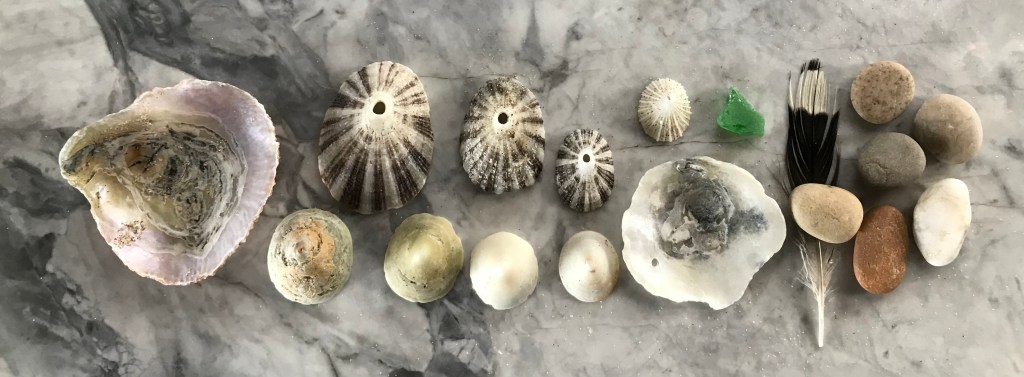
It’s the end of the month I turned 73, and we were busy with cleaning and walking; I’m running a mile at a time on the flat and writing and reading. There’s more. The basalt shore is stirred up along the edges and we’re finding things.
Today, March 20th is, according to NPR, International Happiness Day. I am failing to feel it.

It’s not that I’m ungrateful. I am sad even though my life has been fortunate in many ways.
Continue reading
Gary caught me working on this and when I told him it was a new blog post, he said, “Finally!” I had “resolutions” for 2024. Some of those plans fell apart and some went better than I dared hope and shifted my goals. Toward the end of the year I began making plans for 2025. Those have shifted too.
Continue readingWhen I was teaching high school English, I kept a Bible and the Qur’an on my shelves. I had the American stories collected by Erdoes and Ortiz. (Most of my books were free to borrow and generally came back, but that book and the side-by-side original Spanish and English translations of Chilean poet Pablo Neruda had to be replaced again and again.) I had many novels, books of poetry, collections of short stories, literary journals, nonfiction, science fiction, fantasy, realism, traditional and modern stories. I urged my students to be respectful of what is called “myth” because that word has become pejorative. Myths are most often the sacred stories of other cultures. Have respect.

My own book is not a myth, not sacred, magical, nonfiction, poetry, or even published. But it is done.
Yes, there will be further drafts, editing, revision, new words, passages cut, rewritten, moved. I may have crossed a line with Nadya’s or Amani’s story. Just for the next hours, let me say it is done. Just for today.
And if you or someone you know might be willing to help me make the story better, please let me know. [See below.]
Continue readingWord count, dental visits, complaints about the weather, lies, and the lying liars who tell them.

I should have got a photo. I caught Gary vacuuming his woodpile.

As I type this post on the morning of the last day of November, I have over 61k written for National Novel Writing Month. The official goal is 50k of a novel. In case you wonder, a typical novel is around 75-80k, but sixty thousand words is regarded by many as the absolute minimum length for a novel. By this evening, I might have over 70k once I add these new words to the one already written. Fingers crossed for me.

The first time he hit her was three weeks after their wedding. She didn’t leave him, she said, because she could not face telling her mother she was right that he was a mistake. Her husband didn’t like her working, so she worked only when he was at sea and had to quit whenever he was home. He made her return the sofa she bought with money she earned. Every once in a while, he beat her up. It was always her fault. I don’t know if their daughter was aware of those occasional beatings, but she left the country for college and never went back.
Another woman I knew did finally leave her husband, packed a quick bag and drove her children away across two states to her brother’s home. There had been beatings, threats. He didn’t like her working. It was always her fault. She called a crisis line when she came home to find all her work clothing cut into pieces on their bed. The crisis worker told her that was a rehearsal, that she would be what her husband cut next, that she should go someplace he could not find her. She discovered during her divorce that he had put his first wife in the hospital. She hadn’t even known he’d been married before.
A woman I did not know was married to a local doctor. Maybe he beat her, maybe he was unfaithful, maybe he was cruel in some other way. I don’t know. I trust she had her reasons for what she did. She left him, moved away, divorced, and began a new life. She came home from work on a day that was not one of his days to see his children, to find he’d murdered both of her daughters and killed himself. His reasoning was to punish her and leave her with nothing.
For years I tried to understand how anyone could come back from that?
People make mistakes. Maybe you could share a few stories of people who suffered from their mistakes. Maybe you have a story of your own. My marriage has been my salvation, but I have made plenty of mistakes.
Everyone falls. Not everyone gets back up and carries on.
I wrote a novel about a woman who makes a bad marriage, but eventually leaves, suffers unbearably, and then must find a way to walk on through life without her daughter. I’m not certain I could do what my fictional character does, I am not certain I could recover. I wrote the novel to figure out how to do it.
My book, variously titled Everybody’s Mother Dies, The Promised Hour, and Painting Over, is not structured like a conventional novel. The bad stuff happens early and through the middle, but that’s not what the story is about. Everyone’s mother dies, everyone experiences loss, everyone makes mistakes. Mine is a novel about what comes after tragedy. It is the story of a woman taking a day at a time, placing one foot in front of another. Maybe that is where we are all going to be in the next year: figuring out how to get on with our lives.

Have I mentioned recently how much I still miss my mom and dad?
•
•
•

Some books were entertaining but slid right off the dinner plate of my attention and a few I did not like. Here are two novels—though not the only two—I thought were wonderful.
Olive, Again by Elizabeth Strout
I loved Olive Kitteridge, but I loved this one more. Maybe that is because I am aging and Strout has tackled the challenge of writing about older people without sentimentality, but with realism, compassion, and wisdom.
An example: Out of the blue, Olive visits a much younger woman who is undergoing cancer treatment and fears death, but who also feels confused and guilty that she is becoming unkind to her husband, irritated and impatient. Olive shares about her own husband.
” ‘I don’t know,’ Olive said thoughtfully. ‘He may have been [sick before] and I just didn’t know it. He became very needy. And I wasn’t—I just wasn’t very nice to him. It’s something I think about a lot these days, and it bugs me like hell.’
. . . [and later in the same visit]
“You’re scared to die, even at your age?”
“Olive nodded. ‘Oh Godfrey, there were days I’d have liked to have been dead. But I’m still scared of dying.’ Then Olive said, ‘You know, Cindy, if you should be dying, if you do die, the truth is—we’re all just a few steps behind you. Twenty minutes behind you, and that’s the truth.’
“Cindy had not thought of that. She had thought that Tom, and her sons, and—people—that they would go on living forever and ever, without her. But Olive was right: They were all headed where she was going. If she was going.”
Of course it is Olive looking back sometimes, as well as forward, but that is Strout who recognizes how this tough, hard-edged “old bag” will continue her voyage. Again and again Olive’s choices and words felt personal to me. I laughed and cried and reread passages. There was one where someone confesses to Olive how weary she is at the idea of starting over and Olive basically says, “Oh, now, we never star over, we just go right on.”
As the first book, Olive is not always central to the narrative in these chapters which concern many people in the town. I read Olive Kitteridge when it was new and I feel fortunate to win an ARC of this follow-up. This in no way affects my review. I loved this novel. It’s one I want to read aloud to my husband, and that is a rare compliment.


I think of this as the Big Altar. Sometimes in summer that back wall shows lime green.
I received notice this morning that I saved $5.66 on the order of a book I have absolutely no memory of ordering six months ago. And another one, a book costing over twenty-five dollars, hard cover, by an author whose name I do not recognize, is coming in September. I think I must have read a short story by this person on-line. Maybe?
What I was actually thinking about this morning was the sound of the dawn chorus—the chattering and peeking and calling of a variety of songbirds that I particularly enjoy in late spring with my bedroom window open. Too quiet this morning. I hear the eurasian doves flirting. I hear the ocean, always the ocean. I hear my husband clearing his throat downstairs.
And I was reviewing memories of other lives I have lived. Pushing teaching off to the side, I was once a goldsmith, a sighthound field trial judge, an illustrator, a teenager. These were exhausting and interesting occupations—still fascinating to me after all this time.
My husband came upstairs and told me that I was not hearing the birds because they did not come on duty for another twenty minutes. I wanted to believe he was serious.
A crow.
I opened the novel the day before yesterday and worked for a couple of hours. I found a typo. I found a half-page repeated twice because I had rewritten it and then failed to delete the first version. I liked the first version better so I deleted the revision. I think I have still failed to scatter the ashes of the dead. If I open the manuscript today in order to scatter the dead, I think I will only find a typo.
I will begin the right front of my youngest granddaughter’s pink cardigan instead.

This is the Little Altar.
 IMPERFECT PATIENCE