ANNIVERSARY

IMG_6229.jpeg

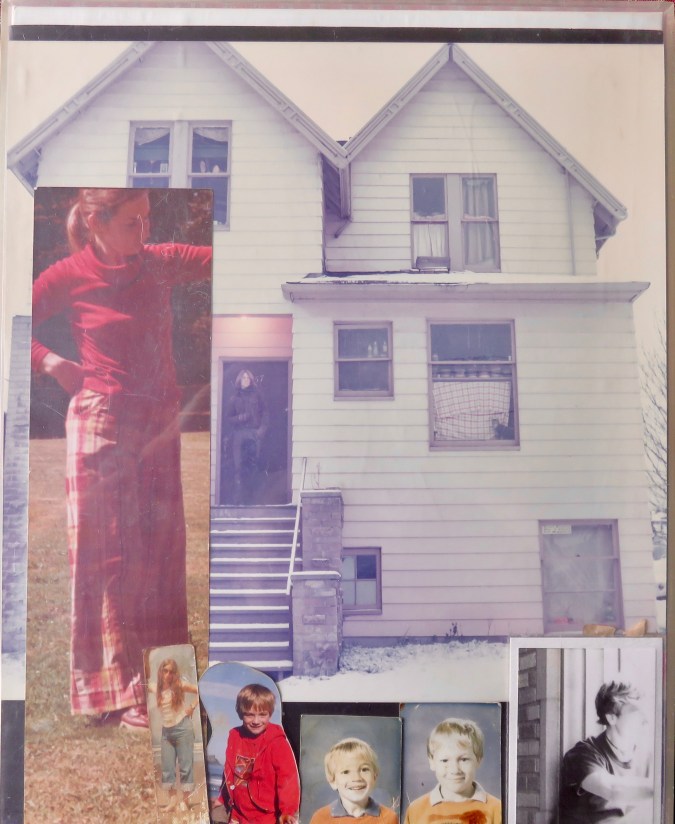
Gary’s photo collage: That is me at left in early 1977 (the part I cut from a photo of Manny), another of me on the beach at about the same time (also a trimming from the important photo of a dog). Then Ian in red, Ian, Alan and Alan as a teenager. Behind these snaps is the faded photo of Gary standing in the main entrance to “Big Pink” with Ann Ann, our first Afghan Hound (she was black and so is hard to see—she always was). Our cat Rabbit is in the kitchen window at right. Herbs and geraniums are in the pots lined above her.

There had been drug dealers and prostitutes and a “witch” living there. The police would come for Debbie when she had a drug-overdose-triggered “complete psychotic break” and the FBI to investigate number 12, where a member of the Weather Underground had stayed. Rent was cheap and the location just up the street from the Blue Moon Tavern where Gary would always find change dropped on the ground in the parking lot at back. More important, the building was only a few blocks west of The Ave and the University of Washington campus, which guaranteed it was always fully occupied.

Today is not our wedding anniversary, which will be next month, but is still an important anniversary for Gary and me. In 1972 we moved together into a tiny apartment in a notorious building in the University District of Seattle. Continue reading

MOM at the BEACH

fullsizeoutput_fd3

My mother was named “Fay” for her mother’s first name and “Gordon” for her father. Born in 1925, she died in 2007. She and her sister spent all the summers of their childhood at the beach house, which my grandfather rebuilt and retired to in the 40s. Mom said she and her sister cried when electricity reached the beach house. 

In later years, my mother Fay Gordon would not recall carrying water for the cabin as a child, though surely she must have done this. The beach house had no utilities at all. Her mother, my grandmother Fay, cooked on a wood stove and heated water for weekly baths. The outhouse hung over the swampy next-door lot, and light for reading after the sun went down came from oil lamps. A marvelous, imperfect vacation all summer long. Paradise for children. 

Fay Gordon and her sister cleaned sooty glass oil lamp chimneys on Tuesdays. That was the only chore she spoke of. Perhaps the chore was lightened because the girls did it together as they did so many things together in the summers on the Pacific shore. They dug clams and used a long-handled rake to gather crabs for supper, but never ate the mussels. She had never eaten the wild salal berries either, fearing they were poisonous. Never gathered salmon berries or thimbleberries. Their choices were simple ones. Children pretended the sand was poison, arms held out, balancing barefoot on drift logs. The daily milk wagon, long walks to Neahkahnie Mountain for picnics and to pick huckleberries or a ride north for roller skating in Cannon Beach. She and her sister played all day, sometimes in company of cousins, and their mother cleaned and cooked. 

Her mother never complained about being stuck miles beyond the nearest road for three months each year. Cousins filled the upstairs dorm for weeks at a time. She sighed over her in-laws’ reimbursement for toilet paper, but dutifully collected the supplies they would need between Memorial Day and Labor Day. All carted from Portland to the beach house in June. She and the children first arrived by car or on the train as far as Seaside and then the long ride along the shore at low tide, the tight squeeze around Hug Point, the house opened from a long off-season. Mice had nested in the attic. Fay Gordon remembered painting the trim each year, or that it was painted each year a color she called “Chinese red,” bright red-orange. Surely she was not trusted at four years of age or seven or even twelve years with a bristle brush and oil-based enamel paint.


My grandmother baked and canned, cleaned, and did laundry in tubs by hand, even in the city. No servant like in the movies, just Fay, barely five feet tall, who was compelled at sixteen to decline the Reed College scholarship in order to help support her family. She had always worked hard. Once learning Latin and poetry and piano, then in a shipping office, and finally women’s work as a wife. 

It was only much later in her life that it occurred to Fay Gordon how these summers might have been difficult for my grandmother. Perhaps my mother’s idyllic barely-supervised summers were not easy for her own mother. Salt-stained clothing and baths and cooking and dishes for just herself and her daughters and often for another three or seven children, without running water or electricity.

“My poor mother,” my mother would say when she was old herself. “What a lot of work.”

But I wonder. Children off playing outdoors was likely a relief. Fay Gordon and her sister were stuck on a seastack when they failed to notice the rising water and had to wait out the tide. They came to no harm. Their dog chased up and down the beach until it caught the seagull and promptly let it go. No poisonous snakes or insects. No broken bones. No recollections of illness. Sand castles. Beach fires. The ocean’s roar. Freedom for their mother too?

My grandmother had summer to herself as well. Despite the labor, perhaps she spent hours each day beach combing, lying back on the sand under a canvas shade, reading. 

I like to think of my grandmother Fay enjoying her summer free of social duties and husbandly demands. My grandfather was known to be demanding. My grandmother was known to be kind. I like to think of her kneading her four loaves of Thursday bread as later would my mother when I was small, baking a pie with wild huckleberries, soaking clothing and hanging it to dry. Maybe even the work was pleasant when there was no one to insist it be perfect. Maybe the work was simple, satisfying, and like the weather, sweet. Lovely summers.

Even so, someone carried water from the creek. 

THIS IS HOW OLD I AM

BpOq7_MIQAA57sC

The original logo.

I remember when there was only one Starbucks across the street from the Public Market and it also sold chocolate from Belgium and spices in little baggies as if cumin were something that could get you high and maybe it did.

I remember when Nordstrom only sold shoes.

I remember when the Smith Tower was enormous, instead of a dwarfish little icon fading from Seattle’s skyline.

I remember when it was free to visit the Woodland Park Zoo and the Seattle Art Museum was on Capital Hill and a walk along the waterfront smelled cold and thick with creosote and import stores sold seamen’s chests and incense cedar screens carved with a thousand gods.

I remember before we went to war with Vietnam and it was still Viet Nam before the American War.

I remember Jack Kennedy’s funeral and the balcony where the Reverend Martin Luther King, Junior was shot.

I remember long, slow evenings in suburbia.

I remember my father’s gold wedding band, thick around his finger, and holding his index finger as we walked, stretching my stride to match his. 

I remember the small chest in the living room with two shallow drawers at the top holding broken tools and orange index cards, a fountain pen needing ink, dental floss and model airplane glue, keys to doors and boxes the family no longer owned, ticket stubs, a pocket knife, and a miniature chess set in a folding wooden case. 

I remember my mother’s hands crimping piecrust and mashing potaoes in a white glass bowl, meatloaf and tomato soup with toasted cheese sandwiches and tuna noodle casseroles and green peas barely warmed from the freezer. 

I remember the gingham dog and calico cat salt and pepper shakers on the kitchen window sill, the clock that creaked as it marked the passing seconds, bread kept in a drawer, the junk drawer with mucilage and four brown pennies and a bent spoon, a red capped shaker with cinnamon, and the toaster that always burned the toast. 

I remember rain on the roof and the softball through the front window in an exploding star. 

I remember my brother’s cap pistols and the bright smell of burnt powder, roadway scars in the back garden for Matchbox trucks and sedans, and the juniper bush six feet across, a spiral of prickly green. 

I remember our dog Roo circling and circling to carve her space on the carpet and my mother’s slip-covered chair in the living room revealing a warm depression when we came home from the store. 

I remember the reading lamp over my bed with butterfly wings embedded in the fiberglass shade, and a bright line of light under my door and hushed voices in the living room, the blush of dawn sunlight above the neighbor’s house, condensation on the glass, and the clutter of school papers and lists of horse names marking a landscape on my desk. 

I remember scum in the corner of the bathtub, mold on the wall of my closet, the sound of the furnace coming on at night in winter because it was especially cold, the plastic cups we used for KoolAide in the summer, and the crisp pale fungus that grew between the boards of the picnic table. 

I remember cracks in the driveway. 

I remember the hollow creak of the mailbox door, splitting open an orange with my thumb, sunflower seeds in their shells, card games, bare oak floors, the World War Two surplus search lights scraping across the sky in the summer, and moths beating against porch lights all up and down the block.

I remember.

I remember how it was. The Bad Word scratched into the stop sign post. Women fired for failing to wear stockings even in the back room. The man on the block who stripped his kids’ shirts and beat them with a strap. The bullies up the street who made it dangerous to walk that way. The open gutters and frost throwing the soil up into sparkling shards. Empty lots gone to tall grass. Cows grazing in a field. Climbing trees. The shack in the woods mouldering back into the past. Tree stumps broad as foreign cars. Foreign cars so rare their drivers stop to compare notes.

I remember laughing with my brother and my children as infants. I remember what youth was like. I remember songs from their first notes and cranberry sauce from cans and the color of my mother’s eyes.

It was everything and it’s every bit gone, and if someone told me I could start over and have all that back again, I would not stop crying.

How old does that make me? If I think I could not bear to have it all again? If I can barely contain all that has happened since?

If that is how old I am, I do not want to start again.


MEETING & GREETING

IMG_3367

The man I love. Gary does not read my blog, so he will have no idea I posted this photograph. He is beautiful to my eyes. He won’t think so, but it’s true.

Love consists in this, that two solitudes protect and touch and greet each other. —Rainer Maria Rilke

When my husband and I take our morning walk, we wander apart as much as we walk side by side. “I am going up to check that,” Gary will say, gesturing at something pink higher upshore. Yesterday morning it was a used diaper in a pink plastic bag. If it’s still there tomorrow, he’ll pick it up.

That is not what we talked about for quite a while that morning. We talked about candor and honesty in our relationship. We reviewed our history. We acknowledged our shared trust. I have since been thinking about love and family.

My mother and I were always very close. She had mental health problems and sometimes that made for painful or awkward moments, but her mental health while I was a girl only hovered on the edge of my awareness. The therapy. Medication. Hospitalization. Her furious insistence on trivial matters was just the way it was. (She had to be the first one to open a magazine that came in the mail. Tape, glue, and scissors were hidden.) She was my mother.

I told my mother most everything. Yes, I was one of those girls. I never revealed the worst, but mostly I told. I told her about boys I liked at school. We talked and talked and talked. We had family discussions about people I knew from school. We argued about gun control and hunting and race relations. My parents used their new reel-to-reel tape recorder to record family conversations about boys I knew and other issues. Conversation and debate were valued in my home.

Yes, I understand now that some of this is odd.  (Weird?) It only occasionally seemed uncomfortable at the time, and I was not in a position to judge. This was my family. (Some things are actually bizarre—strange enough that I do not see how I could use these events in fiction, and I have cannibalized most of my life for my fiction.)

When I began dating my future husband in 1969, I did not discuss him with my parents. This was not a conscious choice, it was merely the result of my absolute conviction that Gary was better than I deserved or was ever likely to meet again, and my determination that our relationship would last. I was not going to muck it up. Gary went further in that he believed we were destined. So we worked at our relationship. We made some smart choices.

For one, we played no games. We were and remain entirely honest with one another. Do I tell him every thought that crosses my mind? No. But mostly he knows and I trust him with that knowing. He knows me and I know him equally well.

It was my mother who pointed out early on, “You never talk about Gary. I think you must not care much about him.” She smiled but was wary.

I did not rise to what I now recognize was bait. I was merely surprised at the time. I think I smiled and shrugged. Did I tell her she was wrong? Not that I recall. But since then, I have thought a lot about that comment from my mother. She was threatened, of course. Did she think he was a bad influence? Did she judge him too old for me? Was it really that she did not care for him or about his family? He was never going to make enough money to support me in the manner she hoped I would become accustomed? Probably bits of all those things.

I never discussed Gary with my parents. I never complained about him to them either. I had complaints, of course I did. I have had my grievances and so has he. We have quarreled. We talked about them. We were loud. We were apologetic. I considered leaving the relationship. I yelled and ranted and we hurt one another’s feelings. We apologized. We tried to do better. Sometimes we were successful. Mostly we said little or nothing to anyone else. This was between us.

Even now, when I recognize that someone is more forthcoming with a friend than a “partner”, I figure it’s a bad sign. I might joke about Gary’s “failings” but there is no running to others about them. I did not complain to my mother about Gary. I did not complain to my girlfriends about Gary. I never once complained to his parents about Gary. They would have been hurt, I think. They would not have been able to help. If I had a problem, I complained to Gary. We discussed our issues between us.

We shared the good stuff with others. We did not intend to portray a false impression of our relationship. Sure, we argued, we bickered, we hurt each other. But only we could address that between us. Our honesty was honestly shared.

Outside of Gary, I am inclined to lie about annoyances. It is unfortunate, perhaps even dishonest and unhelpful and mostly the result of how I was raised as a girl. Do you like turquoise clothing? No, but I will say yes. Is that okay with you? No, but sometimes I will not admit that. Did I hurt your feelings? Only to Gary will I immediately admit: Yes. Yes, you did.

I love him and respect him and we have both worked hard to build a relationship of trust and openness.

If that used diaper is still there tomorrow, Gary will take along an extra plastic bag to use to pick it up. Yes, he is a bit of a germ-phobe. He wakes up too early in the morning. He wants to be asleep by 8pm. He still listens sometimes to old rock-and-roll that I could never hear again and be satisfied.

These are not things I expect others to help me change. These are not even things I expect him to change. He has a list, I know, of my troubling habits. These are not character flaws. These are merely the ordinary wackiness any of us must learn to live with if we hope to have a family.


CLEANING OUT


IMG_3003

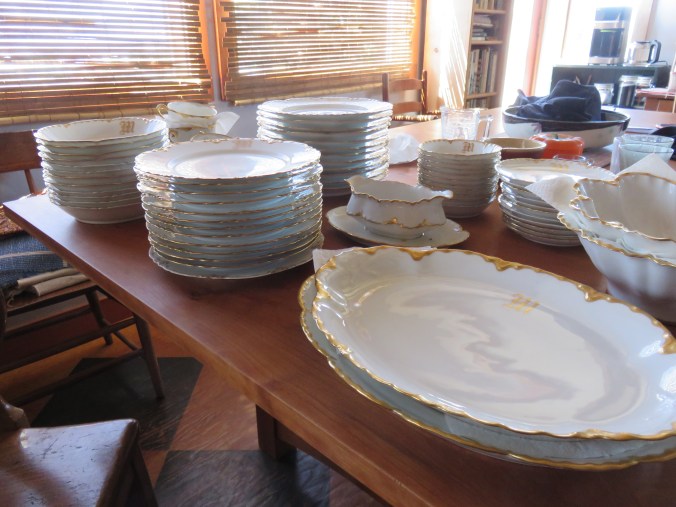
Seeking a loving home: nearly 100 pieces of Havilland porcelain, a pattern called “Ranson” made in France about a hundred years ago and emblazoned with a W or M in 24k gold. I have never used these pieces. Even my grandmother never used them, to my knowledge.

We paid off our mortgage on Tuesday. We asked for a payout balance and had the bank wire the funds. The trick is that we will still be putting the money into the bank to cover insurance and taxes. It feels good even so.

As I type, my husband is realizing a long-term goal. He is emptying the attic. It is part of a broader effort to streamline the house and rid ourselves of accumulated stuff. We have filled the garage and atrium with things that will not return to the house.

For many years I have presented my husband with a pair of champagne flutes on our anniversary. We generally broke them, or at least one of them, but I still have twenty or more cluttering up a cabinet.

No one wants this sort of thing anymore, I find. And neither do I.

In my childhood, coming to the beach was an enormous effort. The highway through Arch Cape was so evenly lined with aged spruce that finding the turn to the narrow gravel track leading to my grandfather’s house was tricky. My mother had spent all her childhood summers here, but even so we always overshot the turn. Today, and especially during the 4th, the change is unmistakable. Nearly all the houses are short-term rentals. A new business of several thousand square feet will be added to the property that was a tiny deli and post office in my childhood. The three-unit rental cabins south of us are converted to year-round rental use and a new 7-unit motel is only the latest.

This is not the quiet, isolated beach where my great grand-aunts purchased property for $10 in 1911. They packed up toilet paper for the summer and drove on the beach at low tide to get here on Memorial Day and stayed till Labor Day. My grandfather inherited the place in the 30s and continued the tradition. My mother raked crabs for supper as a child. She and her sister had to clean the lanterns of soot once a week. There was no electricity or running water. The outhouse hung over the swamp next door. The house on that sand-filled lot rents for $695/night in September these days. It’s fully booked for the rest of the summer at over a thousand/night.

The house was always “too rich for our blood” with taxes costing more than the mortgage on our Seattle house. When we moved to my grandfather’s house, it was a two-bedroom, 1 1/2 bath, one story house. We added back the second story my grandfather removed in the 40s. Our children were born here and raised and went to public school here. Beyond home improvements, we have added too much stuff.

I have bins of yarn and fabric and some day I must have whittled down our possessions so that our sons will not be faced with the monumental task of doing it for us. We did that for my mother, my grandmother, my aunt, and even my grandmother’s second husband’s brother. We still have unexamined boxes of family documents and photos that my mother never sorted and which I will never sort. All the lifetime accumulation of stuff no one wants. If I could sell it, we might afford a vacation. In 44 years of marriage we had no honeymoon and have never traveled for longer than the week spent with friends in Alberta nearly 30 years ago. It is memories of that sort I still desire. But then I live in a vacation paradise, too beautiful to leave. Instead I have beautiful things.

I confess even I no longer want them.

When I explained to my mother that inheriting my grandfather’s house was the reason we had children, that having a safe and largely undeveloped place for children to play was essential to our vision of child-rearing, she called that “a ridiculous reason to have children.”

Maybe she never made the connection between her own childhood spent playing in the woods in Gresham and on the sand here, and my own childhood play in woods and swamp north of Seattle. I cannot imagine growing up in a city. I cannot picture what sort of childhood that would have been. My husband and I both “ran wild” as children. We were determined that our children would have that opportunity.

Those times and those ideals of childhood freedom seem to have gone the way of typewriters. Manual typewriters.

Taxes were the largest portion of our mortgage payment, and living here is really more than we can afford. It always was. There has been no time since 1978 when we could have afforded this house. It has been an enormous gift to live here. Every morning we go for our walk. And Gary is about done emptying the attic.

The china is beautiful. Want it?

SaveSave

“The Supreme Court traded one injustice for another 74 years later.”

FIGHTING HATE // TEACHING TOLERANCE // SEEKING JUSTICE

JUNE 30, 2018

Weekend Read // Issue 86

Fred Korematsu was 23 when he defied the order sending him to an internment camp.

He was one of 120,000 Japanese immigrants and Americans detained by the federal government under Executive Order 9066. He fought his case all the way to the Supreme Court.

He lost.

Korematsu v. United States — in which the Supreme Court ruled that the internment was justified — was never overturned.

Not even after President Gerald Ford formally terminated Executive Order 9066; not after President Ronald Reagan provided each detainee with financial redress; not even after President Bill Clinton awarded Korematsu with the Presidential Medal of Freedom did the Supreme Court overturn its ruling upholding the internment of Japanese Americans.

That all changed Tuesday, when the Supreme Court finally repudiated Korematsu v. United States, writing that it “was gravely wrong” — at the same time that it upheld Trump’s discriminatory Muslim ban.

It was painful irony, especially for Korematsu’s daughter.

“Racial profiling was wrong in 1942 and racial profiling and religious profiling is wrong in 2018,” Karen Korematsu told The Washington Post. “The Supreme Court traded one injustice for another 74 years later.”

Using the “same dangerous logic underlying Korematsu,” wrote Justice Sonia Sotomayor in a powerful dissent, the Supreme Court “blindly accept[ed] the government’s misguided invitation to sanction a discriminatory policy motivated by animosity toward a disfavored group, all in the name of a superficial claim of national security.”

Or, as Karen neatly summarized it, the court allowed the government to “racially profil[e] a group because they looked like the enemy.”

It’s not the only parallel between the Trump administration’s actions and the incarceration of people President Franklin D. Roosevelt deemed “alien enemies.”

Once targeted, Japanese Americans were interned for over four years. They were held in converted racetracks, fairgrounds and horse stables in camps west of the Rocky Mountains. Korematsu himself was held in a horse stall with a single light bulb.

“Jail was better than this,” he told one biographer.

Today, migrant children are being detained — soon, ostensibly, to be held with their parents — in “tent cities” and converted Walmarts.

Their trauma, according to psychotherapist Satsuki Ina, herself born in an internment camp, is all too familiar. As she detailed for Splinter:

They have no idea how long they’re going to be held. They have no idea if they’ll ever see their parents again. That level of anxiety causes tremendous emotional stress, and we know from the research in neuroscience that constant release of these stress hormones can affect a child’s ability to learn, a child’s ability to self-manage, to regulate themselves. The long-term impact that I’ve seen in my own Japanese American community is this hyper-vigilance … a reaction to having been incarcerated unjustly. This kind of treatment has consequences for a lifetime for a child. The trauma effect is pretty severe when there’s been captivity trauma. We were unjustly incarcerated when we weren’t guilty of anything.

Today, people across the country will rally to protest Trump’s “zero tolerance” policy toward migrants who cross the border. We’re partnering with the ACLU and the Alabama Coalition for Immigrant Justice to host the Families Belong Together rally here in Montgomery, Alabama, as well as in Atlanta and Washington, D.C.

Now, more than ever, apathy is not an option. As Ina recalled for Splinter:

When thousands of Japanese Americans were being removed from their classrooms, from their jobs, and their neighborhoods, there was no outcry. No one instituted any kind of protest. … My hope is that people will know how important it is to stand up for the injustice that’s happening right now.

We couldn’t agree more.

The Editors

“Hillbilly”

Last fall, I read the memoir Hillbilly Elegy and I struggled with its view of poverty. The man suffered, but suffering does not necessarily make us wise. I both recognized that he was reporting his personal experience, and felt concerned that his view of his own life was limited by his selfish political point of view. This morning, an essay by Chris Offut, “I Will Always Write About Appalachia” helped me understand why.

“The most recent addition to these false accounts of Appalachian life is the widely read book Hillbilly Elegy, the author of which grew up in the decaying Rust Belt town of Middletown, Ohio. Nevertheless, he blames his personal difficulties on the culture of Appalachia.”

The writing in Vance’s memoir isn’t anything special, but the story is emotionally compelling. Vance grew up in a violent, loud, drug-afflicted, under-educated, and sometimes poor household, but he had people who genuinely loved him and cared for him, even if those people had their flaws and were not necessarily his parents. I love the quote from a teacher at his former high school: “They want us to be shepherds to these kids. But no one wants to talk about the fact that many of them are raised by wolves.” And then . . .

I began to consider stories I knew best from my own family and from teaching in public schools. I don’t know much about Appalachia, but I do know something about poverty and disadvantage. “Hillbilly” and “white trash” are filthy words in my home.

For one, I know it’s no shame to be poor is immediately followed in my head by “It’s no great honor either” from Fiddler on the Roof. Tevye was not a sinful man, but a good, honest, hardworking father and husband. “Economically disadvantaged” is a euphemism I find personally offensive because it suggest there is something shameful about poverty. Being rich is not supposed to give anyone special rights or privileges, and I have been thinking a lot about that lately. I know being poor is not a sin or a failure.

My husband was raised poor in a family that did not take charity. His family bought “day old” bread from an outlet when he was little, and he picked the mold off his lunch, trying not to be seen doing it. He sat on the porch waiting for his dad to get home on payday because there was no food in the house beyond scraped jars of condiments. His experience of poverty was not unique, and it didn’t happen in Kentucky, but in Arizona, but it was hard. One side of his family was Ballard Swedes from Seattle, Washington and the other was Dust Bowl Scots-Irish share croppers from Oklahoma, orphaned when their mother died and Pappie gave them away.

No one in his family intervened or encouraged him to make something of himself. Vietnam was raging and his hair was long. In the years between high school and college, he had three pieces of luck. He was granted a draft deferment based on his eyesight that eventually became permanent, he began working at the University Book Store where he was exposed to new people and ideas, and he met me. When I graduated from high school the next year, he went to college because I was going to college. My husband graduated from high school with a C average but he was Phi Beta Kappa when he graduated from the University of Washington four years later. Like Vance, he saw no point in pajamas and is still in a perpetual state of what others term catastrophizing. Christmas was fraught when I met him but has become a good holiday through decades of determined effort on my part. He loves his cotton jersey pajamas.

Vance would like to give himself all the credit. He would blame achievement or lack of it on people rather than circumstance, but like my husband, he had some luck.

From the LA Times: “As Vance puts it at the beginning of this American dream memoir, he has done nothing ‘extraordinary.’ So what’s wrong with all those other hillbillies? In suggesting that his own success in Silicon Valley was a matter of refusing cinnamon rolls, Vance is giving us a basis in feeling for the devastating policy Ben Carson wants to enact. People are poor because they deserve to be. And there it is: Trump-era elitism defined.”

Some people abuse the system, and some people are too proud to accept help, even for their children. When my husband was given a sweater by his pastor because his second-hand store clothing was too poor for church and too sad for the pastor to ignore, it was only because his mother won the argument with his father that he was allowed to keep it. It was the nicest item of clothing he ever owned as a child. “White trash” is a filthy expression in my home. “Red neck” was the term I was taught as a child. I would not use it today. Change is not easy.

In my forty-year experience working with students, I witnessed most parents doing the absolute best they knew how. Neglectful poor parents do not necessarily love their children any less than neglectful affluent parents do, but the results tend to be more public among the poor. They are less skillful at concealing problems because they do not have the money to hide behind. Some parents work too many jobs just to get by. I think of a single parent who could not ensure his child did his homework because he got off work in the middle of the night find his teenager drinking soda and playing video games instead of sleeping.

Affluent families have their own troubles involving drugs and mental health, abuse and time. Even in my poor, rural community, some entitled parents send their children to elite private schools. They can afford private lessons and vacations their peers cannot even imagine. Their students drive cars worth more than the average local yearly income. Affluent parents may not need to work two or three jobs to pay rent, but sometimes they work long hours or ignore their children because they choose to do so. The results are similar.

Things go horribly wrong for children, dreadful things happen to them, but in my experience, not always, but often when things go wrong with children—pregnancy, drinking, drugs, crime, dropping out—the causes are not simple genetics, politics, poverty, public education, or an unwillingness to work hard. Something is wrong in the home. Too many children from “nice homes” have revealed the truth of their lives to me. Wealthy or impoverished, when kids’ lives go very wrong, there is nearly always something very wrong in their lives. It is not a character flaw, but reaction to something they cannot control. And there is bad luck again.

Unintended teenage pregnancy caused moves and marriages and monstrous errors beginning with his Mamaw when she was too young to drive. It seems to me to be the particular curse of Vance’s family is early pregnancy. Yet he reflects on this only in passing, perhaps because as a boy it did not hit him personally.

Vance works hard not to blame the people he loved, even the people who damaged his life, but he is also specific and detailed in itemizing the chaos, abuses, insults, and injuries inflicted upon himself and he repeats the lists every few chapters to ensure readers do not miss the hardships he suffered. Still, this book is lived truth, and if Vance fails to recognize the irony of complaining that a single call to child services fails to net any interference in a neighbor’s neglect of her children and then complaining a handful of pages later about child services “prying” into his own messy family . . . well, I guess he’s what one of my young students once called “a guy”.

There is no easy answer to the problems we face in America, but I think it is fair to suggest that we could do better as a nation for our children, regardless of who is at fault for their troubles. An equitable public education, a reliable health care, a decent diet, and a nation caring enough to inconvenience itself would go a long way toward making the lives of all American children better. It would give us all a better future.

Vance was lucky in more ways that he credits.

His Mamaw was tough-talking and violent, but she used her threats to keep him off drugs and she assured him that golf was a rich boy’s game and education was his best hope for a decent future. In other words, he was pushed—hard!—to do what every person ambitious for monetary success does. Vance had support.

In addition to choosing to reject the dysfunctional walk he witnessed all around him and gaining the stability and peace of his Mamaw’s house, Vance claims he “found a couple of teachers who inspired [him] to love learning”, but it’s likely he didn’t find them; those teachers found him. No member of his family killed him though several seem to have tried, and he found a family and practical education in the Marines, without seeing action in Iraq. That’s another piece of luck. The Marines taught him to give more than he thought he had, and they took less than they have required from many others.

Vance would like to blame people on assistance for their trouble, but he had plenty of assistance himself.

Vance was lucky. He had strong people who loved him unconditionally. He found friends and mentors along the way. It was luck and generous people who saved him. He knows that. Or at least he should.

MEMORY

my-brain-is-full-1.jpgOne of the assignments I used to give my juniors was to memorize the Preamble to the Constitution of the United States.

We the People of the United States, in Order to form a more perfect Union, establish Justice, insure domestic Tranquility, provide for the common defence, promote the general Welfare, and secure the Blessings of Liberty to ourselves and our Posterity, do ordain and establish this Constitution for the United States of America.

We listened to the School House Rock song (which leaves out four words) and sang it together several times. Then we wrote the fifty-two words on a slip of paper. Students had to write it perfectly, with all the peculiar caps, punctuation and spellings, before they were done. Almost no one got it the first time they tried to write it out. Some needed a dozen tries. For many, this was the first time they noticed the word “posterity” and I had to define the term. Many initially complained it was “impossible.” Yet most of these same students could likely sing the lyrics of favorite songs. Eventually they all got it.

Students routinely underestimated their own capacities in many ways. Memory was one.

In the past, I have used the example of my younger son’s experience as an undergraduate Theater major. Ian will say he is fortunate, and that is likely true, but he is also smart and a skilled performer. He was a gamer from the age of 4 and now makes his living in theater, mostly as a master electrician.

In earlier days, Ian starred in high school musicals, performed in community theater, and while a college student at Portland State he played on every university stage as well as in commercial theater, and starred in an indie film. When the male lead in a local community theater walked off four days before the opening of a play, the director called Ian. He was on stage for the opening, off script and brilliant.

I recently read a new translation of The Odyssey by Emily Wilson. It functions as a comfortable introduction to that ancient story, offering an excellent overview of its background and an attempt at form—the original Greek is in a poetic form that does translate so Wilson chose to use iambic pentameter with shorter lines, which do not allow for all the detail of other translations. But the story is lively and interesting with monsters and divine storms and bloody battles. The claim that most disturbed me was her insistence that no one poet or performer could have memorized the entire epic of over 12,000 lines. I could only conclude she didn’t know theater people.

One of the plays my son performed in college was the restoration comedy She Stoops to Conquer. The play includes many characters and he memorized all the lines—he had little choice since he performed all six of the major male roles in rotation as well as all the unnamed male roles such as “servant.” It is a long play.

So is Hamlet, which contains just over 4,000 lines and anyone playing the lead would likely, by necessity, learn the entire play. It is not enough to know cues, the lines immediately previous to those the actor knows. The actor needs to know more than that. And that is not the only role a lead actor in Shakespeare’s day would have known. In repertoire, where a limited groups of actors perform several plays in rotation, he might be performing a dozen roles. It would not be unusual for a single actor to have 12,000 lines mostly memorized. And then a month later he would have a new play and another and another.

Assuming a minstrel sang only long piece or perhaps a handful learned over a lifetime? To perform 12,000 lines is not “impossible.” It would require 12 hours, be sung over a series of nights. Again and again.

It is, frankly, incredible what the human brain can do.

Many of us struggle to commit a phone number to memory. How about 67,980 digits? That’s how many digits of pi that Chao Lu of China, a 24-year-old graduate student at the time, recited in 2005. Chao uttered the string of numbers during a 24-hour stretch without so much as a bathroom break, breaking the world record.

It is only in modern literate times that we have so underestimated the capacity of the human mind to memorize. Modern research suggests that most people know as few as 10,000 or as many as 35,000 words. A working vocabulary, words we use routinely in conversation, is much smaller, a few thousand words. The Kottke blog (one of the oldest) offers an interesting overview:

In his collected writings, Shakespeare used 31,534 different words. 14,376 words appeared only once and 846 were used more than 100 times. Using statistical techniques, it’s possible to estimate how many words he knew but didn’t use.

This means that in addition the 31,534 words that Shakespeare knew and used, there were approximately 35,000 words that he knew but didn’t use. Thus, we can estimate that Shakespeare knew approximately 66,534 words.

According to one estimate, the average speaker of English knows between 10,000-20,000 words.

True, Shakespeare cannot be considered typical, but words were his business. His command of language was not so unusual, even in Europe. Wordplay was entertainment as well as occupation. Courtiers invented puns on the fly. People got the joke. When my typical Honors students were assigned to read Huck Finn, they often complained about the difficulty of reading Jim’s dialogue and rarely found the book funny. When I read it aloud to my regular English classes, they laughed continuously. They heard all the jokes. My “smarter” readers were not often hearing the language, but skimming.

(A reading specialist once told me that reading under 350 wpm was failure. This represents a misunderstanding of how the brain processes language. True, a very slow reader, sounding out one word on the page after another, struggles to make sense of a sentence. But a very fast reader fails to grasp anything but an overview of content. The fast reader cannot help but resent poetry for the demands it places on the reader, and thus loses the art on the page completely—a complaint for another time.)

The impact of cell phones, audiobooks, and other technology on language has been estimated to be anywhere from debateable to improved. It might result in little change to overall usage or actively cause vocabulary and grammar to deteriorate or even improve usage.

In any event, the memory capacity of the human brain is enormous. There is no danger of filling it up. Whatever we might believe limits our abilities to learn and use new information, we are likely wrong.

People are capable of learning and growing throughout their lives. It is wise for us to do that, a healthy habit. However long we live and any way we look at learning—through formal education, memorization, life experience, or invention—it is what we are meant to do throughout our lives.

Our brains are never full.

SaveSave

SaveSave