BABKA & GOALS

I have made New Years Resolutions since I was young, really young. I weighed 114 in high school, but most every year my goal was to maintain that weight, or often to lose weight. And I did it after my first child but not the second and not ever again. Soon I had more important goals, more pressing concerns, and more significant ideals than my weight.

I baked my very first chocolate babka today, January 1st. Without a recipe! Half the twisted loaf was gone inside five minutes and there were only the two of us! This is not on my list of goals for 2024.

Continue reading

ASCOB

Hardly anyone will recognize the letters I used to title my thoughts today. “Any Solid Color Other than Black” is a class in AKC shows for American Cocker Spaniels (ASCOB is pronounced ass’ cob). For the record, I have never owned or shown American Cocker Spaniels of any color, though I do have a scar on my upper lip from being bitten by one when I was a small child.

This is not a post about bites or even dogs. There are no assignments or exercises. A few crows. Trees. Our condo news.

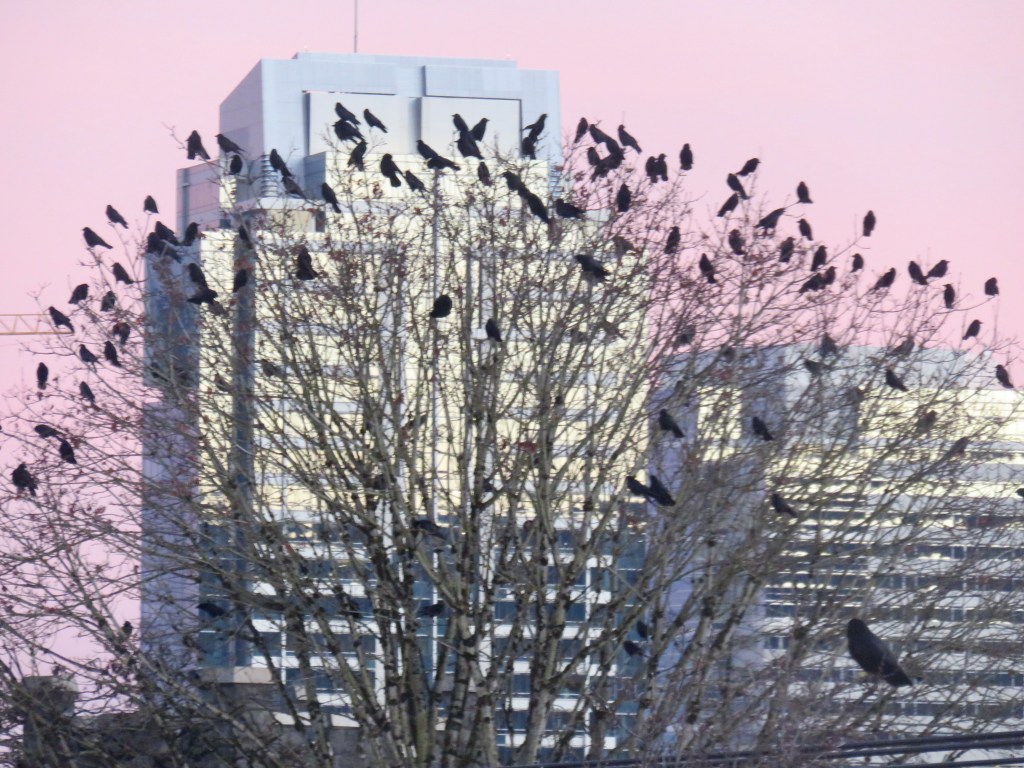
We like crows. Above is a tree with over a hundred crows, but there might have been a thousand nearby when I took this photo. (HINT: this was not the only tree, and most of the birds were flying.) There are “local” birds, but they gather as a massive flock (“murder” seems unkind), usually in late afternoon but on their own schedule.
Continue reading

SOME ADJUSTmeant

Pre-pandemic, we followed a simple route from coast to the city at least twice a month. We left home early and returned before dark. We shopped at the Farmers Market, saw family, went to the music store, visited the nursery, and walked through Powell’s Book Store. We were always in a hurry because of weather and darkness and animals waiting at home. Our last dog and our last cat are gone now, but the other big difference is that now we have a place to stay.

This is one of my favorite skies—when a roll of cloud sits out on the horizon, but the sky overhead is clear. You can see the sky reflected in wave-washed sand.
Continue reading

52 WEEKS + 2 DAYS

Full moon over the ocean.

I assumed that a year was precisely 52 weeks, but had never done the math. That is odd for a lot of reasons, mostly because I was always good at arithmetic and algebra and geometry etc. I worked figures in my head back when I was running regularly in my 40s and 50s. Anyway, I created a calendar and realized that a year is more than 52 weeks. Add two days and a third during leap year.

The weather is changing. We have been grateful for rain, for cooling temperatures, and colorful leaves on our longer drives. Because nearly all my life has involved beginning school in the fall, this is the season for something new.

A year ago today, I decided to take charge of my daily habits, eat a better diet, lose weight, stop wasting food, and live a more physically active daily life. I was retired and so had time to devote to taking better care of myself, covid had forced me to shop less often and pay more attention to food in my fridge and on my pantry shelves, my Body Mass Index put me in the “overweight” category which was a risk factor for covid I could do something about (unlike my age), and I had begun winding down an intense creative production. I needed a new focus.

Three other events impressed me, one from personal experience and two from “authority” figures. When sitting and watching television, my fat pressed so hard into my belly that I sometimes experienced cramps and that seemed scary. An article suggested that humans need to fast for at least ten hours overnight to rest our digestion and that made a lot of sense to me. And Samantha Bee announced on her show (which I love) that “diets don’t work!” Well, of course they do, I thought. Nothing motivates me like a good argument. I had lost weight without trying during cross country season when I was often too tired to eat when I got home from a long day and when grief stopped me eating after my mother died.

And then I thought more about what both Bee was saying and my own experience of deliberately and successfully dieting after childbirth. The trouble with dieting is that what most people regard as “a diet” is something to do to lose (or gain) weight and then they return to the poor habits they had before. Surprise! They end up back where they started.

I needed a permanent change.

Usually Gary spots eagles after hearing them first. This one hadn’t made a sound. She was watching crows consume a dead bird. Maybe she’d already feasted, maybe it would be her turn next.

I would weigh myself every day, I would expect my weight to fluctuate, but I would track the same day of the week as the one that “counted.” I would meticulously count and cut calories, but allow for higher calorie days since that is actually helpful to maintaining a normal metabolism. Since I began on a Friday, the date that mattered would be the last day of seven, Thursdays. Over the past year my weight was stable 3 weeks, I gained weight by the end of 11 weeks, and for the other 38 weeks, I lost. Sometimes I lost a couple ounces, sometimes a pound.

I set up a chart on my computer to track what I ate each day. This was not merely a diet, but my intention to radically reform my eating habits: more vegetables and fruits, regular mealtimes, only occasional no- or low-calorie snacks. I set up a sample weekly menu (that I referred to less and less, whenever I was stuck about what to make for meals) and typical lo-cal meals, goal weight, and overall aspirations, appointments, and accomplishments—first to be “Normal Weight” according to my Body Mass Index, then to achieve my prior ideal weight during cross country season. I was in it for the long haul, and assumed it would take me at least a year to get where I wanted to be.

The chart grew more complicated as I went along. I added tracking for minutes and then miles I walked and where I went. Later I added miles run. I tracked my vitamin D and calcium. I tracked the days I went to the post office for my mail (once or twice a week) and grocery shopping (every three weeks). I measured myself so that I would know when I had a waist under 31″ because that’s supposed to be healthier for me. I regained a sense of limited control over my body and health.

  • My BMI is under 21,
  • I lost 40 pounds,
  • my waist measures 29″ and my hips are under 37″,
  • old favorite clothing stashed in a bin now fits (items I never expected to wear again but kept for their fabrics),
  • new LL Bean petite 6 jeans fit (in my youth, before size inflation, my measurements would have made me a size 9/10, and size 2 did not even exist),
  • I walk about 25 miles each week, and
  • I can run every other day.

A week ago I ran (most of) a 5k. I had not actually ever expected to run again, but when I hit my old cross country weight I began running short distances in June, hoping to achieve a mile, and gradually built to a couple of miles. The nearest Park Run 5k had rolling hills, but I only walked about a half mile of the 3.1 miles. My time was five or six minutes slower than what I could manage twenty years ago. That’s probably good news, but I have begun training on hills—short distances. So far, so good. My long range goal is to run an entire 5k after my 70th birthday in October of next year. Slow is okay.

Right at the end of my 5k in Hillsboro last weekend. Yeah, I was tired!

I might lose another 4 pounds or settle on the weight I am now. I know how to eat better while including treats, including ice cream (rarely and a half-cup at a time instead of an entire pint) and pie and cake and popcorn with butter (again, not so often and not as much as I used to eat). I eat what I know is enough instead of until I feel full—since it takes a long time for the brain to catch up and signal “full” and eating lunch at school for nearly all my life taught me to eat too fast. I do not feel discouraged if my weight abruptly pops up a pound or two—salted popcorn will do that, but it’s temporary. Feeling hungry might actually mean I am only thirsty or bored—I can live with that for a few hours before bedtime. I get to eat sourdough waffles (or toast with peanut butter or homemade granola) for breakfast. And I am breaking my fast each morning, because while I might eat 11 almonds as a snack before my morning walk, I do not breakfast until after I get home, lunch (my biggest meal) is around noon, and dinner (usually salad or roasted veg) is around five. If I snack beyond that, it’s tea or iced coffee with milk, 1% fat.

During our last-day-of-summer walk, I found limpets and agates, two pieces of seaglass, and a large hunk of Mt. St. Helens pumice!

The upshot? The trauma in our country and the world is completely beyond my comprehension or control, but I can behave mindfully in my own actions and choices. I feel physically better and I have regained healthy habits at a time in my life and because of covid where I felt the need to exercise such control. I am not in denial about my age, but am delighted at how much I can manage. (I nap.)

This morning I ran two miles on highway hills, more up than down since I ran up to the highway, to the top of the headland north, and then rolling hills past my marker, and back to walk down through the steep Hug Point parking lot. I found a machete in the ditch alongside the highway and carried it carefully all the way home. It needs cleaning and sharpening, but I am the person to do that.

Without meaning to brag (yet I know I’m bragging), the past year has proven a lot to me. I am proud of myself; I am both hopeful and grateful. I want to prove Samantha Bee wrong by maintaining this progress, by finding a healthy maintenance and maintaining as long as I can.

SO MUCH WANTS DOING

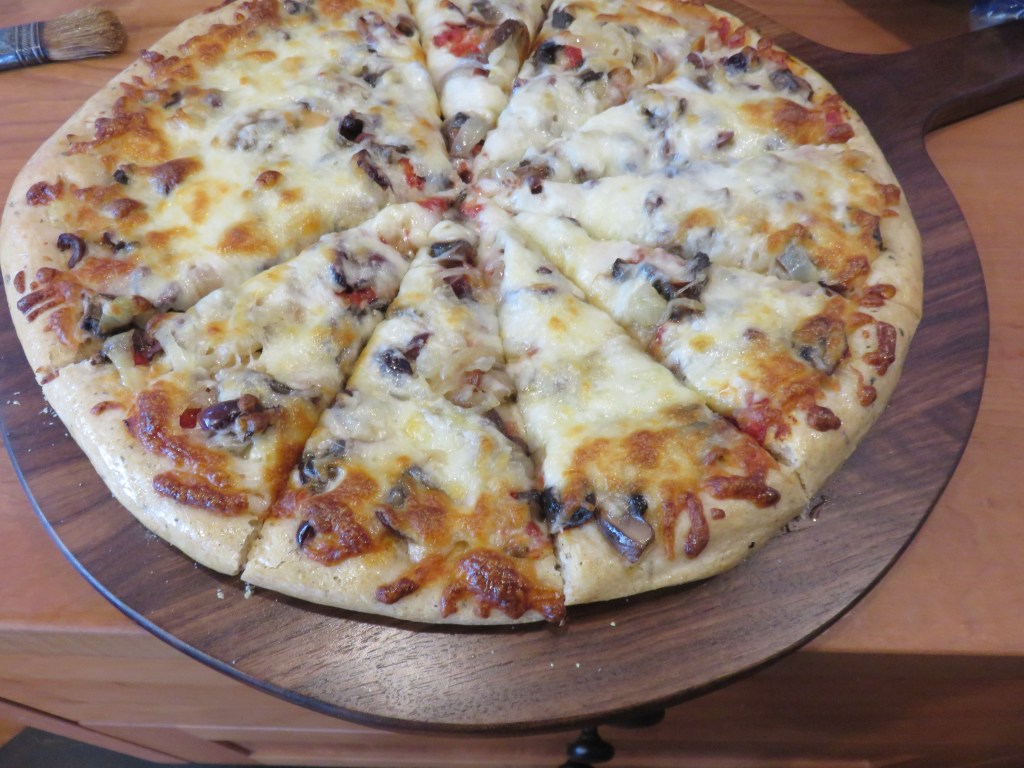
Hello world. I’m writing about covid and my BMI and tidying up. You might want to stop right here and not read any more. The pizza was wonderful, btw.

Mushroom, olive, cheese pizza on sourdough crust.
Continue reading

The BREAD RISES

Since the beginning of the pandemic, and setting aside art purchases, our most expensive budgetary item for the past year has been food. This has been the case throughout most of human history. Food first, but the animals and manner of raising crops changed dramatically. We have eaten organic for years just like my grandparents would have. We prefer fresh or frozen food, strong flavors, and I am a good cook willing to try things.

I began baking bread as a child with my mother. I baked bread in college even as a full time student and working 18-30 hours a week. My studio classes did not meet on Fridays and I usually had that day off. I have always baked bread on occasion, but in the past year I bake weekly, usually sourdough, half whole wheat flour, and no sugar in my bread at all. It takes most of the day to bake sourdough, though less than an hour of actual work. The house smells of healthy yeast and the loaves that come out of the oven are tastier than anything I could buy. It is even convenient to bake it. 

Americans eat badly because we have failed to start at the beginning by teaching children to cook.

My most recent loaves just out of the oven: Sourdough raisin bread made with AP, whole wheat and einkorn flours, eggs, salt, and sunflower oil.

Many women of my generation were resistant to learning to cook because they were understandably resistant to a sexist notion of a housewife’s destiny. They saw cooking and cleaning as Erma Bombeck did, as a trap for women. My own mother loved Bombeck’s humor (If Life Is a Bowl of Cherries, What Am I Doing in the Pits? etc.), but she knew how to do all those chores of canning and cooking and baking bread. She didn’t like doing any of them.

Continue reading

HUNGER

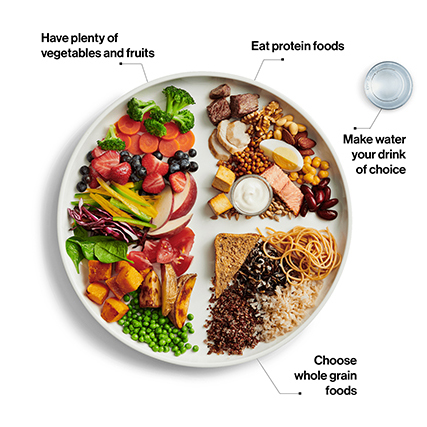
I have read Berkeley Wellness Letter for years. In their latest report they applaud the new Canadian dietary recommendations.

Canada food guide-1.jpg

“Canada has done away with the dairy category altogether (instead including dairy as just one of many sources of “healthy protein foods”) in favor of reminding people that water is the best beverage overall. Its previous guide advised two to four servings of milk (or milk alternatives) a day, depen­­­­ding on one’s age.”

The USDA continues to emphasize meat and dairy in diet because “unlike Health Canada, whose sole mission is to improve the health of Canadians, the mission of the USDA is not only to safeguard the health of Americans but also to promote agriculture production (including meat and dairy foods)—which is a conflict of interest.”

Intense lobbying has created the plates Americans are encouraged to eat. Advertising supports the industry paying for it. Advertising and industry-biased research has fed us a pack of lies.

We have lost faith in dieting as a way to control or lose weight because the soda industry has devoted millions to convincing us, often through bogus research, that changing what we eat (and how much) will not work. Hello. What we eat matters. What we eat, how much, and when does impact our body weight. Exercise is critical for a healthy body, but what we feed ourselves matters most of all.

I share this in full knowledge that I eat badly, that I should lose weight, and that baking rugelach and cake is one reason I have gained weight over the past year. We have been vegetarian/pescatarian for decades, and there is little chance of our abandoning dairy any time soon (cheese!) but we hope for small stage changes toward more vegetables.

The colorful illustration above does not represent how my husband and I eat. It is entirely different from how my family ate when I was a child. In those days our plates were half brown (meat), a quarter each green or yellow or orange (peas, corn, carrots) and a quarter white (potatoes). In my childhood a salad meant chopped iceberg lettuce and Catalina dressing (sweet). Dessert was something large, sugary, and baked, cut into four pieces. Sweet drinks vied with whole milk (or powdered milk in lean times). It was a diet driven by culture and industrial interests, not health. Our meals were all too valid and sweet.

“Eat food, not too much, mostly vegetables.”

The very concept of meals has disappeared in our country. We eat all day, though recent research strongly suggests that we are meant to feel a bit hungry each day. Breakfast is intended to break a fast of at least 12 hours. We are meant to feel and to be empty. People all over the world literally starve, but Americans are deeply afraid to feel hungry and so we snack and nibble and “graze” all the hours we are awake. We encourage our children to develop lifelong habits that will impact their health and shorten their lives.

The way we eat is not healthy. I should have seen this coming when the sleep surveys I have been completing online began asking me not only about hours of sleep, sound, lighting, and how quickly I got out of bed in the morning, but also how many nights I went to bed a bit hungry. Never, I responded. But then I wondered and sure enough the research began to come out.

Eat within a 10-12 hour window, between 7am and 7pm, for example. Or between 7am and 5pm. Fill our plates with vegetables. A little grain, a little protein. (Protein is actually easy to come by. Almost everything we consume contains protein.) One large meal, ideally earlier in the day. One very light meal, ideally the last of the day. (Or first like the French, back when we envied how they were all so slender.) Give your gut a rest overnight. Feel genuinely hungry for a few hours. No, you are not “starving” when you feel a bit hungry. Each day I hope to experience just a little “hunger” because my body needs a rest from eating.

Berkeley Wellness Letter also warns that by midcentury “the world will have nearly 10 billion people. One looming challenge will be how to feed them healthfully and without wreaking even more havoc on the environment. Our current eating habits, especially in wealthy Western countries, are responsible for creating an excess of greenhouse gas emissions that contribute to climate change, largely due to our penchant for red meat and other animal foods. What’s more, the typical Western diet plays a major role in obesity and other chronic health problems; meanwhile, millions of people elsewhere are undernourished.”

I need a break from feeling full.

I need a different fullness: Full of hope. Full of passion. Full of intent and wonder and admiration and love. I am hungry for conversation and compassion and kindness. I am hungry for productivity and purpose.


on another note: Today is Zora Neale Hurston’s birthday.

GREEN: LOST IN UNDERGROWTH

IMG_4432 (1)

[CLICK TITLES TO READ THE ENTIRE POSTS]  During my Junior year at the University of Washington, I took Elementary Botany in order to fulfill the distribution requirement for natural sciences. Most of my friends recommended Astronomy or Geology, but I chose plants for that last required class outside my major. Two months later I was ready to change majors, and though I ultimately stayed in the School of Art, I never looked at green in quite the same way again. There were weekly labs and lectures about various aspects of plant growth, use, and biology. We took field trips to look at a hydroponic tomato greenhouse. We dissected leaves and flowers under the microscope. We grew coleus plants from a single leaf and discussed alternative to clear cutting forests. One of our textbooks was notable for simplicity, many photographs, and the green leaf on the cover. I still have it on my shelf. During a lab, we dissolved chlorophyll, which makes leaves green, into alcohol. Light shining through through the liquid was transparent red like the ruby glass in a cathedral window. In pigment, green is opposite on the color wheel and thus the compliment of red. It is created through combination of the two other primary colors: yellow and blue. In optics, green is just to the left of middle.

Less than two percent of people in the world have green eyes. More than half the people in the world have brown eyes and so do most dogs, cows, horses, and many other mammals, but green eyes are typical in domestic cats. Cats’ eye color comes from more than pigment in the lens, the result of the two layers combining to give the appearance of green—the underlying layer is most often gold to brown and the clear layer refracts blue—like a pale translucent blue marble placed over a rippled and gilded surface. This is how some albino cats have violet eyes—the pink is overlaid with blue refraction making pale violet. This is also why all kittens are born with blue eyes—the color of the iris has not yet produced the gold to brown pigment found in most adult cats, and which we see overlaid with blue, creating green. Oddly, green frogs appear that color as a result of two layers in their skin, one blue and the other yellow.

The green-eyed monster is not a cat, but a jealous person, and the term probably originated with Shakespeare’s: How all the other passions fleet to air, / As doubtful thoughts, and rash-embraced despair, / And shuddering fear, and green-eyed jealousy!” from Portia of The Merchant of Venice in 1596 and from Iago: “O, beware, my lord, of jealousy; / It is the green-eyed monster which doth mock/ The meat it feeds on.” from Othello a few years later. The color represents a long history of paradox.

U.S. paper money is green on one side, but real value has always been in the land where we live and where the green grows. Scarlett O’Hara’s crazy dad was on to something when he warned her that “land is the only thing that matters, the only thing that lasts.” Now, with global warming, we understand it may not last forever, as that Irishman once thought. But on a human scale, it is green that keeps us alive.

Eat your leafy greens, we are advised, and yet people may choose a vegan diet and gain weight because they fail to follow that sage advice by eating too much of everything but their green vegetables. Green leaves are, and likely always have been, a critical staple in the human diet. I know people who defensively claim to be “carnivorous” when vegetarians show up at the table. They are not carnivorous, they simply like eating meat. Protein is an essential part of any human diet, too, but most of the nutrients we need to survive and thrive come from plant sources.

A quick survey of our biology proves that humans are omnivorous—like bears we can and will eat almost anything. Our teeth are more suited to grinding than to tearing flesh. Our gut is long enough to digest grain, though not complex enough to digest raw grass. The enzymes in our mouth a gut are suited better for fruits and vegetables than anything else.

In his book The Omnivore’s Dilemma, journalist Michael Pollan regards the irony that humans seem to thrive on most any diet except the one Americans eat. He is mostly right, but recent genetic testing reveals that populations surviving on a genuinely carnivorous diet, such as the Inuit, have a genetic adaptation that allows them to thrive on an all-meat and high fat diet. Most humans cannot eat their diet and remain healthy. That’s because the chances are slim that people whose ancestors evolved outside the Arctic Circle possess necessary genetic adaptations allowing us to digest omega-3s and other fatty acids as efficiently as the Inuit in Greenland. The Inuit’s adaptations have likely been around for thousands of years, allowing humans to live in the far north. In exchange for these particular adaptations, Danish researchers found the Inuit are uniquely healthy, living on a very high fat and animal protein diet, are leaner and shorter, and almost never suffer from heart disease. It seems those fad diets that tailor diet to body type may have been on to something.

Still, for most of humanity, Pollan’s opening advice is solid: “Eat Food. Mostly vegetables. Not too much.” Eat your leafy greens, just like Mrs. Michelle taught me in seventh grade Home Ec.

Not everything that is green is healthy for your body. Tobacco was green leaves once. Marijuana, too. Oregon has recently legalized the possession and sale of recreational marijuana. The stores are everywhere. Now we are seeing enormous increase in demands for electricity to grow this newly legal crop in a climate that does not really suit it. In warmer nations like Pakistan, the drug is truly a weed, something farmers yanked from their fields like dandelions. Green.

The Green Revolution was the first great attempt in modern history to end famine. In the 1940s, Dr. Norman Borlaug, a biologist, developed a strain of disease-resistant wheat producing high yields. His goal was to end starvation by allowing crop yields to catch up with population growth, and he did this not through current practices of genetic manipulation but through old-fashioned selection, rushing evolution—breeding the best of the best of the best, backcrossing hybrids to set traits, and developing shorter and stronger stems to hold a larger ear of wheat. Beginning his work in Mexico, it would be the 60s before his improved wheat became a staple crop around the world. He would win the Nobel Peace Prize in 1970 for his efforts and was honored many times before his death.

When I heard of Borlaug’s work in high school, I thought he had permanently resolved the problem of population outstripping food production. Dr. Borlaug was not so naïve. Wheat yields have quadrupled in developing nations since 1950, but populations have grown faster to eat them. In his Nobel speech, Borlaug warned: “The green revolution has won a temporary success in man’s war against hunger and deprivation; it has given man a breathing space. If fully implemented, the revolution can provide sufficient food for sustenance during the next three decades. But the frightening power of human reproduction must also be curbed; otherwise the success of the green revolution will be ephemeral only. Most people still fail to comprehend the magnitude and menace of the “Population Monster . . . ” He saw clearly into our future and one of his goals was to increase yields on the best agricultural land in order to avoid further deforestation. Ironically, his work has been criticized for increasing dependence on artificial fertilizers and pesticides.

Yes, what matters is the land and what we can grow on that land, but the greatest threat to green on this earth is us and our growing need for food. What matters is not just the green before us, but allowing the green to continue. Something else I learned in school is that population growth will always be always limited. It can be limited through deaths from war, disease, and starvation, or it can be limited by choice. One reason I am a vegetarian is that my food leans a little lighter on the environment. But when the kale goes bad in the crisper, as mine did and had to be tossed yesterday, then I become part of the problem. Some 40% of food in America is thrown away. We are fat in America, fat and wealthy enough that we can afford to throw food away.

What we value impacts the ways we use language. People who have lived in tropical forests all their lives see many greens and can name each one. People who expect to see a shape and color together will, when faced with a mismatch, first see the color and assume the shape, rather than the other way around. The green circle repeated makes the next green thing appear round even when it is a square. Color is prime. Leaves are green. Shown a dozen leaves that are yellow and red and purple, we are still certain that all leaves are green.

The word for green in English derives from the German, to grow. Other languages show similar associations between the words describing green and notions of growth, meadow, grass and to flourish. Yet, like other colors, the color green has different associations in different parts of the world. Japanese and ancient Egyptian cultures associate green with eternal life, and among Muslims it is a sacred color associated with the Prophet Mohammed. In the Renaissance, green was a color commoners were allowed to wear, but it was a sacred color of plumes worn by Aztec priests. Jade is a precious stone, as is the emerald, and both are valued above colorless diamonds. Green is a Sunday color among Catholics and the color of the Roman goddess of love, Venus.

The ocean I watch every day is most often green. It is green just now, that shade called celadon in Chinese porcelain from the first century. Burning heat turns some metals toward their opposite on the spectrum. The celadon glaze is translucent, pale gray-green and comes from a chemical reaction in firing the glaze with tiny amounts of iron oxide. Rust. Like iron, copper also turns green in some firings, but can also produce russet-redbrowns. Natural contamination of sand used to make Coke bottles is responsible for the green color. That is the green I see outside my window, and the colors most often in sea glass from my beach.

“Going green” requires us to tread lightly in the world, and green is also a color of mould and decay, the tint of white skin after death, a hue of disease but also of crops and food. Rare, treasured, dangerous obsession and envy, the color of money and heartache, the rich satisfaction of appetite and lush landscape. Green is a color we distrust and consume, both love and avoid. The study of plants and consumption, life and survival.

SaveSave