My birthday is two months from next Friday. I will be 74, the age my grandmother and also her elder daughter died. When my mom turned 80, I teased her that she hadn’t expected to live that long. She laughed and said it was true.

My birthday is two months from next Friday. I will be 74, the age my grandmother and also her elder daughter died. When my mom turned 80, I teased her that she hadn’t expected to live that long. She laughed and said it was true.
I left my first job at Taco Bell on Aurora Avenue North in 1970 because my boss said the people shot at Kent State got what they deserved. My second job was at DJ’s Sound City at Northgate in Seattle but my boss had an eye for another employee and when the business began to fail, she was the only one not laid off. In 1972, the University of Washington’s University Book Store hired me for the Music Department, a job for which I was eminently unqualified. Think bins of LPs and a scattering of cassettes tapes—that long ago. I would work there for most of the next four years while completing two studio art degrees. Despite having abandoned guitar, I learned a lot about music during those years.
And I met an old woman named Florence.

No one calls us. No. That’s inaccurate. We have friends in Canada who call sometimes to touch base and one of our sons often calls us during his breaks working from home, especially while he is on a walk.
Our younger son got us each a cell phone and pays our new phone bill, so the land line became a useless expense. Even so it took us months to cancel and unplug our big landline phones. We finally did last week. We dickered about who and how to alert this change. In the end, family. We figured most everyone everyone has my email.
Retirement, gray hair, gardening, beauty and telephones in no particular order—



Last week we saw this osprey land on the snag at the headland north of our home. Usually there is an eagle there, or a raven or crow. We had never seen an osprey there and my zoom struggled in the wind, shot from the north in the next beach. She flew right over us in a long lazy turn.
Continue readingPre-pandemic, we followed a simple route from coast to the city at least twice a month. We left home early and returned before dark. We shopped at the Farmers Market, saw family, went to the music store, visited the nursery, and walked through Powell’s Book Store. We were always in a hurry because of weather and darkness and animals waiting at home. Our last dog and our last cat are gone now, but the other big difference is that now we have a place to stay.

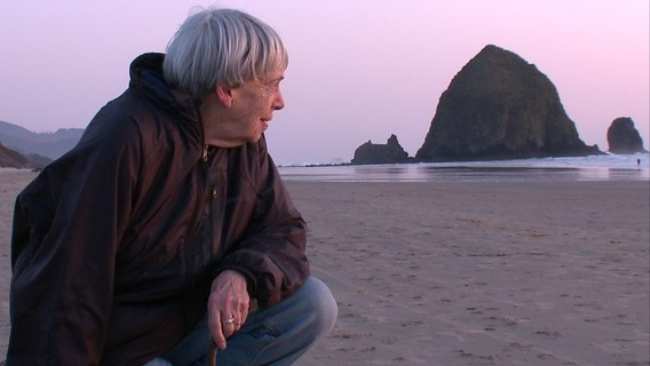
Ursula K. Le Guin once talked about embracing that word, “crone” as an honorific. For most, it is pejorative, inherently agist and sexist, but Ursula argued for a different take. The crone has experience and perspective, intelligence and awareness. The crone is old because she has lived long and prospered. She has earned respect, even though she rarely gets it.
“In her essay, ‘The Space Crone,’ Ursula Le Guin wrote that old women would make the best space explorers. Free from the daily tasks of rearing helpless children, free to see and comprehend without vanity, loving life because we know we may have to leave it soon, we would embark on our journey to the stars not for ego or planting flags but only for information to transmit back to our grandchildren for their future explorations. We know by then that we are part of the flow of life.”
I heard her talk about crones in the 1990s when she was about what my age is now. She wrote this essay twenty years earlier in 1976, when she was in her late 40s and I was in my 20s. It’s the first essay in Dancing at the Edge of the World, which includes her speech “Hunger” that I teach each year. Half that volume is made up of collected book reviews about writers such as C.S. Lewis, Doris Lessing, and Molly Gloss.
Kate Atkinson objects to book reviews written by authors, and particularly to a reviewer declaring her a “matron” in The New Yorker. I understand she considers the term disrespectful. I get it. She’s right. It wants to connect to “society” as in society matron, some woman with grown children who works on charitable committees without ever dirtying her hands. Matron, according to common use and the dictionary is a married woman, especially a dignified and sober middle-aged one. Like “bitch” maybe it’s time we took back the label of matron, the way Dick Gregory took back “Nigger” when he used it to title his memoir, so his mama would know that when she heard that loaded word, it was someone talking about her son’s book. Except that never quite worked and the n-word is still a bad’un.
Like racism and sexism, agism is something we’d like to pretend does not exist. In our youth-obsessed, age- and death-denying society, everyone past high school feels pressure to be young. How many times have people declared: It’s only natural to want to be young? Maybe. But in most past cultures, even the feeble old were regarded as having earned respect. They are the holders of what we now call institutional knowledge.
A woman I worked with on the local arts council assured me decades ago that “the great thing about being 70 years old is that no one expects you to look young anymore.” She made me laugh. We both laughed. I admired her home, her view, the wooden blackbird hovering over her dining table. I admired her ability to be who she was. I was 30-something at the time, no longer “young” but still uncomfortable with “middle aged.” I clung to Gloria Steinem’s incredible birthday riff about turning forty. “This is what forty looks like. We’ve been lying for so long, who would know?” Except, she was always beautiful, still is, and she’s 84 now. Gloria Steinem is old. She is even that worse thing, elderly.
I will be 66 next week, and I am old. (In medical terms, I am also elderly, but I resist that term. It belongs to my next decade and the one or ones after, should I be so lucky.) I am old, not middle-aged, not young. And I am not “66 years young” which is a pathetic claim to my mind. I am not living backwards. I am not trying to look 35 or 45. I am what I am. I am tired of guilt about youth. I am weary of being told I should yearn for youth, that I should strive for it, that I must always be forever young. I am not young.
Ethel: “Hey, I just met the nicest couple…. In the woods.”
Norman: “Couple of people?”
Ethel: “No, a couple of antelope. Of course a couple of people. Their name is Migliori, I believe…. They’re a nice middle-aged couple, just like us.”
Norman: “If they’re just like us, they’re not middle-aged. Middle-aged means middle, Ethel. Middle of life. People don’t live to be 150!”
Ethel: “Well, we’re at the far edge of middle age,” she says: “That’s all.”
Norman: “We’re not, you know. We’re not middle-aged. You’re old, and I’m ancient.”
Ethel: “Oh, pooh! You’re in your seventies, and I’m in my sixties.”
Norman: “Just barely on both counts”
[In fact, Hepburn was 74 when she said those lines. Henry Fonda was 76. Both were genuinely old, but not ancient. Hepburn was 94 when she died in 2003, but this was Fonda’s last theatrical film—he also made a TV movie that year. He passed early the next year, in 1982.]
There is nothing I want back from youth but the ability to run distance. I could still do that when I was 58. I would like that back. Yes, I truly would. But it won’t happen. I can walk for 2 hours and run short distances, but I will never run 6 or 16 miles again.* I mourn for the loss of that running freedom, but I honor what living, reading, and thinking have given me at my age.
I have experienced much, read many books, and thought deeply. I have never stopped reading and thinking and observing the world. There is still learning in my life. I am subject to change. That last should be another posting.
In the mean time, I have lived long and prospered. I have earned my age. Give me the credit I am due.
______________________________
*UPDATE: In October of 2022, the week before my 70th birthday, I ran a 10k in 71 minutes, 9 seconds. That’s 6.2 miles and I was 8th of two-hundred-something in the 65-69 age group. Whoo-hoo for me!
further UPDATE: I completed the same run the next year, a little slower but came in 2nd in my age group of over 200 runners because at a week before my 71st birthday, I was 70-74. Yeah, elderly now.

[CLICK TITLE TO READ MORE] Just now, sitting up in bed, I have already updated my progress on Ursula K. Le Guin’s last book No Time to Spare. Le Guin ruminates about, among other things such as her cat and overpopulation, the meaning of spare time. Here I have to stop for a moment.
Through my email inbox, The Literary Hub offers links to various articles and I read one or two of those. The New Yorkers sends me the frequent Borowitz Report. I read the headline and kicker, but I do not click through.
The New Yorker wants me to subscribe. This is my “last chance.”
I read a good deal every day. I read stories from three newspapers (I subscribe online to two of them) and some days I read stories on NPR or The Atlantic. I read Brevity—both the blog and the magazine. I read short fiction on four SF/fantasy websites. I receive daily posts from three poetry websites, and occasional ones from a poet and an educator, plus a handful of others. Sometimes I even read whatever book I am carrying around. In the school library I look over a magazines.
I do not read The New Yorker cover to cover, though I have a friend who has been doing that since we were both in high school, going on 50 years ago. I have an attitude about The New Yorker. I am not their target demographic.
Even when Jamaica Kincaid was writing Talk of the Town, I found the magazine elitist and representative of a view from, as Walter Lee Younger declared, “a bunch of hustling people all squeezed together being Eastern.” Richer than me, too. It is one of the magazines I find in the library. I enjoyed Zadie Smith’s essay about (finally) discovering Joni Mitchell. I sometimes read the fiction, which used to be common in magazines and is still featured there. I routinely urged students to check it out for full length literary analysis essays, another increasing rarity in mainstream magazines. I do not subscribe.
These days, I subscribe to Poets & Writers, which I fail to read, and occasional other literary journals, which I also fail to read. This failure to subscribe has not always been my practice. There were years when I subscribed to many journals and read each one cover to cover, particularly making note of fiction. One year, when The Best American Short Stories (BASS) came out, I had already read all but two of the award-winning stories.
Then my thesis adviser, as I was completing my MFA, asked: “Why bother to submit to journals? No one reads them.”
And I realized that I didn’t read them anymore either. It was the most depressing thing anyone had said to me since my mother began dying. I felt that my literary goals had been shot dead on the spot. Certainly this was not the intention of my mentor, but it bit deep, even so.
The New Yorker wants me to subscribe, and I am a reader. But no. I will read in the library and I will read periodicals online and save the paper.
I will not be subscribing. It is not my last chance. I receive such emails at least once a week. The New Yorker will offer many others.
In the mean time, I am not done myself. This is not my last chance. I will go for a walk this morning once it is light enough to see. I was asked to bake a birthday cake for our youngest grandchild’s 2nd birthday party. EV just turned two. She likes pink and she like berries so there will be wild huckleberries in the cake, blackberries tinting the buttercream pink, and raspberries on top. I will be busy today making lemon curd, a layer cake, and buttercream. There is a lot to get done and I have only an outline of my day. I have not yet begun.
At 65, I accept that some things are pretty much over for me. No plans to run another 10k. I will not be teaching full time again. Not ever. But I am still doing most things I love. I am writing every day. This is not my last chance.
What I do now is not my last chance, but I have no time to spare.
 IMPERFECT PATIENCE