BURNING

IMG_2225

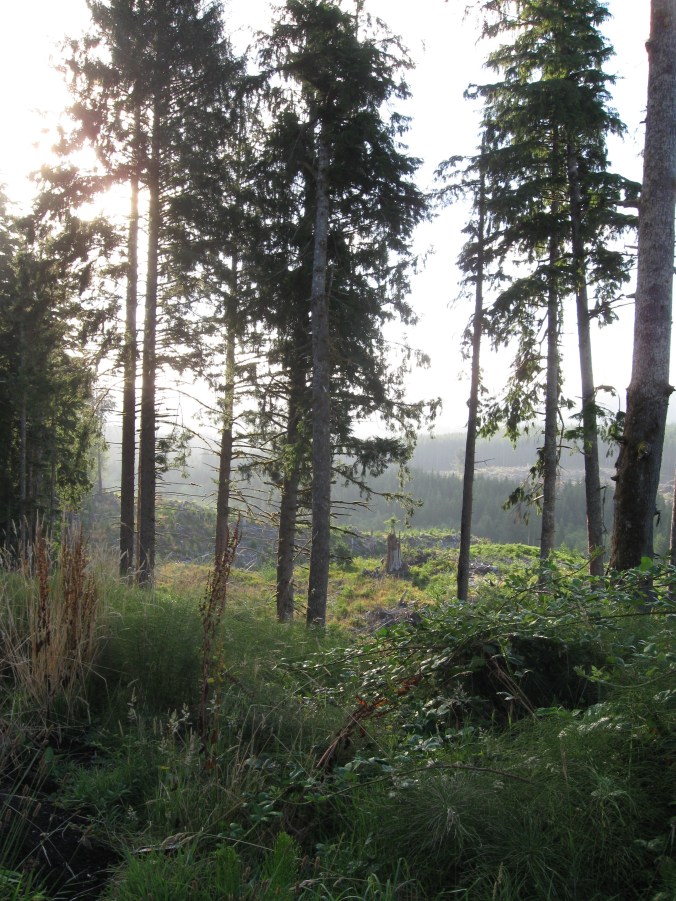
This is “managed forest” in the Coast Range. There is an abundance of fuel for fire.

The West is burning.

In 1975, Canadian friends picked me up in Seattle to ride with them to Colorado. The driver was Jeff, and Jeff smoked cigarettes. At one point, he tossed the lit butt of a cigarette out his window. It was early September, the end of a long, hot, dry summer. We were in eastern Montana and there was nothing, absolutely nothing to stop a fire in those grasslands.

This was something I knew was dangerous. I had been raised with respect for forest, and by a father who never tossed his cigarette butts. I said something from the back seat of the van. Maybe I said it was dangerous to throw a lit cigarette out the window, maybe I merely yelped and said he shouldn’t do that. I don’t remember what I said. I was thinking at the time about what I knew about fire, and cannot recall my words, What I remember is his irritated response.

“What do you care? You don’t live here,” he said.

Maybe we argued after that. Reasons lined up: I did live there. It is my country, my nation. My father was born in Montana. This sort of reasoning that because it would not be my field that burned I should not care was immoral. I should care. He should care.

The West is burning. The human body count continues the rise.

Pundits, politicians, and ordinary people would like someone or something to blame—errors in forest management, a camp fire, climate change, an unusually dry summer. All of the above? Answers are rarely simple.

Someone always points out that Native peoples set fires (every time, I see it). This doesn’t make setting fires a good practice. Humans in every culture have done foolish and cruel things.

Europeans drove entire herds off cliff faces. The BaMbuti pigmies roast songbirds alive because it makes their flesh more tender. Londoners drank water contaminated with typhus. Stupid.

My point is that what a small population can get away with is not necessarily the answer to our troubles today. One post I read claimed that Fewer trees/acre does not signify. I know from walking in the coast range that trees were once further apart. This was first, pre-logging, “old growth” trees with stumps six feet across. Most Americans will never see old growth trees that massive. And even so, there were forests so dense, a horse and rider could not pass between them. Most forest fires used to be started by lightening strike. Today, most are begun by humans.

The West is burning because we have more forest remaining in the West compared to the East; because climate change is causing forested, moist places to become drier; and because we start fires with cigarettes and electrical sparks and camp fires and good intentions.

California’s fire record dates back to 1932; of the 10 largest fires since then, nine have occurred since 2000, five since 2010 and two this year alone, including the Mendocino Complex Fire, the largest in state history.” Undergrowth, including the low growth after an area has been logged and replanted, allows for a fast-moving fire. The Tillamook Burn of 1933 destroyed 390,000 acres in western Oregon. The next three Tillamook Burns would take over 400,000 additional acres. It was so huge my mother and her sister swam in a warm ocean, and came out covered in soot. That one started from a spark from logging operations. A couple of years ago there was a fire a half mile east of our home in the coast range. That one started from a slash burn that went out of control in high winds.

Fire suppression, which worked for most places, played a part, but climate change, weather, and human beings played critical roles. Well, human beings mostly.

Even “controlled burns” get out of hand, and the research does not entirely support any method currently used to prevent fires, other than not starting them to begin with.

The West is burning and we are looking for someone or something to blame.


THESE VIOLENT DELIGHTS HAVE VIOLENT ENDS by Caitlin Gildrien

I don’t want to write
about California. I don’t want to look.
Did you know there were two new litters
of mountain lions in the Santa Monica mountains?
A mama can only carry one at a time. I don’t know
why that’s the thing that breaks me. It’s the world
that breaks me. We’ve broken the world.
Just past the tweet that tells me about the kittens
is a thread about Romeo and Juliet,
the Claire and Leo movie version,
and that is what I click through. How I loved that movie,
the fish tank, the kissing. I wanted to live
in a world like that, a world like this world
except slant. Better lighting, better language.
How you can understand it best
by not listening too closely. I think too much.
All the fish in that tank scooped probably from the sea;
how the sea is failing. I wanted to love someone
until they would die for me. I wanted to be the one
they would choose to carry out of the burning world.
When the fish stocks fail, when the Amazon tips
past the point for which it can compensate
with the meager reforestation it is allowed—
there should be nicer language for this in a poem,
I’m sorry. I just keep thinking of Juliet, who thought the sea
was infinite and so a good metaphor for love.
But we’re determined to find the bottom
of any bounty. They thought this continent
was boundless, too, and scraped it clean
to prove themselves its better. They.
Did you see that storm of smoke,
utterly apocalyptic, over the highway?
It makes a person say God. God, lift me
by the scruff. Or the throat, maybe.
All of us, maybe. Shake hard.
Be rough with love.

—from Poets Respond
November 15, 2018

__________

Caitlin Gildrien: “A friend who is a science writer tweeted about the mountain lion kittens, and though of course the costs of these fires are deep and broad for humans and for the rest of the environment, that fact really shook me—as did the way that Twitter shoves the somber and heartbreaking up against the trivial as though they are equally weighted. I was born in California, though I live across the country now, and it’s been increasingly painful each year to watch the fires become more uncontrollable. It’s one of the many reasons I fear for our future.”

Reprinted without permission. It made me cry.
CAT & SHREW

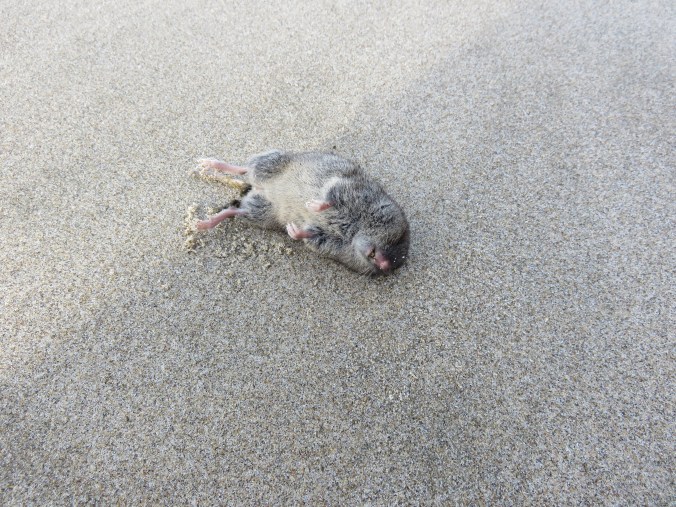
IMG_3595We found this shrew on the beach the other day. A sad little creature. We find fish sometimes, but also this tiny rodent which had no business a hundred feet out on the sand.

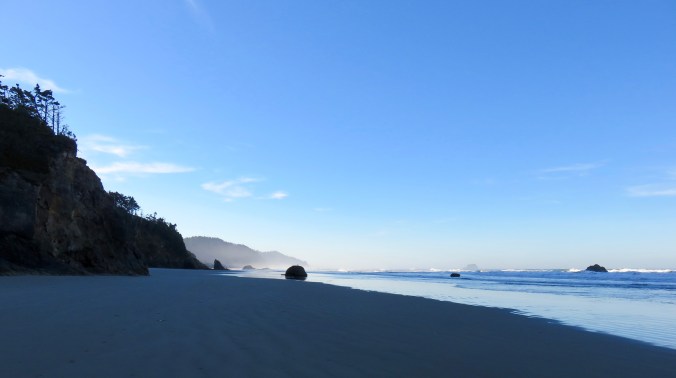
Every morning as we head out on our walk, I write essays in my head. They are usually the same essay about what treasures we find, about petting Roxxie, and about the trash we pick up. Sometimes write in my head about our nicer neighbors and sometimes I plan bitter exposés concerning the selfish, mean so-and-so who likes to lie to tourists.

Mostly, I do something else when I get home. This month, I go back to work on my computer. I was awake buy 5am and writing for National Novel Writing Month, thirty days of November to write 50,000 words of fiction.

I thought this month that I would write a science fiction novel. I had done the research, I had the characters and some of the action. In April I whizzed right through 15k words during NaNo Camp. I planned to restart this story from scratch. I thought it would be my novel for the year. I had questions I would answer as I wrote. I even had a list of chapters, an outline of plot. I would work on a five-thousand word section at a time. I had it figured out.

Theoretically, I was in good shape at the start, but my confidence almost immediately went to ground. My story about all animals—birds, reptiles, amphibians, and mammals—dying and only a handful of human survivors scattered across the planet did not need the 70k words I’d planned to write in November. I read a news story about loss of insects on isolated tropical islands and my story about seven women alone on a planet with only insects collapsed. Could I kill off the insects too? I abandoned hope oh me who entered here! This was not going to fly. I was unprepared to make the necessary changes. This was obvious by the third or fourth day of NaNo. What I felt prepared to write did not need even the 50k words that NaNo demanded. The story today is 37 pages and 11k words and has ended. True, I have a couple of places still marked “place scene here”, but these will add a couple of thousand words, no more and possibly only a page. There is no novel here. No possibility for a novel. There is not even a novella. My eventual 12 or 14 thousand words will make a novelette, and that’s before I go back to butchering. It’s an 8k story pretending to be something longer. Maybe it’s only a 6k story. Maybe, in the end, it will not be anything at all.

In the mean time, I have dug into my files and found fragments and even stories I thought were complete (they aren’t) to work on. I have a file with 49k already, but the last seven thousand words are a very old story that will have to be torn apart and rewritten from scratch. I pasted it into my NaNo packet because I hope that a single line will get me going. A woman thinks she sees a dead kangaroo in the grass beside the freeway, and her daughter thinks she imagining things. There are 141 words of dialogue and a good title. That’s what I hope will lead to a story of about five thousand words.

It’s like that poor little shrew on the sand. I don’t know how he got there. Or she. She probably thought she was on her way somewhere else. Sure this was not where she planned to end.

I called this post “cat and shrew” because when I was a little girl, my cat Mica was an enthusiastic hunter of shrews. I thought I might tell that story, but instead, as with NaNo, I went somewhere else/

IMG_3596

Anyone recognize this bird?

There was this hawk the other day perched in a snag on top of the cliff north of our home. Sometimes there are crows there or one of the ravens. Most often we see an eagle. We have seen a Cooper’s hawk because our tenant means to feed birds, but also feeds chipmunks and rats, which then feed the hawk. The doves too.

All of us are just muddling along I suppose.


VETERAN’S DAY

IMG_3604

We watched birds on the beach this morning, but it is Veteran’s Day, so Gary and I talked about our dads’ military service.

Gary’s dad joined the Army during World War 2, but was mustered out as a result of a hernia. He joined again, this time the Army Air Force and spent the war in Texas working on planes.

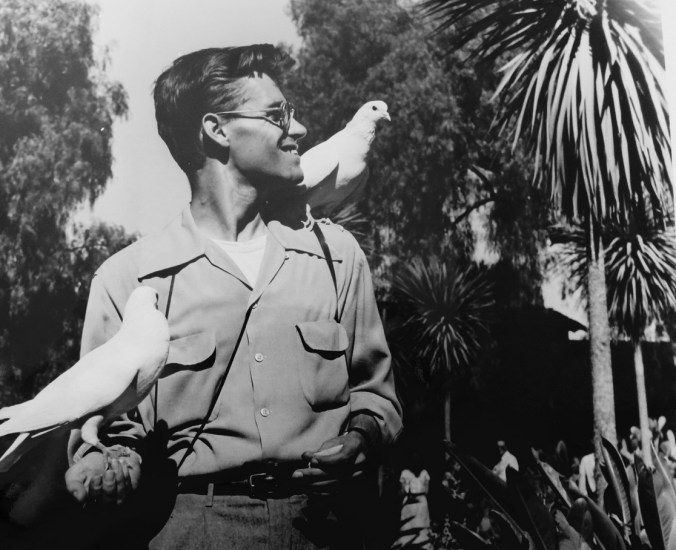
My dad joined the Army too. He served in France and Germany, was present at liberation of a concentration camp in Germany, and met the King of England while on leave. He was injured and earned a Purple Heart. He almost never spoke of the war other than to joke about rations, about how the men used their gas masks to carry things and he hung his on the back of a Jeep and laughed watching them away.

He contended that men who bragged about their wartime experiences had not seen what he saw.

What is most memorable to me was asking my dad about how he got into the service. Was I an adolescent when I asked? Older?

He said he joined because he would have been drafted anyway. Everyone had to go, he said from his corner of the sofa in the living room.

My mother was in the kitchen, wiping counters, but she stopped and moved to the edge of the room. “Art, that is not true. You wouldn’t have been drafted,” she said. There was anger, bitterness in her voice. “No. You worked in a sheltered industry. You did not have to serve.” He’d been at McDonald-Douglas, building planes my father-in-law took care of a thousand miles away. My mother went on muttering about his disastrous first marriage, the damage his wartime experiences had done him. She did not mean the leg injury and hospitalization. She did not know about his addiction to pain killers, a detail he revealed to me and warned me not to tell my mother. “She doesn’t know.”

On that day, I stood in the dining room where I could see them both. I looked from one to the other, knowing each was telling their truth. My father was beginning his long debilitation RA. Perhaps I was already a teenager at the cusp of my political awareness when I would march against the current war in Vietnam. The war was a problem for many people because the reasons for our involvement were clearly excuses, with no end in sight.

My father was proud of his service in the Second World War. My mother’s sister joined the Marines right out of high school, even though they arrested her best friend simply for having parents born in Japan. People did what they had to.

Another thing my father said about his war was that people who criticized the capitulation of France in the Second World War did not understand how that country had suffered a couple of decades before. I studied history, so I thought I knew, but it would be many years before I fully understood what he meant. It was a novel, a French historical novel, that revealed the incredible suffering of the French during the Great War.

The United States came late into each of the wars, late into the Great War, the Second, and Vietnam. We were spared the worst of things in those World Wars, entered the next ones thinking we would again be the great rescuers we had been before. We were wrong about that.

We had entered into war with Spain under false pretenses. Mark Twain wrote as much in his bitter satire, “The War Prayer” which was so critical of the paradox of any war that it could not be published in his lifetime. American entry helped to end two World Wars, and but our interference has been making trouble for self-determination around the world before and since.

I feel no happiness on Veteran’s Day. It is not a day to be happy. I honor those who risked their lives in the belief that they were helping to preserve a safe place in the world. They did their best, and sometimes they died. Sometimes they even achieved peace. These days, I find it hard to see how that goal is being served.

I would like the world to be safe for everyone.

13498088_10153800182133667_9184182959186154569_o.jpg

Today, he would have been diagnosed with PTSD. My mother always insisted that his experiences in the war “destroyed” my father. Here he is just after the Second World War.

RELATIVE

IMG_3580

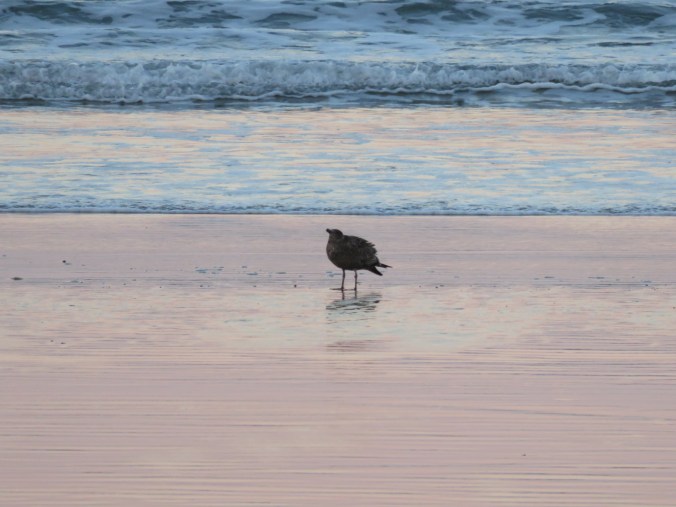
This young seagull was peeping for its parent, but that adult flew away.

When my husband was young, sometimes he would sit on the back steps in a parched Arizona payday waiting for his dad to get home with groceries. Another family of four children was left alone for the weekend that turned into a week or maybe two. The woman who told me about her childhood was not sure, only that even the mustard was scraped out of the jar by the time Child Services showed up.

My own childhood was not so deprived. I went without dental care and my mother mixed powdered milk and when I first tasted a real butter pat, it was like candy to me. In kindergarten, I had two skirts and three short-sleeved Orlon sweaters. For Easter, I had a new cotton dress. It is odd the things you remember. But we were never hungry, and my father’s mother and aunt had enough money put by that it was safe to assume we could borrow money if things got desperate, which they did on occasion.

This is to say, I was not raised poor. Raised poor is hunger and no one to turn to who is better off. “Poor” is so bad that we make up euphemisms like “economically challenged” or my students say a person is “not very rich.” No, poor is not having enough money to pay bills even though you live cheap. Poor is embarrassed because even when everyone in the household is working hard to earn money, money is still “tight” and bills are sometimes late. Poor is being blamed in our country.

And that isn’t fair. Innumerable studies show the sort of income necessary to pay for housing in different parts of the country. Recent studies are equally clear that poor children almost never receive the quality of education wealthier parents give their children. Their health care isn’t as good. What they suffer damage in childhood that their ability to improve their lives, quite permanently.

The truth is that wages have not kept up with inflation—they have been falling behind for decades. Telling someone that if they want to earn money, they should get a better job is like telling a person waiting in a wheelchair to run to the head of the line, like telling the five year old to reach something down from the top shelf, like asking someone who is starving in a third world country: “Well, for heaven’s sake, go to the store and buy some food!”

Sometimes we simply fail to pay attention.

Poverty is lousy circumstance, not a character defect.

I am reading Adrienne Rich’s essays in her new collection, Essential Essays: Culture, Politics, and the Art of Poetry, edited by Sandra M. Gilbert. Rich was a force of nature, a woman who found compassion for others when she granted it to herself. She reminds me that compassion is necessary, that affluence is not a free pass to righteousness, that everyone faces difficulties in life and it’s a good thing to remember that sorrow and trouble come to each of us.

Here is the first poem I ever read of hers:

Prospective Immigrants Please Note

Prospective Immigrants Please Note
Either you will
go through this door
or you will not go through.

If you go through
there is always the risk
of remembering your name.

Things look at you doubly
and you must look back
and let them happen.

If you do not go through
it is possible
to live worthily

to maintain your attitudes
to hold your position
to die bravely

but much will blind you,
much will evade you,
at what cost who knows?

The door itself makes no promises.
It is only a door.

Thoughts from Adrienne Rich

I believe that poetry is asking us to consider the quality of life. And it is reflecting on what makes it possible for us to continue as human. Under the barrage of brute violence, numbing indifference, trivialization, shallowness, that we endure.

Even when I was very young, I was reading poetry, looking for what it could tell me about how to live. For me, poetry has never, ever been just an escape from the world, an escape from history.

I think in this poem, what I am talking about is the choice that we can make, to move deeper into things, or simply to live worthily, maintain your attitudes, hold your position, even die bravely, but not to see what might have been seen. Not to grasp what might have been grasped. And that is a choice, for us all, whether in poetry or in life.

Our country has many truths, but certainly one of them has to be that this was never a democracy. That this was a hope of democracy, an enormous, an enormous hope for true democracy, and that it failed many people from the outset and it’s failing more people now.

I think that more and more people feel uncared for, feel that their lives are not only unvalued, but meaningless. Feel that though they may care for their lives, no one else will. Feel that the only way that they can protect their survival and their interests is by the gun. I’m afraid that many people feel an enormous desperation which plays into the propaganda of hate.

I think that poetry speaks beyond that, to something different. And that’s why it can bring those parts of us together, that are both in dread, and which have the surviving sense of a possible happiness, and a possible collectivity, a possible community, a loss of isolation.

These reflections are excerpted from an interview Bill Moyers did with Adrienne Rich in 1995 as part of The Language of Life series. Rich died in 2012 at the age of 82. You can read the transcript of her entire interview with Bill in our archive and read more of her poems at Poetry Foundation website.

FOOD for the HOLIDAYS

IMG_3574When Gary and I were in college at the University of Washington, Starbucks was a brand new store at the old Public Market, Pike Place. We did not drink coffee, but I shopped in Starbucks for spices and chocolate at the original store, and then later at University Village, at their second store. Spice and herbs were put up in little sealed plastic packets kept in gallon jars. Those jars filled a wall of shelves. The chocolate was broken into fist-sized chunks from ten kilo blocks imported from Europe. All the coffee was roasted locally.
Italian delis in the Market stored candied citron, lemon, and orange peel in enormous glass jars. These fruits were nothing like the gumdrop candied fruit found then and now in chain grocery stores. The lemons were the peel of half a lemon, with a bittersweet bite of lemon. I used these candied fruits and others when I baked our wedding cake in 1974 from a traditional 100-year-old fruitcake wedding cake recipe (white cakes were called “Bride’s Cake” back in the day). I found all the ingredients I needed at the Market.

By the time we’d moved to Oregon (a return home for me), we began drinking coffee, starting with instant. However, once we tried Starbucks, we could not drink anything else. For a time, we received coffee each Friday that had been roasted the day before in Seattle. Then the new CEO took over the company, and everything changed. Coffee was roasted not in NW Seattle but some other part of the country and we never enjoyed fresh-roasted beans in quite the same way again. For a time our coffee orders were the envy of our neighbors.

We also used to order from an Oakland, California deli-style food store when our boys were young. I ordered, actually, it was on me. In the late fall I went through their lengthy catalogue, searching for unusual food items like pappadams and pomegranate molasses. It was a holiday tradition, at least in my mind, to place a big order of unfamiliar foods,  spices and sauces and lovely pasta. The large box would arrive and I would unpack all those wonderful and strange foods. Food for Christmas.

The import food store I ordered from in the 80s was established in 1897, but these days all they deliver is sandwiches. I don’t remember when it became impossible to order foods from Ratto’s (the 90s, or later?) but somewhere along the way, we lost that habit.

Everything is available on Amazon now. And that is not the same somehow.

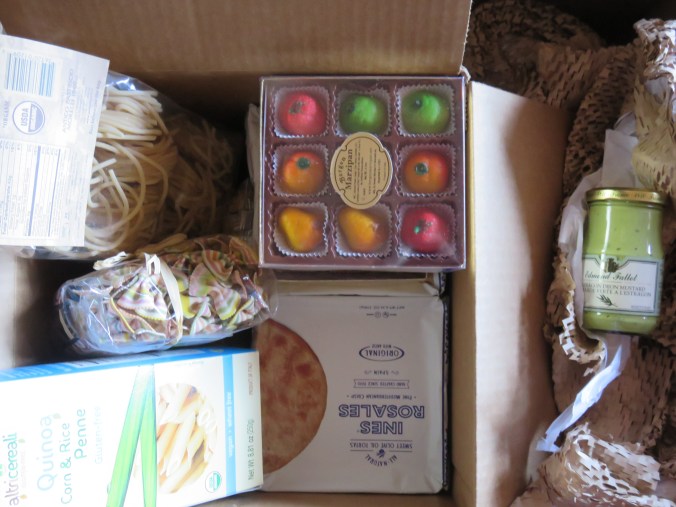
This year I found a small company selling the brand of imported tarragon mustard we like best and a lot of other good things. Yesterday, a big box arrived.

Some of the items from that box will be gifts—the tiny marzipan fruits are something I would have loved as a child—but two bottles of the mustard went straight onto my pantry shelf. Pasta went into my cracker and bread drawer, because even though I like making pasta from scratch, the striped bow ties were just too sweet not to order. Orange flower and rose water put up in glass bottles. The sweet olive oil Ines Rosales Tortas are crispy wafers that make a luscious breakfast with goat cheese and fresh raspberries—my favorite since I discovered the combination in Ashland when I was there for a Shakespeare workshop.

It might have been Thoreau or Emerson who said the only proper gifts were food and flowers—items that were useful and consumable, implying no obligation other than being edible and beautiful. We do not need things, but these packages of food are marvelous and entertaining. We will eat them and they will be gone.

[A nice detail is that everything was packed in paper, ruffle-cut waste kraft paper—you can see it off to the right in the photo above.]


LETTING THINGS GO

IMG_3578

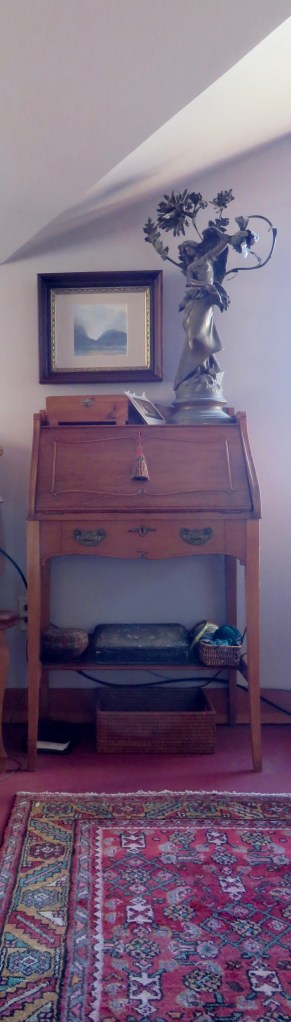
My grandmother’s desk.

My step grandmother gave a mandolin to Gary many years ago. He had the instrument cleaned and repaired but then nearly sold it after she died because somehow an essential family connection had slipped by him unnoticed. When I explained it had belonged to Genevieve’s father, he took it out again and held it. “Then it stays.” He also has a guitar made the year I was born. I like to think that is one reason he treasures it, but it’s the tone. I know it’s the pure, lovely tone that earns it a place in our home.

A friend chided me on Facebook: “NEVER get rid of musical instruments.”

The note was in response to my post of Gary with his Guy Fawkes bonfire and my words: “Gary is on the phone lamenting every single splendid guitar he ever let get away (not to mention the awful ones he laughs over), in his entire life. It is a painful litany and one I have listened to too many times.” The bonfire was of attic refuse from ten and twenty years. I told him about never getting rid of instruments. Gary says, “I get that.” Books, too, I was told should never be allowed to go.

There is a part of me that completely agrees. Books and music and art are essential and precious. Ridding oneself of such things suggests we do not want them, and that is almost never the case. We want it all.

We never want to “get rid of” musical instruments or books.

Sometimes we choose to let go.

Over recent years, I have given away or sold hundreds, perhaps even a thousand books. I just counted twenty-eight bookcases in our home, some as wide as six feet, others just two. Some are six feet high, some just three. There are thousands of books in our house. None are kept in the attic anymore, and only a few dozen are stacked on the floor behind the couch upstairs. I am not allowed to discuss Gary’s instruments in details, but he has “several.” I have books I walked down to the bookshop in Aurora Village to buy when I was twelve, and books I finished reading last month. We have no free local library, so most of the books I read were purchased used, often from Powell’s Book Store in Portland. I no longer keep books if I do not love them.

My husband and I, as I have explained in earlier posts, are engaged in Swedish Death Cleansing, a pragmatic approach to discarding and giving possessions we do not need.

I sort through my clothing. I love clothes, always have, and I know I have too many hanging in my closet, not to mention the tub of genuinely vintage things I have held onto since high school and college. I give things away to charity. I cannot keep it all.

Recently, I went through my jewelry box. I pulled out family pieces for my daughters-in-law. I set aside pieces for my granddaughters. And I gave a box of jewelry to my son to sell on Ebay. We offered many things to family first. People, in case you have not noticed, no one wants the family furniture or china or sterling either. You jewelry is costume or old fashioned or both and no one wants it. If he or anyone liked something, I said to keep it. The money will pay for a new roof next year, or at least a tiny corner of a roof.

Sometimes possessions accomplish more negative than merely taking up space. I gave away my enameling kiln, sold boxes of yarn for a fraction of what they cost me. I was not using them, and their existence in our home felt like a reproach, a lack of industry. And honestly, industrious is pretty much my middle name. I let things go to relieve guilt for not having made more of them.

And sometimes we have had no choice but to sell.

Decades ago, Gary sold his amp because his dad was out of work and could not afford to pay bills. In college we sold our entire collection of Maxfield Parrish prints. We did not mean to “get rid” of them, we needed money to buy bread and pay tuition.

Sometimes by choice, but always the result of some sort of need.

These days, stacks of books everywhere in our house meant I could not find the one I wanted amidst the dozens or hundreds I would never open again. I still have thousands of books on shelves.

Guitars and books have left us because we were not using or reading them. Sometimes Gary traded up for a better guitar. He could not afford to keep every one he ever owned, and we would not have had space to store them. And there is no one to love them when we are gone. If we are not enjoying them, they simply take up space.

Not everyone is experiencing this, I understand that. We could have left our attic stuffed, and I could expand my clothing to fill every closet in the house. But we have sorted attics for others who passed and did not want to leave that task for our family. Our family does not have room for even the stuff we love best, much less the stuff we are indifferent to.

There is an entire social network, an industry of sorts, devoted to reminding us again and again that we are not our possessions, that this gathering of objects is an inadequate substitute for gathering of the self, for questioning and self-awareness. Humility.

My husband and I took stock after dealing with the deaths and possessions of relatives. Our lives were cluttered and if the clutter was not useful to us nor interesting to our family and friends, I still believe it is for the best to let it go to someone who cares.

We do not rid ourselves, we let go.

NOT BOX

IMG_3567

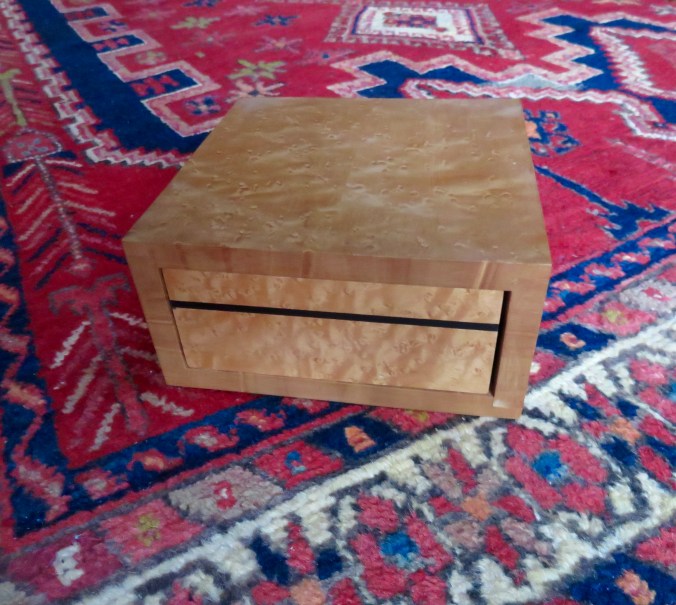
The “Not Box” made from a single narrow board in 1974.

I felt the cold coming on Monday night. I tried to convince myself it was nerves. It is my first real sickness since I retired.

On the 7th of July, I put money down on a desk that I had been saving for since the year before. On the 7th of November, they finally came and picked up the desk that had sat unused for three weeks. It was not what I wanted, not what I ordered. Wood this shop calls “Western Walnut” is sourced on my coast and every example on their website shows wild, dark chocolate, purply grain. Deep. Rich. I showed the salesman exactly what I wanted. What I received was a beautiful desk of milk straight grain like milk chocolate teak. It about broke my heart. (It will look fine in some trendy mid-century modern house—I’ve no doubt it will sell once it’s on display in their shop.) They tried to make it good, but not hard enough. I am sorry for this very expensive lesson learned, $620 at least to ship it here and back, and yes, I am expected to pay both ways. If they try to bill me for restocking too, I suppose I will shriek.

Wood grain and color is variable, unreliable, as I know from experience. The appearance of rough cut hardwood lumber can be deceptive. Picture cedar fence board—that is the surface, splintery and dull—and wetting the wood gives a hint of its finish color. The only way to be sure is to plane it smooth.

In college I went down to the Seattle warehouses to sort through rough hardwood boards. Stacks leaning against the wall and into racks in rows. I found a single rough maple board that would reveal tiny knots, a pattern called birdseye maple. The “eyes” are tiny knots, and such boards are generally sliced thin and used as veneer. Constructing even a small object out of solid birdseye seems a little wasteful, but it’s what I did in college. I ran it through the planner to find the pattern and then designed and built an object to use every scrap of one small, narrow rough board. I made a “Not-Box”, a single drawer in a box with a stripe of black ebony, a precious strip of black wood, also purchased rough and planed to 1/8th inch. I have the leftover ebony, barely two inches wide and a foot long, still flat and true, smooth and hard as glass after all these years. I think, sometimes, of make=ing something of it. I could score lines and create a ruler.

I bought walnut too, back in those woodshop days, choosing boards in the rough and no certainty about how it will look until I’d run it through the hog. A family friend gave me a fourteen foot “English brown oak” board he’d had nailed to the inside of his workshop for decades. In 1974, my friend and I ran it through the planer in the University of Washington shop. “I want to show you what we did,” said the patient shop foreman who was teaching us how to use tools. There were chips all over the cutting edges. He had never seen oak do that to a planer, what teak can do without using carbide steel. Later my son would use some of that wood to fashion a guitar in high school.

I made a walnut triptych frame for cloisonné enamel and an ash bench which I have never used. My joints were never perfect. Wood is not forgiving of error. Even metal can be reworked, and I was raising sterling from a flat disk into a tall, narrow vessel at the same time I was making mistakes I could not correct in wood.

I know about wood.

This morning I feel better, though I was lying in bed when they picked up that desk yesterday. (The careful men scarred the walls carrying it up and scarred it again going down, but our narrow staircase has seen worse. I will repaint.) I had not left the house since the previous morning. Our granddaughter does not know how to talk on the phone. I have managed over 12k words for NaNo, thought I think I wrote only 149 words yesterday. I have not been knitting or weaving or piecing, and only a little reading. I have slept. I have avoided the news. It is not good enough.

This morning I feel better. My throat is not so sore and I can breathe through my nose. Better, not well. Gary wants me to stay home today. He tries to take care of me, but the Senior Research Papers are due tomorrow, so I will head to school early this afternoon, just in case.

Gulls are running across the roof.

I might get a walk today. A light run used to be my cure for a cold.

THE PLANS

IMG_3533

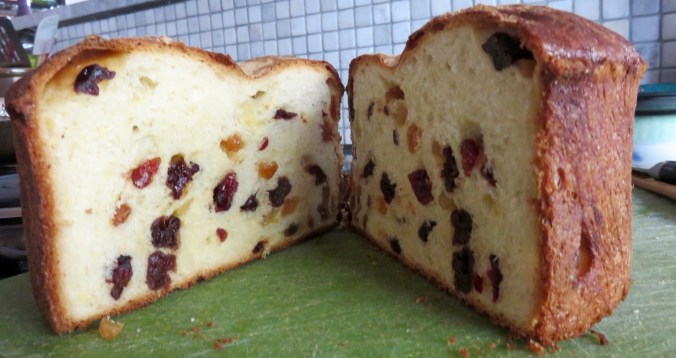
My first panettone. 

Last night I started the dough for panettone. This morning I mixed the dough and set it to rise, and that’s when the trouble started.

An hour before they went into the oven, Gary had plans. “Bring your breakfast and I will hold things up. You don’t even have to touch it. Just say yes or no,” he said.

My husband was determined this past summer to empty our attic, the spaces north and south behind the knee wall. He was entirely successful. The spaces are empty, the roof only barely leaking, and most of the contents given away. Most.

What is left? A stack of “old” good stuff for our son to sell on Ebay and a dozen or so cardboard bankers boxes with “school stuff” I will never use again. There was also a fair-sized cardboard box with rolls of plans and prints of plans and my original plans drawn on translucent paper. There had been another box of these, or perhaps two boxes. I thought I’d rescued all the architectural plans I needed or wanted to keep, but then he unrolled plans for a house I’d forgotten I designed. I remembered it only vaguely from those years I was designing additions to coastal dwellings and entire houses.

There were many more than I recalled: homes and home additions in Gearhart, Little Beach, Tolovana Park, Cannon Beach, Arch Cape, and Falcon Cove. This began in 1983 when I was a new mother with preschool children when our tenant asked if I could make an architectural model. I said, Of course, though I had never done anything of the sort before. My model was the wrong scale and clumsy, but it satisfied the homeowner who was leery of a roofline redesigned to meet a local covenant. She was pleased enough to ask me to design the interior, with the architect’s blessing. He was glad to be shut of this difficult client.

That first project led to work for several homeowners, architects, contractors, and myself too over the next ten or twelve years. I designed and supervised the building of my brother’s home and my mother’s. Neither paid me, and I missed work to complete them, but sacrifice is expected of daughters. I tiled the entry, kitchen backsplash, and the tub surround, floor and wall of Mom’s house. I had to quit my job to get it all done, but she was hysterical most of that time. The contractor went far, far over budget. (It would be years before I understood how little that contractor cared about honest billing.)

The houses I am most fond of were the Buckley House in Tolovana Park and my mother’s house on Jefferson Street in the Presidential Streets of Cannon Beach. I have not passed any of these houses other than my mother’s, which is painful since the new owners remodeled all the charm out of it. I loved that house, and I cannot bear to look at how they ruined it. Mom always promised to leave it to me, but she sold it instead because she liked having cash. It is a sad memory. Perhaps that was what my mother meant when she told me the day she died that she had been cruel to me?

I stopped drawing plans once I was a full time teacher, which paid less, but gave me a steady income and work I enjoyed a great deal. I always thought I would design one more home, from scratch and just for Gary and me, but alas.

In any event, I had forgotten how many projects I completed. The one I live in is good and well, though I find that I changed it from my drawings as we built. The plans tell an interesting story and there a great deal more, what we refer to in the family as “The Big Mess.” That is no fun at all, still a mess in our minds.

The attic is no longer any sort of mess. The atrium, where Gary staged his sorting of attic stuff, is also no longer any sort of mess either with just the two neat stacks destined to leave us permanently. In the house, there are still four original Thonet bentwood chairs labeled 1907, purchased in 1968, when I was in high school. They want recaning and free to a new home. Anyone?

Today, I have begun National Novel Writing Month with 1404 words (so far), somewhat under my goal. And I am supposed to complete knitting the first sleeve for Ruby’s birthday sweater. And really, I would like to curl up with hot chocolate and a slice of panettone.

I made two loaves in pans I had, not proper panettone paper pans, and substituted regular for instant yeast and other things. It was still wonderful!

PREPARATION

IMG_2587

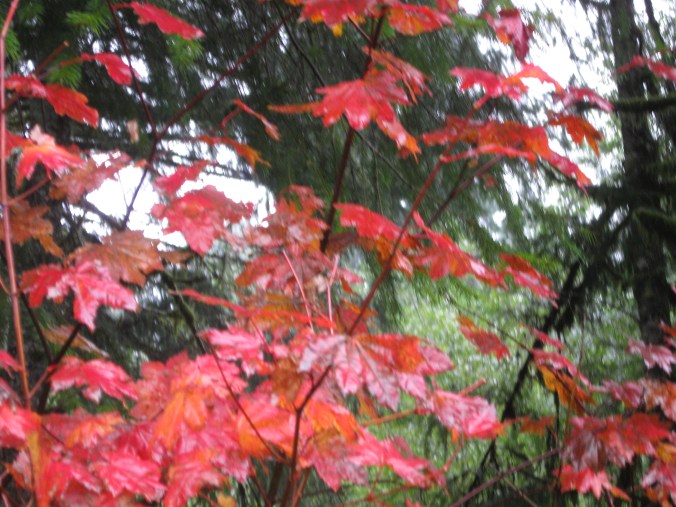
The rain is finally here, and the tide sweeps up over sand that has been dry for months. The last time we drove over the coast range, vine maples were turning scarlet and purple.

It is only October for one more day and I have been receiving weekday recommendations for holiday preparations from Apartment Therapy. I do not live in an apartment, and the therapy offered is useful to me mostly for the photographs. (I am one of those people who almost never reads magazines, not even the captions. I only admire the photographs. Now, between Pinterest and the library, I don’t buy magazines. It is a financial savings like quitting smoking, except I never smoked.)

The weekday emails have advised me to make a gift-giving list, purchase just one holiday gift, organize my holiday card strategy. Mostly I have found myself one step ahead in planning and preparation. Nevertheless, I enjoy the reminders. My favorite so far is “Do an act of kindness on Day 4. I sent a card to someone who was recently unkind to me. This was intended both as kindness and as a way of reconnecting with a person I care about.

eqyzrphyqtzfbwzzftrqlfqqwqfrjhqpsywsdypftppt~.gif

DAY 8:

Book an appointment or service you need for the holidays.

Think about that thing you always put off or forget until late in the season, when all the good appointment times are taken or—gasp!—your favorite provider is all booked up through New Year’s Day. Today, call them up or fire up the app and make the appointment.

Nothing came immediately to mind.

If nothing immediately comes to mind, here are some services that might jog your memory. If you read something and your gut screams out, “oh RIGHT,” that might be the task for you today.

  • haircuts or color
  • eyebrow grooming
  • manicures and pedicures
  • spray tan
  • facial and spa services

The list goes on quite a bit further, including pet care, house cleaning, travel, and professional photographs. But I got stuck on the first five that concern personal grooming.

I have not had my hair cut since the mid-60s. The last time I put color on my hair was a few years ago when I was playing with purple. Mostly I was fortunate in my eyebrows, which used to be quite dark and well-shaped. They are now going gray, and I cannot be bothered. I have never had a manicure or pedicure and every time I consider the process, I remember that I really do not enjoy strangers touching my body in an intimate way, and I think about nail fungus (which I dod not have and do not want). Spray tan reminds me of the person in the White House, so that’s out. Facial and spa? My skin might thank me, but it seems a waste of money.

The man whose admiration I care about, the only man I feel any need to impress, is easily impressed. Frankly, he is the only man I am interested in. Lucky, yes.

[Next month, though I have not even used mascara or lip gloss in a while, this may change. Hanging around with teenagers tends to make me feel dowdy. A little color?]

Thinking over all of this had me reviewing what my holiday preparation actually look like. I buy gifts all year long, I plan gift wrapping, which is the most onerous task of the holidays. We mail only a few gifts. I design cards (though so few people send them anymore that some of the fun is lost). I bake and decorate the house with lights and ornaments and nutcrackers.

Teaching is not part of my holiday preparation, but my part-time job teaching college writing begins next month. Three weeks sandwiched between Thanksgiving and Christmas, and right on top of Hanukkah. (It will be a busy time because I have 33 students on my role and I am scheduled to use a math teacher’s room. At least the desks are flat, though when I went in for a peak I could not find 33 chairs.)

Years ago, we hosted a holiday party on a mid-December Sunday. It was an Open House in the afternoon, usually 2 to 4 so that it was clearly not lunch. We furiously cleaned before the party. I came home after work each day and worked my way down the refreshments list, baking and freezing.

We did not serve alcohol, and that might be the secret to having a pleasant time. I made mushroom pastries and curried filo triangles, fancy cakes with nuts and fruit, a Java cake, cookies, and a dip made with homemade chili relleno and a pound or more of grated cheddar that always disappeared moments after I put it on the serving table. It was not lunch, but people could get a meal out of it.

We invited family, the neighbors and everyone we worked with. Sometimes we had over forty people in the house at once. People stood around and talked and we played the Muppets’ Christmas album or The Anonymous Four. Though I am uncomfortable in social situations, it was not a long party, and a lovely time. Post party clean-up took only a little over and hour. By dinner time the house looked neat and festive and we generally had enough leftovers that I did not have to cook for a couple of days.

[Our first Saluki, during her first Christmas party, peed in the middle of our bed in front of Ted Tallman, who asked, “Does she do that often?” No, never before or since. She disapproved of the crowd.]

One year, my brother and mother (who lived nearby) gave their excuses, did not attend, and we stopped after that. It seemed a lot of trouble with so much preparation and almost no one reciprocated.

It’s been a long time, but I think about those parties still. I miss the preparations! I miss the people!

Maybe it is time to reestablish that tradition. Either that or find a hotel and fly away.

Those parties demanded a lot of planning and cleaning and baking, but I love to bake, and the result was smiling with friends and a week before Christmas, our home was beautiful.

This morning we heard rain and tomorrow is the start of National Novel Writing Month. I will be writing each day, and for the month, if there are any post, they will likely be brief.

‘When something like this happens . . . ‘

44758674_10219065663539373_8219845102713962496_n.jpg

Many people are finding it emotionally challenging to watch the news these days. They do not feel connected to events, to politics, to the ebb and flow of our national debate. I understand that.

Just last week I was thinking over my personal experiences with accidental shootings leading to lost use of legs, to murders, and to suicides—yes, plural for each. I have known no one who was killed by a serial killer or terrorist, but people I know have been crippled and murdered, and all were the victims of white men. There is nothing unusual about that. In my country, most murderers and terrorists have been white, male, and Christian, even when the majority of citizens were not.

I love and would trust with my life, most every white male I know personally. They would not harm anyone based on color, religion, or politics. They are joined to one another through their communities and by love and respect.

So then, the past few days.

Things happen. Terrible things happen to everyone. A father commits suicide in the driveway while his daughter desperately beats on the locked car doors and windows to stop him—something similar happened to more than one of my students. A girl slept on the dirt floor of a shed, determined to stay with her homeless mother who was mentally ill and drug-addicted. A father returned from Iraq with no visible wounds but still changed beyond recognition. A student hospitalized, not for the first time, in a mental facility. Mothers and fathers died. A student drowned. Students died in car wrecks. Students killed themselves.

Ask any teacher in a weak moment and they will share their stories.

Then there was the student who slammed a school desk into a wall, the one who threw a chair, a padlock. The ones who did not want me to know what bothered them. The cruel parent, the near fatal overdose, the guilty confession of keeping score of girls, the marks on my board to count off the days without drinking.

I do not know how to adequately respond to cries for help. I have done my best as a mandatory reporter. I have offered comfort, I have listened. I have tried to be what my students needed from me, and often I have failed.

What leadership and decency look like:

“When Rabbi Joseph Miller learned of the Squirrel Hill massacre, less than a mile from his own pulpit, he ordered the doors of his synagogue locked,” Franklin Foer writes. “Despite his congregants’ terror that they would be next, they recited the mi sheberach. They didn’t pray for their own protection; they prayed for the healing of others.”

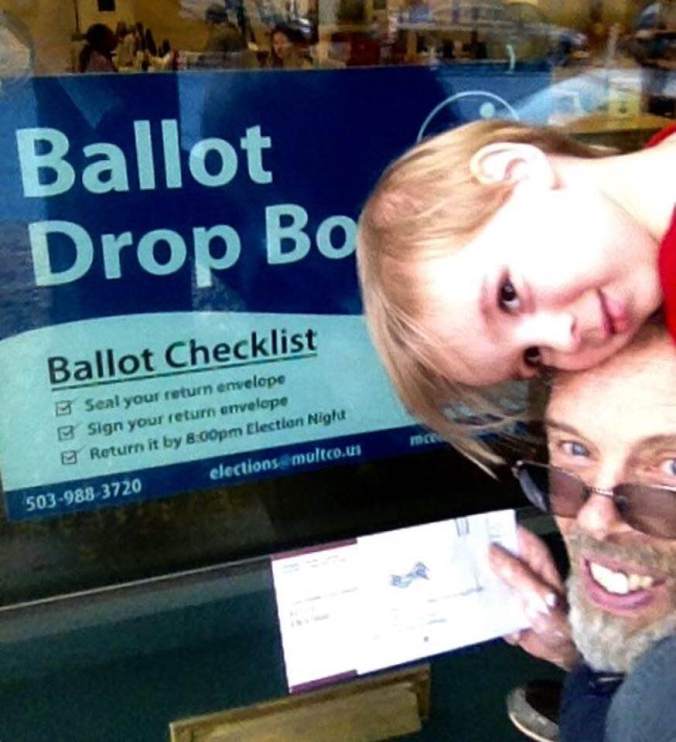
A dear friend has just managed to let those of us who were concerned know through social media that she is well, despite hospitalization with a terrible health crisis. She begs people will vote in lieu of flowers.

There is no point trying to avoid the pain. It comes and it comes. We can deny our responsibility or face what comes with compassion and care. The best we can do is take steady, honest steps toward healing our beleaguered nation.