MUDDLED MAY

fullsizeoutput_f3b

The ODF&G lists ten species of shrew found in Oregon, but no photos. It might be Trowbridge’s shrew (Sorex trowbridgii), first described in 1857, though it does not resemble the dead shrew in the Wikipedia entry.

Yesterday we spotted a shrew and I followed it about for a couple of minutes, trying to capture photos of its tiny face. This was a small critter, just over an inch across, and it poked its head into the grass repeatedly, upending itself into little depressions and then moving on, apparently looking for shelter. Shrews often use holes dug by others such as moles. (So do salamanders.)

Shrews have a bad reputation, and though I find them sweet, I am careful not to antagonize them. The last one I saw close up was a round ball carried to my feet by our gray cat Zora. It looked like a fat black cherry in her mouth, and she did not intend it as a gift. She fairly spit it out onto the grass. It unrolled itself and rustled across the moss and between blades of grass struggling to be a lawn. Zora glanced down when it made a six-inch dash, but then lost interest. That shrew got away.

Those who predict say the summer will be dry this summer. An early burn ban. Trees and entire unwatered gardens drooping. Just now a gull landed on the roof, that tide came in high last night. I heard the drizzle as I dozed, reluctant to get out of bed. I slept past five, a good night for me, but our walk will be postponed. It is a luxury to choose the time of day for our walk.

May is a muddled month. Typically, the weather runs from cool and wet to heat. This fools us each time into believing summer has arrived. June will change all that. Reliable summer arrives in July. I know this. Weeks past the solstice, it will be dry.

Time for sharing need.

The shadows of bats

flicker across open windows. 

IMPRINT EACH DAY

IMG_4160

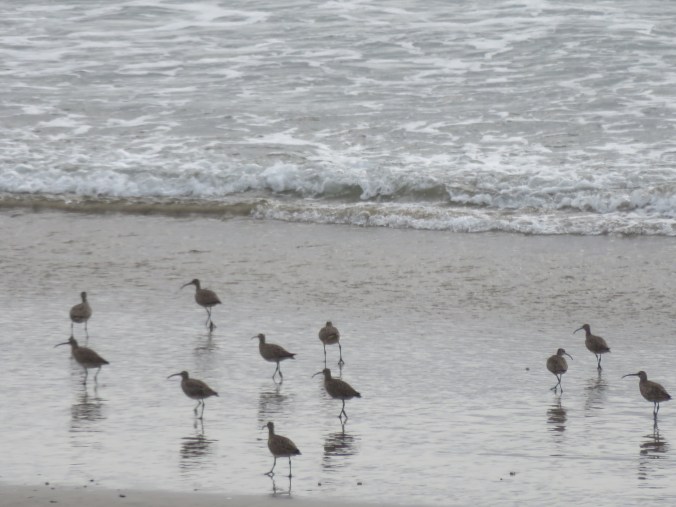
Whimbrel imprints in the sand.

We walk nearly every morning and some days, when the wind drives onshore, we fill our bags with trash. Other days, like this morning, there was hardly a thing cast ashore. Most trash comes from the ocean.

All of Gary’s Mother’s Day wish is gone this morning. I thought the sand dollars had been swept away, but Gary points to the busy pattern of footprints even above the high tide line. Someone has gone out late yesterday evening and collected them. We do not mind. Take more, we say aloud. Take the other shells left as an offering on the edge of our path. Take the garden clippings Gary will not burn unless the weather turns damp and the wind blows off-shore.

We hope it was a neighbor’s child who took the sand dollars, a child not enrolled in school and not being home schooled, whatever might be the excuse. Her parents have told her that in the fall she will start at the local private school—a strong producer of entitled local youngsters, a few of them independent and charming people, but too many who think they are more important than the rest of the world. Nevermind. The little girl’s parents cannot afford to pay for trash pickup. Private school?

In the mean time I wonder: Is this something I must report? Since I am retired, am I still a mandatory reporter? Do I think this is neglect? I have known many mandatory reporters—teachers, doctors, counselors—who failed to report. My mother was still driving when she could barely walk. Where was the mandatory reporter then? No one ever thanks you for doing this duty. I have known both parents and students who never forgave me. That’s why it is mandatory, that is why I do not need to be sure. I need to have doubt.

Still.


Maggie Rue Hess

A HOUSEKEEPER’S VILLANELLE

I learned the beauty of futility, and now I know its sorrow
from cleaning rooms at the Holiday Inn;
what you tidy today will need you again tomorrow.
There’s a satisfaction in work whose effort you can show,
soothing to proper corners what is chaos when you begin.
I learned the beauty of futility, and now I know its sorrow,
because there is no end to the process. You must borrow
time, must accept that the struggle is the win:
what you tidy today will need you again tomorrow.
Is it never done? How do you live when you must go
through the same back-bending motions day out and day in?
I learned the beauty of futility, and now I know its sorrow.
Remember that it’s not just about hotel rooms, though;
it’s just as true for hate, failure, pain, or sin.
What you tidy today will need you again tomorrow.
The good work never sleeps: a housekeeper would know.
We clock in and clean up again and again.
And I—I’ve learned the beauty of futility as well as its sorrow—
what I tidy today will need me again tomorrow.


from Rattle #63, Spring 2019
Tribute to Persona Poem

Mother’s Day

fullsizeoutput_f35

IMG_0718

me with Alan

The courage that my mother had

Edna St. Vincent Millay, 18921950

The courage that my mother had
Went with her, and is with her still:
Rock from New England quarried;
Now granite in a granite hill.

The golden brooch my mother wore
She left behind for me to wear;
I have no thing I treasure more:
Yet, it is something I could spare.

Oh, if instead she’d left to me
The thing she took into the grave!—
That courage like a rock, which she
Has no more need of, and I have.


fullsizeoutput_f3a

Spelled out in sand dollars by my husband.

fullsizeoutput_f37

Me with Ian, Logan, and Ruby last year.

BOOK ORDERS

IMG_4120

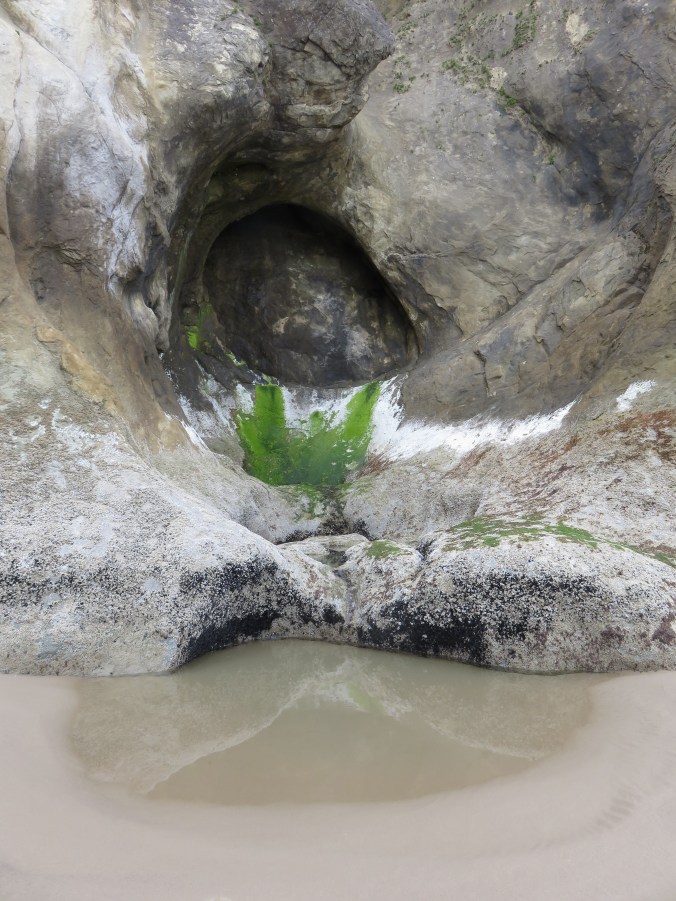
I think of this as the Big Altar. Sometimes in summer that back wall shows lime green.

I received notice this morning that I saved $5.66 on the order of a book I have absolutely no memory of ordering six months ago. And another one, a book costing over twenty-five dollars, hard cover, by an author whose name I do not recognize, is coming in September. I think I must have read a short story by this person on-line. Maybe?

What I was actually thinking about this morning was the sound of the dawn chorus—the chattering and peeking and calling of a variety of songbirds that I particularly enjoy in late spring with my bedroom window open. Too quiet this morning. I hear the eurasian doves flirting. I hear the ocean, always the ocean. I hear my husband clearing his throat downstairs.

And I was reviewing memories of other lives I have lived. Pushing teaching off to the side, I was once a goldsmith, a sighthound field trial judge, an illustrator, a teenager. These were exhausting and interesting occupations—still fascinating to me after all this time.

My husband came upstairs and told me that I was not hearing the birds because they did not come on duty for another twenty minutes. I wanted to believe he was serious.

A crow.

I opened the novel the day before yesterday and worked for a couple of hours. I found a typo. I found a half-page repeated twice because I had rewritten it and then failed to delete the first version. I liked the first version better so I deleted the revision. I think I have still failed to scatter the ashes of the dead. If I open the manuscript today in order to scatter the dead, I think I will only find a typo.

I will begin the right front of my youngest granddaughter’s pink cardigan instead.

IMG_4122

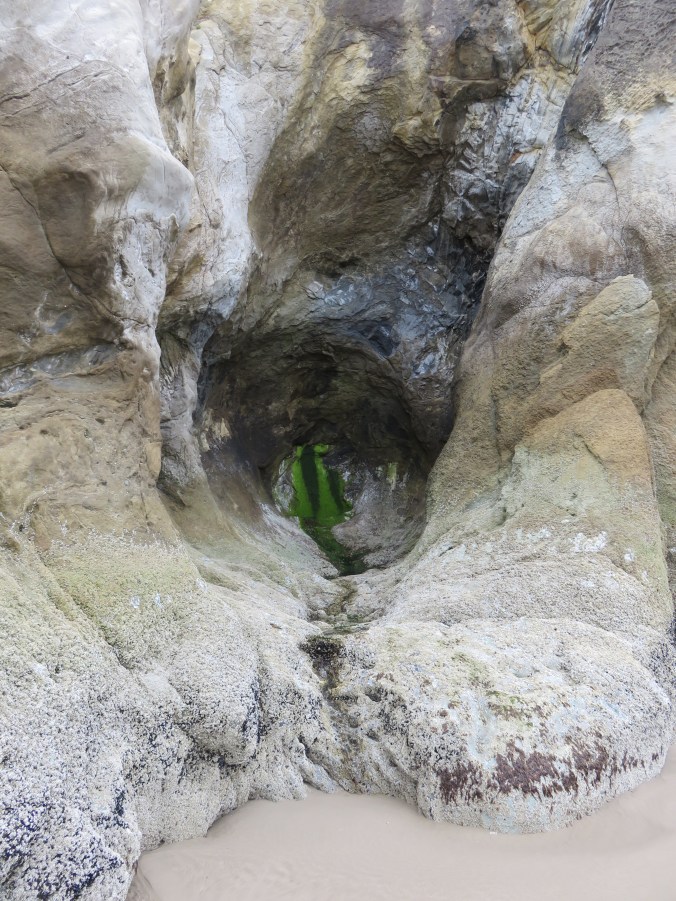
This is the Little Altar.

‘4 Dead in O-hi-O’

The best-known popular culture response to the deaths at Kent State was the protest song “Ohio”, written by Neil Young (who was Canadian) for Crosby, Stills, Nash & Young. Gary was playing the song early this morning, one of only two he plays on specific days. The other is for the day he failed to pass his draft physical. Both are connected to the Vietnam War, then often spelled Viet Nam.

Forty-nine years ago today.

“The Kent State shootings, also known as the May 4 massacre or the Kent State massacre, were the shootings on May 4, 1970, of unarmed college students by members of the Ohio National Guard at Kent State University in Kent, Ohio, during a mass protest against the bombing of Cambodia by United States military forces. Twenty-eight guardsmen fired approximately 67 rounds over a period of 13 seconds, killing four students and wounding nine others, one of whom suffered permanent paralysis.

“Some of the students who were shot had been protesting against the Cambodian Campaign, which President Richard Nixon announced during a television address on April 30 of that year. Other students who were shot had been walking nearby or observing the protest from a distance.

… “The question of why the shots were fired remains widely debated.

“Many guardsmen later testified that they were in fear for their lives, which was questioned partly because of the distance between them and the students killed or wounded. Time magazine later concluded that “triggers were not pulled accidentally at Kent State.” The President’s Commission on Campus Unrest avoided probing the question of why the shootings happened. Instead, it harshly criticized both the protesters and the Guardsmen, but it concluded that “the indiscriminate firing of rifles into a crowd of students and the deaths that followed were unnecessary, unwarranted, and inexcusable.”

“The shootings killed four students and wounded nine. Two of the four students killed, Allison Krause and Jeffrey Miller, had participated in the protest. The other two, Sandra Scheuer and William Knox Schroeder, had been walking from one class to the next at the time of their deaths. Schroeder was also a member of the campus ROTC battalion. Of those wounded, none was closer than 71 feet (22 m) to the guardsmen. Of those killed, the nearest (Miller) was 265 feet (81 m) away, and their average distance from the guardsmen was 345 feet (105 m).

“There was a significant national response to the shootings: hundreds of universities, colleges, and high schools closed throughout the United States due to a student strike of 4 million students, and the event further affected public opinion, at an already socially contentious time, over the role of the United States in the Vietnam War.”—Wikipedia
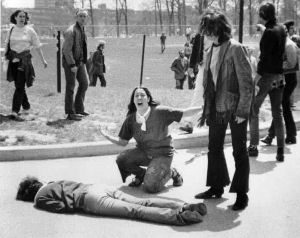
Kent_State_massacre.jpgThere was a march in Seattle after the killings at Kent State. It was 1970, and Gary was working at the University Book Store since the year before while he was still 1A. (Few businesses would hire a man with that status—who knew when he might be called up for the war?) His physical in June of the previous year changed his status to 1Y, and he was “safe.”

That  day, the management of the book store told employees if they wanted to participate in the Kent State march, they were free to go. Feelings about the war had shifted dramatically in the country. Increasingly, soldiers were not viewed as heroes, but as victims of an unjustified and criminal violence.

Gary walked from work and remembers looking down a major street as he marched and seeing a solid wall of people walking before him. march-on-45th-485.jpg
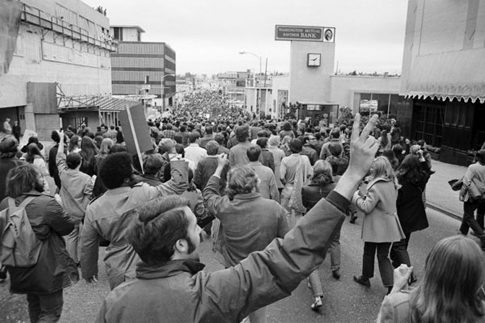
I was still in high school during those years, of course, but I also went to marches, including that most significant one. Thousands of people started in the University District, marched downtown and then back to the U District on the Express Lanes of I-5, because the mayor closed the lanes to traffic. News reports I can find describe the day in a way quite different from what I recall. Many thousands of students marching, yes. Police in riot gear, not so much. (That was a different day when I was shoved from a sidewalk onto a street downtown by officers in riot gear. Imagine the threat I posed, all 114 pounds of me!)

There are three distinct memories I have of that day in May 1970. As we walked through downtown streets, professional people came out of office buildings in their three-piece suits and in pumps and walked with us. I saw that happen. We passed buildings I knew, though I saw no one I knew. Perhaps Gary and I were walking together then, but that is not part of my memory. It was the sense that so many people opposed the war, so many ordinary decent people agreed the killings were unAmerican.

I walked quickly to get to the front of the marchers. I would not attend the rally at the end, because I had to get back to my mother’s car. I was in a hurry, because I had to be at work for the evening and closing at my job at Taco Bell where I’d been working since the year before. Because it was not my first march, I recognized people—some of them specifically from other rallies and some in a sort of general way. A handful of dark-suited men at a previous march taking photos were not part of the anti-war movement. On that day, despite the many thousands of people I saw, there were people who did not belong, men I thought of as paid agitators. Some scruffy men at the front of the Kent State march were not familiar. They turned over trash cans and newspaper stands. These strangers were trying to start trouble, trying to make a peace march violent and we didn’t let that happen. As we righted trash cans, people standing on sidewalks cheered us.

At work that late afternoon, I had changed into my uniform but I was still wearing my black armband. My boss confronted me, asked me why I was wearing it, told me to take it off. I did remove the band, but then he said it served those protesters right that they were shot. They had no right to go march, that they were throwing rocks. I said, fine, you go downhill with a handful of rocks and I will stand uphill with my rifle and let’s see who gets hurt. This exchange happened in the front, but with no customers around. I was shocked, horrified, and I remembered the people who had joined the march downtown, the ordinary adults who marched with us. And then I turned, walked around the steam case, past the sinks, the stoves, and his office, and out the back door. I got in my mother’s car and drove home. I found out later from the assistant manager that Rob thought I was in the bathroom for at least an hour before he realized I’d left. He wanted me back, but I never went back to work at Taco Bell.

I often recall those days of marching for peace, our optimism that we could make the world a better place, that our protests would change the world. In some ways they did. Anyway, times did change.

Rob would watch the store sometimes from across the street, using binoculars to ensure there was always someone up front, that we did not close early, that we did the job right. He also shorted our paychecks and did not pay us at all for closing, and I had gotten very good at that, developing a system that covered all the cleanup and mopping and storing of food to get us done and out the door in minutes.

When I found out that a new boy I was training was already paid more than I was, I confronted Rob. “But Tim is a boy and has a car,” he said as if even an idiot could see that. I might have had a car if he’d paid me more, I said, though in fact my money was set aside for college. It was really a terrible job.

I am proud of that day, start to finish. I am proud of the anti-war movement. Increasingly as I age I wonder what sort of madness takes us into sport and war with the foolish notion that the “best man” wins?

Sometimes good people are shot while crossing campus between classes. Sometimes good people have to stand up for what is decent and right. And, of course, often the “best man” is a woman.


NEXT?

IMG_2882

Yesterday morning ravens came to eat the stale bread we threw out. An eagle flew low over our heads, and we found the pile of abandoned “treasures” dumped from some child’s bucket. It must have looked like food. Only two gulls stood in the stream. The sky was bright blue all day.That afternoon I counted twenty-eight whimbrels.

There are even more this morning and we are walking out as this goes post goes live. I like thinking someone will read this while we are a couple of miles north on the sand.

To prepare for today’s post I checked back four years ago to the first time I (almost) retired.

I entered a classroom as a teacher-in-training in 1975, had my first job later that next year at a private girls’ prep school. After moving home to Oregon I worked as a substitute teacher for a long time in the English Department, but I quit teaching altogether this past March. I taught high school for over thirty years, and I substitute taught for another decade.

Each April morning between about four and about seven, I spent writing. I do this sitting up in bed. Some days I went right on writing for the rest of the day. It was a busy, reckless month. We went away for two nights. More recently, windows have been open sometimes this week. The ocean is always calling. Today we will get our longer morning walk.

Another retired teacher asked me recently what I would do now that I am retired? It is a good question for which I have no answer. Will I do something new, or merely divvy up my time in a slightly different way? I suspect the later.

What I miss is community. During the past month, various workshops, and my MFA program, I found that writing group I feel I needed. . . . At least for a month or couple of years or a few days at a time, but not regularly. What I have are a few people who will, if I ask not too often, read my work.

My original writing group was twenty years ago and it was only me and one student. B was the first sophomore we skipped over Sophomore English into the most rigorous junior class. This was pretty much necessary since she was, in skill and ability, far beyond her peers. She needed the challenge. She was the one junior in my senior class as well, and one day I walked out of the Faculty Room and there she was coming out of the Library. “Do you want to write together this summer?” I said. She agreed. We thought we would try writing a novella, just for the challenge because it is longer than a story and neither of us had written anything long. We weren’t even sure what a novella was, so while I was busy ending the year in yearbook, B researched.

After school ended in mid-June, we began writing and meeting weekly to share and respond to each others’ work. Neither of us wanted to look bad to the other. We worked hard. The manuscripts forged ahead, the stories growing beyond what we’d expected from ourselves, beyond our early goal of seventy pages or so of a novella. I discovered what a messy process I have, and B discovered she could do anything.

By August we each had a full length novel. Since I had a publishing connection, our books were read by HarperCollins. They liked B’s quite a lot. It was far the better of the two. (A senior editor wanted to see more, but HC was about to undergo a transformation and this went by unexplored by B.)

B has published since—poetry and academic writing, books, magazine and journal articles. She is a professor of English and much in demand. I have had publications too.

Later, I nominated a student for a writing award, which she didn’t win. But she went on to an MFA in fiction.

A third student was for a time a respected slam poet. And a fourth student completed an MFA in poetry from a program that rejected me twice.

Many of the students I had the pleasure of working with for a term or the better part of a year, have gone on to careers in education, the military, the government, and various professions and occupations in the private sector. Many of them earn more than I ever have. Many are smarter and more talented than I am. They are good in their various fields.

Someday they will retire too.

I receive emails about submission opportunities almost every day, but I rarely send out fiction anymore. I don’t know what I will do about writing. Duotrope shows many fiction submission in the past 12 months, but these were nearly all agent queries about the most recent novel, and now that is completely rewritten. I am not sure what to do about that. I have other work to submit, but that will take some organization. The poems too. I keep thinking I should print them all off and see what I have. There is a warp on the loom, waiting to be completed. Two quilts fight in my head. I have worked on a pattern for a grandchild’s cardigan.

Several times I have joined writing groups in the past twenty-odd years. More than one fizzled. Another decided fiction was too much trouble. Another turned out to be social, and I did not want to drink wine and smoke dope. (That word, “dope.”) I don’t know what  new thing will be that I pass on to.

That word “passing.” We pass tests, pass by, pass it on, pass Go, pass through, pass as something we’re not, pass out, pass under or around, pass over, pass away. Time Passes. So many ways to leave the building.

Francesco del Cossa

3may_1.jpg

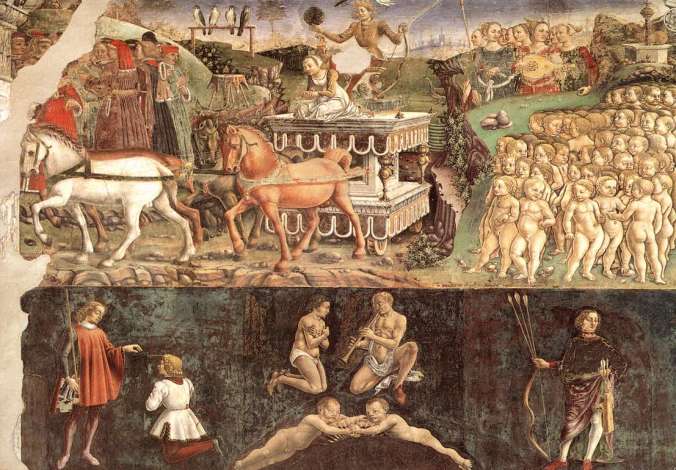
Allegory of May – Triumph of Apollo, a fresco by Francesco del Cossa (c. 1430 – c. 1477) was an Italian Renaissance painter of the School of Ferrara.

“Cossa is now known for fresco decoration of the summer pleasure villa/palazzo known as the Palazzo Schifanoia, located just outside the city gates. Together, they painted a series of the elaborate allegories around the themes of zodiacal signs and months of the year. These were only partially restored in the 20th century, and there are three that are reasonably assigned to Cossa. Of these, one of the most remarkable images is the horde of naked toddlers in the Allegory of May – Triumph of Apollo.”

“The façade was originally decorated with a cornice of feigned battlements, its surface smoothly stuccoed and decorated with geometric designs of highly colorful imitation marbles, which have been lost, lending a somewhat dour public face to Palazzo Schifanoia that was not what Borso d’Este intended. The rich white marble entrance door survives, though its tinted colors have weathered away and art historians disagree whether it is to be attributed to the painter-designer Francesco del Cossa or to Biagio Rossetti. Above the arched door, flanked by pilasters, the Este arms are displayed and the unicorn, a symbol of ducal benevolence and the source of patronage. In 1493 the terracotta cornice was added to designs by Biagio Rossetti, who was also commissioned by Ercole I d’Este to extend the palace.

“From the Salone dei Mesi the visitor once passed directly into the gardens reached by a monumental stair from the summer loggia, structures that were demolished in the 18th century. After the Este left Ferrara in 1598, the palazzo was inherited through successive heirs, eventually by the Tassoni family, its frescoes whitewashed over. Eventually, during administration of the duchy as part of the Papal States, with a Habsburg garrison, it became a tobacco warehouse and manufactory. When Palazzo Schifanoia came into the possession of the comune of Ferrara in the aftermath of World War I, only seven of the months in the Salone remained legible.”—Wikipedia

Listing this under the category of “color” is a stretch. I had to create “ART.”

Camp NaNo day 30: The Last Day

fullsizeoutput_f2c

Camp NaNoWriMo word count: over 45,000 as I type this before 7am, Tuesday, 30 April 2019

So. I complete my month of furious (not angry, just driven and desperate) writing, and I outstripped my original simpler goal of ten thousand words. I have journaled and written essays and book reviews and worked on stories and revised a novel and begun revising another, and not all those words found their way into my official word count. I completed reading and reviewed several books, for example, and only one review is included in my NaNo pages. I wrote emails, responses to news, and rants about politics and population and poverty. Most of what I wrote will never be read by anyone other than myself. Sometimes I merely thought about things. 

Expect nothing more from me for a while.

Camp NaNo day 29

Saint Lucy, by Francesco del Cossa (c. 1430 – c. 1477)

Camp NaNoWriMo word count: 43,032 by early Monday morning, 29 April 2019

The light was coming as I typed on Sunday, early-early.

Food52 is promoting a new cookbook that recommends buying small and often, using everything up as you go along, and yes! that is what I have been trying to do lately. Most of the Food52 article is common sense advice I already follow, but confirmation is always welcome. My crisper has only one lemon and some apples. I supposeI should make some sortofapple tart, preferably without sugar. Last night I thawed out the next-to-last last season’s pesto and made a pizza to use up the fresh mozzarella. Years ago when our fridge died I tried earnestly to get by with one of those tiny dorm-sized fridges, the ones about the size of a generous waste-paper basket. Milk and cheese and butter filled it. No room in the tiny freezer compartment for berries or peppers or anything beyond either an ice cube tray or frozen peas. One the other, not both. Condiments were a huge challenge, and my family thought I was mad. I argued that we really could not afford a new refrigerator at the time. That was not entirely true. Eventually I gave in and we bought a new fridge. There is this attitude that we must have twenty cubic feet or more of chilled storage, but many Europeans manage with tiny refrigerators or none at all by purchasing what they need for a meal and then using it up. Americans tend to gather stuff in the their fridges until they could condiment a regiment and the crisper goes sodden and has to be emptied directly into the trash. I have too many spices too. I dumped a jar of very-much out-dated dried Italian herbs the other day in order to have the jar for an herb I use frequently. I am wondering if my herbs, spices, and condiments should be marie-kondoed like my clothes closet—taking note of what flavors spark joy and discarding the rest? 

I have emptied both crispers now, used the sourdough start for the pizza dough, and consumed the recommended daily amounts of fruit and vegetables. The cheese drawer still contains seven cheeses. There is real bakery bread waiting to be toasted. (The stuff sold in plastic bags bears almost no resemblance to actual bread. Even the “whole wheat” slices smash into a lump the way we once turned Wonder Bread into a ball as if it were raw dough.) 

A TNYT story reveals the impact of our poor diet on mental health because “most Americans are overfed in calories yet starved of the vital array of micronutrients that our brains need, many of which are found in common plant foods. A survey published in 2017 by the Centers for Disease Control and Prevention reported that only one in 10 adults meets the minimal daily federal recommendations for fruit and vegetables — at least one-and-a-half to two cups per day of fruit and two to three cups per day of vegetables. Nutritional psychiatrists like Dr. Ramsey prescribe antidepressants and other medications, where appropriate, and engage in talk therapy and other traditional forms of counseling. But they argue that fresh and nutritious food can be a potent addition to the mix of available therapies.”  We all need, as my mother would say, to take better care of ourselves. 

Inhale a bit of a horror story and found a market to submit it to. Tuesday is the final day for Camp NaNo. Tomorrow. Tomorrow. Tomorrow I will finish this task and move on to something else.