LET THERE BE JOY

Academy of American Poets
75 Maiden Lane, Suite 901
New York, NY 10038
info@poets.org

Dear Friend,

Please join us in congratulating our Chancellor Joy Harjo on being named our nation’s newest Poet Laureate! Harjo was elected an Academy Chancellor earlier this year and received the Academy’s Wallace Stevens Award for proven mastery in the art of poetry in 2015.

As a poet, a teacher, and a literary leader Joy Harjo has touched many lives and many communities. She now has what is one of the largest platforms a poet can aspire to and it is a well-deserved honor. We’re thrilled for Joy and for the nation on this historic appointment.

We’ve enjoyed wonderful partnerships with our Poets Laureate. Since the position was created in 1937—a year after our organization was incorporated—more than half of the poets in this esteemed role have been Academy Chancellors. We look forward to continuing our tradition of celebrating our nation’s Poet Laureate and supporting Joy however we might.

Read this special Q&A with Joy about her new role.

Learn more about Joy Harjo.

Read poems by Joy Harjo.

Sincerely,

PERSONAL

IMG_4373

It was probably 1973 and Gary and I were managing the apartment building while we were students at the University of Washington. I was just twenty years old when we had dinner with the owners of a cat we liked, Slump. Slump’s people were educated and had traveled and in the course of the meal I began talking about an horrifying situation, a news story about abuse of women in an Eastern European country. Gary recalls this and also Tom’s response: “What do you care? You don’t know those women.”

Mitch McConnell does not understand why Jon Stewart is so upset about the failure of Congress to make adequate provisions for First Responders who were exposed to toxic substances while protecting and rescuing people, and later bodies, from the Two Towers after 911. He didn’t get why Stewart was “all bent out of shape” about caring for these sick and dying men and women. (You might recall that First Responders were assured they were in no danger from toxins, which was later revealed to be a lie from the Bush administration.)

“I want to make it clear that this has never been dealt with compassionately by Senator McConnell,” the former Daily Show host said. “He has always held out until the very last minute and only then, under intense lobbying and public shaming has he even deigned to move on it.”

Why, McConnell wonders, does Stewart care so much?

Why should anyone care about anything that does not directly impact them?

I would like to think most Americans would be as confused (if not downright horrified) as Stewart feels. Compassion is not dealt out evenly, but a complete lack of it is puzzling to me. We are seeing it a lot lately, these men and women who have so recently entered politics, this current regime devoted only to power and position.

But still. As you do unto the least of these . . . why is that so mystifying?

TODAY

The fathers in my life have all been good men. I am grateful, too for the father-in-law who was so kind to me. Not everyone is so fortunate. These men did not ever, so far as I know (and I have always paid attention), abused people, picked fights, or assumed they were entitled simply because they were who they were. They were and are all the other things, the things anyone might hope for in a father: loving, patient, and present parents.

I have decided to cut back on gift-giving, at least a little because I overdo, and to do something otherwise for holidays and birthdays. So today, happy Fathers Day! And may the days that follow be fine and sweet!

IMG_0894 (1)

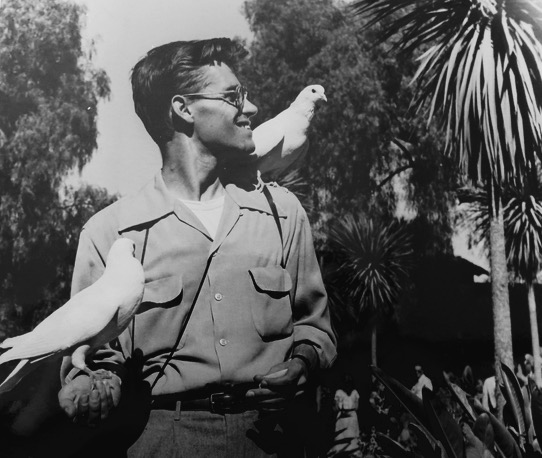
My favorite photo of my dad right after the war. (WW2)

IMG_4371

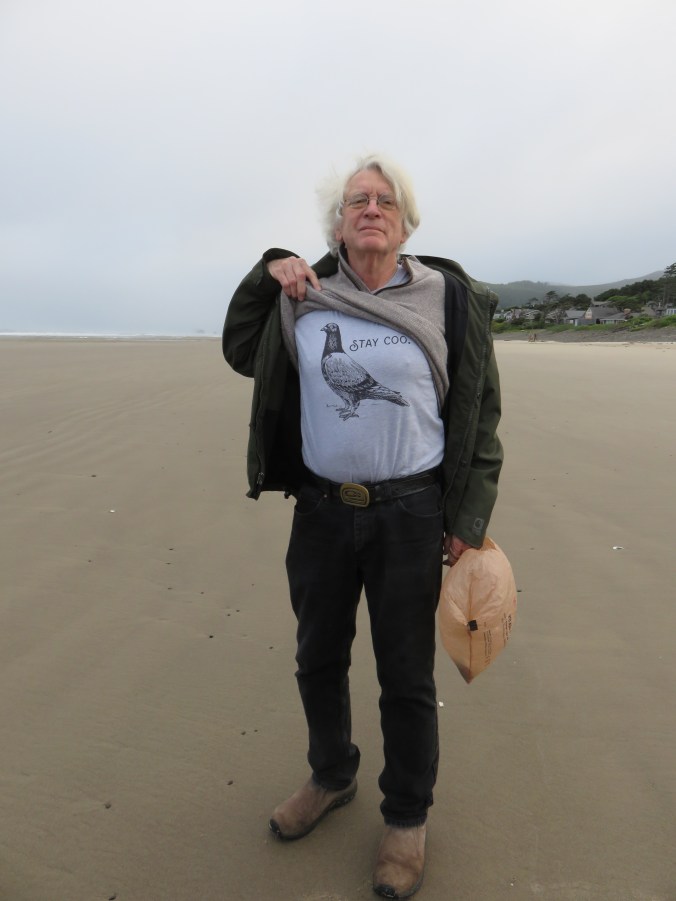
Gary had pigeons as a boy in Arizona. Here he is on our 40th anniversary on the coast! Today.

20190614_101952 2.jpg

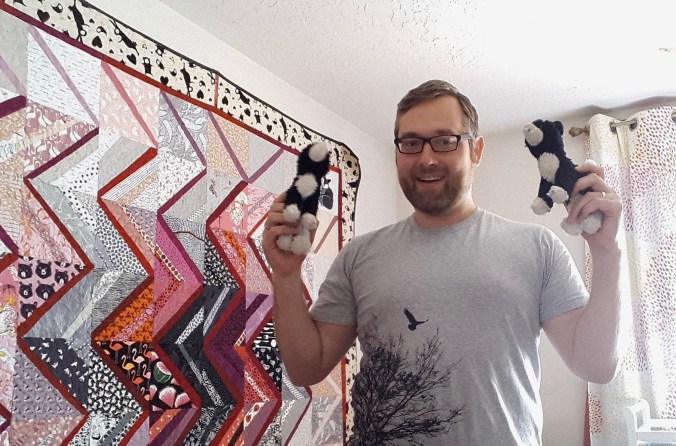
Our firstborn in his daughter’s room. She has two dogs.

IMG_6911.JPG

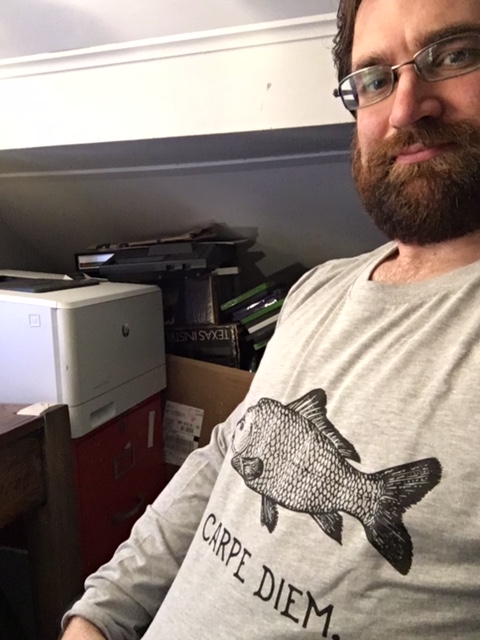
Our son who says he has now “arrived at the fish pun landmark in life.” 

My favorite father poem. A poem I have shared many times. They often struggled to consider discipline a good thing, to recognize that the child’s screams are hysterical, not literal.

The Gift


To pull the metal splinter from my palm

my father recited a story in a low voice.
I watched his lovely face and not the blade.
Before the story ended, he’d removed
the iron sliver I thought I’d die from.


I can’t remember the tale,

but hear his voice still, a well
of dark water, a prayer.
And I recall his hands,
two measures of tenderness
he laid against my face,
the flames of discipline
he raised above my head.


Had you entered that afternoon

you would have thought you saw a man
planting something in a boy’s palm,
a silver tear, a tiny flame.
Had you followed that boy
you would have arrived here,
where I bend over my wife’s right hand.


Look how I shave her thumbnail down

so carefully she feels no pain.
Watch as I lift the splinter out.
I was seven when my father
took my hand like this,
and I did not hold that shard
between my fingers and think,
Metal that will bury me,
christen it Little Assassin,
Ore Going Deep for My Heart.
And I did not lift up my wound and cry,
Death visited here!
I did what a child does
when he’s given something to keep.
I kissed my father.


*And while I have your attention: Please don’t smoke. Both my father and father-in-law were killed by smoking, a habit they developed while serving their country during wartime. We know smoking is deadly. We know almost no one begins smoking after their childhood—I think of that every time I see a young person smoking. We all do stupid things when we are young, and cigarettes are designed to be habitual. And they kill. These smoking children cannot conceive of it now of course, but it’s likely that some day someone or several someones who love them will cry over their hospital bed. I know.

My favorite father poem. A poem I have shared many times. They often struggled to consider discipline a good thing, to recognize that the child’s screams are hysterical, not literal.


JUNE ROSES

IMG_4360

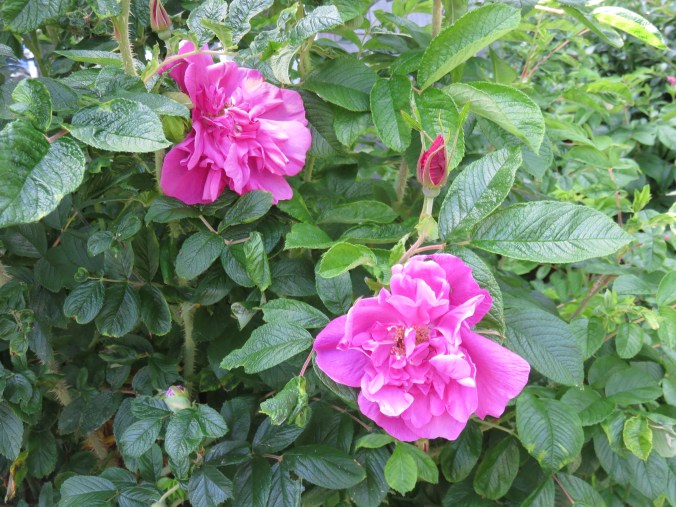
The semi-double Hansa is a rugosa rose. This one is planted on the east side of our property. I took it as a volunteer from my mother’s garden. The rose it sprang from is no longer there, and ours has to be cut down from over seven feet high here, where it is also sending out plants to fill the bed.

Oregon is home to the City of Roses, Portland, where there is an official test garden and several beautiful public rose garden parks. My grandmother had roses planted along her driveway, mostly memorably Oklahoma, a deep dark red.

Here on the coast, however, salt and wind and cloudy days are a bit of a challenge for hybrid teas and the other well-known roses. What does well here, aside from the wild roses that we fight from taking over, are mostly the rugosas, which require no special care, are disease resistant, and shade tolerant. I counted ten varieties of rose in our garden. The raccoons takes the best hips, and our tenant eats the hips from Hansa.

IMG_4358

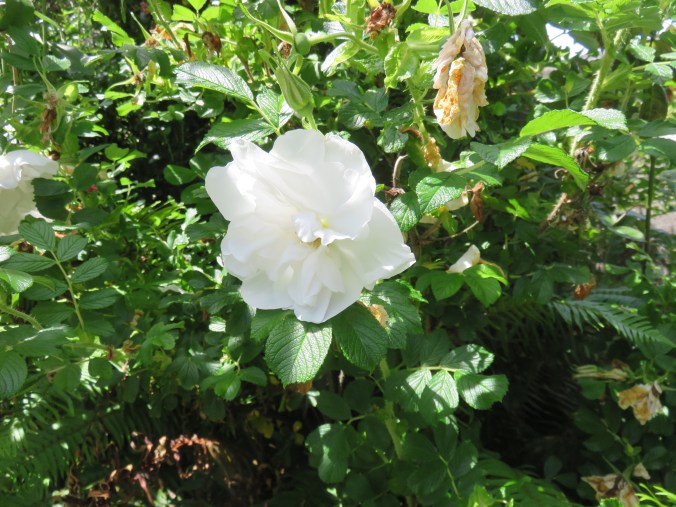
Double De Coubert is another rugosa, marvelously scented. It has long been my favorite. We also have a rapacious single white that would happily take over the world.

IMG_4352

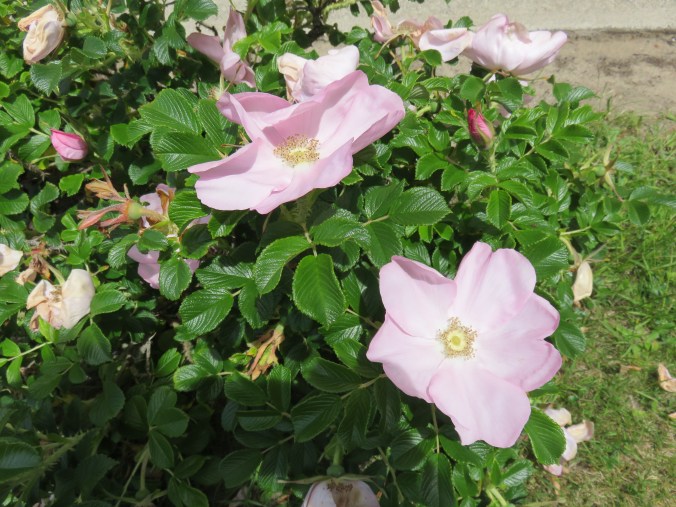
We think most years that this low-growing rugosa in our front (ocean-side) yard has died. It is the last to leaf out, but then blooms for a long time. The flowers don’t look impressive in a photo, but they are five inches across, their spicy scent fills the yard, and the hips are spectacular. They are little small red apples and a chipmunk gets them every year.

IMG_4357

This little beauty was a risk this early spring. It is not a rugosa, but I could not resist the photograph showing the dark burgundy eye and bright stamens. Then it bloomed!

fullsizeoutput_f70

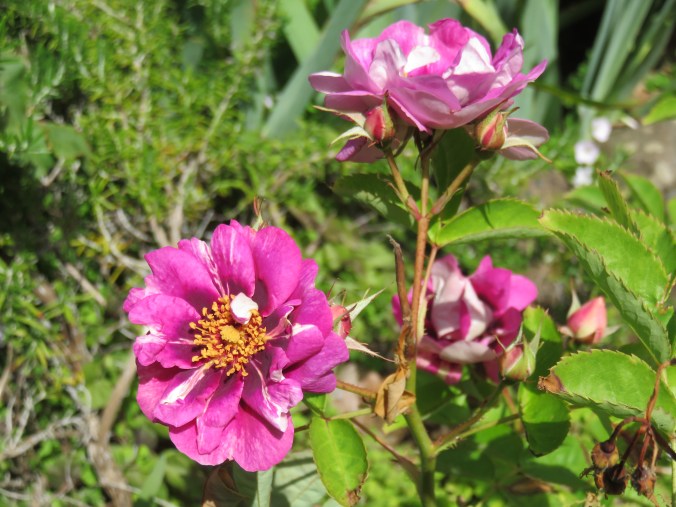
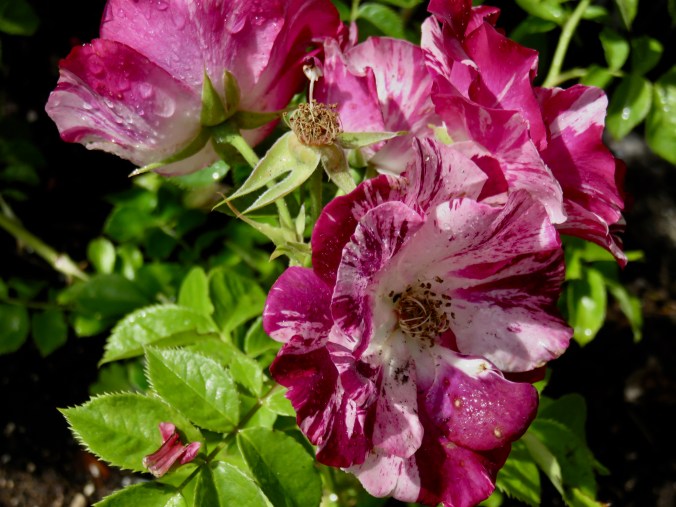
This rambler has medium-sized flower, good scent, and it is striped. I adore stripy flowers, and the colors are just right. The last striped rose did not survive, but this disease-resistant, shade tolerant variety seems determined. We will build it an arbor if it does. The tag says it reaches 12-14 feet.

It is June and the garden is lush: “Everyone looks like a great gardener in June.” I can’t remember who said that, but it’s true. We look brilliant.

HABITS OF PLEASURE

IMG_4277.jpg

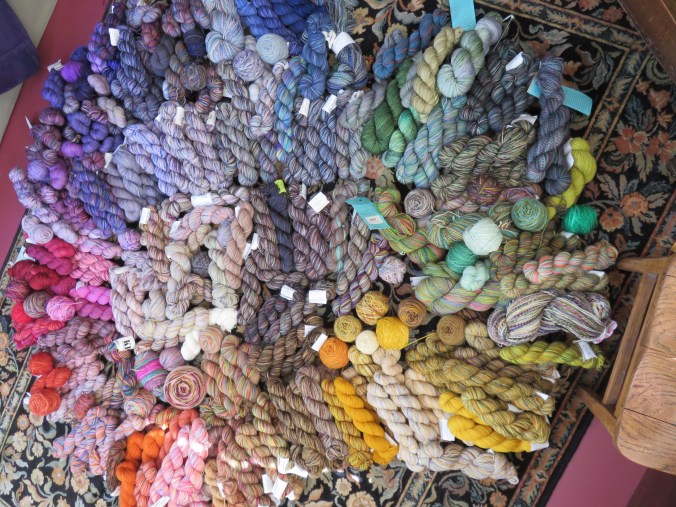
There are too many blues. I am not actually a blue person—I do not now have more than one garment in my closet with a pale blue pattern. What I have in my Made Things drawer is all from the other side of the spectrum. As a result, I have many blues, but mostly tipping toward green and especially purple. Not enough red. The red/pink bin is only a quarter full.

We all have our habits. My husband and I both love books and tend to fill shelves. Beyond that we have other things, too much of other things.

When I spread all my Koigu yarn and a handful of handspun skeins out in order to get them sorted back into bins by hue, he took a look and announced: “I am cutting you off.”

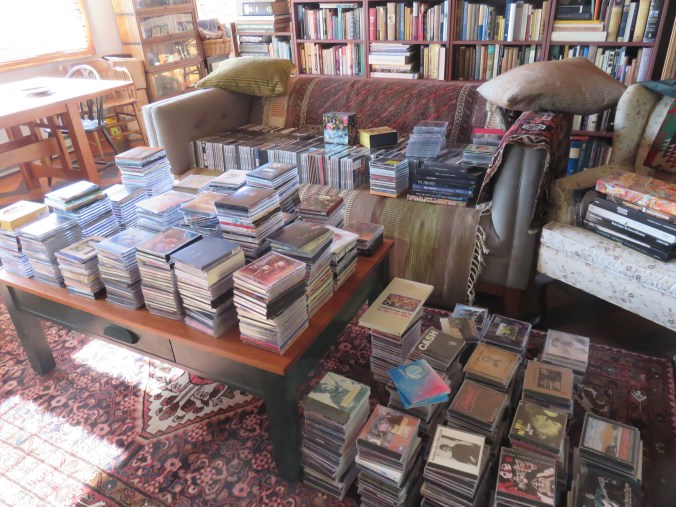
Then, the other day, he took all his CDs out of his bookcases. They filled the sofa and two chairs and made stacks a foot and more high covering the coffee table and the carpet. I tried to get a photo but could not get all the CDs in one shot. He did not count them. Suffice it to say he is cut off. He is humbled and sorry. “I am serious. You have to cut me off.”

IMG_4342.jpg

This is most of Gary’s CD collection, removed from shelves Monday. I think he meant to eliminate a few, but in the end, he spent an entire day (the day before yesterday) putting them all back. Every one. They are organized by artist and tradition or period. (Those are his books in the back too. Also organized by topic.)

Gary says, “It’s not a habit, it’s a sickness. Somebody please stop me.” He would like to blame Cervantes for some recent acquisitions because Don Quixote alerted him to even more music without diminishing his interest in Sami and middle Eastern, not to mention classic rock and roll. (No one should try to tell Gary about classic rock and roll.)  We will not go into musical instruments since he has friends with four times as many.

On the other hand, I felt free to order seven more skeins the other day. His pile is bigger than mine, more costly. And after all, I eventually wear or mostly give away my yarn when it has become something.

And when we spread them out, Gary might feel guilt, but all I can think of is how to put the colors together in order to make something, how that might be a shawl or blanket, those skeins might make a striped sweater. And then he plays a CD and his imagination soars, just like mine. Not “harmless” habits but beautiful.

Both of us know what sparks joy.

FIRST RESPONDERS

jon-stewart-dc3-ht-usatoday-ml-190611_hpEmbed_7x6_992.jpg

“Behind me, a filled room of 9/11 first responders, and in front of me, a nearly empty Congress,” Stewart said.

John Stewart spoke to many empty seats in a House Committee about the needs of first responders. All these years later and the men and women who responded “in five seconds” to a disaster: “I’m awfully tired of hearing that it’s a 9/11 New York issue. Al-Qaeda didn’t shout death to Tribeca. They attacked America, and these men and women … brought our country back,” and are still having to beg for relief.

“I’m sorry if I sound angry and undiplomatic, but I’m angry, and you should be, too, and they’re all angry as well and they have every justification to be that way.”

Watch the PBS News Hour video: https://www.youtube.com/watch?time_continue=10&v=HT5FTrIZN-E

Stewart alludes to a Senator who has held up funding as a political tool? That’s Mitch McConnell.

Truth to power.

CLOSING

fullsizeoutput_f6a

I discovered yesterday that Tin House is closing after this month’s issue. I already knew about Glimmer Train, Shimmer, and the end of Apex except as a publisher of books. These were all excellent publications. The New York Times is only writing about Tin House, because the founding editors are in New York?

Sometimes I really do wish there were a newspaper on this coast I could subscribe to.

Penguin has reissued No-No Boy by John Okada. It’s an important novel that I read for a graduate class on Asian-American literature taught by a San Francisco University professor in a class at Portland State. Despite the fact that the novel was already reissued (the copy I read with an introduction by Lawson Inada), Penguin has chosen to completely ignore previous copyright and to claim the novel is in the public domain.

Sometimes I wish New York(City)ers were not such “a bunch of hustling people all squeezed up together being ‘Eastern!’ “—Lorraine Hansberry’s character Walter Lee Younger in A Raisin in the Sun.

A New York editor reportedly complained about a West Coast novel because it “has all these trees.” City people.

Reading the editor’s description of their literary journal, I found two women’s names in the list of authors they were proud to have published. Both names were misspelled. Ursula K. Le Guin. (She always included the K. and Le Guin is two words, not one.) The first woman to publish science fiction under her own name was Clare, without the I, Clare Winger Harris, not Claire.

And don’t get me started on the lay/lie issue in print publications—everybody has trouble getting that right, it seems, but some of us take the trouble to doublecheck this obvious trip.

Yes, peevish today, on a minor note, and despite the fact that my own line-editing is never perfect.

I am rereading Wild Life by Molly Gloss.


Middlemarch by George Eliot

fullsizeoutput_f58

“But the effect of her being on those around her was incalculably diffusive: for the growing good of the world is partly dependent on unhistoric acts; and that things are not so ill with you and me as they might have been is half owing to the number who lived faithfully a hidden life, and rest in unvisited tombs.”

SHIFTING GEARS

fullsizeoutput_f54

The ocean yesterday morning. We had several insane bursts of rain later on, as if someone was playing a firehose on the house. No exaggeration!

Last month I determined to complete several projects, mostly knitting. I knit a narrow scarf, a huge shawl, a cardigan sweater for my granddaughter, and a washcloth—that last from a horrible but gorgeous cotton linen blend. I would make another washcloth if the yarn were not so stiff and rough that it hurt my hands to knit with it.

There were small writing projects I worked on and larger ones I skirted. I have ideas for two quilts and a couple of warps. Plenty of work is waiting for me. But instead of any of these, I am planning another knitting project.
fullsizeoutput_f56

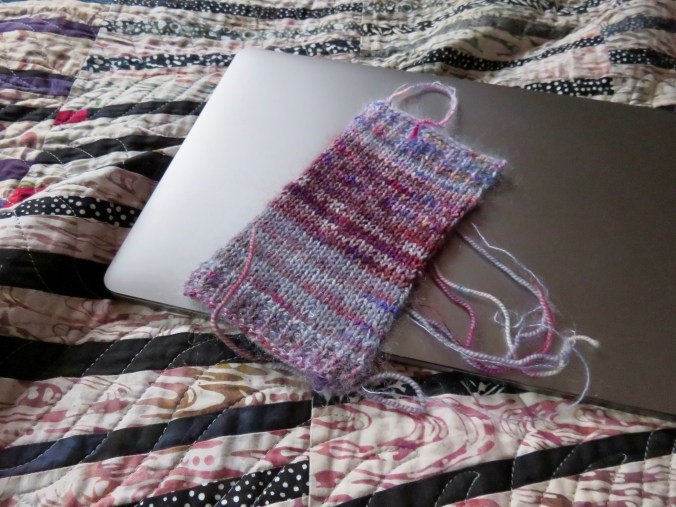
This little 4″ x 7″ swatch uses two yarns, a 2-ply Canadian merino in three colors and kid mohair/silk blends from Japan and Canada in two colors. There’s a sweater in this swatch—I just have to figure it out. In the mean time, I am writing out a pattern for my other granddaughter.

I knit a swatch and have been carrying it around for three days. Yesterday, in the coffee shop where I was meeting a friend to play Scrabble, and there was a woman knitting. I walked over and identified the yarn right down to the color: brand Malabrigo, yarn Rio, color Anniversario. Then I had to confess that no, I had not made my sweater.

That needs to change. Doesn’t it?


A PBS special about where we get our food claimed that human beings were nomadic for thousands of years until we began farming so we “didn’t have to move anymore.” The writer got that wrong. When we began farming, we could not move around anymore because we always had to be there to look after our crops. Farming did not allow us to remain in one place, it forced us to stop moving. There is evidence that this shift, rather than relieving us of a burdensome life of mobility, actually oppressed us, forcing our workdays to become longer, our labor more backbreaking. There is every possibility that this assumption that stability is preferable is mere bias. True, human beings developed architecture of stone once forced to remain in one spot, but we were already creating on a smaller scale.

Whether we traveled each day, or closed the door to a house every night, we created what scientists like to call artifacts. We call them garments, useful objects, pendants, and toys. We made art, we sang, and we told stories. These are human activities. Making stuff beautiful. This is what we do.

IMG_4321

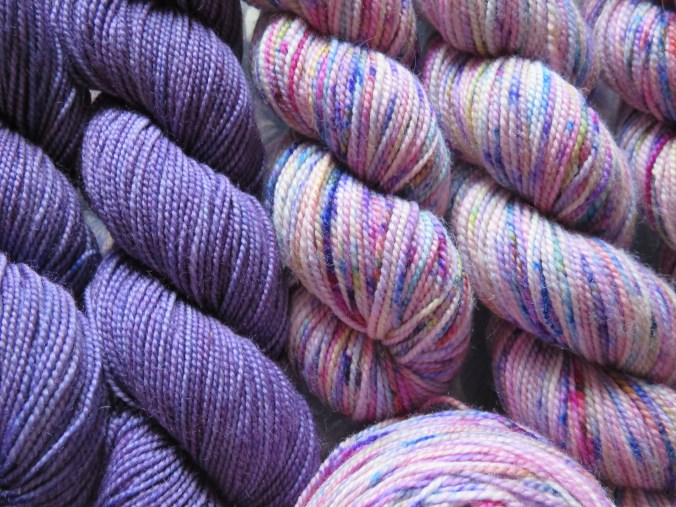
My older granddaughter told me the other day that she wanted purples and pinks, and here’s the start after combining and recombining many other colors. The mohair/silk blend will likely be burgundy, and that whisper-weight thread will tip these colors darker and redder. I still need to make a swatch. If I don’t like it. I reorder my colors until I get them right.