HOW TO BE

If you, like me, cried every time you watched the brilliant video of “How to Be Alone,” there’s more. But in case you haven’t, here is that video collaboration between poet Tanya Davis and filmmaker Andrea Dorfman, the one I shared with students more than ten years ago.

Maybe I’m an easy crier, but this one does it every time. So does the new one. Good cries.

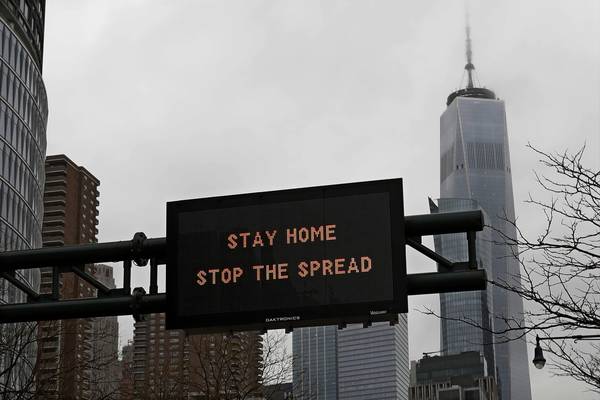
Gary and I went out for a quick walk this morning. Then Gary came in because he was expecting the exterminator and a plumber. He’d worked on the kitchen sink for several hours without unplugging it. He used the plunger marked “sink” and removed the trap. No luck. Somehow this has been a crazy year for all sorts of reasons. Months ago a friend said the pandemic was only an inconvenience for us, but Gary and I know people who have been sick and who have died, so while we are not essential workers facing contagion every day (more praise to those brave souls) and we do not actually suffer under lockdown—we have one another, we have our walks, and we are retired—it feels like something more than an “inconvenience.”

We have ordered one take-out meal since March (and not again—too much trust and people who eat restaurant meals are statistically more likely to become sick), we have been to Portland three times (once for a root canal, once to deliver something, and once to pick up a painting), shop for groceries every two or three weeks, and we pick up our mail only every few days. I do not miss movies in theaters, despite the Big Screen. (And Queen’s Gambit on Netflix surprised me by proving better than any theatrical movie I have seen in the past few years.)

Most of what is missing is not missed. But there are gaps. I miss live events. I miss actual people. I miss visiting my old high school and the teachers, who would be in a new building on a fancy new campus but local schools are virtual. I miss the Farmers’ markets and shopping in stores and hugging my grandchildren and eating chili rellenos from The Stand. I have not seen my brother in thirteen years. I miss him sometimes, but he is completely out of contact. Loved ones are divorcing and in therapy—the therapist says there have been a lot of separations during the pandemic, that it is “not uncommon these days.”

But the cards we ordered last month say “joyful” on the front and we have reasons to feel joyful.

Our family is all well, our closest friends are well, friends who are working are mostly doing it virtually and staying healthy. My friend in cancer treatment has completed treatment, her health outlook is excellent, and she has enough hair to brush! We have been able to afford the unusual bills from exterminators, plumbers, electricians, and so forth. We paid our property taxes from our checking account, which held an obscene amount of money because we did not go anywhere or spend money on anything for most of the past nine months. The paintings—those extravagant and out-of-character expenses—are a pleasure and not a regret. They are a glancing vacation each time I pass them. We are lucky that the house is large enough to allow us to spend time away from one another, and even more lucky for our morning walks and evenings together. We have accomplished several major tasks—Gary fixed the drainage on the south edge of the property (a huge task) and I completed a ridiculous amount of weaving and piecing. We attended a virtual wedding. I heard from former students. Adrian sat twenty-five feet away from me—both of us masked—and told me about his life.

There are things we cannot do—visit people we love or any other country—but we are fine. An abundance of caution.

My grandmother had a half-full quart jar of black walnut meats in her freezer when she died in 1978. It was still there when we moved into this house in 1979. The jar remained unloved for a few more months—moved to one corner and then another till I needed the freezer space they took up—and then I opened the jar and tasted them. Incredible.

Thanksgiving will be just the two of us, but I ordered two pounds of shelled black walnuts on the internet.

•

•

•
RUBE GOLDBERG MACHINE

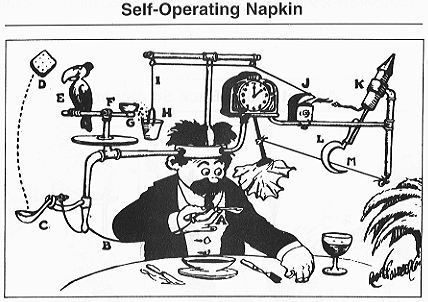
When he was teaching Physics at Seaside High School, my brother held a Rube Goldberg Machine competition for his students. They worked in teams and were given a specific goal to build a machine that did something simple like cut a fruit in half or open a box. That simple process was deliberately and pointedly complicated through over a dozen steps—pulleys, marbles rolling down tracks, things falling over, balloons popping. That’s what Rube Goldberg Machines are supposed to do. It is satire on modern life.

Teams wrote manuals explaining how their machine worked and why. Then they demonstrated their accomplishment for an audience. They were given a couple tries to get the entire string of operations to work properly and chop their fruit or squeeze a lemon. It was a big deal, students, parents, and community members came to watch in the evening, judges ruled, and a member of the Rube Goldberg family handed over the honors to the winners. I do not remember what the prize was, other than bragging rights.

“A Rube Goldberg machine, named after American cartoonist Rube Goldberg, is a machine intentionally designed to perform a simple task in an indirect and overly complicated way. Usually, these machines consist of a series of simple unrelated devices; the action of each triggers the initiation of the next, eventually resulting in achieving a stated goal.”

—Wikipedia
Rube Goldberg’s Professor Butts and the Self-Operating Napkin (1931). Soup spoon (A) is raised to mouth, pulling string (B) and thereby jerking ladle (C), which throws cracker (D) past toucan (E). Toucan jumps after cracker and perch (F) tilts, upsetting seeds (G) into pail (H). Extra weight in pail pulls cord (I), which opens and ignites lighter (J), setting off skyrocket (K), which causes sickle (L) to cut string (M), allowing pendulum with attached napkin to swing back and forth, thereby wiping chin.

This class project involving teams explains why, over the years, I have continued to look for and enjoy Rube Goldberg Machines. My brother was doing this at least thirty years ago. Today, if you search online, you’ll find lots of information about Rube Goldberg Machines and competitions as well as the same thing done under different names in other nations. We all enjoy a pointless effort just for fun.

In the machine below, the goals is to pour glasses of lemonade. At nine minutes, it is incredible, absurdly lengthy, often funny, and the work of a six-person team.

Truly, you do want to watch this. It is ridiculous fun.

CALL & RESPONSE

The main thing is that we are not sick, though we seem to know several people now who have been ill.

Biden and Harris won the election. Trump is sulking and raking in all the money he can. The pandemic has exploded due to small (careless) gatherings. There is a divorce coming in our family (not Gary and me). And last night was stormy. The power went out. Gary made coffee the instant it came back on in the middle of the night. Emailed a former student. Two people from my MFA program reached out. I have lost eleven pounds, gained back two—I expected that my weight would move up and down, but I still hope to reach my goal next June. We gave up seafood this year and that is going well but I am considering a sockeye fillet for our small Thanksgiving. Yesterday I began weaving the third of three shawls on an “Olive” warp.

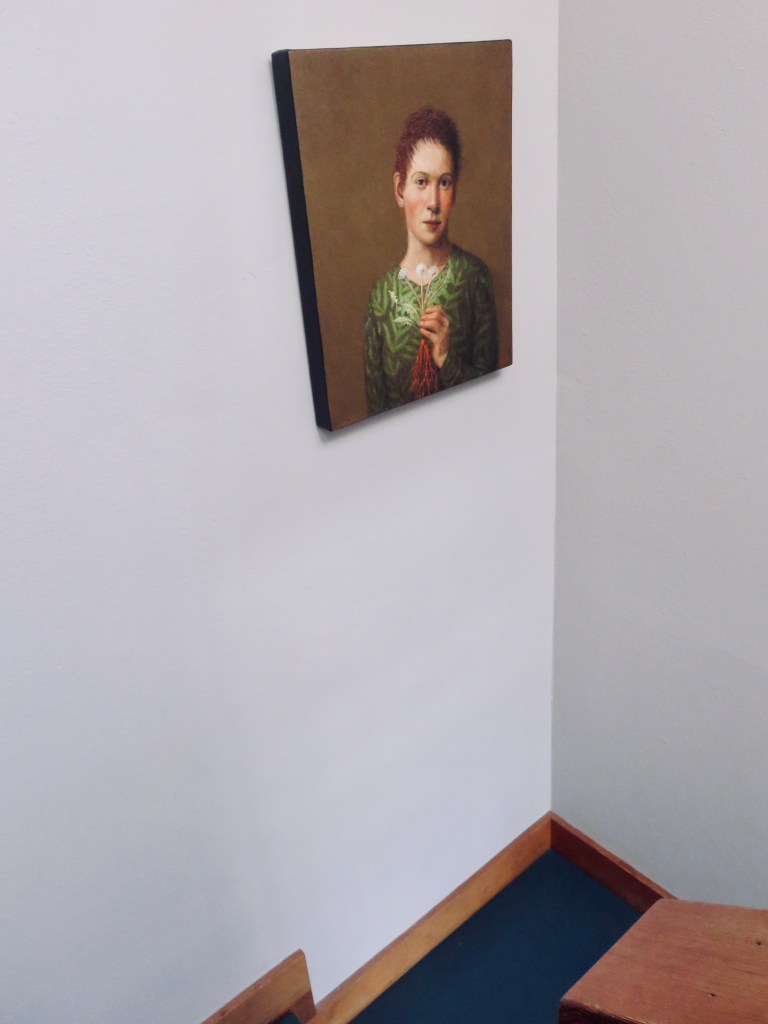
I am on track to read 70 books this year, which was how many I was reading before beginning my MFA in 2005. The Russian doll arrived after three or four months; the painting arrived from Georgia after five months; and I bought another painting because she kept looking at me. She hangs on the landing, visible from up and downstairs. “Weed Gardener” by Katherine Ace (2017).

I found this painting title “The Gardener” on Ace’s website, just “Gardener” on her local gallery’s website, but on the back of the painting it says “Weed Gardener,” so I’m going with that.

Pinterest allowed me to suspend magazine subscriptions. I visit that site to find images and to save images. Sometimes I revisit what I have saved. Mostly I never look at it again, but I preserve the illusion of ownership. Last month I became aware that a number of favorite paintings I had “collected” were all by the same person. These are mostly magical realist pictures, often with birds and women. Women with birds on their heads or a stack of stones. Illustrative paintings of folktale characters. I put “Feather” on my desktop, the only time I have used an image that I had not created myself. Once I went looking it took me only a short time to find the artist’s name and local representative gallery. I had missed a Portland show by a week. I cannot afford the paintings.

“Weed Gardener” looked to me like a self portrait from the Face to Face show. The artist often uses a similar face, but this one felt deliberate—not similar a real person but an actual portrait. I looked at her and looked again, the more I studied her face and the dandelion in her hand, the more I felt she was a cancer survivor with her plushy hair just coming back in. Imagine my lack of surprise to discover the artist lives in Portland and is indeed a cancer survivor. (So is one of my dearest friends.)

That’s why I called Visa to raise my credit limit and we drove to Portland to pick her up from the gallery. (That gallery visit, masked, is another absurd story. Suffice to say, I will not go there again.)

A neighbor has kindly shared her sourdough start, in her family since the 60s. I have sent over rhubarb and apricot jams. She is offering salal, which I did not manage to make this year. We have not actually seen one another in months.

I will add more here on the website, later.

•

•

•

LETTING GO OF SUMMER

The air is clear here and has been good for days now. Rain has settled smoke out of the sky and made fighting the fires more possible in other parts of the state. Two weeks ago a powerful windstorm knocked leaves off trees, stripped some alder trees almost bare, stripped flowers and leaves from the lacecap hydrangea in our yard, and knocked down trees and power lines locally. Our fallen power mast has been replaced and insurance will pay all but the $1k deductible. No one was hurt, but that and the smoke might explain the behavior of some birds. The clean air explains this morning’s sky tinted pink the way it should be, and two skinny trees are still clinging to the cape.

Our sons and their families are well. As Gary said just a few minutes ago: We did the best we could and not a bad job raising our boys. Now it’s up to them.

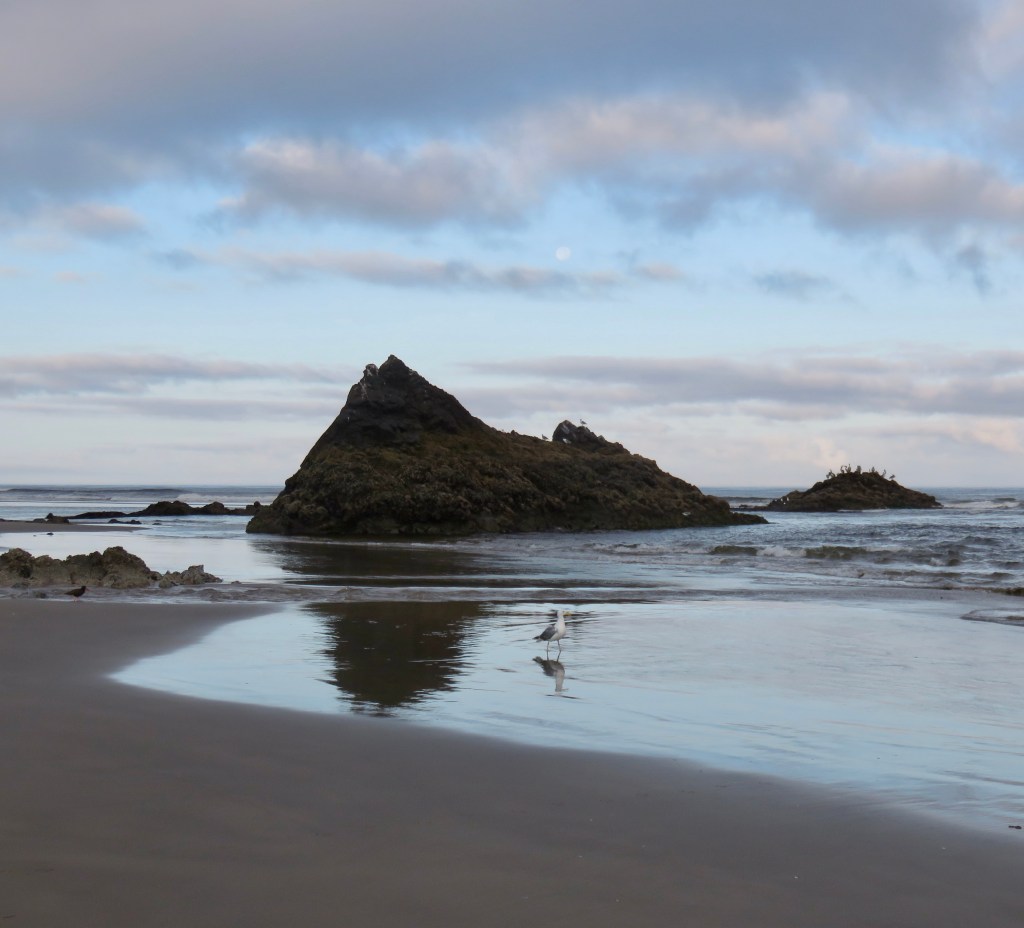
We walked long yesterday and creek to creek today. The baby crabs have continued to surprise us in their variety. There was a seal just offshore the other day. We heard but did not see our favorite black oystercatcher child. The young eagles have moved on, the ravens are about, fifteen crows have been hanging together on the sand, in trees, in flight. An extended family.

Ruth Bader Ginsberg has left the building. I read some comments in major newspapers that blame her for not retiring earlier while Obama could have replaced her. Why pretend it’s her fault for not guessing she would die? Why pretend McConnell would have allowed anyone with her heart, honor, and steel to replace her? Why not blame how people ought to have voted in the last Presidential election? Why not go back to the 90s and blame the failure to eliminate the Electoral College? Why not blame . . . well, this does no good at all.

We all did the best we knew how. Now it’s up to us all to find a way to make it better.

Today is the last full day of summer. Gary and I sat on the deck and talked about repairs and gardening and tidying that we will begin now and complete . . . probably never. There is always something that needs doing. Something we must put on a list and check off after it’s done.

This past year has seen many changes for us. A marriage is coming apart, but not ours. I vowed to buy no more than eight items of clothing during this entire year and it looks like I will manage that. We stopped gathering trash off the beach, though Gary still carries an old plastic bag in case of syringes or fluorescent lightbulbs cast onshore—we’ve gathered many. We gave up all seafood at New Years and going-on nine months in, I think we do not miss it much. We are fully vegetarian. I have only the frame and border to sew onto a quilt top and I expect to finish it tomorrow. I have lost count of how many quilts and weavings I have completed so far this year, but there is a present waiting for me to pack it up for mailing to a dear woman and a wedding present for a former student who is having a virtual ceremony next month. I am invited to participate in a couple of events virtually that I would not have been able to attend in person. It is the new normal, in a good way.

I painted the stair treads dark green. I let the front yard grow wild. I have hung things on my walls that I have been meaning to hang for years. The painting by Jeanie Tomanek never arrived. “Soul Queen” is lost forever, but I have “Bramble” on my wall. The handmade Russian doll by Marina Glebova took four months to arrive and I am more than half convinced that customs took her apart before sending her on. Now she lives under a glass dome on my dressing table that once belonged to my mother.

“Soul Queen” by Jeanie Tomanek

But RBG is gone and members of my family are way beyond “unwell” and into what I cannot call anything less than “mentally ill.” One of them spills madness into my husband’s ear on the phone, believing all the conspiracy theories and that everything is ugly and cruel. But then so do other people I know (and many I do not know) believe in cruelty—people who are not even schizophrenic. While I was writing this, one of them tried to post a vile comment about Ginsberg, but I will not approve it. I am not such a “toad” or “fool” as to allow space to someone who posts hate, and anonymously. That poster meant only to hurt, and succeeded. Yippee for them. I would prefer to be hurt than hurter.

Stories stir in my head, but I am not yet writing them. I think maybe in November I will try NaNoWriMo here. I have an essay coming up on 16 October on Brevity, the day before my birthday. I thought I didn’t have anything left to say, but then I did.

I am taking a break from this blog. This is my last post for a while. I thank my readers for being here, for reading, and for their thoughtful and often kind comments. I expect to be back. Maybe in a few weeks, or in winter or the new year or even sooner when something wonderful happens.

Strange crab.

•

•

•

OUR WALK

We’ve had our walks yesterday and this morning and did not smell smoke at all. I smelled only ocean yesterday, just purely ocean. Today, also chlorine in a stream and then something unidentifiable and sweet in the air.

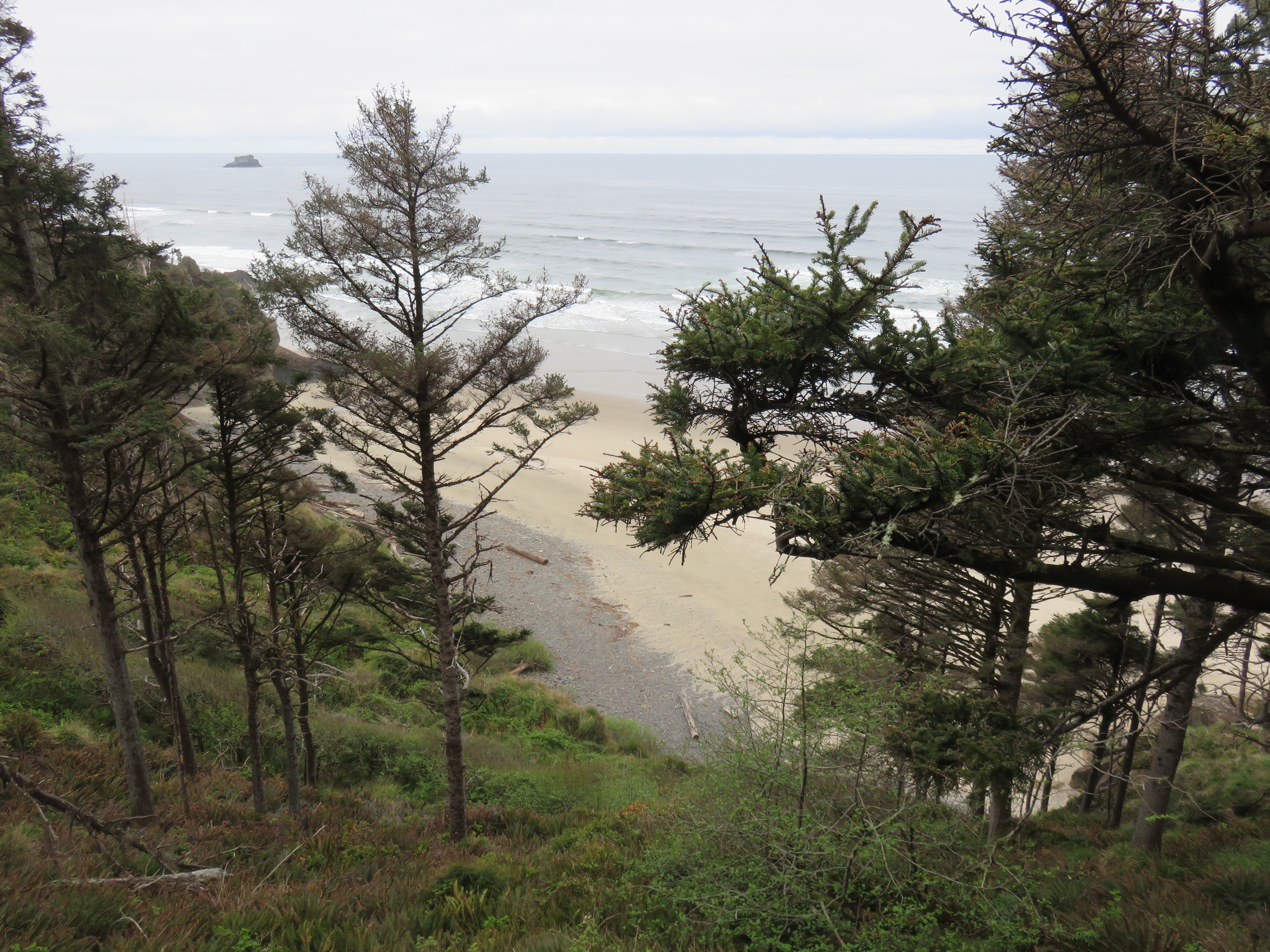
Heavy fog when we went out just after low tide today—so thick we found the sweet spot where we could see neither shore nor surf. It is a rare thing and did not last till we turned around for home. The fog lifted as the sun rose. Every receding wave has left a line of spruce needles on the sand—a dozen lines—where usually there is only a single line of broken shells, seaweed, and feathers. Whole trees and shrubberies were nearly stripped of leaves during the wind last week. The sun was red coming up today, but my camera cannot capture that effect. 

Overhead blue sky with clouds like thin curdled milk. 

Gary was out scrubbing and refilling the bird bath yesterday. He says Steller’s jays have been picking up and moving rocks around in the garden. Not tiny rock, but rocks he thought were too big for them to lift. He watched them doing it but can’t explain why. Perhaps they are teasing.

There is a new pair of scrub-jays in the spruce trees next door. We have never seen them here before. (We saw them last summer in the NE corner of the state and so did others who were told by an officious biologist they were absolutely wrong because such birds could not exist there. Gary and I said nothing but exchanged a look and shrug. [photo below] I was told by a man in 2005 that I could not possible have seen Steller’s jays in Portland as a child or at the coast. He had lived in the PNW for a little over a year. “Men explain things to me.” Ha!)

The black oystercatcher pair have successfully raised a baby this year—the species is struggling but the juvenile seems well (see above). There were no birds resting at Asbury Creek north of our home this morning. [Current maps show Shark Creek as a tributary of Asbury, but my 1941 map shows Shark Creek reaching the beach further north where my online map shows a different, unnamed waterway.]

On the way home we saw several gulls eating stranded crabs.

The bald eagles have also successfully raised two babies.

Hundreds (Gary says thousands) of brown pelicans have flown over with fourteen in residence this season. When we moved here in 1979, we saw no brown pelicans because they were on the endangered species list. Today they are “of least concern.”

Thank Rachel Carson and her warning book Silent Spring. 

Western scrub-jay (Aphelocoma californica)

•

•

•

STRANGE DAYS

Yesterday was our 46th anniversary, and today the people who own the house north of us called me a “b—-” and a “f—ing b—-.” Several times, actually. I was told to go in the house, that I did not understand what was happening. That I did not understand psychology and using that language was entirely within their rights.

You have to wonder about people like that. How do they manage communication within their own families when someone disagrees with them? Does anyone dare?

•

•

•

•

WAIT

IMG_1206

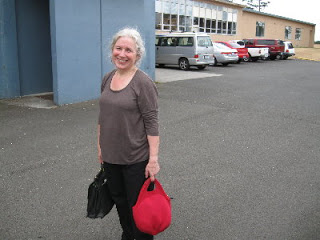
Immediately after my shower. I had run to school (15.3 miles) in August 2011. My husband trailed me & carried my briefcase and lunch. Don’t I look happy? I was.

I loved running. Loved it! I was never very fast, never did better than eight-something miles, never ran a marathon. But I ran the Hood to Coast several times, a bundle of 3ks, the Bridge Crossing, and a slow but official half-marathon in Portland nine years ago (2:17). Ten kilometers was my favorite distance and I aimed for 9-minute miles. I had measured runs of three and four and five and six miles on the beach and highway from my home. I ran at least every other day for years. I used to run the six miles on the beach to my mother’s house in Cannon Beach two or three times a week in summer.

And then I couldn’t do it anymore. I could barely walk for a year. I tried other exercise but biking is unsafe around here and involves a mechanical device, and the pool has too much chlorine. All I have is walking, and I am usually on the sand for over an hour a day without a problem. But I miss running.

That might change. I have decided I might try running again this next year, but to do that I need to weigh less. Wait for weight. When I quit teaching, I was about five pounds over my running weight. I meant to lose eight to fifteen pounds—is this starting to sound familiar?—but instead I have gained fifteen. Now you see it, don’t you?

Weight isn’t a huge issue for me. Well, that’s a lie. I grew up in the twentieth and live in the twenty-first century. I am female. Yeah, weight has been a huge deal all my life. In my teens the doctor was worried when I weighed 121 pounds. My mother tried to put me on a diet. Eventually I lost 7 pounds only because I had my tonsils out when I was fifteen, Ballard Hospital was remodeling, and I was in from Sunday until Friday. They brought me one meal on Tuesday, which I was still too sore to eat and neither the nurses nor I noticed that I was being starved. So I weighed 114 pounds by that Friday and throughout high school. By my senior year of college I weighed 118. Or maybe by then I weighed 121 again. I do not remember.

In my thirties, a friend called me plump when I weighed 130 after my second child. I dieted back to 114, but that did not last.

I began running, a few blocks in April and six miles by August. I am not built like a runner and had absolutely no history as an athlete. But running turned out to be wonderful. I felt strong and capable. I found runner’s high at three and a half miles in a rainstorm and laughed. Thus in my forties, I usually weighed 132 to 142 because of running muscle, lightest by the end of cross country season. (I tried dieting while running but that was pointless.)

During my fifties when I was caring for my mother and running time grew sparse, my weight pushed up. Then grief over my mother’s death took off 40 pounds. People complimented me on my weight loss, which I found ironic.

Like most people, weigh has gone on and then off and then on again with no deliberate effort on my part. I am always impressed by people who maintain a consistent weight throughout their lives. I am not fully in tune with my body. I know it does not want to weigh 114 pounds any more than it liked running more than eight 9-minute miles in a row. Lower weight and longer distance runs were each a struggle. I could do those distance runs, but it was against my body’s better judgement. In 2011 when I ran over 15 miles in bad shoes my body was not happy. My feet up and resigned their commission. I stopped running.

How’s it been without running? Like how a dog with no nose smells. Awful.

So, a new and more reasonable plan. Take a year to go back to my most typical running weight of between 132 and 142, mostly by eating only between 8am and 6pm. Three meals, no snacks, less sugar, more veggies. (Well, we all know that: “Eat food. Not too much. Mostly vegetables.”) And walking. For the duration, only walking. At sixty-seven years old, I can not afford to put too much weight on knees and feet. But I think, perhaps, if I can drop those recently gained pounds, I might manage three miles again. Slower miles perhaps and only on sand.

I’ll let you know.