An imperturbable demeanor comes from perfect patience. Quiet minds cannot be perplexed or frightened, but go on in fortune and misfortune at their own private pace like a clock during a thunderstorm.—Robert Louis Stevenson
Today is a bread-baking day. I will make two loaves and a few savory rolls, I think. Usually I start first thing in the morning in order to have bread for lunch, but today I am still winding a warp and typing away.
Pussywillows are out but the place where I have been picking them the last few years was pruned back hard last fall. There are other places.
The daffodils are in bloom too. In our yard, “February Gold” is a small, early variety. They are only about eight inches tall and ours have been blooming their fool heads off for most of the month. The escalonia has given up its last carmine blooms, but rosemary is all over tiny blue-violet flowers, the rhubarb is coming up, and the primroses never stopped.
We’ve been talking about moving. To be candid, we’ve talked about moving on and off ever since we moved to my family’s home on the Oregon coast in 1979. We missed family and friends. Now it’s the non-stop stream of tourists in a residential neighborhood that used to house people who actually lived here. The truth is, however, that we like the climate, the weather, and our permanent neighbors. We raised our children here, wetsuits dripping over the tub. They moved off but we stayed. We love our daily walks on the shore, even when our fingers and toes go numb in winter. We are accustomed to the continual roar of ocean and water shifting stone. We are used to silence.
We are used to seeing sky, to watching the storms roll in, the sea go high, the gulls and black oystercatchers and broken shells in the rocks. We enjoy finding the shoreline changed every day. This past year has not been easy for most people. The weather alone has been, as they say, interesting.
You can see the two fallen-over trees on the cape are still hanging on. So are we.Continue reading →
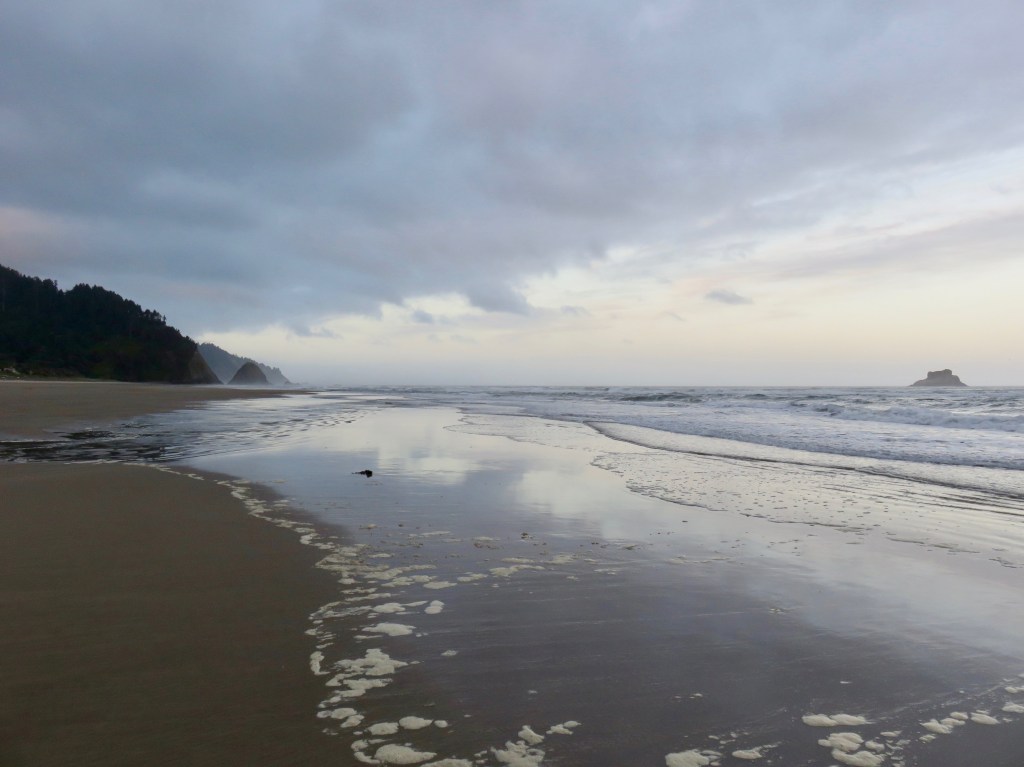
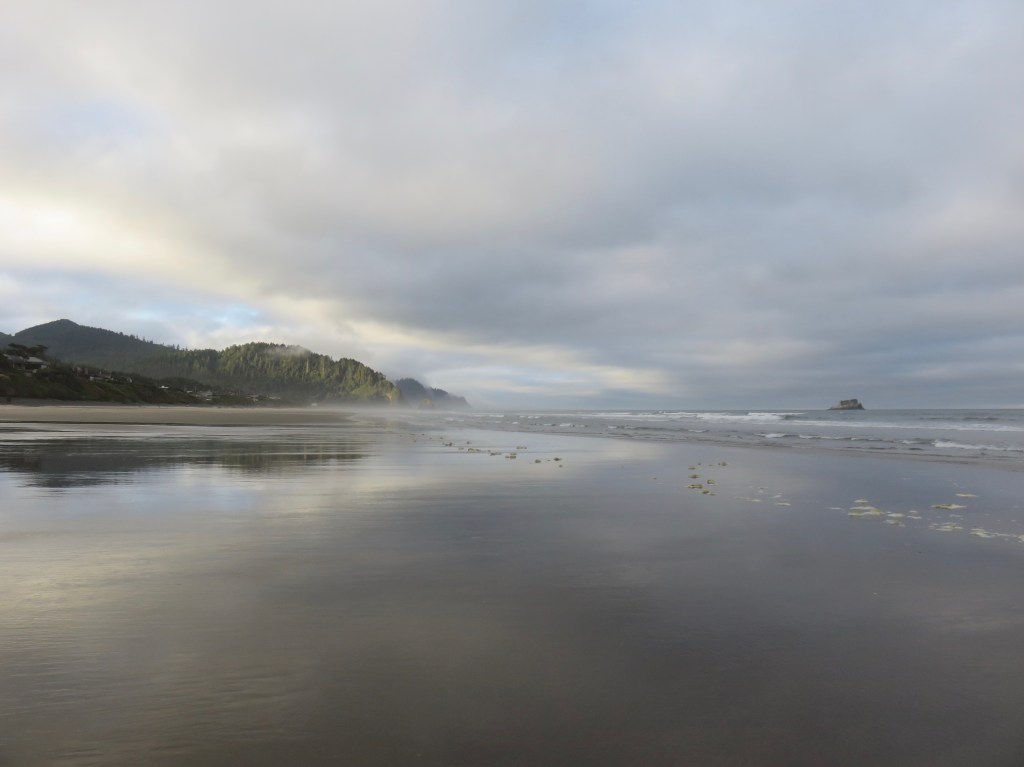
The cloud-occluded sky was dove gray and Oregon chalcedony blue. A fragmented break to open sky over the ocean glimmered platinum that swept a reflection across wet sand. I did not have my camera with me, so perhaps you will take my word. It was beautiful.
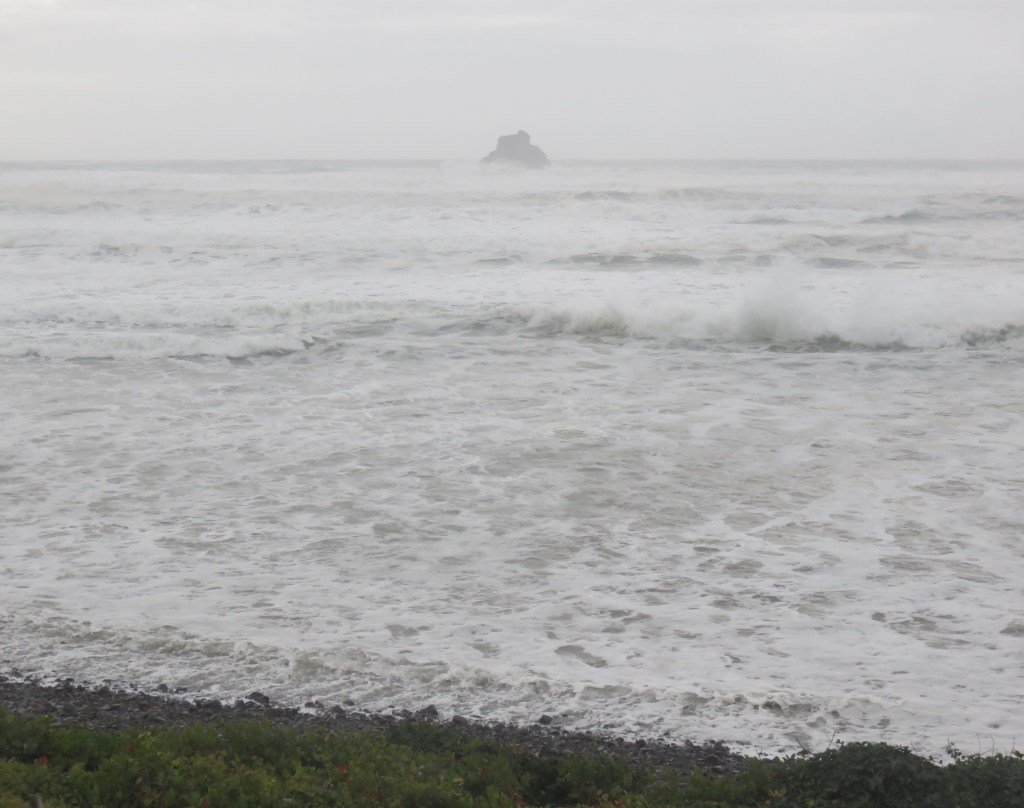
November, the middle of autumn, is like this. We are just home from a walk in a dry gale wind. It was easy walking out north, hard work coming back, our heads bowed into the blow. We had missed our morning walk because of the fierce winds and drenching rain. There was no sand at all, though it was only an hour past low tide. When the weather cleared this afternoon we took our chance. It is the great advantage to retirement, I think. We can go out whenever we like.
Yesterday, we were out early to see what the ten foot tide had left us. We have walked the shore daily for so many years, we recognize rocks, the places where sand shows through, where there is a flat stone, where the rocks are rounded and fine like river gravel.
All is changed. The path Gary built in March is entirely swept away, even the heaviest stones set as steps through the hedge were tossed. They have survived a dozen winters. Water flowed right into our neighbor’s yard, a reminder that house is built over a swamp and creek. The ocean remembers and takes back.
In the spring we pull aside basalt stones lining our shore to create a meandering path to the sand, a task requiring gloves and sometimes metal garden tools. This path is a depressed passage two feet wide through the margin between sand and land. It makes our morning walk down onto the beach easier. Walking over the stones is unsteady and bumptious on the bottoms of our feet. It takes hours or a few days to dig away stones. Sometimes the sand is a few inches under the stones. Sometimes we must dig deep and have to carry sand up to fill the resulting trench. The work is satisfying, traditional. Sometimes a high wave in April will sweep the rocks back into place and we must build the path again. Sometimes it happens again and again and we threaten not to bother rebuilding.
By summer, the sand has begun moving inshore from sandbars beyond the breakers. Most oceanfront homes have built paths through the stones to save their feet. The dry sand is untouched by most high tides, and low tide reveals a hundred yards of clean, hard wet sand. For three decades I ran on that smooth sand surface every other morning if the tide was out far enough to permit me. Now we walk our miles regardless. When I was a girl, sand swept all the way into the green by midsummer. That doesn’t happen any more.
Some of the sand is simply gone.
There has been less sand onshore for so many years, local newspapers don’t even mention it. Twenty years ago they offered several explanations. Most involve happenings far away up or down the coast. Barriers intended to protect harbors shifted the seasonal flow of sand, causing it to pile up. There are condominiums built on shore that did not exist so very long ago. A powerful wave in January of 1999 picked up not only sand, but the rocks themselves. Massive sandstones rolled amid the wet-blackened basalt. Strong waves push the basalt high. Some years there has been a ridge of rock five or even ten feet in the rocks up shore from us. We’d like to trust the seasonal shifts to level things out in summer. There is no counting. The tide is not dependable.
In autumn, sand begins to slide back into the sea. Tide and wind swipe the basalt clean, drive sand into the ocean. Waves seem to rise higher. Low tide gives a narrower strip of wet sand than we saw in August.
It is different all the time. Asbury turns hard right and flows a quarter mile south one day, and a week later it spreads straight west. Gulls rest there.
Everything changes, shifts from one tide to another, one month to the next, and year to year. It is a moveable feast. The people who bought the house north of us to use as a commercial rental asked us: “Where has our sand gone?” the first time they visited in the autumn. We could not help laughing.
Yesterday on our walk, a wave swept in across a hundred yards. We had climbed into the rocks. When an outgoing wave flows back into an oncoming wave there can be a great crash—the sound is starling and water sometimes flies straight up into the air. The so-called “sneaker” waves are silent, and it is the sudden quiet that causes us to run. An incoming wave overtakes a wave also moving in, picking up energy and speed from the one below. Then a third wave over the top of that one. There is no predicting, no pattern. It is a random event.
The “blue hour” is a name for that period where there is light enough to see, but the sun has not yet risen. This time bridges time between darkness and the golden hour, those periods just before sunset and after sunrise when the light differs from ordinary daylight.
As might be assumed from the name, the light at end of day is gilded, even, and without shadow. Entire films have been photographed during the golden hour in smaller latitudes and during the right season when that period lingers longest. Near the equator, the magic might last minutes, but moving toward the poles the Hour might be a full hour because of light bending around the world.
I find some details of Wikipedia‘s “golden hour” entry confusing. We see a noticeable warm light extending long after sunset, but the morning light is clearly blue before the sunrise, become bright and yellow only by contrast once the light hits the sand. That is, perhaps because of the ocean, we see a “golden” light after sunset until dark in the evening and only blue light in the morning. Having learned the term first from cinematographers and second from experience, my understanding may be insufficiently scientific.
In photography, the golden hour is the period of daytime … during which daylight is redder and softer than when the Sun is higher in the sky.
The period of time shortly before sunrise and shortly after sunset is called the “magic hour,” especially by cinematographers.
The period of time shortly before the magic hour at sunrise (or after at sunset) is called the blue hour, when the Sun is at a significant depth below the horizon and residual, indirect sunlight takes on a predominantly blue shade.
—Wikipedia
Blue Hour is the title of a book of poetry by Carolyn Forché.
    come, love, through burning
    composed of light
    converging on my own life
                   from  "On Earth"
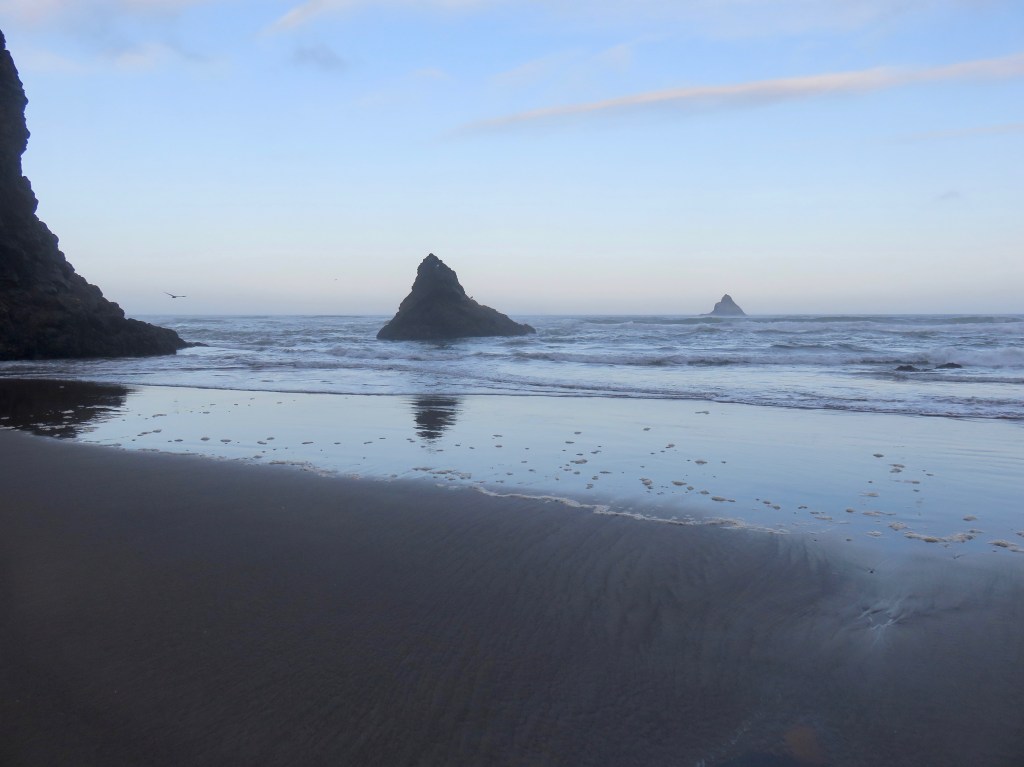
The blue hour is the time of day my husband and I walk out on the sand, unmasked, and alone. Before sunrise. Before the day begins its busy work.
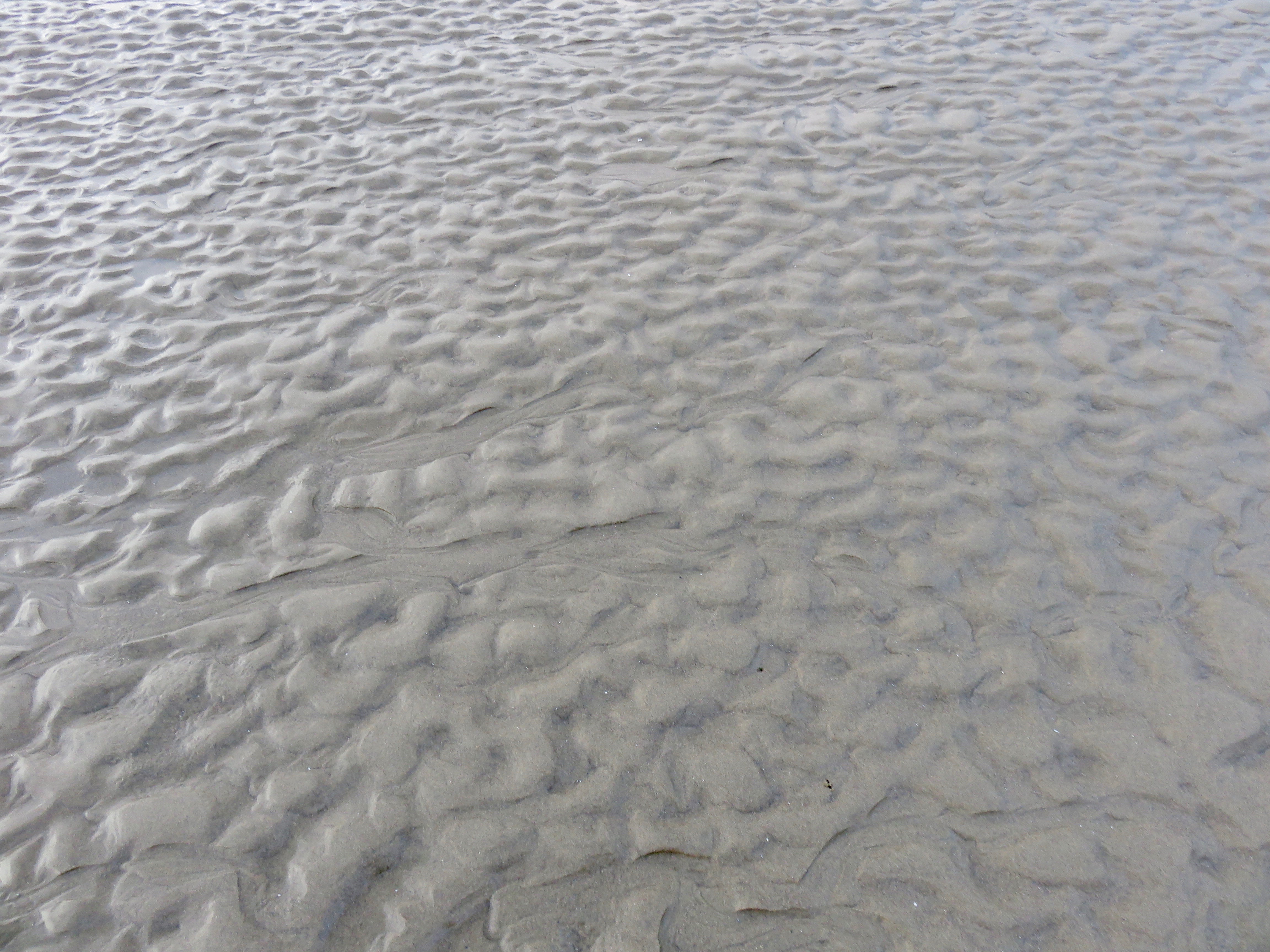
The blue hour reveals sand newly swept by the sea.
The blue hour is the time of tiny shore birds rising and settling, rising and settling, search and searching.
The blue hour witnesses gulls eating crabs cast onshore.
The blue hour is given over to breaking waves and mere silence underneath.
The blue hour precedes the blind light climbing the coast range and casting brilliance out to sea and finally onto the sand.
The blue hour is cool and clear, damp and dim.
The blue hour.
The pure clean daylight makes an end.
Ah! I have learned how to change text color, single space multiple lines, and indent text—hoorah!
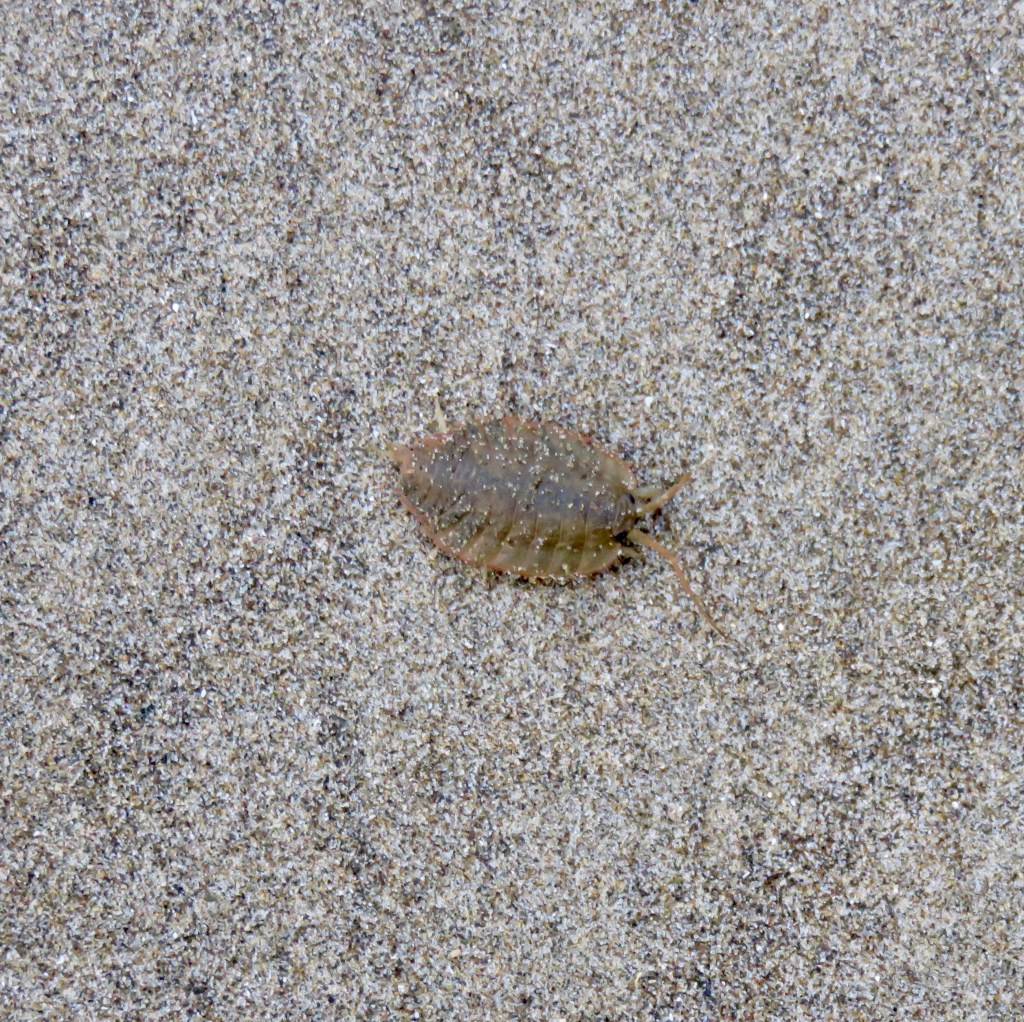
Our walk is what begins our day, what gets me out of bed and moving so that we can walk tide-washed sand and get home before the crowds. What we see on our walks—crabs, isopods, a moth caught on the wet sand, seabirds and eagles, the sand crabs and hoppers of various sorts—decorate our path. There were no chitons, none at all this morning, on the headlands or seastacks, but juvenile gulls still cried for their mothers to feed them.
When my nearby footsteps alarmed this isopod, it flipped onto its back, rolled up just like a pill bug, and then flipped back onto it myriad legs and scurried on. It was more than an inch long
The odd little fellow rushing past us was an isopod, a sort of catch-all term covering the ten thousand other species of Isopoda, an order of crustaceans that include woodlice, what we called “pill bugs” when I was little. The Isopoda include 4500 species that live in or near the ocean, 500 on dry land, and the other 5000 in fresh water. They are found worldwide and the land-based species are entirely herbivorous and harmless to humans. Some marine species bore into wood (such as boats) or are parasitic to fish, shrimp, or crabs. The one I saw this morning was likely a rock lice or sea slater, considered a terrestrial isopod, though its habitat includes tide pools—the entire splash zone. Taken together, this order lives everywhere in the world, from the tropics to the edges of the Arctic and the continent of Antarctica.
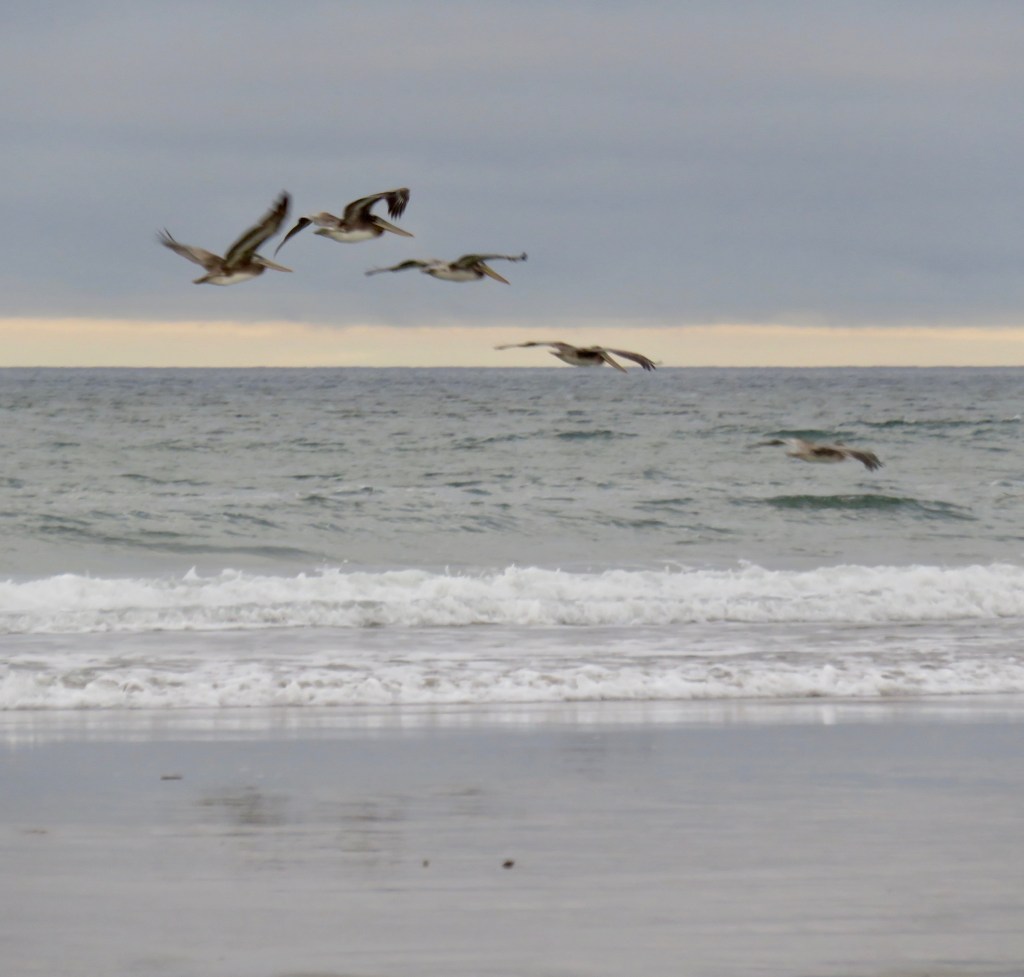
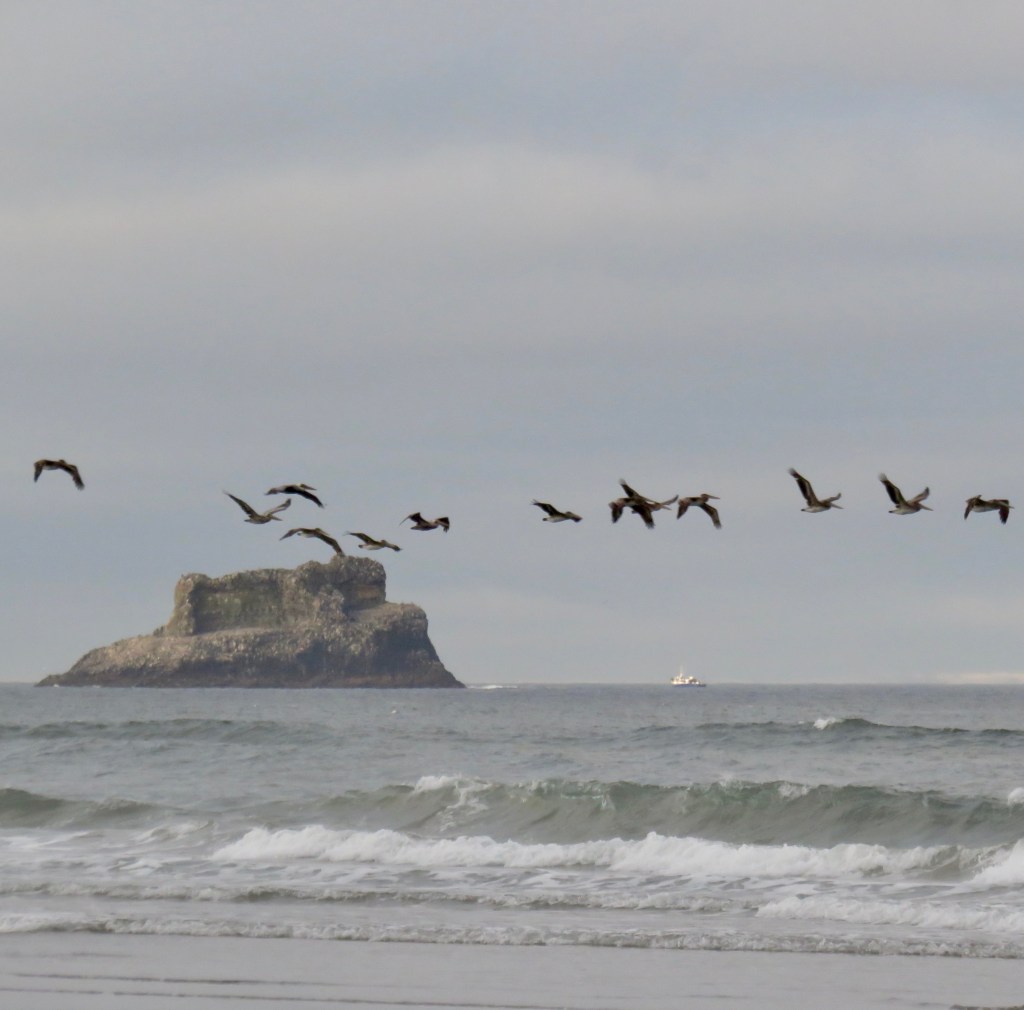
We walked long this morning and after touching stone at Hug Point, hundreds (Gary says thousands!) of pelicans flew past us heading north. The first group of seventeen was followed by a small group of five, which appeased us since we suspect they are almost always in even numbers. (They are monogamous for the breeding season.) Then a group flew just outside the surf line, too many to get an accurate count, and another group and another and another all the way while we walked the two miles home.
This is part of a group that flew between us and the surf. Some groups flew out near the horizon, usually in a looping line.
The brown pelican (Pelecanus occidentalis) was identified and named by Linneaus in 1766. It is found from the mouth of the Amazon River and Galapagos Islands north into Canada on both the Atlantic and Pacific shores. It was listed among the endangered species by the U.S. from 1970 until 2009, but thanks to the ban on DDT in 1972 the species has recovered and today is listed of “least concern.” The local subspecies is californicus, which breeds on the California coast. A large seabird, our brown pelicans are the smallest of their kind. Their flight feathers are dark brown when I find them onshore, and sometimes a foot and a half long. They have a wingspan of about seven feet (6’8″ to 7’6″) but weigh seven to eight pounds. They spend their lives almost entirely at sea. They glide steadily near the surface and we enjoy watching them dive into water for fish. Pressed to catch up with their pod, a pelican can move very fast indeed. They can perhaps fly at speeds past 50mph, and live for decades.
When we moved here forty-one years ago, neither of us recall seeing these birds at all. Then one summer, there were a few who passed, then fourteen arrived one early summer and stayed into the fall. That might have been fifteen years ago, perhaps more recently, perhaps in 2007. We see them each year now and long lines of hundreds sometimes pass, but usually a dozen or more hang about, fourteen or eighteen, throughout the warmer weather. They have flown right in front of our windows—their strange pterodactyl faces, always seeming to be pointed north. Most often they glide a few feet above the ocean, between breakers or just outside the surf. But other days we see them far out on the horizon, moving in smooth, graceful arcs.
We are always heartened to see the pelicans. Thank you, Rachel Carson. Thank you thank you thank you!