An imperturbable demeanor comes from perfect patience. Quiet minds cannot be perplexed or frightened, but go on in fortune and misfortune at their own private pace like a clock during a thunderstorm.—Robert Louis Stevenson
Many years ago a famous author commented about the sloppy appearance of women in Washington State, where I went to public schools, Kindergarten through three undergrad degrees. She also talked about Puget Sound, using terminology appropriate to the East coast. Both comments irritated me, but non-locals talking about my corner of the natural world is particularly irksome. She spoke with authority and got details all wrong. I mean to write about two things today. First, a peevish rant about people misunderstanding my home.
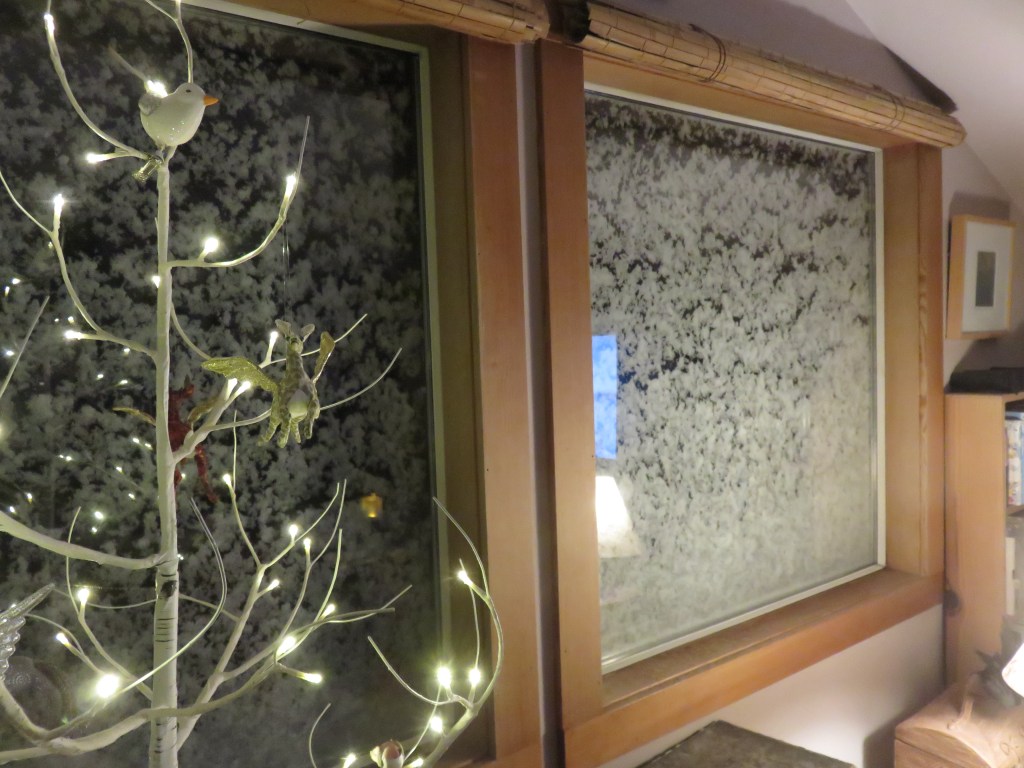
I should have shared this photo before now. Christmas snow with a west wind. Most winters we have not seen snow. Some winters we have not even experienced a major frost on the coast—the impact of the largest body of water in the world right outside our door.
A mediocre mystery/romance novel set on “the Puget Sound” referred to it as “ocean,” which it isn’t. Look at a map for goodness sake. And no one born here includes that article “the” before Puget. As in: We took the ferry across Puget Sound to Orcas Island.
I was writing a card to Bette and realized that most things do not matter… the passage of time, the work I still miss doing, the “accomplishments” I would like to detail—none of that really matters. What matters is beauty and people. People and beauty.
So here is beauty that I have seen in the past year.
JanuaryFebruaryMarchAprilMayJuneJulyAugustSeptemberOctoberNovemberDecember, Portland in sunrise
I could have chosen photos of eagles or of highways or flowers. I could have chosen photos entirely of the people I love. I could have chosen other landscapes or birds. These images were chosen because they are what I have looked at early in the morning and thought: beautiful!
Thank you, John Keats. We only remember this stuff because it matters.
Ode on a Grecian Urn  (1809)
by John Keats

Thou still unravish'd bride of quietness,
       Thou foster-child of silence and slow time,
Sylvan historian, who canst thus express
       A flowery tale more sweetly than our rhyme:
What leaf-fring'd legend haunts about thy shape
       Of deities or mortals, or of both,
               In Tempe or the dales of Arcady?
       What men or gods are these? What maidens loth?
What mad pursuit? What struggle to escape?
               What pipes and timbrels? What wild ecstasy?

Heard melodies are sweet, but those unheard
       Are sweeter; therefore, ye soft pipes, play on;
Not to the sensual ear, but, more endear'd,
       Pipe to the spirit ditties of no tone:
Fair youth, beneath the trees, thou canst not leave
       Thy song, nor ever can those trees be bare;
               Bold Lover, never, never canst thou kiss,
Though winning near the goal yet, do not grieve;
       She cannot fade, though thou hast not thy bliss,
               For ever wilt thou love, and she be fair!

Ah, happy, happy boughs! that cannot shed
         Your leaves, nor ever bid the Spring adieu;
And, happy melodist, unwearied,
         For ever piping songs for ever new;
More happy love! more happy, happy love!
         For ever warm and still to be enjoy'd,
                For ever panting, and for ever young;
All breathing human passion far above,
         That leaves a heart high-sorrowful and cloy'd,
                A burning forehead, and a parching tongue.

Who are these coming to the sacrifice?
         To what green altar, O mysterious priest,
Lead'st thou that heifer lowing at the skies,
         And all her silken flanks with garlands drest?
What little town by river or sea shore,
         Or mountain-built with peaceful citadel,
                Is emptied of this folk, this pious morn?
And, little town, thy streets for evermore
         Will silent be; and not a soul to tell
                Why thou art desolate, can e'er return.

O Attic shape! Fair attitude! with brede
         Of marble men and maidens overwrought,
With forest branches and the trodden weed;
         Thou, silent form, dost tease us out of thought
As doth eternity: Cold Pastoral!
         When old age shall this generation waste,
                Thou shalt remain, in midst of other woe
Than ours, a friend to man, to whom thou say'st,
         "Beauty is truth, truth beauty,—that is all
                Ye know on earth, and all ye need to know."
The truth isn’t always beauty, but the hunger for it is.
—Nadine Gordimer
I don’t know if any of this is true—that beauty is truth or that an urn can speak to any truth—but it is beautiful. And we do hunger for both beauty and truth.
May your day be beautiful… a blessing on your house.
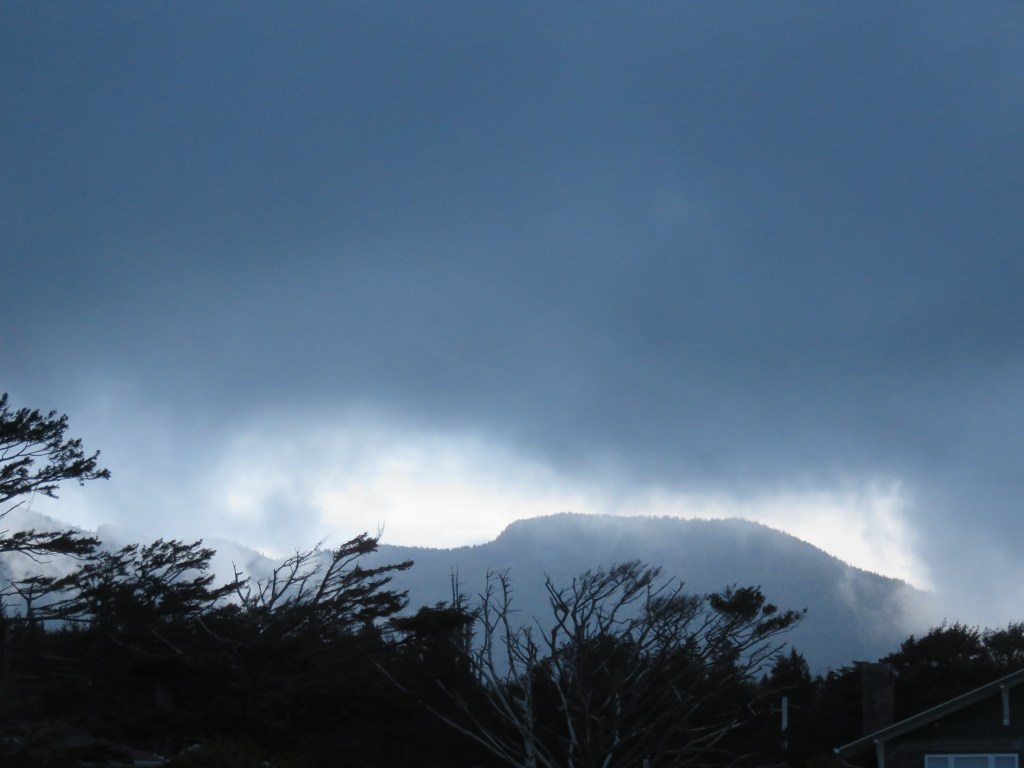
West back to the beach—snow all the way except for this brief clearing in the sky.
Pre-pandemic, we followed a simple route from coast to the city at least twice a month. We left home early and returned before dark. We shopped at the Farmers Market, saw family, went to the music store, visited the nursery, and walked through Powell’s Book Store. We were always in a hurry because of weather and darkness and animals waiting at home. Our last dog and our last cat are gone now, but the other big difference is that now we have a place to stay.
This is one of my favorite skies—when a roll of cloud sits out on the horizon, but the sky overhead is clear. You can see the sky reflected in wave-washed sand.Continue reading →
We do not have cable television anymore. We watch shows via the internet. We rewatched the entire Psych series last fall and discovered episodes we had never seen before. That should not have come as a surprise. Like all children with a television in their home during the second half of the twentieth century, our childhood revolved around when our favorite shows played. Saturday morning cartoon, holiday parades—would we be allowed to stay up and watch Have Gun, Will Travel? It felt at the time like the major problem with bedtimes was missing something on the television, and that would not happen once were grown.
But it did. We both had to work mornings during the original airing of Psych. Sometimes we looked at one another, knew we were tired. and went to bed before it started. Sometimes we tried to stay awake and woke to the closing credits. The clock was still not on our side.
This seaweed looks to me like something from Dr. Suess. Most clusters had multiple tops, but this one only kept one and the other stems had been decapitated by the tide.
“At some point in elementary school, many American children learn that Daylight Saving Time was originally intended to give farmers an extra hour of light to work the fields.
This is the largest “sea nettle” I have ever seen, dwarfing Gary’s size 13 shoes. It was at least 28″ across—Gary said three feet.
We’ve been busy hustling back and forth, walking our 25 miles a week (and me running a few of those), working on our second home, and admiring everything we see.
One of our tenants believes in the “good old days.” He is young. He thinks the fifties and sixties and seventies were times of idyllic freedom. I look at his long hair and think: You’d have been beaten half to death living around here in the 60s; you’d have been jailed for what you smoke. Times were only good in some ways and for some people. I had to wear a skirt to school every single day and had the bloody knees to show for it. School counselors, aptitude tests, and my own mother assumed my primary role in life was to get married and stay home with children. Gary was nearly expelled from school because his hair touched his collar and was not encouraged to pursue . . . anything beyond 9-5 employment or perhaps death in the war. (Gary graduated with honors from the UW and Phi Beta Kappa. He dropped out of grad school to care for his family while his father was dying of cancer.) Our opportunities were limited by gender and class and the draft. And we are reasonably smart and able white people. (So is our tenant, which might be another reason he’s nostalgic for a time that only looks good if you don’t look too closely.)
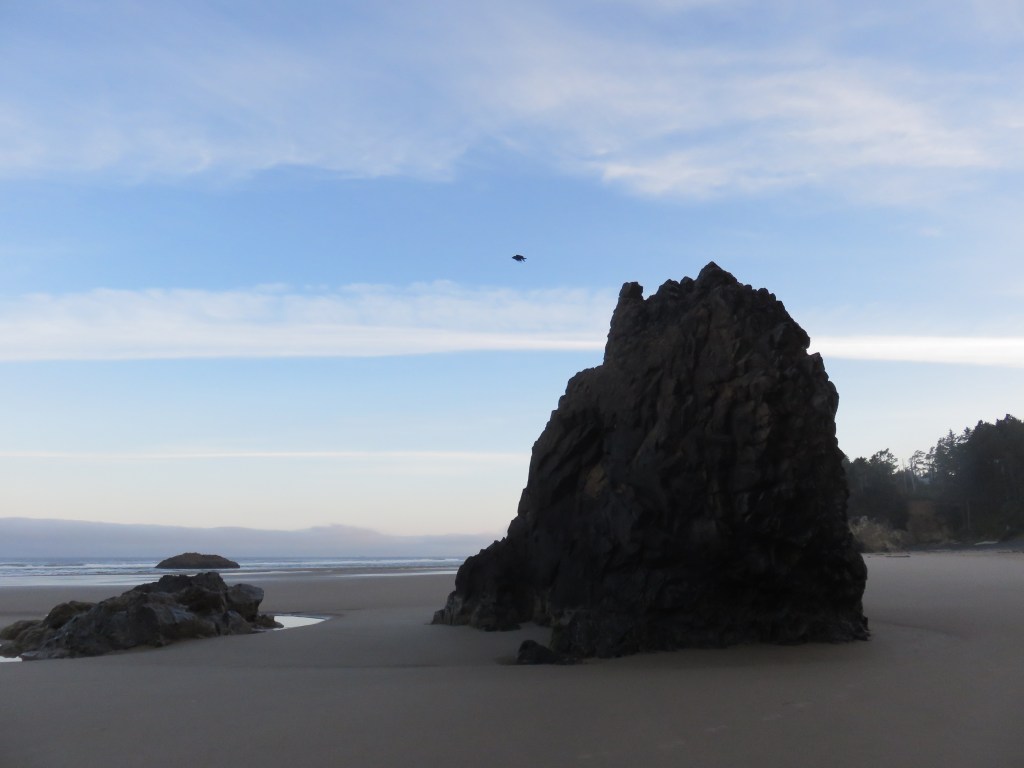
A crow was perched on top of what we term the “turnaround rock” because walking to and around it marks a three-mile journey from our home. That crow flew the instant I took my camera out of my pocket—the little black blot in the middle of the photo. I’ve been running a nine-minute mile three or four times a week, usually right past this rock. On the back side, the ocean goes quiet.
My 50-year high school reunion was this past weekend, about 200 miles north of where I’ve lived since soon after my undergraduate years. I did not attend. The group photo shows a fraction of my 600 fellow graduates standing shoulder to shoulder. Only a handful wear masks. A friend said she could not recall the events reported to her about shared high school experiences. But I wonder who of us can remember all events important to other people? In the group photograph she and her husband are the only people I immediately recognize.
Today is my high school reunion, the 50th delayed to year 51, and it is also my elder son’s 41st birthday. I will be baking a vegan, gluten-free, refined sugar-free cake later today. Our family is coming. They’ve had good reason to stay safe, isolated, and healthy. So that is the best reason for staying home. But there’s also the pandemic, which is the real reason.
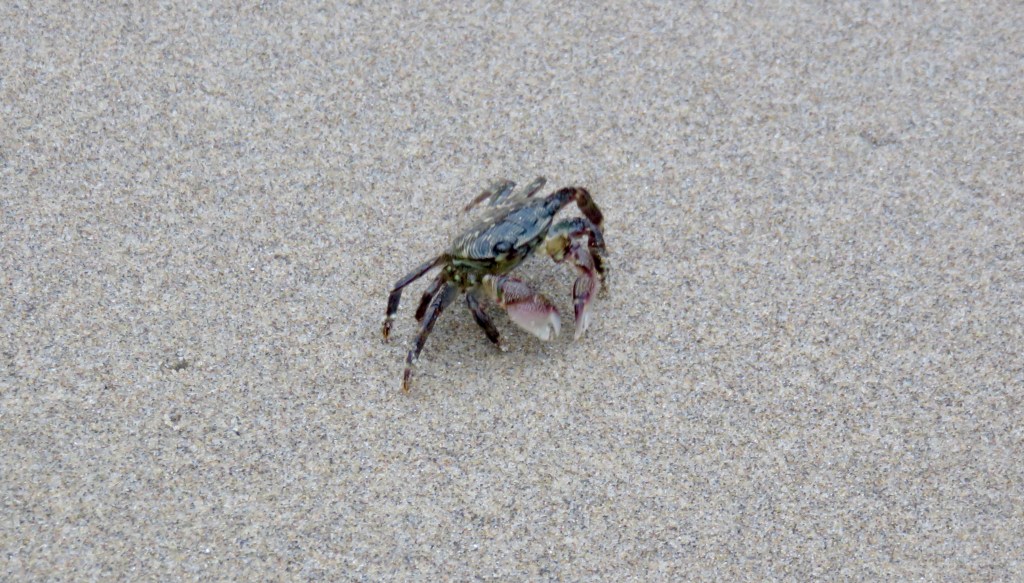
We occasionally see crabs stranded by a high wave, especially in late summer. Usually it’s a big Dungeness so far up on the sand that it would bake before the tide came back in. Such crabs requiring two hands to carry back to a tide pool. We got this little guy—about an inch front to back of the body and furious at being noticed— back to a tide pool, and the tide was incoming. It probably lived. Continue reading →
My 50th high school reunion is coming up in less than a week. It is actually our 51st graduation anniversary, but there was that pandemic. Actually, the pandemic is still raging, and locally it’s worse than ever with more cases daily than we saw in a month last year. I live in a tourism destination and we routinely see license plates from Texas and Florida, Georgia and Tennessee, not to mention plenty from Washington, Idaho, and California. Sometimes there are more cars from out of state than Oregon on the road. Who can blame them for coming?
Almost the entire PNW is suffering from fire or the smoke of blazing forests. Air quality was so bad in Portland last week, it was labeled “hazardous” to health and people were advised to stay indoors. The one grace is that smoke-polluted air makes for glorious sunrises and sunsets. The dawn and late afternoons have shown peach-colored suns. The color in this photo is not what my eye saw, which was quite red. Yet tourists persist in lighting beach fires, even in wind. The air is fine here, but you might think that people would consider climate change? Continue reading →
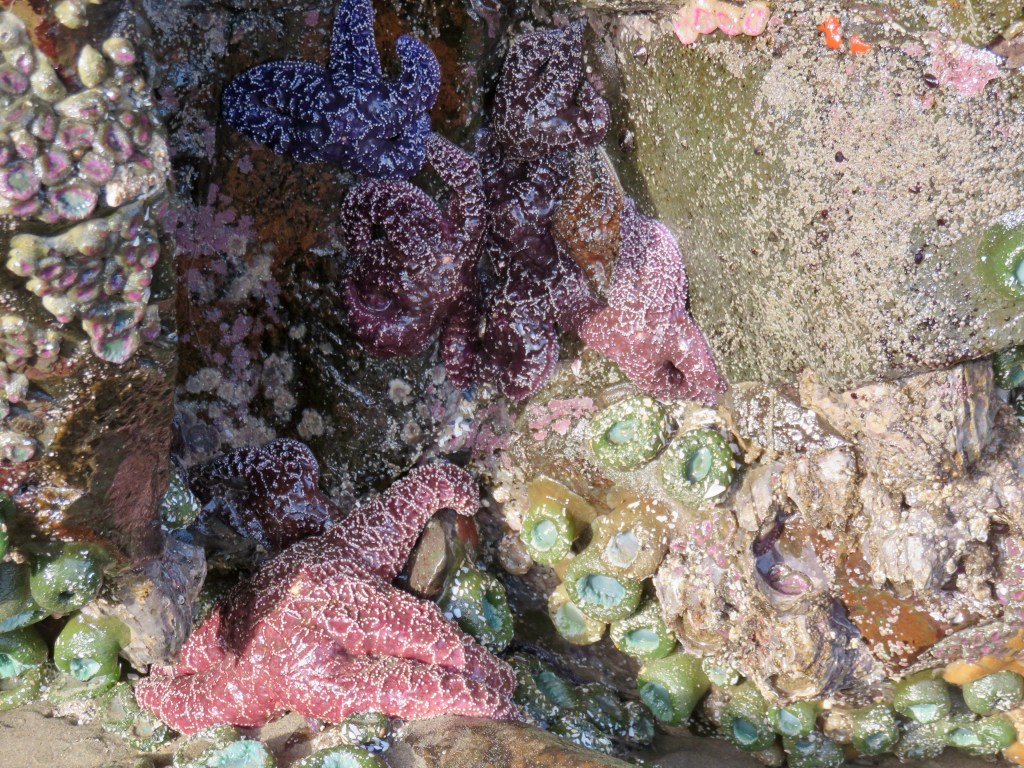
There are many healthy-looking purple and orange starfish again! Nine in this photo. The green rounds are anemones folded in against the receded tide. Little pink rounds in the upper left are anenomes too.
Ripper: I don’t know how well I could stand up under torture.
Mandrake: Well of course the answer to that is, boy, no one ever does. And my advice to you, Jack, is to give me the code now. And if those devils come back and try any rough stuff, we’ll fight them together, boy, like we did just now, on the floor, eh? You with the old gun, and me with the belt and the ammo, feeding you, Jack! Feed me, you said, and I was feeding you, Jack.
—Dr. Strangelove: or, How I learned to stop worrying and love the bomb
A deer came up our path and pooped just outside our gate.
Those little round brownish pellets in the middle of this picture are deer poop.
The nearest nesting pair of black oystercatchers were out on the sand with their youngster.
The bird at left is an adult (one of the parents. The one in the middle is the other parent. The one at right, with black shading on the end of her beak, is the “baby” already as big as her parents.
The little shorebirds are a mystery. After all these years, I can’t be certain what they are, Least sandpiper (Calidris minutilla)? Or something else?
And then the new driftwood growing up out of the sand. Usually the ocean plows them right up in a high tide, but there have been such drift logs that lasted a year or more because they were well planted.
When Portland, on the east side of the coast range, experiences seasonal hot weather, we often have morning fog. It’s been foggy the last few days when we went out for our walk, clearing once the sun is high enough to burn off the mists.
The eagle flew over our heads on its way to what Gary calls the Bird Snag on the headland north of us.
Sometimes a crow perches here a couple of hundred feet above us, but this is definitely an eagle perch.We usually walk 3-4 miles, but the other day we walked past Arcadia, more than three miles to the north of us, better than a six mile round trip according to my old running measures. And then home.