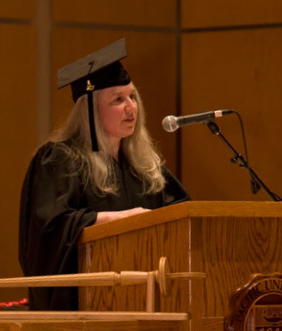
I was Class Speaker in 2007 at Pacific University’s MFA in Writing graduation.
A writer friend of mine who has taught in an MFA program for several years reported that not one of her students had become a “successful” writer by publishing a book. I shared that among students from the two years of my MFA program, only a handful had published books. Of those, most were poets and most came to the program with a chapbook already published.
Tom Jenks writes in the newest edition of his online publication:
“By 1975 the number of graduate programs had grown to fifty-two, a number that in the subsequent nine years tripled to 150, and by 2017 the number grew to more than four hundred. If undergraduate programs are included, today’s number exceeds two thousand. Across approximately eighty years, writing programs have proliferated as the accepted foundation for the would-be writer’s route of entry to a life of writing, publishing, and/or teaching. …
“The 2016 AWP conference in Los Angeles hosted twelve thousand attendees, a number that represents perhaps 7 percent of an estimated 170,000 MFA degree holders and students in the US. Currently, graduate writing programs and undergraduate programs with an emphasis in creative writing turn out some fourteen thousand new degree holders each year.”—Narrative
Need I point out that we do not publish 14,000 books from “new” writers each year? The industry published a bit over 316k titles in 2010, but actual sales were down by 14 million that same year. More books, fewer buyers. A book has less than a 1% chance of showing up in a bookstore. That is a bit better odds than being published by most noted literary magazines, which rarely pay anything to their authors.
Academic life? Other than the (very) rare person who lands a tenure track position, the demand for college professors without substantial publications and research means most work as adjunct. Trust me, a high school English teacher is paid much better. A good cocktail waitress is paid much better. Retail sales at least do not result in hours spent scoring papers.
Years ago, I read that the average full-time writer earns less than $10k/year. True, Neil Gaiman, but there is only one of him. The nation does not need many new writers. They will not earn a living through creative writing of any kind. A writer I knew from years ago had this piece of advice: “Marry money.” Unlike the graduate of an engineering program or even one with an English degree, very few creative writing majors will find work relevant to their education. Their odds are about on par with the high school character actor becoming the next Cate Blanchett.
So of the majority of people who graduated with me in 2005, what are we up to? Several are not writing at all. They have stopped pursuing “writing, publishing, and/or teaching” altogether. Some have moved on in their academic careers. At least half published work in literary journals or books, but several of those are not actively writing now. Only two that I know of have new books out in the past few years. They are not making even $10k/year from those books.
I am mostly retired from teaching but still writing. I am publishing in journals. According to Duotrope, an online resource I use to locate markets and track my submissions, my publication rate has consistently been “higher than the average for members who have submitted to the same markets.” My acceptance ratio has varied over the years from a low of around 5% at the start to a brief high of 14%. Just now I am at 8.5%. I submit to journals than accept less than 1% of submissions recorded by Duotrope. At no time have I made a profit on my writing. I have been published in fine journals (without pay) and have presented to regional and national conferences (for zero pay). I have been paid for technical writing, but I was better paid freelancing graphic design, which was not my major, or drawing plans for an architect, for which I had no educational preparation at all. Even when I was judging field trials across the West, a hobby, I was paid travel expenses and was housed and fed. Writing and presentations on writing? Not a chance. I have never actually been paid for any literary work, though I do expect a small check to arrive in the next month from a paying market. Maybe.
So why the degree?
I had promised myself an MFA. I assumed it would be in the visual arts since my undergraduate degrees were in the visual arts. I have BFA degrees in ceramics and metal and a BA in Arts Education. I came to writing relatively late in life because I wanted to return to teaching and there were no arts jobs available. I thought I would teach Social Studies, those classes where I learned to write essays, but instead I began teaching English, where all writing is taught these days. I did not need an MFA for that job.
My MFA cost me $20,000 and I will never see a return on that investment in any job. I had already written three novels and published essays, stories, and poetry before I began the program.
So why?
There were people in my program who only wanted to write a book, people who needed a terminal degree to advance in academia, and people who left the program and became musicians. I have kept writing and reading and writing and reading. Why the MFA? I was already productive and growing.
It was that promise to myself. Self-indulgence really. Just as most the other actual writing is self-indulgence. My sons had graduated from college and I found that the frugal habits I had developed when we were a one-income family and throughout our sons’ education were not as easy to break as I once thought they would be. I was at the top of the pay scale as a teacher, my husband was also working, and we went no where on vacation, drank only cheap wine and good homemade coffee, used no drugs, and ate out rarely at restaurants labeled with one fork, for “cheap eats.” I could afford $20,000 spent over the course of two years.
The degree was for me. I hoped to become a better writer and to find a writing community since my efforts at finding a writing group had failed again and again. (There was the group where the poet-leader declared fiction “annoying.” The group that wanted mostly to gossip. The one that wanted to get high. The one that self-published horrible trendy fiction.)
Jenks assures me that I didn’t need that MFA degree, that I will likely join the tens of thousands who will never “use” their degree to be a “successful author,” a term even he finds it difficult the define. Did I enjoy the program? Yes, very much. Would I do it again? Absolutely. Did I find the writing community that I desired? Not really. Did it make me a better writer? Perhaps it did. Did it help me to become a published writer? No, it did not. That is something else again. I got something from the program, made a few friends, and often consider how to return. That is enough.
Were I today in my early 20s, a white girl, even a white girl from a modest upbringing 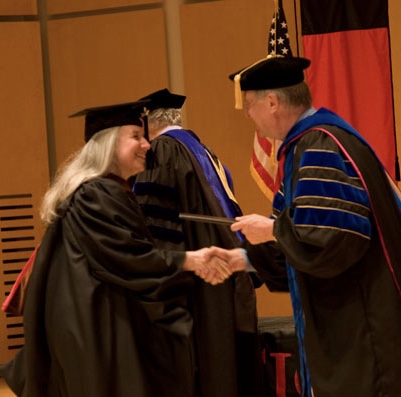 and married to a man raised in poverty, what value would I bring to fiction? What story do I offer? It is a question I ask myself even now.
“Some things can be taught, some learned—so much depends on the character of the writer.”—Tom Jenks


 &PRIDE Press