SOCIAL SECURITY

IMG_3106

As a child, I thought I would one day have many horses. This is one of my horses.

When I was a teenager, my mother was buying and selling antiques. She reported the income as coming from both herself and my dad because, having worked for the feds and before that for a college, he did not have many years in the Social Security system. In other words, he qualified for a federal pension but not for Social Security benefits. Mom wanted to ensure he could have both so my dad was a partner in the resale business of antiques and collectables. Today, she would have done this via Ebay; in those years, she attended flea markets and antique shows.

This was a good lesson for me as a teenager, to see someone planning ahead.

Talking about money is uncomfortable. I get that. It is for me too.

Some in my parents’ generation were diligent about preparing for retirement. They may have been particularly motivated if they faced particular challenges related to race or religion or divorce, humble upbringing or handicap. There was also the fact of growing up in the Depression, which tended to instill a sense of monetary insecurity and need for preparation. And the G.I. Bill had sent a generation of Americans to college who would not have had that opportunity in previous decades.

The G.I. Bill was initially conceived primarily as a home-buying incentive for returning veterans. The educational portion was tacked on at the end, but it might have created the most dramatic shift in American culture.

Don A. Balfour was “the first recipient of the 1944 GI Bill.” Veterans Administration letter to George Washington University.

On June 22, 1944, the Servicemen’s Readjustment Act of 1944, commonly known as the G.I. Bill of Rights, was signed into law.

During the war, politicians wanted to avoid the postwar confusion about veterans’ benefits that became a political football in the 1920s and 1930s. Veterans’ organizations that had formed after the First World War had millions of members; they mobilized support in Congress for a bill that provided benefits only to veterans of military service, including men and women. Ortiz says their efforts “entrenched the VFW and the Legion as the twin pillars of the American veterans’ lobby for decades.”

Harry W. Colmery, Republican National Committee chairman and a former National Commander of the American Legion, is credited with writing the first draft of the G.I. Bill. He reportedly jotted down his ideas on stationery and a napkin at the Mayflower Hotel in Washington, D.C. U.S. Senator Ernest McFarland, (D) AZ, and National Commander of the American Legion Warren Atherton, (R) CA were actively involved in the bill’s passage and are known the “fathers of the G.I. Bill.” One might then term Edith Nourse Rogers, (R) MA, who helped write and who co-sponsored the legislation, as the “mother of the G.I. Bill”. As with Colmery, her contribution to writing and passing this legislation has been obscured by time.[Wikipedia]

Like slightly more than half of World War Two veterans, my aunt (Marines) and my father (Army) used the G.I. Bill to gain a college education. Both went to the University of California at Berkeley. They were first generation. My mother was too young to have served during the war, but she lived with her sister and after the war also attended UC Berkeley before her marriage.

The Bill was not perfect. It suffered from the bigotries of the day, stumbled, lapsed, but has been renewed in recent years. It still looks like opportunity for many young people seeking to serve their country and find a better life.

There used to be a popular fiction, the Horatio Alger myth, that encouraged a belief that in America anyone can rise. Indeed, many have come to our country to find a better life. Many have found that better life, but actual wealth tends to run in families. We do not live in a fluid society. Children born into affluent families may achieve actual wealth (Gates), but the rags-to-riches story is rare to nonexistent. (Riches-to-rags is an easier move. There is plenty of research documenting how a single generation brought up in privilege can squander wealth.) Most people shift slightly up or down in class, work and earn slightly more or less than the generation before them.

It has never been easy to shift social classes, and there is deep resentment among the wealthy, hence derogatory terms such “Nouveau Rich” and “social climber.” Research suggests that active resistance has grown. Social mobility is less likely today than is has been in the middle of the last century.  My mother’s mother had hoped to attend college and according to family stories was accepted to Reed College, but was unable to attend when she and her sister were forced to support the family due to a strike. Later my grandmother was an office manager in a shipping company, a single mother supporting her daughters. My own mother attended college only until she married. I have four college degrees, and my sons have four between them.

What we are given is ultimately less important than what we assume we are entitled to pursue. I assume my grandchildren will attend college, and because of such assumptions about their futures, they likely will. My parents assumed as much for me. My husband attended college only because I did, not because anyone in his family had ever attended college or because anyone in the educational system encouraged him. He graduated in 1974 with honors and Phi Beta Kappa. His work has rarely relied on that education directly, but a look at his bookshelves reveals a man still interested in his own education. I am proud of him—he is interested in knowing.

Assumptions about my own life have also flexed. I thought I would teach till I was in my 70s, but a year of lingering illnesses forced me to retire at 62 when there was “no money” to offer me a half-time teaching position. I have not been sick since, though I do still teach two college classes each year.

My husband and I have three pensions between us, none of them enough to pay rent, but adequate together with Social Security, which we each paid into since the 60s.

My mother was determined that she and my father would enjoy a secure retirement. In practice, life did not proceed in the manner she hoped for. My father was forced to retire early due to rheumatoid arthritis. He died of lung cancer before reaching my age. My mother moved alone to a coastal town in Oregon, and her contractor underestimated the cost of her retirement home by a factor of three, so she went back to work part time for a few years.

We do what we can and hope for the best.
READING SCIENCE FICTION, pt. 1

IMG_3093

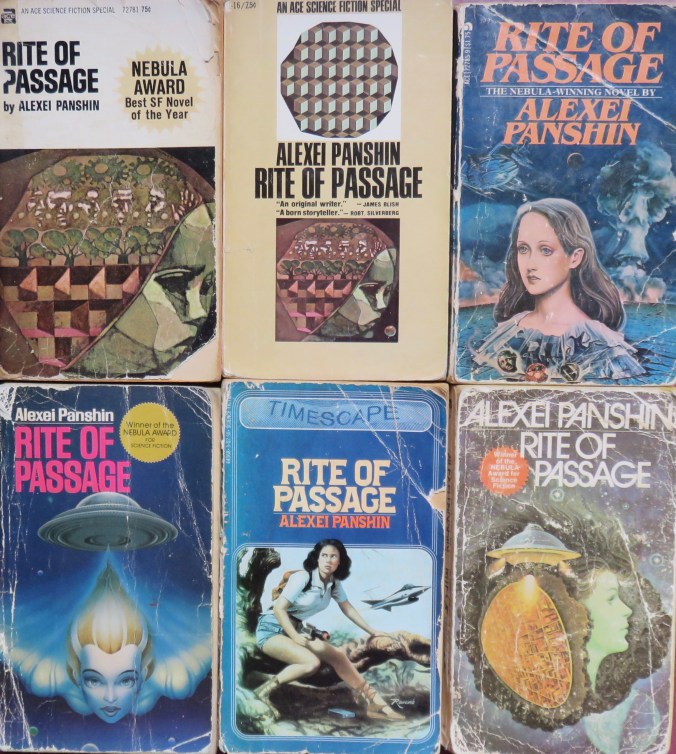
I could pretend to love The Left Hand of Darkness, but I never did. I could acknowledge that I do love many other novels such as Ursula K. Le Guin’s The Dispossessed, Vonda McIntyre’s Dream Snake, and Molly Gloss’s The Dazzle of Day. But my favorite science fiction novel is Rite of Passage by Alexei Panshin. Above are a few of the covers of this science fiction novel title.

The first time I read it, I was in college and about the age of the main character as she tells her story.

Rite of Passage is a science fiction novel by American writer Alexei Panshin. Published in 1968 as an Ace Science Fiction Special, this novel about a shipboard teenager’s coming of age won that year’s Nebula Award, and was nominated for the Hugo Award for Best Novel in 1969.—Wikipedia

This is the dystopian coming-of-age novel people should be reading, what is known as “hard” science fiction because there is no magic, no fantasy, only scientific possibility. There are also no clear villains, just people doing the best they know how to take care of the themselves and their own. The “heroes” are flawed, the ethical choices are not clear cut and tidy, and no one is shot with an arrow.

Mia Havero is a “little black-haired, black-eyed girl” of about 12 at the start of the story she tells of her rite of passage. Few of the covers I have seen indicate that the designers had actually opened the book, much less read it. Upper left and middle are solid. Sometimes what you see is not what you get.

I was reminded of this a day or two ago when I found a meme in my feed with a misquote of the Constitution of the United States. The meme contended that if the President were impeached, he and all his people (VP on down) would be forced from office. A lot of people liked the meme. People who have college degrees and should know better. And I will admit that I would be happy to see the back of Pence and the rest of Trump’s minions, but that is not what would happen.

That so many people accepted this meme as true was disappointing. I was left wondering if no one else remembers anything from our Constitution?

Does no one verify their sources anymore?

The left has been eager to throw up their hands at the ignorance of those supporting Trump. I have witnessed this again and again. Sadly, there is plenty of evidence that those on the right believe exactly what they want to believe. It is so much easier than actually finding out what is true. Those on the left do that too sometimes.

There is this simple black-and-white view of the world that is not the least helpful to accomplishing anything. It’s comfortable to discard another’s viewpoint just because it differs from our own, to ignore the demands of people we do not identify with. Working to hammer out solutions is messy compared to simply “laying down the law.” The Russian interference in our national conversation has done further damage to thinking that already viewed “compromise” as a dirty word.

We seem unwilling to understand that the world is not a YA dystopia with an evil force (them) fighting to take down those fighting purely for good (us). Reality is a whole lot of people with different ideas about how to achieve justice and liberty. When we acknowledge that complexity, we will get farther as a nation. There are times when the only solution is an imperfect one, when you get a little of what you want and I get a little of what I want, but no one gets buried in the process.

I read science fiction to find a laboratory for possibility. I already know how things can go wrong. I am interested in how things go right without the intervention of comic book heroes. Plenty of science fiction and fantasy is just another world struggling for power, but some science fiction and fantasy looks hard at difficult ideas. Not the dark lord or evil empire, but really people struggling to do their best.

Mia Havero is a Latina name. The author is American, and his book is back in print.

“The Nebula Award-winning novel, back in print at long last!

“In 2198, one hundred and fifty years after the desperate wars that destroyed an overpopulated Earth, Man lives precariously on a hundred hastily-established colony worlds and in the seven giant Ships that once ferried men to the stars.

“Mia Havero’s Ship is a small closed society. It tests its children by casting them out to live or die in a month of Trial in the hostile wilds of a colony world. Mia Havero’s Trial is fast approaching and in the meantime she must learn not only the skills that will keep her alive but the deeper courage to face herself and her world.

“Published originally in 1968, Alexei Panshin’s Nebula Award-winning classic has lost none of its relevance, with its keen exploration of societal stagnation and the resilience of youth.”—Fairwood Press

BOOKS I TAUGHT

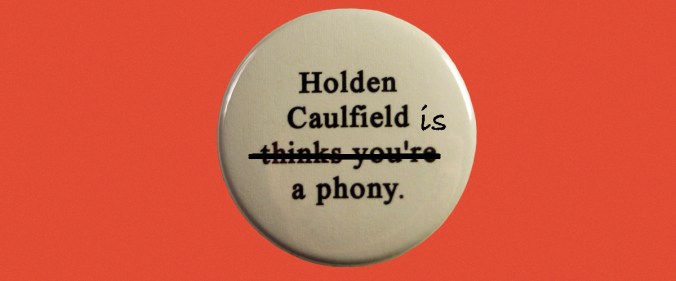
phony.jpg

A student wrote to me the other day to thank me for assigning Mountains Beyond Mountains when she was  junior in my class. The young woman is in her third year of medical school and credits Tracy Kidder’s true story of Dr. Paul Farmer for inspiring her ambition. It was not the only nonfiction I taught, but it was the only nonfiction book I taught.

I showed films to introduce my students to other lives and other times. I am proud that I taught the novels Their Eyes Were Watching God, The House on Mango Street, Things Fall Apart, and A Yellow Raft in Blue Water.

A self-proclaimed “non-reader” in my regular English class agreed to keep reading Yellow Raft after I’d read the first chapter of part one “Rayona” but could not read “Christine” because she was “too much like my own mom.” So we struck a weekend bargain. He would read seven pages and if he still couldn’t stand to read that part of the book, I would given him a summary and he wouldn’t have to read the rest. He came back to class on Monday and declared he “loved Christine.” She helped him understand his own family and the fictional character remained her favorite in the novel.

Sometimes we find ourselves or people we need to understand in a novel.

I taught both The Catcher in the Rye and The Adventures of Huckleberry Finn for over 20 years. 

I generally shared William Raspberry’s column about Huck Finn, and worked hard to introduce my students to satire. The novel was a consistent failure in my Honors classes. These “good readers” were unwilling to slow down and hear Huck and Jim speak, they were too good at skimming. As a result they found the novel unfunny and boring. However, when my voice could manage it, for several years I read nearly the entire novel aloud to my “regular” students. They got every joke.

Huck is a poor boy with a rotten father, a racist boy who eventually learns to respect and honor his friendship with the young man, the slave Jim. He is on a hero’s journey but he fails because he does not figure out that slavery is wrong. He cannot overcome society’s instruction about what is decent and proper. Even at the end, he believes it is a sin to help a runaway slave. Nevertheless, he is willing to go to hell rather than betray a friend: Jim, who is far craftier and kinder than Huck recognizes. Jim reveals himself as one of the view decent adults in the novel when he risks his life staying with the critically wounded Tom. Some students responded to the moral lesson in the novel and the humor throughout. Many missed it completely.

By contrast, for more than twenty years, students loved Holden Caulfield in The Catcher in the Rye.

Holden is a rich white boy attending elite private schools but with neglectful parents. He is grieving and riddled with guilt. He does not overcome these challenges. Parents of my students sometimes balked at the language, but the real problem with this novel, from this parent’s perspective, is that Holden is suicidal throughout and in a mental hospital as he relates his story and he’s been there for months and still lying about where he is and why.

Teaching this novel allowed students to develop understanding of “voice” in literature, and to realistically extrapolate Holden’s future (they were never optimistic). One girl waited after class to speak to me and sobbed that Holden would not like her if they met. Sadly, she was right. Holden’s tolerance for most people is slim.

I used Jane Smiley’s ridiculous take-down of Huck Finn and Calvin Trillion’s questionable 50th anniversary review of Catcher in order to introduce my students to opposing views, to critical thinking, and evidence-based argument. The more they liked the novel, the more passionate was their response to the reviews. To be fair, however, even people who had not initially liked Huck Finn sometimes became fans after recognizing the false equivalency of Smiley’s comparison of Huck Finn to Uncle Tom’s Cabin. As if Jane Austen failed because she did not write novels more like Charles Dickens.

Eventually the tide turned for Holden, and one year a majority of readers found Holden “annoying.” I gratefully replaced him with Jason Taylor in Black Swan Green by David Mitchell. That book also contains language, but deals with bullying and class. Jason is also a relatively affluent white boy, but younger and in many ways nicer than Holden. He is not oblivious to social injustice. He is not so obsessed with his own suffering that he is largely incapable of noticing others’. 

We read all of The House on Mango Street aloud in class, each student choosing a story to read and I read the rest. It is brilliant and a superior trigger for personal stories. We talked about fiction and creative nonfiction and prose poetry. It’s all there.

I taught Toni Morrison’s first novel The Bluest Eye for 25 years. I warned students about content. I advised them to skip pages or call me if they had trouble. I had an alternative and more euphemistic novel in the wings. But Toni Morrison is our only living Nobel novelist, and she is among the best writers to ever exist. There are no substitutes. She writes about love, including the love of little black girls, the most neglected of all. She teaches paradox of pain and beauty, of survival when someone loves us and tragedy when we are unloved.

Isn’t that what all novels are about?

WRITING EDUCATION

_MG_0011

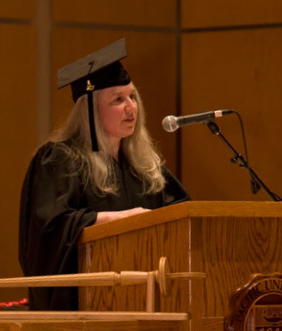
I was Class Speaker in 2007 at Pacific University’s MFA in Writing graduation.

A writer friend of mine who has taught in an MFA program for several years reported that not one of her students had become a “successful” writer by publishing a book. I shared that among students from the two years of my MFA program, only a handful had published books. Of those, most were poets and most came to the program with a chapbook already published.

Tom Jenks writes in the newest edition of his online publication:

“By 1975 the number of graduate programs had grown to fifty-two, a number that in the subsequent nine years tripled to 150, and by 2017 the number grew to more than four hundred. If undergraduate programs are included, today’s number exceeds two thousand. Across approximately eighty years, writing programs have proliferated as the accepted foundation for the would-be writer’s route of entry to a life of writing, publishing, and/or teaching. …

“The 2016 AWP conference in Los Angeles hosted twelve thousand attendees, a number that represents perhaps 7 percent of an estimated 170,000 MFA degree holders and students in the US. Currently, graduate writing programs and undergraduate programs with an emphasis in creative writing turn out some fourteen thousand new degree holders each year.”—Narrative

Need I point out that we do not publish 14,000 books from “new” writers each year? The industry published a bit over 316k titles in 2010, but actual sales were down by 14 million that same year. More books, fewer buyers. A book has less than a 1% chance of showing up in a bookstore. That is a bit better odds than being published by most noted literary magazines, which rarely pay anything to their authors.

Academic life? Other than the (very) rare person who lands a tenure track position, the demand for college professors without substantial publications and research means most work as adjunct. Trust me, a high school English teacher is paid much better. A good cocktail waitress is paid much better. Retail sales at least do not result in hours spent scoring papers.

Years ago, I read that the average full-time writer earns less than $10k/year. True, Neil Gaiman, but there is only one of him. The nation does not need many new writers. They will not earn a living through creative writing of any kind. A writer I knew from years ago had this piece of advice: “Marry money.” Unlike the graduate of an engineering program or even one with an English degree, very few creative writing majors will find work relevant to their education. Their odds are about on par with the high school character actor becoming the next Cate Blanchett.

So of the majority of people who graduated with me in 2005, what are we up to? Several are not writing at all. They have stopped pursuing “writing, publishing, and/or teaching” altogether. Some have moved on in their academic careers. At least half published work in literary journals or books, but several of those are not actively writing now. Only two that I know of have new books out in the past few years. They are not making even $10k/year from those books.

I am mostly retired from teaching but still writing. I am publishing in journals. According to Duotrope, an online resource I use to locate markets and track my submissions, my publication rate has consistently been “higher than the average for members who have submitted to the same markets.” My acceptance ratio has varied over the years from a low of around 5% at the start to a brief high of 14%. Just now I am at 8.5%. I submit to journals than accept less than 1% of submissions recorded by Duotrope. At no time have I made a profit on my writing. I have been published in fine journals (without pay) and have presented to regional and national conferences (for zero pay). I have been paid for technical writing, but I was better paid freelancing graphic design, which was not my major, or drawing plans for an architect, for which I had no educational preparation at all. Even when I was judging field trials across the West, a hobby, I was paid travel expenses and was housed and fed. Writing and presentations on writing? Not a chance. I have never actually been paid for any literary work, though I do expect a small check to arrive in the next month from a paying market. Maybe.

So why the degree?

I had promised myself an MFA. I assumed it would be in the visual arts since my undergraduate degrees were in the visual arts. I have BFA degrees in ceramics and metal and a BA in Arts Education. I came to writing relatively late in life because I wanted to return to teaching and there were no arts jobs available. I thought I would teach Social Studies, those classes where I learned to write essays, but instead I began teaching English, where all writing is taught these days. I did not need an MFA for that job.

My MFA cost me $20,000 and I will never see a return on that investment in any job. I had already written three novels and published essays, stories, and poetry before I began the program.

So why?

There were people in my program who only wanted to write a book, people who needed a terminal degree to advance in academia, and people who left the program and became musicians. I have kept writing and reading and writing and reading. Why the MFA? I was already productive and growing.

It was that promise to myself. Self-indulgence really. Just as most the other actual writing is self-indulgence. My sons had graduated from college and I found that the frugal habits I had developed when we were a one-income family and throughout our sons’ education were not as easy to break as I once thought they would be. I was at the top of the pay scale as a teacher, my husband was also working, and we went no where on vacation, drank only cheap wine and good homemade coffee, used no drugs, and ate out rarely at restaurants labeled with one fork, for “cheap eats.” I could afford $20,000 spent over the course of two years.

The degree was for me. I hoped to become a better writer and to find a writing community since my efforts at finding a writing group had failed again and again. (There was the group where the poet-leader declared fiction “annoying.” The group that wanted mostly to gossip. The one that wanted to get high. The one that self-published horrible trendy fiction.)

Jenks assures me that I didn’t need that MFA degree, that I will likely join the tens of thousands who will never “use” their degree to be a “successful author,” a term even he finds it difficult the define. Did I enjoy the program? Yes, very much. Would I do it again? Absolutely. Did I find the writing community that I desired? Not really. Did it make me a better writer? Perhaps it did. Did it help me to become a published writer? No, it did not. That is something else again. I got something from the program, made a few friends, and often consider how to return. That is enough.

Were I today in my early 20s, a white girl, even a white girl from a modest upbringing _MG_0049and married to a man raised in poverty, what value would I bring to fiction? What story do I offer? It is a question I ask myself even now.

“Some things can be taught, some learned—so much depends on the character of the writer.”—Tom Jenks

SaveSave

4BITS OF FOUND WISDOM

IMG_3000

We had no local ravens when we moved to the coast in 1979. In 1992 I saw a raven at the crest of highway 26 through the coast range. He stood on the shoulder and four crows walked around him. I would never confuse crows and ravens again. The first raven I saw at sea level would have been while running in the late 1990s. Then a pair moved into the neighborhood. Today we have an extended family of four ravens. This is one of the youngsters.

What to do and how to live.

1. SMILING. As a very young girl I read in one of my mother’s magazines—Redbook?—that smiling was the secret to forming friendships. I was a lonely child, but I learned that lesson that most girls are taught from a magazine.

Too many girl and women have been told to smile. Maybe not so much. Maybe smile only when there is something to smile about. Lesson unlearned.

2. SLEEPING. Somewhere, at least ten years later, I read another article that more permanently altered the way I live my life. A neuroscientist explained that sleeping in on the weekends guaranteed that on Mondays, I would feel “jet-lagged” since my body would have to make a two-three hour adjustment to sleep schedule. I realized then that the secret to getting my eight hours of sleep was not so much bedtime as getting-up time. Yes, I needed to be asleep by ten or eleven at night, but that meant I also needed to have gotten up by six or seven in the morning in order to feel ready to sleep that night. It is the reason I took Art 101 Drawing at 7:30am my first term at the University of Washington. The class was smaller and I knew I would be awake.

Sleeping in these days means 6am, and that is because it is June and the day is bright by 5am.

I have absolutely no memory of where I found this bit of wisdom.

If we struggle to get up Monday morning at 6:30, but we have to because we have to get to work or school, we resist and resent the effort to be wide-awake-an-bushy-tailed at the crack of dawn. We struggle Tuesday and Wednesday, and by Thursday we’re thinking one more day till the weekend. So Friday is only bearable because tomorrow is Saturday. The Saturday and and Sunday we sleep in a couple or three hours, so on Monday morning, we feel cheated of sleep and much start all over again with the struggle to wake.

Get up at the same time every day. No matter what. Pick a time and get up. Go to bed in time to get the sleep you need. And then get up at the same time as yesterday.

3 MY WAY. Another great truth that I might never have come by on my own concerned the Way People Do Things. If you want something done in a particular way—the dishes washed just so, the laundry sorted in a particular way (beyond not putting the red t-shirt in with your white underwear), colored pencils sorted by rainbow—if you are very picky about a job and your partner is not, do it yourself. Yes, I know, “If you want something done right, do it yourself.” But this is a reminder that when we are fussy about some things, it is unreasonable to expect anyone else to absorb our fuss, because half the time it’s just our preference.

If it’s rationally better and the other person is willing, teach them to do the job right. But if the precise manner something is done is just a personal preference, for heaven’s sake don’t expect others to see the need.

Do it yourself the way you want. 

4. COMPLAINING. One bit of wisdom dropped on me all by myself partially as a daughter and reinforced as a result of teaching for over 40 years has to do with dealing with parents. You cannot go wrong telling parents something good about their child. I’m a daughter and mother, and as a teacher: Say something nice and keep most criticism to yourself.

My husband and I were not perfect people when I met him and we are certain I still am not a perfect person today. Both of us have our flaws, our fussiness, our weaknesses and fits of temper. My husband dyed the laundry pink at least three times before he learned to sort colors. I have given in to being a morning person. But in the early years of our relationship, while were were famously in love with the giddy passion associated with youth and romance, sometimes we got on one another’s case. We squabbled and quarreled and yelled.

In all those years, I never once complained to his parents about Gary. I did not even complain to my parents about him. Our struggles, however angry and irritating, were between us and they were worth working through because, you know, love. Complaining to his parents would only have been seeking allies. And what kind of future daughter-in-law allies herself with her husband’s parents against him? Not this one.

Do not complain to parents or in-laws about their children. You will only hurt their feelings. They likely did the best they could, and most do as well as anyone. Give them a break.

Did I have complaints about my in-laws’ offspring? Of course. Did Gary? Undoubtedly. We worked it out.

Perhaps that is a reason we have 49 years.

MY WRITING LIFE

IMG_2766

I began writing fiction in 1990 when I was hired to teach English at Seaside High School. I believed myself wholly unqualified to teach English (and others have agreed), but I had taught art in an elite prep school for three years, picked up a Social Studies endorsement through exam, and substituted in the Seaside District for eleven years. I had 20 undergraduate English credits. I had never considered teaching English. Nevertheless, the Chair of the English Department at that time knew me well as a substitute teacher and argued that I was better read than she was and urged me to apply.

My hiring was contingent upon gaining a certification in English. I took another test and began taking graduate classes that summer. In the fall, I was teaching English. Among my advantages were an excellent public school education and substantial experience as an essayist.

My first novel was written over the summer of 1995, working with a student who also wrote a (better) novel. Both were read my the editor of a major publishing house. My student’s manuscript received the better response.

My second novel, Clean Away, was written from multiple points of view, nine women representing several generations of a family over many decades. Certain experiences seem to repeat themselves through the generations. I began that in 1999 and it was funny.

My third novel, A Single Fact written in 2002, was the very rough draft I later rewrote in 2017. The main character of this novel is a teenager who is having a rotten senior year and afraid the only thing worse than high school might be that nothing better will come next. The title story was published by CALYX in 2006 as “A Single Fact Can Spoil a Good Argument.”

All this time I was working 60-80 hours a week teaching English and advising the yearbook. When I crawled out from under the yearbook in 2002, I found I could not slow down. I wrote more.

In 2007, while completing my MFA, I compiled Blonde Indian, later retitled Living in Snake Land. These linked stories about a poor white boy are set in 1961 in Phoenix, Arizona. That novel-in-stories is number four.

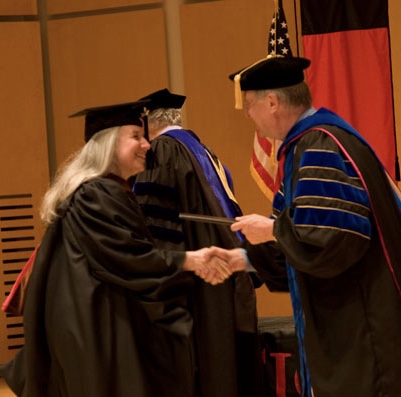
In 2007 I completed an MFA in fiction from Pacific University. Three of my dearest friends came to my graduation—two of them from Seattle. It was a great day, and Gary preserved that for me by not telling my that my mom had been back in the hospital until all my obligations in defending my thesis, a public reading and craft talk, were complete. She died a week later.

I dropped 40 pounds in the next few months. I stopped writing. I struggled to regain optimism, to regain my stride, whatever that might be.

Revision happens in people’s lives, too. I retired from teaching full time in 2015 after nearly 40 years of teaching art and English in private and public high schools. I think I am, I was good at my job. My greatest joy is hearing from former students who discover I taught them something useful. I think most of us hope to be useful.

In November of 2016, I  took the 4k short story, “The Promised Hour,” that I wrote to apply for my MFA and wrote from there. I had rewritten that story dozens of times (literally) and submitted it dozens of times but it couldn’t find a home. I hoped that maybe what it needed was to become a novel. National Novel Writing Month (NaNoWriMo) offered me an opportunity to race through a much longer version of that story.

Since then, I revised the novel going-on eight times. I originally hoped for 60k but did better than that, ending the month with over 75,000 words. By it’s 8th draft, it was retitled Escape My Heart of Sorrows. By the eleventh draft it had seen several new names, the best of which was suggested by a former student who got it from her husband, Painting Over. I am working on draft 14 now and still dithering about the title. Maybe Everybody’s Mother Dies. This is novel number five and it is not finished.

My work has earned many awards including an Oregon Literary Arts Fellowship, Arts & Letters fellowship, Soapstone residency, Pushcart nomination, and publication in the Brevity blog (several times), The MacGuffin, CALYX, Work Magazine, Raven Chronicles, Ink Filled Page, The Humanist, North American Review, and anthologies about running and race. There is a list of all my publications, or most of them, under “Publications” on this site. There are links to all the works available online.

I thought my second NaNo year in 2017 was time for something completely different, stories or fantasy, but I changed my mind at the last minute. Instead of a new piece, I returned to an earlier effort, the novel from 2002. I altered verb tense, added and changed characters, and introduced the crime I originally intended to provide more tension. So those were the differences. A familiar first person voice but an entirely new book. I hoped to complete 80k and I got 75k. I was okay with that, but since then I have completely lost track of that novel and begun working in a new direction.

Last year I surprised myself by writing a fantasy story, “If It Were True Owls Dream,” which will be published in August in Liminal Stories. (When that goes live, I will provide a link.)

In April 2018, I wrote 15k of a science fiction novelette. Writing science fiction is new for me though I have been a fan for many years. In the fall I intend to add 50k to an existing short manuscript. But I might be still busy rewriting novel number five, the one that began as “The Promised Hour”:

The way back from loss may seem unimaginable, but people do it all the time. Thena Justice was building a new life near Seattle after the death of her mother and breakup of a terrible marriage when her former husband murders the babysitter and their daughter before committing suicide. Lost in grief and guilt, Thena first hides in a friend’s converted garage, then in a tiny cottage on the Pacific coast, thrashing her way through anguish, apathy, anger, and routine. Instead of returning to Puget Sound, she moves to Portland, Oregon, the city where she was born, takes the bus to a retail job each day, and keeps her head down until a child crying in the night wakens her sense of agency and hope.

It sounds a sad book, I know, but it is all about survival, about hope. My interest is in how we regain an active role after a calamity and that is the focus of this story. Would you read it?

For several years I blogged at Quiet Minds, which is now renamed and active here on WordPress as Imperfect Patience. I send work out. I am still teaching college writing in Winter and Spring Term, at least I hope I am.

I walk the beach. I weave. I write. I am mostly retired, but I am not done.


SaveSave

“Hillbilly”

Last fall, I read the memoir Hillbilly Elegy and I struggled with its view of poverty. The man suffered, but suffering does not necessarily make us wise. I both recognized that he was reporting his personal experience, and felt concerned that his view of his own life was limited by his selfish political point of view. This morning, an essay by Chris Offut, “I Will Always Write About Appalachia” helped me understand why.

“The most recent addition to these false accounts of Appalachian life is the widely read book Hillbilly Elegy, the author of which grew up in the decaying Rust Belt town of Middletown, Ohio. Nevertheless, he blames his personal difficulties on the culture of Appalachia.”

The writing in Vance’s memoir isn’t anything special, but the story is emotionally compelling. Vance grew up in a violent, loud, drug-afflicted, under-educated, and sometimes poor household, but he had people who genuinely loved him and cared for him, even if those people had their flaws and were not necessarily his parents. I love the quote from a teacher at his former high school: “They want us to be shepherds to these kids. But no one wants to talk about the fact that many of them are raised by wolves.” And then . . .

I began to consider stories I knew best from my own family and from teaching in public schools. I don’t know much about Appalachia, but I do know something about poverty and disadvantage. “Hillbilly” and “white trash” are filthy words in my home.

For one, I know it’s no shame to be poor is immediately followed in my head by “It’s no great honor either” from Fiddler on the Roof. Tevye was not a sinful man, but a good, honest, hardworking father and husband. “Economically disadvantaged” is a euphemism I find personally offensive because it suggest there is something shameful about poverty. Being rich is not supposed to give anyone special rights or privileges, and I have been thinking a lot about that lately. I know being poor is not a sin or a failure.

My husband was raised poor in a family that did not take charity. His family bought “day old” bread from an outlet when he was little, and he picked the mold off his lunch, trying not to be seen doing it. He sat on the porch waiting for his dad to get home on payday because there was no food in the house beyond scraped jars of condiments. His experience of poverty was not unique, and it didn’t happen in Kentucky, but in Arizona, but it was hard. One side of his family was Ballard Swedes from Seattle, Washington and the other was Dust Bowl Scots-Irish share croppers from Oklahoma, orphaned when their mother died and Pappie gave them away.

No one in his family intervened or encouraged him to make something of himself. Vietnam was raging and his hair was long. In the years between high school and college, he had three pieces of luck. He was granted a draft deferment based on his eyesight that eventually became permanent, he began working at the University Book Store where he was exposed to new people and ideas, and he met me. When I graduated from high school the next year, he went to college because I was going to college. My husband graduated from high school with a C average but he was Phi Beta Kappa when he graduated from the University of Washington four years later. Like Vance, he saw no point in pajamas and is still in a perpetual state of what others term catastrophizing. Christmas was fraught when I met him but has become a good holiday through decades of determined effort on my part. He loves his cotton jersey pajamas.

Vance would like to give himself all the credit. He would blame achievement or lack of it on people rather than circumstance, but like my husband, he had some luck.

From the LA Times: “As Vance puts it at the beginning of this American dream memoir, he has done nothing ‘extraordinary.’ So what’s wrong with all those other hillbillies? In suggesting that his own success in Silicon Valley was a matter of refusing cinnamon rolls, Vance is giving us a basis in feeling for the devastating policy Ben Carson wants to enact. People are poor because they deserve to be. And there it is: Trump-era elitism defined.”

Some people abuse the system, and some people are too proud to accept help, even for their children. When my husband was given a sweater by his pastor because his second-hand store clothing was too poor for church and too sad for the pastor to ignore, it was only because his mother won the argument with his father that he was allowed to keep it. It was the nicest item of clothing he ever owned as a child. “White trash” is a filthy expression in my home. “Red neck” was the term I was taught as a child. I would not use it today. Change is not easy.

In my forty-year experience working with students, I witnessed most parents doing the absolute best they knew how. Neglectful poor parents do not necessarily love their children any less than neglectful affluent parents do, but the results tend to be more public among the poor. They are less skillful at concealing problems because they do not have the money to hide behind. Some parents work too many jobs just to get by. I think of a single parent who could not ensure his child did his homework because he got off work in the middle of the night find his teenager drinking soda and playing video games instead of sleeping.

Affluent families have their own troubles involving drugs and mental health, abuse and time. Even in my poor, rural community, some entitled parents send their children to elite private schools. They can afford private lessons and vacations their peers cannot even imagine. Their students drive cars worth more than the average local yearly income. Affluent parents may not need to work two or three jobs to pay rent, but sometimes they work long hours or ignore their children because they choose to do so. The results are similar.

Things go horribly wrong for children, dreadful things happen to them, but in my experience, not always, but often when things go wrong with children—pregnancy, drinking, drugs, crime, dropping out—the causes are not simple genetics, politics, poverty, public education, or an unwillingness to work hard. Something is wrong in the home. Too many children from “nice homes” have revealed the truth of their lives to me. Wealthy or impoverished, when kids’ lives go very wrong, there is nearly always something very wrong in their lives. It is not a character flaw, but reaction to something they cannot control. And there is bad luck again.

Unintended teenage pregnancy caused moves and marriages and monstrous errors beginning with his Mamaw when she was too young to drive. It seems to me to be the particular curse of Vance’s family is early pregnancy. Yet he reflects on this only in passing, perhaps because as a boy it did not hit him personally.

Vance works hard not to blame the people he loved, even the people who damaged his life, but he is also specific and detailed in itemizing the chaos, abuses, insults, and injuries inflicted upon himself and he repeats the lists every few chapters to ensure readers do not miss the hardships he suffered. Still, this book is lived truth, and if Vance fails to recognize the irony of complaining that a single call to child services fails to net any interference in a neighbor’s neglect of her children and then complaining a handful of pages later about child services “prying” into his own messy family . . . well, I guess he’s what one of my young students once called “a guy”.

There is no easy answer to the problems we face in America, but I think it is fair to suggest that we could do better as a nation for our children, regardless of who is at fault for their troubles. An equitable public education, a reliable health care, a decent diet, and a nation caring enough to inconvenience itself would go a long way toward making the lives of all American children better. It would give us all a better future.

Vance was lucky in more ways that he credits.

His Mamaw was tough-talking and violent, but she used her threats to keep him off drugs and she assured him that golf was a rich boy’s game and education was his best hope for a decent future. In other words, he was pushed—hard!—to do what every person ambitious for monetary success does. Vance had support.

In addition to choosing to reject the dysfunctional walk he witnessed all around him and gaining the stability and peace of his Mamaw’s house, Vance claims he “found a couple of teachers who inspired [him] to love learning”, but it’s likely he didn’t find them; those teachers found him. No member of his family killed him though several seem to have tried, and he found a family and practical education in the Marines, without seeing action in Iraq. That’s another piece of luck. The Marines taught him to give more than he thought he had, and they took less than they have required from many others.

Vance would like to blame people on assistance for their trouble, but he had plenty of assistance himself.

Vance was lucky. He had strong people who loved him unconditionally. He found friends and mentors along the way. It was luck and generous people who saved him. He knows that. Or at least he should.

MEMORY

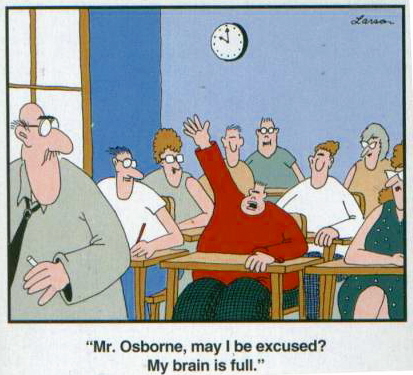
my-brain-is-full-1.jpgOne of the assignments I used to give my juniors was to memorize the Preamble to the Constitution of the United States.

We the People of the United States, in Order to form a more perfect Union, establish Justice, insure domestic Tranquility, provide for the common defence, promote the general Welfare, and secure the Blessings of Liberty to ourselves and our Posterity, do ordain and establish this Constitution for the United States of America.

We listened to the School House Rock song (which leaves out four words) and sang it together several times. Then we wrote the fifty-two words on a slip of paper. Students had to write it perfectly, with all the peculiar caps, punctuation and spellings, before they were done. Almost no one got it the first time they tried to write it out. Some needed a dozen tries. For many, this was the first time they noticed the word “posterity” and I had to define the term. Many initially complained it was “impossible.” Yet most of these same students could likely sing the lyrics of favorite songs. Eventually they all got it.

Students routinely underestimated their own capacities in many ways. Memory was one.

In the past, I have used the example of my younger son’s experience as an undergraduate Theater major. Ian will say he is fortunate, and that is likely true, but he is also smart and a skilled performer. He was a gamer from the age of 4 and now makes his living in theater, mostly as a master electrician.

In earlier days, Ian starred in high school musicals, performed in community theater, and while a college student at Portland State he played on every university stage as well as in commercial theater, and starred in an indie film. When the male lead in a local community theater walked off four days before the opening of a play, the director called Ian. He was on stage for the opening, off script and brilliant.

I recently read a new translation of The Odyssey by Emily Wilson. It functions as a comfortable introduction to that ancient story, offering an excellent overview of its background and an attempt at form—the original Greek is in a poetic form that does translate so Wilson chose to use iambic pentameter with shorter lines, which do not allow for all the detail of other translations. But the story is lively and interesting with monsters and divine storms and bloody battles. The claim that most disturbed me was her insistence that no one poet or performer could have memorized the entire epic of over 12,000 lines. I could only conclude she didn’t know theater people.

One of the plays my son performed in college was the restoration comedy She Stoops to Conquer. The play includes many characters and he memorized all the lines—he had little choice since he performed all six of the major male roles in rotation as well as all the unnamed male roles such as “servant.” It is a long play.

So is Hamlet, which contains just over 4,000 lines and anyone playing the lead would likely, by necessity, learn the entire play. It is not enough to know cues, the lines immediately previous to those the actor knows. The actor needs to know more than that. And that is not the only role a lead actor in Shakespeare’s day would have known. In repertoire, where a limited groups of actors perform several plays in rotation, he might be performing a dozen roles. It would not be unusual for a single actor to have 12,000 lines mostly memorized. And then a month later he would have a new play and another and another.

Assuming a minstrel sang only long piece or perhaps a handful learned over a lifetime? To perform 12,000 lines is not “impossible.” It would require 12 hours, be sung over a series of nights. Again and again.

It is, frankly, incredible what the human brain can do.

Many of us struggle to commit a phone number to memory. How about 67,980 digits? That’s how many digits of pi that Chao Lu of China, a 24-year-old graduate student at the time, recited in 2005. Chao uttered the string of numbers during a 24-hour stretch without so much as a bathroom break, breaking the world record.

It is only in modern literate times that we have so underestimated the capacity of the human mind to memorize. Modern research suggests that most people know as few as 10,000 or as many as 35,000 words. A working vocabulary, words we use routinely in conversation, is much smaller, a few thousand words. The Kottke blog (one of the oldest) offers an interesting overview:

In his collected writings, Shakespeare used 31,534 different words. 14,376 words appeared only once and 846 were used more than 100 times. Using statistical techniques, it’s possible to estimate how many words he knew but didn’t use.

This means that in addition the 31,534 words that Shakespeare knew and used, there were approximately 35,000 words that he knew but didn’t use. Thus, we can estimate that Shakespeare knew approximately 66,534 words.

According to one estimate, the average speaker of English knows between 10,000-20,000 words.

True, Shakespeare cannot be considered typical, but words were his business. His command of language was not so unusual, even in Europe. Wordplay was entertainment as well as occupation. Courtiers invented puns on the fly. People got the joke. When my typical Honors students were assigned to read Huck Finn, they often complained about the difficulty of reading Jim’s dialogue and rarely found the book funny. When I read it aloud to my regular English classes, they laughed continuously. They heard all the jokes. My “smarter” readers were not often hearing the language, but skimming.

(A reading specialist once told me that reading under 350 wpm was failure. This represents a misunderstanding of how the brain processes language. True, a very slow reader, sounding out one word on the page after another, struggles to make sense of a sentence. But a very fast reader fails to grasp anything but an overview of content. The fast reader cannot help but resent poetry for the demands it places on the reader, and thus loses the art on the page completely—a complaint for another time.)

The impact of cell phones, audiobooks, and other technology on language has been estimated to be anywhere from debateable to improved. It might result in little change to overall usage or actively cause vocabulary and grammar to deteriorate or even improve usage.

In any event, the memory capacity of the human brain is enormous. There is no danger of filling it up. Whatever we might believe limits our abilities to learn and use new information, we are likely wrong.

People are capable of learning and growing throughout their lives. It is wise for us to do that, a healthy habit. However long we live and any way we look at learning—through formal education, memorization, life experience, or invention—it is what we are meant to do throughout our lives.

Our brains are never full.

SaveSave

SaveSave

WALKING IN THE DARK

Pacifica Project Presentations

There was no color essay on Tuesday. I have been busy the past few days because my high school has a graduation requirement that ends with presentations at the convention center. Students have identified a community and a need—a charitable concern such as feeding children, tagging salmon, collecting litter, or coaching kids—then designed a project to address the need, put in dozens of hours, researched a related issue and written a lengthy persuasive essay, and finally, yesterday, presented their projects to the community at the Seaside Civic & Convention Center. Their 12-15 minute talks required visuals and rehearsals beginning last week at school and then all day on Tuesday in their assigned rooms downtown.

I meant to skip the Pacifica Project Presentations this year, its 26th. I was a member of the original team that designed the program, and one year when the mastermind behind it all, Mike Hawes, was unable to be there, I hosted. I always create the program and attend rehearsals. This year, I was tired (more about that some other time). In the end, I managed to see two full presentations and parts of four others. It was, as always, an inspiring evening.

Mr. Hawes made me cry (not the first time) in his opening address about the inspiration of these earnest young people and the need for hope.

Students worked hard, many of them at work on their projects a year or even several years before. More than a few were deeply impacted by their service. One young man who volunteered at a weekly community event found that this forced him out of his dependence on media and into relationships with people face to face. He said it reminded him of the need to see and talk to people, to hear them. A young woman who tagged on to an existing anti-bullying program in another state discovered that she wanted to more and organized a parade in favor of kindness and hope.

I started two blog posts, but was unable to finish either of them because I was so focused on these Pacifica Projects.

This afternoon while my husband was collecting our mail, I heard a father explaining the Golden Rule to his little girls:

“If you want people to be kind to you . . . “

In the mean time, Rosanne Barr tweeted a series of deeply offensive messages (more than just the racist one) and her show was cancelled by a network unwilling to defend or overlook her remarks. Samantha Bee used a horrible word to describe Ivanka Trump and people are scrambling about that one. Trump, who has said equally terrible things without apology, made the recent events about himself, which is to be expected. He has no principles beyond his personal popularity and fortune.

This morning (Thursday), republican John Kasich called for the Senate to get their act in gear and do something about DACA. He wants something to be done. In a CNN interview this morning, he said that Congress should not wait for permission from Trump. It was not their responsibility to pass only what the executive branch wanted. They should, in the end, be doing something, the right thing, he said, and I hope he pulls his people together.

In the interview, Kasich could not resist a partisan remark that he didn’t know what the democrats stand for—which is unfortunate especially since DACA is a program most compassionate people of both parties defend. Still, it is a republican talking point to say democrats do not take a stand. The unfortunate corollary is to wonder if Barr and Trump’s locker-room talk is what too many of these congresspeople stand for?

I believe most republicans are horrified by these ugly comments. I think the vast majority of Americans are decent people who respect Gold Star families, POW, women and children and men of any color and station, and most honor ordinary courtesy.

This brings me uncomfortably to my son’s recent distress about Samantha Bee. Yes, she is a left-leaning comedian, and yes, my husband especially loves her (he has lost respect now). She is married and a mother and she is not polite about politicians she disagrees with. Is it okay for her to be vulgar, but not the president? Is it fair for her to call names she would certainly condemn coming from a politician? It’s worth thinking about.

There is false equivalency coming from every direction. Anti-Nazi protesters are not equivalent to Pro-Nazi protesters, at least not given our world history. And sexualized workplace comments are not equivalent to rape. Any abusive behavior is to be condemned, but on the scale of abuses, there is error and lapse in judgement and there is clear, egregious abuse of power.

Hitting Up

I have always contended that humor at the expense of some individual or group only works when the blow is delivered up. That is, it is fair to challenge and ridicule the richer and more powerful, to laugh at the expense of those with a superior position in society. It’s a cheap shot to ridicule the weak and powerless. It is in Christian scripture to serve the powerless, it is part of our national character to support the underdog, and it is the over-size bully on the playground we are all inclined to dislike.

“With the rich and powerful, always a little patience.”

I am deeply concerned with principle, with doing the right thing regardless of the impact on myself. Nevertheless, I often site my own experiences to explain my positions.

In high school, I used to sneak out of the house to walk all alone. I was depressed and lonely and struggling. Walking in darkness was my way of coping, a way of avoiding death. I felt close to death at times.

The significance of this is not just that when I write about depression, I am speaking from experience. It is also true that in hundreds of solitary walks, I was never attacked, and I avoided people and spoke to no one, even on weekend nights when drunken people in cars were common. I hid in shadows and if I felt something was off somehow, I did not question my own judgement, but took steps to keep myself safe.

A gun would not have served to protect me. I was brought up with guns, taught how to take apart and assemble, load and unload. I do not hate guns, but I do fear the impact they have on frightened people. If I had a gun, the most likely result, statistically, would be that it would be taken from me and used against me. Toddlers kill their parents or a sibling accidentally every year. Police officers, trained to perform, miss their target 72% of the time when they fire in a real life situation. I would not expect to do better than those who have made law enforcement their profession.

Back in my teens, I ducked behind hedges to avoid being spotted by drivers in cars or drunken walkers, and I avoided populated areas. I walked across campus alone in the dark every term I attended the University of Washington. (There were advantages to scheduling an early morning or evening class in those days.) One night I was walking down the hill from Denny Hall, a paved but dimly lit path I followed regularly. That evening, I looked ahead at the mountainous overgrown cherry laurels just ahead and stopped. Something felt wrong. I didn’t hear anyone or see anyone in that dense twenty-foot mound of shrubbery, but I turned aside anyway. Following a more open path cost me seconds and might have kept me safe. Ted Bundy was killing women in those years around Seattle and I fit his preferred victim profile. No one admitted there were campus rape statistics to track in those days, but terrible things happened. I knew of terrible things happening. Maybe it was only luck that I was never  attacked, but I was aware, I wore a rape whistle, I splayed my keys between the fingers of my fisted right hand. I walked like I knew where I was going, and it was true.

Today, America is a dangerous place, and some of the danger comes from people slinging guns around. The responsible gun-owners I know keep their guns locked up, and I honor their family tradition of filling their freezers. I honestly do not want to take away everyone’s guns, but I also do not believe than guns are the only way to be safe. Our national obsession with guns is not a Constitutional right, but something more cynical. The harboring of guns and ammo with no purpose but to kill our fellow citizens amounts to dangerous paranoia. Our nation was founded on many things, a promise of semi-automatic weapons was never part of the original plan.

A small minority of people are terribly afraid of gun regulation. It is ironic, isn’t it? Especially given that the second amendment specifically calls for a “well regulated militia” and this wording refers back to an ancient tradition in Britain of requiring all adult males to train in military skills because the kingdom did not maintain a standing army large enough to defend the country. In case we have not noticed, we have the largest military the world has ever know. It consumes 43% of our discretionary funds—an enormous weight upon our budget and one reason we have little left for education and health care. Yet, we are so frightened we must allow ordinary citizens to have military weapons in their homes?

I’ve been accused of being too optimistic about human behavior. But I see things differently. I recognize that people do terrible things every day. I recognize that accidents happen. People make mistakes. But if we were at heart such terrible monsters as some seem to think, I wonder how I survived my parents’ temper with I was an obnoxious child. (You know I had to have been obnoxious now and again.) We survive because we are social animals, committed to working together for the common good. At least, that is how I was raised to understand my country.

‘I Told Him, I Said’

IMG_3962

It’s been a while since men at my school considered it appropriate to make a retirement speech suggesting that a male teacher was putting moves on a teenage girl. Ten years? Maybe longer. Maybe not so long ago. Not long enough.

I heard them make such remarks and others. The promise of a better grade if a girl would lose ten pounds. “She’ll thank me.” The detailed speculation about what a girl might have done at a weekend party, spoken in the Library where other students could hear. Those are mild examples, much worse was suggested at that banquet. A school guidance counselor got up and left the room that evening. Unlike him, I went to the Ladies until the speech was over. I couldn’t leave because I was making a speech about someone else later in the program, a decent man who did not find his peers’ bawdy humor the least bit funny.

Did I say anything to anyone about the off-color remarks? I believe I did. Was there a reaction? Not so’s you would notice. My distress was not important. My professional opinion did not count. I was being fussy or a “feminazi” or needed to get a sense of humor.

Worse happened.

This was the world I lived in. Mostly, it still is.

I am expected to ignore inappropriate remarks, pretend they do not embarrass or offend me, that there is such a thing as harmless “locker room talk.”

The experiences of women have not changed enough since that evening. Teachers, coaches, and school safety officers have had inappropriate romantic relationships with students. Local cops. Prominent members of the community. That is, they have had a romantic relationship with a minor student, which is never appropriate. The girl is inevitably blamed when this becomes known. Her own peers, even the girls, blame her. They may even ostracize, harass, and threaten her. I remember this from my own days as a young girl. The girl is blamed. Did she do something stupid? Probably. It’s why we have rules about minors. Young people do stupid things all the time. It’s our job as adults to stop them, not to tempt them. But adults do tempt them, and then they step away. The man denies improprieties publicly, and perhaps privately feels he has done no wrong. Clearly the girl tempted him.

Stupid girl.

A Senator is called a disgrace and forced from office for making decidedly inappropriate gestures. The person calling for that man to abandon his career, makes specific and crude remarks. Each man claimed afterward that he was only joking. Only one of them removed himself from office.

Neither one was Bill Cosby or Harvey Weinstein or Humbert Humbert. Only one was a buddy of a convicted pedophile, also accused of sexual harassment, also accused of physical harassment . . . and President.

Unless the offender is a democrat, the President blames women. Naturally.

A “Lolita” is a colloquialism for a “sexually precocious girl.” “No one knows . . .” It’s easy to forget that Lolita is not the main character of the novel by that name. The main character is a middle-aged man who marries a mother in order to gain access to her 12 year old daughter. TWELVE YEARS OLD. He grooms and abuses that child. Lolita, the title character, will end up ruined, pregnant, and dead. But no one throws the term “Humbert” around like a dirty joke. It’s the adolescent girl (who died, remember?) whose pain becomes a dirty joke tossed at girls.

It’s easy to see how men excuse their indiscretion and abuses. For one, they have been encouraged to be assertive and certain. Aggression is rewarded, but hesitation is a weakness. Doubt is a weakness. Apologizing is weakness. Among men, that it. The rules are different for women. And, of course, for men in our society, being weak is absolutely not an option.

Being weak as a woman is allowed, even encouraged and considered attractive. Willingness to doubt, to question our own actions, to rethink, change our minds, apologize . . . all allowed, but then this humility is also often used against us. But demonstrating assertiveness and certainty? “Unladylike.” “Offensive.” “Aggressive” and ugly in “the weaker sex.” A woman projecting that sort of confidence unleashes a landslide of ugly words. Do I need to list them all here? “Unlikeable.”

Both men and women are caught in this terrible stereotype of gender-enforced behavior. The narrow, brutal definitions of what it means to be a woman or man allow us scant wiggle-room for individuality, male, female, or anyone else.

But when strength is considered a character flaw and weakness is considered attractive . . .

And when we talk about it. Out loud. Oh, dear. When we try to defend ourselves . . . that’s just not something we should be talking about. Right?

This year, a dear colleague is retiring. I am not attending the banquet. The banquet on the year I retired was not offensive, but absurdly wounding, and as a retiree I do not feel compelled to attend ever again. My friend will be given a good speech (I know who is in charge) and I wish him well. There is not a wisp of scandal associated with him, and times have changed enough that no one would find it amusing to invent or exaggerate a sorry and humiliating (for someone else) story for the occasion.

Times have changed, but not enough. Too many in power believe they have a lock on decency. And they are wrong.


SaveSave

SaveSave