HABIT

IMG_1622

Taken on a winter day, the tide was out far enough this morning that I could walk well out on the sand beyond that triangular seasick I think of as a seal sticking his head up out of the sand.

Clouds like cobblestones drift over the eastern horizon. Light seams their edges. Birds join the morning music.

We might miss a half dozen days out of the year, but my husband and I try to walk each morning. We go out as soon as there is light or whenever I can get my behind in gear. Two cups of coffee, checking my email, and this time of year, it is light at 4 but even so we are usually not before 6am.

We are rarely first.

This morning was perfect, sun already over the coast range, reaching across the sand. Low clouds sliding down along the cape to the south and mist rising up off the ocean. A roll of fog out on the horizon, blue sky overhead. We walked south, Gary with the trash bag, mw filling my pockets with little stone, as is our habit. Sometimes we walked together, more often we wove away and back across sand and the rock edging the beach, looking for trash, agates, and glass. The tide was sweeping in, but there was a broad expanse of sand and last night’s high tide had left a stretch of dry sand along most of our shore.

We headed north, waving at locals as we went. I thought about going past the northern point, the first long distance of the year. Drift logs pile up in that little cove north, the way they once did all along Arch Cape beach. My mother used to play a game with her sister where they pretended the sand was poison and they walked drift logs all the way south to the big creek. I might have played that same game in my own childhood, but now locals cut up the logs and tourists place them whole across beach fires and walk off.

A group of campers were just waking up on the sand just south of the falls at Hug Point State Park. It can be a risky place to camp. When the tide comes in high in the dark, it strikes the cliff face and the only escape is pretty much straight up.

By the time I got to Hug Point, a hundred-year-old roadway carved into the rock, waves were already lapping around at the base of the rock. I went up anyway. This was part of my favorite run. No wind. No chance of drizzle. A bright blue, misty day cool enough that I would not be overheated. I ran this path for twenty years. This morning, I would have run all the way to Arcadia, if I had been running and not walking.

It was a good and healthy habit, my running days. Giving it up was one of the hardest things I have ever done. Ask anyone. Ask anyone who used to smoke. Kicking a habit is hard.

I never smoked, and experimented with drugs only briefly. When I was caring for my mother I drank too much, too much for me. Three glasses of wine and I am wasted, and I did that once or twice a week during those five terrible years. I gained weight, but kept running, which certainly shortened my running days. One bad habit destroying a good one.

I am trying to find better habits of eating and drinking, walking and work. I track everything and already, after almost four weeks of keeping track, I am doing better—drowning the bad habits with the good one.

It seems to me that there is too much talk these days about addiction and lifestyle. I was not addicted to running and I was not addicted to eating too much or drinking or writing. These were habits. That is not meant to minimize their power; I mean to acknowledge the power of habit.

When I stopped running I thrashed around, seeking some way to move. I swam when my boys were little, but chlorine and I are not friends and the pool is my only option. I tried bellydance for a while, but now I am a walker, which seems to suit me best.

We were out for two hours this morning, four mile as the crows flies, longer as a real crow might fly and as I walked up and down, up and down, my eyes examining thousands of square feet of rocky shore and sand.

We brought home a sheet of polystyrene foam the size of a lounge chair, a bag of trash, a pocketful of agates, two limpets, and ten sand-washed bits of glass.

Then I went out into the yard and picked the first salal berries from our hedge to make muffins. That is a habit too. At the peak of season, I could make muffins most very day from the berries in our yard. I will save the pickings from three or four days and make jam next month.

I have only worked on my loom for a short time this morning. A bit over four inches are done so far today, and I want twenty.

Some will call this a lifestyle. It’s just life.

FAIR TRADE

IMG_2996

My husband and I pick up trash along the shore, and in some magical-superstitious way, I believe removing plastic pays for my pleasure on our daily walks.

Yesterday morning there was a seal resting onshore. She was alive but unwell, sick or injured. She would either live or die and nothing I could do would aid her survival. We gave her a wide berth during our walk so as not to unduly hasten her death. She was our second beached seal already this season. The body of another seal rots higher up the beach.

More often we see sea lions swimming in surf or basking just beyond the surf line. But we have found them dead onshore with a bullet wound in their face. You will have to take my word for that. I do not take photographs of everything.

Years ago at a writing retreat, a woman described how she became a writer. It began with a solo vacation on the western edge of the Olympic Peninsula. “I found an abandoned baby seal,” she began. And I sat upright in the audience, waiting for her understanding. But no, she “rescued” that baby marine mammal. She took it from the beach, put it in the back of her car, and drove it to Seattle. I waited for her to admit her terrible error. She never did.

At best, she stole a baby from its mother. Signs at many beach access locations warn against interfering with marine mammal, particularly baby seals, which have been left by their mothers while the parents fish.

At best, that baby and mother were separated for all time, a shelter was able to get the baby to feed, and perhaps release it later. I do not know that this ever happens. The more likely outcome would be that the baby sickens and dies or lives and spends the remainder of its life in a compound or cage.

Sea mammals are beautiful and smart, and most of us would not be willing to eat one. They have appealing faces and large eyes that seem too human. We cry at the thought of clubbing baby seals. Charities garner funding with photos and videos of bloody beaches.

The Marine Mammal Act levies heavy fines for interfering with sea mammals or allowing them to be interfered with—think people wanting to touch the animal or “help” the weak animal back into the ocean, consider loose dogs on the beach.

Three women hovered near the seal this morning. One of them had, thankfully, leashed her dog, a dog which has in the past harassed a baby seal, driving it into the surf. I approached one woman, who stood too close.

“We don’t know who to call,” she said.

“It will live or or it will die, and there is nothing you can do to help.”

“Won’t they come and put it back in the water?”

I shook my head. “They might stake out the seal with signs warning people to keep their distance. You need to stay back and give it space. The seal needs to rest, and she will live or die.” We have been through this before.

“Thank you,” she said. “Thank you.”

What for? I wondered. The seal was dying. I did not tell her the truth, what I did not want to know. The seal was dead by afternoon.

In our hubris, our self-importance, our presumed human power to damage and destroy and build and create, we want to believe we can control everything. We want to believe that we or some expert can fix everything.

It is wise to accept that much of the world spins on without our help and often without even our notice. It is wise to place our humanity a little off from the center of the universe.

SaveSave

SaveSave

BETTER

IMG_2587

We were up on the balcony at the Schnitz in Portland the other evening. A woman sitting behind us dropped her cane and it hit my husband right on the top of his head.

“Oh! I am sorry!”

“It’s okay.”

“No, really, I am so sorry.”

“It’s fine.”

“But are you sure you’re okay? I can’t believe I did that!” She could not stop apologizing.

My husband turned full around. “Hello, I’m Gary.” He grinned.

Soon they knew one another’s history and we all chatted away.

There is some empirical evidence that talking to others, particularly the habit of reaching out to people we meet casually—the person waiting in line in front of us, the man watering his lawn, the woman having coffee at the next table—is a reliable predictor of longevity. It’s certainly no cure for what ails us, but it focuses us away from our pain in the same way the I was taught to focus away from labor pains.

Talking to other people is a challenge during depression, but if we already have the habit and refuse to let go, such casual conversation can be a distraction from our sadness.

Depression IS sadness, but on a level and for a length of time that there is no end in sight. This belief that depression is not often caused by circumstances flies in the face of all evidence. It is not a literal “epidemic” but a failure of our culture to provide meaning and purpose. We fail to eat, sleep, communicate, work, and live meaningful lives and then we wonder . . .

Undoubtedly, suicide is sometimes the result of illness. It is always the result of unbearable circumstances, it is always the result of overwhelming sadness. Like the current “epidemic” of opioid abuse, suicide is about loss.

Sometimes the loss is entirely personal and unknowable. Increasingly, the loss is widespread and a failure of our culture to sustain the human soul.

For most of human history, human interaction was primarily cooperative.

For most of human history, communication was between people, not machines.

For most of human history, people ate what they could find or grow themselves.

For most of human history, we slept more than we do today.

For most of human history, we sat quietly for regularly periods of time. We attended to the seasons, to the darkness and light, to shifts of other living things because this attention was necessary to survival.

Despite growing awareness of the dangers of depression, acknowledgement of suicide, and drug and talk therapy, suicide rates continue to grow.

I have heard depression compared to diabetes, in that we would not expect a person ill with diabetes to thrive only on good intentions. A symptom of diabetes is increased thirst. A glass of water addresses their immediate need but not the problem. The “epidemic” of depression and suicide will not be cured with anti-depressants or even with talk therapy. It will only be repaired by addressing the cause, which is the result of a failed culture, not broken brains.

Wiser people than me have insisted that suicide is not a cry for help. But maybe it is a cry for help in the way we live. Maybe it is a symptom of illness not of the person but of an increasingly unsatisfying, unsustainable, and unbearable way of life.

Maybe I can’t do a thing about any of that. But I can greet others. I can trade stories. As long as I can participate, I will.

Hello! My name is Jan, and you are . . .


SaveSave

SaveSave

SaveSave

BIRTH

To my second-born son:

Thirty-six years ago, just now, I was in labor. My first pains were last night and Gary said, “Don’t think about it.” So I didn’t. I went to bed. I got up about now because I couldn’t ignore labor any longer.

At the hospital, a nurse examined me. “Well,” she said, “whatever happened last time you are doing it again.” You were 4 weeks early and I was already close to delivery. I was glad of that because I did not want them to send me to Portland again, or do anything to stop the labor.

I overheard a frantic conversation in the hall outside my room. My doctor would not come for the delivery because it was his day off. This didn’t surprise me. That doc was new and his father was an OB/GYN in Beverly Hills. He didn’t intend to stay in Oregon.

There was literally no doctor in the entire hospital. They called Dr. Larry Zagata, who had been my original doctor in my first pregnancy. He had just come off a weekend on ER duty, but he drove back from Neahkahnie. The baby was coming fast—you—and I recall quite clearly thinking, “It could not possibly have hurt this much the first time, or I would never have done it again!”

They barely got me into the delivery room before you came out, spilled amniotic fluid all over Larry, and then you pissed on him. He laughed. He’d only just showered before returning to the hospital.

So Larry Zagata, your dad and I, and three nurses were there in that moment. We saw you first.

I always figured Larry owed me a birth since your brother arrived in Portland.

I was in a room, showered and elated by 8:30 that morning. My temperature and other vitals were down and nurses kept coming in to check me. They did not tell me they were concerned, but I knew, and I wasn’t worried because a dropped temp is a sign of imminent labor in dogs. I took the birthing classes both times I was pregnant, and they were helpful. I did not scream, I sang during labor (Joni Mitchell’s “Song for a Seagull”), and though I cried on the third day of labor with your brother, I did not cry for you. What most helped was breathing exercises I learned in high school PE (the only useful thing I ever learned in PE) and relearned in classes plus what I learned watching our dogs whelp puppies. It’s called labor because it is hard work being born.

Welcome to the world, my dear boy. I always wanted brown eyes as a child and you were that gift.

love,

mom

MEMORY

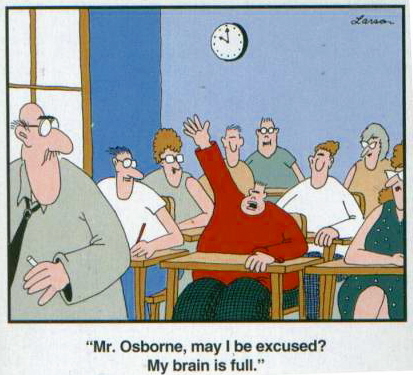
my-brain-is-full-1.jpgOne of the assignments I used to give my juniors was to memorize the Preamble to the Constitution of the United States.
We the People of the United States, in Order to form a more perfect Union, establish Justice, insure domestic Tranquility, provide for the common defence, promote the general Welfare, and secure the Blessings of Liberty to ourselves and our Posterity, do ordain and establish this Constitution for the United States of America.

We listened to the School House Rock song (which leaves out four words) and sang it together several times. Then we wrote the fifty-two words on a slip of paper. Students had to write it perfectly, with all the peculiar caps, punctuation and spellings, before they were done. Almost no one got it the first time they tried to write it out. Some needed a dozen tries. For many, this was the first time they noticed the word “posterity” and I had to define the term. Many initially complained it was “impossible.” Yet most of these same students could likely sing the lyrics of favorite songs. Eventually they all got it.

Students routinely underestimated their own capacities in many ways. Memory was one.

In the past, I have used the example of my younger son’s experience as an undergraduate Theater major. Ian will say he is fortunate, and that is likely true, but he is also smart and a skilled performer. He was a gamer from the age of 4 and now makes his living in theater, mostly as a master electrician.

In earlier days, Ian starred in high school musicals, performed in community theater, and while a college student at Portland State he played on every university stage as well as in commercial theater, and starred in an indie film. When the male lead in a local community theater walked off four days before the opening of a play, the director called Ian. He was on stage for the opening, off script and brilliant.

I recently read a new translation of The Odyssey by Emily Wilson. It functions as a comfortable introduction to that ancient story, offering an excellent overview of its background and an attempt at form—the original Greek is in a poetic form that does translate so Wilson chose to use iambic pentameter with shorter lines, which do not allow for all the detail of other translations. But the story is lively and interesting with monsters and divine storms and bloody battles. The claim that most disturbed me was her insistence that no one poet or performer could have memorized the entire epic of over 12,000 lines. I could only conclude she didn’t know theater people.

One of the plays my son performed in college was the restoration comedy She Stoops to Conquer. The play includes many characters and he memorized all the lines—he had little choice since he performed all six of the major male roles in rotation as well as all the unnamed male roles such as “servant.” It is a long play.

So is Hamlet, which contains just over 4,000 lines and anyone playing the lead would likely, by necessity, learn the entire play. It is not enough to know cues, the lines immediately previous to those the actor knows. The actor needs to know more than that. And that is not the only role a lead actor in Shakespeare’s day would have known. In repertoire, where a limited groups of actors perform several plays in rotation, he might be performing a dozen roles. It would not be unusual for a single actor to have 12,000 lines mostly memorized. And then a month later he would have a new play and another and another.

Assuming a minstrel sang only long piece or perhaps a handful learned over a lifetime? To perform 12,000 lines is not “impossible.” It would require 12 hours, be sung over a series of nights. Again and again.

It is, frankly, incredible what the human brain can do.

Many of us struggle to commit a phone number to memory. How about 67,980 digits? That’s how many digits of pi that Chao Lu of China, a 24-year-old graduate student at the time, recited in 2005. Chao uttered the string of numbers during a 24-hour stretch without so much as a bathroom break, breaking the world record.

It is only in modern literate times that we have so underestimated the capacity of the human mind to memorize. Modern research suggests that most people know as few as 10,000 or as many as 35,000 words. A working vocabulary, words we use routinely in conversation, is much smaller, a few thousand words. The Kottke blog (one of the oldest) offers an interesting overview:

In his collected writings, Shakespeare used 31,534 different words. 14,376 words appeared only once and 846 were used more than 100 times. Using statistical techniques, it’s possible to estimate how many words he knew but didn’t use.

This means that in addition the 31,534 words that Shakespeare knew and used, there were approximately 35,000 words that he knew but didn’t use. Thus, we can estimate that Shakespeare knew approximately 66,534 words.

According to one estimate, the average speaker of English knows between 10,000-20,000 words.

True, Shakespeare cannot be considered typical, but words were his business. His command of language was not so unusual, even in Europe. Wordplay was entertainment as well as occupation. Courtiers invented puns on the fly. People got the joke. When my typical Honors students were assigned to read Huck Finn, they often complained about the difficulty of reading Jim’s dialogue and rarely found the book funny. When I read it aloud to my regular English classes, they laughed continuously. They heard all the jokes. My “smarter” readers were not often hearing the language, but skimming.

(A reading specialist once told me that reading under 350 wpm was failure. This represents a misunderstanding of how the brain processes language. True, a very slow reader, sounding out one word on the page after another, struggles to make sense of a sentence. But a very fast reader fails to grasp anything but an overview of content. The fast reader cannot help but resent poetry for the demands it places on the reader, and thus loses the art on the page completely—a complaint for another time.)

The impact of cell phones, audiobooks, and other technology on language has been estimated to be anywhere from debateable to improved. It might result in little change to overall usage or actively cause vocabulary and grammar to deteriorate or even improve usage.

In any event, the memory capacity of the human brain is enormous. There is no danger of filling it up. Whatever we might believe limits our abilities to learn and use new information, we are likely wrong.

People are capable of learning and growing throughout their lives. It is wise for us to do that, a healthy habit. However long we live and any way we look at learning—through formal education, memorization, life experience, or invention—it is what we are meant to do throughout our lives.

Our brains are never full.

SaveSave

SaveSave

DID IT

IMG_2969.jpg

It was raining in Portland. Kids were dancing. The music was fine.

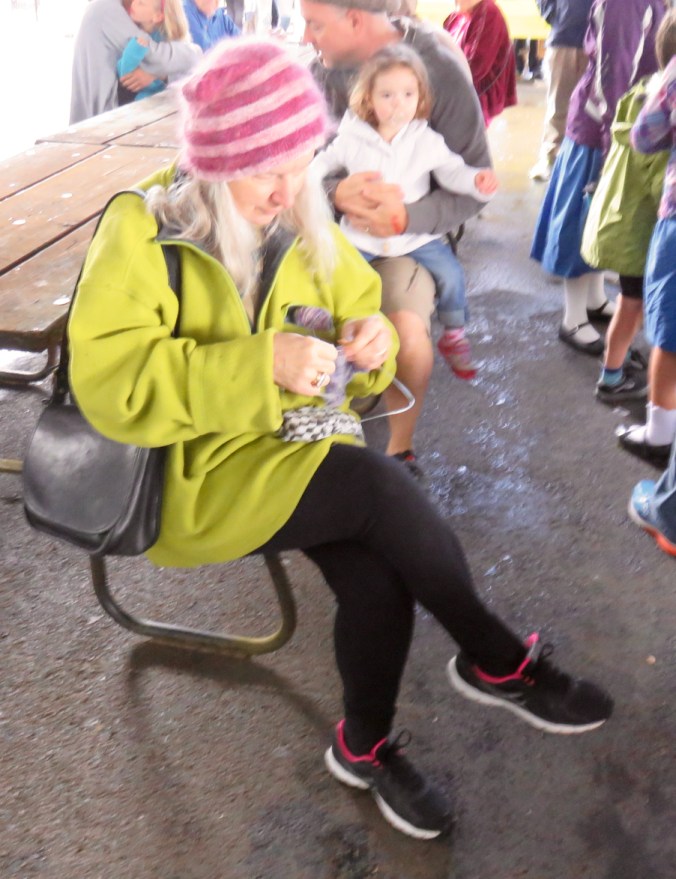
Today is a big day. Sand Castle Day happened in Cannon Beach and Rose Festival in Portland. It was also World Wide Knit in Public Day, so I took my knitting along with me to the Scandinavian Midsummer Festival in Oaks Park. We’d gone to the Scandinavian Festival closer to home, but this was our first time to the one in Oaks Park. The skies poured rain down on us and the traffic was terrible on the way over, but we found the venue without getting lost. I wore my pussy hat to keep my head warm and a huge sport top I borrowed from my son Alan almost 20 years ago and never returned.

It was a wet day, but I finished my swatch for . . . something. I have 7 skeins of a lovely tweedy-painted violet and blue Koigu merino 2-ply and a matching extra fine, silk-and-mohair lace-weight, which is also from Canada. I think I bought them to knit a sweater.

When I got home, the sun was shining, I blocked the gauge swatch, and now I suppose I will have to write up a pattern and actually knit a garment.

LIKE A RUNNER

IMG_1206.jpg

After my 15-16 miles—happy, but hurt.

In August 2011, I ran from my house to school.

It would be the last good run of my life. And it was not good.

I had been training all summer for my second official half marathon that October. I ran long one day a week, working up to 12.5 miles, and 3-6 miles other days, including hills. I was conditioned, but I underestimated the distance to school. I believed I was running about 13.5 miles that day and figured I could take my time and manage that stretch. I’d covered that distance before. The run turned out to be more than 2 miles further than I’d expected. Even so, I might have been okay except that my new runners were sitting in a box at home—saved for the Portland Half Marathon, still six weeks away. I ran the first 5 miles on sand but as soon as I turned off the beach, I realized my shoes were dead flat. By mile eleven on pavement, I was hurting. By mile fourteen I was struggling.

LESSON ONE: Know what you are doing.

I began running after my eldest son ran with the cross country team because the boys and girls teams were so cheerful and supportive of one another. I’ve read plenty of books about running, written by runners, and I was a runner for nearly twenty years, covering a modest 3-6 miles at least every other day.

At the age of 41 in 1994, I began training over a distance less than a third of a mile. I started April 1st. It was a joke on myself that accepted the likelihood I would not be running for long. My plan was never to hurt myself. I am not a believer in no-pain/no-gain. That’s a crock. Pain is an indication of damage. I didn’t want to hurt myself. I wanted to get in shape. I ran every other day and added a couple of hundred feet each day. This schedule of running every other day allowed my muscles time to heal. By August I was able to run strong for six miles. When the cross country team began practicing, I ran with them and could keep up with all but a handful Varsity boys. I was not fast, but steady and capable of distance.

When I set goals for myself, I intend to promise only what I am certain I can complete. When I make a list of task, I pace myself, allowing for flexibility but also for serious deadlines.

LESSON TWO: Make reasonable, doable, consistent plans.

Despite my good planning, I made other mistakes at the beginning. I did not buy any sort of running gear for myself and chaffed my legs between my thighs on cuffed shorts. I didn’t have a running bra. My running shoes were hand-me-down sport shoes that were a full size too small. No muscle pains from my early training, but blisters and sore feet.

LESSON THREE: Buy or borrow the right equipment. 

Once I began working with the cross country team, I picked up race strategies. When I was covering distance, I maintained a steady pace. There was a sweet spot between one and four miles where running felt almost effortless.  Right at the beginning and after the first four or five miles, my effort increased. Another had to do with “running strong” right through the finish line. In other words, resist the temptation to slow when approaching the end, even if I am doing well enough that I believe I could.

When I near the end of a process—the end of the school year, for example—I push myself to sustain my pace. In other work, this is one of my greatest challenges. Sustain attention, quality, and detail right through the end.

LESSON FOUR: Run through the finish line. 

I was not yet 59 years old when I had my last “good” run. I’d become fond of a vision of myself hobbling along at age 72. I gave myself time, went back to running slowly and over short distances. I was careful, but my feet were ruined. I got orthotics and wore larger shoes all day until I could walk without pain. By 2013, at age 61, I accepted that I would not be running again. It about broke my heart.

I considered biking and swimming, belly dance and yoga and gave up. Walking stuck.

There is a memoir about running by the novelist Haruki Murakami, where he describes trying to run at a pace in his middle years that he never trained for in his youth. The entire time I read that section I shook my head. As we age, some goals become unrealistic. I’m not happy about it, no one is. I have a neighbor who is in his mid-70s and still runs the beach. It’s true I can walk faster than he can run, but I admire his spirit and his willingness to continue doing what he loves, even if he has to slow down.

Most of the activities I have enjoyed in my life are still fully available to me. I quilt and weave and go to films. On my morning walk I can see to beachcomb. I read a book every few days, though I need better light to see the page. I lost the habit of 8 hours of sleep at night when I was an overworked high school English teacher. I nap instead. I am careful about what shoes I wear and how hard I pinch because my hands and feet are inclined to ache. I no longer run.

Could I do more? Hubris needles me to answer yes, but common sense wins. I will do what does not hurt me, and that is more than I would have expected for a woman my age.

LESSON FIVE: Accept your limitations.

SaveSave

WHAT’S IN A NAME?

IMG_2963

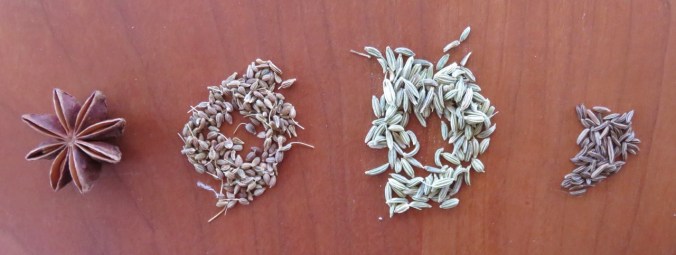
STAR ANISE     ANISE     FENNEL     CARROWAY   

So. If apples are a fruit, and pineapples are also a fruit, then pineapples are a kind of apple. And pineapples are surely similar to pinecones? Then pinecones must also be apples!

Don’t worry, it’s not logical. It’s just the way my day has gone.

I had a peculiar experience today while searching in Whole Foods for aniseed (anise) to bake a seed cake for my students. I reviewed all of what they had. No anise. I found a hapless produce worker and, after apologizing for talking to him when I knew it was not his area, complained that “I can’t find what I want.”

Another employee appeared at my shoulder. “What are you looking for?” He sounded more annoyed than concerned.

“Aniseed.”

“Anise? You want anise? That’s the same as fennel.”

“Is it?”

He pointed to packets of star anise and other packets of fennel. I thanked him, though he still seemed somewhat cross. I got all the way to check-out with fennel seed before I remembered I’d made this mistake before. It’s easy to assume that they are related, but fennel seed and anise, not to mention star anise are not the same spice. Not quite.

Star anise (Illicit serum), found inside a fruit, originally grew on small evergreen trees in China. I have eaten it in tea, but never baked with it. According to Wikipedia it is “a highly fragrant oil used in cooking, perfumery, soaps, toothpastes, mouthwashes, and skin creams. About 90% of the world’s star anise crop is used for extraction of shikimic acid, a chemical intermediate used in the synthesis of oseltamivir (Tamil).” It is sometimes used in the west as a cheap substitute for aniseed.

Aniseed (Pimpinella animus) is from a flowering annual plant native to the Eastern Mediterranean and SE Asia. Wikipedia says it “is widely cultivated and used to flavor food and alcoholic drinks, especially around the Mediterranean. It served as a carminative in herbal medicine.” I love it in pastry. 

Fennel seed (Foeniculum vulgar) comes from a member of the carrot and parsley family found originally in the Mediterranean. The bulb at the bottom is a delicious vegetable I frequently add to dishes. But no, fennel is not the same as anise. They are not even in the same genus, though Wikipedia points out: “In North American supermarkets, it is often mislabeled as ‘anise’.” (I swear I did not post that.) See above. Do they look the same to you? Trust me, they do not smell alike. 

Caraway seed (Carum carve) from another member of the carrot family native to western Asia, Europe, and North Africa. I’ve used this in seed cake, it taste nothing like the others, and is most often found stuck between my teeth after eating caraway rye bread. I put it here because, up close, the shape of the seeds resembles fennel more than aniseed does and because seed cakes are more often made with caraway. The plants of caraway, anise, and fennel all look similar when in flower, to be entirely honest. But they are not the same.

Wikipedia and my nose tell me that fennel, both seed and vegetable, anise, and even star anise all smell somewhat like licorice. (Caraway does not.) While both fennel seed and star anise are sometimes substituted for anise, the scent and flavor are distinctive in each. They are not identical, and none of them are true licorice, which comes from the root of an entirely unrelated perennial legume plant found in southern Europe and some parts of Asia (Glycyrrhiza glare). 

Who knew?

Tomorrow I will bake the seed cake. Photos to follow, if I am successful in emulating the delicious flavors of the Pearl Bakery’s gibassier pastry. I have candied citrus peel on purpose.


SaveSave

‘I Told Him, I Said’

IMG_3962

It’s been a while since men at my school considered it appropriate to make a retirement speech suggesting that a male teacher was putting moves on a teenage girl. Ten years? Maybe longer. Maybe not so long ago. Not long enough.

I heard them make such remarks and others. The promise of a better grade if a girl would lose ten pounds. “She’ll thank me.” The detailed speculation about what a girl might have done at a weekend party, spoken in the Library where other students could hear. Those are mild examples, much worse was suggested at that banquet. A school guidance counselor got up and left the room that evening. Unlike him, I went to the Ladies until the speech was over. I couldn’t leave because I was making a speech about someone else later in the program, a decent man who did not find his peers’ bawdy humor the least bit funny.

Did I say anything to anyone about the off-color remarks? I believe I did. Was there a reaction? Not so’s you would notice. My distress was not important. My professional opinion did not count. I was being fussy or a “feminazi” or needed to get a sense of humor.

Worse happened.

This was the world I lived in. Mostly, it still is.

I am expected to ignore inappropriate remarks, pretend they do not embarrass or offend me, that there is such a thing as harmless “locker room talk.”

The experiences of women have not changed enough since that evening. Teachers, coaches, and school safety officers have had inappropriate romantic relationships with students. Local cops. Prominent members of the community. That is, they have had a romantic relationship with a minor student, which is never appropriate. The girl is inevitably blamed when this becomes known. Her own peers, even the girls, blame her. They may even ostracize, harass, and threaten her. I remember this from my own days as a young girl. The girl is blamed. Did she do something stupid? Probably. It’s why we have rules about minors. Young people do stupid things all the time. It’s our job as adults to stop them, not to tempt them. But adults do tempt them, and then they step away. The man denies improprieties publicly, and perhaps privately feels he has done no wrong. Clearly the girl tempted him.

Stupid girl.

A Senator is called a disgrace and forced from office for making decidedly inappropriate gestures. The person calling for that man to abandon his career, makes specific and crude remarks. Each man claimed afterward that he was only joking. Only one of them removed himself from office.

Neither one was Bill Cosby or Harvey Weinstein or Humbert Humbert. Only one was a buddy of a convicted pedophile, also accused of sexual harassment, also accused of physical harassment . . . and President.

Unless the offender is a democrat, the President blames women. Naturally.

A “Lolita” is a colloquialism for a “sexually precocious girl.” “No one knows . . .” It’s easy to forget that Lolita is not the main character of the novel by that name. The main character is a middle-aged man who marries a mother in order to gain access to her 12 year old daughter. TWELVE YEARS OLD. He grooms and abuses that child. Lolita, the title character, will end up ruined, pregnant, and dead. But no one throws the term “Humbert” around like a dirty joke. It’s the adolescent girl (who died, remember?) whose pain becomes a dirty joke tossed at girls.

It’s easy to see how men excuse their indiscretion and abuses. For one, they have been encouraged to be assertive and certain. Aggression is rewarded, but hesitation is a weakness. Doubt is a weakness. Apologizing is weakness. Among men, that it. The rules are different for women. And, of course, for men in our society, being weak is absolutely not an option.

Being weak as a woman is allowed, even encouraged and considered attractive. Willingness to doubt, to question our own actions, to rethink, change our minds, apologize . . . all allowed, but then this humility is also often used against us. But demonstrating assertiveness and certainty? “Unladylike.” “Offensive.” “Aggressive” and ugly in “the weaker sex.” A woman projecting that sort of confidence unleashes a landslide of ugly words. Do I need to list them all here? “Unlikeable.”

Both men and women are caught in this terrible stereotype of gender-enforced behavior. The narrow, brutal definitions of what it means to be a woman or man allow us scant wiggle-room for individuality, male, female, or anyone else.

But when strength is considered a character flaw and weakness is considered attractive . . .

And when we talk about it. Out loud. Oh, dear. When we try to defend ourselves . . . that’s just not something we should be talking about. Right?

This year, a dear colleague is retiring. I am not attending the banquet. The banquet on the year I retired was not offensive, but absurdly wounding, and as a retiree I do not feel compelled to attend ever again. My friend will be given a good speech (I know who is in charge) and I wish him well. There is not a wisp of scandal associated with him, and times have changed enough that no one would find it amusing to invent or exaggerate a sorry and humiliating (for someone else) story for the occasion.

Times have changed, but not enough. Too many in power believe they have a lock on decency. And they are wrong.


SaveSave

SaveSave