NEIGHBORING MYTH


fullsizeoutput_10fc

Myth is scripture. Myth is wisdom. Myth is sacred story. Myth is magic and meaning. Myth defines and supports the goodness in us. It shows us a path, and as symbol—never underestimate symbols—myth is always true. Always.

As a public high school English teacher I was very respectful in using the word “myth.” I introduced it as a sacred story. However, like the authors of most every essay and study I have read, I did not address the obvious connection between the mythology of traditional cultures and the mythology of more modern ones. I was careful not to offend. I continued to be hopeful that others more powerfully placed will detail the parallels between Christian and other contemporaries mythologies and the ancient ones. They never do.

There is the “old wives’ tale” smear of mythology, as if the story your old grandmother told was a lie because it was not entirely factual. Or because it was told by an old woman. As if the decency and honesty rewarded in her story were not the point. As if she meant harm.

I used to hope that a few of my students, at least, might eventually see how Spider Grandmother and an archangel might share a place in the human pursuit for meaning. That they might appreciate how our connection to decency and fairness is not merely regulatory, but human and humane, a spiritual negotiation that allows us all to survive. Goodness as a universal truth. A Truth.

Most creation stories involve animals, plants, and failure. The Haida allow that Raven created the world mostly by accident. The Judeo-Christian tradition made the world on purpose, human beings on purpose, and death as a result of error. It matters to some people whether all or any of these stories are literally true. To others the message is significant enough. Do the right thing. Do right. All mythology works that way. Was it Atlas who carried the world on his back or a tortoise? Is the snake a symbol of evil or, by shedding skin, of rebirth?

It depends on who you ask.

The Story of Job warns against assuming we understand the why of events, but all mythology warns against doing what we know to be wrong, even when we do not understand why.

Societies pursue various goals and notions of virtue, but theft and murder and deceit are common evils. Generosity, compassion, and patience are nearly always admired and spiritually rewarded.

We are capable of knowing right from wrong. We are even capable of changing our minds about how we define those terms—which is much harder to manage. It is easier to stick with what we always thought before. Easier to not think, not weigh options, not reconsider what we think we know, not question good. Easier to assume evil is somewhere else far away. Evil as something outside and Other.

Strangely, like most life on earth, we will sacrifice ourselves for others. Human beings will do this, even sacrificing our safety and our lives for others. Wolves will do that too. Trees will pass over nutrition to a neighbor tree. Insects, fungus, single-celled life—all willing to die that their fellows may live. Altruism is not a rare virtue.

Sometimes we become so caught up in competition, in winning, and in hubris (our inflated self-importance) that we forget what we know to be true: we live together and we must get along in order to live virtuous lives.

Perfect innocence was never our destiny. We must constantly choose to do the right thing. Some humans creep about like Cain, hoping no one will notice who killed their brother. But there is no future in worrying continually, in fortifying ourselves against the Cains among us. How can that profit our lives? Surrendering to such fears makes cowards of us.

The vast majority of us are only doing the best we know how—to be good, generous, compassionate, and patient. We do this not only from fear of punishment. We do this not only when someone is watching. Sometimes we fail and bow to pride, selfishness, spite, and vengeance. Most often we do not. We do the right thing because we know it is right and we are comfortable with ourselves in doing what is right and good.

If we were more bad than good, no child would survive past the age of two. It would not be safe for me to say good morning to strangers on the beach. There would be no one risking censure to speak back to those in power. I see goodness everywhere, because even in our failings, most of us are trying our best to do good. Virtue is not Other.

We do the right thing because that goodness is in us.

The wives told.

WEATHER CHANGE

We like being the first out, while the sand is still unmarked by dogs and people. Usually we find prints and recognize by position who they belong to. That’s John out for his run because the bare feet make prints so close together. Larry drags a bit. Tammy walks close to the water. The tracks of dogs are familiar too. Roxxie and Charlie and Hank.

In summer we have been out on the sand before five in the morning. Real time is nearly 6am just now. [Have we all forgotten that time is not purely a human invention? Noon, for example, is a genuine natural event, that instant when the sun is highest in the sky, and is now marked on the DST clock an hour before it occurs. Like summer and winter, noon is not a fiction, but part of the natural way of things.]

Summer is long gone. Two days ago tides swept away our entire pathway cleared through the stony edge of our beach. Gary cleared that path in spring and it remained clear all this time. The beach is routinely washed free of sand in the winter months, but that day did not show a particularly high tide measured in feet above and below sea level. We check the tide table each day. Their numbers do not reveal the entire story. High surf from a storm at sea, a tame ocean under heavy clouds.

It is the wave action, sometimes showing only one or two low breakers, but this past Thursday breaking nearly to the horizon, breaking over the top of Castle Rock, thick and foamy at the edges. We had walked early in a gale. Our sitting log is gone and an enormous log that rested high up into the hedge fifty yards north of us. Thirty inches across and thirty feet long, that rotting monster has found a new temporary lodging further up the beach. Our sitting log (the one the visitor to a neighbor’s house used to pee in public) has vanished altogether. We walked a mile without finding where it had drifted.

I no longer take photos of waves crashing up into the air, a hundred feet above Castle Rock. I have those photos from previous autumns, dozens. Now I watch.

The surf is up, as they say. We watch with concern when tourists take their little children onto the sand during at out-going tide. A former student drowned, a strong swimmer, and on a pleasant day. No telling when the sea will swing her skirts.

A single wave in January of 1999 pushed the basalt stones up out of their bed and into a ridge along shore that we have never seen before. Until that winter, summer tides brought sand in from the offshore bar and nearly covered the rocky edge, and then for years we did not have a clear sandy beach at all.

yetiONbeach

The sand has come back, though the rocks have not been completely covered for twenty years.

A friend came to lunch the other day and asked me whether I spent much time watching the ocean. Yes, both of us do. Even after all these years—forty so far—we watch the ocean and shore. When we think about moving, that is a major sticking point. We are accustomed to the view. Watching the weather come in, tracking the birds in the air and in our tiny front garden, the shift of sand and tides, wave action. Nothing new, always different.

When we walk north, the shoreline dips and rises on our right. Some neighbors need long stairs to get to the beach. Our property is set low, just a few feet above the beach. My grandfather’s old path through the hedge, built before the Great War, is completely overgrown. There were no more than a half dozen concrete steps. That stair might still be there buried under salal and sand and basalt rubble. From our western door we walk through a new path in the middle of our hedge and down a short stretch of stones Gary has placed to ease our steps down to the shore.

fullsizeoutput_10e9

This is what counts as “a lot” of sand. At low tide there might be a couple of hundred yards of sand between the black basalt and surf. I paced off the distance other day.

fullsizeoutput_10de

The out-of-state owners of the rental north of us, after their first autumn, asked what happened to “our sand?” Gone for the season, I told them. Visitors have asked us whether the sand is trucked in, where we get the rocks brought in to protect the shore. Tourists try to “save” resting baby seals and fully grown eagles. It is hard for us, who live here, to imagine such ignorance. We have watched the flow in and out, the fledging of birds and the drowned onshore, the shift and shuffle of sand, the rare hard freeze, the slow progress of water and wildlife.

The sand is leaving. Maybe it will return in the spring. We watch for that.


‘in my great and unmatched wisdom’

IMG_4975

What are we doing here?

The President has invited foreign powers to interfere in the US presidential election.
Democrats want to impeach him for it.
Or, as my husband says, “We’ve been interfering in their government; it’s only fair that they should be allowed to interfere with ours.” Of course, Gary is being facetious.

IT’S NOT YOU, IT’S ME

IMG_4937.jpeg

I hope to take my third quilt up to be quilted this week—that’s it above while it was about a third complete. I am waiting to hear when I can deliver it because I need to send my laptop in for repair. Again.

I have been using a Mac daily since 1990 and until this one I never needed a repair. I replaced my best laptop at the age of nine, about 112 years old in computer years. But this one I am working on right now is still under the original warrantee. Months ago, the screen started pixilating in dark areas. Shadows in images were no longer black but turquoise or peacock green or cobalt. Or white. Bold Helvetica showed up as outline text. The weird appearance got worse and worse. Eventually the entire screen turned to pastel snow in horizontal bands.

Imagine trying to explain to a young tech person what’s wrong. They kept wanting to see it, or have me email or send them something. I kept having to explain again that the computer was unusable and I have no smart phone. (One of my sons keeps trying to remedy that by giving me an iPhone. I probably should let him.)

Anyway, my computer went to the Apple store where it was diagnosed as troubled, then it was sent away, and shipped back to me good as new inside a week.

But now it’s doing it again. I can still use it, but I figure it’s heading again toward pastel snow. I hope if I send it in they will see the problem.

I’m not going to freak out about being without my laptop for a week. I no longer teach so I am not depriving students of immediate access. But just in case you try to get ahold of me in the next week or so, just so you know, my computer is in repair limbo.

It’s not you, it’s me.

WET

IMG_4967.jpg

Yesterday there were deer tracks at the base of our path to the beach. This morning a coyote had passed by. We went out a bit late, and I did not put up my hair or even put on a hat because it wasn’t cold or windy, just cooler and damp the way we like it. I unzipped my jacket on the way north because the rising breeze hit my back and I was warm. By the time I thought I should put up my hood, it was already wet inside. I figured that was okay. I hadn’t worn the jacket to keep warm but because it was wet.

As a rule, we do not mind the wet. If we minded we would live someplace else.

We walked for an hour, north and then back south. On our way north, Gary mostly followed the tracks of the coyote on the sand, and I mostly walked in the basalt rubble lining the shore. The tide came right up over the sand and several feet into the rocks last night. I found plastic bits and bobs and leftovers from fireworks, a piece of quartz, a crumb of sand-buffed green glass, and a shell. On the way home, we walked with Tammy. She was dressed for weather—hood, rubber boots—though she’d decided it wasn’t worth digging out her rainproof pants. Like my hair, her pants were drenched by then.

IMG_4966.jpgRecently, juvenile gulls have been following me. One trailed me up and down the sand and over the rocks for a quarter mile the other day. I told him that was not wise. Humans are not to be trusted, and I would not feed him even if I had anything in my pockets he could eat. Yesterday, one came quite close, stood no more than four feet away and waited for a long time for me to do something. What?

There are too many dead birds on the beach, it seems to me. We always see one or two when we walk a few miles. This time of year the new seabirds who have failed to learn their survival skills start showing up, juveniles who have starved or done something stupid. Fully grown juveniles hunker down and call weep-weep at their mothers, who are done feeding them. After the first big storm or a crazy tide, youngsters are swept off Castle Rock and wash up onshore. This morning we saw a dead bird every five to fifteen yards, and that is not typical for late September or really at any time. We haven’t had a storm and many of the dead are adults. Three banded birds in as many yards—a seagull and two cormorants. Gary says the banding may have been enough to stress them, and there is no typical, no normal anymore.

Climate change has killed billions of birds, and millions of species are already lost or threatened.

But this morning we came home dripping and I sat comfortably watching the pale sky dissolve into pale sea. The osprey was fishing, the tide rushed in, waves swept across the sand, which has not begun moving back out into offshore bars.

IMG_4969I have finished a third quilt earlier than I expected (the last four rows of stitching completed Tuesday evening instead of Friday). Late next week I will carry it to Linda, or whenever she’s finished the two I pieced in August.

Yesterday I cleared out my work space, sweeping my work table, sorting colors into warm and cool and black&white bins, and finding storage for miscellaneous sewing and knitting tools and notions. The floor seems oddly empty without fabric spread out in patterns. The scraps from stitching and trimming—trimmed threads and bits of fabric less than an inch wide—made a heap on my work table. I dug through the little pile once more and then tossed it into a waste basket. I hope Gary might pluck out bits and pieces to save for birds’ nest-building in the spring. If we composted, they could go in as “carbon” I think.

The season is changing, weather and focus. There was Open House at the high school last evening, but we were at a restaurant visiting with mostly-retired school employees. Are you enjoying retirement? Some confess to having a hard time, missing students and the work. Some are simply relieved to stop. A friend in the former group is in the hospital. After decades of deep involvement and commitment to teaching, the way we are let go can seem rather heartless. And the way those with social connections are privileged and allowed to continue on their own terms can seem unfair. Six months out, I am still uncertain where I stand.

My kitchen floor is cleaner than it’s been in almost thirty years.

Change is inevitable. Not all of it is good. Not all bad.


GRETA IS PAYING ATTENTION

image.png

“This is all wrong.” Her words begin at 23 minutes, but the NPR article covers most of her speech [or here]. It is a brief, compelling speech. She is an amazing young woman, angry because it is impossible to be anything but angry. She has been paying attention, she will not forget, and she will not forgive.

I have been told throughout my life: Don’t get upset, don’t be angry, don’t lose your temper. Smile more. Find your inner peace. Yes, all that honey zen-like wavering.

As has been said: If you are not angry, you haven’t been paying attention.

Have the courage to be angry about the right things.

We walked long this morning. Our continued commitment to the coast is perhaps a foolish act of faith, an unwillingness to abandon our home, an unwillingness to abandon hope, and unwillingness to accept evil, and unwillingness to move to higher ground because so many in the world do not have that option.


WATCHING THE STORM ARRIVE

fullsizeoutput_1082

Sometimes I worry about things. Mostly I have worried about that shallow and selfish threat to my country. You know, that one. But since I unsubscribed from cable television, The New York Times, and The Washington Post, I push those concerns to one side.

I worry about global warming and the use of poisons to control insects and weeds and people. I worry about cancers and the danger of a tidal wave washing my home away.

I worry about population growth, a concern when I was a little girl and the earth’s human population was less than three billion, and now approaching eight billion. I worry about the loss of empty spaces, that human need to use everything.

I worry that a journal that has short-listed my story for a year only means to tease me. I worry about using too much purple or not enough in the quilt I am making. I worry that the sweater I should be re-knitting for my grandson will be too large or scratchy or no longer colors he likes.

I worry that so many people are reading my post “Why You Don’t Want to Become a Teacher” and will think I did not love teaching and miss teaching with all my heart.

I worry about the way our community is changing into an industrial zone without people to care for more than income.

I worry about my brittle bones and bad teeth, my weight gain and poor posture, and finding better medical care.

I worry about the power flickering in and out, but not too much.

Those are the easy things.

I worry about dying and leaving my husband alone or being left alone by him dying first. I worry about alienating my daughters-in-law, each a dear person but not my daughter. I worry that I have failed to help my sons know and trust their obvious courage and kindness.

I worry my older granddaughter will throw herself on the floor in a fit of embarrassment. I worry that my younger granddaughter will be the pretty sweet girl people take advantage of. I worry about my grandson’s attention.

I worry every time my husband calls across the house to tell me about reading that someone we know has died.

And then.

And then I sit down during a break from the sewing machine and steam iron, push color aside, and I watch the storm come in. The waves are higher than yesterday. The sky is dark and brilliant. Rain makes a variable patter on the skylights. There is thunder far away, but the ocean roars steady over all.

And the sky is sometimes aqua overhead and bright and then darkening with heavy clouds. Those who only value the clear sunny days as good weather must have simpler lives than mine. This is the world I love.

My worries are fruitless, pointless, fussing. The storm is inevitable, inviolable, and out of my control. It is coming onshore.

I watch the storm arrive and I am not worried.


SPLC

Girls at the 16th Street Baptist Church in Birmingham, Alabama
SPLC logo
Tomorrow marks 56 years since the murder of four young girls at the 16th Street Baptist Church in Birmingham, Alabama.

In an act of terror intended to intimidate civil rights activists who used the predominantly African-American church as a rallying point and organizing hub, Ku Klux Klan members planted a bomb under the building’s steps. It detonated at 10:22 a.m. on Youth Sunday, a day dedicated to the church’s young members, as the girls were getting ready for the service in a basement lounge.

During his eulogy for Denise McNair, Carole Robertson, Cynthia Wesley and Addie Mae Collins, Dr. Martin Luther King Jr. called the attack “one of the most vicious and tragic crimes ever perpetuated against humanity.” He sent a telegram to then-Alabama Gov. George Wallace, telling the state’s top segregationist: “The blood of our little children is on your hands.” Ten days before the bombing, Wallace had railed against the civil rights movement to The New York Times, saying, “What this country needs is a few first-class funerals.”

At that time, violent attacks on the civil rights movement were common in the city dubbed “Bombingham.” And in the decades since, researchers have laid bare the lack of political will to convict the perpetrators. Then-FBI Director J. Edgar Hoover blocked prosecution of the case, and the FBI failed to turn over thousands of files to prosecutors, including audio surveillance tapes.

It wasn’t until 1977 that the first of four Klansmen behind the crime was brought to trial by the state attorney general and convicted. Two others were convicted in the mid-1990s by federal prosecutors. A fourth died before being charged.

In 1987, the SPLC would win an unrelated, and unprecedented, civil lawsuit against the same Klan group behind the bombing – the United Klans of America – after its members murdered a black teenager in Alabama six years earlier. The $7 million verdict bankrupted the United Klans, finally putting an end to the group whose members had also killed civil rights activist Viola Liuzzoafter the Selma-to-Montgomery march.

The church bombing did not slow the momentum of the civil rights movement. Instead, it became a seminal moment that galvanized the nation and propelled the  movement forward. Ten months later, Congress passed the Civil Rights Act of 1964, outlawing segregation in public accommodations.

Today, a memorial named “Four Spirits” stands across the street from the church with the inscription “A love that forgives” – the title of the pastor’s undelivered sermon on Sept. 15, 1963.

During this moment of remembrance for these and all civil rights martyrs – those who fought and died for freedom – let us reflect on the words of Dr. King’s eulogy for the girls. And let us remember that deadly violence remains an all-to-common response to the ongoing struggle for civil rights in this country:

“[T]his afternoon, in a real sense [the four girls] have something to say to each of us in their death. They have something to say to every minister of the gospel who has remained silent behind the safe security of stained-glass windows.

“They have something to say to every politician who has fed his constituents with the stale bread of hatred and the spoiled meat of racism. … They say to each of us, black and white alike, that we must substitute courage for caution. They say to us that we must be concerned not merely about who murdered them, but about the system, the way of life, the philosophy which produced the murderers.

The Editors

VOLUNTEERS

fullsizeoutput_104d

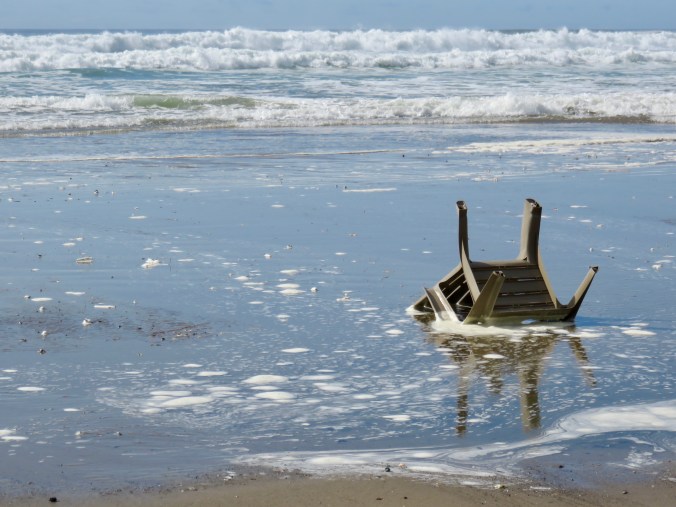
This is the chair that eventually traveled south all the way to the end of our beach, and then was tossed up on the basalt inner shore by the tide. Our Adirondack chairs are locally made of wood.

Looking west out over the ocean this afternoon, I can sometimes see Castle Rock, point-six nautical miles offshore. Then the fog folds it back into invisibility. We are both fond of this, I think, the cooling fogs, the way fog signals a very hot day someplace else but not here, at least not yet. Overhead, even when we first went out for our walk this morning, the sky shows blue, whisked by thin clouds, but north, south, east, and west over the ocean, the mist makes a pale mask on the landscape.

This morning we picked the plastic remains of (illegal) fireworks—some pieces are quite sharp—and four golf balls, our fourteenth Bic lighter of the season, plastic packaging and trimmings from cord and twine, candy wrapper, broken cutlery, unidentifiable objects lost off boats, broken beach toys. It’s what we usually find. I found glass melted and sharp from a beach fire. (Glass does not burn and neither does plastic.) Just as we turned for home, I found a sand-frosted disk of clear glass.

There are many dead birds. It is the season of juvenile gulls following after a parent, heads ducked in a vain effort to appear small when they are fully grown. Peep, peep, peep! they cry. Sometimes their parent leads them to food and walks away. Sometimes you can almost hear an adult gull sigh with exasperation. Get a life. The sea lion’s skeleton has finally come apart, and we saw a dead otter, which may have fallen victim to the unusual surf.

Yesterday, Gary went out and retrieved four beach chairs that had been caught up by high waves on the day before. The tide had not been especially high that day, but before the people picnicking on the sand south of us had to move, twice, he was already saying there was a danger of sneaker-waves. A true sneaker rages up fast and far beyond where you might expect. “Sneaker” because of that and because it is often silent.

The surf went from a single breaker in the morning to ten foot swells and many rows of breakers almost a half mile out on that day. It was a roaring sea with lots of plankton washing in from the recent heat and upturned colder water. The first sneaker swept up over the onshore sand bar that had been dry and untouched for weeks. A hundred-yard sweep of rushing saltwater. The next waves swept higher, all the way into the rocks bordering the green—the sort of massive sweep we expect in November not in summer. It was not yet even high tide.

This brings me to the chairs. A drunken party of tourists staying in one of the rentals a block east of the beach brought them down onto the sand early last month and then never bothered to return them. Four plastic chairs, two pistachio-green plastic Adirondack chairs with rounded backs and two tan plastic Adirondack chairs with fan backs. We hoped for a long time that someone would retrieve them or steal them, but no one did. Some visitors used the chairs and some pretended they were not there. The owners of the rental house closest to the chairs ignored them.

We certainly didn’t want them.

However, when we we discovered that one of the chairs had been swept a quarter mile south and then up onto the rocks, Gary went out again. He carried each of them into the front yard and hosed off the plankton. We have gathered up broken plastic chairs in the past. One way or another, he decided, we would be carrying these chairs up—either whole and still useful or broken into pieces.

IMG_4582At top, violets we did not plant in our front garden. They are what gardeners call volunteers, like the little spruce growing in the center yard and the salal coming up everywhere. Nobody planted it, it just grew.

When we had our ocean-side deck removed earlier this year, most of what was revealed was bare, empty sand. The naturalized crocosmia (the orange montbrecia) came up immediately and the wild rabbits like to lift up on their hind legs, bite a montbrecia leaf halfway up, and then eat from there to the tip. They nibble dandelions down to the ground. Good bunnies.

Lately other plants have sprouted: lamb’s ears and wild roses and violets. The roses are prickly and I pluck them out with care, but the others are a lovely surprise. So far the rabbits have left the violets and lamb’s ears alone. We like to think they are gifts from the rabbits because we never shoo they out of our yard.

HIM

I have avoided saying his name or typing it, but it’s really getting out of hand now. I am sorry if you disagree. (Trump supporters had best avert their eyes. I am not likely to devote another post to this particular issue. It will be safe to return.)

Recent events and words are beyond offensive. They seem to me insane. And much of the medical community and even the more circumspect political analysts are speaking out. This is not my rant, but another’s. Follow the link and read the whole thing.


from James Fallows in The Atlantic, “If Trump Were an Airline Pilot”:

“But now we’ve had something we didn’t see so clearly during the campaign. These are episodes of what would be called outright lunacy, if they occurred in any other setting: An actually consequential rift with a small but important NATO ally, arising from the idea that the U.S. would “buy Greenland.” Trump’s self-description as “the Chosen One,” and his embrace of a supporter’s description of him as the “second coming of God” and “King of the Jews.” His logorrhea, drift, and fantastical claims in public rallies, and his flares of belligerence at the slightest challenge in question sessions on the White House lawn. His utter lack of affect or empathy when personally meeting the most recent shooting victims, in Dayton and El Paso. His reduction of any event, whatsoever, into what people are saying about him.

“Obviously I have no standing to say what medical pattern we are seeing, and where exactly it might lead. But just from life I know this:

  • If an airline learned that a pilot was talking publicly about being “the Chosen One” or “King of the Jews” (or Baptists or whatever), the airline would be looking carefully into whether this person should be in the cockpit.
  • If a hospital had a senior surgeon behaving as Trump now does, other doctors and nurses would be talking with administrators and lawyers before giving that surgeon the scalpel again.
  • If a public company knew that a CEO was making costly strategic decisions on personal impulse or from personal vanity or slight, and was doing so more and more frequently, the board would be starting to act. (See: Uber, management history of.)
  • If a university, museum, or other public institution had a leader who routinely insulted large parts of its constituency—racial or religious minorities, immigrants or international allies, women—the board would be starting to act.
  • If the U.S. Navy knew that one of its commanders was routinely lying about important operational details, plus flaring up under criticism, plus talking in “Chosen One” terms, the Navy would not want that person in charge of, say, a nuclear-missile submarine. (See: The Queeg saga in The Caine Mutiny, which would make ideal late-summer reading or viewing for members of the White House staff.)

“Yet now such a  person is in charge not of one nuclear-missile submarine but all of them—and the bombers and ICBMs, and diplomatic military agreements, and the countless other ramifications of executive power.

“If Donald Trump were in virtually any other position of responsibility, action would already be under way to remove him from that role. The board at a public company would have replaced him outright or arranged a discreet shift out of power. (Of course, he would never have gotten this far in a large public corporation.) The chain-of-command in the Navy or at an airline or in the hospital would at least call a time-out, and check his fitness, before putting him back on the bridge, or in the cockpit, or in the operating room. (Of course, he would never have gotten this far as a military officer, or a pilot, or a doctor.)

“There are two exceptions. One is a purely family-run business, like the firm in which Trump spent his entire previous career. And the other is the U.S. presidency, where he will remain, despite more and more-manifest Queeg-like  unfitness, as long as the GOP Senate stands with him.

“(Why the Senate? Because the two constitutional means for removing a president, impeachment and the 25th Amendment, both ultimately require two thirds support from the Senate. Under the 25th Amendment, a majority of the Cabinet can remove a president—but if the president disagrees, he can retain the office unless two thirds of both the House and Senate vote against him, an even tougher standard than with impeachment. Once again it all comes back to Senate Majority Leader Mitch McConnell.)

“Donald Trump is who we knew him to be. But now he’s worse. The GOP Senate continues to show us what it is.”